

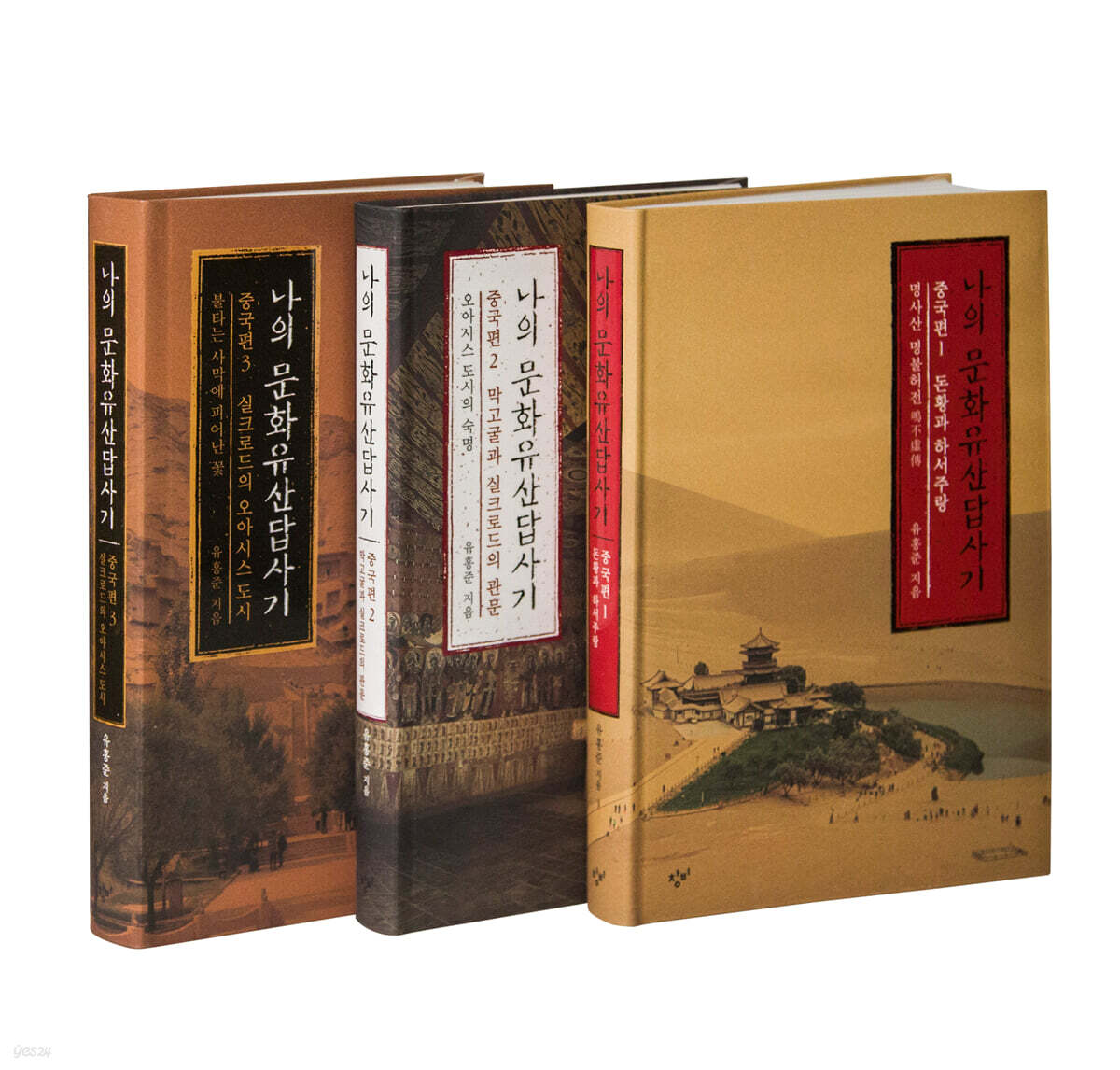
My Cultural Heritage Tour: China's Silk Road Edition
 |
Description
Book Introduction
- A word from MD
-
The culmination of Yu Hong-jun's exploration, the final installment of the Silk Road.“The Silk Road tour was the most moving journey of my life.” The Silk Road, the past, present, and future of East-West exchange.
In Volumes 1 and 2 of the China edition, the journey begins in Xi'an in search of the Silk Road, passes through the Hexi Corridor and Dunhuang, and in Volume 3, explores the oasis cities of the Xinjiang Uyghur Autonomous Region and the Taklamakan Desert.
June 19, 2020. History PD Son Min-gyu
The culmination of Yu Hong-jun's exploration: a grand tour of the Silk Road.
"The Silk Road tour was the most moving journey of my life."
The unrivaled best-selling series of our time, "My Cultural Heritage Tour," has completed its three-year journey along the Silk Road.
The journey, which began in Xi'an, China, traveled over 4,000 kilometers, passing through the Hexi Corridor and Dunhuang (Volumes 1 and 2) and exploring the oasis cities of the Xinjiang Uyghur Autonomous Region and the Taklamakan Desert (Volume 3).
The Silk Road, the center of ancient civilization exchange, is truly a place where you can encounter fantastic deserts and oases, hidden treasures of Buddhist relics, historical sites, and archaeological artifacts.
The history of the Silk Road, which not only gave birth to ancient Chinese civilization but also served as a crossroads of civilizations as various ethnic groups fought against each other, is vividly recreated in 'Travelogue'.
Author Yoo Hong-jun, a synonym for field trips, described this Silk Road trip as “the most moving trip of my life” and strongly recommended that readers take the Silk Road journey along with “Field Trip.”
"The Silk Road tour was the most moving journey of my life."
The unrivaled best-selling series of our time, "My Cultural Heritage Tour," has completed its three-year journey along the Silk Road.
The journey, which began in Xi'an, China, traveled over 4,000 kilometers, passing through the Hexi Corridor and Dunhuang (Volumes 1 and 2) and exploring the oasis cities of the Xinjiang Uyghur Autonomous Region and the Taklamakan Desert (Volume 3).
The Silk Road, the center of ancient civilization exchange, is truly a place where you can encounter fantastic deserts and oases, hidden treasures of Buddhist relics, historical sites, and archaeological artifacts.
The history of the Silk Road, which not only gave birth to ancient Chinese civilization but also served as a crossroads of civilizations as various ethnic groups fought against each other, is vividly recreated in 'Travelogue'.
Author Yoo Hong-jun, a synonym for field trips, described this Silk Road trip as “the most moving trip of my life” and strongly recommended that readers take the Silk Road journey along with “Field Trip.”
- You can preview some of the book's contents.
Preview
Publisher's Review
Along the corridor of civilization, the Hexi Corridor, to Dunhuang
Volume 1, 'Dunhuang and the Hexi Corridor', contains a 2,000-kilometer journey starting from the Guanzhong Plain in China, following the Hexi Corridor, and ending at Mingsha Mountain in Dunhuang.
It is a long journey that covers the eastern third of the Silk Road, which is estimated to be about 6,400 kilometers long, and is a true exploration route that allows you to feel the scale of the continent.
Buddhism entered China from the West through this route, and the struggle between the Han Chinese and nomadic tribes took place along this route.
The Hexi Corridor, named for its long, stretched-out gorges that resemble a "running corridor" connecting continents, stretches 900 kilometers from Lanzhou, the capital of Gansu Province, through Wuwei, Zhangye, and Zhuquan to Dunhuang.
This is the place where Emperor Wu of the Han Dynasty drove out the Huns and established the Four Commanderies of Hexi. It also reminds us of our history, where the Four Commanderies of Han were established at the same time.
You can see the spectacular Bingling Temple Grottoes in Nanzhou, where splendid Buddhist statues are nestled in the bizarre Yellow River Stone Forest, and experience the leisurely flow of the Yellow River more realistically than anywhere else.
The Huns, who are said to have disappeared long ago after clashing with China, can only be traced through the statues and fragments of relics erected here and there, creating a sense of sorrow.
After passing through Jiayuguan at the western end of the Great Wall, you finally arrive at Dunhuang.
Dunhuang, an oasis city that many people consider a "dream of exploration," has become a tourist destination bustling with visitors who come to see its grotto temples and picturesque desert landscape.
In particular, the Mogao Grottoes, one of the best grotto temples in China, were not only the driving force behind Dunhuang's status as a center of trade on the Silk Road since ancient times, but are also a prominent Buddhist site that was the first UNESCO World Heritage site in China, along with the Great Wall of China.
High-quality Buddhist statues and paintings remain, and paintings that provide insight into the history and lifestyle of the region serve as valuable research materials.
Meanwhile, Myeongsa Mountain and Wolacheon are popular tourist destinations these days as natural landscapes that evoke romantic feelings befitting the word 'romance'.
When you step foot here, the shadows of merchants who traded across the desert in the past or monks who set out to seek asceticism seem to linger.
The History of the Mogao Grottoes and Gateways to the Silk Road
Volume 2, 'Mogao Grottoes and the Gateway to the Silk Road', explores the Mogao Grottoes, a treasure trove of Buddhist art, and also contains the turbulent history of the Dunhuang documents discovered there.
The Mogao Grottoes, located at the foot of Mingsha Mountain in Dunhuang, have been open for hundreds of years since the 4th century, and 492 caves have been discovered to date.
Upon reaching the entrance, through a sophisticated management system worthy of a UNESCO World Heritage Site, you will be greeted by a spectacular view of hundreds of caves carved into a 1.6-kilometer cliff.
Various Buddhist statues and sculptures that are important in the history of Chinese art and Buddhist art, as well as murals depicting various iconography, are contained in this stone cave.
The Mogao Grottoes were forgotten for a while, but they received renewed attention in the 20th century when over 30,000 Dunhuang documents were discovered there.
These documents were considered so valuable academically that they were called the "discovery of the century," but they were scattered around the world due to a complex intertwining of academic passion and imperialist invasion.
In China, people who took Dunhuang artifacts during this period were called treasure thieves, meaning they stole treasures.
In addition to major figures such as Aurel Stein of Britain, Paul Pelliot of France, Kozui Otani of Japan, and Langdon Warner of the United States, several other "travelers" also took Dunhuang manuscripts and artifacts.
On the other hand, there were also 'guardians'.
Renowned painter Zhang Daqian, who noticed the artistic value of the Mogao Grottoes; Shang Shuhong, who stopped studying abroad and returned to China to dedicate his life to protecting and researching the Mogao Grottoes; and Han Leyan, a Korean-Chinese painter who was captivated by the beauty of the Mogao Grottoes murals. These and other notable artists in China have worked to protect the Mogao Grottoes from further damage. Today, the Dunhuang Research Institute has carried on this legacy and is contributing to world-class Dunhuang studies.
The Essence of the Silk Road: The Taklamakan Oasis Cities
Xinjiang Uyghur Autonomous Region, explored in Volume 3, “Oasis Cities on the Silk Road,” is China’s largest province, encompassing the vast Tarim Basin, the vast and terrifying Taklamakan Desert, the Gobi Desert, the Tian Shan, the Kunlun Mountains, and the Pamir Plateau, massive mountain ranges, endless grasslands, and oasis cities welcoming visitors.
This area is the central section of the Silk Road, which is largely divided into three sections. In fact, it is the section that passes through the Taklamakan Desert, a huge obstacle that gave birth to the concept of the Silk Road, so in a narrow sense, this area is also referred to as the Silk Road.
Also, from here, the Silk Road Northern Route (Northern Tianshan Road), Middle Route (Southern Tianshan Road), and Southern Route (Southern Western Regions Road) began to expand in earnest, forming a land route where Eastern and Western civilizations met.
So to speak, this is the essence of the Silk Road, which stretches for thousands of kilometers.
Professor Yoo Hong-jun and his tour group visit representative oasis cities in Xinjiang, including Turpan, Kuqa, Hotan, and Kashgar, and encounter the culture and history of these places that are little known to us.
The key points of the Silk Road tour in the Xinjiang region are Turpan and Kucha.
Turpan is located at the crossroads of the Northern and Middle Silk Roads and has been considered a representative oasis city of the Silk Road since ancient times.
This place is a must-see for tourists, with its large ancient city and tombs, long vineyards, artificial waterway Karez, and Buddhist and Islamic architectural remains such as the Bezeklik Caves.
If you go further along the South Tian Shan Road from Turpan, you will come across Kucha, the ancient capital of the Old Qiao state, which houses splendid Buddhist ruins.
Kucha is home to many important historical sites that provide insight into the Buddhist culture of the Xinjiang region, including the Kizil Grottoes, the Kumtura Grottoes, and the Subashi Monastery.
In particular, the Kizil Grottoes are the largest grottoes in Xinjiang, and although many relics, including murals, have been destroyed, you can still see splendid Buddhist art pieces.
It is also a place where the stories of Kumarajiva, who first translated Buddhist scriptures into Chinese characters, and Han Rak-yeon, a Korean-Chinese painter, captivate visitors.
A mystical pilgrimage to deserts and oases, mummies and cave temples
The driving force that enabled ancient people to cross the deadly deserts and mountain ranges and pioneer the Silk Road was money and faith.
The ancients did not spare their lives to satisfy the most pressing needs in material and spiritual life.
But what we call the Silk Road today is the culture, the history, and the great spirit of exploration to discover the unknown.
Imperialist explorers of the early 20th century not only consumed that spirit with plunder and destruction, but also left irreparable scars on the cultural heritage of the Silk Road, but now that "age of barbarism" is over.
The attitude of encountering new cultures and fostering a deeper appreciation for our own culture is the great passion of today's "cultural citizens," a passion that even the desert cannot stop.
Through Volume 3 of “My Cultural Heritage Tour” and the Silk Road section, we encourage you to experience a pilgrimage route as grand as the journeys of ancient people.
Volume 1, 'Dunhuang and the Hexi Corridor', contains a 2,000-kilometer journey starting from the Guanzhong Plain in China, following the Hexi Corridor, and ending at Mingsha Mountain in Dunhuang.
It is a long journey that covers the eastern third of the Silk Road, which is estimated to be about 6,400 kilometers long, and is a true exploration route that allows you to feel the scale of the continent.
Buddhism entered China from the West through this route, and the struggle between the Han Chinese and nomadic tribes took place along this route.
The Hexi Corridor, named for its long, stretched-out gorges that resemble a "running corridor" connecting continents, stretches 900 kilometers from Lanzhou, the capital of Gansu Province, through Wuwei, Zhangye, and Zhuquan to Dunhuang.
This is the place where Emperor Wu of the Han Dynasty drove out the Huns and established the Four Commanderies of Hexi. It also reminds us of our history, where the Four Commanderies of Han were established at the same time.
You can see the spectacular Bingling Temple Grottoes in Nanzhou, where splendid Buddhist statues are nestled in the bizarre Yellow River Stone Forest, and experience the leisurely flow of the Yellow River more realistically than anywhere else.
The Huns, who are said to have disappeared long ago after clashing with China, can only be traced through the statues and fragments of relics erected here and there, creating a sense of sorrow.
After passing through Jiayuguan at the western end of the Great Wall, you finally arrive at Dunhuang.
Dunhuang, an oasis city that many people consider a "dream of exploration," has become a tourist destination bustling with visitors who come to see its grotto temples and picturesque desert landscape.
In particular, the Mogao Grottoes, one of the best grotto temples in China, were not only the driving force behind Dunhuang's status as a center of trade on the Silk Road since ancient times, but are also a prominent Buddhist site that was the first UNESCO World Heritage site in China, along with the Great Wall of China.
High-quality Buddhist statues and paintings remain, and paintings that provide insight into the history and lifestyle of the region serve as valuable research materials.
Meanwhile, Myeongsa Mountain and Wolacheon are popular tourist destinations these days as natural landscapes that evoke romantic feelings befitting the word 'romance'.
When you step foot here, the shadows of merchants who traded across the desert in the past or monks who set out to seek asceticism seem to linger.
The History of the Mogao Grottoes and Gateways to the Silk Road
Volume 2, 'Mogao Grottoes and the Gateway to the Silk Road', explores the Mogao Grottoes, a treasure trove of Buddhist art, and also contains the turbulent history of the Dunhuang documents discovered there.
The Mogao Grottoes, located at the foot of Mingsha Mountain in Dunhuang, have been open for hundreds of years since the 4th century, and 492 caves have been discovered to date.
Upon reaching the entrance, through a sophisticated management system worthy of a UNESCO World Heritage Site, you will be greeted by a spectacular view of hundreds of caves carved into a 1.6-kilometer cliff.
Various Buddhist statues and sculptures that are important in the history of Chinese art and Buddhist art, as well as murals depicting various iconography, are contained in this stone cave.
The Mogao Grottoes were forgotten for a while, but they received renewed attention in the 20th century when over 30,000 Dunhuang documents were discovered there.
These documents were considered so valuable academically that they were called the "discovery of the century," but they were scattered around the world due to a complex intertwining of academic passion and imperialist invasion.
In China, people who took Dunhuang artifacts during this period were called treasure thieves, meaning they stole treasures.
In addition to major figures such as Aurel Stein of Britain, Paul Pelliot of France, Kozui Otani of Japan, and Langdon Warner of the United States, several other "travelers" also took Dunhuang manuscripts and artifacts.
On the other hand, there were also 'guardians'.
Renowned painter Zhang Daqian, who noticed the artistic value of the Mogao Grottoes; Shang Shuhong, who stopped studying abroad and returned to China to dedicate his life to protecting and researching the Mogao Grottoes; and Han Leyan, a Korean-Chinese painter who was captivated by the beauty of the Mogao Grottoes murals. These and other notable artists in China have worked to protect the Mogao Grottoes from further damage. Today, the Dunhuang Research Institute has carried on this legacy and is contributing to world-class Dunhuang studies.
The Essence of the Silk Road: The Taklamakan Oasis Cities
Xinjiang Uyghur Autonomous Region, explored in Volume 3, “Oasis Cities on the Silk Road,” is China’s largest province, encompassing the vast Tarim Basin, the vast and terrifying Taklamakan Desert, the Gobi Desert, the Tian Shan, the Kunlun Mountains, and the Pamir Plateau, massive mountain ranges, endless grasslands, and oasis cities welcoming visitors.
This area is the central section of the Silk Road, which is largely divided into three sections. In fact, it is the section that passes through the Taklamakan Desert, a huge obstacle that gave birth to the concept of the Silk Road, so in a narrow sense, this area is also referred to as the Silk Road.
Also, from here, the Silk Road Northern Route (Northern Tianshan Road), Middle Route (Southern Tianshan Road), and Southern Route (Southern Western Regions Road) began to expand in earnest, forming a land route where Eastern and Western civilizations met.
So to speak, this is the essence of the Silk Road, which stretches for thousands of kilometers.
Professor Yoo Hong-jun and his tour group visit representative oasis cities in Xinjiang, including Turpan, Kuqa, Hotan, and Kashgar, and encounter the culture and history of these places that are little known to us.
The key points of the Silk Road tour in the Xinjiang region are Turpan and Kucha.
Turpan is located at the crossroads of the Northern and Middle Silk Roads and has been considered a representative oasis city of the Silk Road since ancient times.
This place is a must-see for tourists, with its large ancient city and tombs, long vineyards, artificial waterway Karez, and Buddhist and Islamic architectural remains such as the Bezeklik Caves.
If you go further along the South Tian Shan Road from Turpan, you will come across Kucha, the ancient capital of the Old Qiao state, which houses splendid Buddhist ruins.
Kucha is home to many important historical sites that provide insight into the Buddhist culture of the Xinjiang region, including the Kizil Grottoes, the Kumtura Grottoes, and the Subashi Monastery.
In particular, the Kizil Grottoes are the largest grottoes in Xinjiang, and although many relics, including murals, have been destroyed, you can still see splendid Buddhist art pieces.
It is also a place where the stories of Kumarajiva, who first translated Buddhist scriptures into Chinese characters, and Han Rak-yeon, a Korean-Chinese painter, captivate visitors.
A mystical pilgrimage to deserts and oases, mummies and cave temples
The driving force that enabled ancient people to cross the deadly deserts and mountain ranges and pioneer the Silk Road was money and faith.
The ancients did not spare their lives to satisfy the most pressing needs in material and spiritual life.
But what we call the Silk Road today is the culture, the history, and the great spirit of exploration to discover the unknown.
Imperialist explorers of the early 20th century not only consumed that spirit with plunder and destruction, but also left irreparable scars on the cultural heritage of the Silk Road, but now that "age of barbarism" is over.
The attitude of encountering new cultures and fostering a deeper appreciation for our own culture is the great passion of today's "cultural citizens," a passion that even the desert cannot stop.
Through Volume 3 of “My Cultural Heritage Tour” and the Silk Road section, we encourage you to experience a pilgrimage route as grand as the journeys of ancient people.
GOODS SPECIFICS
- Date of issue: June 15, 2020
- Page count, weight, size: 1,132 pages | 2,048g | 160*225*80mm
- ISBN13: 9788936478049
- ISBN10: 8936478044
You may also like
카테고리
korean


korean

![GQ KOREA Mark (Monthly): December [2025]](http://librairie.coreenne.fr/cdn/shop/files/8ef265dbbfbf186523ed75ba7319009d.jpg?v=1765340328&width=3840)


