

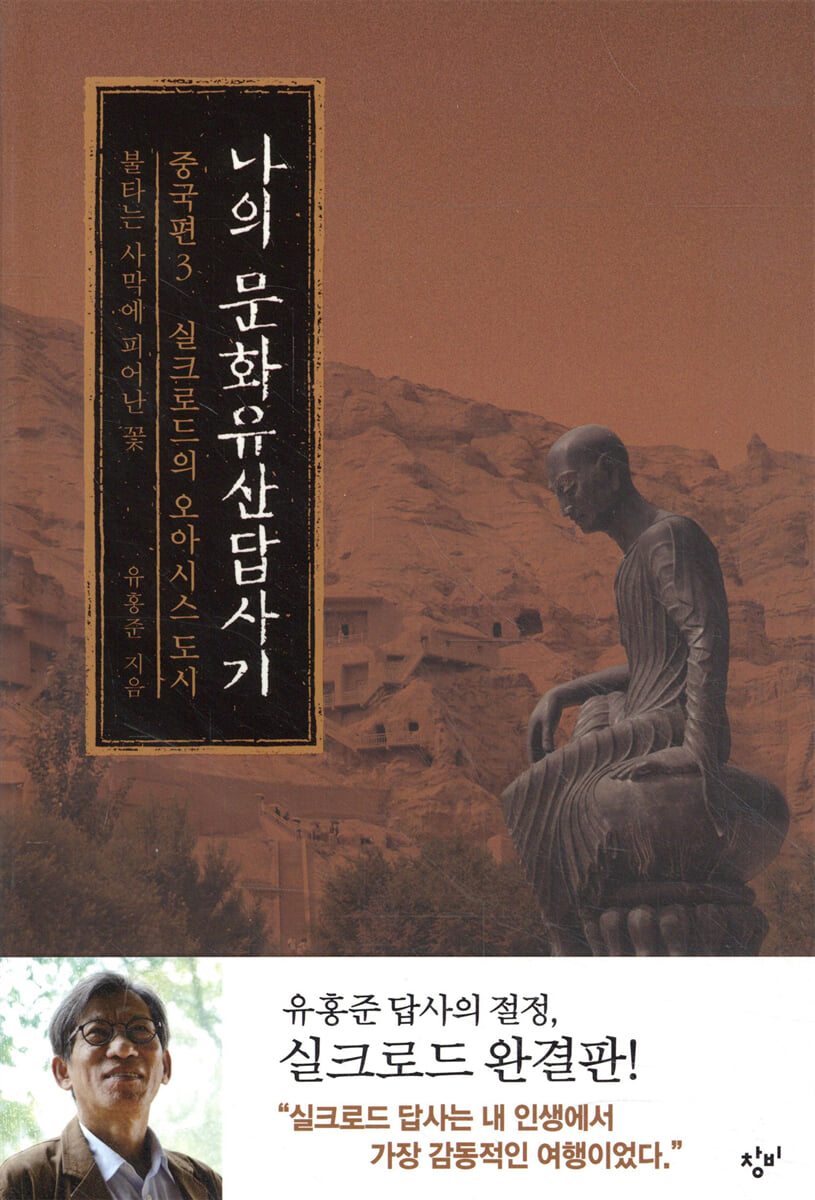
My Cultural Heritage Tour: China Part 3: Oasis Cities on the Silk Road
 |
Description
Book Introduction
- A word from MD
- The culmination of Yu Hong-jun's field trip, the final installment of the Silk Road.
“The Silk Road tour was the most moving journey of my life.” The Silk Road, the past, present, and future of East-West exchange.
In Volumes 1 and 2 of the China edition, the journey begins in Xi'an in search of the Silk Road, passes through the Hexi Corridor and Dunhuang, and in Volume 3, explores the oasis cities of the Xinjiang Uyghur Autonomous Region and the Taklamakan Desert.
- Son Min-gyu, MD of History
The culmination of Yu Hong-jun's exploration, the final installment of the Silk Road.
"The Silk Road tour was the most moving journey of my life."
Our era's representative humanities book, "My Cultural Heritage Tour," has completed its epic journey along the Silk Road.
In Volumes 1 and 2 of the China series, the journey begins in Xi'an in search of the Silk Road, passes through the Hexi Corridor and Dunhuang, and in Volume 3, explores the oasis cities of the Xinjiang Uyghur Autonomous Region and the Taklamakan Desert.
The path that the monk and Sun Wukong took in search of Buddhist scriptures, the center of ancient trade between Eastern and Western civilizations, a place overflowing with tempting fruits and archaeological treasures.
The Silk Road in Xinjiang is full of fantastic scenery and colorful stories.
Professor Yoo Hong-jun and his team embark on a special journey to study the diverse cultures and histories of representative oasis cities such as Turpan, Kuqa, Hotan, and Kashgar.
The scenery unfolds one after another, eliciting exclamations from visitors, to the point that Yoo Hong-jun, a synonym for field trips, personally evaluated it as “the most moving trip of my life.”
Although it's the peak travel season, these days we're hesitant to even leave the house, let alone travel abroad. Therefore, I highly recommend quenching your thirst for cultural experiences through the oasis found in the book "Silk Road Travelogue."
"The Silk Road tour was the most moving journey of my life."
Our era's representative humanities book, "My Cultural Heritage Tour," has completed its epic journey along the Silk Road.
In Volumes 1 and 2 of the China series, the journey begins in Xi'an in search of the Silk Road, passes through the Hexi Corridor and Dunhuang, and in Volume 3, explores the oasis cities of the Xinjiang Uyghur Autonomous Region and the Taklamakan Desert.
The path that the monk and Sun Wukong took in search of Buddhist scriptures, the center of ancient trade between Eastern and Western civilizations, a place overflowing with tempting fruits and archaeological treasures.
The Silk Road in Xinjiang is full of fantastic scenery and colorful stories.
Professor Yoo Hong-jun and his team embark on a special journey to study the diverse cultures and histories of representative oasis cities such as Turpan, Kuqa, Hotan, and Kashgar.
The scenery unfolds one after another, eliciting exclamations from visitors, to the point that Yoo Hong-jun, a synonym for field trips, personally evaluated it as “the most moving trip of my life.”
Although it's the peak travel season, these days we're hesitant to even leave the house, let alone travel abroad. Therefore, I highly recommend quenching your thirst for cultural experiences through the oasis found in the book "Silk Road Travelogue."
- You can preview some of the book's contents.
Preview
index
Introducing the Book: A Pilgrimage to the Oasis Cities of the Taklamakan Desert
Chapter 1 Yellow
The story of the suddenly vanished oasis kingdom
The History of Nuran / Bancho's Western Management / Lopnor, the "Wandering Lake" / Jamsam's "Hoga" / Sven Hedin and Aurel Stein's Nuran Excavations / The Beautiful Mummy of Nuran / Kim Chun-su's "The West Wind"
Chapter 2 Turpan 1
I watered the horse at the twilight castle.
Turpan, a key Silk Road junction / Passing through Hamis / The origins of Xianxian County / The beautiful Kumtak Desert / The aesthetics of the ruins, or the castle of Gyohago / "The March of Emperor Gojong" by the poet Yi Gi
Chapter 3 Turpan 2
Gaochang Ancient City is the flower of ancient Xinjiang culture.
Turpan's Vineyards / Passing the Flaming Mountains / Gochang Fortress / Gochang Fortress's Great Buddha and Monk Xuanzang / German Central Asian Expedition / Astana Tombs / Tomb of General Goyo, a Descendant of Goguryeo
Chapter 4 Turpan 3
The Glory and Wounds of the Tianshan Uyghur Kingdom
National Museum of Korea, Central Asia Gallery / Uyghur History / Structure of the Bezeklik Grottoes / Tragic Fate of the Bezeklik Murals / Lost Pride of the Uyghurs / Passing through the Maja Village of Toyokgou / History of the Sogong Pagoda / Artificial Capital Karez
Chapter 5 Kucha 1
The blue sky was heaven
Crossing the Tian Shan Mountains / The origins and history of the old country / The Han Dynasty's beacon tower / The legend of Kizilgaha / The life of Kumarajiva / The Kizil Grottoes / The Han Lok Yeon / The Adanjimo of Kucha / The Mysterious Grand Canyon of the Tian Shan Mountains / The discovery of the 'Aye Grottoes'
Chapter 6 Kucha 2
His song echoes in the ruins of a temple on the banks of the Kucha River
At the Kumtura Caves / The Immortal Site of Subashi / The Lyricism of the Ruined Temple Site / The Reliquary Excavated from Subashi / Kucha During the Buddhist Period / General Gao Xianzhi / The Uyghurization of Kucha and the Kucha Master / The Kucha Dynasty and Today's Kucha
Chapter 7: The Taklamakan Desert
Human footprints standing in the desert of death
The Taklamakan Desert and the Desert Highway / Crossing the Tarim River / The Shikpidae / The Sogdians and the Caravan / The Sillaogi's "Speed Reading" / Under the Poplar Tree / Owen Lattimore / The Ship of the Desert, the Camel
Chapter 8 Hotan
Legend meets art, reborn as history.
The Kingdom of Jade and Buddhism, Khotan / The Islamic Destruction of Khotan / Khotan Jade / The Reclaimed Yotkan Ruins / The Story of the Discovery of Dandanwilik / The Ruins of the Rawak Buddhist Temple / The Myth of Visamonten
Chapter 9 Kashgar
Pearl of the West or Tears of the Uyghurs?
Kunlun Mountain "Yojiyeondo" / From Yecheng / Queen Amanisahan of Yarkand / History of Kashgar / Xiang Fei's Tomb / Qingjin Temple in Aitigar / Russian and British Consulates / Black Lake in the Pamir Plateau
supplement
Field Trip Schedule / List of Key People and Place Names / References
Chapter 1 Yellow
The story of the suddenly vanished oasis kingdom
The History of Nuran / Bancho's Western Management / Lopnor, the "Wandering Lake" / Jamsam's "Hoga" / Sven Hedin and Aurel Stein's Nuran Excavations / The Beautiful Mummy of Nuran / Kim Chun-su's "The West Wind"
Chapter 2 Turpan 1
I watered the horse at the twilight castle.
Turpan, a key Silk Road junction / Passing through Hamis / The origins of Xianxian County / The beautiful Kumtak Desert / The aesthetics of the ruins, or the castle of Gyohago / "The March of Emperor Gojong" by the poet Yi Gi
Chapter 3 Turpan 2
Gaochang Ancient City is the flower of ancient Xinjiang culture.
Turpan's Vineyards / Passing the Flaming Mountains / Gochang Fortress / Gochang Fortress's Great Buddha and Monk Xuanzang / German Central Asian Expedition / Astana Tombs / Tomb of General Goyo, a Descendant of Goguryeo
Chapter 4 Turpan 3
The Glory and Wounds of the Tianshan Uyghur Kingdom
National Museum of Korea, Central Asia Gallery / Uyghur History / Structure of the Bezeklik Grottoes / Tragic Fate of the Bezeklik Murals / Lost Pride of the Uyghurs / Passing through the Maja Village of Toyokgou / History of the Sogong Pagoda / Artificial Capital Karez
Chapter 5 Kucha 1
The blue sky was heaven
Crossing the Tian Shan Mountains / The origins and history of the old country / The Han Dynasty's beacon tower / The legend of Kizilgaha / The life of Kumarajiva / The Kizil Grottoes / The Han Lok Yeon / The Adanjimo of Kucha / The Mysterious Grand Canyon of the Tian Shan Mountains / The discovery of the 'Aye Grottoes'
Chapter 6 Kucha 2
His song echoes in the ruins of a temple on the banks of the Kucha River
At the Kumtura Caves / The Immortal Site of Subashi / The Lyricism of the Ruined Temple Site / The Reliquary Excavated from Subashi / Kucha During the Buddhist Period / General Gao Xianzhi / The Uyghurization of Kucha and the Kucha Master / The Kucha Dynasty and Today's Kucha
Chapter 7: The Taklamakan Desert
Human footprints standing in the desert of death
The Taklamakan Desert and the Desert Highway / Crossing the Tarim River / The Shikpidae / The Sogdians and the Caravan / The Sillaogi's "Speed Reading" / Under the Poplar Tree / Owen Lattimore / The Ship of the Desert, the Camel
Chapter 8 Hotan
Legend meets art, reborn as history.
The Kingdom of Jade and Buddhism, Khotan / The Islamic Destruction of Khotan / Khotan Jade / The Reclaimed Yotkan Ruins / The Story of the Discovery of Dandanwilik / The Ruins of the Rawak Buddhist Temple / The Myth of Visamonten
Chapter 9 Kashgar
Pearl of the West or Tears of the Uyghurs?
Kunlun Mountain "Yojiyeondo" / From Yecheng / Queen Amanisahan of Yarkand / History of Kashgar / Xiang Fei's Tomb / Qingjin Temple in Aitigar / Russian and British Consulates / Black Lake in the Pamir Plateau
supplement
Field Trip Schedule / List of Key People and Place Names / References
Publisher's Review
The Essence of the Silk Road: The Taklamakan Oasis Cities
The Legend of the Lost Kingdom of Nuran
Xinjiang Uyghur Autonomous Region is China's largest province, centered around the vast Tarim Basin, encompassing the vast and formidable Taklamakan and Gobi Deserts, the Tian Shan, Kunlun, and Pamir Mountains, vast mountain ranges, endless grasslands, and oasis cities welcoming visitors.
This area is the central section of the Silk Road, which is largely divided into three sections. In fact, it is the section that passes through the Taklamakan Desert, a huge obstacle that gave birth to the concept of the Silk Road, so in a narrow sense, this area is also referred to as the Silk Road.
Also, from here, the Silk Road Northern Route (Northern Tianshan Road), Middle Route (Southern Tianshan Road), and Southern Route (Southern Western Regions Road) began to expand in earnest, forming a land route where Eastern and Western civilizations met.
So to speak, this is the essence of the Silk Road, which stretches for thousands of kilometers.
The itinerary of 'Dapsagi' goes through the oasis cities of the Middle Silk Road, crosses the Taklamakan Desert, and then runs along the Southern Route, ending in Kashgar where the Middle and Southern Routes meet. Before that, it begins with a story about the ancient oasis city of 'Nuran' that disappeared.
Nuran is a place name that no longer exists, but it was an ancient kingdom of European descent that once flourished on the southern Silk Road.
It was discovered that the 'Beauty of Nuran' actually existed near Lake Lop Nor, also known as the 'Wandering Lake', when 20th-century imperialist explorers excavated the mummy and residence of the 'Beauty of Nuran'.
It was in such a key position that it gave rise to the saying, "Whoever rules the Nuran rules the Western Regions." However, because of this, it suffered from being tormented by powerful forces such as China and the Huns, and was destroyed by the invasion of China's Northern Wei in the 5th century.
Unlike other oasis cities that survived under the rule of powerful nations, Nuran completely disappeared, causing people to feel sorry for it while also stimulating their imagination and giving rise to many stories.
Although this sad story could be called the 'dream' of the explorer, it was not included in the tour schedule because it was designated as a military zone.
Turpan, the splendid center of the ancient Silk Road
Buddhist ruins of Kucha and Kumarajiva
The key points of the Silk Road tour in the Xinjiang region are Turpan and Kucha.
Turpan is located at the crossroads of the Northern and Middle Silk Roads and has been considered a representative oasis city of the Silk Road since ancient times.
This place is a must-see for tourists, with its large ancient city and tombs, long vineyards, artificial waterway Karez, and Buddhist and Islamic architectural remains such as the Bezeklik Caves.
There is so much to see in Turpan that one third of this Silk Road tour is devoted to it.
In particular, the Bezeklik Grottoes, which represent the Buddhist relics of Turpan, are a beautiful grotto temple that unfolds beautifully against the backdrop of the Flaming Mountains that appear in Journey to the West. In terms of scale, it is the second largest grotto in Xinjiang after the Kizil Grottoes, but it was no longer in operation when the region became Islamized, and it is especially regrettable that the main murals and Buddhist statues were brutally destroyed by German imperialist explorers.
Turpan, even among the oasis cities, was also a place with many political ups and downs.
The places that best show that history are Gyohago Castle and Gochang Castle.
These two ancient cities are now uninhabited, and they bear witness to the history of the Western countries that rose and fell in the Turpan region, such as the Chasa Kingdom and the Gaochang Kingdom.
Like other Silk Road sites, it is a magnificent city site that is a UNESCO World Heritage Site.
Gyohago Castle is a natural fortress built on a large scale of 150,000 pyeong at the intersection of rivers. It has been a settlement since ancient times when people began living in the Silk Road region, and was the capital of the Chasa Kingdom, one of the 36 countries of the Western Regions.
Gochang Castle is a city much larger than Gyoha Castle, and as it was occupied by various ethnic groups for 900 years, traces of various cultures have been excavated.
Its history is directly connected to the history of the Xinjiang region, and its historical value is so high that it can be called the “flower of ancient Xinjiang culture.”
Both castles are deeply imbued with the scent of human life and history.
If you go further along the South Tian Shan Road from Turpan, you will come across Kuqa, the ancient capital of the Old Qiao state with a splendid cultural heritage.
The core of the Kucha tour is exploring Buddhist ruins.
Kucha is home to many important historical sites that provide insight into the Buddhist culture of the Xinjiang region, including the Kizil Grottoes, the Kumtura Grottoes, and the Subashi Monastery.
In particular, the Kizil Grottoes are the largest grottoes in Xinjiang, and although many relics, including murals, have been destroyed, you can still see splendid Buddhist art pieces.
It is also a place where the stories of Kumarajiva, who first translated Buddhist scriptures into Chinese characters, and Han Rak-yeon, a Korean-Chinese painter, captivate visitors.
The tone of the travelogue, which traces the life and achievements of Kumarajiva, who played a decisive role in the establishment of East Asian Buddhism, is heightened.
The sacred appearance of the statue of Kumarajiva encountered in front of the Kizil Caves further enhances the historical and humanistic image of the Kizil Caves and Kucha.
In addition, the Kumthura Caves, which were heavily damaged by grave robbery, and the Subhashi Temple, of which only the temple ruins remain, are also important historical sites that have passed down the splendid Buddhist culture of ancient Kucha to future generations.
Kucha is also the place where General Go Seon-ji, a descendant of Goguryeo, served as the commander of the Anxi Protectorate of the Tang Dynasty.
Beyond the Taklamakan Desert, the 'Sand Sea of Death', to the Southern Route
The exotic atmosphere of Hotan and Kashgar
The Taklamakan Desert, sometimes called the "desolate desert mountain" or "place from which no one can return alive," is a land of death, with endless sand dunes and ferocious sandstorms.
From ancient times to the early 20th century, pilgrims, merchants, and explorers who passed through here all risked their lives.
Two 'desert highways' are now open and can be traveled by car.
The expedition group, traveling south from Kucha on the 'New Desert Highway', discusses the desert.
The representative group of merchants who traveled through this desert in ancient times were the Sogdians.
These people, who accumulated wealth and influence by selling various goods and food on camels, were the true protagonists of the Silk Road.
Several relics confirm that the Sogdians interacted with the ancient Korean Peninsula countries.
Another main character of the desert is the camel.
It is no exaggeration to say that the Silk Road existed thanks to camels, which have characteristics optimized for moving through the desert.
Even today, wild camels live in the Taklamakan Desert, forming a desert landscape along with camel grass, rhododendron, and poplar trees.
Awaiting the expedition group crossing the desert is the jade and Buddhist city of Hotan, with the Kunlun Mountains behind them.
Khotan is considered the birthplace of Western Buddhism, and although many Buddhist sites still remain, there are few places that can actually be visited or are worth visiting.
As expected, it is because of the persecution of Islam and the plunder and destruction of imperialists.
The history of imperialists' competitive search for relics paradoxically conveys the value of Khotan.
Hotan jade has been considered the most valuable jade in China since ancient times, and has brought fame to this region.
Even now, the sight of people searching for jade in the tributaries of the Hotan River, known as 'No-ok', attracts attention.
The expedition group moves from Hotan to Kashgar along the Southern Route, with the Kunlun Mountains on their left.
Kashgar is a strategic point on the Silk Road, located near the westernmost border of China, and is the final destination of this tour.
With the Pamir Plateau in front of us, the Southern Tian Shan Route and the Southern Western Route meet here, and we are now preparing to cross a rugged mountain range rather than a desert road.
Kashgar has a strong Islamic influence compared to other Silk Road oasis cities, giving it an exotic feel.
Nearby, you can find many relics steeped in the legends of the ancient Yarkand Kingdom and the culture of the Uyghur people. Representative examples include the tomb of Queen Amani Sahan, a poet, musician, and thinker who systematically organized the dances and music of the Uyghur people, and the tomb of Xiang Fei, which is related to the story of the fall of the Yarkand Kingdom.
A mystical pilgrimage to deserts and oases, mummies and cave temples
The Silk Road expedition concluded its epic journey with the mysterious snow-capped mountains and lakes of the Pamir Plateau in front of us.
Even today, with the development of roads and transportation, traveling across deserts and mountain ranges is by no means easy.
The Silk Road, a place that is not easily accessible to anyone, has become a dream come true for travelers, and its blend of history, culture, people, and nature offers a thrill that far exceeds expectations.
In ancient times, it was money and faith that enabled people to overcome the Taklamakan Desert, the land of death.
The ancients did not spare their lives to satisfy the most pressing needs in material and spiritual life.
But what we call the Silk Road today is the culture, the history, and the great spirit of exploration to discover the unknown.
Imperialist explorers of the early 20th century not only consumed that spirit with plunder and destruction, but also left irreparable scars on the cultural heritage of the Silk Road, but now that "age of barbarism" is over.
The attitude of encountering new cultures and fostering a deeper appreciation for our own culture is the great passion of today's "cultural citizens," a passion that even the desert cannot stop.
Through this Silk Road edition of "My Cultural Heritage Tour," I encourage you to experience a pilgrimage route as grand as the journeys of ancient people.
The Legend of the Lost Kingdom of Nuran
Xinjiang Uyghur Autonomous Region is China's largest province, centered around the vast Tarim Basin, encompassing the vast and formidable Taklamakan and Gobi Deserts, the Tian Shan, Kunlun, and Pamir Mountains, vast mountain ranges, endless grasslands, and oasis cities welcoming visitors.
This area is the central section of the Silk Road, which is largely divided into three sections. In fact, it is the section that passes through the Taklamakan Desert, a huge obstacle that gave birth to the concept of the Silk Road, so in a narrow sense, this area is also referred to as the Silk Road.
Also, from here, the Silk Road Northern Route (Northern Tianshan Road), Middle Route (Southern Tianshan Road), and Southern Route (Southern Western Regions Road) began to expand in earnest, forming a land route where Eastern and Western civilizations met.
So to speak, this is the essence of the Silk Road, which stretches for thousands of kilometers.
The itinerary of 'Dapsagi' goes through the oasis cities of the Middle Silk Road, crosses the Taklamakan Desert, and then runs along the Southern Route, ending in Kashgar where the Middle and Southern Routes meet. Before that, it begins with a story about the ancient oasis city of 'Nuran' that disappeared.
Nuran is a place name that no longer exists, but it was an ancient kingdom of European descent that once flourished on the southern Silk Road.
It was discovered that the 'Beauty of Nuran' actually existed near Lake Lop Nor, also known as the 'Wandering Lake', when 20th-century imperialist explorers excavated the mummy and residence of the 'Beauty of Nuran'.
It was in such a key position that it gave rise to the saying, "Whoever rules the Nuran rules the Western Regions." However, because of this, it suffered from being tormented by powerful forces such as China and the Huns, and was destroyed by the invasion of China's Northern Wei in the 5th century.
Unlike other oasis cities that survived under the rule of powerful nations, Nuran completely disappeared, causing people to feel sorry for it while also stimulating their imagination and giving rise to many stories.
Although this sad story could be called the 'dream' of the explorer, it was not included in the tour schedule because it was designated as a military zone.
Turpan, the splendid center of the ancient Silk Road
Buddhist ruins of Kucha and Kumarajiva
The key points of the Silk Road tour in the Xinjiang region are Turpan and Kucha.
Turpan is located at the crossroads of the Northern and Middle Silk Roads and has been considered a representative oasis city of the Silk Road since ancient times.
This place is a must-see for tourists, with its large ancient city and tombs, long vineyards, artificial waterway Karez, and Buddhist and Islamic architectural remains such as the Bezeklik Caves.
There is so much to see in Turpan that one third of this Silk Road tour is devoted to it.
In particular, the Bezeklik Grottoes, which represent the Buddhist relics of Turpan, are a beautiful grotto temple that unfolds beautifully against the backdrop of the Flaming Mountains that appear in Journey to the West. In terms of scale, it is the second largest grotto in Xinjiang after the Kizil Grottoes, but it was no longer in operation when the region became Islamized, and it is especially regrettable that the main murals and Buddhist statues were brutally destroyed by German imperialist explorers.
Turpan, even among the oasis cities, was also a place with many political ups and downs.
The places that best show that history are Gyohago Castle and Gochang Castle.
These two ancient cities are now uninhabited, and they bear witness to the history of the Western countries that rose and fell in the Turpan region, such as the Chasa Kingdom and the Gaochang Kingdom.
Like other Silk Road sites, it is a magnificent city site that is a UNESCO World Heritage Site.
Gyohago Castle is a natural fortress built on a large scale of 150,000 pyeong at the intersection of rivers. It has been a settlement since ancient times when people began living in the Silk Road region, and was the capital of the Chasa Kingdom, one of the 36 countries of the Western Regions.
Gochang Castle is a city much larger than Gyoha Castle, and as it was occupied by various ethnic groups for 900 years, traces of various cultures have been excavated.
Its history is directly connected to the history of the Xinjiang region, and its historical value is so high that it can be called the “flower of ancient Xinjiang culture.”
Both castles are deeply imbued with the scent of human life and history.
If you go further along the South Tian Shan Road from Turpan, you will come across Kuqa, the ancient capital of the Old Qiao state with a splendid cultural heritage.
The core of the Kucha tour is exploring Buddhist ruins.
Kucha is home to many important historical sites that provide insight into the Buddhist culture of the Xinjiang region, including the Kizil Grottoes, the Kumtura Grottoes, and the Subashi Monastery.
In particular, the Kizil Grottoes are the largest grottoes in Xinjiang, and although many relics, including murals, have been destroyed, you can still see splendid Buddhist art pieces.
It is also a place where the stories of Kumarajiva, who first translated Buddhist scriptures into Chinese characters, and Han Rak-yeon, a Korean-Chinese painter, captivate visitors.
The tone of the travelogue, which traces the life and achievements of Kumarajiva, who played a decisive role in the establishment of East Asian Buddhism, is heightened.
The sacred appearance of the statue of Kumarajiva encountered in front of the Kizil Caves further enhances the historical and humanistic image of the Kizil Caves and Kucha.
In addition, the Kumthura Caves, which were heavily damaged by grave robbery, and the Subhashi Temple, of which only the temple ruins remain, are also important historical sites that have passed down the splendid Buddhist culture of ancient Kucha to future generations.
Kucha is also the place where General Go Seon-ji, a descendant of Goguryeo, served as the commander of the Anxi Protectorate of the Tang Dynasty.
Beyond the Taklamakan Desert, the 'Sand Sea of Death', to the Southern Route
The exotic atmosphere of Hotan and Kashgar
The Taklamakan Desert, sometimes called the "desolate desert mountain" or "place from which no one can return alive," is a land of death, with endless sand dunes and ferocious sandstorms.
From ancient times to the early 20th century, pilgrims, merchants, and explorers who passed through here all risked their lives.
Two 'desert highways' are now open and can be traveled by car.
The expedition group, traveling south from Kucha on the 'New Desert Highway', discusses the desert.
The representative group of merchants who traveled through this desert in ancient times were the Sogdians.
These people, who accumulated wealth and influence by selling various goods and food on camels, were the true protagonists of the Silk Road.
Several relics confirm that the Sogdians interacted with the ancient Korean Peninsula countries.
Another main character of the desert is the camel.
It is no exaggeration to say that the Silk Road existed thanks to camels, which have characteristics optimized for moving through the desert.
Even today, wild camels live in the Taklamakan Desert, forming a desert landscape along with camel grass, rhododendron, and poplar trees.
Awaiting the expedition group crossing the desert is the jade and Buddhist city of Hotan, with the Kunlun Mountains behind them.
Khotan is considered the birthplace of Western Buddhism, and although many Buddhist sites still remain, there are few places that can actually be visited or are worth visiting.
As expected, it is because of the persecution of Islam and the plunder and destruction of imperialists.
The history of imperialists' competitive search for relics paradoxically conveys the value of Khotan.
Hotan jade has been considered the most valuable jade in China since ancient times, and has brought fame to this region.
Even now, the sight of people searching for jade in the tributaries of the Hotan River, known as 'No-ok', attracts attention.
The expedition group moves from Hotan to Kashgar along the Southern Route, with the Kunlun Mountains on their left.
Kashgar is a strategic point on the Silk Road, located near the westernmost border of China, and is the final destination of this tour.
With the Pamir Plateau in front of us, the Southern Tian Shan Route and the Southern Western Route meet here, and we are now preparing to cross a rugged mountain range rather than a desert road.
Kashgar has a strong Islamic influence compared to other Silk Road oasis cities, giving it an exotic feel.
Nearby, you can find many relics steeped in the legends of the ancient Yarkand Kingdom and the culture of the Uyghur people. Representative examples include the tomb of Queen Amani Sahan, a poet, musician, and thinker who systematically organized the dances and music of the Uyghur people, and the tomb of Xiang Fei, which is related to the story of the fall of the Yarkand Kingdom.
A mystical pilgrimage to deserts and oases, mummies and cave temples
The Silk Road expedition concluded its epic journey with the mysterious snow-capped mountains and lakes of the Pamir Plateau in front of us.
Even today, with the development of roads and transportation, traveling across deserts and mountain ranges is by no means easy.
The Silk Road, a place that is not easily accessible to anyone, has become a dream come true for travelers, and its blend of history, culture, people, and nature offers a thrill that far exceeds expectations.
In ancient times, it was money and faith that enabled people to overcome the Taklamakan Desert, the land of death.
The ancients did not spare their lives to satisfy the most pressing needs in material and spiritual life.
But what we call the Silk Road today is the culture, the history, and the great spirit of exploration to discover the unknown.
Imperialist explorers of the early 20th century not only consumed that spirit with plunder and destruction, but also left irreparable scars on the cultural heritage of the Silk Road, but now that "age of barbarism" is over.
The attitude of encountering new cultures and fostering a deeper appreciation for our own culture is the great passion of today's "cultural citizens," a passion that even the desert cannot stop.
Through this Silk Road edition of "My Cultural Heritage Tour," I encourage you to experience a pilgrimage route as grand as the journeys of ancient people.
GOODS SPECIFICS
- Date of issue: June 15, 2020
- Format: Hardcover book binding method guide
- Page count, weight, size: 432 pages | 668g | 142*208*30mm
- ISBN13: 9788936478032
- ISBN10: 8936478036
You may also like
카테고리
korean


korean

![GQ KOREA Mark (Monthly): December [2025]](http://librairie.coreenne.fr/cdn/shop/files/8ef265dbbfbf186523ed75ba7319009d.jpg?v=1765340328&width=3840)


