

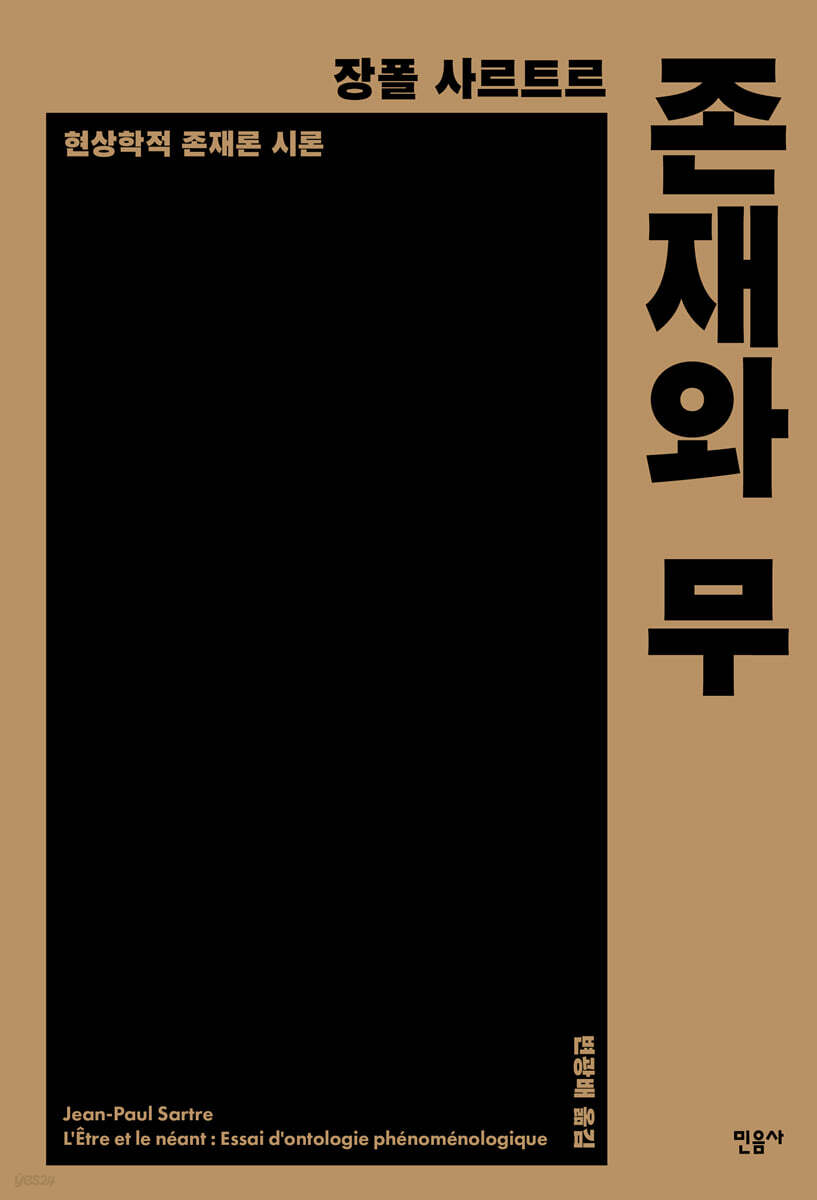
Being and Nothingness
 |
Description
Book Introduction
“Freedom precedes human nature.”
The best book of the 20th century
The world's most read philosophy book
Jean-Paul Sartre's Being and Nothingness
In 1999, Le Monde asked its readers:
“What book is most memorable to you?” In a poll of over 17,000 people to select the 100 best books of the 20th century, “Being and Nothingness” ranked 13th.
This is the highest ranking among philosophy books, and it is also noteworthy that the survey was conducted in collaboration with the Pnac bookstore, which has a wide sales network throughout France.
In 1943, Jean-Paul Sartre published Being and Nothingness.
France was under German occupation, and the French were divided over the German army's pillaging of their food.
Sartre decides to resist not with bombs but with writing.
He develops his own ideas based on the phenomenology of Edmund Husserl and the ontology of Martin Heidegger, which he studied during his student days.
It was an idea that said that humans were free even in a miserable world of war with no way out.
"Being and Nothingness" sold like bread.
It was used as a substitute for scales during times of material shortages and served as food for the spirits of hungry people.
“I had a passion for understanding humanity.” “Being and Nothingness” was the practice of this passion.
It was a bomb thrown at the heavy-handed philosophy that weighed on our shoulders, and a new milestone set on the old path of exploring human existence.
Philosopher Gilles Deleuze said this about Sartre:
“Fortunately, there was Sartre.
Sartre was outside of us.
It was a breath of fresh air, the only possibility that gave them the strength to endure the new order.
“Sartre was the kind of intellectual who would change the atmosphere of the intellectual community when he entered a café.”
The best book of the 20th century
The world's most read philosophy book
Jean-Paul Sartre's Being and Nothingness
In 1999, Le Monde asked its readers:
“What book is most memorable to you?” In a poll of over 17,000 people to select the 100 best books of the 20th century, “Being and Nothingness” ranked 13th.
This is the highest ranking among philosophy books, and it is also noteworthy that the survey was conducted in collaboration with the Pnac bookstore, which has a wide sales network throughout France.
In 1943, Jean-Paul Sartre published Being and Nothingness.
France was under German occupation, and the French were divided over the German army's pillaging of their food.
Sartre decides to resist not with bombs but with writing.
He develops his own ideas based on the phenomenology of Edmund Husserl and the ontology of Martin Heidegger, which he studied during his student days.
It was an idea that said that humans were free even in a miserable world of war with no way out.
"Being and Nothingness" sold like bread.
It was used as a substitute for scales during times of material shortages and served as food for the spirits of hungry people.
“I had a passion for understanding humanity.” “Being and Nothingness” was the practice of this passion.
It was a bomb thrown at the heavy-handed philosophy that weighed on our shoulders, and a new milestone set on the old path of exploring human existence.
Philosopher Gilles Deleuze said this about Sartre:
“Fortunately, there was Sartre.
Sartre was outside of us.
It was a breath of fresh air, the only possibility that gave them the strength to endure the new order.
“Sartre was the kind of intellectual who would change the atmosphere of the intellectual community when he entered a café.”
- You can preview some of the book's contents.
Preview
index
Introduction: The Quest for Existence
Part 1: The Problem of Nothingness
Chapter 1: The Origin of Negation
Chapter 2 Self-Deception
Part 2: The Great Self
Chapter 1: The Direct Structure of the Great Self
Chapter 2 Temporality
Chapter 3 Transcendence
Part 3: Substitute Beings
Chapter 1: The Existence of Others
Chapter 2 Body
Chapter 3: Specific Relationships with Others
Part 4: Having, Having, and Being
Chapter 1: Being and Beingness: Freedom
Chapter 2: What and What Not
conclusion
Translator's Note
Look up (proper noun)
Search (Signature)
Part 1: The Problem of Nothingness
Chapter 1: The Origin of Negation
Chapter 2 Self-Deception
Part 2: The Great Self
Chapter 1: The Direct Structure of the Great Self
Chapter 2 Temporality
Chapter 3 Transcendence
Part 3: Substitute Beings
Chapter 1: The Existence of Others
Chapter 2 Body
Chapter 3: Specific Relationships with Others
Part 4: Having, Having, and Being
Chapter 1: Being and Beingness: Freedom
Chapter 2: What and What Not
conclusion
Translator's Note
Look up (proper noun)
Search (Signature)
Into the book
Human freedom precedes and enables human nature.
The essence of human existence lies in the freedom of man.
Therefore, it is impossible to distinguish what we call freedom from the existence of human reality.
It is not that humans come first and then freedom comes later.
There is no difference between human existence and human 'freedom'.
Therefore, the problem is not to confront head-on a problem that can be dealt with completely only after a rigorous elucidation of human existence.
We must deal with freedom in connection with the problem of nothingness, and we must deal with freedom insofar as it thoroughly conditions the appearance of nothingness.
--- From "Part 1, Chapter 1, 'The Origin of Negation'"
A café employee cannot be a café employee directly, in the same sense that an ink bottle is an ink bottle and a cup is a cup.
It is not that he cannot form reflective judgments or concepts about his own identity.
He knows very well what his status “means.”
These include the obligation to wake up at 5 o'clock, the obligation to clean the store before opening, and the obligation to prepare the coffee pot.
He also recognizes the rights inherent in his status.
These include the right to receive tips and the right to join a union.
But all these concepts, all these judgments, point to something transcendent.
The question is one of abstract possibilities, of rights and duties given to the “subject of rights.”
It is this subject that I should be with, but that I am not with.
This is not because I want to be the subject or because this subject is something else.
Rather, it is because there is no common measure between the subject's existence and my existence.
The subject is a “representation” for other people and for myself.
This means that I can only be a subject in representation.
But, to be precise, if I represent myself as the subject, I am never the subject, and I am separated from the subject by nothing, just as the object is separated from the subject.
This nothingness isolates me from the subject.
I cannot be the subject.
I can only pretend that I am the subject.
In other words, I can only imagine that I am the subject.
And by doing so, I am influencing this subject in a way.
[As a result] no matter how hard I try to fulfill my duties as a cafe employee, it is of no use.
I can only be a café worker in a neutral way, just as an actor can be Hamlet.
--- From "Part 1, Chapter 2, 'Self-Deception'"
Nothingness is the inherent possibility of existence, the only possibility of that existence.
Moreover, this fundamental possibility appears only in the absolute act of realizing it.
Since nothingness is the nothingness of being, it can only come into being through being itself.
Of course, nothing comes into existence through a unique being called human reality.
But this being constitutes itself as human reality insofar as it is nothing other than its own original struggle for nothingness.
Human reality exists only insofar as it is the sole ground of nothingness in the midst of being, and for its own existence.
--- From "Part 2, Chapter 1, 'The Direct Structure of the Great Self'"
When I say, “I am not handsome,” I am not merely denying some single virtue about myself, captured in a completely concrete way.
Again, this virtue passes into nothingness, but does not in any way affect the positive totality of my being (as when I say, “The vase is not white, but gray,” or, “The inkwell is not on the table, but on the mantelpiece”).
I understand “not handsome” to mean a kind of negative virtue that characterizes me from within.
As far as negativity goes, “not being handsome” is a real quality of myself.
And this negative quality, like my pessimistic mood, may explain, for example, my failures in social life.
We understand the relationship between two beings through internal negation as one being [in-itself] being negated by the other being [in-itself], which qualitatively determines the other being [in-itself] in the midst of its own essence by its own absence itself.
At this point, negation becomes an essential existential connection.
Because at least one of the beings being negated points to the other and keeps that other at its center as an absence.
--- From "Part 2, Chapter 3, 'Transcendence'"
The other is what I am not, and what I am not.
This ne-pas refers to a nothingness as an element of separation given between the other and myself.
There is a separation between the other and myself.
This nothingness derives its source neither from myself, nor from others, nor from the reciprocal relationship between others and myself.
On the contrary, this nothingness is the primal absence of relationship, which is fundamentally the basis of all relationships between the other and myself.
The reason is that, in fact, the other is what appears to me empirically on the occasion when I perceive a body, and this body is an in-itself external to my body.
The type of relationship that unites and separates these two bodies is that of things that have no relationship to each other, and that of a spatial relationship as a simple externality insofar as it is given.
--- From "Part 3, Chapter 1, 'The Existence of the Other'"
I am condemned to exist forever beyond my essence, beyond the causes or motivations of my actions.
That is, I am sentenced to be free.
This means that we will find no limits to our freedom other than freedom itself.
Or, to put it this way, we are not free to cease to be free.
Insofar as the Great Self tries to hide its own nothingness from itself and to merge the self into itself as its true mode of being, the Great Self also tries to hide its own freedom from itself.
The profound meaning of determinism is to establish within us a single, uninterrupted, self-contained continuum of existence.
From a deterministic point of view, mental facts, that is, causes conceived as given, full realities, are connected with decisions and actions conceived as mental data as well, even without a solution to the problem of continuity.
The self takes up all that “data”.
Just as a cause brings about an effect, so an motive brings about an action.
Everything is real, everything is full.
In this way, the denial of freedom can only be thought of as an attempt to grasp oneself as an in-itself.
The denial of freedom and the attempt to understand oneself as an in-itself are paired together.
Human reality is one in which freedom is questioned in its very existence, because it constantly attempts to deny recognition of its own freedom.
The essence of human existence lies in the freedom of man.
Therefore, it is impossible to distinguish what we call freedom from the existence of human reality.
It is not that humans come first and then freedom comes later.
There is no difference between human existence and human 'freedom'.
Therefore, the problem is not to confront head-on a problem that can be dealt with completely only after a rigorous elucidation of human existence.
We must deal with freedom in connection with the problem of nothingness, and we must deal with freedom insofar as it thoroughly conditions the appearance of nothingness.
--- From "Part 1, Chapter 1, 'The Origin of Negation'"
A café employee cannot be a café employee directly, in the same sense that an ink bottle is an ink bottle and a cup is a cup.
It is not that he cannot form reflective judgments or concepts about his own identity.
He knows very well what his status “means.”
These include the obligation to wake up at 5 o'clock, the obligation to clean the store before opening, and the obligation to prepare the coffee pot.
He also recognizes the rights inherent in his status.
These include the right to receive tips and the right to join a union.
But all these concepts, all these judgments, point to something transcendent.
The question is one of abstract possibilities, of rights and duties given to the “subject of rights.”
It is this subject that I should be with, but that I am not with.
This is not because I want to be the subject or because this subject is something else.
Rather, it is because there is no common measure between the subject's existence and my existence.
The subject is a “representation” for other people and for myself.
This means that I can only be a subject in representation.
But, to be precise, if I represent myself as the subject, I am never the subject, and I am separated from the subject by nothing, just as the object is separated from the subject.
This nothingness isolates me from the subject.
I cannot be the subject.
I can only pretend that I am the subject.
In other words, I can only imagine that I am the subject.
And by doing so, I am influencing this subject in a way.
[As a result] no matter how hard I try to fulfill my duties as a cafe employee, it is of no use.
I can only be a café worker in a neutral way, just as an actor can be Hamlet.
--- From "Part 1, Chapter 2, 'Self-Deception'"
Nothingness is the inherent possibility of existence, the only possibility of that existence.
Moreover, this fundamental possibility appears only in the absolute act of realizing it.
Since nothingness is the nothingness of being, it can only come into being through being itself.
Of course, nothing comes into existence through a unique being called human reality.
But this being constitutes itself as human reality insofar as it is nothing other than its own original struggle for nothingness.
Human reality exists only insofar as it is the sole ground of nothingness in the midst of being, and for its own existence.
--- From "Part 2, Chapter 1, 'The Direct Structure of the Great Self'"
When I say, “I am not handsome,” I am not merely denying some single virtue about myself, captured in a completely concrete way.
Again, this virtue passes into nothingness, but does not in any way affect the positive totality of my being (as when I say, “The vase is not white, but gray,” or, “The inkwell is not on the table, but on the mantelpiece”).
I understand “not handsome” to mean a kind of negative virtue that characterizes me from within.
As far as negativity goes, “not being handsome” is a real quality of myself.
And this negative quality, like my pessimistic mood, may explain, for example, my failures in social life.
We understand the relationship between two beings through internal negation as one being [in-itself] being negated by the other being [in-itself], which qualitatively determines the other being [in-itself] in the midst of its own essence by its own absence itself.
At this point, negation becomes an essential existential connection.
Because at least one of the beings being negated points to the other and keeps that other at its center as an absence.
--- From "Part 2, Chapter 3, 'Transcendence'"
The other is what I am not, and what I am not.
This ne-pas refers to a nothingness as an element of separation given between the other and myself.
There is a separation between the other and myself.
This nothingness derives its source neither from myself, nor from others, nor from the reciprocal relationship between others and myself.
On the contrary, this nothingness is the primal absence of relationship, which is fundamentally the basis of all relationships between the other and myself.
The reason is that, in fact, the other is what appears to me empirically on the occasion when I perceive a body, and this body is an in-itself external to my body.
The type of relationship that unites and separates these two bodies is that of things that have no relationship to each other, and that of a spatial relationship as a simple externality insofar as it is given.
--- From "Part 3, Chapter 1, 'The Existence of the Other'"
I am condemned to exist forever beyond my essence, beyond the causes or motivations of my actions.
That is, I am sentenced to be free.
This means that we will find no limits to our freedom other than freedom itself.
Or, to put it this way, we are not free to cease to be free.
Insofar as the Great Self tries to hide its own nothingness from itself and to merge the self into itself as its true mode of being, the Great Self also tries to hide its own freedom from itself.
The profound meaning of determinism is to establish within us a single, uninterrupted, self-contained continuum of existence.
From a deterministic point of view, mental facts, that is, causes conceived as given, full realities, are connected with decisions and actions conceived as mental data as well, even without a solution to the problem of continuity.
The self takes up all that “data”.
Just as a cause brings about an effect, so an motive brings about an action.
Everything is real, everything is full.
In this way, the denial of freedom can only be thought of as an attempt to grasp oneself as an in-itself.
The denial of freedom and the attempt to understand oneself as an in-itself are paired together.
Human reality is one in which freedom is questioned in its very existence, because it constantly attempts to deny recognition of its own freedom.
--- From "Part 4, Chapter 1, 'Being and Being: Freedom'"
Publisher's Review
“Being free means
“He was sentenced to freedom.”
Sartre, the intellectual of the times,
Through the exploration of existence
Laying the foundation for engaging with reality
The 20th century was a century of violence.
In the 19th century, when human culture reached its peak, 'modernity' seemed to shine.
However, with the outbreak of World War I and the subsequent outbreak of World War II, humanity was plunged into the worst crisis in history.
Sartre lived surrounded by wars and clashes of ideas that reshaped the world.
In Being and Nothingness, the object of inquiry is the isolated human being.
An individual who remains in the establishment of a relationship of 'me versus the other'.
How can humans be so cruel to one another? Have the greatness and dignity they once praised vanished? Are humans not subjects of reason, but mere beings struggling in the abyss of inhumanity? "Being and Nothingness" is a grand ontology that delves into these questions.
“Only existence comes from man.” To escape from this, man must be able to place himself outside of existence and weaken the structure of existence.
It is to nullify existence.
In this way, Sartre rewrites Heidegger's 'Dasein', which goes beyond phenomena to the essence, as 'human reality'.
There is “the possibility that human reality secretes a void that isolates itself.”
“That is freedom.”
The exploration of human existence, which seeks freedom as a being that cannot remain in self-existence, is not merely speculative.
The famous anecdote from Being and Nothingness, that no matter how hard a cafe employee tries to act like an employee, he or she can never be an employee, explains a truth we all know.
From the realities of self-deception to the escape from anxiety, emotions like sadness, jealousy, and shame, to the problems of love, sexuality, and masochism, all the topics this book addresses are questions of life that we must endure and transcend.
Byun Gwang-bae of the Korean Sartre Research Association, who participated in the translation of 『Critique of Dialectical Reason』, a representative work of Sartre's later thought, and has been studying Sartre with a focus on 'gaze' and 'violence', has taken great pains to translate the philosophical theories and literary descriptions precisely in this translation, which is being released after five years.
This is the first complete Korean translation based on the 1994 edition published by Gallimard, France.
“He was sentenced to freedom.”
Sartre, the intellectual of the times,
Through the exploration of existence
Laying the foundation for engaging with reality
The 20th century was a century of violence.
In the 19th century, when human culture reached its peak, 'modernity' seemed to shine.
However, with the outbreak of World War I and the subsequent outbreak of World War II, humanity was plunged into the worst crisis in history.
Sartre lived surrounded by wars and clashes of ideas that reshaped the world.
In Being and Nothingness, the object of inquiry is the isolated human being.
An individual who remains in the establishment of a relationship of 'me versus the other'.
How can humans be so cruel to one another? Have the greatness and dignity they once praised vanished? Are humans not subjects of reason, but mere beings struggling in the abyss of inhumanity? "Being and Nothingness" is a grand ontology that delves into these questions.
“Only existence comes from man.” To escape from this, man must be able to place himself outside of existence and weaken the structure of existence.
It is to nullify existence.
In this way, Sartre rewrites Heidegger's 'Dasein', which goes beyond phenomena to the essence, as 'human reality'.
There is “the possibility that human reality secretes a void that isolates itself.”
“That is freedom.”
The exploration of human existence, which seeks freedom as a being that cannot remain in self-existence, is not merely speculative.
The famous anecdote from Being and Nothingness, that no matter how hard a cafe employee tries to act like an employee, he or she can never be an employee, explains a truth we all know.
From the realities of self-deception to the escape from anxiety, emotions like sadness, jealousy, and shame, to the problems of love, sexuality, and masochism, all the topics this book addresses are questions of life that we must endure and transcend.
Byun Gwang-bae of the Korean Sartre Research Association, who participated in the translation of 『Critique of Dialectical Reason』, a representative work of Sartre's later thought, and has been studying Sartre with a focus on 'gaze' and 'violence', has taken great pains to translate the philosophical theories and literary descriptions precisely in this translation, which is being released after five years.
This is the first complete Korean translation based on the 1994 edition published by Gallimard, France.
GOODS SPECIFICS
- Date of issue: August 30, 2024
- Format: Hardcover book binding method guide
- Page count, weight, size: 1,296 pages | 1,944g | 152*225*65mm
- ISBN13: 9788937416392
- ISBN10: 8937416395
You may also like
카테고리
korean


korean

![GQ KOREA Mark (Monthly): December [2025]](http://librairie.coreenne.fr/cdn/shop/files/8ef265dbbfbf186523ed75ba7319009d.jpg?v=1765340328&width=3840)


