

Genius' Map
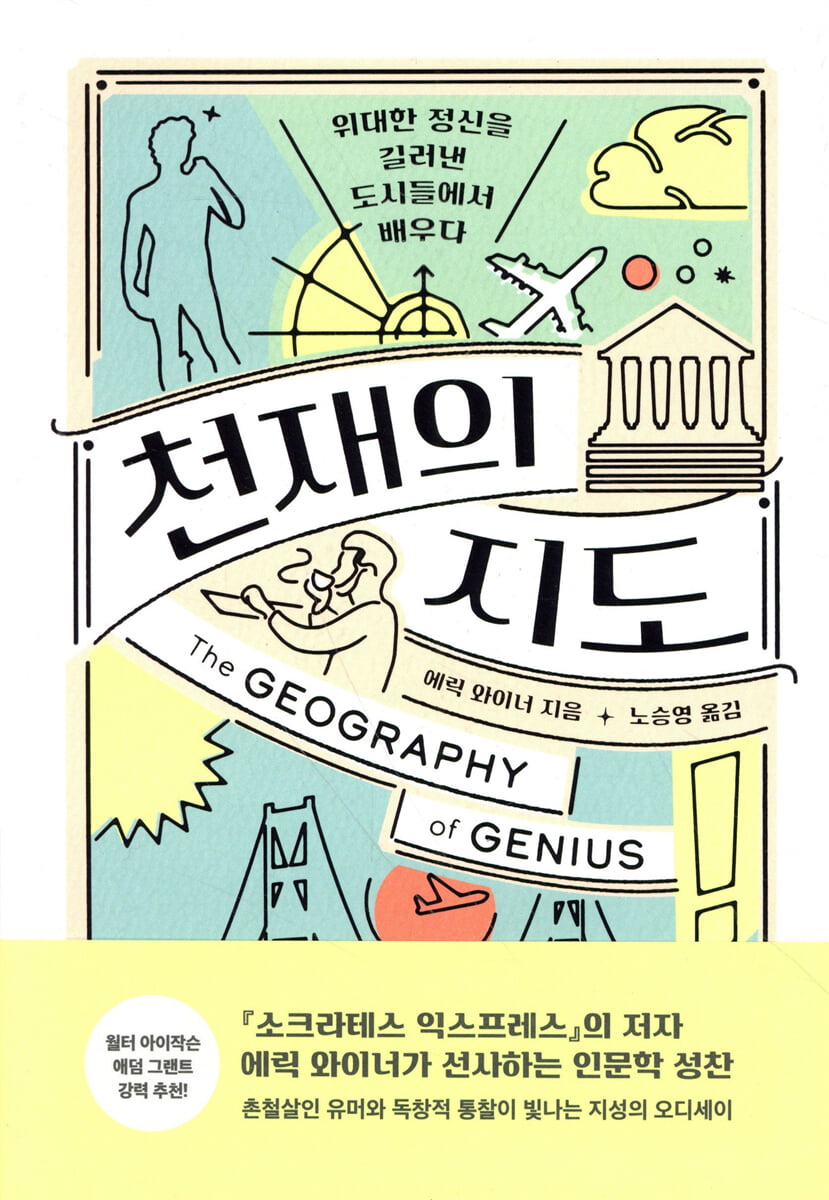 |
Description
Book Introduction
Eric Weiner, author of "Socrates Express,"
He sets out to discover the secrets of great geniuses for his young daughter.
'The talented one hits the target that no one else can hit,
Genius hits the target that no one else sees.'
From humorous philosopher and thoughtful traveler Eric Weiner
A delightful and profound humanities study of human creativity.
Study genius, diet genius, investment genius, political genius.
We live in an age of genius inflation.
When we praise and respect those who excel in a particular field, we often use the word genius to describe them.
But isn't it true that the word genius has become so commonplace that it has become caught up in current conventions?
Are we living in an age of declining genius? Or is there hope for us all to become geniuses? Human history has been a history of discoveries and inventions by creative minds, so it's only natural that the word "genius" carries with it a sense of aspiration and longing.
Traveling philosopher and delightful humanist Eric Winer travels the world to discover the golden age cities where the geniuses who made humanity leap forward emerged, and explores the "secrets of leaps" held by human creativity.
It is because he wants his young daughter to grow up in a creative culture.
However, I have no intention of further solidifying the genius myth.
Rather, it's the opposite.
Rather than illuminate the inner workings of genius, Eric Weiner offers a multifaceted look at the creative culture of the time that allowed them to emerge, drawing on a variety of contemporary historical and psychological research findings.
Perhaps I hope to be influenced by some of the geniuses I encounter? Of course, I am, but I'm middle-aged, and any hope of becoming the next Einstein or Leonardo da Vinci has long since faded, along with my hair.
But now, our nine-year-old daughter, full of intelligence and endless potential, is a different story.
There is still hope for this child.
And what parent doesn't secretly hope their child will become the next Darwin or Marie Curie? To that end, we focus our energies on them.
For example, some parents foster good study habits, while others provide a buffet of intellectual possibilities.
_From the "Preface"
He sets out to discover the secrets of great geniuses for his young daughter.
'The talented one hits the target that no one else can hit,
Genius hits the target that no one else sees.'
From humorous philosopher and thoughtful traveler Eric Weiner
A delightful and profound humanities study of human creativity.
Study genius, diet genius, investment genius, political genius.
We live in an age of genius inflation.
When we praise and respect those who excel in a particular field, we often use the word genius to describe them.
But isn't it true that the word genius has become so commonplace that it has become caught up in current conventions?
Are we living in an age of declining genius? Or is there hope for us all to become geniuses? Human history has been a history of discoveries and inventions by creative minds, so it's only natural that the word "genius" carries with it a sense of aspiration and longing.
Traveling philosopher and delightful humanist Eric Winer travels the world to discover the golden age cities where the geniuses who made humanity leap forward emerged, and explores the "secrets of leaps" held by human creativity.
It is because he wants his young daughter to grow up in a creative culture.
However, I have no intention of further solidifying the genius myth.
Rather, it's the opposite.
Rather than illuminate the inner workings of genius, Eric Weiner offers a multifaceted look at the creative culture of the time that allowed them to emerge, drawing on a variety of contemporary historical and psychological research findings.
Perhaps I hope to be influenced by some of the geniuses I encounter? Of course, I am, but I'm middle-aged, and any hope of becoming the next Einstein or Leonardo da Vinci has long since faded, along with my hair.
But now, our nine-year-old daughter, full of intelligence and endless potential, is a different story.
There is still hope for this child.
And what parent doesn't secretly hope their child will become the next Darwin or Marie Curie? To that end, we focus our energies on them.
For example, some parents foster good study habits, while others provide a buffet of intellectual possibilities.
_From the "Preface"
- You can preview some of the book's contents.
Preview
index
Preface_A Reckless Adventure with the Galton Box
Chapter 1: Genius is Simple - Athens
The first step to every leap forward is to realize that your own knowledge is imperfect.
Chapter 2: Genius is Not New - Hangzhou
What matters is not how many times you succeed, but how many times you start again.
Chapter 3: Genius is expensive - Florence
Since I don't have money, I have no choice but to think.
Chapter 4 Genius is Practical - Edinburgh
There is nothing like forbidden learning to ignite the spark of intellect.
Chapter 5: Genius is a mess - Kolkata
Nothing sticks to a smooth surface.
Chapter 6: Genius is not a product of intention - Vienna, the city of music
They say inspiration is only useful to amateurs.
Chapter 7: Genius is Contagious - The Empty Seat on the Sofa
Underdog responds to cracks and contradictions.
Chapter 8: Genius is Weak - Silicon Valley
Fail fast and fail better.
Review_Baking and Surfing
Acknowledgements
References
Chapter 1: Genius is Simple - Athens
The first step to every leap forward is to realize that your own knowledge is imperfect.
Chapter 2: Genius is Not New - Hangzhou
What matters is not how many times you succeed, but how many times you start again.
Chapter 3: Genius is expensive - Florence
Since I don't have money, I have no choice but to think.
Chapter 4 Genius is Practical - Edinburgh
There is nothing like forbidden learning to ignite the spark of intellect.
Chapter 5: Genius is a mess - Kolkata
Nothing sticks to a smooth surface.
Chapter 6: Genius is not a product of intention - Vienna, the city of music
They say inspiration is only useful to amateurs.
Chapter 7: Genius is Contagious - The Empty Seat on the Sofa
Underdog responds to cracks and contradictions.
Chapter 8: Genius is Weak - Silicon Valley
Fail fast and fail better.
Review_Baking and Surfing
Acknowledgements
References
Into the book
Socrates is remembered as a great philosopher, but above all, he was a conversationalist.
Even before Socrates, people spoke, but it was not dialogue.
It was just an exchange of monologues, especially when one side was of a higher social status.
Socrates pioneered the use of dialogue as a means of intellectual inquiry.
This is a way to question assumptions that are so deeply ingrained that we don't even recognize them.
--- p.61
In fact, creativity thrives under imperfect conditions.
The block of marble from which Michelangelo carved his masterpiece, David, was discarded by other artists.
They thought the marble was flawed, and it was.
However, Michelangelo viewed flaws as challenges to be addressed, not as disqualifications.
--- p.168
The person who solves the problem answers the question.
A problem seeker discovers new questions and then answers them.
What distinguishes genius is not the right answer, but the new question.
So Picasso left this witty remark.
“Computers are stupid.
“Because I can only give you the correct answer.”
--- p.178
We see risk not as a noble adventure or a dance with the universe, but as something to be avoided at all costs, or at least reduced to a fraction.
And then I wonder why there hasn't been a second Renaissance.
--- p.192
To create something of value, you must have a firm belief that someone will appreciate your creation.
Creativity is having faith not only in the present moment but also in the moments to come.
That's why we don't hear about nihilists producing creative achievements.
--- p.249
It is this persistence, rather than the apocryphal "moment of enlightenment," that characterizes creative genius.
When asked how he discovered the law of gravity, Isaac Newton answered without a word about falling apples:
“I thought and thought again.”
--- p.254
They say originality is the art of hiding one's source.
There is some truth to this, for Mozart owed much to his fellow composers, living and dead.
He was deeply influenced by Italian opera, his teacher Padre Martini and Joseph Haydn, and the music of Bach and Handel.
Mozart copied the scores of these masters by hand, as if this mechanical act could bring about greatness.
--- p.351
A place full of geniuses is both a blessing and a curse.
Inspiration can be found everywhere, but the danger of imitation, even if unintentional, is always present.
This fear cast a shadow over Beethoven throughout his life, but it also became the driving force behind his foray into new and unexplored paths.
--- p.354
The patrons of Vienna's coffee shops at the turn of the century were fellow travelers.
The coffee shop people were a special group of people with a strange combination of introversion and extroversion, traits that define most geniuses.
No, as Alfred Polgar wrote in his brilliant 1927 essay “The Café Centrale Theory,” they were “people whose hatred of their fellow human beings is as fierce as their longing, who long for solitude but need companionship.”
--- p.393
It is better to launch an imperfect product today than a perfect product tomorrow.
As Steve Jobs said, when the light bulb was invented, no one complained that it was too dark.
Even before Socrates, people spoke, but it was not dialogue.
It was just an exchange of monologues, especially when one side was of a higher social status.
Socrates pioneered the use of dialogue as a means of intellectual inquiry.
This is a way to question assumptions that are so deeply ingrained that we don't even recognize them.
--- p.61
In fact, creativity thrives under imperfect conditions.
The block of marble from which Michelangelo carved his masterpiece, David, was discarded by other artists.
They thought the marble was flawed, and it was.
However, Michelangelo viewed flaws as challenges to be addressed, not as disqualifications.
--- p.168
The person who solves the problem answers the question.
A problem seeker discovers new questions and then answers them.
What distinguishes genius is not the right answer, but the new question.
So Picasso left this witty remark.
“Computers are stupid.
“Because I can only give you the correct answer.”
--- p.178
We see risk not as a noble adventure or a dance with the universe, but as something to be avoided at all costs, or at least reduced to a fraction.
And then I wonder why there hasn't been a second Renaissance.
--- p.192
To create something of value, you must have a firm belief that someone will appreciate your creation.
Creativity is having faith not only in the present moment but also in the moments to come.
That's why we don't hear about nihilists producing creative achievements.
--- p.249
It is this persistence, rather than the apocryphal "moment of enlightenment," that characterizes creative genius.
When asked how he discovered the law of gravity, Isaac Newton answered without a word about falling apples:
“I thought and thought again.”
--- p.254
They say originality is the art of hiding one's source.
There is some truth to this, for Mozart owed much to his fellow composers, living and dead.
He was deeply influenced by Italian opera, his teacher Padre Martini and Joseph Haydn, and the music of Bach and Handel.
Mozart copied the scores of these masters by hand, as if this mechanical act could bring about greatness.
--- p.351
A place full of geniuses is both a blessing and a curse.
Inspiration can be found everywhere, but the danger of imitation, even if unintentional, is always present.
This fear cast a shadow over Beethoven throughout his life, but it also became the driving force behind his foray into new and unexplored paths.
--- p.354
The patrons of Vienna's coffee shops at the turn of the century were fellow travelers.
The coffee shop people were a special group of people with a strange combination of introversion and extroversion, traits that define most geniuses.
No, as Alfred Polgar wrote in his brilliant 1927 essay “The Café Centrale Theory,” they were “people whose hatred of their fellow human beings is as fierce as their longing, who long for solitude but need companionship.”
--- p.393
It is better to launch an imperfect product today than a perfect product tomorrow.
As Steve Jobs said, when the light bulb was invented, no one complained that it was too dark.
--- p.463
Publisher's Review
Traveling humanist Eric Winer questions our age's myths about creativity.
_Having a high intelligence does not mean you are a creative genius.
Eric Weiner travels to seven cities that once hosted creative geniuses, exploring how and why human creativity emerges.
From ancient Athens, Song Dynasty Hangzhou, Renaissance Florence, and fin-de-siècle Vienna to present-day Silicon Valley, Eric Weiner's delightful humanities exploration of creativity in cities that have drawn contemporary creative talent shatters the myths about creativity to which we obsessively cling in the modern era.
Is it true that geniuses are people who are genetically gifted with high intelligence, or who work hard without giving up, as in the 10,000-hour rule or the 99 percent effort rule?
According to Eric Weiner's exploration, no.
What matters is a creative culture that attracts and drives talent.
And from that incubator of genius, those we call geniuses emerged in droves.
So how is such a culture created?
Cities that have produced great geniuses each have their own answers.
The first step to every leap is to realize that your own knowledge is imperfect.
_Socrates is remembered as a great philosopher, but above all, he was a conversationalist.
Eric Winer first focuses on ancient Athens, the birthplace of immortal philosophers like Socrates, Plato, and Aristotle.
Why on earth did a people, "neither numerous, powerful, nor well-organized, yet who presented a completely new conception of the purpose of human life and demonstrated for the first time what the human spirit was for" emerge here? Furthermore, the zenith of Athenian civilization occurred during the brief 24-year period between the Persian and Peloponnesian Wars.
Yet, it was then and there that almost all the fundamental concepts we use today emerged, including democracy, science, and philosophy.
Eric Winer believes that the reason they could do so was because all the citizens of Athens questioned everything around them, every taboo, and talked and debated freely and fiercely.
We are all a little bit Greek, whether we know it or not.
If you've ever voted, served on a jury, watched a movie, read a novel, or had a conversation with a friend over a glass of wine about anything from last night's football game to the nature of truth, you owe it to the Greeks.
If you've ever thought rationally, asked the question "Why?", or gazed at the night sky with a sense of quiet awe, you've experienced a Greek moment.
_Page 31 of the text
The Athenians lived in a time of great uncertainty, but rather than retreating behind their walls like the fierce Spartans or indulging in pleasures and delicacies like other city-states, they embraced uncertainty, suffering, and everything with strength and were open in all directions.
Even when it seems wise not to.
Openness to foreign cultures, strange people, and unfamiliar ideas.
This openness is what makes Athens Athens.
_Page 103
The law of constraints: when you don't have money, you have no choice but to think.
If growing up in a wealthy environment and receiving both material and spiritual support leads to greater creativity, then only rich children will achieve genius-level achievements.
However, geniuses were those who did not give in to deficiencies and inadequacies and challenged themselves.
Leonardo da Vinci was an illegitimate child, which meant he was not properly educated and had no way to advance through formal channels.
Freud was a Jewish fin-de-siècle Viennese, an eccentric outsider of the academic world.
Just as the 'paradox of oil' causes oil-producing countries to become culturally stagnant, if everything were abundant, there would be no need to worry about how to overcome the situation.
The idea that the place of genius is like paradise is the biggest misconception of all.
Never.
Paradise is the antithesis of genius.
In paradise, nothing is required, whereas creative genius is rooted in meeting needs in new and ingenious ways.
Nietzsche said, “The Athenians matured because they were challenged on all sides.”
It's in the same vein as his famous maxim, "What doesn't kill me makes me stronger."
Creativity is a response to the environment.
_Page 51 of the text
Creative people are particularly adept at Janus-shaped thinking.
Janus-faced thinking is “the active imagining of two or more opposing or antithetical concepts, images, or ideas simultaneously.”
Creative people are particularly adept at Janus-shaped thinking.
Janus-shaped thinking is not about synthesizing two incompatible concepts, but about living with the incompatibility.
For example, Einstein conceived the theory of general relativity because he could imagine the coexistence of the contradictory truths that an object can be both moving and at rest.
Physicist Niels Bohr thought that light was both a wave and a particle.
How can something be two completely different things at the same time? Simply asking this question, without necessarily answering it, is the first step toward a creative leap.
Eric Weiner suggests that perhaps a love of paradox defines creativity.
Enlightenment Scotland was a paradise of paradoxes.
We are British and yet we are not British.
We are a big country and a small country.
We are proud but lack confidence.
We are pragmatic adventurists.
We are hopeful pessimists.
It is not surprising that the author of the monumental book, The Divided Self, was a Scottish psychiatrist.
This is the land of the divided self, the land of the Cardinals Brodie (who inspired Dr. Jekyll and Mr. Hyde)_Page 241
A feast of humanities with sophisticated humor and sharp intellect
"The Genius Map" is a book that looks back on the present era, when creativity is emphasized more than ever, and vigorously explores when, how, and why human intelligence and creativity have been expressed from the past to the present through extensive historical data and empirical experimental results.
Humans become creative when they can question the circumstances and conditions surrounding them, when they try to exploit or overcome limitations, when they acknowledge their own shortcomings, and when they challenge boundaries.
Rich with sophisticated humor and a wealth of humanistic knowledge, this book offers invaluable insights to modern readers hungry for "creative ideas."
We consider ourselves deeply modern, clutching our shiny new Apple products and breathlessly anticipating the ensuing devastation.
But our ideas about creativity are stuck in the 19th century.
You can't breathe there.
I have to get out.
We need to think of creativity as something that is acquired, not a genetic trait or gift.
This requires constant effort, but a favorable environment must be carefully created.
Creativity should be considered a public good, not a personal indulgence.
We have the genius we want and deserve.
_Page 498
_Having a high intelligence does not mean you are a creative genius.
Eric Weiner travels to seven cities that once hosted creative geniuses, exploring how and why human creativity emerges.
From ancient Athens, Song Dynasty Hangzhou, Renaissance Florence, and fin-de-siècle Vienna to present-day Silicon Valley, Eric Weiner's delightful humanities exploration of creativity in cities that have drawn contemporary creative talent shatters the myths about creativity to which we obsessively cling in the modern era.
Is it true that geniuses are people who are genetically gifted with high intelligence, or who work hard without giving up, as in the 10,000-hour rule or the 99 percent effort rule?
According to Eric Weiner's exploration, no.
What matters is a creative culture that attracts and drives talent.
And from that incubator of genius, those we call geniuses emerged in droves.
So how is such a culture created?
Cities that have produced great geniuses each have their own answers.
The first step to every leap is to realize that your own knowledge is imperfect.
_Socrates is remembered as a great philosopher, but above all, he was a conversationalist.
Eric Winer first focuses on ancient Athens, the birthplace of immortal philosophers like Socrates, Plato, and Aristotle.
Why on earth did a people, "neither numerous, powerful, nor well-organized, yet who presented a completely new conception of the purpose of human life and demonstrated for the first time what the human spirit was for" emerge here? Furthermore, the zenith of Athenian civilization occurred during the brief 24-year period between the Persian and Peloponnesian Wars.
Yet, it was then and there that almost all the fundamental concepts we use today emerged, including democracy, science, and philosophy.
Eric Winer believes that the reason they could do so was because all the citizens of Athens questioned everything around them, every taboo, and talked and debated freely and fiercely.
We are all a little bit Greek, whether we know it or not.
If you've ever voted, served on a jury, watched a movie, read a novel, or had a conversation with a friend over a glass of wine about anything from last night's football game to the nature of truth, you owe it to the Greeks.
If you've ever thought rationally, asked the question "Why?", or gazed at the night sky with a sense of quiet awe, you've experienced a Greek moment.
_Page 31 of the text
The Athenians lived in a time of great uncertainty, but rather than retreating behind their walls like the fierce Spartans or indulging in pleasures and delicacies like other city-states, they embraced uncertainty, suffering, and everything with strength and were open in all directions.
Even when it seems wise not to.
Openness to foreign cultures, strange people, and unfamiliar ideas.
This openness is what makes Athens Athens.
_Page 103
The law of constraints: when you don't have money, you have no choice but to think.
If growing up in a wealthy environment and receiving both material and spiritual support leads to greater creativity, then only rich children will achieve genius-level achievements.
However, geniuses were those who did not give in to deficiencies and inadequacies and challenged themselves.
Leonardo da Vinci was an illegitimate child, which meant he was not properly educated and had no way to advance through formal channels.
Freud was a Jewish fin-de-siècle Viennese, an eccentric outsider of the academic world.
Just as the 'paradox of oil' causes oil-producing countries to become culturally stagnant, if everything were abundant, there would be no need to worry about how to overcome the situation.
The idea that the place of genius is like paradise is the biggest misconception of all.
Never.
Paradise is the antithesis of genius.
In paradise, nothing is required, whereas creative genius is rooted in meeting needs in new and ingenious ways.
Nietzsche said, “The Athenians matured because they were challenged on all sides.”
It's in the same vein as his famous maxim, "What doesn't kill me makes me stronger."
Creativity is a response to the environment.
_Page 51 of the text
Creative people are particularly adept at Janus-shaped thinking.
Janus-faced thinking is “the active imagining of two or more opposing or antithetical concepts, images, or ideas simultaneously.”
Creative people are particularly adept at Janus-shaped thinking.
Janus-shaped thinking is not about synthesizing two incompatible concepts, but about living with the incompatibility.
For example, Einstein conceived the theory of general relativity because he could imagine the coexistence of the contradictory truths that an object can be both moving and at rest.
Physicist Niels Bohr thought that light was both a wave and a particle.
How can something be two completely different things at the same time? Simply asking this question, without necessarily answering it, is the first step toward a creative leap.
Eric Weiner suggests that perhaps a love of paradox defines creativity.
Enlightenment Scotland was a paradise of paradoxes.
We are British and yet we are not British.
We are a big country and a small country.
We are proud but lack confidence.
We are pragmatic adventurists.
We are hopeful pessimists.
It is not surprising that the author of the monumental book, The Divided Self, was a Scottish psychiatrist.
This is the land of the divided self, the land of the Cardinals Brodie (who inspired Dr. Jekyll and Mr. Hyde)_Page 241
A feast of humanities with sophisticated humor and sharp intellect
"The Genius Map" is a book that looks back on the present era, when creativity is emphasized more than ever, and vigorously explores when, how, and why human intelligence and creativity have been expressed from the past to the present through extensive historical data and empirical experimental results.
Humans become creative when they can question the circumstances and conditions surrounding them, when they try to exploit or overcome limitations, when they acknowledge their own shortcomings, and when they challenge boundaries.
Rich with sophisticated humor and a wealth of humanistic knowledge, this book offers invaluable insights to modern readers hungry for "creative ideas."
We consider ourselves deeply modern, clutching our shiny new Apple products and breathlessly anticipating the ensuing devastation.
But our ideas about creativity are stuck in the 19th century.
You can't breathe there.
I have to get out.
We need to think of creativity as something that is acquired, not a genetic trait or gift.
This requires constant effort, but a favorable environment must be carefully created.
Creativity should be considered a public good, not a personal indulgence.
We have the genius we want and deserve.
_Page 498
GOODS SPECIFICS
- Publication date: November 16, 2021
- Page count, weight, size: 516 pages | 680g | 145*210*35mm
- ISBN13: 9788954683593
- ISBN10: 8954683592
You may also like
카테고리
korean


korean

![GQ KOREA Mark (Monthly): December [2025]](http://librairie.coreenne.fr/cdn/shop/files/8ef265dbbfbf186523ed75ba7319009d.jpg?v=1765340328&width=3840)


