

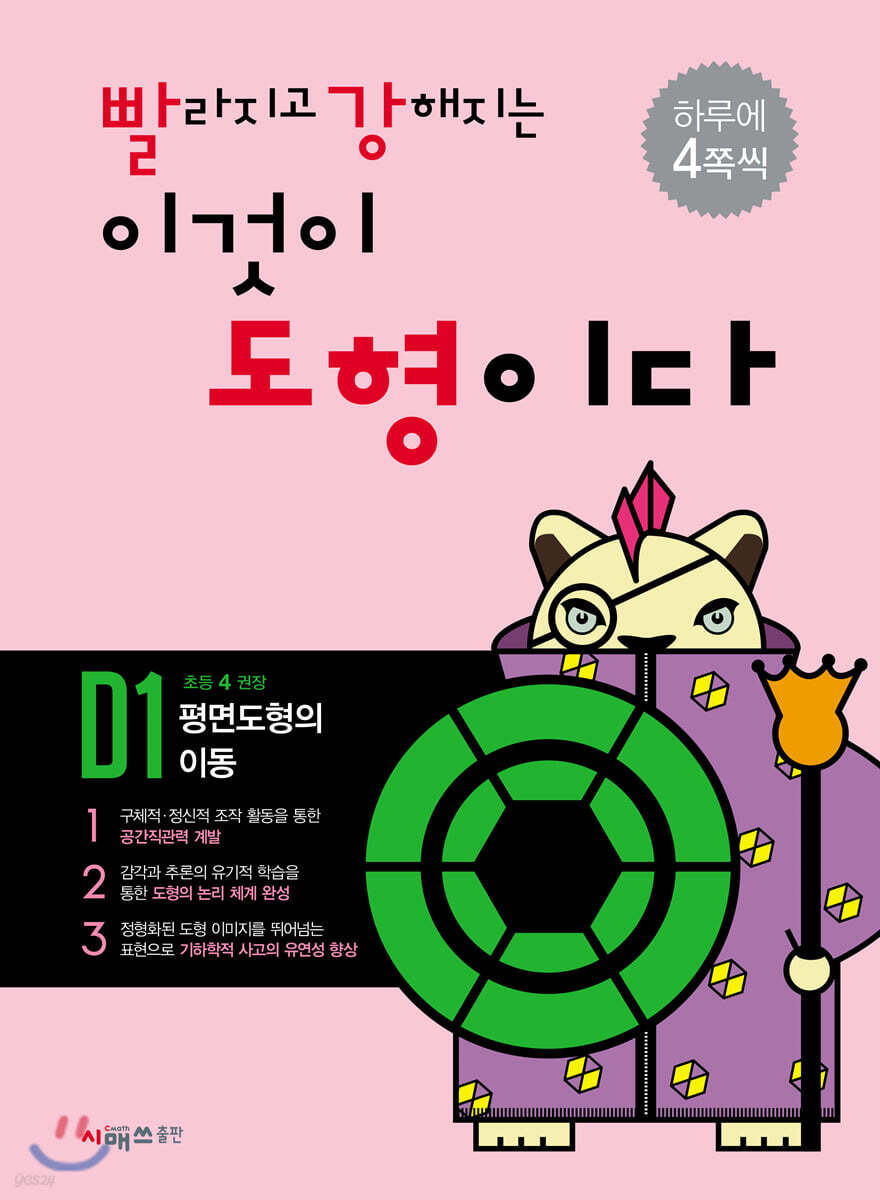
This is the shape that gets faster and stronger D1
 |
Description
Book Introduction
Before starting to learn about shapes, prepare for self-directed learning by stimulating interest and motivation, then intuitively form concepts related to the topic through visual recognition, and provide various examples so that concepts are not limited to stereotypical shapes and locations.
Next, you can apply and utilize the concepts you have learned through various problems to improve your mathematical thinking skills and solidify the concepts. You can also check whether the correct concepts have been formed and improve your spatial sense through specific manipulations and mental manipulation activities such as drawing, measuring, and moving.
Finally, take your skills to the next level with challenging problems that build on what you've learned and enhance your critical thinking and problem-solving skills.
This five-step learning process of [preparation → concept → practice → operation → challenge] will help you properly improve your shape skills.
Next, you can apply and utilize the concepts you have learned through various problems to improve your mathematical thinking skills and solidify the concepts. You can also check whether the correct concepts have been formed and improve your spatial sense through specific manipulations and mental manipulation activities such as drawing, measuring, and moving.
Finally, take your skills to the next level with challenging problems that build on what you've learned and enhance your critical thinking and problem-solving skills.
This five-step learning process of [preparation → concept → practice → operation → challenge] will help you properly improve your shape skills.
index
Push and flip No. 1
Turn number 2
Move number 3 several times
Rule 4 of movement
Turn number 2
Move number 3 several times
Rule 4 of movement
Detailed image
.jpg)
Publisher's Review
Why are shapes difficult in math?
Children who struggle with learning in the area of shapes often have a limited image of shapes, thinking only of stereotypical shapes.
In this case, even if the same shape is flipped or rotated, an error occurs in which it is recognized as a different, separate shape.
Also, because you may learn only with limited images and mistakenly believe that you have formed a concept of shapes.
How can we solve problems without concrete objects?
When a child first expresses a three-dimensional object on a flat surface, he or she needs to directly touch and match concrete objects.
However, geometric skills are not developed solely through activities involving concrete objects.
Through activities of constructing shapes directly, the concept and properties of shapes are recognized in a concrete and intuitive way, and then the process of guessing in the head and then justifying them gradually develops into a process of thinking in geometry, which becomes possible through mental manipulation alone without any concrete objects.
So how should I study?
Before starting to learn about shapes, we prepare students for self-directed learning by stimulating interest and motivation. Then, we intuitively form concepts related to the topic through visual recognition and provide various examples so that concepts are not limited to stereotypical shapes and locations.
Next, you can apply and utilize the concepts you have learned through various problems to improve your mathematical thinking skills and solidify the concepts. You can also check whether the correct concepts have been formed and improve your spatial sense through expressive activities such as drawing, measuring, and moving.
Finally, build on what you've learned by taking your skills to the next level with challenging problems that will enhance your critical thinking and problem-solving skills.
This five-step learning process of [Preparation → Concept → Practice → Operation → Challenge] will help you properly improve your shape skills.
Perfect your shape skills! The 5-step shape learning system of "Red Shape" will definitely take care of it.
[Textbook Structure]
Consists of 6 stages in total, 3 volumes per stage
D1 Movement of plane figures
D2 Perpendicular and parallel / Square⑴
D3 Rectangle⑵ / Polygon
[Recommended Grade]
4th graders who need to learn basic shapes
Children who struggle with learning in the area of shapes often have a limited image of shapes, thinking only of stereotypical shapes.
In this case, even if the same shape is flipped or rotated, an error occurs in which it is recognized as a different, separate shape.
Also, because you may learn only with limited images and mistakenly believe that you have formed a concept of shapes.
How can we solve problems without concrete objects?
When a child first expresses a three-dimensional object on a flat surface, he or she needs to directly touch and match concrete objects.
However, geometric skills are not developed solely through activities involving concrete objects.
Through activities of constructing shapes directly, the concept and properties of shapes are recognized in a concrete and intuitive way, and then the process of guessing in the head and then justifying them gradually develops into a process of thinking in geometry, which becomes possible through mental manipulation alone without any concrete objects.
So how should I study?
Before starting to learn about shapes, we prepare students for self-directed learning by stimulating interest and motivation. Then, we intuitively form concepts related to the topic through visual recognition and provide various examples so that concepts are not limited to stereotypical shapes and locations.
Next, you can apply and utilize the concepts you have learned through various problems to improve your mathematical thinking skills and solidify the concepts. You can also check whether the correct concepts have been formed and improve your spatial sense through expressive activities such as drawing, measuring, and moving.
Finally, build on what you've learned by taking your skills to the next level with challenging problems that will enhance your critical thinking and problem-solving skills.
This five-step learning process of [Preparation → Concept → Practice → Operation → Challenge] will help you properly improve your shape skills.
Perfect your shape skills! The 5-step shape learning system of "Red Shape" will definitely take care of it.
[Textbook Structure]
Consists of 6 stages in total, 3 volumes per stage
D1 Movement of plane figures
D2 Perpendicular and parallel / Square⑴
D3 Rectangle⑵ / Polygon
[Recommended Grade]
4th graders who need to learn basic shapes
GOODS SPECIFICS
- Date of issue: June 15, 2020
- Page count, weight, size: 120 pages | 210*297*20mm
- ISBN13: 9791134702175
- ISBN10: 1134702175
- KC Certification: Certification Type: Confirming Certification Number: -
You may also like
카테고리
korean


korean

![GQ KOREA Mark (Monthly): December [2025]](http://librairie.coreenne.fr/cdn/shop/files/8ef265dbbfbf186523ed75ba7319009d.jpg?v=1765340328&width=3840)


