

Where to live
 |
Description
Book Introduction
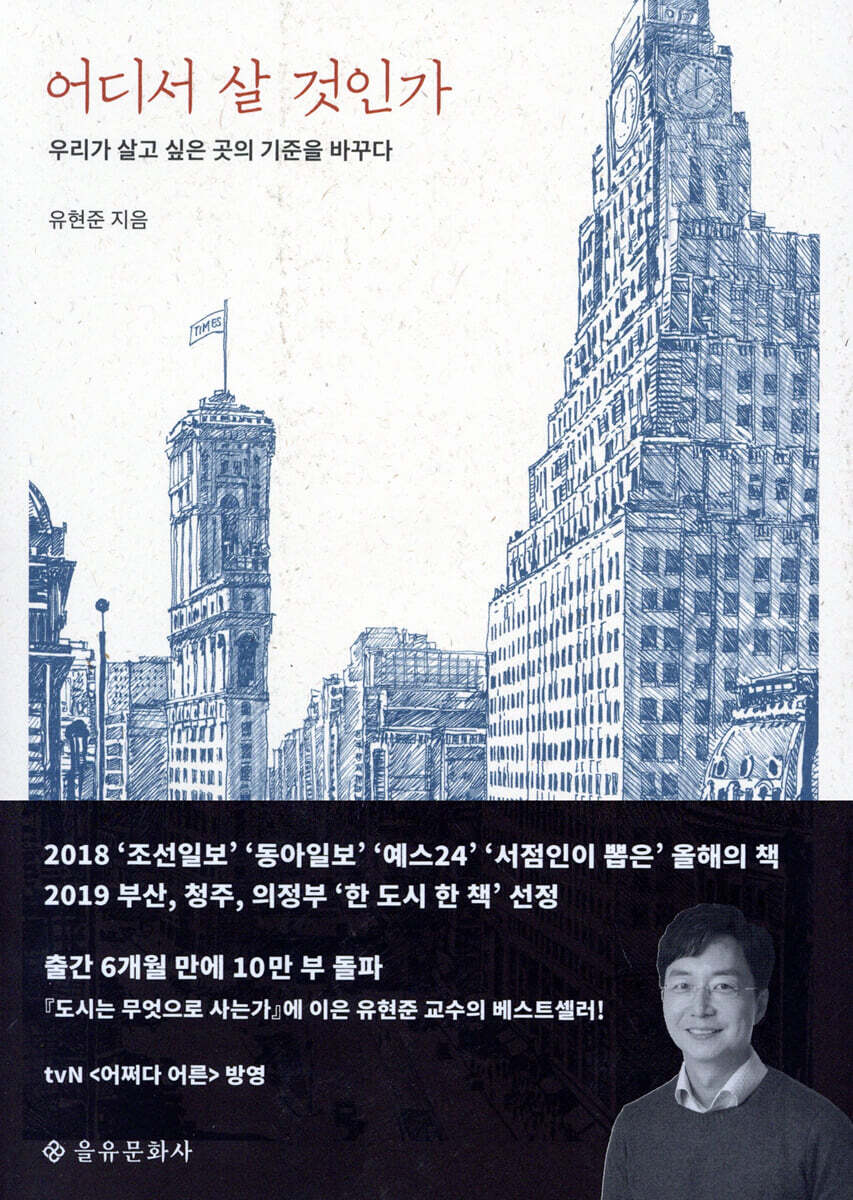
Can we really be happy in this city? A new book by Professor Hyun-Jun Yoo, the author of "What Makes Cities Live" and architect of [All-Round 2] Architect Hyun-Jun Yoo, who presented a new perspective on cities and space in his previous work, "What Makes a City Live?" and told stories about architecture in an easy and fun way in [All-Round 2], has published a new work titled "Concerns We Might Have Every Day." “Where should I live?” In these days when owning a home is becoming a distant dream for most people, the question, “Where should I live?” may be a daunting one. However, “Where to Live” is not a book that talks about which neighborhood, which apartment, or what size to move to. In his previous work, “What Makes Cities Live?”, the author asked the question “why” about cities and ourselves. In this book, he asks the questions “where” and “how” and talks about the city we will create in the future. The word 'where' in this book contains the meaning of the question, 'What kind of space makes us happy?' What matters is not what brand of apartment it is, but what kind of space enriches our lives. Just as when we choose a car, we should consider who we will be riding with and where we will be going more than the exterior design or brand, the same goes for where we live. This book talks about the transformation of cities into places where we can meet face-to-face, communicate, and share our unique colors, and where cities align with the direction we desire for our lives. Change is of course difficult and takes time, but let's create our own place to live. |
- You can preview some of the book's contents.
Preview
index
Opening Remarks | A Society Where Diverse Thoughts Are Extinct
Chapter 1: No Eagles in the Chicken Farm
School architecture is a prison | The school bell rings | Knowledge comes from books, wisdom comes from nature | Soccer and studying | Schools like Smurf Village | Low buildings, high ceilings | Unchanging school architecture | New school architecture is the future
Chapter 2: The Dining Table, the Building, and Radio Star
Jobs' Garage | A Space for Nurturing Genius | What Kind of Office Building Is Ideal | High-Rise Office Building | Dining Room Office Building | Horizontal Office Building | Pros and Cons of Apple's Headquarters | Radio Star Architecture | Ambiguity of Boundaries | Zeitgeist and Architectural Space
Chapter 3: Why Hip Hop Singers Wear Hoodies
Rat Tales | A City of Single-Person Households | Why New Yorkers Can Live in Tiny Houses | The Law of Gravity and Park Street | Should I Take the Elevator When I'm Depressed? | Creating a Pedestrian-Friendly Seoul | Public and Private Life in the City | Motel Rooms | Why Hip-Hop Singers Wear Hoodies | Bathroom Remodeling | Middle School Students and Convenience Stores | Staircases on the Veranda | Single-Person Households and Short-Term Rental Housing
Chapter 4: Why Are There Multiplex Theaters in Shopping Malls?
Cities and Anonymity | Commercial Buildings as Public Enemies | Why Multiplex Theaters Are in Shopping Malls | A City Like a Dadohae | The City Transformed by Baedal Minjok | From Points to Lines | The Evolution of Hot Places and Smartphones | Alleyways as People-Centered Spaces | Transportation and the Size of the Road Network | Changing Landscapes and the Pleasure of Walking | Alleyways Are Tidal Flats | Let Go of Your Naive Thoughts
Chapter 5: Addition and Subtraction: The Mysterious Equations of Architecture
How Architecture Survives | The Struggle of Evolution | The Resurgent Building Materials | A New Architecture Created by Constraints | Architectural Dialogue | Jazz and Remodeling
Chapter 6: Who Would Win in a Fight Between the Pharaoh and the First Emperor of Qin?
Why did Rome last for over a thousand years, but the Mongol Empire fall in just 150? | Why were dolmens built? |
Roman Bricks and Beyond | Moai Statues and the Burj Khalifa | Expensive and Expensive | Pyramids and the Atomic Bomb | Potential Energy of Power | Potential Energy and Stock Market Capitalization | Hairstyles and Power |
Chapter 7: Why Modern People Use Social Media So Much
Architecture vs. Letters | Commercial Churches Are Silicon Valley's Garage Startups | Coeducational Churches | Why Do Those on the Stage Have Authority? | The Theater That Created Greek Democracy | Why Political Rallies Are Held in Gwanghwamun Square | Power Comes from Symmetry | Why Modern People Use Social Media So Much | Why We Call People Tall | The Stairs That Create Power | Why We Don't Have Empires | The Stairs That Killed Elevators
Chapter 8: A City Created by Crisis and Invention
The Millionaires Who Built the Modern City | Carnegie and Otis, the Fathers of Skyscrapers | The Age of Electricity | From Kerosene to Gasoline | The Shipbuilding Slump and Architecture | From Caves to Apartments | Why the Sumerians Created the First Civilization | The Ice Age and the City | Climate, Building Materials, and Architectural Styles | The Story of Glass | Windows and Paper | Window Taxes and the Rise of Shop Windows |
The future of glass windows
Chapter 9: The Face of Seoul
The Three-Lane Rule | Botox City | Joseon vs. South Korea | Why Chelsea Redevelopment Is Easy | Samseong-dong Times Square | Galaxy and Seoul Station Skypark | Please Take Care of My Refrigerator
Chapter 10: How to Make Our City Better
Seoul Forest Bridge | Let's Remove the Park Wall | Hide-and-Seek Park | Village Library | Development Dreaming of Gangnam | Message from [Black Panther]
Chapter 11: Pokémon Go and the Future of Cities
Boiler Big Bang | Internet Big Bang | Travel vs. Comics | From Matter to Information | Creation by Amplification of Relationships | Primitive Methods of Networking: Language | WWW | Empty Roads and Parking Lots | Underground Farms and Road Development | New Elevators | Pokémon Go and the Boundaries of Space | Sharing Economy = (Socialism × IT) ÷ Capitalism | Completion of the Central Nervous System | Yoo Si-min and Jeong Jae-seung
Chapter 12: The Discovery of Space
Wall | Window | Column | Roof | Road | Bridge | Stepping Stone | Under the Bridge, Eternal Space
Conclusion
main
Image source
Chapter 1: No Eagles in the Chicken Farm
School architecture is a prison | The school bell rings | Knowledge comes from books, wisdom comes from nature | Soccer and studying | Schools like Smurf Village | Low buildings, high ceilings | Unchanging school architecture | New school architecture is the future
Chapter 2: The Dining Table, the Building, and Radio Star
Jobs' Garage | A Space for Nurturing Genius | What Kind of Office Building Is Ideal | High-Rise Office Building | Dining Room Office Building | Horizontal Office Building | Pros and Cons of Apple's Headquarters | Radio Star Architecture | Ambiguity of Boundaries | Zeitgeist and Architectural Space
Chapter 3: Why Hip Hop Singers Wear Hoodies
Rat Tales | A City of Single-Person Households | Why New Yorkers Can Live in Tiny Houses | The Law of Gravity and Park Street | Should I Take the Elevator When I'm Depressed? | Creating a Pedestrian-Friendly Seoul | Public and Private Life in the City | Motel Rooms | Why Hip-Hop Singers Wear Hoodies | Bathroom Remodeling | Middle School Students and Convenience Stores | Staircases on the Veranda | Single-Person Households and Short-Term Rental Housing
Chapter 4: Why Are There Multiplex Theaters in Shopping Malls?
Cities and Anonymity | Commercial Buildings as Public Enemies | Why Multiplex Theaters Are in Shopping Malls | A City Like a Dadohae | The City Transformed by Baedal Minjok | From Points to Lines | The Evolution of Hot Places and Smartphones | Alleyways as People-Centered Spaces | Transportation and the Size of the Road Network | Changing Landscapes and the Pleasure of Walking | Alleyways Are Tidal Flats | Let Go of Your Naive Thoughts
Chapter 5: Addition and Subtraction: The Mysterious Equations of Architecture
How Architecture Survives | The Struggle of Evolution | The Resurgent Building Materials | A New Architecture Created by Constraints | Architectural Dialogue | Jazz and Remodeling
Chapter 6: Who Would Win in a Fight Between the Pharaoh and the First Emperor of Qin?
Why did Rome last for over a thousand years, but the Mongol Empire fall in just 150? | Why were dolmens built? |
Roman Bricks and Beyond | Moai Statues and the Burj Khalifa | Expensive and Expensive | Pyramids and the Atomic Bomb | Potential Energy of Power | Potential Energy and Stock Market Capitalization | Hairstyles and Power |
Chapter 7: Why Modern People Use Social Media So Much
Architecture vs. Letters | Commercial Churches Are Silicon Valley's Garage Startups | Coeducational Churches | Why Do Those on the Stage Have Authority? | The Theater That Created Greek Democracy | Why Political Rallies Are Held in Gwanghwamun Square | Power Comes from Symmetry | Why Modern People Use Social Media So Much | Why We Call People Tall | The Stairs That Create Power | Why We Don't Have Empires | The Stairs That Killed Elevators
Chapter 8: A City Created by Crisis and Invention
The Millionaires Who Built the Modern City | Carnegie and Otis, the Fathers of Skyscrapers | The Age of Electricity | From Kerosene to Gasoline | The Shipbuilding Slump and Architecture | From Caves to Apartments | Why the Sumerians Created the First Civilization | The Ice Age and the City | Climate, Building Materials, and Architectural Styles | The Story of Glass | Windows and Paper | Window Taxes and the Rise of Shop Windows |
The future of glass windows
Chapter 9: The Face of Seoul
The Three-Lane Rule | Botox City | Joseon vs. South Korea | Why Chelsea Redevelopment Is Easy | Samseong-dong Times Square | Galaxy and Seoul Station Skypark | Please Take Care of My Refrigerator
Chapter 10: How to Make Our City Better
Seoul Forest Bridge | Let's Remove the Park Wall | Hide-and-Seek Park | Village Library | Development Dreaming of Gangnam | Message from [Black Panther]
Chapter 11: Pokémon Go and the Future of Cities
Boiler Big Bang | Internet Big Bang | Travel vs. Comics | From Matter to Information | Creation by Amplification of Relationships | Primitive Methods of Networking: Language | WWW | Empty Roads and Parking Lots | Underground Farms and Road Development | New Elevators | Pokémon Go and the Boundaries of Space | Sharing Economy = (Socialism × IT) ÷ Capitalism | Completion of the Central Nervous System | Yoo Si-min and Jeong Jae-seung
Chapter 12: The Discovery of Space
Wall | Window | Column | Roof | Road | Bridge | Stepping Stone | Under the Bridge, Eternal Space
Conclusion
main
Image source
Detailed image
Into the book
Our school buildings are usually about 580 times the size of a person's body.
Buildings like this are so big that it's hard for our children to get attached to them.
This building feels like a kind of 'facility'.
Most children, who are in the period of personality formation, are staying in these facilities.
--- p.41
Single-person housing is becoming an inevitable trend for various socioeconomic reasons.
In this environment, if we want to live a happier life without compromising our quality of life, we need to be able to enjoy the entire city as if it were our own home.
The architectural answer could be a more pedestrian-centric network and a greater number of densely distributed, attractive 'free' spaces.
--- p.96
Architectural remodeling is like jazz.
Remodeling is when a current architect continues to work on a building designed decades ago by an unknown architect.
It is difficult to develop completely different notes because there is a basic melody that has been developed by someone before.
But that doesn't mean we should blindly follow the past.
You have to express your individuality within constraints.
(…) Remodeling is a time-slip drama unfolding between architects of the past and present, a duet between two architects.
--- p.159~160
When we were growing and developing, we built bridges.
Seoul expanded into Gangnam, and a total of 31 bridges were built on the Han River in the metropolitan area.
All of this construction was done during a period when we experienced one of the fastest and most dazzling economic growth rates in the world.
A bridge is an architectural element that connects divided spaces in architecture.
Building a bridge is a declaration of intent to communicate with one's neighbors.
But unfortunately, we are building more walls than bridges these days.
The famous Turkic general Tonyukuk said, “Those who build walls will perish, and those who build roads will prosper.”
The story is that those who communicate will develop and grow.
When you walk around a large apartment complex that is being rebuilt, the wall surrounding the complex is the most striking feature.
It seems like I'm seeing the 'sex' that Tonyukuk is talking about.
In fact, there are apartment brand names that include the word 'castle'.
Building walls and castles like these blocks communication, which in turn sows the seeds of conflict.
We need to make our cities more communicative.
When neighborhoods are connected by walkable streets, boundaries between regions will become blurred and gaps will narrow.
I hope that by increasing communication and exploring the individuality of each region, we can reduce regional disparities and relative deprivation, and establish the idea of "our city."
Buildings like this are so big that it's hard for our children to get attached to them.
This building feels like a kind of 'facility'.
Most children, who are in the period of personality formation, are staying in these facilities.
--- p.41
Single-person housing is becoming an inevitable trend for various socioeconomic reasons.
In this environment, if we want to live a happier life without compromising our quality of life, we need to be able to enjoy the entire city as if it were our own home.
The architectural answer could be a more pedestrian-centric network and a greater number of densely distributed, attractive 'free' spaces.
--- p.96
Architectural remodeling is like jazz.
Remodeling is when a current architect continues to work on a building designed decades ago by an unknown architect.
It is difficult to develop completely different notes because there is a basic melody that has been developed by someone before.
But that doesn't mean we should blindly follow the past.
You have to express your individuality within constraints.
(…) Remodeling is a time-slip drama unfolding between architects of the past and present, a duet between two architects.
--- p.159~160
When we were growing and developing, we built bridges.
Seoul expanded into Gangnam, and a total of 31 bridges were built on the Han River in the metropolitan area.
All of this construction was done during a period when we experienced one of the fastest and most dazzling economic growth rates in the world.
A bridge is an architectural element that connects divided spaces in architecture.
Building a bridge is a declaration of intent to communicate with one's neighbors.
But unfortunately, we are building more walls than bridges these days.
The famous Turkic general Tonyukuk said, “Those who build walls will perish, and those who build roads will prosper.”
The story is that those who communicate will develop and grow.
When you walk around a large apartment complex that is being rebuilt, the wall surrounding the complex is the most striking feature.
It seems like I'm seeing the 'sex' that Tonyukuk is talking about.
In fact, there are apartment brand names that include the word 'castle'.
Building walls and castles like these blocks communication, which in turn sows the seeds of conflict.
We need to make our cities more communicative.
When neighborhoods are connected by walkable streets, boundaries between regions will become blurred and gaps will narrow.
I hope that by increasing communication and exploring the individuality of each region, we can reduce regional disparities and relative deprivation, and establish the idea of "our city."
--- p.297~298
Publisher's Review
How should we build the cities we live in?
A unique perspective and insight that encompasses our 'life', 'architecture', and 'cities'.
The insights of architect Hyunjun Yoo, presented in this book, resemble a free space.
As Yoo Hong-jun, author of “My Cultural Heritage Tour,” said, “In his stories, the past, present, and future coexist, and cutting-edge science and tradition are intertwined,” he travels across diverse time and space, keenly observing our own appearance.
As we read the story of Göbekli Tepe, the first example of ancient religious architecture, as the author led us, we suddenly find ourselves in a modern Korean city, then on a journey into cyberspace like social media, and in the blink of an eye, we find ourselves back in the alleyway in front of our house.
The topics covered in this book are also diverse.
Modern architecture that shows characteristics of having no center and ambiguous boundaries like [Radio Star] where multiple MCs talk nonstop; the 'table-top office building', a building type that enables active communication among colleagues as if sitting around a table eating and talking together; the reason why there is always a multiplex theater in large shopping malls; how hip-hop singers wearing hoodies are connected to the thirst for private space; is it really possible to protect alleyways, which are people-centered spaces, in a city where large-scale construction and high-rise buildings are the trend; and even stories about spaces under bridges where you can escape the breathless city and lose yourself in thought.
As we wander through the book's nooks and crannies, as if exploring a building, we will naturally return to questions about ourselves.
“What kind of place do I really want to live in?” This book may change or solidify your standards, but it is a book that forces you to ask yourself this question.
“Architecture reflects our appearance.”
Society Created by Architecture, Architecture Created by Society
There are many factors that influence our lives, but this book speaks primarily about architectural space.
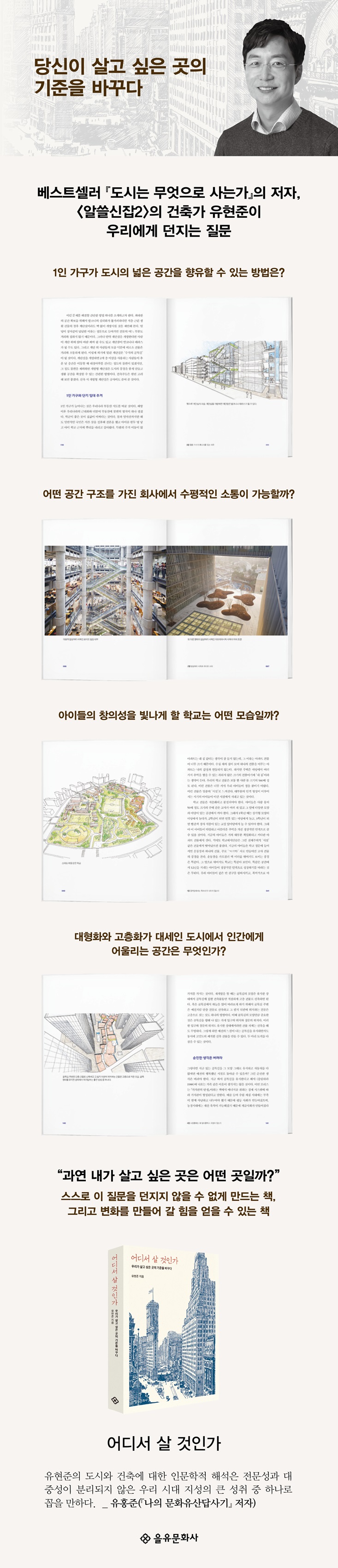
The theme that opens this book is none other than the story of the school where children live for 12 years (Chapter 1).
Our school's architecture, which has maintained the same box-shaped four- or five-story buildings and large playground for decades, is too uniform and large for children in their formative years to live in.
In Korea, the only representative buildings with this structure are prisons and schools.
Both are comprised of a 4-5 story building and a fence surrounding a single playground.
Aside from the window size, it is difficult to find any differences in the spatial configuration.
Just as eagles cannot emerge from a chicken farm, asking children who have been raised for 12 years under a uniform education in a prison-like building to be creative is like raising them as chickens and asking them to fly like eagles.
Children who grew up in the same classrooms and classes of 3rd grade and 4th grade with different numbers in a large school building will feel comfortable in room 304 of a large apartment building.
Statistics show that the indoor space used per student has increased sevenfold over the past 40 years, yet students' quality of life has not improved.
This is because although the number of internal facilities such as special activity rooms, gymnasiums, cafeterias, auditoriums, and libraries has increased, opportunities to come into contact with nature have actually decreased.
The author suggests that school buildings should be divided into smaller sections so that children's diverse tastes and interests can shine without being lost, and that they should have small yards and outdoor spaces of various shapes in front of them where children can play in various ways.
If conditions are not right, we need to build terraces, ceilings of various shapes and heights, and classrooms of various shapes.
The saying, 'space makes the person', cannot help but resonate more deeply in school stories.
Because the children who grow up in school will shape our society.
From the ancient structures of Göbekli Tepe to the underground farms and road power plants of the future city,
From the alleyways of Ikseon-dong to the Burj Khalifa in Dubai,
The face of a city that weaves together freely across time and space
Who would win in a fight between the Pharaoh and the First Emperor of Qin? While we can't speculate on history, we can offer our own answer to this question from the perspective of architecture and space.
The Pharaohs and Qin Shi Huang built huge structures called 'pyramids' and 'Great Wall of China' to show off their power and survive.
If we convert the enormous weight that these buildings are emitting with their entire bodies into the formulas for kinetic energy and potential energy, the difference in strength between the two is revealed (Chapter 6).
We can see from this story that architecture does not explain everything, but it is an important indicator that reveals one aspect of humanity.
So why do modern people use social media so much? As evidenced by single-person households, modern people, living in increasingly cramped living spaces, connect with others through social media.
There is no more free space, and we end up staring at a smartphone the size of our palm.
And ordinary people who cannot build pyramids or the Great Wall of China gather power little by little by uploading their photos on social media and using other people's attention as a resource, just as those who are the center of attention have power.
In the extension of this story, we can also infer the influence that the Theater of Dionysus in Athens had on Greek democratic society.
The existence of a circular theater like this, where the audience could look down, meant that anyone in the country could stand on a stage where they could be the center of attention if they were an actor.
What this means is that any citizen can become the center of power.
While the existing powerful figures were in high places and received the focus of attention, in the Theater of Dionysus, where the audience was supposed to look down, the position was reversed.
It can be said that the Theater of Dionysus, which allowed ordinary citizens, not just kings or priests, to be the center of attention at any time and provided a spatial structure of equal power, completed Greek democratic society.
And we can use this spatial structure as a reference to create 21st-century amphitheaters (Chapter 7).
The architectural spaces we create will gradually change the way we live.
A unique perspective and insight that encompasses our 'life', 'architecture', and 'cities'.
The insights of architect Hyunjun Yoo, presented in this book, resemble a free space.
As Yoo Hong-jun, author of “My Cultural Heritage Tour,” said, “In his stories, the past, present, and future coexist, and cutting-edge science and tradition are intertwined,” he travels across diverse time and space, keenly observing our own appearance.
As we read the story of Göbekli Tepe, the first example of ancient religious architecture, as the author led us, we suddenly find ourselves in a modern Korean city, then on a journey into cyberspace like social media, and in the blink of an eye, we find ourselves back in the alleyway in front of our house.
The topics covered in this book are also diverse.
Modern architecture that shows characteristics of having no center and ambiguous boundaries like [Radio Star] where multiple MCs talk nonstop; the 'table-top office building', a building type that enables active communication among colleagues as if sitting around a table eating and talking together; the reason why there is always a multiplex theater in large shopping malls; how hip-hop singers wearing hoodies are connected to the thirst for private space; is it really possible to protect alleyways, which are people-centered spaces, in a city where large-scale construction and high-rise buildings are the trend; and even stories about spaces under bridges where you can escape the breathless city and lose yourself in thought.
As we wander through the book's nooks and crannies, as if exploring a building, we will naturally return to questions about ourselves.
“What kind of place do I really want to live in?” This book may change or solidify your standards, but it is a book that forces you to ask yourself this question.
“Architecture reflects our appearance.”
Society Created by Architecture, Architecture Created by Society
There are many factors that influence our lives, but this book speaks primarily about architectural space.
The theme that opens this book is none other than the story of the school where children live for 12 years (Chapter 1).
Our school's architecture, which has maintained the same box-shaped four- or five-story buildings and large playground for decades, is too uniform and large for children in their formative years to live in.
In Korea, the only representative buildings with this structure are prisons and schools.
Both are comprised of a 4-5 story building and a fence surrounding a single playground.
Aside from the window size, it is difficult to find any differences in the spatial configuration.
Just as eagles cannot emerge from a chicken farm, asking children who have been raised for 12 years under a uniform education in a prison-like building to be creative is like raising them as chickens and asking them to fly like eagles.
Children who grew up in the same classrooms and classes of 3rd grade and 4th grade with different numbers in a large school building will feel comfortable in room 304 of a large apartment building.
Statistics show that the indoor space used per student has increased sevenfold over the past 40 years, yet students' quality of life has not improved.
This is because although the number of internal facilities such as special activity rooms, gymnasiums, cafeterias, auditoriums, and libraries has increased, opportunities to come into contact with nature have actually decreased.
The author suggests that school buildings should be divided into smaller sections so that children's diverse tastes and interests can shine without being lost, and that they should have small yards and outdoor spaces of various shapes in front of them where children can play in various ways.
If conditions are not right, we need to build terraces, ceilings of various shapes and heights, and classrooms of various shapes.
The saying, 'space makes the person', cannot help but resonate more deeply in school stories.
Because the children who grow up in school will shape our society.
From the ancient structures of Göbekli Tepe to the underground farms and road power plants of the future city,
From the alleyways of Ikseon-dong to the Burj Khalifa in Dubai,
The face of a city that weaves together freely across time and space
Who would win in a fight between the Pharaoh and the First Emperor of Qin? While we can't speculate on history, we can offer our own answer to this question from the perspective of architecture and space.
The Pharaohs and Qin Shi Huang built huge structures called 'pyramids' and 'Great Wall of China' to show off their power and survive.
If we convert the enormous weight that these buildings are emitting with their entire bodies into the formulas for kinetic energy and potential energy, the difference in strength between the two is revealed (Chapter 6).
We can see from this story that architecture does not explain everything, but it is an important indicator that reveals one aspect of humanity.
So why do modern people use social media so much? As evidenced by single-person households, modern people, living in increasingly cramped living spaces, connect with others through social media.
There is no more free space, and we end up staring at a smartphone the size of our palm.
And ordinary people who cannot build pyramids or the Great Wall of China gather power little by little by uploading their photos on social media and using other people's attention as a resource, just as those who are the center of attention have power.
In the extension of this story, we can also infer the influence that the Theater of Dionysus in Athens had on Greek democratic society.
The existence of a circular theater like this, where the audience could look down, meant that anyone in the country could stand on a stage where they could be the center of attention if they were an actor.
What this means is that any citizen can become the center of power.
While the existing powerful figures were in high places and received the focus of attention, in the Theater of Dionysus, where the audience was supposed to look down, the position was reversed.
It can be said that the Theater of Dionysus, which allowed ordinary citizens, not just kings or priests, to be the center of attention at any time and provided a spatial structure of equal power, completed Greek democratic society.
And we can use this spatial structure as a reference to create 21st-century amphitheaters (Chapter 7).
The architectural spaces we create will gradually change the way we live.
GOODS SPECIFICS
- Date of issue: May 30, 2018
- Page count, weight, size: 380 pages | 540g | 152*210*30mm
- ISBN13: 9788932473802
- ISBN10: 8932473803
You may also like
카테고리
korean


korean

![GQ KOREA Mark (Monthly): December [2025]](http://librairie.coreenne.fr/cdn/shop/files/8ef265dbbfbf186523ed75ba7319009d.jpg?v=1765340328&width=3840)


