

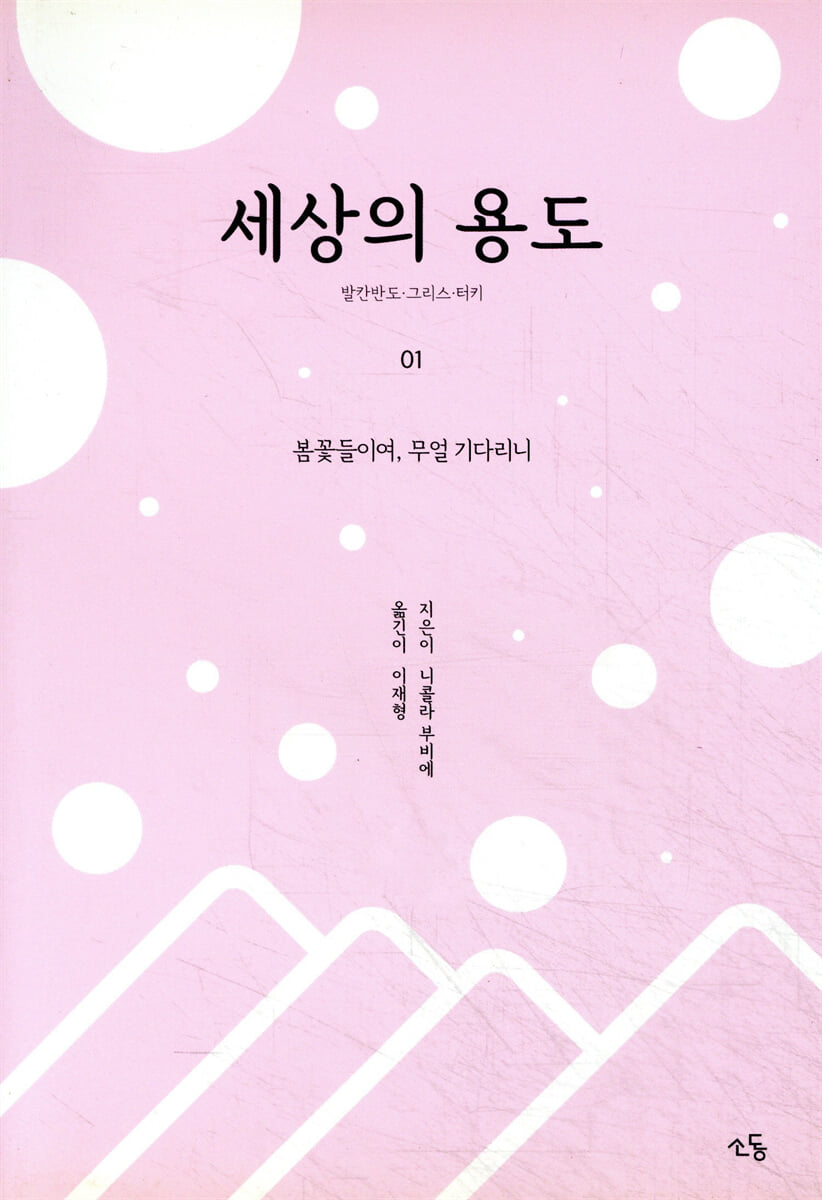
The World's Purposes 01 Balkan Peninsula Greece Turkey
 |
Description
Book Introduction
There are people for whom travel is their destiny.
Nicolas Bouvier did.
He was a writer, photographer, paleographer and poet, but he was always a traveler.
Travel was both a path that destroyed his life and a passage that connected him to the world.
He discovered a new side of himself through his travels, and this was recorded in his books.
The Use of the World is his first and best book.
This book, a travelogue from Europe to Asia and an excellent collection of prose, has a powerful appeal.
This book is the first in a series of three conveniently portable volumes of the original hardcover 『The World's Purpose』, and contains writings about the journey from the start of the trip through the Balkans, Greece, and Turkey to the Iranian border.
This book is a travelogue that encourages reflection on life and a collection of essays that achieves remarkable literary success. At the same time, it is also a valuable history book that tells the story of the cultures and customs of Yugoslavia, Iran, and Afghanistan, places that are not well known to domestic readers.
Although Bouvier is revered as a master of travel literature in the West, this is the first time his representative work has been introduced to Korea.
Additionally, it introduces Swiss literature, which is rarely seen in Korea, and by looking at the region, which is still a conflict zone, from the perspective of the Swiss (a neutral country), it allows for an objective look at the influence of major powers such as the United States and the United Kingdom on the history of these regions.
Nicolas Bouvier did.
He was a writer, photographer, paleographer and poet, but he was always a traveler.
Travel was both a path that destroyed his life and a passage that connected him to the world.
He discovered a new side of himself through his travels, and this was recorded in his books.
The Use of the World is his first and best book.
This book, a travelogue from Europe to Asia and an excellent collection of prose, has a powerful appeal.
This book is the first in a series of three conveniently portable volumes of the original hardcover 『The World's Purpose』, and contains writings about the journey from the start of the trip through the Balkans, Greece, and Turkey to the Iranian border.
This book is a travelogue that encourages reflection on life and a collection of essays that achieves remarkable literary success. At the same time, it is also a valuable history book that tells the story of the cultures and customs of Yugoslavia, Iran, and Afghanistan, places that are not well known to domestic readers.
Although Bouvier is revered as a master of travel literature in the West, this is the first time his representative work has been introduced to Korea.
Additionally, it introduces Swiss literature, which is rarely seen in Korea, and by looking at the region, which is still a conflict zone, from the perspective of the Swiss (a neutral country), it allows for an objective look at the influence of major powers such as the United States and the United Kingdom on the history of these regions.
- You can preview some of the book's contents.
Preview
index
Volume 1
Spring flowers, what are you waiting for?
The journey of the West doesn't require motivation 9
First Story: The Balkan Peninsula
Idle in a new world
Is there anything more exciting than being lazy? 17
Second Story: The Road to Anatolia
This vast land, this strong smell,
As love becomes like that 119
Third Story: Iranian Border
No matter how much I chew the bread
There are moments when it doesn't go down and gets stuck in your throat. 169
The Purpose of the World Route Map 176
Translator's Note: 180 Life-Changing Books of Wonder
The Life of Nicolas Bouvier, Vol. 185, The Use of the World, Vol. 15
Spring flowers, what are you waiting for?
The journey of the West doesn't require motivation 9
First Story: The Balkan Peninsula
Idle in a new world
Is there anything more exciting than being lazy? 17
Second Story: The Road to Anatolia
This vast land, this strong smell,
As love becomes like that 119
Third Story: Iranian Border
No matter how much I chew the bread
There are moments when it doesn't go down and gets stuck in your throat. 169
The Purpose of the World Route Map 176
Translator's Note: 180 Life-Changing Books of Wonder
The Life of Nicolas Bouvier, Vol. 185, The Use of the World, Vol. 15
Into the book
"When I was between ten and thirteen, I used to lie on the carpet and look at a world map.
As time went by, the desire to travel naturally arose.
I dreamed of places like Banat, the Caspian Sea, Kashmir, and their music, the eyes I would encounter there, the thoughts that awaited me there… … .
We don't really know what to call this uncontrollable desire.
When something grows bigger and bigger and one day the anchor is released, it's not necessarily with confidence, but it's still about leaving for the time being."
"Travel doesn't require motivation.
Travel will soon prove to be enough in itself.
The traveler believes he is traveling, but soon the traveler makes the traveler and then the traveler unmakes the traveler."
"What could be more exciting than lazing around in a new world?"
"A Muslim farmer was sleeping and snoring on a long bench between baskets of onions.
There was a truck driver with a wrinkled face, a soldier fiddling with a toothpick while holding a glass in front of him, and an officer who jumped up and tried to strike up a conversation while lighting a cigarette.
And every night, at a table by the door, four young prostitutes would crunch watermelon seeds and listen to the passionate arpeggios of an accordionist strumming his new instrument.
On days when they had been working on the nearby embankment, their smooth, pretty, bronze knees would sometimes be slightly dusted with dirt, and their prominent cheekbones would pulse with blood.
They fell asleep in an instant, and when they did, they looked surprisingly young.
Their sides, covered in purple or green cotton, would rise as they occasionally breathed rhythmically.
Their rough and noisy manners, shivering, coughing in a hoarse, unpleasant sound, and then suddenly spitting into the sawdust, seemed rather beautiful."
"I will return here someday.
Even if it means riding a broomstick if necessary."
"A city is like a wound that can only be healed by the flow of blood and the stench of something bad, and that thick blood can heal any wound.
What this river has already given is more important than what it still lacks.
The reason I haven't been able to write well yet is because happiness has taken all my time."
"The day ends in silence.
We had a great chat over dinner.
The journey is carried by the sound of the engine and the passing scenery, penetrating your body and illuminating your mind.
Thoughts accepted without reason leave you.
Conversely, other thoughts are newly organized and settle in your heart like pebbles at the bottom of a river.
There is absolutely no need to intervene.
The road does the work for you.
I hope the road will do its job and extend all the way to the end of India, the final destination of this journey, or even further, to death."
"When I returned home, many people who had never been away told me that with a little imagination and focus, they could travel without leaving their chairs.
......
But I can't do that.
Specifically, you have to move around and move within the space.
Fortunately, the world is wide open and supports the weak.
As I did one night on the road to Macedonia, the world was made up of the moon floating on my left and the Morava River sparkling silver on my right, and as I planned to go beyond the horizon to find the village where I would live for the next three weeks, I felt a profound satisfaction in the fact that I could not live without such things.
“Travel gives you the opportunity to shake off your body and wake up refreshed.
But contrary to what people think, it doesn't give you freedom.
Rather, it only allows us to experience a kind of reduction.
A traveler, removed from his usual surroundings and stripped of his habits, finds himself reduced to a small, insignificant size, as if a wrapping had been peeled away.
But he becomes more curious and has a keener intuition, and he begins to place greater importance on first impressions."
"The ripe golden autumn that covered this city shook our hearts.
When you live a wandering life, you become sensitive to the seasons.
It depends on the season and becomes the season itself.
And every time the seasons change, I feel like I have to force myself away from the place where I learned to live."
"When I travel, there are times when fear surges up and no matter how much I chew the bread, it doesn't go down and gets stuck in my throat.
When you're terribly tired, alone after a long time, or in that moment of mad excitement and then despair, fear overtakes you as you turn back, like a cold shower.
Fear of the next month, of dogs roaming the town threatening anything that moves, of wanderers coming at you with pebbles, even of the horse you borrowed from your previous lodging, and of a violent and mean man who was hiding his true intentions."
"Time passes by like boiling tea, like rare words, like cigarettes.
Then, dawn breaks.
The increasingly bright light illuminates the feathers of the magpie and the sparrow… … .
Then I hastily bury this wondrous moment in the depths of my memory, ready to reclaim it someday.
As I stretch and take a few steps, the word 'happiness' feels too weak to describe what has happened to me.
Ultimately, what forms the basis of my existence is not my family, nor my work, nor what other people say or think about me.
Moments when I am uplifted by a transcendent power more serene than love form the backbone of my life.
Life hands out such moments sparingly.
Our weak hearts can no longer endure it."
As time went by, the desire to travel naturally arose.
I dreamed of places like Banat, the Caspian Sea, Kashmir, and their music, the eyes I would encounter there, the thoughts that awaited me there… … .
We don't really know what to call this uncontrollable desire.
When something grows bigger and bigger and one day the anchor is released, it's not necessarily with confidence, but it's still about leaving for the time being."
"Travel doesn't require motivation.
Travel will soon prove to be enough in itself.
The traveler believes he is traveling, but soon the traveler makes the traveler and then the traveler unmakes the traveler."
"What could be more exciting than lazing around in a new world?"
"A Muslim farmer was sleeping and snoring on a long bench between baskets of onions.
There was a truck driver with a wrinkled face, a soldier fiddling with a toothpick while holding a glass in front of him, and an officer who jumped up and tried to strike up a conversation while lighting a cigarette.
And every night, at a table by the door, four young prostitutes would crunch watermelon seeds and listen to the passionate arpeggios of an accordionist strumming his new instrument.
On days when they had been working on the nearby embankment, their smooth, pretty, bronze knees would sometimes be slightly dusted with dirt, and their prominent cheekbones would pulse with blood.
They fell asleep in an instant, and when they did, they looked surprisingly young.
Their sides, covered in purple or green cotton, would rise as they occasionally breathed rhythmically.
Their rough and noisy manners, shivering, coughing in a hoarse, unpleasant sound, and then suddenly spitting into the sawdust, seemed rather beautiful."
"I will return here someday.
Even if it means riding a broomstick if necessary."
"A city is like a wound that can only be healed by the flow of blood and the stench of something bad, and that thick blood can heal any wound.
What this river has already given is more important than what it still lacks.
The reason I haven't been able to write well yet is because happiness has taken all my time."
"The day ends in silence.
We had a great chat over dinner.
The journey is carried by the sound of the engine and the passing scenery, penetrating your body and illuminating your mind.
Thoughts accepted without reason leave you.
Conversely, other thoughts are newly organized and settle in your heart like pebbles at the bottom of a river.
There is absolutely no need to intervene.
The road does the work for you.
I hope the road will do its job and extend all the way to the end of India, the final destination of this journey, or even further, to death."
"When I returned home, many people who had never been away told me that with a little imagination and focus, they could travel without leaving their chairs.
......
But I can't do that.
Specifically, you have to move around and move within the space.
Fortunately, the world is wide open and supports the weak.
As I did one night on the road to Macedonia, the world was made up of the moon floating on my left and the Morava River sparkling silver on my right, and as I planned to go beyond the horizon to find the village where I would live for the next three weeks, I felt a profound satisfaction in the fact that I could not live without such things.
“Travel gives you the opportunity to shake off your body and wake up refreshed.
But contrary to what people think, it doesn't give you freedom.
Rather, it only allows us to experience a kind of reduction.
A traveler, removed from his usual surroundings and stripped of his habits, finds himself reduced to a small, insignificant size, as if a wrapping had been peeled away.
But he becomes more curious and has a keener intuition, and he begins to place greater importance on first impressions."
"The ripe golden autumn that covered this city shook our hearts.
When you live a wandering life, you become sensitive to the seasons.
It depends on the season and becomes the season itself.
And every time the seasons change, I feel like I have to force myself away from the place where I learned to live."
"When I travel, there are times when fear surges up and no matter how much I chew the bread, it doesn't go down and gets stuck in my throat.
When you're terribly tired, alone after a long time, or in that moment of mad excitement and then despair, fear overtakes you as you turn back, like a cold shower.
Fear of the next month, of dogs roaming the town threatening anything that moves, of wanderers coming at you with pebbles, even of the horse you borrowed from your previous lodging, and of a violent and mean man who was hiding his true intentions."
"Time passes by like boiling tea, like rare words, like cigarettes.
Then, dawn breaks.
The increasingly bright light illuminates the feathers of the magpie and the sparrow… … .
Then I hastily bury this wondrous moment in the depths of my memory, ready to reclaim it someday.
As I stretch and take a few steps, the word 'happiness' feels too weak to describe what has happened to me.
Ultimately, what forms the basis of my existence is not my family, nor my work, nor what other people say or think about me.
Moments when I am uplifted by a transcendent power more serene than love form the backbone of my life.
Life hands out such moments sparingly.
Our weak hearts can no longer endure it."
--- From the text
Publisher's Review
"We had enough money to live for nine weeks.
The amount of money was small, but time was abundant.
We have decided to reject all luxuries and enjoy only the most precious luxury of slowness." - Excerpt from the text
What kind of book is "The Use of the World"? A simple answer might be that it's the story of a journey that took two young Swiss men from Geneva to Yugoslavia, Turkey, Iran, Pakistan, and finally Kabul, Afghanistan, between 1953 and 1954.
One was a writer, the other a painter.
They traveled in a Fiat Topolino.
It may be accurate to say this, but it is incomplete.
Because, above all, 『The Use of the World』 is a ‘book of wisdom.’
Because it is a textbook on life that explains how to use the world.
It is also a 20th century version of the 'Book of Wonders'.
- From the translator's note
Travel books are overflowing.
However, there are not many books that give direction to life.
This book is a record of the journey of two young Swiss writers and painters, who set out from the former Yugoslavia to India and then traveled through Greece, Turkey, Iran, Pakistan, and finally Afghanistan.
They traveled not as passing observers, but with a settled mind.
In addition to the harsh climate, he was imprisoned in Iran due to the political situation and survived a near-death experience in a capsized accident in Afghanistan.
In Serbia, while searching for a gypsy village to record gypsy music, he encounters a fundamental (but very ordinary) scene of life in a tavern.
To make money, writers wrote and painters painted and exhibited their works.
In Pakistan, some people work in bars.
In it, Nicolas Bouvier's Gauguin-like writing emerged.
The book vividly portrays a warm perspective on humanity, born from profound life experiences, the life of a traveler, writing, and the question of how to live.
Nicolas Bouvier wrote The Use of the World after his travels and revised it several times, each time adding to his reading, artistic sensitivity, and intuition about the world.
In his writing, people, landscapes, and adventures are interwoven with humor, creating a beautiful mosaic of life.
There are people for whom travel is their destiny.
Nicolas Bouvier did.
He was a writer, photographer, paleographer and poet, but he was always a traveler.
Travel was both a path that destroyed his life and a passage that connected him to the world.
He discovered a new self through his travels, and this was recorded in his books. "The Use of the World" is his first and best book.
This book, a travelogue from Europe to Asia and an excellent collection of prose, has a powerful appeal.
This book is the first in a series of three conveniently-portable volumes of the original hardcover 『The World's Purpose』, and contains writings about the journey from the start of the trip through the Balkans, Greece, and Turkey to the Iranian border.
Thirty years after the publication of "The Use of the World," the book has become a classic of travel literature, and Bouvier was honored as a master by an entire generation of writers at the 1991 Saint-Malo Book Fair (the theme of which was "Travel").
The amount of money was small, but time was abundant.
We have decided to reject all luxuries and enjoy only the most precious luxury of slowness." - Excerpt from the text
What kind of book is "The Use of the World"? A simple answer might be that it's the story of a journey that took two young Swiss men from Geneva to Yugoslavia, Turkey, Iran, Pakistan, and finally Kabul, Afghanistan, between 1953 and 1954.
One was a writer, the other a painter.
They traveled in a Fiat Topolino.
It may be accurate to say this, but it is incomplete.
Because, above all, 『The Use of the World』 is a ‘book of wisdom.’
Because it is a textbook on life that explains how to use the world.
It is also a 20th century version of the 'Book of Wonders'.
- From the translator's note
Travel books are overflowing.
However, there are not many books that give direction to life.
This book is a record of the journey of two young Swiss writers and painters, who set out from the former Yugoslavia to India and then traveled through Greece, Turkey, Iran, Pakistan, and finally Afghanistan.
They traveled not as passing observers, but with a settled mind.
In addition to the harsh climate, he was imprisoned in Iran due to the political situation and survived a near-death experience in a capsized accident in Afghanistan.
In Serbia, while searching for a gypsy village to record gypsy music, he encounters a fundamental (but very ordinary) scene of life in a tavern.
To make money, writers wrote and painters painted and exhibited their works.
In Pakistan, some people work in bars.
In it, Nicolas Bouvier's Gauguin-like writing emerged.
The book vividly portrays a warm perspective on humanity, born from profound life experiences, the life of a traveler, writing, and the question of how to live.
Nicolas Bouvier wrote The Use of the World after his travels and revised it several times, each time adding to his reading, artistic sensitivity, and intuition about the world.
In his writing, people, landscapes, and adventures are interwoven with humor, creating a beautiful mosaic of life.
There are people for whom travel is their destiny.
Nicolas Bouvier did.
He was a writer, photographer, paleographer and poet, but he was always a traveler.
Travel was both a path that destroyed his life and a passage that connected him to the world.
He discovered a new self through his travels, and this was recorded in his books. "The Use of the World" is his first and best book.
This book, a travelogue from Europe to Asia and an excellent collection of prose, has a powerful appeal.
This book is the first in a series of three conveniently-portable volumes of the original hardcover 『The World's Purpose』, and contains writings about the journey from the start of the trip through the Balkans, Greece, and Turkey to the Iranian border.
Thirty years after the publication of "The Use of the World," the book has become a classic of travel literature, and Bouvier was honored as a master by an entire generation of writers at the 1991 Saint-Malo Book Fair (the theme of which was "Travel").
GOODS SPECIFICS
- Date of issue: June 30, 2018
- Page count, weight, size: 190 pages | 128*188*25mm
- ISBN13: 9788994750255
- ISBN10: 8994750258
You may also like
카테고리
korean


korean

![GQ KOREA Mark (Monthly): December [2025]](http://librairie.coreenne.fr/cdn/shop/files/8ef265dbbfbf186523ed75ba7319009d.jpg?v=1765340328&width=3840)


