

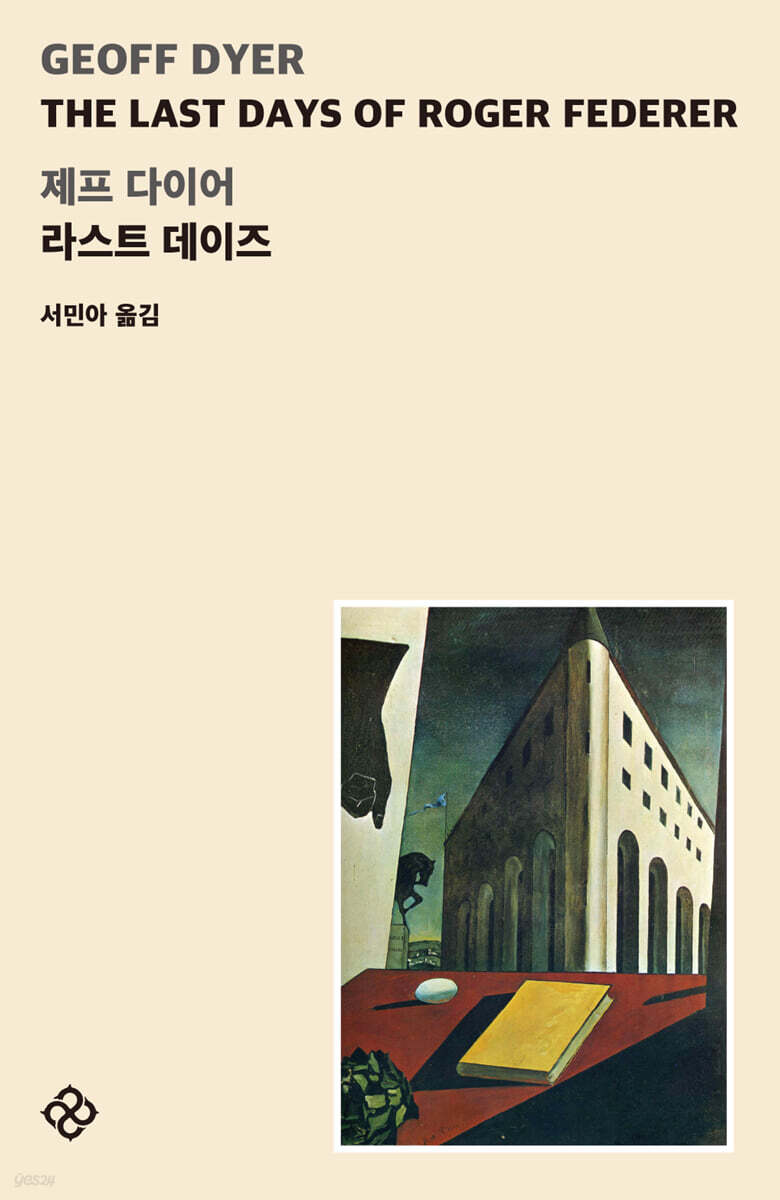
Last Days
 |
Description
Book Introduction
Written in Jeff Dyer's own style
On the Style of Later Life
Geoff Dyer, who considers himself to be in the final years of his life, or at least as a writer, writes this book by focusing on the achievements of geniuses at the end of their careers.
What immediately stands out here is one of Dyer's unique talents: his extensive knowledge.
A wide range of music is presented, from Beethoven and Bob Dylan to ambient and jazz, while paintings and photographs feature works by William Turner, Giorgio de Chirico, and Edward Weston.
Needless to say, in Dyer's specialty, literature, numerous authors are listed.
But 『Last Days』 doesn't just introduce these numerous characters and anecdotes; it organizes them into a common flow.
The exterior of that flow is made up of the weariness and loneliness of Dyer's own life, a life that is fading away.
For example, perhaps no other writer could so sentimentally describe the last years of Friedrich Nietzsche as Michelle Schneider, author of Glenn Gould: Piano Solo.
'Nietzsche was lying in a room on the second floor of this house, and visitors would hear howls coming from the upper floor.
The screams sounded like an expression of mental pain, but in reality they had no meaning beyond the biological fact that they make sounds because they are alive.
The scream contained no painful memories, no vanished insights, not even the remains of a shattered mind.
(...) In August 1888, Nietzsche wrote a long letter with the postscript, “Some people are born after death,” but the last decade of his life raised the chilling possibility that life after death can begin even while one is still conceptually alive.
And he was preparing for that kind of life in advance.
He wrote:
“There is a great price to pay for immortality.
“You have to die many times while you are alive.” - From page 101 of the text
But Dyer also testifies to the special energies that only these dying flames possess.
As he quotes, moments arise where “matter is exchanged for light.”
This mysterious creative power, which appears only when the sun is fading away like the green light of dusk, colors 『Last Days』 with various colors.
The mysterious allure of Bob Dylan, who continued his musical career with a voice that was as lost as it was in his youth; the masterpieces of William Turner in his later years, who was unsure whether his work was complete or incomplete; the moving movements of tennis star Roger Federer, who played mediocre matches despite repeated injuries.
However, this 'late-life style' is a characteristic separate from physical aging.
Dyer also introduces people who, from a young age, had already seen the end of their careers.
Jack Kerouac, Philip Larkin, Björn Borg… … .
These 'retirements' are little deaths in that they leave behind the achievements they have achieved.
'Even while we are still conceptually alive, life after death has already begun.'
On the Style of Later Life
Geoff Dyer, who considers himself to be in the final years of his life, or at least as a writer, writes this book by focusing on the achievements of geniuses at the end of their careers.
What immediately stands out here is one of Dyer's unique talents: his extensive knowledge.
A wide range of music is presented, from Beethoven and Bob Dylan to ambient and jazz, while paintings and photographs feature works by William Turner, Giorgio de Chirico, and Edward Weston.
Needless to say, in Dyer's specialty, literature, numerous authors are listed.
But 『Last Days』 doesn't just introduce these numerous characters and anecdotes; it organizes them into a common flow.
The exterior of that flow is made up of the weariness and loneliness of Dyer's own life, a life that is fading away.
For example, perhaps no other writer could so sentimentally describe the last years of Friedrich Nietzsche as Michelle Schneider, author of Glenn Gould: Piano Solo.
'Nietzsche was lying in a room on the second floor of this house, and visitors would hear howls coming from the upper floor.
The screams sounded like an expression of mental pain, but in reality they had no meaning beyond the biological fact that they make sounds because they are alive.
The scream contained no painful memories, no vanished insights, not even the remains of a shattered mind.
(...) In August 1888, Nietzsche wrote a long letter with the postscript, “Some people are born after death,” but the last decade of his life raised the chilling possibility that life after death can begin even while one is still conceptually alive.
And he was preparing for that kind of life in advance.
He wrote:
“There is a great price to pay for immortality.
“You have to die many times while you are alive.” - From page 101 of the text
But Dyer also testifies to the special energies that only these dying flames possess.
As he quotes, moments arise where “matter is exchanged for light.”
This mysterious creative power, which appears only when the sun is fading away like the green light of dusk, colors 『Last Days』 with various colors.
The mysterious allure of Bob Dylan, who continued his musical career with a voice that was as lost as it was in his youth; the masterpieces of William Turner in his later years, who was unsure whether his work was complete or incomplete; the moving movements of tennis star Roger Federer, who played mediocre matches despite repeated injuries.
However, this 'late-life style' is a characteristic separate from physical aging.
Dyer also introduces people who, from a young age, had already seen the end of their careers.
Jack Kerouac, Philip Larkin, Björn Borg… … .
These 'retirements' are little deaths in that they leave behind the achievements they have achieved.
'Even while we are still conceptually alive, life after death has already begun.'
- You can preview some of the book's contents.
Preview
Detailed image
Into the book
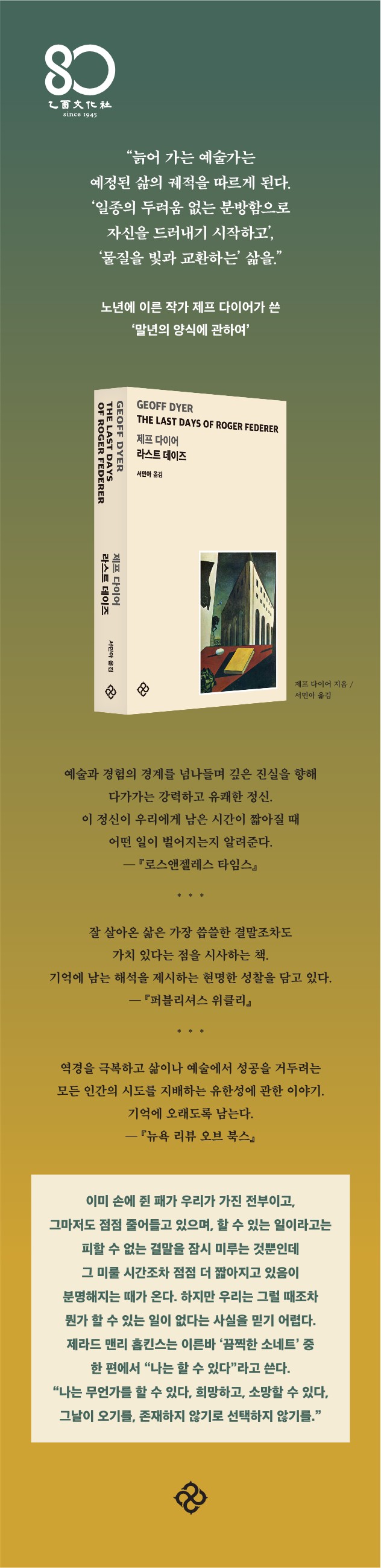
We too try our best and try everything we can, but at some point, no matter how hard we try, we run out of options.
Life is coming to an end, or as Al Pacino said in the movie "The Insider," there is "no other way to go."
There comes a time when it becomes clear that the cards we already hold are all we have, and that even those are dwindling, and that all we can do is postpone the inevitable, and even that postponement time is getting shorter.
But even then, we find it hard to believe that there is nothing we can do.
“I can,” writes Gerard Manley Hopkins in one of his so-called “terrible sonnets.”
“I can do something, I can hope, I can wish, that day will come, that I will not choose not to exist.”
--- p.53
He (D.
Aldous Huxley, a friend of H. Lawrence, wrote:
“For the past 20 years he has been like a flame that has miraculously continued to burn, ignoring the fact that there is no longer any fuel to justify his existence.” This is true, but it was his own life that fueled the fire that was Lawrence.
--- p.59
In the case of Czesław Miłosz, he speaks to the reader from a high position, as if he himself lived there.
That doesn't mean he's particularly narcissistic.
Rather, it is closer to the arrogant attitude characteristic of someone who has long been accustomed to being highly regarded.
You could say that it's well-deserved, since he's a Nobel Prize winner.
How could one not think so? (…) Of course, he does not say it in a boastful way, but his thoughts, reflections, and meditations (…) are unconsciously expressed in the so-called “Nobel Prize winner style”.
As the overbearing attitude becomes a habit, instead of making a cup of tea in the morning, you end up making Nobel tea and eating it with Nobel eggs and Nobel bacon.
--- p.145
While books always have the potential for change, even later, films are a medium that does not forgive failure.
Once you mess up the first few minutes, there's no chance of recovery.
Perhaps this characteristic of the film is one of the reasons why salvation is always an important plot or theme in the film.
--- p.170
In Enrique Villamatas's Bartleby and the Bartlebys, the young narrator publishes one short story and then does not write again for 25 years.
(Then) I begin an essay-like investigation into writers like Rimbaud and Robert Walser, who, for whatever reason, stopped writing.
(...) The list of non-works created as a result is not only vast in content but also problematic in its implications.
Because the question “Why don’t I write?” “inevitably leads to another, much more disturbing question: Why did I write in the first place?”
--- p.232
My father, who had never read a book in his life, hated Christianity fiercely, for much the same reason he was against monarchy and everything else: economic reasons.
For my father, the most powerful symbolic moment in a church service was not when he said something like "blood of my blood" (I have no clear idea what goes on in such places), but when he took the offering.
On the few occasions when we had to go to church, my father not only didn't pay a penny to save face, but he didn't even try to make it look like he did.
I asked my father how he had become so vehemently opposed to the church, and he explained that a friend he had in the military was an "antichrist."
If so, I will leave it in the record like this.
While Hitch (Christopher Hitchens) and Mart (Martin Amis) were having fun attacking priests, my father met the Antichrist.
--- p.255~256
Nothing is more important in Nietzsche's thought than the complete rejection of the possibility of salvation and liberation.
Paradoxically, his idea of eternal recurrence can best be understood as the opposite of endless repetition.
This ideology emphasizes that we live this one life over and over again without any variation, by completely excluding the possibility of parole, mitigation, or change.
In reality, this idea meant long years of wandering and almost complete solitude.
Chronic illness, frustrated hopes for love, and conflicts and discord with his family formed the foundation of his life.
--- p.362~363
According to Willem Duconing's biographers Mark Stevens and Annalyn Swann, the aging artist follows a predetermined life trajectory.
A life that “begins to reveal itself with a kind of fearless freedom” and “exchanges matter for light.”
Life is coming to an end, or as Al Pacino said in the movie "The Insider," there is "no other way to go."
There comes a time when it becomes clear that the cards we already hold are all we have, and that even those are dwindling, and that all we can do is postpone the inevitable, and even that postponement time is getting shorter.
But even then, we find it hard to believe that there is nothing we can do.
“I can,” writes Gerard Manley Hopkins in one of his so-called “terrible sonnets.”
“I can do something, I can hope, I can wish, that day will come, that I will not choose not to exist.”
--- p.53
He (D.
Aldous Huxley, a friend of H. Lawrence, wrote:
“For the past 20 years he has been like a flame that has miraculously continued to burn, ignoring the fact that there is no longer any fuel to justify his existence.” This is true, but it was his own life that fueled the fire that was Lawrence.
--- p.59
In the case of Czesław Miłosz, he speaks to the reader from a high position, as if he himself lived there.
That doesn't mean he's particularly narcissistic.
Rather, it is closer to the arrogant attitude characteristic of someone who has long been accustomed to being highly regarded.
You could say that it's well-deserved, since he's a Nobel Prize winner.
How could one not think so? (…) Of course, he does not say it in a boastful way, but his thoughts, reflections, and meditations (…) are unconsciously expressed in the so-called “Nobel Prize winner style”.
As the overbearing attitude becomes a habit, instead of making a cup of tea in the morning, you end up making Nobel tea and eating it with Nobel eggs and Nobel bacon.
--- p.145
While books always have the potential for change, even later, films are a medium that does not forgive failure.
Once you mess up the first few minutes, there's no chance of recovery.
Perhaps this characteristic of the film is one of the reasons why salvation is always an important plot or theme in the film.
--- p.170
In Enrique Villamatas's Bartleby and the Bartlebys, the young narrator publishes one short story and then does not write again for 25 years.
(Then) I begin an essay-like investigation into writers like Rimbaud and Robert Walser, who, for whatever reason, stopped writing.
(...) The list of non-works created as a result is not only vast in content but also problematic in its implications.
Because the question “Why don’t I write?” “inevitably leads to another, much more disturbing question: Why did I write in the first place?”
--- p.232
My father, who had never read a book in his life, hated Christianity fiercely, for much the same reason he was against monarchy and everything else: economic reasons.
For my father, the most powerful symbolic moment in a church service was not when he said something like "blood of my blood" (I have no clear idea what goes on in such places), but when he took the offering.
On the few occasions when we had to go to church, my father not only didn't pay a penny to save face, but he didn't even try to make it look like he did.
I asked my father how he had become so vehemently opposed to the church, and he explained that a friend he had in the military was an "antichrist."
If so, I will leave it in the record like this.
While Hitch (Christopher Hitchens) and Mart (Martin Amis) were having fun attacking priests, my father met the Antichrist.
--- p.255~256
Nothing is more important in Nietzsche's thought than the complete rejection of the possibility of salvation and liberation.
Paradoxically, his idea of eternal recurrence can best be understood as the opposite of endless repetition.
This ideology emphasizes that we live this one life over and over again without any variation, by completely excluding the possibility of parole, mitigation, or change.
In reality, this idea meant long years of wandering and almost complete solitude.
Chronic illness, frustrated hopes for love, and conflicts and discord with his family formed the foundation of his life.
--- p.362~363
According to Willem Duconing's biographers Mark Stevens and Annalyn Swann, the aging artist follows a predetermined life trajectory.
A life that “begins to reveal itself with a kind of fearless freedom” and “exchanges matter for light.”
--- p.376
Publisher's Review
Recommendation
A powerful and joyful spirit that crosses the boundaries between art and experience, reaching out toward profound truth.
This spirit tells us what happens when our time is short.
-The Los Angeles Times
A book that suggests that a life well lived is worth even the most bitter ending.
It contains wise reflections that offer memorable interpretations.
-Publisher's Weekly
A story about the finitude that governs all human attempts to overcome adversity and achieve success in life or art.
It will remain in your memory for a long time.
-The New York Review of Books
Only through the time of extinction and separation
The richness of life that can be realized
Therefore, the 'life in later years' that Dyer speaks of can be said to differ from common sense in two ways.
Regret and aging are something that everyone experiences, but no one knows when it will happen.
And that there is a beauty that can only be achieved through aging.
At this point, Last Days overlaps with Dyer's own confession about his impending retirement as a writer.
A tennis fanatic, he is increasingly unable to play due to various joint and muscle problems, and it is becoming increasingly difficult for him to go to concerts or festivals.
The books I had to read when I was young are now meaningless even if I hold them in my hands (The Brothers Karamazov), and people's reactions to the same jokes become more cynical than when I was young.
Needless to say, writing books is becoming increasingly difficult.
Will a green ray shine upon this life? Or has that light long since passed, and what lies ahead is only twilight? Like all humans, Dyer, unsure of which path his future will take, seals the mystery within his aging body.
The secret will be revealed in due time.
Instead of forcing open the box containing the mystery of the future, that is, his own body, he quietly accepts it, and at that moment, his knowledge and life become one.
Could it be said that Dyer has achieved the loftiest goal of his "essay"? "Last Days," a living testimony to the harmony between knowledge and life, elevating each other to greater heights, will show us how enriching reading and contemplation can be.
A powerful and joyful spirit that crosses the boundaries between art and experience, reaching out toward profound truth.
This spirit tells us what happens when our time is short.
-The Los Angeles Times
A book that suggests that a life well lived is worth even the most bitter ending.
It contains wise reflections that offer memorable interpretations.
-Publisher's Weekly
A story about the finitude that governs all human attempts to overcome adversity and achieve success in life or art.
It will remain in your memory for a long time.
-The New York Review of Books
Only through the time of extinction and separation
The richness of life that can be realized
Therefore, the 'life in later years' that Dyer speaks of can be said to differ from common sense in two ways.
Regret and aging are something that everyone experiences, but no one knows when it will happen.
And that there is a beauty that can only be achieved through aging.
At this point, Last Days overlaps with Dyer's own confession about his impending retirement as a writer.
A tennis fanatic, he is increasingly unable to play due to various joint and muscle problems, and it is becoming increasingly difficult for him to go to concerts or festivals.
The books I had to read when I was young are now meaningless even if I hold them in my hands (The Brothers Karamazov), and people's reactions to the same jokes become more cynical than when I was young.
Needless to say, writing books is becoming increasingly difficult.
Will a green ray shine upon this life? Or has that light long since passed, and what lies ahead is only twilight? Like all humans, Dyer, unsure of which path his future will take, seals the mystery within his aging body.
The secret will be revealed in due time.
Instead of forcing open the box containing the mystery of the future, that is, his own body, he quietly accepts it, and at that moment, his knowledge and life become one.
Could it be said that Dyer has achieved the loftiest goal of his "essay"? "Last Days," a living testimony to the harmony between knowledge and life, elevating each other to greater heights, will show us how enriching reading and contemplation can be.
GOODS SPECIFICS
- Date of issue: June 25, 2025
- Page count, weight, size: 468 pages | 550g | 130*200*30mm
- ISBN13: 9788932475622
- ISBN10: 8932475628
You may also like
카테고리
korean


korean

![GQ KOREA Mark (Monthly): December [2025]](http://librairie.coreenne.fr/cdn/shop/files/8ef265dbbfbf186523ed75ba7319009d.jpg?v=1765340328&width=3840)


