

embrace
 |
Description
Book Introduction
- A word from MD
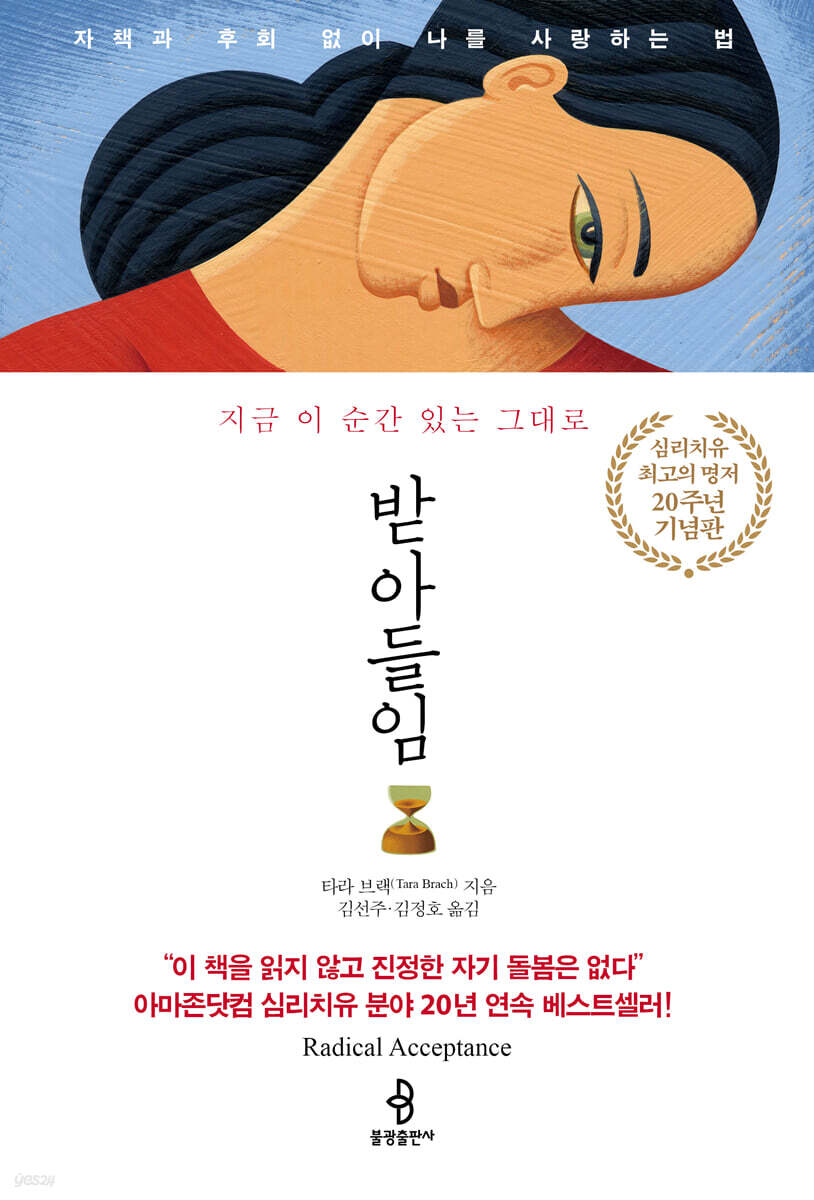
- The renowned book on mindfulness and meditation, "Acceptance," which has been consistently loved not only on Amazon but also in Korea, has been released in a revised edition to commemorate its 20th anniversary.
This book, which emphasizes 'radical acceptance', which is accepting oneself completely as one is, is Buddhist meditator Tara Brach's masterpiece and is worthy of being a classic.
- Son Min-gyu, humanities PD
★★★ Amazon.com's Bestseller in Psychological Healing for 20 Consecutive Years ★★★
★★★ The best psychological healing book highly recommended by Thich Nhat Hanh and Kwak Jeong-eun ★★★
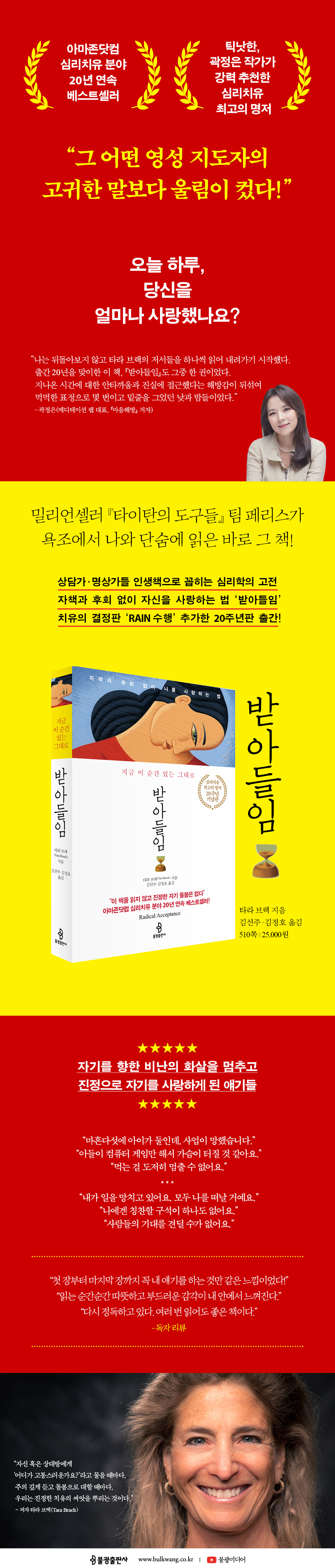
“It resonated louder than the noble words of any spiritual leader!”
Tim Ferriss, the author of the million-seller “Tools of Titans,”
The book I read in one sitting after getting out of the bath!
A classic in psychology, considered a life-changing book by counselors and meditation practitioners.
How to Love Yourself Without Regret or Remorse: Acceptance
The 20th Anniversary Edition of the Healing Critical Edition RAIN Practice Method has been released!
“It resonated louder than the noble words of any spiritual leader!”
There is one book that has been consistently loved by readers in the field of psychotherapy for over 20 years.
The book, "Radical Acceptance," has been a bestseller in the psychological healing category on Amazon.com for 20 consecutive years since its publication in 2003.
The world's best-selling book on psychological healing, which helped readers in 22 countries love themselves, has returned to Korea with a 20th anniversary edition, adding the core healing training RAIN.
How to Love Yourself Without Self-Regret and Regret 『Acceptance: Just As It Is Right Now』 is a psychological healing book that teaches you how to truly love yourself.
This book finds the answer in the 'power of acceptance' and suggests 'radical acceptance' training as a way to develop the 'power of acceptance'.
'Radical acceptance' means being clear about what is happening inside and looking at it with an open mind and a kind, loving heart.
In this book, Tara Brach, a world-renowned clinical psychologist and Buddhist meditation practitioner, demonstrates specifically what “radical acceptance” is through real-life examples from herself, as well as from numerous clients and fellow practitioners.
Furthermore, after receiving comfort, it helps maintain happiness through various specific meditation methods such as mindfulness, embracing myself with compassion, Tibetan Tonglen practice, and Vipassana.
This 20th-anniversary edition features the newly added RAIN training, the author's definitive guide to healing and self-care, a practice he has long practiced and proven. RAIN stands for Recognize-Allow-Investigate-Nurture, and systematically awakens mindfulness and compassion, which bring healing to difficult emotions.
This book introduces universal examples that anyone could have experienced, helping you see that the protagonist in the story is yourself.
Above all, it guides us, who are tired of competition, to find our true 'selves' and achieve true happiness by helping us escape from the self-loathing of thinking, 'I am useless.'
This is also the reason why numerous spiritual leaders and meditators, including world-renowned spiritual master Thich Nhat Hanh, meditation and Buddhist psychology expert Jack Kornfield, and meditator and author of “Mind Liberation” Jeong-eun Kwak, confidently recommend it.
The 20th Anniversary Edition of Acceptance, featuring the core healing training RAIN, will open the path to true self-care for all those navigating the era of anxiety and depression.
★★★ The best psychological healing book highly recommended by Thich Nhat Hanh and Kwak Jeong-eun ★★★
“It resonated louder than the noble words of any spiritual leader!”
Tim Ferriss, the author of the million-seller “Tools of Titans,”
The book I read in one sitting after getting out of the bath!
A classic in psychology, considered a life-changing book by counselors and meditation practitioners.
How to Love Yourself Without Regret or Remorse: Acceptance
The 20th Anniversary Edition of the Healing Critical Edition RAIN Practice Method has been released!
“It resonated louder than the noble words of any spiritual leader!”
There is one book that has been consistently loved by readers in the field of psychotherapy for over 20 years.
The book, "Radical Acceptance," has been a bestseller in the psychological healing category on Amazon.com for 20 consecutive years since its publication in 2003.
The world's best-selling book on psychological healing, which helped readers in 22 countries love themselves, has returned to Korea with a 20th anniversary edition, adding the core healing training RAIN.
How to Love Yourself Without Self-Regret and Regret 『Acceptance: Just As It Is Right Now』 is a psychological healing book that teaches you how to truly love yourself.
This book finds the answer in the 'power of acceptance' and suggests 'radical acceptance' training as a way to develop the 'power of acceptance'.
'Radical acceptance' means being clear about what is happening inside and looking at it with an open mind and a kind, loving heart.
In this book, Tara Brach, a world-renowned clinical psychologist and Buddhist meditation practitioner, demonstrates specifically what “radical acceptance” is through real-life examples from herself, as well as from numerous clients and fellow practitioners.
Furthermore, after receiving comfort, it helps maintain happiness through various specific meditation methods such as mindfulness, embracing myself with compassion, Tibetan Tonglen practice, and Vipassana.
This 20th-anniversary edition features the newly added RAIN training, the author's definitive guide to healing and self-care, a practice he has long practiced and proven. RAIN stands for Recognize-Allow-Investigate-Nurture, and systematically awakens mindfulness and compassion, which bring healing to difficult emotions.
This book introduces universal examples that anyone could have experienced, helping you see that the protagonist in the story is yourself.
Above all, it guides us, who are tired of competition, to find our true 'selves' and achieve true happiness by helping us escape from the self-loathing of thinking, 'I am useless.'
This is also the reason why numerous spiritual leaders and meditators, including world-renowned spiritual master Thich Nhat Hanh, meditation and Buddhist psychology expert Jack Kornfield, and meditator and author of “Mind Liberation” Jeong-eun Kwak, confidently recommend it.
The 20th Anniversary Edition of Acceptance, featuring the core healing training RAIN, will open the path to true self-care for all those navigating the era of anxiety and depression.
- You can preview some of the book's contents.
Preview
index
Recommendation: A healing book filled with warmth and assurance.
Translator's Note: How to get out of the swamp?
20th Anniversary Edition Preface: Where Is the Pain?
Prologue: "Something's Wrong with Me"
1.
“I am not worthy of existing in this world.”
2.
Radical Acceptance: Accepting everything as it is, right now.
3.
Sacred Pause: Resting Under the Tree of Wisdom
4.
Unconditional Kindness: The Spirit of Radical Acceptance
5.
Getting Close to Your Body: The Foundation of Radical Acceptance
6.
What do we really want?
7.
How to Live with Fear
8.
Embrace me with compassion: “May I be free from suffering.”
9.
RAIN OF COMPASSION: Applied Meditation for Healing and Freedom
10.
Embracing the World with Compassion: "May my life benefit all beings."
11.
Realizing the Goodness Within Us: The Gateway to Forgiveness and Love
12.
Waking Up Together: Awakening Friendship is the Whole of Divine Life
13.
Who am I?
Appendix: RAIN Partners You Train With
Translator's Note: How to get out of the swamp?
20th Anniversary Edition Preface: Where Is the Pain?
Prologue: "Something's Wrong with Me"
1.
“I am not worthy of existing in this world.”
2.
Radical Acceptance: Accepting everything as it is, right now.
3.
Sacred Pause: Resting Under the Tree of Wisdom
4.
Unconditional Kindness: The Spirit of Radical Acceptance
5.
Getting Close to Your Body: The Foundation of Radical Acceptance
6.
What do we really want?
7.
How to Live with Fear
8.
Embrace me with compassion: “May I be free from suffering.”
9.
RAIN OF COMPASSION: Applied Meditation for Healing and Freedom
10.
Embracing the World with Compassion: "May my life benefit all beings."
11.
Realizing the Goodness Within Us: The Gateway to Forgiveness and Love
12.
Waking Up Together: Awakening Friendship is the Whole of Divine Life
13.
Who am I?
Appendix: RAIN Partners You Train With
Detailed image
Into the book
Imperfection is not our personal problem; it is a natural part of existence.
--- p.57
I call this "radical acceptance"—being clearly aware of what's happening inside and looking at it with an open mind, kindness, and love.
--- p.66
The essence of our consciousness is to know what is happening.
The essence of our heart is to care.
--- p.72
The boundaries of what we can accept are the boundaries of our freedom.
--- p.89
When we run away from what we fear, the darkness within us grows bigger.
--- p.103
The part of our mind that we cannot see or feel is the source of all neurosis and suffering.
--- p.106
If an untrained child could taste freedom in an innate way without effort, then such a state must be a natural part of human existence.
--- p.109
Every dragon in our lives may be a princess waiting for us to act with beauty and courage just once.
Perhaps the deepest essence of all that fears us is the helplessness of beings who want our love.
--- p.117
When we stop the vicious cycle of misunderstanding, even for just a moment, we become aware of the unconscious beliefs and feelings that lie behind the problem.
--- p.119
Because pleasant or unpleasant sensations can so quickly trigger a chain reaction of emotions and mental stories, it is important in practice to immediately return your attention to the immediate sensory experience as soon as you notice a thought arising.
--- p.165
Pain is inevitable, but suffering is optional.
--- p.171
The important thing is not “what is happening?” but “how do you relate to the experience?”
--- p.204
Fear is the anticipation of future suffering.
--- p.249
When we pretend we're okay, we sink deeper into feeling disconnected, isolated, and at risk.
--- p.256
As great as our fears are, the truth that we are interconnected is far greater.
--- p.265
Since fear is an essential part of life, resistance to it is resistance to life itself.
--- p.274
When we engage with our fears by approaching them rather than running away from them, our identity begins to change.
--- p.271
We are the huggers and the hugged.
--- p.314
Whispering to the painful emotion, “Thank you for trying to protect me,” or making some other kind and considerate gesture can help it heal.
--- p.333
“The mind creates a deep chasm, and it is the mind that crosses it.”
--- p.339
Seeing through the eyes of the other person is the essence of compassion.
--- p.382
The fate of all life is my fate.
--- p.383
Only when we feel forgiven by ourselves and others and cast off the armor of painful self-reproach can we truly forgive others in meditation.
--- p.412
Taking pain personally is central to radical acceptance.
--- p.466
Look, let go and be free.
--- p.57
I call this "radical acceptance"—being clearly aware of what's happening inside and looking at it with an open mind, kindness, and love.
--- p.66
The essence of our consciousness is to know what is happening.
The essence of our heart is to care.
--- p.72
The boundaries of what we can accept are the boundaries of our freedom.
--- p.89
When we run away from what we fear, the darkness within us grows bigger.
--- p.103
The part of our mind that we cannot see or feel is the source of all neurosis and suffering.
--- p.106
If an untrained child could taste freedom in an innate way without effort, then such a state must be a natural part of human existence.
--- p.109
Every dragon in our lives may be a princess waiting for us to act with beauty and courage just once.
Perhaps the deepest essence of all that fears us is the helplessness of beings who want our love.
--- p.117
When we stop the vicious cycle of misunderstanding, even for just a moment, we become aware of the unconscious beliefs and feelings that lie behind the problem.
--- p.119
Because pleasant or unpleasant sensations can so quickly trigger a chain reaction of emotions and mental stories, it is important in practice to immediately return your attention to the immediate sensory experience as soon as you notice a thought arising.
--- p.165
Pain is inevitable, but suffering is optional.
--- p.171
The important thing is not “what is happening?” but “how do you relate to the experience?”
--- p.204
Fear is the anticipation of future suffering.
--- p.249
When we pretend we're okay, we sink deeper into feeling disconnected, isolated, and at risk.
--- p.256
As great as our fears are, the truth that we are interconnected is far greater.
--- p.265
Since fear is an essential part of life, resistance to it is resistance to life itself.
--- p.274
When we engage with our fears by approaching them rather than running away from them, our identity begins to change.
--- p.271
We are the huggers and the hugged.
--- p.314
Whispering to the painful emotion, “Thank you for trying to protect me,” or making some other kind and considerate gesture can help it heal.
--- p.333
“The mind creates a deep chasm, and it is the mind that crosses it.”
--- p.339
Seeing through the eyes of the other person is the essence of compassion.
--- p.382
The fate of all life is my fate.
--- p.383
Only when we feel forgiven by ourselves and others and cast off the armor of painful self-reproach can we truly forgive others in meditation.
--- p.412
Taking pain personally is central to radical acceptance.
--- p.466
Look, let go and be free.
--- p.486
Publisher's Review
Stop pointing the arrows of blame at yourself
Stories of how to truly love yourself
How much did I love you today?
How can I love myself without remorse and regret?
Accepting everything as it is, right now
Kwak Jeong-eun: "A Healing Book Filled with Warmth and Confidence"
“I’m forty-five, have two children, and my business is failing.”
“My heart is about to burst because my son only plays computer games.”
“I just can’t stop eating.”
“I have nothing to praise.”
“I can’t stand people’s expectations.”
How much did we love ourselves today? We easily blame ourselves, feel regret, and even push ourselves into suffering.
In the countless conflicts and discord that arise in our relationships with ourselves and those around us, we often get hurt.
How can I love myself without self-reproach or regret? The word "trance" is often used in "Acceptance."
The dictionary defines it as “a state of sleep in which one is unconscious and has no control over one’s thoughts or actions.”
The 'trance of worthlessness' discussed in this book is a state of being caught up in the thoughts and feelings that one is worthless and incomplete.
It's like being stuck in a swamp called 'trance of worthlessness', and the more you struggle to get out, the deeper you sink.
Some people struggle to prove their worth, while others resign themselves to this swamp, identifying themselves with it.
Whether it's resistance or resignation, the result is the same.
The trance is reinforced when we indulge in food, alcohol, or drugs, become obsessed with relationships, or become workaholics to fill the void that arises from not being able to love ourselves as we are, and when we hide within a protective shell that protects our fragile selves, the trance is reinforced.
To get out of here, paradoxically, you have to stop trying to get out.
And you have to acknowledge and accept yourself as being in a trance.
That's when the possibility of change opens up.
Because through the practice of experiencing and embracing each moment as it is, we realize that love and compassion are our true nature.
Even at this very moment, we live missing the present.
Trapped in memories of the past or haunted by anxiety about a future that has not yet arrived.
This book tells us that if we miss this moment, we miss ourselves.
And it presents 'radical acceptance' as a way to experience every moment as it is.
'Radical acceptance' means clearly recognizing what is happening inside and looking at it with an open mind and kind, loving heart.
This is possible when we can clearly see our own experiences with mindfulness and embrace them with compassion.
Just as a young bird must practice countless times before it can fly freely through the air, we too must train ourselves to cultivate the two wings of fundamental acceptance—mindfulness and compassion—in order to live freely in life.
That's why, at the end of each chapter in this book, we provide helpful training methods for cultivating mindfulness and compassion, titled "Meditation Practice" and "Reflection Practice."
Author Jeong-eun Kwak, who considers Tara Brach, author of "Acceptance," as her mentor, also developed mindfulness and compassion through this book.
Although his body was clearly here, his mind wandered helplessly between the past and the future, and he began to blame himself. However, after encountering Tara Brach's book, his daily life began to change.
The voices that blamed themselves and regretted the past became quiet, and the way they reacted to similar situations in daily life changed.
He was the one who read this book, underlining it over and over again.
So, the book I confidently recommend is “Acceptance.”
“I started reading Tara Brach’s books one by one without looking back.
This book, "Acceptance," which celebrated its 20th anniversary, was one of them.
“It was a day and night where I repeatedly underlined with a heavy expression the regret for the time that had passed and the sense of liberation from approaching the truth.”
- Kwak Jeong-eun (CEO of Meditation Lab, author of "Mind Liberation")
Self-reproach, regret, and doubt
A specific way to avoid being hit by the second arrow!!
“Every moment I read it, I feel a warm and gentle sensation within me.”
The consistent, genuine empathy of readers who have been guided to true self-care.
“I am rereading it again.
“It’s a book worth reading over and over again.”
“It’s a book that has a healing effect just by reading it.”
“Every moment I read the book, I feel a warm and soft sensation inside me.”
These are the sincere sympathies of countless readers who have encountered the book since 『Acceptance』 was first introduced in Korea.
Because this book helped me truly take care of myself.
We often find ourselves thinking like this when things go wrong or when loneliness creeps in.
“I am such a useless person!” “Am I truly loved?” The Buddha calls these self-reproaches and doubts “the second arrow.”
They said that not getting hit by this arrow is the way to live happily.
The author, an expert in both clinical psychology and meditation, suggests "radical acceptance" training as a way to avoid being hit by the second arrow.
‘Radical acceptance’, translated as ‘acceptance’ in this book, refers to clearly seeing one’s own experience through mindfulness meditation and embracing it with compassion.
If you live with an attitude of 'fundamental acceptance,' you can stop judging yourself negatively or struggling in pain, and be happy in 'this moment,' according to the author's own experience and that of countless others.
This book demonstrates through concrete counseling cases how 'radical acceptance' can bring about changes in our lives.
There are many examples throughout the book of people accepting pain and changing their lives.
Because the stories present situations that anyone could have experienced, readers will realize that the main characters in the stories are themselves.
So, while reading this book, readers encounter their own wounds and experience their wounds being healed.
Above all, the author's understanding has deepened over the 20 years since this book was first published.
It helps us to kindly embrace our human imperfections, these imperfections that are so natural.
This 20th anniversary edition features the RAIN training, a core component of the author's self-care series and a life-changing resource for countless individuals. RAIN, an acronym for Recognize-Allow-Investigate-Nurture, will guide us through the profound and liberating work of transforming the darkness we face.
Furthermore, by freeing us from the perception that “I am useless,” this book guides us, who are tired of self-improvement and competition, to find our true “selves” and achieve true happiness.
Whether you're new to this book or re-reading it, Tara Brach's teachings and practices of acceptance will help you free your mind.
Why do we keep falling into self-reproach?
We often and too easily think, 'I am useless and unworthy of love.'
At times like that, I feel even more miserable because other people seem to be doing a good job and seem lovable.
Why on earth is that? Because I think I'm the main character in the world, and that I can do anything.
Is that really true? No.
We already know that.
But it is difficult to break free from this habit of thinking.
When you are suffering from self-reproach, comfort can be a great help.
On the other hand, if we cannot diagnose the cause of the pain and provide a treatment accordingly, the comfort will only be temporary and not lasting happiness.
"are you okay.
The consolation of “it’s not your fault” is merely an ‘escape’ to temporarily escape the harsh reality or a ‘pain reliever’ to endure the hardship.
When the effect of the medicine wears off, you start blaming yourself again and cannot escape the cycle of looking for more medicine.
How can we resolve the root cause of our problems and be completely free from self-reproach and regret? How can we "accept" everything as it is, right now, in this moment? We must encounter the truth that "it's not my fault" and "I am pure consciousness."
The reason this book contains numerous episodes surrounding these two truths is to clearly convey them.
The author first gives strength and comfort to the countless people who come to him with empathy.
They then go through a process that reveals the 'two' truths of the incident.
At this time, psychological counseling techniques and Buddhist meditation methods are utilized.
The meditation the author uses relaxes the body and mind, broadens the mind, and gives the strength and space to see situations as they are.
But why "Buddhist" meditation? Because the Buddhist wisdom that "the suffering of all beings is interconnected" shifts the focus from "me" to "the whole."
So Buddhist meditation has great power in helping us realize that it is not our fault.
Based on this, the author goes through a process of ‘fundamental acceptance.’
We reflexively associate 'me' with the phenomena that occur, whether they are joy or pleasure, sadness or anger, and judge them as good or bad.
Here, the attitude (tendency) of wanting to continue to enjoy or have good things, or the attitude (tendency) of pushing away or suppressing bad things, leads to a vicious cycle of self-reproach and regret.
If you continue to want to enjoy or have something, when the object disappears, regret and anger will come flooding in, and if you push it away or suppress it, it will eventually explode.
Instead, if you practice “radical acceptance,” accepting what you are experiencing in this moment as it is, with the strength and wisdom you have cultivated through Buddhist meditation, your life will change.
Pain is the first arrow that cannot be avoided, but the second arrow that follows pain, suffering, gives us the wisdom to choose and the power to act on it.
Then we come to realize that suffering is also a part of life, and that our very existence is an all-encompassing whole.
Ultimately, we will come to realize that we are 'pure consciousness' observing the experience.
In this way, we are freed from the habit of identifying ourselves with self-reproach and regret, and find true happiness.
From beginning to end, this book is your story!
“From the first page to the last, it felt like it was telling my story!”
This is the response consistently sent by readers who participated in monitoring before 『Acceptance』 was first published in Korea.
right.
This book deals with stories that anyone could have experienced, the emotional pain that anyone would experience.
A father in his mid-40s who blames himself for his failed business, a mother who argues with her son who is addicted to computer games, a woman in her 20s who just can't stop eating, a brother who blames himself for losing his younger brother in an accident, a wife who is suffering because of her husband's infidelity, a woman who is suffering from the pain of a broken heart, and a man who believes he is worthless if he doesn't feel special...
It's someone we've all been or are likely to be around at some point.
The author, an expert in psychotherapy and meditation, vividly and specifically describes the stories of the people he met.
It captures every detail, from why they suffered so much, to how they felt when they encountered suffering, to how they felt when they looked at that suffering clearly through meditation, to how they escaped from it.
What is most surprising is that the author himself confesses the suffering he experienced in his daily life and reveals how he was freed from it.
By revealing his human side, the author shows that 'everyone' has pain and that we are all beings with common problems.
The stories in the book are not about 'them', but about 'me' and 'you'.
It's a story about the criticism I used to heap on myself, and a vivid portrayal of the process I went through to truly love myself.
So, anyone who reads this book will naturally experience pain and healing together.
Close the last page of the book and look around you and at yourself.
You will find yourself loving yourself more and listening to the suffering of others.
Stories of how to truly love yourself
How much did I love you today?
How can I love myself without remorse and regret?
Accepting everything as it is, right now
Kwak Jeong-eun: "A Healing Book Filled with Warmth and Confidence"
“I’m forty-five, have two children, and my business is failing.”
“My heart is about to burst because my son only plays computer games.”
“I just can’t stop eating.”
“I have nothing to praise.”
“I can’t stand people’s expectations.”
How much did we love ourselves today? We easily blame ourselves, feel regret, and even push ourselves into suffering.
In the countless conflicts and discord that arise in our relationships with ourselves and those around us, we often get hurt.
How can I love myself without self-reproach or regret? The word "trance" is often used in "Acceptance."
The dictionary defines it as “a state of sleep in which one is unconscious and has no control over one’s thoughts or actions.”
The 'trance of worthlessness' discussed in this book is a state of being caught up in the thoughts and feelings that one is worthless and incomplete.
It's like being stuck in a swamp called 'trance of worthlessness', and the more you struggle to get out, the deeper you sink.
Some people struggle to prove their worth, while others resign themselves to this swamp, identifying themselves with it.
Whether it's resistance or resignation, the result is the same.
The trance is reinforced when we indulge in food, alcohol, or drugs, become obsessed with relationships, or become workaholics to fill the void that arises from not being able to love ourselves as we are, and when we hide within a protective shell that protects our fragile selves, the trance is reinforced.
To get out of here, paradoxically, you have to stop trying to get out.
And you have to acknowledge and accept yourself as being in a trance.
That's when the possibility of change opens up.
Because through the practice of experiencing and embracing each moment as it is, we realize that love and compassion are our true nature.
Even at this very moment, we live missing the present.
Trapped in memories of the past or haunted by anxiety about a future that has not yet arrived.
This book tells us that if we miss this moment, we miss ourselves.
And it presents 'radical acceptance' as a way to experience every moment as it is.
'Radical acceptance' means clearly recognizing what is happening inside and looking at it with an open mind and kind, loving heart.
This is possible when we can clearly see our own experiences with mindfulness and embrace them with compassion.
Just as a young bird must practice countless times before it can fly freely through the air, we too must train ourselves to cultivate the two wings of fundamental acceptance—mindfulness and compassion—in order to live freely in life.
That's why, at the end of each chapter in this book, we provide helpful training methods for cultivating mindfulness and compassion, titled "Meditation Practice" and "Reflection Practice."
Author Jeong-eun Kwak, who considers Tara Brach, author of "Acceptance," as her mentor, also developed mindfulness and compassion through this book.
Although his body was clearly here, his mind wandered helplessly between the past and the future, and he began to blame himself. However, after encountering Tara Brach's book, his daily life began to change.
The voices that blamed themselves and regretted the past became quiet, and the way they reacted to similar situations in daily life changed.
He was the one who read this book, underlining it over and over again.
So, the book I confidently recommend is “Acceptance.”
“I started reading Tara Brach’s books one by one without looking back.
This book, "Acceptance," which celebrated its 20th anniversary, was one of them.
“It was a day and night where I repeatedly underlined with a heavy expression the regret for the time that had passed and the sense of liberation from approaching the truth.”
- Kwak Jeong-eun (CEO of Meditation Lab, author of "Mind Liberation")
Self-reproach, regret, and doubt
A specific way to avoid being hit by the second arrow!!
“Every moment I read it, I feel a warm and gentle sensation within me.”
The consistent, genuine empathy of readers who have been guided to true self-care.
“I am rereading it again.
“It’s a book worth reading over and over again.”
“It’s a book that has a healing effect just by reading it.”
“Every moment I read the book, I feel a warm and soft sensation inside me.”
These are the sincere sympathies of countless readers who have encountered the book since 『Acceptance』 was first introduced in Korea.
Because this book helped me truly take care of myself.
We often find ourselves thinking like this when things go wrong or when loneliness creeps in.
“I am such a useless person!” “Am I truly loved?” The Buddha calls these self-reproaches and doubts “the second arrow.”
They said that not getting hit by this arrow is the way to live happily.
The author, an expert in both clinical psychology and meditation, suggests "radical acceptance" training as a way to avoid being hit by the second arrow.
‘Radical acceptance’, translated as ‘acceptance’ in this book, refers to clearly seeing one’s own experience through mindfulness meditation and embracing it with compassion.
If you live with an attitude of 'fundamental acceptance,' you can stop judging yourself negatively or struggling in pain, and be happy in 'this moment,' according to the author's own experience and that of countless others.
This book demonstrates through concrete counseling cases how 'radical acceptance' can bring about changes in our lives.
There are many examples throughout the book of people accepting pain and changing their lives.
Because the stories present situations that anyone could have experienced, readers will realize that the main characters in the stories are themselves.
So, while reading this book, readers encounter their own wounds and experience their wounds being healed.
Above all, the author's understanding has deepened over the 20 years since this book was first published.
It helps us to kindly embrace our human imperfections, these imperfections that are so natural.
This 20th anniversary edition features the RAIN training, a core component of the author's self-care series and a life-changing resource for countless individuals. RAIN, an acronym for Recognize-Allow-Investigate-Nurture, will guide us through the profound and liberating work of transforming the darkness we face.
Furthermore, by freeing us from the perception that “I am useless,” this book guides us, who are tired of self-improvement and competition, to find our true “selves” and achieve true happiness.
Whether you're new to this book or re-reading it, Tara Brach's teachings and practices of acceptance will help you free your mind.
Why do we keep falling into self-reproach?
We often and too easily think, 'I am useless and unworthy of love.'
At times like that, I feel even more miserable because other people seem to be doing a good job and seem lovable.
Why on earth is that? Because I think I'm the main character in the world, and that I can do anything.
Is that really true? No.
We already know that.
But it is difficult to break free from this habit of thinking.
When you are suffering from self-reproach, comfort can be a great help.
On the other hand, if we cannot diagnose the cause of the pain and provide a treatment accordingly, the comfort will only be temporary and not lasting happiness.
"are you okay.
The consolation of “it’s not your fault” is merely an ‘escape’ to temporarily escape the harsh reality or a ‘pain reliever’ to endure the hardship.
When the effect of the medicine wears off, you start blaming yourself again and cannot escape the cycle of looking for more medicine.
How can we resolve the root cause of our problems and be completely free from self-reproach and regret? How can we "accept" everything as it is, right now, in this moment? We must encounter the truth that "it's not my fault" and "I am pure consciousness."
The reason this book contains numerous episodes surrounding these two truths is to clearly convey them.
The author first gives strength and comfort to the countless people who come to him with empathy.
They then go through a process that reveals the 'two' truths of the incident.
At this time, psychological counseling techniques and Buddhist meditation methods are utilized.
The meditation the author uses relaxes the body and mind, broadens the mind, and gives the strength and space to see situations as they are.
But why "Buddhist" meditation? Because the Buddhist wisdom that "the suffering of all beings is interconnected" shifts the focus from "me" to "the whole."
So Buddhist meditation has great power in helping us realize that it is not our fault.
Based on this, the author goes through a process of ‘fundamental acceptance.’
We reflexively associate 'me' with the phenomena that occur, whether they are joy or pleasure, sadness or anger, and judge them as good or bad.
Here, the attitude (tendency) of wanting to continue to enjoy or have good things, or the attitude (tendency) of pushing away or suppressing bad things, leads to a vicious cycle of self-reproach and regret.
If you continue to want to enjoy or have something, when the object disappears, regret and anger will come flooding in, and if you push it away or suppress it, it will eventually explode.
Instead, if you practice “radical acceptance,” accepting what you are experiencing in this moment as it is, with the strength and wisdom you have cultivated through Buddhist meditation, your life will change.
Pain is the first arrow that cannot be avoided, but the second arrow that follows pain, suffering, gives us the wisdom to choose and the power to act on it.
Then we come to realize that suffering is also a part of life, and that our very existence is an all-encompassing whole.
Ultimately, we will come to realize that we are 'pure consciousness' observing the experience.
In this way, we are freed from the habit of identifying ourselves with self-reproach and regret, and find true happiness.
From beginning to end, this book is your story!
“From the first page to the last, it felt like it was telling my story!”
This is the response consistently sent by readers who participated in monitoring before 『Acceptance』 was first published in Korea.
right.
This book deals with stories that anyone could have experienced, the emotional pain that anyone would experience.
A father in his mid-40s who blames himself for his failed business, a mother who argues with her son who is addicted to computer games, a woman in her 20s who just can't stop eating, a brother who blames himself for losing his younger brother in an accident, a wife who is suffering because of her husband's infidelity, a woman who is suffering from the pain of a broken heart, and a man who believes he is worthless if he doesn't feel special...
It's someone we've all been or are likely to be around at some point.
The author, an expert in psychotherapy and meditation, vividly and specifically describes the stories of the people he met.
It captures every detail, from why they suffered so much, to how they felt when they encountered suffering, to how they felt when they looked at that suffering clearly through meditation, to how they escaped from it.
What is most surprising is that the author himself confesses the suffering he experienced in his daily life and reveals how he was freed from it.
By revealing his human side, the author shows that 'everyone' has pain and that we are all beings with common problems.
The stories in the book are not about 'them', but about 'me' and 'you'.
It's a story about the criticism I used to heap on myself, and a vivid portrayal of the process I went through to truly love myself.
So, anyone who reads this book will naturally experience pain and healing together.
Close the last page of the book and look around you and at yourself.
You will find yourself loving yourself more and listening to the suffering of others.
GOODS SPECIFICS
- Date of issue: March 18, 2025
- Page count, weight, size: 510 pages | 770g | 152*225*26mm
- ISBN13: 9791172611446
- ISBN10: 1172611440
You may also like
카테고리
korean


korean

![GQ KOREA Mark (Monthly): December [2025]](http://librairie.coreenne.fr/cdn/shop/files/8ef265dbbfbf186523ed75ba7319009d.jpg?v=1765340328&width=3840)


