

Sydney!
 |
Description
Book Introduction
It looks rough, but it's actually soft.
Correspondent Haruki Murakami's 23-day stay in Sydney
In 2000, when Olympic fever was at its peak, Haruki Murakami boarded a plane to Sydney at the request of the influential Japanese magazine [Sports Graphic Number] as a special reporter.
"Sydney!", a collection of Murakami Haruki's Olympic observation and travelogues written daily by "tapping the keyboard like a machine gun," in the author's own words, 30 pages of 400-character manuscript paper, is being republished in a new translation by Bichae.
Over 100 pages of manuscripts that were omitted or abbreviated in the previous translation have been newly included, and the translation has also captured the nuances of the original text in Korean.
The title, introduced as "Something More Precious Than Victory," has also been revived as "Sydney!", allowing readers to experience the author's unique style and rhythm even more vividly.
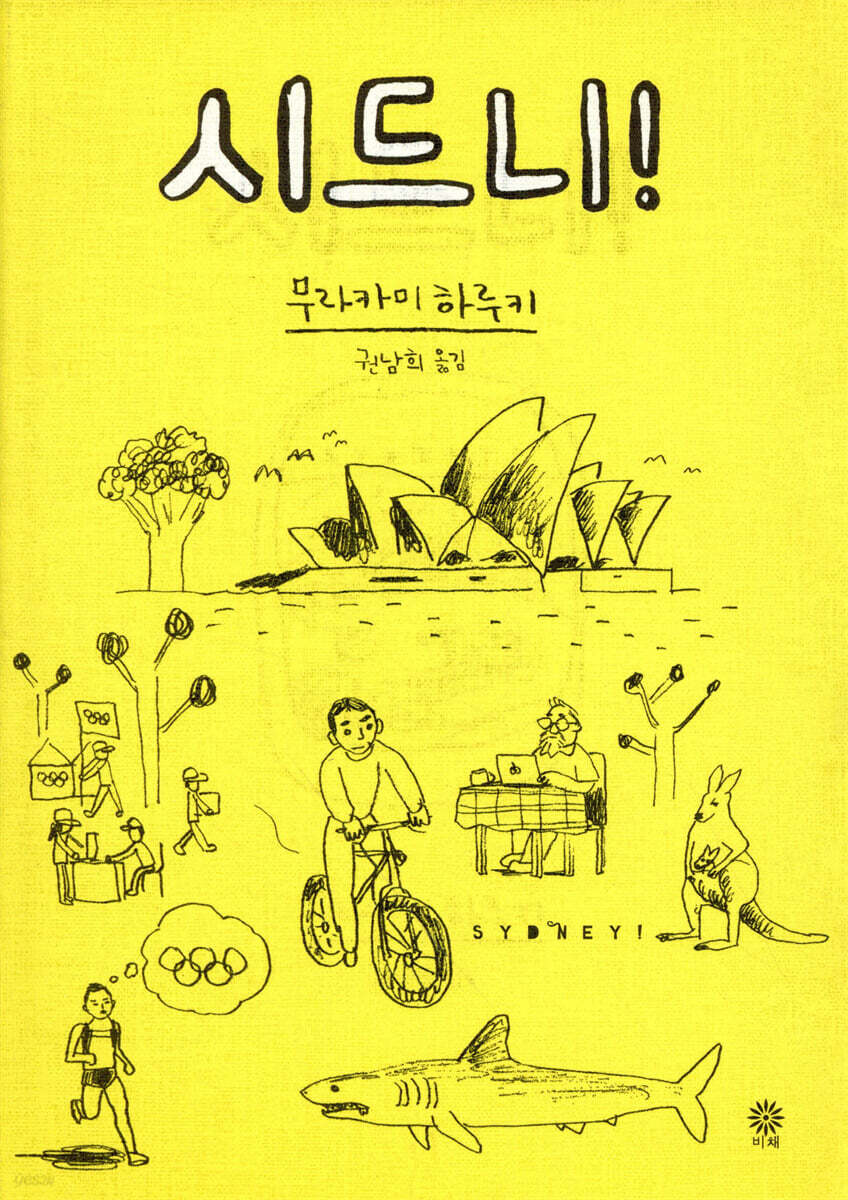
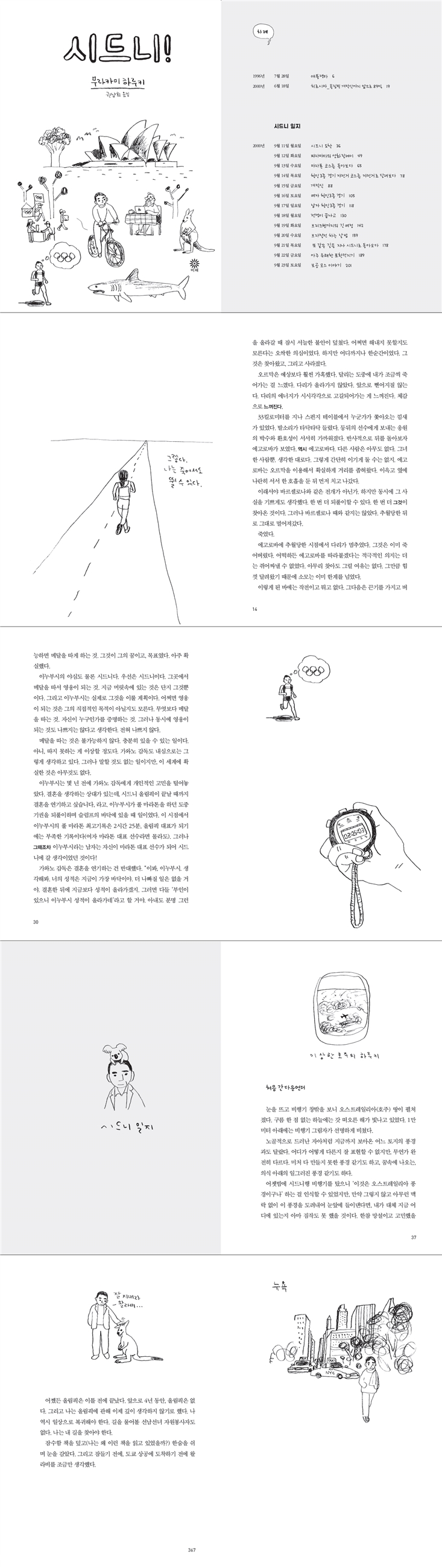
In particular, it includes over 100 illustrations by popular cartoonist Lee Woo-il, which is the first collaboration attempted in a Korean edition of Haruki Murakami's work.
With his lively and witty illustrations, Lee Woo-il presents a fantastic combination of text and image, following in the footsteps of Mizumaru Anzai and Makoto Wada, who collaborated on "Haruki Murakami's Miscellaneous Essays," and Ayumi Ohashi, who collaborated on the "Murakami Radio" series, including "The Lion Who Loves Salad."
Correspondent Haruki Murakami's 23-day stay in Sydney
In 2000, when Olympic fever was at its peak, Haruki Murakami boarded a plane to Sydney at the request of the influential Japanese magazine [Sports Graphic Number] as a special reporter.
"Sydney!", a collection of Murakami Haruki's Olympic observation and travelogues written daily by "tapping the keyboard like a machine gun," in the author's own words, 30 pages of 400-character manuscript paper, is being republished in a new translation by Bichae.
Over 100 pages of manuscripts that were omitted or abbreviated in the previous translation have been newly included, and the translation has also captured the nuances of the original text in Korean.
The title, introduced as "Something More Precious Than Victory," has also been revived as "Sydney!", allowing readers to experience the author's unique style and rhythm even more vividly.
In particular, it includes over 100 illustrations by popular cartoonist Lee Woo-il, which is the first collaboration attempted in a Korean edition of Haruki Murakami's work.
With his lively and witty illustrations, Lee Woo-il presents a fantastic combination of text and image, following in the footsteps of Mizumaru Anzai and Makoto Wada, who collaborated on "Haruki Murakami's Miscellaneous Essays," and Ayumi Ohashi, who collaborated on the "Murakami Radio" series, including "The Lion Who Loves Salad."
- You can preview some of the book's contents.
Preview
index
Atlanta 6, July 28, 1996
June 18, 2000 Hiroshima_89 days until the Olympic opening ceremony 19
Sydney Diary
Arrived in Sydney on Monday, September 11, 2000. 36
Torch Relay 49 in Parramatta on Tuesday, September 12
Wednesday, September 13th: A look back at the marathon course 65
Cycling the Ironman triathlon bike course on Thursday, September 14th 78
Opening Ceremony 88 on Friday, September 15th
Women's Triathlon 105, Saturday, September 16
Sunday, September 17th Men's Triathlon 118
Monday, September 18th, the war ended and 130
Long Journey to Brisbane, Tuesday, September 19th 142
Wednesday, September 20th, the night of the match against Brazil, 159
Thursday, September 21st: Return to Sydney via the same route. 178
Friday, September 22nd: A Very Fun Shot Put 189
Saturday, September 23rd, Bogong Moss Story 201
Sunday, September 24th, finally the women's marathon 217
Naoko Takahashi's press conference on Monday, September 25th, and Cathy Freeman's win at #238
Bondi Beach Rainy Day, Tuesday, September 26, 2023
Wednesday, September 27th: Matsuzaka Can't Win 273
Special segment 'Australian History, etc.' on Thursday, September 28th, 285
Letter 298 from Sydney, Friday, September 29
313 days ahead of Saturday, September 30th
Sunday, October 1st: Men's Marathon and Closing Ceremony 328
After the festival on Monday, October 2nd, 345
Goodbye, Sydney 360, Tuesday, October 3
Tokushima 368 on October 20th
- Director Kawano's perspective
- Race with Nightmare
New York 384, November 5
Author's Note 403
Publishing a paperback edition 406
June 18, 2000 Hiroshima_89 days until the Olympic opening ceremony 19
Sydney Diary
Arrived in Sydney on Monday, September 11, 2000. 36
Torch Relay 49 in Parramatta on Tuesday, September 12
Wednesday, September 13th: A look back at the marathon course 65
Cycling the Ironman triathlon bike course on Thursday, September 14th 78
Opening Ceremony 88 on Friday, September 15th
Women's Triathlon 105, Saturday, September 16
Sunday, September 17th Men's Triathlon 118
Monday, September 18th, the war ended and 130
Long Journey to Brisbane, Tuesday, September 19th 142
Wednesday, September 20th, the night of the match against Brazil, 159
Thursday, September 21st: Return to Sydney via the same route. 178
Friday, September 22nd: A Very Fun Shot Put 189
Saturday, September 23rd, Bogong Moss Story 201
Sunday, September 24th, finally the women's marathon 217
Naoko Takahashi's press conference on Monday, September 25th, and Cathy Freeman's win at #238
Bondi Beach Rainy Day, Tuesday, September 26, 2023
Wednesday, September 27th: Matsuzaka Can't Win 273
Special segment 'Australian History, etc.' on Thursday, September 28th, 285
Letter 298 from Sydney, Friday, September 29
313 days ahead of Saturday, September 30th
Sunday, October 1st: Men's Marathon and Closing Ceremony 328
After the festival on Monday, October 2nd, 345
Goodbye, Sydney 360, Tuesday, October 3
Tokushima 368 on October 20th
- Director Kawano's perspective
- Race with Nightmare
New York 384, November 5
Author's Note 403
Publishing a paperback edition 406
Detailed image
Into the book
Koalas are sensitive animals and can quickly become traumatized by anything unfamiliar.
If many people come and hug, touch, pat, and make noise, they become mentally exhausted and it becomes a trauma and they cannot 're-enter society'.
So the New South Wales (Sydney's parent state) parliament passed a law banning holding koalas.
This is the so-called 'Koala Hugging Ban'.
Before the law was passed, koalas were said to have been hugged by as many as two hundred people an hour.
I think that's too much too.
Even I think I would get traumatized if I was hugged 200 times in an hour by a group of noisy middle-aged women who would go “Wow, wow, wow!” or by girls who would say, “This kid is so cute!”
--- p.167-168
It's a strange thing, but we can appreciate the sheer brilliance of the human body more when we watch the athletes leave the race than when we watch the 100-meter dash itself.
To be honest, I don't know if it's fast or not after watching the 100-meter dash on the field.
It's over in the blink of an eye, and there's nothing to compare it to.
Of course, seeing the body's movements so incredibly fast, I understood that it was a speed approaching the limits of human ability.
But strangely enough, if you ask me if it's really fast, I don't feel that way.
All we feel is a vague sense that a group of muscular athletes are challenging something to its limits right before our eyes.
But when it's all over, only then do we sense how fast they ran, in the expressions and movements of the players, in their desperation or their joy that seems to pierce through the bottom of the bucket.
And then something like emotion comes rushing in.
What is this?
Yes, it is a kind of religion.
It is a teaching.
--- p.214
As I was working at my desk in the press center, a young Korean journalist approached me and said, “Are you Mr. Murakami?”
He asked if he could do an interview.
I answered that since I had free time until 3:30, 30 minutes would be fine.
The interview took place from 1:30 to 2:00.
I asked the same question, "How did you come to the Olympics?"
I was asked questions in English and answered in English.
“The Olympics were generally boring, and the opening ceremony was the most boring.”
“What do you think about the athletes from North and South Korea entering the stadium at the same time?”
“This is a very cool thing.
It's something I couldn't have imagined until recently, but it turned out really well.
I was so bored that I left when the Danish players came in.
If I had known, I would have waited until the Korean team entered.”
If many people come and hug, touch, pat, and make noise, they become mentally exhausted and it becomes a trauma and they cannot 're-enter society'.
So the New South Wales (Sydney's parent state) parliament passed a law banning holding koalas.
This is the so-called 'Koala Hugging Ban'.
Before the law was passed, koalas were said to have been hugged by as many as two hundred people an hour.
I think that's too much too.
Even I think I would get traumatized if I was hugged 200 times in an hour by a group of noisy middle-aged women who would go “Wow, wow, wow!” or by girls who would say, “This kid is so cute!”
--- p.167-168
It's a strange thing, but we can appreciate the sheer brilliance of the human body more when we watch the athletes leave the race than when we watch the 100-meter dash itself.
To be honest, I don't know if it's fast or not after watching the 100-meter dash on the field.
It's over in the blink of an eye, and there's nothing to compare it to.
Of course, seeing the body's movements so incredibly fast, I understood that it was a speed approaching the limits of human ability.
But strangely enough, if you ask me if it's really fast, I don't feel that way.
All we feel is a vague sense that a group of muscular athletes are challenging something to its limits right before our eyes.
But when it's all over, only then do we sense how fast they ran, in the expressions and movements of the players, in their desperation or their joy that seems to pierce through the bottom of the bucket.
And then something like emotion comes rushing in.
What is this?
Yes, it is a kind of religion.
It is a teaching.
--- p.214
As I was working at my desk in the press center, a young Korean journalist approached me and said, “Are you Mr. Murakami?”
He asked if he could do an interview.
I answered that since I had free time until 3:30, 30 minutes would be fine.
The interview took place from 1:30 to 2:00.
I asked the same question, "How did you come to the Olympics?"
I was asked questions in English and answered in English.
“The Olympics were generally boring, and the opening ceremony was the most boring.”
“What do you think about the athletes from North and South Korea entering the stadium at the same time?”
“This is a very cool thing.
It's something I couldn't have imagined until recently, but it turned out really well.
I was so bored that I left when the Danish players came in.
If I had known, I would have waited until the Korean team entered.”
--- p.243
Publisher's Review
An Olympic report packed with extremely personal opinions, completely different from the TV broadcast.
The charm of Sydney, an unfamiliar city, conveyed through the sensibility of novelist Haruki Murakami!
I felt good and sweated.
After running all the way back to the hotel, the doorman asked, “Are you going to the game today?”
No way._In the text
Haruki Murakami grumbled that there was nothing more boring than the Olympics, but he flew to Sydney as a member of the Olympic press corps.
《Sydney!》 contains Haruki's Olympic report and travelogue of Sydney, which he stayed in half voluntarily and half involuntarily.
As a self-proclaimed running enthusiast, he conveys the atmosphere inside and outside the stadium with a knowledge that rivals that of an expert, and in his spare time, he conveys the charm of Sydney, an unfamiliar city on the other side of the globe in the Southern Hemisphere, with the rich sensibility characteristic of a novelist.
In particular, before delving into the 'Sydney Diary' in earnest, the two journals included at the beginning are impressive.
It unfolds using the technique of new journalism that moves between the first and third person, and the author's perspective overlaps with that of a runner running the marathon course, and then separates again into the perspective of an observer, creating a strange sense of tension.
Of course, humor cannot be left out.
When facing the 'Koala Breeding Center', he asks the absurd question, "Are you showing porn to the koalas to make them feel horny?" and while watching the opening ceremony, he leaves an impressive(!) observation, "There were so many horses, how come not a single koala pooped during the long opening ceremony? Did they get trained to hold it in?"
It's also quite fun to encounter content related to Korea.
You will encounter the book with a different feeling when you read about Samsung's cell phone, an official sponsor of the Sydney Olympics (which leads to an episode where Haruki loses the phone), Haruki's interview about the simultaneous march of North and South Korea at the opening ceremony, and the report on the Korean baseball game that decided the bronze medal.
"Sydney!" is a colorful collection of honest essays, insightful travelogues, and novelistic charms that will have you wanting to read the next page.
However, you might want to be a bit wary of the aftereffects of rushing to Sydney to find a flight or packing your suitcase as soon as you close the bookcase.
Author's Note
“Unfortunately, I couldn’t see it in person because Denmark stormed out of the stadium just as they were entering, but I think it was a really good thing (and kept saying ‘wonderful’) that North and South Korea entered the opening ceremony together, holding hands.” _Haruki Murakami, in an interview in Sydney (JoongAng Ilbo, September 27, 2000)
I'm not really interested in the Athens Olympics, to be honest.
The Olympics are in Sydney, I've seen everything I've ever seen in my life, that's enough.
This is my honest opinion.
What I find most disappointing about the Olympics is the daily buzz surrounding the number of medals won, the somewhat distorted (or so it seemed to me) rise of nationalism, and the increasingly money-fueled (or so I can't help but think) management of the Games.
As I wrote in the main text, this has to be done somehow.
Otherwise, the world will become increasingly distorted.
A sign that says 'Festival of Peace'
Although the Olympics have been widely used since ancient times, it is my humble opinion that throughout their long history, the Olympics have contributed nothing to peace.
But the three weeks I spent in Australia during the Olympics are now fond memories.
The people were also very friendly, so I came back completely enamored with Australia.
I have also become quite knowledgeable about Australian history and customs.
From then on, I started to enjoy Australian wine.
These are certainly some of the personal 'achievements' I have made through the Olympics.
It has nothing to do with sports though.
If, by reading this book, you can experience those days in Sydney in a vivid way, I would be more than happy.
_April 2004, Haruki Murakami
The charm of Sydney, an unfamiliar city, conveyed through the sensibility of novelist Haruki Murakami!
I felt good and sweated.
After running all the way back to the hotel, the doorman asked, “Are you going to the game today?”
No way._In the text
Haruki Murakami grumbled that there was nothing more boring than the Olympics, but he flew to Sydney as a member of the Olympic press corps.
《Sydney!》 contains Haruki's Olympic report and travelogue of Sydney, which he stayed in half voluntarily and half involuntarily.
As a self-proclaimed running enthusiast, he conveys the atmosphere inside and outside the stadium with a knowledge that rivals that of an expert, and in his spare time, he conveys the charm of Sydney, an unfamiliar city on the other side of the globe in the Southern Hemisphere, with the rich sensibility characteristic of a novelist.
In particular, before delving into the 'Sydney Diary' in earnest, the two journals included at the beginning are impressive.
It unfolds using the technique of new journalism that moves between the first and third person, and the author's perspective overlaps with that of a runner running the marathon course, and then separates again into the perspective of an observer, creating a strange sense of tension.
Of course, humor cannot be left out.
When facing the 'Koala Breeding Center', he asks the absurd question, "Are you showing porn to the koalas to make them feel horny?" and while watching the opening ceremony, he leaves an impressive(!) observation, "There were so many horses, how come not a single koala pooped during the long opening ceremony? Did they get trained to hold it in?"
It's also quite fun to encounter content related to Korea.
You will encounter the book with a different feeling when you read about Samsung's cell phone, an official sponsor of the Sydney Olympics (which leads to an episode where Haruki loses the phone), Haruki's interview about the simultaneous march of North and South Korea at the opening ceremony, and the report on the Korean baseball game that decided the bronze medal.
"Sydney!" is a colorful collection of honest essays, insightful travelogues, and novelistic charms that will have you wanting to read the next page.
However, you might want to be a bit wary of the aftereffects of rushing to Sydney to find a flight or packing your suitcase as soon as you close the bookcase.
Author's Note
“Unfortunately, I couldn’t see it in person because Denmark stormed out of the stadium just as they were entering, but I think it was a really good thing (and kept saying ‘wonderful’) that North and South Korea entered the opening ceremony together, holding hands.” _Haruki Murakami, in an interview in Sydney (JoongAng Ilbo, September 27, 2000)
I'm not really interested in the Athens Olympics, to be honest.
The Olympics are in Sydney, I've seen everything I've ever seen in my life, that's enough.
This is my honest opinion.
What I find most disappointing about the Olympics is the daily buzz surrounding the number of medals won, the somewhat distorted (or so it seemed to me) rise of nationalism, and the increasingly money-fueled (or so I can't help but think) management of the Games.
As I wrote in the main text, this has to be done somehow.
Otherwise, the world will become increasingly distorted.
A sign that says 'Festival of Peace'
Although the Olympics have been widely used since ancient times, it is my humble opinion that throughout their long history, the Olympics have contributed nothing to peace.
But the three weeks I spent in Australia during the Olympics are now fond memories.
The people were also very friendly, so I came back completely enamored with Australia.
I have also become quite knowledgeable about Australian history and customs.
From then on, I started to enjoy Australian wine.
These are certainly some of the personal 'achievements' I have made through the Olympics.
It has nothing to do with sports though.
If, by reading this book, you can experience those days in Sydney in a vivid way, I would be more than happy.
_April 2004, Haruki Murakami
GOODS SPECIFICS
- Date of issue: December 1, 2015
- Page count, weight, size: 407 pages | 572g | 140*195*30mm
- ISBN13: 9788934972211
- ISBN10: 8934972211
You may also like
카테고리
korean


korean

![GQ KOREA Mark (Monthly): December [2025]](http://librairie.coreenne.fr/cdn/shop/files/8ef265dbbfbf186523ed75ba7319009d.jpg?v=1765340328&width=3840)


