

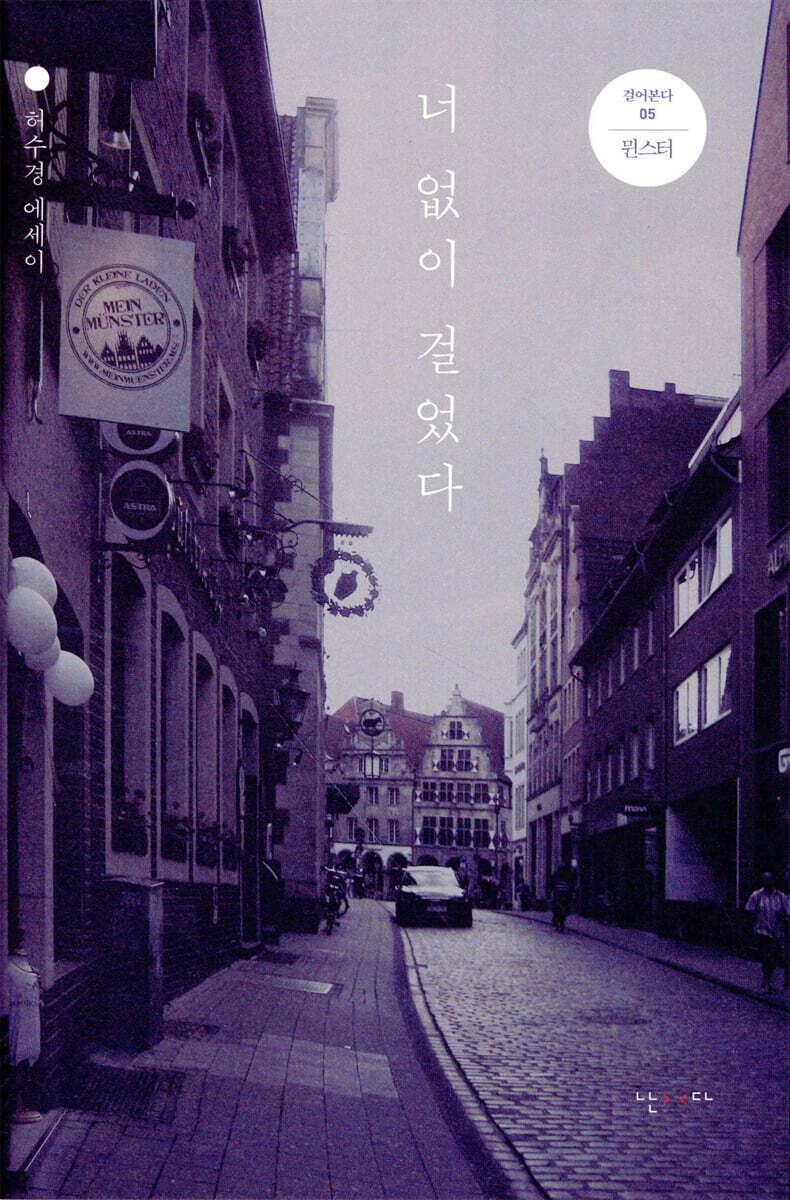
I walked without you
 |
Description
Book Introduction
“You can’t forget a road you often take.
The reason we can't forget is because we often passed each other by in our hearts."
You and me, poetry, and Münster!
Nanda's fifth story of walking.
Poet Heo Su-gyeong, who immigrated to Germany and has lived there for 23 years, introduces the people and times of the place that she walks slowly and looks deeply into, woven together with the poetry of German poets.
For example, each chapter includes a poem by a German poet that she translated, which is quite useful for understanding the history, traditions, and culture of Germany and Münster that she knows and has come to know.
There are poets like Heine, Trakl, Benn, Sachs, Goethe, and Rilke, who are widely known to us, but we also pronounce unfamiliar names like Gwerda, Eisinger, Hofmannsthal, and Drostehuelshoff, who have never been introduced before.
However, there is no need to question the poet's fame, as the poems introduced through her translation are themed around Münster, which began around the 6th century BC and grew into a 'city' with a population of 300,000 today, and are largely based on the history of Germany, a country that experienced a devastating war.
The reason we can't forget is because we often passed each other by in our hearts."
You and me, poetry, and Münster!
Nanda's fifth story of walking.
Poet Heo Su-gyeong, who immigrated to Germany and has lived there for 23 years, introduces the people and times of the place that she walks slowly and looks deeply into, woven together with the poetry of German poets.
For example, each chapter includes a poem by a German poet that she translated, which is quite useful for understanding the history, traditions, and culture of Germany and Münster that she knows and has come to know.
There are poets like Heine, Trakl, Benn, Sachs, Goethe, and Rilke, who are widely known to us, but we also pronounce unfamiliar names like Gwerda, Eisinger, Hofmannsthal, and Drostehuelshoff, who have never been introduced before.
However, there is no need to question the poet's fame, as the poems introduced through her translation are themed around Münster, which began around the 6th century BC and grew into a 'city' with a population of 300,000 today, and are largely based on the history of Germany, a country that experienced a devastating war.
- You can preview some of the book's contents.
Preview
index
Prologue
1│A City of Coincidence
2│At the train station
3│In front of the Lacquerware Museum
4│The Blue Ring of Münster
5│From Zwinger
6│Salt Road, and Other Roads─A War That Is Far Yet Near?
8│Central Market and Old City Hall
9│The Cathedral and its surroundings
10│On Ludgeri Street and König Street
11│Walking along the Münster River 1
12│Walking along the Münster River 2
13│At Lake Aho
14│From the Cupiertel to Frauenkirche
epilogue
1│A City of Coincidence
2│At the train station
3│In front of the Lacquerware Museum
4│The Blue Ring of Münster
5│From Zwinger
6│Salt Road, and Other Roads─A War That Is Far Yet Near?
8│Central Market and Old City Hall
9│The Cathedral and its surroundings
10│On Ludgeri Street and König Street
11│Walking along the Münster River 1
12│Walking along the Münster River 2
13│At Lake Aho
14│From the Cupiertel to Frauenkirche
epilogue
Into the book
Kimbap means well-organized chaos.
The ingredients used in kimbap come from rivers, the sea, and the fields.
Vegetables, fish cakes, ham, and seasoned rice.
All of these things are mixed with salt and mixed together to form a mixture and then go into the seaweed.
Therefore, kimbap signifies a cold time filled with the confusion brought about by salt.
Anyone who has ever salted food knows that in the heat, salt just sits around and reveals its true colors when the food cools.
We know how salty and bitter the pickled time is when it enters our mouths, but we cannot shake off its temptation.
To taste the saltiness of life, we go to the train station.
Even though I often get choked up while eating kimbap on the train and the train station I was leaving from keeps appearing in my mind.
--- p.41-42
What are you drawing?
Just… …whatever you want.
I was speechless in front of a girl who asked me to draw what she wanted.
What do I want?
I drew a small house standing in a yard full of flowers.
And he drew women busily going back and forth in the house, preparing dinner, and children playing marbles in front of the women.
I drew a chimney with small clouds of smoke coming out of it, and a bird flying next to it.
When she finished drawing, the girl said to me.
Please draw a walnut tree in front of the window.
why?
Winter is coming, so even squirrels need food.
The ingredients used in kimbap come from rivers, the sea, and the fields.
Vegetables, fish cakes, ham, and seasoned rice.
All of these things are mixed with salt and mixed together to form a mixture and then go into the seaweed.
Therefore, kimbap signifies a cold time filled with the confusion brought about by salt.
Anyone who has ever salted food knows that in the heat, salt just sits around and reveals its true colors when the food cools.
We know how salty and bitter the pickled time is when it enters our mouths, but we cannot shake off its temptation.
To taste the saltiness of life, we go to the train station.
Even though I often get choked up while eating kimbap on the train and the train station I was leaving from keeps appearing in my mind.
--- p.41-42
What are you drawing?
Just… …whatever you want.
I was speechless in front of a girl who asked me to draw what she wanted.
What do I want?
I drew a small house standing in a yard full of flowers.
And he drew women busily going back and forth in the house, preparing dinner, and children playing marbles in front of the women.
I drew a chimney with small clouds of smoke coming out of it, and a bird flying next to it.
When she finished drawing, the girl said to me.
Please draw a walnut tree in front of the window.
why?
Winter is coming, so even squirrels need food.
--- p.191-192
Publisher's Review
“You can’t forget a road you often take.
The reason we can't forget is because we often passed each other by in our hearts."
You and me, poetry, and Münster!
*
Nanda's fifth story of walking.
Poet Heo Su-gyeong, who moved to Germany and has lived there for 23 years, is set in Münster, and she slowly walks and looks deeply into the people and times of that place, and she smoothly weaves them together with the poetry of German poets.
For example, each chapter includes a poem by a German poet that she translated, which is quite useful for understanding the history, traditions, and culture of Germany and Münster that she knows and has come to know.
This is because their poetry, which is being introduced through her translation, is themed around Münster, which began around the 6th century BC and grew into a 'city' with a population of 300,000 today, and is also based on the history of Germany, a country that experienced a devastating war.
"When I was tired of walking down the streets of Münster, I sat down on a bench and read Trakl's poems. Suddenly, it occurred to me that life is strange and terrifying at any moment.
Who wouldn't be like that?
You too, living in your city, your existence will be cold and bitter.
"Like a lone little pufferfish suddenly caught in a rubber tub in a fish market and thrown to the market floor." -p26
There are poets like Heine, Trakl, Benn, Sachs, Goethe, and Rilke, who are widely known to us, but we also pronounce unfamiliar names like Gwerda, Eisinger, Hofmannsthal, and Drostehuelshoff, who have never been introduced before.
Among them, I am particularly interested in 'Selma Merbaum Eisinger'.
A girl who has been completely ignored while we focus on Anne Frank.
A girl who died of typhus, a disease of war, at the age of eighteen.
A German girl from Cernovich, Romania.
A girl who dedicated a book of poetry she had started writing at the age of fifteen to her lover and died.
Her lover, Fichmann, was destined to leave for Palestine, and it is said that he, sensing his fate, entrusted the manuscript of the poetry collection to the girl's friend.
The ship that Fichmann was on eventually sank, but thanks to the girl's friend, the manuscript of the poetry collection barely survived.
The manuscript of a girl's poetry book that was in her friend's backpack during the long journey through Poland, Hungary, the Czech Republic, Austria, Germany, France, and from France by boat to Israel.
Thanks to a friend who later became a bank employee, the girl's poetry collection was able to be kept in a bank vault for a long time and was even included in a German textbook. The reason the girl's long story is told at such length is precisely because of this passage.
"One day, they rise to the surface of my heart, brightly basking in the sunlight like that brick wall.
If there were a name to be given to all that was breathing beneath the layers of the heart, what other name could there be but longing? -p117
*
At one time, we could say that we were in a similar situation to Germany.
He may have been going through some kind of transformation on the inside, but at least that was how it looked on the outside.
While Germany was tearing down the wall and Korea was tightening its barbed wire fence, a poet from a small Korean town called Jinju left for Germany, a small German town called Münster, to become a student.
It was 1992, and I was studying archaeology, not poetry.
Her colleagues said she would return soon, that she was a woman who could not live without Korea, that she was especially gifted at writing poetry in Korean, that she could cook any Korean food, and that she loved all of our writers unconditionally, so how could she possibly become a German woman? They said she would give it all up early and come back right away, but she has been away from Korea for 23 years and is still there.
Add a few more years and you'll have spent about half your life there.
The book I am about to introduce may be a keyhole or a pinhole that allows us to glimpse into the inner workings of such a person.
However, what I could clearly see while reading this book was that the place she loved so much was still Korea, and that even though she was walking alone all over Germany, her heart was still full of her own 'you' instead of her empty side.
*
Although "I Walked Without You" is referred to as a single essay, it is no exaggeration to say that it is a comprehensive cultural encyclopedia of Germany, covering the country of Germany, to the point that it is simultaneously a poetry collection and a history book.
The reasoning is deep and the writing is beautiful in objectively explaining a country from the past to the present.
Rather than being careful and neat like walking with newly bought high heels, it is flexible and free like walking with feet wearing sneakers that have been worn for a long time and are moderately worn.
Yet, I always know how to find the axis of what I want to say and the flagpole of my will and wave it.
“Lorelai the Temptress.
Poetry is a “dizzying text that tempts.”
However, we can call her a beautiful traveler because we know her unique personality.
Didn't she say that?
“Warm people always touch us warmly. This is the basis of our belief that we are human.”
Warmth, humanity, touch, trust, foundation - how beautiful these words are.
*
In this book, which consists of sixteen chapters, there are passages on every page that you simply cannot help but underline. This is because, as a foreigner, she often reveals her loneliness, yearning for the Korean language and yearning for it out of fear that she might be gradually losing it.
She said, “There was no way to endure the unfamiliarity other than walking.”
“There is a price to pay for loneliness,” he also said.
However, he confessed without hesitation from the beginning that what allowed him to endure was, more than anything, 'poetry'.
Going there and being like that, even there, being like that, “vague landscapes that cannot be grasped without poetry.
Just moments of foreignness that pass by like that.
“While reading the poems, those moments suddenly began to fill my heart with a sense of sadness,” confesses Heo Su-gyeong, a natural poet.
*
This book asks us about 'humanity', 'life', 'stars', 'existence', 'wounds', and 'death'.
It is a question she asks herself, but as we read it over and over again, it becomes a question upon question for us.
Her questions continue endlessly.
“I was nothing, but because of you, I was a little special,” she hummed.
Even if life is ugly, there is poetry and you learn 'comfort'.
One of the virtues that she values most is 'love'.
Love is over, but it teaches us hope that love can continue, and it teaches us despair that love is over and we can no longer see the person we loved.
“He found 'you'.
Then, poems that only he could write began to be written.
As can be seen from the saying, “Love gave him language,” to her, ‘love’ is like ‘poetry.’
It's all in 'poem'.
If we do not comfort the city we live in, who will?
Like it or not, haven't our cities embraced us?
Münster was a city that would not exist without you.
I've been walking through that city for a long time without you.
Like all the ordinary cities of this world, or the stars in the sky walking.
?p33
I walk while thinking of you.
You were there once.
And now he is absent.
I come to you and you come to me.
I can't believe this at all.
Someone is turning towards me, I am turning towards someone.
?p76
*
“You are roughly fifteen hours away.
So, because she says, “We are so close,” we know that the story of Korea contained in this book is not a story of the past, but a story of today, right now.
Although physically limited by time, she has lived through a generation and an era together in real time, and has taken on the role of another generous godmother who wants to feel our pain while always looking for a way to heal it.
There's nothing I can do.
It may be because the number is visible to her eyes.
It is cruel to be forgotten by those who sacrificed themselves.
This is why a society that encourages forgetting is inhumane.
When people forget someone's wrongdoing, they become beasts.
The beast is not aware of what it is doing as it drives humans back into a corner of injustice.
They try to assert and enforce their own righteousness.
Resisting forgetting is the bare minimum we can do to preserve our humanity. p91-92
We are both objects of forgetting, and we are also the agents who cause someone or something to disappear by completely forgetting them.
The repeated vow, "I will not forget," repeatedly reminds us of how easily we forget. p171
*
When talking about her, one thing that cannot be left out is her 'hands'.
Aren't the words that she extends to you, the person reading this book now, also part of her hand?
The saying that a hand begets a hand means that two people must hold hands to hold a fragile glass that is likely to roll away and break.
In the end, the relationship between two people begins when they hold each other's hands, and the moment they hold each other's hands, it is said that it makes people come closer to each other.
It would not be an exaggeration to say that the meaning of 'peace' is to say that the last thing a human can do for another human is to hold their hand.
Isn't that true peace, telling each other that our hands are safe?
Your hand, the safety you must hold on this street.
My hands tremble that much, that anxiety.
It is an event for a human being to hold another's hand well.
How many times in our lives have we truly held hands?
Just a few hands.
Just a hand extended in the belief that it would touch death and love.
Hands that are hated by that rough work.
Those who remember walking down a cold street holding someone's hand will know what this hand means.
?p176
We probably need to read her story again and again, because there are reasons why she can't go back yet, reasons why she can't go to you, reasons why she hasn't explored everything inside her.
No, I think that's how you know.
Her own secret story, her true feelings.
Author's Note
Just stop by.
You may not come here on purpose, but if you happen to pass by this area, you will feel like a traveler without any plans, with a light shoulder,
Just once.
In this busy world, where do we find time for that?
okay.
But if, by some chance, you have the time,
If you fly from Incheon Airport and it takes about ten hours, you will arrive at Frankfurt Airport.
From Frankfurt Fernbahnhof, the airport station, it takes about three and a half or four hours by train to reach Münster.
Departing from Incheon Airport in the morning, after an eight-hour time difference (in winter) or seven-hour time difference (in summer), your arrival at Frankfurt Airport will be around evening.
Even in summer, the evenings in Germany are still bright.
Summer evenings here come surprisingly slowly.
Well, you could rent a car, or if you want, you could take a few days to get there by bike, even if it takes a very long time, but I would recommend taking the train.
Firstly, it is comfortable because you don't have to drive yourself, and above all, the train tracks are beautiful.
All you have to do is sit there, exhausted from your journey across the Eurasian continent.
This route, which passes through Frankfurt Station, Mainz, Koblenz, and Cologne, is the route of the Rhine River.
(……)
You might look out across the Rhine River at sunset from the train and, with a hint of trepidation, think of the road ahead.
That's what travel is like.
What accompanies humans on their journey to unfamiliar places is excitement and loneliness.
It's exciting to be faced with all the unknown, but having to deal with it all alone is a terrible loneliness.
Loneliness manifests itself in very specific physical symptoms when you find yourself at an airport or station for the first time, unable to find anyone to watch your luggage and having to drag it around in a hurry to find a bathroom.
And what awaits us when we arrive?
A very ordinary place on this Earth, yet a very special place because you chose to travel there.
When you arrive at Münster station, you might ask yourself in the dark, "Where is this ugly station?"
It's not that there aren't many ugly buildings like this in Münster, which was almost completely destroyed by World War II.
But which entrance is this?
It is an entrance to an unfamiliar place, but if you say, "Oh, the places where people live are the same," it is an entrance to a very familiar star.
The city is friendly to travelers, and you can already see inns in front of the station.
These inns might look as shabby as the station building.
But it's a good place to spend a day.
But there is one thing to be careful about.
Bicycles race through this city at breakneck speed! These city bikes have more power than cars.
So be careful.
When a bicycle suddenly appears and disappears, just smile.
The reason we can't forget is because we often passed each other by in our hearts."
You and me, poetry, and Münster!
*
Nanda's fifth story of walking.
Poet Heo Su-gyeong, who moved to Germany and has lived there for 23 years, is set in Münster, and she slowly walks and looks deeply into the people and times of that place, and she smoothly weaves them together with the poetry of German poets.
For example, each chapter includes a poem by a German poet that she translated, which is quite useful for understanding the history, traditions, and culture of Germany and Münster that she knows and has come to know.
This is because their poetry, which is being introduced through her translation, is themed around Münster, which began around the 6th century BC and grew into a 'city' with a population of 300,000 today, and is also based on the history of Germany, a country that experienced a devastating war.
"When I was tired of walking down the streets of Münster, I sat down on a bench and read Trakl's poems. Suddenly, it occurred to me that life is strange and terrifying at any moment.
Who wouldn't be like that?
You too, living in your city, your existence will be cold and bitter.
"Like a lone little pufferfish suddenly caught in a rubber tub in a fish market and thrown to the market floor." -p26
There are poets like Heine, Trakl, Benn, Sachs, Goethe, and Rilke, who are widely known to us, but we also pronounce unfamiliar names like Gwerda, Eisinger, Hofmannsthal, and Drostehuelshoff, who have never been introduced before.
Among them, I am particularly interested in 'Selma Merbaum Eisinger'.
A girl who has been completely ignored while we focus on Anne Frank.
A girl who died of typhus, a disease of war, at the age of eighteen.
A German girl from Cernovich, Romania.
A girl who dedicated a book of poetry she had started writing at the age of fifteen to her lover and died.
Her lover, Fichmann, was destined to leave for Palestine, and it is said that he, sensing his fate, entrusted the manuscript of the poetry collection to the girl's friend.
The ship that Fichmann was on eventually sank, but thanks to the girl's friend, the manuscript of the poetry collection barely survived.
The manuscript of a girl's poetry book that was in her friend's backpack during the long journey through Poland, Hungary, the Czech Republic, Austria, Germany, France, and from France by boat to Israel.
Thanks to a friend who later became a bank employee, the girl's poetry collection was able to be kept in a bank vault for a long time and was even included in a German textbook. The reason the girl's long story is told at such length is precisely because of this passage.
"One day, they rise to the surface of my heart, brightly basking in the sunlight like that brick wall.
If there were a name to be given to all that was breathing beneath the layers of the heart, what other name could there be but longing? -p117
*
At one time, we could say that we were in a similar situation to Germany.
He may have been going through some kind of transformation on the inside, but at least that was how it looked on the outside.
While Germany was tearing down the wall and Korea was tightening its barbed wire fence, a poet from a small Korean town called Jinju left for Germany, a small German town called Münster, to become a student.
It was 1992, and I was studying archaeology, not poetry.
Her colleagues said she would return soon, that she was a woman who could not live without Korea, that she was especially gifted at writing poetry in Korean, that she could cook any Korean food, and that she loved all of our writers unconditionally, so how could she possibly become a German woman? They said she would give it all up early and come back right away, but she has been away from Korea for 23 years and is still there.
Add a few more years and you'll have spent about half your life there.
The book I am about to introduce may be a keyhole or a pinhole that allows us to glimpse into the inner workings of such a person.
However, what I could clearly see while reading this book was that the place she loved so much was still Korea, and that even though she was walking alone all over Germany, her heart was still full of her own 'you' instead of her empty side.
*
Although "I Walked Without You" is referred to as a single essay, it is no exaggeration to say that it is a comprehensive cultural encyclopedia of Germany, covering the country of Germany, to the point that it is simultaneously a poetry collection and a history book.
The reasoning is deep and the writing is beautiful in objectively explaining a country from the past to the present.
Rather than being careful and neat like walking with newly bought high heels, it is flexible and free like walking with feet wearing sneakers that have been worn for a long time and are moderately worn.
Yet, I always know how to find the axis of what I want to say and the flagpole of my will and wave it.
“Lorelai the Temptress.
Poetry is a “dizzying text that tempts.”
However, we can call her a beautiful traveler because we know her unique personality.
Didn't she say that?
“Warm people always touch us warmly. This is the basis of our belief that we are human.”
Warmth, humanity, touch, trust, foundation - how beautiful these words are.
*
In this book, which consists of sixteen chapters, there are passages on every page that you simply cannot help but underline. This is because, as a foreigner, she often reveals her loneliness, yearning for the Korean language and yearning for it out of fear that she might be gradually losing it.
She said, “There was no way to endure the unfamiliarity other than walking.”
“There is a price to pay for loneliness,” he also said.
However, he confessed without hesitation from the beginning that what allowed him to endure was, more than anything, 'poetry'.
Going there and being like that, even there, being like that, “vague landscapes that cannot be grasped without poetry.
Just moments of foreignness that pass by like that.
“While reading the poems, those moments suddenly began to fill my heart with a sense of sadness,” confesses Heo Su-gyeong, a natural poet.
*
This book asks us about 'humanity', 'life', 'stars', 'existence', 'wounds', and 'death'.
It is a question she asks herself, but as we read it over and over again, it becomes a question upon question for us.
Her questions continue endlessly.
“I was nothing, but because of you, I was a little special,” she hummed.
Even if life is ugly, there is poetry and you learn 'comfort'.
One of the virtues that she values most is 'love'.
Love is over, but it teaches us hope that love can continue, and it teaches us despair that love is over and we can no longer see the person we loved.
“He found 'you'.
Then, poems that only he could write began to be written.
As can be seen from the saying, “Love gave him language,” to her, ‘love’ is like ‘poetry.’
It's all in 'poem'.
If we do not comfort the city we live in, who will?
Like it or not, haven't our cities embraced us?
Münster was a city that would not exist without you.
I've been walking through that city for a long time without you.
Like all the ordinary cities of this world, or the stars in the sky walking.
?p33
I walk while thinking of you.
You were there once.
And now he is absent.
I come to you and you come to me.
I can't believe this at all.
Someone is turning towards me, I am turning towards someone.
?p76
*
“You are roughly fifteen hours away.
So, because she says, “We are so close,” we know that the story of Korea contained in this book is not a story of the past, but a story of today, right now.
Although physically limited by time, she has lived through a generation and an era together in real time, and has taken on the role of another generous godmother who wants to feel our pain while always looking for a way to heal it.
There's nothing I can do.
It may be because the number is visible to her eyes.
It is cruel to be forgotten by those who sacrificed themselves.
This is why a society that encourages forgetting is inhumane.
When people forget someone's wrongdoing, they become beasts.
The beast is not aware of what it is doing as it drives humans back into a corner of injustice.
They try to assert and enforce their own righteousness.
Resisting forgetting is the bare minimum we can do to preserve our humanity. p91-92
We are both objects of forgetting, and we are also the agents who cause someone or something to disappear by completely forgetting them.
The repeated vow, "I will not forget," repeatedly reminds us of how easily we forget. p171
*
When talking about her, one thing that cannot be left out is her 'hands'.
Aren't the words that she extends to you, the person reading this book now, also part of her hand?
The saying that a hand begets a hand means that two people must hold hands to hold a fragile glass that is likely to roll away and break.
In the end, the relationship between two people begins when they hold each other's hands, and the moment they hold each other's hands, it is said that it makes people come closer to each other.
It would not be an exaggeration to say that the meaning of 'peace' is to say that the last thing a human can do for another human is to hold their hand.
Isn't that true peace, telling each other that our hands are safe?
Your hand, the safety you must hold on this street.
My hands tremble that much, that anxiety.
It is an event for a human being to hold another's hand well.
How many times in our lives have we truly held hands?
Just a few hands.
Just a hand extended in the belief that it would touch death and love.
Hands that are hated by that rough work.
Those who remember walking down a cold street holding someone's hand will know what this hand means.
?p176
We probably need to read her story again and again, because there are reasons why she can't go back yet, reasons why she can't go to you, reasons why she hasn't explored everything inside her.
No, I think that's how you know.
Her own secret story, her true feelings.
Author's Note
Just stop by.
You may not come here on purpose, but if you happen to pass by this area, you will feel like a traveler without any plans, with a light shoulder,
Just once.
In this busy world, where do we find time for that?
okay.
But if, by some chance, you have the time,
If you fly from Incheon Airport and it takes about ten hours, you will arrive at Frankfurt Airport.
From Frankfurt Fernbahnhof, the airport station, it takes about three and a half or four hours by train to reach Münster.
Departing from Incheon Airport in the morning, after an eight-hour time difference (in winter) or seven-hour time difference (in summer), your arrival at Frankfurt Airport will be around evening.
Even in summer, the evenings in Germany are still bright.
Summer evenings here come surprisingly slowly.
Well, you could rent a car, or if you want, you could take a few days to get there by bike, even if it takes a very long time, but I would recommend taking the train.
Firstly, it is comfortable because you don't have to drive yourself, and above all, the train tracks are beautiful.
All you have to do is sit there, exhausted from your journey across the Eurasian continent.
This route, which passes through Frankfurt Station, Mainz, Koblenz, and Cologne, is the route of the Rhine River.
(……)
You might look out across the Rhine River at sunset from the train and, with a hint of trepidation, think of the road ahead.
That's what travel is like.
What accompanies humans on their journey to unfamiliar places is excitement and loneliness.
It's exciting to be faced with all the unknown, but having to deal with it all alone is a terrible loneliness.
Loneliness manifests itself in very specific physical symptoms when you find yourself at an airport or station for the first time, unable to find anyone to watch your luggage and having to drag it around in a hurry to find a bathroom.
And what awaits us when we arrive?
A very ordinary place on this Earth, yet a very special place because you chose to travel there.
When you arrive at Münster station, you might ask yourself in the dark, "Where is this ugly station?"
It's not that there aren't many ugly buildings like this in Münster, which was almost completely destroyed by World War II.
But which entrance is this?
It is an entrance to an unfamiliar place, but if you say, "Oh, the places where people live are the same," it is an entrance to a very familiar star.
The city is friendly to travelers, and you can already see inns in front of the station.
These inns might look as shabby as the station building.
But it's a good place to spend a day.
But there is one thing to be careful about.
Bicycles race through this city at breakneck speed! These city bikes have more power than cars.
So be careful.
When a bicycle suddenly appears and disappears, just smile.
GOODS SPECIFICS
- Date of issue: August 12, 2015
- Page count, weight, size: 244 pages | 398g | 138*210*20mm
- ISBN13: 9788954635455
- ISBN10: 8954635458
You may also like
카테고리
korean


korean

![GQ KOREA Mark (Monthly): December [2025]](http://librairie.coreenne.fr/cdn/shop/files/8ef265dbbfbf186523ed75ba7319009d.jpg?v=1765340328&width=3840)


