

The Damian Project
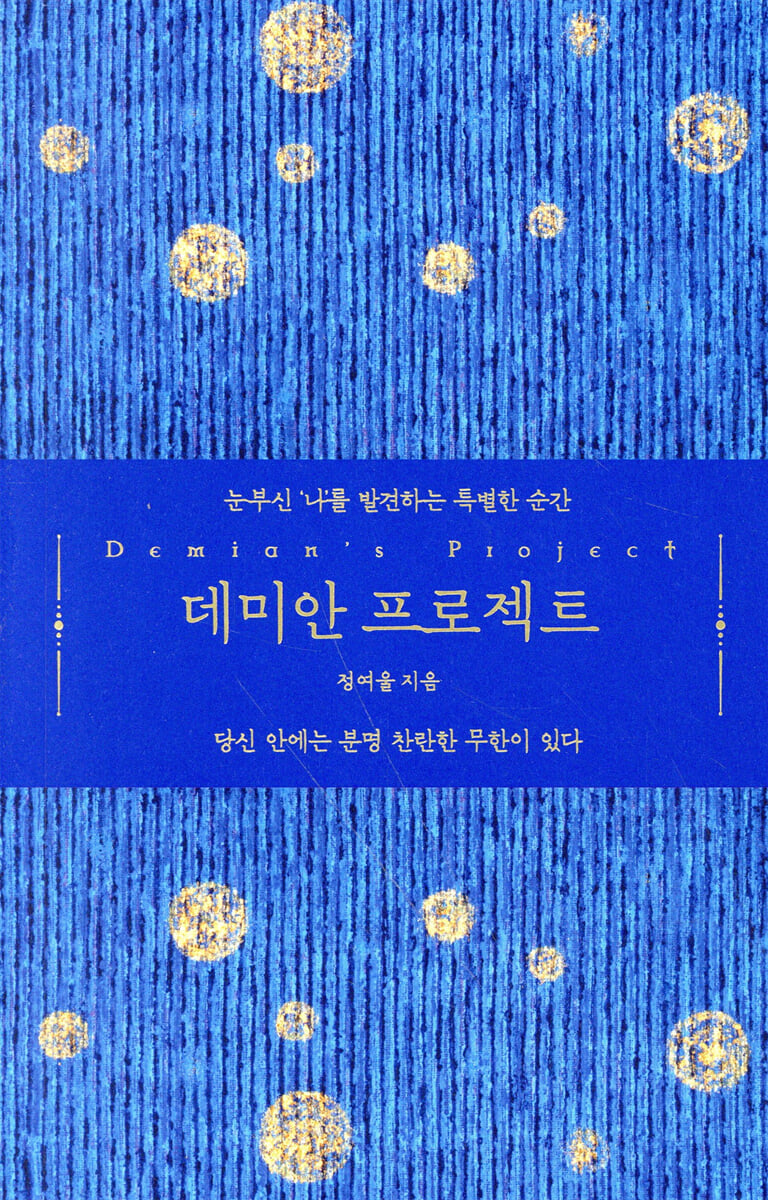 |
Description
Book Introduction
- A word from MD
- A meeting between Hermann Hesse's coming-of-age novel, Demian, and literary critic Jeong Yeo-ul.
A captivating novel about who we are as humans and how we should grow, told through the keen and warm eyes of author Jeong Yeo-ul.
It tells a colorful story about self, others, relationships, violence, hardship, and growth.
- Son Min-gyu, humanities PD
Over 500,000 cumulative views on YouTube!
Meet author Jeong Yeo-ul's special lecture on Damian in book form!
A special moment to discover your dazzling self
Jeong Yeo-ul's new work, "The Demian Project"
A search for "Jeong Yeo-ul Damian" reveals a variety of Damian lecture videos, each with over 500,000 cumulative views on YouTube. The Damian lectures, originally presented on EBS's "The Joy of Knowledge," remain among Jeong Yeo-ul's most frequently requested lectures, along with her writing and psychology lectures.
Jeong Yeo-ul's Damien lectures, which have been presented without fail in libraries and middle and high schools nationwide for 20 years, are now available in book form! Jeong Yeo-ul, a writer and literary critic with 20 years of experience, has been a popular lecturer, accumulating over 500,000 cumulative views on YouTube.
Author Jeong Yeo-ul's perspective, which interprets Demian in her own unique way and shares it with readers, stems from her attitude toward life, which considers reading not merely a tool for culture but an "active prescription for growth and healing."
Meet author Jeong Yeo-ul's special lecture on Damian in book form!
A special moment to discover your dazzling self
Jeong Yeo-ul's new work, "The Demian Project"
A search for "Jeong Yeo-ul Damian" reveals a variety of Damian lecture videos, each with over 500,000 cumulative views on YouTube. The Damian lectures, originally presented on EBS's "The Joy of Knowledge," remain among Jeong Yeo-ul's most frequently requested lectures, along with her writing and psychology lectures.
Jeong Yeo-ul's Damien lectures, which have been presented without fail in libraries and middle and high schools nationwide for 20 years, are now available in book form! Jeong Yeo-ul, a writer and literary critic with 20 years of experience, has been a popular lecturer, accumulating over 500,000 cumulative views on YouTube.
Author Jeong Yeo-ul's perspective, which interprets Demian in her own unique way and shares it with readers, stems from her attitude toward life, which considers reading not merely a tool for culture but an "active prescription for growth and healing."
- You can preview some of the book's contents.
Preview
index
Author's Note
For my dazzling Damian
Opening remarks
Are you still putting off meeting your true self?
Part 1: Come to the Damian Book Club with You and Me
birth
Meet the other me inside me
Your inner child is crying
shadow
The moment trauma awakens
Sunshine Child and Shadow Child
I had a dream about killing my father
Am I Cain or Abel?
love
Like a flame, like Athena
A world ruled by the superego
Finding the gold within
unity
The pain of a fighter, unrequited love, is the dazzling compass of my life.
If you want to communicate with the earnest unconsciousness within you
Sometimes a life of debauchery is necessary
Encounter with the Higher Self
Teachers who hurt me
Personalization
Discovering the seeds of emotion
Battle the dragon, fight everything that keeps me from growing up.
We too can personalize every day.
Abraxas
Be enlightened alone in the wilderness
Can you love your friend's mother?
Transformation
Kiss your blood-soaked lips
When I look in the mirror, I see you beyond me
Let's join us for part 2, the training of a steel-like soul.
consensus
We can all be Damian
Mental training for those lacking animus
In a world lacking anima, overcoming the ego that dreams of a 'supercar'
Exploration
I am a wounded bird
When the shadow helps me
How to Care for Your Trauma
journey
A brilliant leap into the real world
We are all crazy
Closing remarks
Will Abraxas come to me too?
For my dazzling Damian
Opening remarks
Are you still putting off meeting your true self?
Part 1: Come to the Damian Book Club with You and Me
birth
Meet the other me inside me
Your inner child is crying
shadow
The moment trauma awakens
Sunshine Child and Shadow Child
I had a dream about killing my father
Am I Cain or Abel?
love
Like a flame, like Athena
A world ruled by the superego
Finding the gold within
unity
The pain of a fighter, unrequited love, is the dazzling compass of my life.
If you want to communicate with the earnest unconsciousness within you
Sometimes a life of debauchery is necessary
Encounter with the Higher Self
Teachers who hurt me
Personalization
Discovering the seeds of emotion
Battle the dragon, fight everything that keeps me from growing up.
We too can personalize every day.
Abraxas
Be enlightened alone in the wilderness
Can you love your friend's mother?
Transformation
Kiss your blood-soaked lips
When I look in the mirror, I see you beyond me
Let's join us for part 2, the training of a steel-like soul.
consensus
We can all be Damian
Mental training for those lacking animus
In a world lacking anima, overcoming the ego that dreams of a 'supercar'
Exploration
I am a wounded bird
When the shadow helps me
How to Care for Your Trauma
journey
A brilliant leap into the real world
We are all crazy
Closing remarks
Will Abraxas come to me too?
Detailed image
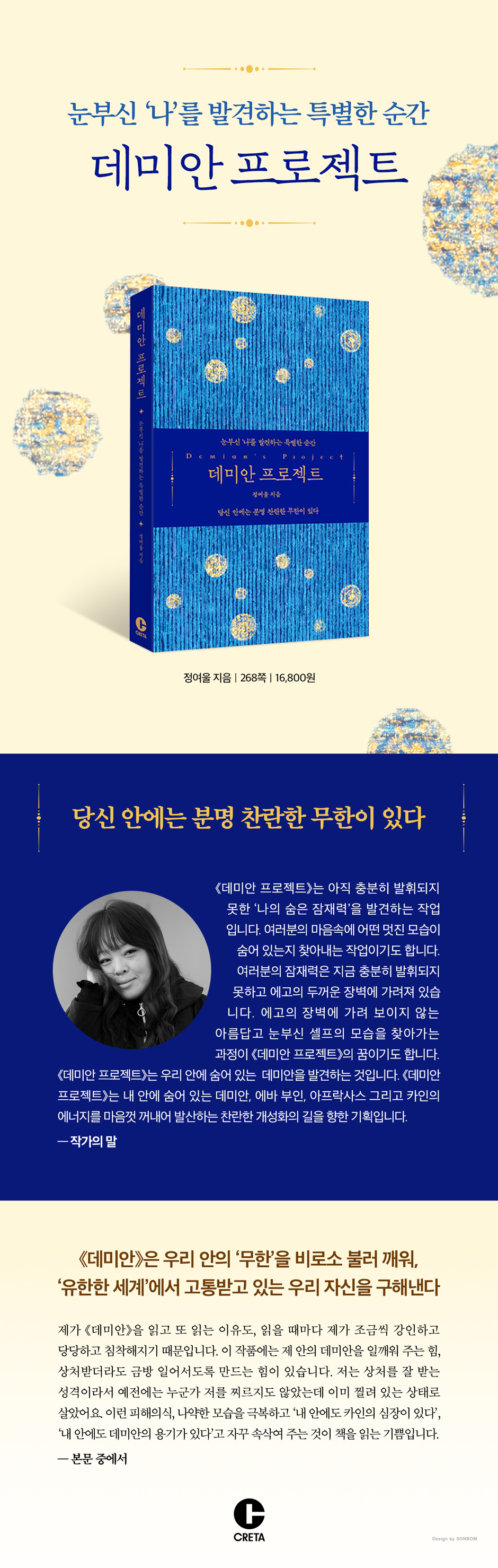
Into the book
The process of finally embracing Demian, a transcendent being, a mentor figure who is sometimes burdensome, immensely great, and difficult to approach, as part of himself, is ultimately the process by which Sinclair sheds the mask of his ego and encounters his true self.
Only when we warmly embrace the other self that speaks so earnestly within our hearts can we rise powerfully as better beings.
That is what Carl Gustav Jung meant by individuation.
Individuation refers to the moment when the 'ego that is swayed by the gaze of others' and the 'self that protects the true self' become one, the moment when the social self takes off its mask and meets the true self.
This process of individuation is every moment that deepens the friendship between Demian and Sinclair.
--- p.28~29
The path from ego to self is indeed arduous, but it is not necessarily sad and difficult.
As we cross each threshold on that path, we can meet true friends.
The moment I cross the threshold within me is the moment I meet the painful shadow in my heart.
In psychology, this is called 'confrontation.' When we encounter our painful wounds, it doesn't end with the pain. Rather, the deeper we encounter them, the more we open the way to experiencing deeper dimensions of life.
--- p.31~32
In the past, I only read Demian from Sinclair's perspective.
Now, you can read it from Damian's perspective, from Kromer's perspective, and from your parents' perspective.
Reading a book is like living with multiple layers of self.
Through literary works, we can experience multiple layers of self, a completely different person who cannot be satisfied with just one life, another self.
I think that is the joy of reading a beautiful work like 『Demian』.
--- p.
35~36
The gesture of breaking the thick shell surrounding me and finally flying towards Abraxas is individualization.
In order to become my true self, I must break my egg, be born again, and experience a new second birth. This is the growth that Sinclair, the protagonist of 『Demian』, will eventually experience.
It was Demian who helped Sinclair shake off the fears and anxieties of his inner child, and Demian recognized that such potential already existed within Sinclair.
The infinite potential of the adult self already existed within Sinclair, but Sinclair pretended not to know it.
--- p.59
Dreaming of killing one's father is surprisingly a very positive dream in Jungian psychology.
Because I see it as a dream of overcoming the father within me, the archetype within me, and the origin.
In Jungian psychology, even when we hate our parents, we are actually hating 'a part of our parents, a part that resembles them'.
Rather than hating your parents themselves, it may be more fundamental to be afraid that there might be something similar to them inside you.
If one of your parents passes away in your dream, it could be a story about overcoming your parents' trauma.
--- p.66
What is the true meaning of Cain's target? It's the belief in myself that I'm okay being alone, that I'm okay with carving out the life I want on my own.
From the perspective of religion or faith, it can be viewed negatively, thinking, 'What kind of person is this? Does he say he doesn't need faith? Does he say he won't rely on God? Does he believe in things like Abraxas? Isn't that a cult or heresy?'
But Damian doesn't care about the gaze of others, the gaze of religion, or the gaze of the group.
Damian was always on the path to individualization with Madame Eva.
Damian had been walking the arduous path of individualization since he was a young boy, a path that most people only begin when they reach middle age.
Damian was truly not afraid of other people's gaze at all.
--- p.78
The feminine (anima) that creates culture is the force that creates a better world through healing and caring.
There are people who embrace existence without giving up, no matter how difficult the situation is.
People who consider others' pain as their own, people who care for and heal the struggling and lonely, thanks to them, the world becomes more livable each day.
The world may seem full of evil villains, but the power of anima, the power of caring and healing, will ultimately prevail.
I believe that Madame Eva, another protagonist of 『Demian』, symbolizes the healing, caring, loving, and empathetic energy of the anima.
--- p.84
The moment Sinclair realizes Demian's warm heart, he thinks this.
Finally, I am no longer alone.
Sinclair finally realizes how scared and lonely he has been.
A strong sense of salvation begins to drift in like a fragrant spring breeze.
What his parents could not do, what no adult had ever done for Sinclair, little Damien did.
It was a great work that saved the soul of one suffering person.
Damian brings out Sinclair's hidden warrior nature.
You can fight.
It gave me courage to believe that I could definitely stand on the path to my own individualization.
--- p.92
The mind that strives toward the ultimate self is also called 'the higher self'.
Not the worldly self that people simply know as me, not the me in reality, not the me that others define for me, but the greater potential of myself that only I know.
A more transparent encounter with myself, completely unrelated to social status, status, business cards, or specifications.
That's Higher Self.
Sinclair's longing for Demian and his desire to become a great person like Demian, the kind of painting that Van Gogh wanted to paint with his whole life, not a painting that sells to others, that is the higher self, the Higher Self.
Finally, Sinclair encounters his most honest self and realizes a deeper longing within himself.
--- p.125
The unconscious becomes conscious, that was the picture of the falcon, and Damian deciphered the message accurately.
It was a picture of Sinclair's future.
What is the name of the bird drawn in this picture?
It must have been Abraxas.
Sinclair drew Abraxas instinctively, following the call of his unconscious.
Abraxas was the 'seed of dreams' that Damian had planted in Sinclair years ago.
For a while, the seed of a dream planted in Sinclair was barely sprouting.
Sinclair's dream seed, after germination through wandering and debauchery, gradually matures in the pure, sacred, and noble 'soil of the heart' of life, and finally draws the bird called Abraxas.
The act of ‘drawing’ simultaneously conveys the nuance of ‘longing’ and the nuance of ‘depicting.’
If you draw with all your might, you will miss with all your might, and if you write with all your might, you will also practice with all your might.
Drawing Abraxas signifies that Sinclair has begun the path of brilliant individualization toward Abraxas.
Sinclair finally found the strength to draw the ultimate milestone of his own heart.
--- p.132
I got everything I lacked through 'books'.
I no longer need to blame the environment, as I gain all the foundation for my lack of sensitivity from all kinds of books every day.
People with a fierce passion for exploration and who never give up their passion will eventually be able to cultivate the anima and animus they lack.
I hope you don't blame yourself and say, "Why am I so insensitive?" just because you can't see the anima and animus clearly right now.
--- p.138
Chrome is always with us.
The important thing is that we must always have the courage to fight and win against the Cromer.
When I can't do it alone, I have to have the courage to call on the Damiens around us, the strength to ask for help.
We must each fight desperately against our own chromers.
To do that, you need the wings of Abraxas.
When a baby bird hatches from an egg, not only does the mother bird peck at it with her beak, but the baby bird inside the egg also puts in a tremendous amount of effort.
It's called "Jultaksimsimultaneous" or "Jultaksimultaneous".
We must not only stimulate ourselves from the outside, but also from the inside, never stopping our efforts to come out.
--- p.154
This is how I interpret Abraxas.
Abraxas is the courage to embrace both the light and shadow of life.
Even if you go to war and lose the person you love most, you must embrace even that maddening sadness because it is a part of life.
Sending Damian out to the battlefield and losing him forever in that terrible place.
That would be a tremendous trauma that Sinclair would have to endure for the rest of his life.
Abraxas would say that even that trauma must be embraced.
Because if we only take the sweet cherries of life and leave out the dry and sticky parts of it, we will never be able to get to the essence of life.
There's also a saying called cherry picking.
It refers to the quiet nature of wanting to take only the good aspects of life.
But with that attitude, you can never reach the path of the great Abraxas.
Abraxas is a terrifying embrace of immeasurable depth and breadth, capable of embracing any shadow, any sorrow, any trauma, any tear.
--- p.176
Protect yourself from the violence of anyone who tries to gaslight you.
It takes courage to distance yourself from the obsession of anyone who seeks to use, exploit, and harass you.
We dream that only then will we meet our true selves, and that at that moment, the warm and affectionate mentor that comes to mind will be Damian.
--- p.204
Caring for your shadow means cherishing and trying to heal your trauma rather than pushing it away.
Doesn't the trauma hidden deep within our subconscious wish for our conscious mind to take care of us?
There are times when I feel the shadow of my painful unconsciousness smiling.
Healing begins when I stop pushing away my trauma and start cherishing it, when I realize that I am no longer a "poor thing standing alone in the middle of that wound."
At times like that, I really feel like my shadow is helping me.
When you begin to care for that wound, creativity and potential begin to soar like a swallow filled with water.
It feels like digging through deep layers of trauma and finally discovering the ultimate gem in the cave of my unconscious.
I become happy when I write like this. I shine brightest when I write about caring for my shadow. When I realize this, my shadow finally begins to smile.
--- p.227
Don't give up and move forward boldly.
Because every single bit of the dazzling, rainbow-colored beauty in this splendid story, Demian, belongs to you.
One bold step, one proud step, one courageous step.
For you, who walk the path of individualization toward a "higher self" day after day, I will wholeheartedly support your every step, wherever you are.
Only when we warmly embrace the other self that speaks so earnestly within our hearts can we rise powerfully as better beings.
That is what Carl Gustav Jung meant by individuation.
Individuation refers to the moment when the 'ego that is swayed by the gaze of others' and the 'self that protects the true self' become one, the moment when the social self takes off its mask and meets the true self.
This process of individuation is every moment that deepens the friendship between Demian and Sinclair.
--- p.28~29
The path from ego to self is indeed arduous, but it is not necessarily sad and difficult.
As we cross each threshold on that path, we can meet true friends.
The moment I cross the threshold within me is the moment I meet the painful shadow in my heart.
In psychology, this is called 'confrontation.' When we encounter our painful wounds, it doesn't end with the pain. Rather, the deeper we encounter them, the more we open the way to experiencing deeper dimensions of life.
--- p.31~32
In the past, I only read Demian from Sinclair's perspective.
Now, you can read it from Damian's perspective, from Kromer's perspective, and from your parents' perspective.
Reading a book is like living with multiple layers of self.
Through literary works, we can experience multiple layers of self, a completely different person who cannot be satisfied with just one life, another self.
I think that is the joy of reading a beautiful work like 『Demian』.
--- p.
35~36
The gesture of breaking the thick shell surrounding me and finally flying towards Abraxas is individualization.
In order to become my true self, I must break my egg, be born again, and experience a new second birth. This is the growth that Sinclair, the protagonist of 『Demian』, will eventually experience.
It was Demian who helped Sinclair shake off the fears and anxieties of his inner child, and Demian recognized that such potential already existed within Sinclair.
The infinite potential of the adult self already existed within Sinclair, but Sinclair pretended not to know it.
--- p.59
Dreaming of killing one's father is surprisingly a very positive dream in Jungian psychology.
Because I see it as a dream of overcoming the father within me, the archetype within me, and the origin.
In Jungian psychology, even when we hate our parents, we are actually hating 'a part of our parents, a part that resembles them'.
Rather than hating your parents themselves, it may be more fundamental to be afraid that there might be something similar to them inside you.
If one of your parents passes away in your dream, it could be a story about overcoming your parents' trauma.
--- p.66
What is the true meaning of Cain's target? It's the belief in myself that I'm okay being alone, that I'm okay with carving out the life I want on my own.
From the perspective of religion or faith, it can be viewed negatively, thinking, 'What kind of person is this? Does he say he doesn't need faith? Does he say he won't rely on God? Does he believe in things like Abraxas? Isn't that a cult or heresy?'
But Damian doesn't care about the gaze of others, the gaze of religion, or the gaze of the group.
Damian was always on the path to individualization with Madame Eva.
Damian had been walking the arduous path of individualization since he was a young boy, a path that most people only begin when they reach middle age.
Damian was truly not afraid of other people's gaze at all.
--- p.78
The feminine (anima) that creates culture is the force that creates a better world through healing and caring.
There are people who embrace existence without giving up, no matter how difficult the situation is.
People who consider others' pain as their own, people who care for and heal the struggling and lonely, thanks to them, the world becomes more livable each day.
The world may seem full of evil villains, but the power of anima, the power of caring and healing, will ultimately prevail.
I believe that Madame Eva, another protagonist of 『Demian』, symbolizes the healing, caring, loving, and empathetic energy of the anima.
--- p.84
The moment Sinclair realizes Demian's warm heart, he thinks this.
Finally, I am no longer alone.
Sinclair finally realizes how scared and lonely he has been.
A strong sense of salvation begins to drift in like a fragrant spring breeze.
What his parents could not do, what no adult had ever done for Sinclair, little Damien did.
It was a great work that saved the soul of one suffering person.
Damian brings out Sinclair's hidden warrior nature.
You can fight.
It gave me courage to believe that I could definitely stand on the path to my own individualization.
--- p.92
The mind that strives toward the ultimate self is also called 'the higher self'.
Not the worldly self that people simply know as me, not the me in reality, not the me that others define for me, but the greater potential of myself that only I know.
A more transparent encounter with myself, completely unrelated to social status, status, business cards, or specifications.
That's Higher Self.
Sinclair's longing for Demian and his desire to become a great person like Demian, the kind of painting that Van Gogh wanted to paint with his whole life, not a painting that sells to others, that is the higher self, the Higher Self.
Finally, Sinclair encounters his most honest self and realizes a deeper longing within himself.
--- p.125
The unconscious becomes conscious, that was the picture of the falcon, and Damian deciphered the message accurately.
It was a picture of Sinclair's future.
What is the name of the bird drawn in this picture?
It must have been Abraxas.
Sinclair drew Abraxas instinctively, following the call of his unconscious.
Abraxas was the 'seed of dreams' that Damian had planted in Sinclair years ago.
For a while, the seed of a dream planted in Sinclair was barely sprouting.
Sinclair's dream seed, after germination through wandering and debauchery, gradually matures in the pure, sacred, and noble 'soil of the heart' of life, and finally draws the bird called Abraxas.
The act of ‘drawing’ simultaneously conveys the nuance of ‘longing’ and the nuance of ‘depicting.’
If you draw with all your might, you will miss with all your might, and if you write with all your might, you will also practice with all your might.
Drawing Abraxas signifies that Sinclair has begun the path of brilliant individualization toward Abraxas.
Sinclair finally found the strength to draw the ultimate milestone of his own heart.
--- p.132
I got everything I lacked through 'books'.
I no longer need to blame the environment, as I gain all the foundation for my lack of sensitivity from all kinds of books every day.
People with a fierce passion for exploration and who never give up their passion will eventually be able to cultivate the anima and animus they lack.
I hope you don't blame yourself and say, "Why am I so insensitive?" just because you can't see the anima and animus clearly right now.
--- p.138
Chrome is always with us.
The important thing is that we must always have the courage to fight and win against the Cromer.
When I can't do it alone, I have to have the courage to call on the Damiens around us, the strength to ask for help.
We must each fight desperately against our own chromers.
To do that, you need the wings of Abraxas.
When a baby bird hatches from an egg, not only does the mother bird peck at it with her beak, but the baby bird inside the egg also puts in a tremendous amount of effort.
It's called "Jultaksimsimultaneous" or "Jultaksimultaneous".
We must not only stimulate ourselves from the outside, but also from the inside, never stopping our efforts to come out.
--- p.154
This is how I interpret Abraxas.
Abraxas is the courage to embrace both the light and shadow of life.
Even if you go to war and lose the person you love most, you must embrace even that maddening sadness because it is a part of life.
Sending Damian out to the battlefield and losing him forever in that terrible place.
That would be a tremendous trauma that Sinclair would have to endure for the rest of his life.
Abraxas would say that even that trauma must be embraced.
Because if we only take the sweet cherries of life and leave out the dry and sticky parts of it, we will never be able to get to the essence of life.
There's also a saying called cherry picking.
It refers to the quiet nature of wanting to take only the good aspects of life.
But with that attitude, you can never reach the path of the great Abraxas.
Abraxas is a terrifying embrace of immeasurable depth and breadth, capable of embracing any shadow, any sorrow, any trauma, any tear.
--- p.176
Protect yourself from the violence of anyone who tries to gaslight you.
It takes courage to distance yourself from the obsession of anyone who seeks to use, exploit, and harass you.
We dream that only then will we meet our true selves, and that at that moment, the warm and affectionate mentor that comes to mind will be Damian.
--- p.204
Caring for your shadow means cherishing and trying to heal your trauma rather than pushing it away.
Doesn't the trauma hidden deep within our subconscious wish for our conscious mind to take care of us?
There are times when I feel the shadow of my painful unconsciousness smiling.
Healing begins when I stop pushing away my trauma and start cherishing it, when I realize that I am no longer a "poor thing standing alone in the middle of that wound."
At times like that, I really feel like my shadow is helping me.
When you begin to care for that wound, creativity and potential begin to soar like a swallow filled with water.
It feels like digging through deep layers of trauma and finally discovering the ultimate gem in the cave of my unconscious.
I become happy when I write like this. I shine brightest when I write about caring for my shadow. When I realize this, my shadow finally begins to smile.
--- p.227
Don't give up and move forward boldly.
Because every single bit of the dazzling, rainbow-colored beauty in this splendid story, Demian, belongs to you.
One bold step, one proud step, one courageous step.
For you, who walk the path of individualization toward a "higher self" day after day, I will wholeheartedly support your every step, wherever you are.
--- p.266~267
Publisher's Review
I have never discovered it before
To you who dreams of meeting 'me'
“There is definitely a brilliant infinity within you.”
“Demian” finally awakens the ‘infinity’ within us,
“It saves us from suffering in a ‘finite world.’”
“The bird struggles to break out of the egg.
The egg is the world.
He who wishes to be reborn must destroy a world.
The bird flies to God.
“The name of that god is Abraxas.”
Hermann Hesse, from Demian, translated by Jeong Yeo-ul
Author Jeong Yeo-ul, who revealed that the most consistently requested lecture during her 20 years as a writer was 'Jeong Yeo-ul's Reading of Demian', has included 'everything about Demian', which is difficult to convey in a few hours of lectures, in this book, 'The Demian Project'.
Author Jeong Yeo-ul, who reads 『Demian』 over and over again, says that she becomes stronger, more confident, and more composed every time she reads it.
Beyond the simple act of reading a book, the author goes out and discovers the Demian within himself, and discovers the strength that allows him to quickly rise up even when hurt.
The author, who had been troubled by his sensitive and introverted personality, sublimated it into his own strengths and went through his own process of 'individualization'. Through 'Demian', the author explored the light and shadow within himself and put all of what he realized, how to heal himself, and how to meet his true 'self' that he had not been able to properly discover until now into this book.
Additionally, all passages from 『Demian』 contained in 『Demian Project』 have been translated by the author himself, allowing you to experience them in Jeong Yeo-ul's own language.
Hermann Hesse, a master of German literature and winner of the Nobel Prize in Literature, wrote Demian, which caused a huge stir in German society immediately after World War I, and to this day, it remains the best-selling literary book in Korea as well as around the world.
『Demian』 is based on the friendship between the main characters Sinclair and Demian, and depicts their journey to find their 'true selves' through the trials, tribulations, and realizations they experience during their growth process.
“You are secret and great
You are invited to the ‘Damian Book Club’
For meeting the true 'me'
Classic Reading Project
In an interview, author Jeong Yeo-ul stated, “The value that allows humanity to come together is the invisible solidarity of people who have endured trauma, and the power of novels and literature is to make this invisible solidarity vivid before our eyes.”
The opening remarks also clearly identify the readers who will meet this book.
“I hope this book will be helpful to readers who have had 『Demian』 on their bookshelf for a long time but never finished it because it felt too difficult or burdensome, readers who like 『Demian』 but have secretly suffered because they felt they didn’t quite understand what it was saying, and those who aren’t yet 『Demian』 readers but have made grand plans to finish it someday.
If you are someone who has resolved, "If I ever have the courage to face my true self, I will read Demian," then I would especially like to gift you this book.
Because ‘a true encounter with myself’ is not a task that can be postponed until tomorrow.
Because even though it may be shameful, inadequate, terrible, and dangerous, meeting my own transparent soul, which is not obscured by any business card or title in this world, is a task that can never be postponed.
Because it is such a refreshing, fascinating and brilliant experience.
“Because meeting the real Demian within me, who only I can recognize, is more thrilling, dazzling, and an experience I cannot miss than any other encounter in this world.”
Demian, a literary classic consistently loved by Koreans, has the power to help people confront their own trauma.
In 『The Damien Project』, the author says, “Taking care of the shadow (trauma) means not pushing away trauma, but rather cherishing and trying to heal it,” and introduces methods for healing trauma and a life of ‘individualization’ in which trauma is healed.
The author sees humans as 'trees that grow both upwards and downwards' through the psychology of Carl Gustav Jung, and says that we should invite better books into our lives because watering the trauma in our unconscious with literature and psychology will help the roots of our unconscious grow better.
Through the Demian Project, author Jeong Yeo-ul invites readers to become members of Hermann Hesse's "Secret and Great Demian Book Club," a brilliantly individualized work.
Facing the shadow within me
The value of literature in healing trauma
This book is largely divided into two parts.
Part 1, 'Come, to Your and My Demian Book Club', contains the process of meeting the inner child still crying within me through 'Demian', realizing the shadow I was unaware of, and moving towards a 'higher self' that strives toward my greater potential that I have not yet encountered, through birth, shadow, love, unity, individuation, Abraxas, and transformation.
Part 2, "Let's do it together, training a soul like steel," encourages everyone to realize their true selves that they have yet to meet while living in this society and to become Damian, and recommends that everyone meet the brilliantly shining mentor Damian at least once in their life.
This is achieved through communication, exploration, and journey.
Through 『Demian』, the author explains how to comfort the wounded inner child and how to embrace all of the inner sadness and shadows.
In particular, the process of acknowledging not only one's positive and shining appearance but also trauma, violence, and sadness, and developing one's true self into an even more mature one is viewed as 'individuation' through Jungian psychology.
'The visible me' and 'the me as I am'
The first sentence of 『Demian』 is “I only wanted to live as it came naturally within me.
It begins with, “Why was it so difficult?”
Author Jeong Yeo-ul conveys that it is more important to find the 'true self' through 'confrontation' with the deep wounds within oneself rather than obsessing over how one appears to others.
When Demian sees Sinclair's drawing of a bird hatching from an egg and spreading its wings, he tells him that the bird is Abraxas.
The author states that Abraxas is not a perfect god, but a world where the worlds of good and evil are united, through which one can see both the light and shadow of life, become wiser, and face enlightenment.
It is explained that only through this process can one achieve 'individualization', that is, find one's true self.
How about discovering your true self through 『The Demian Project』, which captures the journey of self-discovery through Jungian psychology and the loving perspective of author Jeong Yeo-ul?
“Fight everything that keeps me from growing up.
Fight everything that distracts me from my true self.
I think this is Damian's hidden voice.”
To you who dreams of meeting 'me'
“There is definitely a brilliant infinity within you.”
“Demian” finally awakens the ‘infinity’ within us,
“It saves us from suffering in a ‘finite world.’”
“The bird struggles to break out of the egg.
The egg is the world.
He who wishes to be reborn must destroy a world.
The bird flies to God.
“The name of that god is Abraxas.”
Hermann Hesse, from Demian, translated by Jeong Yeo-ul
Author Jeong Yeo-ul, who revealed that the most consistently requested lecture during her 20 years as a writer was 'Jeong Yeo-ul's Reading of Demian', has included 'everything about Demian', which is difficult to convey in a few hours of lectures, in this book, 'The Demian Project'.
Author Jeong Yeo-ul, who reads 『Demian』 over and over again, says that she becomes stronger, more confident, and more composed every time she reads it.
Beyond the simple act of reading a book, the author goes out and discovers the Demian within himself, and discovers the strength that allows him to quickly rise up even when hurt.
The author, who had been troubled by his sensitive and introverted personality, sublimated it into his own strengths and went through his own process of 'individualization'. Through 'Demian', the author explored the light and shadow within himself and put all of what he realized, how to heal himself, and how to meet his true 'self' that he had not been able to properly discover until now into this book.
Additionally, all passages from 『Demian』 contained in 『Demian Project』 have been translated by the author himself, allowing you to experience them in Jeong Yeo-ul's own language.
Hermann Hesse, a master of German literature and winner of the Nobel Prize in Literature, wrote Demian, which caused a huge stir in German society immediately after World War I, and to this day, it remains the best-selling literary book in Korea as well as around the world.
『Demian』 is based on the friendship between the main characters Sinclair and Demian, and depicts their journey to find their 'true selves' through the trials, tribulations, and realizations they experience during their growth process.
“You are secret and great
You are invited to the ‘Damian Book Club’
For meeting the true 'me'
Classic Reading Project
In an interview, author Jeong Yeo-ul stated, “The value that allows humanity to come together is the invisible solidarity of people who have endured trauma, and the power of novels and literature is to make this invisible solidarity vivid before our eyes.”
The opening remarks also clearly identify the readers who will meet this book.
“I hope this book will be helpful to readers who have had 『Demian』 on their bookshelf for a long time but never finished it because it felt too difficult or burdensome, readers who like 『Demian』 but have secretly suffered because they felt they didn’t quite understand what it was saying, and those who aren’t yet 『Demian』 readers but have made grand plans to finish it someday.
If you are someone who has resolved, "If I ever have the courage to face my true self, I will read Demian," then I would especially like to gift you this book.
Because ‘a true encounter with myself’ is not a task that can be postponed until tomorrow.
Because even though it may be shameful, inadequate, terrible, and dangerous, meeting my own transparent soul, which is not obscured by any business card or title in this world, is a task that can never be postponed.
Because it is such a refreshing, fascinating and brilliant experience.
“Because meeting the real Demian within me, who only I can recognize, is more thrilling, dazzling, and an experience I cannot miss than any other encounter in this world.”
Demian, a literary classic consistently loved by Koreans, has the power to help people confront their own trauma.
In 『The Damien Project』, the author says, “Taking care of the shadow (trauma) means not pushing away trauma, but rather cherishing and trying to heal it,” and introduces methods for healing trauma and a life of ‘individualization’ in which trauma is healed.
The author sees humans as 'trees that grow both upwards and downwards' through the psychology of Carl Gustav Jung, and says that we should invite better books into our lives because watering the trauma in our unconscious with literature and psychology will help the roots of our unconscious grow better.
Through the Demian Project, author Jeong Yeo-ul invites readers to become members of Hermann Hesse's "Secret and Great Demian Book Club," a brilliantly individualized work.
Facing the shadow within me
The value of literature in healing trauma
This book is largely divided into two parts.
Part 1, 'Come, to Your and My Demian Book Club', contains the process of meeting the inner child still crying within me through 'Demian', realizing the shadow I was unaware of, and moving towards a 'higher self' that strives toward my greater potential that I have not yet encountered, through birth, shadow, love, unity, individuation, Abraxas, and transformation.
Part 2, "Let's do it together, training a soul like steel," encourages everyone to realize their true selves that they have yet to meet while living in this society and to become Damian, and recommends that everyone meet the brilliantly shining mentor Damian at least once in their life.
This is achieved through communication, exploration, and journey.
Through 『Demian』, the author explains how to comfort the wounded inner child and how to embrace all of the inner sadness and shadows.
In particular, the process of acknowledging not only one's positive and shining appearance but also trauma, violence, and sadness, and developing one's true self into an even more mature one is viewed as 'individuation' through Jungian psychology.
'The visible me' and 'the me as I am'
The first sentence of 『Demian』 is “I only wanted to live as it came naturally within me.
It begins with, “Why was it so difficult?”
Author Jeong Yeo-ul conveys that it is more important to find the 'true self' through 'confrontation' with the deep wounds within oneself rather than obsessing over how one appears to others.
When Demian sees Sinclair's drawing of a bird hatching from an egg and spreading its wings, he tells him that the bird is Abraxas.
The author states that Abraxas is not a perfect god, but a world where the worlds of good and evil are united, through which one can see both the light and shadow of life, become wiser, and face enlightenment.
It is explained that only through this process can one achieve 'individualization', that is, find one's true self.
How about discovering your true self through 『The Demian Project』, which captures the journey of self-discovery through Jungian psychology and the loving perspective of author Jeong Yeo-ul?
“Fight everything that keeps me from growing up.
Fight everything that distracts me from my true self.
I think this is Damian's hidden voice.”
GOODS SPECIFICS
- Date of issue: November 24, 2024
- Page count, weight, size: 268 pages | 314g | 130*200*18mm
- ISBN13: 9791192742380
- ISBN10: 1192742389
You may also like
카테고리
korean


korean

![GQ KOREA Mark (Monthly): December [2025]](http://librairie.coreenne.fr/cdn/shop/files/8ef265dbbfbf186523ed75ba7319009d.jpg?v=1765340328&width=3840)


