

Life is beautiful in Vienna
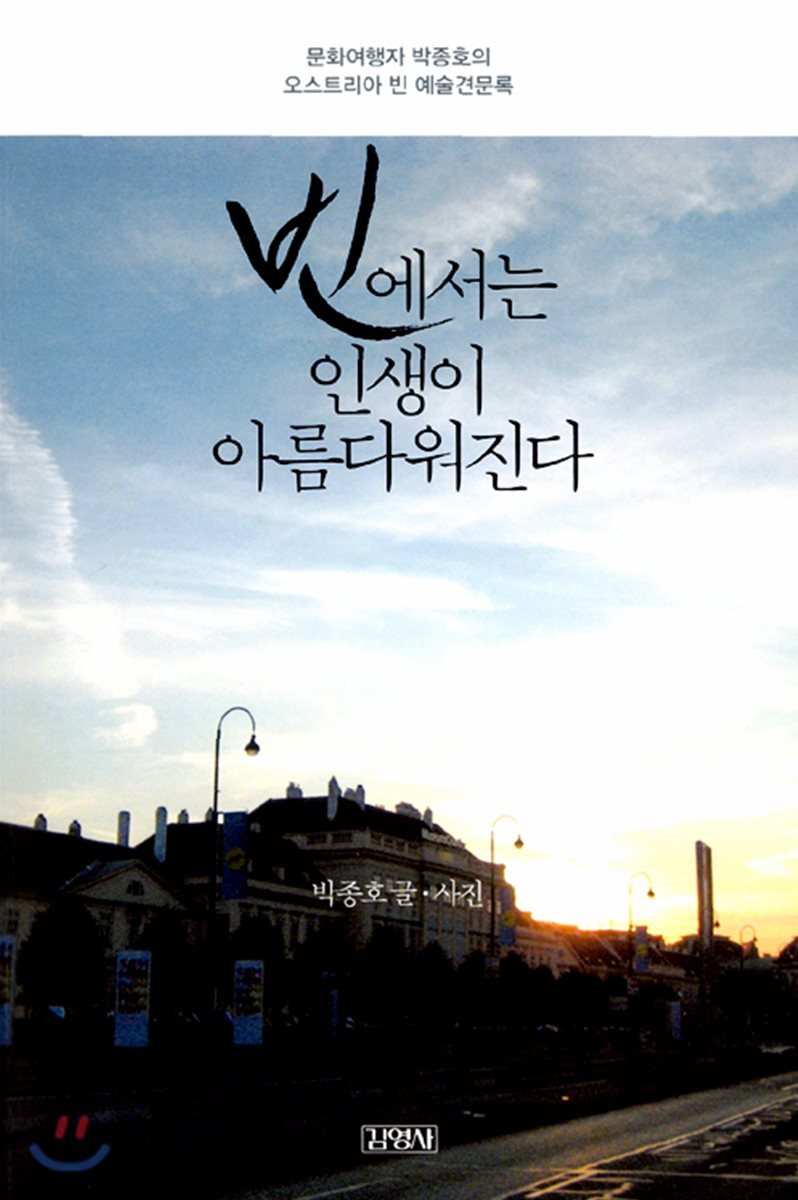 |
Description
Book Introduction
Vienna, Austria, where art flourished to its peak!
Cultural traveler Park Jong-ho shares the beauty of great art and life.
A travelogue that traces the lives and traces of the artists who brought brilliance to the art of Vienna at the turn of the century.
A travelogue of art in Vienna, Austria by Park Jong-ho, the owner of Korea's first classical music store, Pungwoldang, who is more famous as an art lover than as a psychiatrist.
Painter Gustav Klimt, musician Gustav Mahler, architect Otto Wagner, psychologist Sigmund Freud, etc.
In Vienna, they were all brushing shoulders, mixing words, living, loving, and creating.
Vienna, a city where the fierce spirit and passion of its artists have created the pinnacle of European art! Park Jong-ho, a cultural traveler and psychiatrist, shares the beauty of great art and life in this beautiful historical setting!
Cultural traveler Park Jong-ho shares the beauty of great art and life.
A travelogue that traces the lives and traces of the artists who brought brilliance to the art of Vienna at the turn of the century.
A travelogue of art in Vienna, Austria by Park Jong-ho, the owner of Korea's first classical music store, Pungwoldang, who is more famous as an art lover than as a psychiatrist.
Painter Gustav Klimt, musician Gustav Mahler, architect Otto Wagner, psychologist Sigmund Freud, etc.
In Vienna, they were all brushing shoulders, mixing words, living, loving, and creating.
Vienna, a city where the fierce spirit and passion of its artists have created the pinnacle of European art! Park Jong-ho, a cultural traveler and psychiatrist, shares the beauty of great art and life in this beautiful historical setting!
- You can preview some of the book's contents.
Preview
index
prolog
A lump of empty spirit
A city of art where music becomes art and literature becomes opera.
Vienna at the turn of the century: the most remarkable era in history
Chapter 1: Near the Belvedere
Central Cemetery: In Search of Sleeping Musicians
Johann Strauss II: Rising above his father
Stadtpark: The park I've longed for since childhood
Art: A Must-See in Vienna
Belvedere Palace: Famous paintings live in a famous palace.
Alma Mahler: The art world's prima donna, not the artist
Oskar Kokoschka: The Last Wanderer of the 20th Century
Chapter 2: Near the Jechezion
The End of the Century: The Age of Disconnection That Killed My Father
Separatists: Young artists who separated themselves from the past
Secessionists: They worship Beethoven as their god
Jechezion: A temple built by the Separatists
Gustav Klimt: The Emperor of 20th-Century Vienna Art
Cafe Mujeum: The Eternal Artists' Salon
Chapter 3: Near the Opera
Ringstraße: The Ring Road Surrounding Vienna
Vienna State Opera: Hall of Glory, Shame, and Resurrection
Gustav Mahler: The Greatest Honor and the Worst Misfortune
Herbert von Karajan: The King of Theater and Orchestra
Cafe Sacher: A prestigious family built on a single pastry
Richard Strauss: The Little Viennese Musician Who Painted Vienna
Hugo von Hofmannsthal: Anyone can be like him, but not everyone becomes like him.
Chapter 4: Near Albertina
Albertina: An elegant blend of classic and modern
The Vienna Boys' Choir: Little Angels Who Take Us Back to Memories
Ross House: Standing Up to Authority with One Building
Adolf Loos: Function instead of decoration in architecture
Coffee: There is no Viennese coffee in Vienna.
Cafe: A cafe is a 'second home'
Cafe Literature: Art is Born in a Cafe
Cafe Demel: Home of the Viennese Bonbon
Cafe Central: The heart of empty cafes
Peter Albenberg: The Viennese Fool Who Lived Life Like Art
American Bar: The Smallest, Most Alluring Bar
Cafe Havelka: Vienna's day begins with a coffee from Havelka.
Karl Kraus: His writings covered everything of the time.
Chapter 5: Near the Mujicraine
Musikverein: The Heart of Vienna, the City of Music
Vienna Philharmonic Orchestra: A top-notch orchestra boasting tradition and talent
Vienna New Year's Concert: The World's Most Famous Concert
Konzerthaus: Another World, a Top Concert Hall
Paul Wittgenstein: The Pianist Who Lost One Hand
Ludwig Wittgenstein: A true sage who lived philosophy with his actions, not words.
The New Bin School: Three Musicians Who Rocked the 20th Century
Chapter 6 Museum Area
Kunsthistorisches Museum, Vienna: Europe's Finest Collection
Museums Qubartier (MQ): A Small Sea of Art
Leopold Museum: Egon Schiele's Treasure
Egon Schiele: A Short Life of 28 Years that Remains a Legend
Mumok: A Warehouse of Contemporary Art
Chapter 7, near the end
MAK: The pride of Vienna, the home of applied art
The Empty Workshop: A Symbol of Total Art
Otto Wagner: The architect who built Vienna with an ultra-bourgeois spirit
Postal Savings Bank: A post office that feels like it came straight out of a century ago.
Am Steinhof Church: A Masterpiece for the Marginalized
Grihenweisle: A restaurant with traces of artists
Cline's Cafe: The most remote and unpretentious cafe
Chapter 8: Near the City Hall Plaza
City Hall Square: The Quadrilateral of Politics and Culture
The National Assembly Building: A Building That Architects Envisioned for Democracy
Empty City Hall: A Fun City Hall for Citizens
University of Vienna: A Cradle of Academic and Spiritual Achievements
Arthur Schnitzler: The greatest dilettante who loved Vienna and defended it.
Burgtheater: A theater hall where the best actors have passed through
Sigmund Freud: A Great Scholar Who Created His Own Work
Freud House: The Little Clinic Where the Greatest Achievements Are Produced
Café Lantmann: A Love Room for Actors and Intellectuals
Chapter 9: Heiligenstadt Region
Heiligenstadt: In Search of Traces of Despair and Solace
Beethoven's Promenade: Playing Music to the Unheard
Chapter 10: The Hundertwasser Region
Hundertwasser: Living Art with His Body, Practicing Ecology
Hundertwasser House: A Commoner's Apartment Transformed into Art
Kunsthaus: A Place Where New Spirits Are Displayed
Incinerator: Art Transforming the Environment
A lump of empty spirit
A city of art where music becomes art and literature becomes opera.
Vienna at the turn of the century: the most remarkable era in history
Chapter 1: Near the Belvedere
Central Cemetery: In Search of Sleeping Musicians
Johann Strauss II: Rising above his father
Stadtpark: The park I've longed for since childhood
Art: A Must-See in Vienna
Belvedere Palace: Famous paintings live in a famous palace.
Alma Mahler: The art world's prima donna, not the artist
Oskar Kokoschka: The Last Wanderer of the 20th Century
Chapter 2: Near the Jechezion
The End of the Century: The Age of Disconnection That Killed My Father
Separatists: Young artists who separated themselves from the past
Secessionists: They worship Beethoven as their god
Jechezion: A temple built by the Separatists
Gustav Klimt: The Emperor of 20th-Century Vienna Art
Cafe Mujeum: The Eternal Artists' Salon
Chapter 3: Near the Opera
Ringstraße: The Ring Road Surrounding Vienna
Vienna State Opera: Hall of Glory, Shame, and Resurrection
Gustav Mahler: The Greatest Honor and the Worst Misfortune
Herbert von Karajan: The King of Theater and Orchestra
Cafe Sacher: A prestigious family built on a single pastry
Richard Strauss: The Little Viennese Musician Who Painted Vienna
Hugo von Hofmannsthal: Anyone can be like him, but not everyone becomes like him.
Chapter 4: Near Albertina
Albertina: An elegant blend of classic and modern
The Vienna Boys' Choir: Little Angels Who Take Us Back to Memories
Ross House: Standing Up to Authority with One Building
Adolf Loos: Function instead of decoration in architecture
Coffee: There is no Viennese coffee in Vienna.
Cafe: A cafe is a 'second home'
Cafe Literature: Art is Born in a Cafe
Cafe Demel: Home of the Viennese Bonbon
Cafe Central: The heart of empty cafes
Peter Albenberg: The Viennese Fool Who Lived Life Like Art
American Bar: The Smallest, Most Alluring Bar
Cafe Havelka: Vienna's day begins with a coffee from Havelka.
Karl Kraus: His writings covered everything of the time.
Chapter 5: Near the Mujicraine
Musikverein: The Heart of Vienna, the City of Music
Vienna Philharmonic Orchestra: A top-notch orchestra boasting tradition and talent
Vienna New Year's Concert: The World's Most Famous Concert
Konzerthaus: Another World, a Top Concert Hall
Paul Wittgenstein: The Pianist Who Lost One Hand
Ludwig Wittgenstein: A true sage who lived philosophy with his actions, not words.
The New Bin School: Three Musicians Who Rocked the 20th Century
Chapter 6 Museum Area
Kunsthistorisches Museum, Vienna: Europe's Finest Collection
Museums Qubartier (MQ): A Small Sea of Art
Leopold Museum: Egon Schiele's Treasure
Egon Schiele: A Short Life of 28 Years that Remains a Legend
Mumok: A Warehouse of Contemporary Art
Chapter 7, near the end
MAK: The pride of Vienna, the home of applied art
The Empty Workshop: A Symbol of Total Art
Otto Wagner: The architect who built Vienna with an ultra-bourgeois spirit
Postal Savings Bank: A post office that feels like it came straight out of a century ago.
Am Steinhof Church: A Masterpiece for the Marginalized
Grihenweisle: A restaurant with traces of artists
Cline's Cafe: The most remote and unpretentious cafe
Chapter 8: Near the City Hall Plaza
City Hall Square: The Quadrilateral of Politics and Culture
The National Assembly Building: A Building That Architects Envisioned for Democracy
Empty City Hall: A Fun City Hall for Citizens
University of Vienna: A Cradle of Academic and Spiritual Achievements
Arthur Schnitzler: The greatest dilettante who loved Vienna and defended it.
Burgtheater: A theater hall where the best actors have passed through
Sigmund Freud: A Great Scholar Who Created His Own Work
Freud House: The Little Clinic Where the Greatest Achievements Are Produced
Café Lantmann: A Love Room for Actors and Intellectuals
Chapter 9: Heiligenstadt Region
Heiligenstadt: In Search of Traces of Despair and Solace
Beethoven's Promenade: Playing Music to the Unheard
Chapter 10: The Hundertwasser Region
Hundertwasser: Living Art with His Body, Practicing Ecology
Hundertwasser House: A Commoner's Apartment Transformed into Art
Kunsthaus: A Place Where New Spirits Are Displayed
Incinerator: Art Transforming the Environment
Into the book
At the end of the 19th century, Vienna was experiencing one of the greatest changes in the world, as 650 years of the old system collapsed and a new world was created.
In the process, they suffered the greatest pain.
In doing so, Vienna left behind the greatest cultural heritage of its time.
This has been the case in countless fields, including music, art, architecture, crafts, literature, theatre, opera, philosophy, and psychology.
Such a city is Vienna in 1900.
This situation has never happened anywhere on Earth in history.
Therefore, Vinh is not just a city.
A hundred years ago, Vienna was a living, breathing, organic mass of art.
And then it finally exploded.
---From “Fin de siècle Vienna, the most surprising era in history”
All the statues in and around Stadtpark seem to be in places that fit their own personalities.
The picky Beethoven does not like to be with other musicians, so he sits alone, and on the street where people pass by and look up at him.
All the other music also shows off its own stance in an amazingly appropriate position.
They are together here, but like artists, even the statues still exude their own fragrance.
Stadtpark is a park that music lovers will always miss.
All four seasons are nice.
I've been here in spring, fall and winter, except summer.
When I go to Vienna, I walk here every morning, and when I leave Vienna, I walk around Seoul every morning, reminiscing about the wind in Stadtpark.
---From “Stadtpark”
Alma Miller is the widow of Gustav Mahler, one of the greatest composers and conductors of the fin de siècle.
However, Alma remained the eternal lover of four men: Mahler, Gropius, Werfel, and Kokoschka.
All four men never forgot her, and all four carried her in their hearts until their deaths.
Alma was truly the muse of the century.
The four men who lived with Alma were each fin-de-siècle masters in music, architecture, literature, and art.
Through her four men, she produced works that were considered to be among the best in each of the arts.
Her love affairs were a 'cradle of great art'.
---From “Alma Mahler”
Schiller's poetry gave birth to Beethoven's music, Beethoven's music in turn gave birth to Klimt's art, and Klimt's painting gave rise to Mahler's conducting.
The Jesuits are a place full of art.
If Klimt's murals speak of a person who enjoys the pleasure of art, then I, surrounded by Klimt's paintings in this basement, enjoy the pleasure of art.
All four sides are filled with Klimt paintings, and Beethoven's music fills both ears.
---From “Jesusion”
The buildings of the ring are not only beautiful.
They show the history and spirit of Vienna at the turn of the century.
When you look back at the ring, you will find yourself standing in the middle of the ring at the end of the century.
Most of the buildings you see as you walk along the Ringstrasse, with the exception of the Hofburg Palace, were built during the same period as the Ringstrasse was built.
That is, it was built 'all at once' at the end of the century, a hundred years ago.
Isn't it amazing? Aren't you filled with awe, wonder, and awe? You're walking down a street from a hundred years ago.
---From “Ring Strasse”
If you are a psychiatrist, you would naturally visit this place, the Freud House, with the feeling of visiting Mecca.
Having worked as a psychiatrist for over 20 years, I can only imagine the emotions I felt.
He was the epitome of a conscientious doctor, having practiced medicine at the same place, the Freud Clinic, for 47 years without leaving or moving.
What impressed me most here was his sincerity.
It seemed as if I had witnessed with my own eyes the truth that all achievements are born from sincerity, perseverance, and sincerity.
In the process, they suffered the greatest pain.
In doing so, Vienna left behind the greatest cultural heritage of its time.
This has been the case in countless fields, including music, art, architecture, crafts, literature, theatre, opera, philosophy, and psychology.
Such a city is Vienna in 1900.
This situation has never happened anywhere on Earth in history.
Therefore, Vinh is not just a city.
A hundred years ago, Vienna was a living, breathing, organic mass of art.
And then it finally exploded.
---From “Fin de siècle Vienna, the most surprising era in history”
All the statues in and around Stadtpark seem to be in places that fit their own personalities.
The picky Beethoven does not like to be with other musicians, so he sits alone, and on the street where people pass by and look up at him.
All the other music also shows off its own stance in an amazingly appropriate position.
They are together here, but like artists, even the statues still exude their own fragrance.
Stadtpark is a park that music lovers will always miss.
All four seasons are nice.
I've been here in spring, fall and winter, except summer.
When I go to Vienna, I walk here every morning, and when I leave Vienna, I walk around Seoul every morning, reminiscing about the wind in Stadtpark.
---From “Stadtpark”
Alma Miller is the widow of Gustav Mahler, one of the greatest composers and conductors of the fin de siècle.
However, Alma remained the eternal lover of four men: Mahler, Gropius, Werfel, and Kokoschka.
All four men never forgot her, and all four carried her in their hearts until their deaths.
Alma was truly the muse of the century.
The four men who lived with Alma were each fin-de-siècle masters in music, architecture, literature, and art.
Through her four men, she produced works that were considered to be among the best in each of the arts.
Her love affairs were a 'cradle of great art'.
---From “Alma Mahler”
Schiller's poetry gave birth to Beethoven's music, Beethoven's music in turn gave birth to Klimt's art, and Klimt's painting gave rise to Mahler's conducting.
The Jesuits are a place full of art.
If Klimt's murals speak of a person who enjoys the pleasure of art, then I, surrounded by Klimt's paintings in this basement, enjoy the pleasure of art.
All four sides are filled with Klimt paintings, and Beethoven's music fills both ears.
---From “Jesusion”
The buildings of the ring are not only beautiful.
They show the history and spirit of Vienna at the turn of the century.
When you look back at the ring, you will find yourself standing in the middle of the ring at the end of the century.
Most of the buildings you see as you walk along the Ringstrasse, with the exception of the Hofburg Palace, were built during the same period as the Ringstrasse was built.
That is, it was built 'all at once' at the end of the century, a hundred years ago.
Isn't it amazing? Aren't you filled with awe, wonder, and awe? You're walking down a street from a hundred years ago.
---From “Ring Strasse”
If you are a psychiatrist, you would naturally visit this place, the Freud House, with the feeling of visiting Mecca.
Having worked as a psychiatrist for over 20 years, I can only imagine the emotions I felt.
He was the epitome of a conscientious doctor, having practiced medicine at the same place, the Freud Clinic, for 47 years without leaving or moving.
What impressed me most here was his sincerity.
It seemed as if I had witnessed with my own eyes the truth that all achievements are born from sincerity, perseverance, and sincerity.
--- From “Freud House”
Publisher's Review
The great beauty of art and life as told by cultural traveler Jongho Park from Vienna, Austria!
“Bin showed us the pinnacle of art, and art awakened us to the beauty of life!”
Park Jong-ho is more famous as an opera critic than as a psychiatrist, as the owner of Korea's first classical music record store, 'Pungwoldang', and as the author of the music bestseller, 'Classical Music I Love'.
He, who introduced the true value of classical music to Korea, has now begun to guide the global art scene.
The book, "Life Becomes Beautiful in Vienna," a travelogue of art in Vienna, Austria, written by cultural traveler Jong-ho Park, who believes that the value of life is not found in success or work, but in freedom, art, and travel, has been published by Kim Young-sa.
This book is an art travelogue introducing Vienna, Austria, the city of art.
When people think of Vienna, Austria, they often think of musicians like Mozart, but the author sheds light on the lives of artists of all disciplines who brought brilliance to the art of Vienna at the turn of the century, including Klimt, Mahler, and Wagner, and introduces their still-shining legacy.
He claims.
Even if the Vienna Philharmonic Orchestra plays at the Seoul Arts Center, it is different from hearing the performance in Vienna.
The concert halls are different, the structure is different, the acoustics are different, the repertoire is different, the performers' postures are different, the quality of the audience is different, and the people sitting next to you are different.
Even if you bring Klimt's paintings from Vienna to Seoul, the feeling will be different.
The picture is the same, but that's it.
Some travel agencies offer travel packages called "A Few Days in Eastern Europe," and criticize us for asking if we can really get to know Vienna by only stopping by Vienna for a day or two while traveling around several countries.
In this book, we encounter Vienna, a city that enjoyed the peak of art and flourished brilliantly at the turn of the century 100 years ago.
Park Jong-ho feels the emotion of emptiness as he personally searches for it with his own two feet, feels it with his heart, thinks about it with his head.
Taste the vibrant Vienna on the streets, in art galleries, theaters, concert halls, and cafes.
Through his writings and photographs, you can see, hear, smell, feel the breeze, and even feel the goosebumps on your skin the spirit of Vienna that has been passed down there for hundreds and thousands of years, giving you a complete sense of emotion.
“Vincent is not a city.
It's a lump of the mind.
In Vienna, one must savor the things created by the spirit of Vienna.
They, the lumps of the mind, do not travel.
But we have to go there and meet them on our own two feet.
All art has its place.
“What is empty must be seen in empty.” (p. 19)
Get drunk on the most amazing era in history, 'Fin de siècle Vienna'!
Whenever he went on a trip to Vienna, those around him would look at him with puzzlement, asking, "Is there still something to see in that small town? Is he hiding some kind of honey pot?"
What is the fatal charm of Vienna that constantly draws his footsteps to it?
“The end of the 1900s, when modern society began, was the greatest era in history, and at that time, Vienna achieved world-class art in all fields, including music, art, design, architecture, literature, theater, and opera.
The painter Gustav Klimt, the musician Gustav Mahler, the playwright Hugo von Hofmannsthal, the architect Otto Wagner, and the psychologist Sigmund Freud, all of whom are beloved by us today, were Viennese contemporaries.
Their thoughts and footsteps shaped the Vienna of today, and their shadows still cast a beautiful shadow over various parts of Vienna.
This book introduces the charm of Vienna, the city of art.
These are all things that I personally searched for with my own two feet, felt with my heart, and thought with my head.
I want to convey them to you in their entirety.
No, I feel a calling to convey it.
Vienna, what a beautiful place and a great city.
You, now come with me to Vienna.” (From the author’s words)
Vienna has long been the heart of Central Europe.
As the capital of the Austro-Hungarian Empire, which dominated most of what is now Central and Eastern Europe, it is a city that contains everything about the empire that was magnificent for 650 years.
It was the center of politics, economy, culture, and above all, the center of art.
It is a city that has achieved the highest level in all fields of art, including music, art, design, architecture, literature, theater, and opera.
The Vienna introduced in this book is 'Fin de siècle Vienna', around the year 1900, a hundred years ago.
As the 1900s approached, Vienna experienced a cultural movement and artistic innovation.
Vienna at the turn of the century, as the age of empire ended and modern society began, was at the center of tremendous change.
Park Jong-ho evaluates Vienna of that era as the best era in history.
Of all the art we enjoy today, there is hardly anything that has not been influenced by fin-de-siècle Vienna.
The current Vienna is said to be a castle of art created by the fierce spirit and actions of artists at the turn of the century.
When you know the empty space, you see the art.
And yes? You have to see it to see the bin properly!
At the end of the 19th century, Vienna experienced one of the greatest changes in the world.
The old system of 650 years collapsed and a new world was created.
In the process, they suffered the greatest pain.
In doing so, Vienna left behind the greatest cultural heritage of its time.
So, to travel to Vienna is to see the heart of Europe, and to know Vienna is to know art.
Architects include Otto Wagner, Josef Maria Olbrich, Adolf Loos, and Josef Hoffmann.
Other artists include Gustav Klimt, Egon Schiele, and Oskar Kokoschka.
Among the writers, Peter Altenberg, Arthur Schnitzler, Hugo von Hofmannsthal, Karl Kraus, and Stefan Zweig were friends and colleagues of the same era as the painters and architects mentioned above.
Among their acquaintances were psychologist Sigmund Freud and philosopher Ludwig Wittgenstein.
Composers include Gustav Mahler, Hugo Wolf, Richard Strauss, Alexander Zemlinsky, Arnold Schoenberg, Anton Webern, and Alban Berg.
A new profession, conductor, emerged with the rise of musicians who dedicated their lives to conducting, including Bruno Walter, Wilhelm Furtwängler, Erich Kleiber, and Clemens Kraus.
They all lived through the year 1900, the turn of the century.
In Vienna in 1900, they were all brushing shoulders, mixing words, living, loving, and creating.
They had a tremendous influence on each other and were comrades and friends throughout the 20th century.
Therefore, one cannot know Viennese musicians well without knowing art, and one cannot understand Viennese painters without knowing music.
You have to know Klimt to understand Mahler, and you have to know Mahler to truly enjoy Klimt.
“Such a city was Vienna in 1900.
This situation has never happened anywhere on Earth in history.
Therefore, Vienna is not just a city." (p. 31)
"Life Becomes Beautiful in Vienna" is a travelogue that traces the lives and traces of dozens of artists who illuminated Vienna at the turn of the century and then disappeared.
This book will help you truly experience Vienna, a great city created through the fierce spirit and actions of its artists!
“Bin showed us the pinnacle of art, and art awakened us to the beauty of life!”
Park Jong-ho is more famous as an opera critic than as a psychiatrist, as the owner of Korea's first classical music record store, 'Pungwoldang', and as the author of the music bestseller, 'Classical Music I Love'.
He, who introduced the true value of classical music to Korea, has now begun to guide the global art scene.
The book, "Life Becomes Beautiful in Vienna," a travelogue of art in Vienna, Austria, written by cultural traveler Jong-ho Park, who believes that the value of life is not found in success or work, but in freedom, art, and travel, has been published by Kim Young-sa.
This book is an art travelogue introducing Vienna, Austria, the city of art.
When people think of Vienna, Austria, they often think of musicians like Mozart, but the author sheds light on the lives of artists of all disciplines who brought brilliance to the art of Vienna at the turn of the century, including Klimt, Mahler, and Wagner, and introduces their still-shining legacy.
He claims.
Even if the Vienna Philharmonic Orchestra plays at the Seoul Arts Center, it is different from hearing the performance in Vienna.
The concert halls are different, the structure is different, the acoustics are different, the repertoire is different, the performers' postures are different, the quality of the audience is different, and the people sitting next to you are different.
Even if you bring Klimt's paintings from Vienna to Seoul, the feeling will be different.
The picture is the same, but that's it.
Some travel agencies offer travel packages called "A Few Days in Eastern Europe," and criticize us for asking if we can really get to know Vienna by only stopping by Vienna for a day or two while traveling around several countries.
In this book, we encounter Vienna, a city that enjoyed the peak of art and flourished brilliantly at the turn of the century 100 years ago.
Park Jong-ho feels the emotion of emptiness as he personally searches for it with his own two feet, feels it with his heart, thinks about it with his head.
Taste the vibrant Vienna on the streets, in art galleries, theaters, concert halls, and cafes.
Through his writings and photographs, you can see, hear, smell, feel the breeze, and even feel the goosebumps on your skin the spirit of Vienna that has been passed down there for hundreds and thousands of years, giving you a complete sense of emotion.
“Vincent is not a city.
It's a lump of the mind.
In Vienna, one must savor the things created by the spirit of Vienna.
They, the lumps of the mind, do not travel.
But we have to go there and meet them on our own two feet.
All art has its place.
“What is empty must be seen in empty.” (p. 19)
Get drunk on the most amazing era in history, 'Fin de siècle Vienna'!
Whenever he went on a trip to Vienna, those around him would look at him with puzzlement, asking, "Is there still something to see in that small town? Is he hiding some kind of honey pot?"
What is the fatal charm of Vienna that constantly draws his footsteps to it?
“The end of the 1900s, when modern society began, was the greatest era in history, and at that time, Vienna achieved world-class art in all fields, including music, art, design, architecture, literature, theater, and opera.
The painter Gustav Klimt, the musician Gustav Mahler, the playwright Hugo von Hofmannsthal, the architect Otto Wagner, and the psychologist Sigmund Freud, all of whom are beloved by us today, were Viennese contemporaries.
Their thoughts and footsteps shaped the Vienna of today, and their shadows still cast a beautiful shadow over various parts of Vienna.
This book introduces the charm of Vienna, the city of art.
These are all things that I personally searched for with my own two feet, felt with my heart, and thought with my head.
I want to convey them to you in their entirety.
No, I feel a calling to convey it.
Vienna, what a beautiful place and a great city.
You, now come with me to Vienna.” (From the author’s words)
Vienna has long been the heart of Central Europe.
As the capital of the Austro-Hungarian Empire, which dominated most of what is now Central and Eastern Europe, it is a city that contains everything about the empire that was magnificent for 650 years.
It was the center of politics, economy, culture, and above all, the center of art.
It is a city that has achieved the highest level in all fields of art, including music, art, design, architecture, literature, theater, and opera.
The Vienna introduced in this book is 'Fin de siècle Vienna', around the year 1900, a hundred years ago.
As the 1900s approached, Vienna experienced a cultural movement and artistic innovation.
Vienna at the turn of the century, as the age of empire ended and modern society began, was at the center of tremendous change.
Park Jong-ho evaluates Vienna of that era as the best era in history.
Of all the art we enjoy today, there is hardly anything that has not been influenced by fin-de-siècle Vienna.
The current Vienna is said to be a castle of art created by the fierce spirit and actions of artists at the turn of the century.
When you know the empty space, you see the art.
And yes? You have to see it to see the bin properly!
At the end of the 19th century, Vienna experienced one of the greatest changes in the world.
The old system of 650 years collapsed and a new world was created.
In the process, they suffered the greatest pain.
In doing so, Vienna left behind the greatest cultural heritage of its time.
So, to travel to Vienna is to see the heart of Europe, and to know Vienna is to know art.
Architects include Otto Wagner, Josef Maria Olbrich, Adolf Loos, and Josef Hoffmann.
Other artists include Gustav Klimt, Egon Schiele, and Oskar Kokoschka.
Among the writers, Peter Altenberg, Arthur Schnitzler, Hugo von Hofmannsthal, Karl Kraus, and Stefan Zweig were friends and colleagues of the same era as the painters and architects mentioned above.
Among their acquaintances were psychologist Sigmund Freud and philosopher Ludwig Wittgenstein.
Composers include Gustav Mahler, Hugo Wolf, Richard Strauss, Alexander Zemlinsky, Arnold Schoenberg, Anton Webern, and Alban Berg.
A new profession, conductor, emerged with the rise of musicians who dedicated their lives to conducting, including Bruno Walter, Wilhelm Furtwängler, Erich Kleiber, and Clemens Kraus.
They all lived through the year 1900, the turn of the century.
In Vienna in 1900, they were all brushing shoulders, mixing words, living, loving, and creating.
They had a tremendous influence on each other and were comrades and friends throughout the 20th century.
Therefore, one cannot know Viennese musicians well without knowing art, and one cannot understand Viennese painters without knowing music.
You have to know Klimt to understand Mahler, and you have to know Mahler to truly enjoy Klimt.
“Such a city was Vienna in 1900.
This situation has never happened anywhere on Earth in history.
Therefore, Vienna is not just a city." (p. 31)
"Life Becomes Beautiful in Vienna" is a travelogue that traces the lives and traces of dozens of artists who illuminated Vienna at the turn of the century and then disappeared.
This book will help you truly experience Vienna, a great city created through the fierce spirit and actions of its artists!
GOODS SPECIFICS
- Date of issue: July 15, 2011
- Page count, weight, size: 379 pages | 588g | 150*210*30mm
- ISBN13: 9788934952060
- ISBN 10: 8934952067
You may also like
카테고리
korean


korean

![GQ KOREA Mark (Monthly): December [2025]](http://librairie.coreenne.fr/cdn/shop/files/8ef265dbbfbf186523ed75ba7319009d.jpg?v=1765340328&width=3840)


