

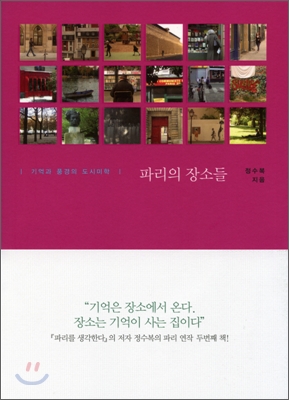
Places in Paris
 |
Description
Book Introduction
The second installment of "Thinking of Paris," a humanist's Parisian walk.
"Places of Paris": A Look into the Depths of Residents
Professor Jeong Su-bok, who uses his 'aesthetic reason' to present his own unique writing style, talks about the aesthetics of urban space by combining the 'memories' of the past that come to mind while walking through Paris with the 'imagination' that allows him to dream of another world beyond the daily life unfolding before his eyes.
The author, who has lived in Paris for over 15 years, focuses on sixteen of the city's many places and presents to readers the multiple layers of meaning they contain.
The places in Paris that the author presents are seen from the perspective of a resident, not a tourist.
In today's urban reality, where "non-places" that are merely functional places, such as 24-hour convenience stores, marts, gas stations, Starbucks, and McDonald's, are increasing, while true "places" such as buildings, bridges, and alleyways that evoke old memories and constitute the identity of a place are gradually disappearing, the author's in-depth perspective on places delivers a meaningful message.
In this book, which features over 350 places ranging from ornate squares to humble alleyways and over 350 people including poets, painters, revolutionaries, and thinkers, readers walk through the places of Paris and uncover the layers of meaning that are not easily visible to the public. The author's work makes us reflect not only on the 'meaning of place' but also on the 'meaning of life'.
As the author says, “Life leaves behind memories, and places are the homes where memories live.”
"Places of Paris": A Look into the Depths of Residents
Professor Jeong Su-bok, who uses his 'aesthetic reason' to present his own unique writing style, talks about the aesthetics of urban space by combining the 'memories' of the past that come to mind while walking through Paris with the 'imagination' that allows him to dream of another world beyond the daily life unfolding before his eyes.
The author, who has lived in Paris for over 15 years, focuses on sixteen of the city's many places and presents to readers the multiple layers of meaning they contain.
The places in Paris that the author presents are seen from the perspective of a resident, not a tourist.
In today's urban reality, where "non-places" that are merely functional places, such as 24-hour convenience stores, marts, gas stations, Starbucks, and McDonald's, are increasing, while true "places" such as buildings, bridges, and alleyways that evoke old memories and constitute the identity of a place are gradually disappearing, the author's in-depth perspective on places delivers a meaningful message.
In this book, which features over 350 places ranging from ornate squares to humble alleyways and over 350 people including poets, painters, revolutionaries, and thinkers, readers walk through the places of Paris and uncover the layers of meaning that are not easily visible to the public. The author's work makes us reflect not only on the 'meaning of place' but also on the 'meaning of life'.
As the author says, “Life leaves behind memories, and places are the homes where memories live.”
- You can preview some of the book's contents.
Preview
index
Opening the Book: Places in Paris Discovered While Walking
Who is this book for? | The joy of chance discovery | Places and non-places | The quality of the city and the quality of life | In search of lost memories | The evocative effect of Parisianism | A sense of nuance | The search for a new way of writing | The path that flows through this book | To Mr. Sommer and my grandfather
Part 1: Seeing Well-Known Places Differently
Climb the Eiffel Tower from a different perspective
The Eiffel Tower I Last Saw | The Pros and Cons of the Eiffel Tower | The Eiffel Tower of Delaunay and Chagall | The Eiffel Tower in Poetry and Image | The Eiffel Tower in Numbers | The Eiffel Tower of Le Corbusier and Roland Barthes | The Eiffel Tower Shining in the Night Sky | The Ideal Place to View the Eiffel Tower | The Semiotics of the City on the Eiffel Tower | Historical Imagination on the Eiffel Tower | The Twisted Encounter of the Eiffel Tower and Sacré-Cœur | Why the Eiffel Tower Replaced Notre Dame as the Symbol of Paris | The Eiffel Tower as a Pure Signifier | The Eiffel Tower as a Place of Ambition and Advertising | The Eiffel Tower as a Place of Adventure | The Eiffel Tower as a Fantasy Drawn by Children | The Ever-Growing Souvenirs of the Eiffel Tower | The Greatness of Uselessness | The Dangerous Abuse of the Eiffel Tower
Crossing the bridge over the Seine
Looking at the Seine | Painters on the banks of the Seine | Crossing the footbridge over the Seine | People I met on the Pont des Arts | Why the Solferino Bridge was torn down and rebuilt | The Simone de Beauvoir Bridge and the Mitterrand National Library | The Devilles Bridge and the Quai Branly Museum | Memories of the Pont Neuf Bridge | Place de Dauphine and its surroundings | The Pont d'Iénat Bridge painted by Gauguin | The Pont Mirabeau Bridge and the André Citroën Park
Notre Dame Cathedral seen from behind
Places Have First Impressions | The History of Notre Dame Cathedral | Victor Hugo and the Myth of Notre Dame | Hidden Stories of the Gardens of John XXIII | A 2 Million Won Landscape | Notre Dame in Painting | Aesthetic Experience and Historical Imagination
The other face of Montmartre
Where to go? | View in front of the Lamarck-Caulaincourt metro station | Vineyards and wild gardens in Montmartre | Painters of Montmartre | Martyr Saint-Denis and the writers of Montmartre | The other side of Montmartre hill | Village atmosphere north of Montmartre hill | Passing through the immigrant streets
Part 2: Deliberately Seeking Out Places You Want to Avoid
Exploring the 'dangerous' neighborhoods of northeastern Paris
Paris's shantytowns | A base for riots and resistance | A parade of immigrants | Cafes on the hill | The stairs where Edith Piaf was born | Philosophers bitten by dogs | A laboratory for the utopian socialism | A symbol of Marxism remaining in Paris | The history of the Metal Workers' Union Cultural Center | Its rebirth as a local cultural center
Pilgrimage to Montparnasse Cemetery
Remember Death | Why There Are Cemeteries in Cities | Collective Memory of the Paris Commune | The Story of Stepping into a Cemetery | Entering the Montparnasse Cemetery | Memories of Sartre and Beauvoir | Émile Durkheim and My Graduate School Days | Raymond Aron, the 'Participating Audience' | A Literary Journey through the Montparnasse Cemetery | The Scream of Marguerite Duras | Entering the Montparnasse Cemetery Differently | Gainsbourg, Castoriadis, and Niki de Saint-Phalael | The Spleen of Paris, Baudelaire | Brâncuși's 'The Kiss' | A Pilgrimage That Still Has Not Ended
Hovering around the prison in Sante
A City of Hypocrisy | Memories of the Rue de Arago | The Origins of the Prison of Santé | How Michel Foucault Viewed Prisons | Around the Prison of Santé | Disappeared Prisons in Paris | A Women's Prison Transformed into a Park | A Military Prison That Became a Cradle of Critical Social Science
Visiting the Butte aux Cailles hill, the battleground of the Paris Commune
The feeling of going up and down a hill | The subway running above ground | Climbing a hill and entering an alley | Memories of the Paris Commune | A small nameless square | Paris Commune Square | Posters and murals | Going down a hill | Singing 'When the Cherry Blossoms Bloom' together | Zhou Enlai and Deng Xiaoping around the Piazza d'Italie
Read Part 3, "Place," to find out the hidden meaning.
Semiotics of the Rue de Campagne Premiere
The world seen from a Parisian café | Picasso's Montparnasse era | Japanese painters in Montparnasse in the 1920s | Befriending the Rue des Campagnes Premieres | Artists at the Hôtel Istria | Psychoanalysis and the road to hell | Monsieur le Monochrom and his excited mother | Aget's apartment and the dead-end alley | A magazine for gays | The artist colony on the Rue des Campagnes Premieres | Léon Werthe, Saint-Exupéry's best friend | The Impressionist painter Jonquin and the Chan bookstore | The transformation of the Rue des Campagnes Premieres
The Cartier Foundation's Wildflower World
A House Built of Glass | A Pine Tree Planted by Chateaubriand | A Wildflower Garden Next to an Old Wall | A Space for Meditation in the Garden | A Nomad's Night | An Ecological Garden | From a Psychiatric Asylum to a Wildflower Garden
The Japanese Garden at Espace Albert Kahn
Nature in the City | The Source of Anti-Japanese Nationalism | A 'Strange' Interest in Japan | Walking through Japanese Gardens in Paris | Albert Kahn's Japanese Garden | Ponds and Bridges | Circulation and Coexistence | Praising Trees | Stone Buddha Statues and the Sound of Water | Walking the Path | The Life and Thought of Albert Kahn | Zen Lectures by a French Gardener | Gardens Without Borders | Aesthetic Ecologist
Parisians in front of the Parc des Brassances
The humble dream of national singer Brassence | The discovery of Brassence Park | The history of Brassence Park | Traces of the past remaining in the space | Eco-friendly installation art | Cosmopolitan 'Beehive' | Weekend second-hand book market | Georges Brassence Music Festival | Sitting on a cafe terrace | Watching people pass by | Keep watching | The emergence of ants | The difference between the center and the periphery | It starts to get cold | It's time to leave now
Part 4: A Leisurely Place: Walk Wherever Your Heart Takes You
A stroll along the Seine River on the Île Saint-Louis
Bookstores along the promenade | At Compagnie's bookstore | Benjamin's Paris | The Island of Liberty, Île Saint-Louis | The Discovery of Île Saint-Louis | A Giant Stone Boat | Landscapes along the Orléans River | The Passion of the Mansion Lambert | The History of Île Saint-Louis | Camille Claudel's Studio | Île Saint-Louis on a Snowy Afternoon
Drifting along the waterways of the Canal Saint-Martin
Another waterway flowing through Paris | Crossing the Parc des Villemin | The flow of the Canal Saint-Martin | The old canalside café 'Atmosphere' | People on the embankment | The story of the 'Hotel des Bourbons' | Changes around the Canal Saint-Martin | Memories of the Rue Thionville | The 'Madness' of the Parc de la Villette
In search of traces of the lost Bièvre River
Taking the subway line 6 | 'Metropolitan' of France's Cultur radio | Étienne School of Publications | Traces of the revolutionary Auguste Blanqui | The man from back then who has now disappeared | Water stories of springs and swimming pools | Alleyways and neighborhood parks | A Zen breeze blowing in Paris | Near Place de l'Enoch | At a café on the corner of the square | The now-vanished water mill | Leaving the 13th arrondissement
A walk through the Tuileries Garden on a winter night
My favorite Parisian parks | A winter night stroll through the Tuileries Garden | Preparing for an evening stroll through the Tuileries Garden | Crossing the Pont Solferino | The history of the Tuileries Garden | The Tuileries Garden as a sculpture garden | Sculptures in the Tuileries Garden | From the café terrace to Saint-Germain-des-Prés | From the east gate of the Tuileries Garden to the Place de la Concorde
Closing the Book: The Paris Walk Isn't Over Yet
The Paris Walk That's Not Over | Beyond Genre | The Place of Unclassifiable Books | The Beckoning Paris: An Ongoing Experiment
Places in this book
People in this book
Works in this book
Who is this book for? | The joy of chance discovery | Places and non-places | The quality of the city and the quality of life | In search of lost memories | The evocative effect of Parisianism | A sense of nuance | The search for a new way of writing | The path that flows through this book | To Mr. Sommer and my grandfather
Part 1: Seeing Well-Known Places Differently
Climb the Eiffel Tower from a different perspective
The Eiffel Tower I Last Saw | The Pros and Cons of the Eiffel Tower | The Eiffel Tower of Delaunay and Chagall | The Eiffel Tower in Poetry and Image | The Eiffel Tower in Numbers | The Eiffel Tower of Le Corbusier and Roland Barthes | The Eiffel Tower Shining in the Night Sky | The Ideal Place to View the Eiffel Tower | The Semiotics of the City on the Eiffel Tower | Historical Imagination on the Eiffel Tower | The Twisted Encounter of the Eiffel Tower and Sacré-Cœur | Why the Eiffel Tower Replaced Notre Dame as the Symbol of Paris | The Eiffel Tower as a Pure Signifier | The Eiffel Tower as a Place of Ambition and Advertising | The Eiffel Tower as a Place of Adventure | The Eiffel Tower as a Fantasy Drawn by Children | The Ever-Growing Souvenirs of the Eiffel Tower | The Greatness of Uselessness | The Dangerous Abuse of the Eiffel Tower
Crossing the bridge over the Seine
Looking at the Seine | Painters on the banks of the Seine | Crossing the footbridge over the Seine | People I met on the Pont des Arts | Why the Solferino Bridge was torn down and rebuilt | The Simone de Beauvoir Bridge and the Mitterrand National Library | The Devilles Bridge and the Quai Branly Museum | Memories of the Pont Neuf Bridge | Place de Dauphine and its surroundings | The Pont d'Iénat Bridge painted by Gauguin | The Pont Mirabeau Bridge and the André Citroën Park
Notre Dame Cathedral seen from behind
Places Have First Impressions | The History of Notre Dame Cathedral | Victor Hugo and the Myth of Notre Dame | Hidden Stories of the Gardens of John XXIII | A 2 Million Won Landscape | Notre Dame in Painting | Aesthetic Experience and Historical Imagination
The other face of Montmartre
Where to go? | View in front of the Lamarck-Caulaincourt metro station | Vineyards and wild gardens in Montmartre | Painters of Montmartre | Martyr Saint-Denis and the writers of Montmartre | The other side of Montmartre hill | Village atmosphere north of Montmartre hill | Passing through the immigrant streets
Part 2: Deliberately Seeking Out Places You Want to Avoid
Exploring the 'dangerous' neighborhoods of northeastern Paris
Paris's shantytowns | A base for riots and resistance | A parade of immigrants | Cafes on the hill | The stairs where Edith Piaf was born | Philosophers bitten by dogs | A laboratory for the utopian socialism | A symbol of Marxism remaining in Paris | The history of the Metal Workers' Union Cultural Center | Its rebirth as a local cultural center
Pilgrimage to Montparnasse Cemetery
Remember Death | Why There Are Cemeteries in Cities | Collective Memory of the Paris Commune | The Story of Stepping into a Cemetery | Entering the Montparnasse Cemetery | Memories of Sartre and Beauvoir | Émile Durkheim and My Graduate School Days | Raymond Aron, the 'Participating Audience' | A Literary Journey through the Montparnasse Cemetery | The Scream of Marguerite Duras | Entering the Montparnasse Cemetery Differently | Gainsbourg, Castoriadis, and Niki de Saint-Phalael | The Spleen of Paris, Baudelaire | Brâncuși's 'The Kiss' | A Pilgrimage That Still Has Not Ended
Hovering around the prison in Sante
A City of Hypocrisy | Memories of the Rue de Arago | The Origins of the Prison of Santé | How Michel Foucault Viewed Prisons | Around the Prison of Santé | Disappeared Prisons in Paris | A Women's Prison Transformed into a Park | A Military Prison That Became a Cradle of Critical Social Science
Visiting the Butte aux Cailles hill, the battleground of the Paris Commune
The feeling of going up and down a hill | The subway running above ground | Climbing a hill and entering an alley | Memories of the Paris Commune | A small nameless square | Paris Commune Square | Posters and murals | Going down a hill | Singing 'When the Cherry Blossoms Bloom' together | Zhou Enlai and Deng Xiaoping around the Piazza d'Italie
Read Part 3, "Place," to find out the hidden meaning.
Semiotics of the Rue de Campagne Premiere
The world seen from a Parisian café | Picasso's Montparnasse era | Japanese painters in Montparnasse in the 1920s | Befriending the Rue des Campagnes Premieres | Artists at the Hôtel Istria | Psychoanalysis and the road to hell | Monsieur le Monochrom and his excited mother | Aget's apartment and the dead-end alley | A magazine for gays | The artist colony on the Rue des Campagnes Premieres | Léon Werthe, Saint-Exupéry's best friend | The Impressionist painter Jonquin and the Chan bookstore | The transformation of the Rue des Campagnes Premieres
The Cartier Foundation's Wildflower World
A House Built of Glass | A Pine Tree Planted by Chateaubriand | A Wildflower Garden Next to an Old Wall | A Space for Meditation in the Garden | A Nomad's Night | An Ecological Garden | From a Psychiatric Asylum to a Wildflower Garden
The Japanese Garden at Espace Albert Kahn
Nature in the City | The Source of Anti-Japanese Nationalism | A 'Strange' Interest in Japan | Walking through Japanese Gardens in Paris | Albert Kahn's Japanese Garden | Ponds and Bridges | Circulation and Coexistence | Praising Trees | Stone Buddha Statues and the Sound of Water | Walking the Path | The Life and Thought of Albert Kahn | Zen Lectures by a French Gardener | Gardens Without Borders | Aesthetic Ecologist
Parisians in front of the Parc des Brassances
The humble dream of national singer Brassence | The discovery of Brassence Park | The history of Brassence Park | Traces of the past remaining in the space | Eco-friendly installation art | Cosmopolitan 'Beehive' | Weekend second-hand book market | Georges Brassence Music Festival | Sitting on a cafe terrace | Watching people pass by | Keep watching | The emergence of ants | The difference between the center and the periphery | It starts to get cold | It's time to leave now
Part 4: A Leisurely Place: Walk Wherever Your Heart Takes You
A stroll along the Seine River on the Île Saint-Louis
Bookstores along the promenade | At Compagnie's bookstore | Benjamin's Paris | The Island of Liberty, Île Saint-Louis | The Discovery of Île Saint-Louis | A Giant Stone Boat | Landscapes along the Orléans River | The Passion of the Mansion Lambert | The History of Île Saint-Louis | Camille Claudel's Studio | Île Saint-Louis on a Snowy Afternoon
Drifting along the waterways of the Canal Saint-Martin
Another waterway flowing through Paris | Crossing the Parc des Villemin | The flow of the Canal Saint-Martin | The old canalside café 'Atmosphere' | People on the embankment | The story of the 'Hotel des Bourbons' | Changes around the Canal Saint-Martin | Memories of the Rue Thionville | The 'Madness' of the Parc de la Villette
In search of traces of the lost Bièvre River
Taking the subway line 6 | 'Metropolitan' of France's Cultur radio | Étienne School of Publications | Traces of the revolutionary Auguste Blanqui | The man from back then who has now disappeared | Water stories of springs and swimming pools | Alleyways and neighborhood parks | A Zen breeze blowing in Paris | Near Place de l'Enoch | At a café on the corner of the square | The now-vanished water mill | Leaving the 13th arrondissement
A walk through the Tuileries Garden on a winter night
My favorite Parisian parks | A winter night stroll through the Tuileries Garden | Preparing for an evening stroll through the Tuileries Garden | Crossing the Pont Solferino | The history of the Tuileries Garden | The Tuileries Garden as a sculpture garden | Sculptures in the Tuileries Garden | From the café terrace to Saint-Germain-des-Prés | From the east gate of the Tuileries Garden to the Place de la Concorde
Closing the Book: The Paris Walk Isn't Over Yet
The Paris Walk That's Not Over | Beyond Genre | The Place of Unclassifiable Books | The Beckoning Paris: An Ongoing Experiment
Places in this book
People in this book
Works in this book
Into the book
French anthropologist Marc Augé defined urban spaces with such meaning and unique feeling as 'places.'
Not all places are ‘places’.
So, he named the uniformly designed, useful but meaningless spaces that can be seen everywhere, such as gas stations, McDonald's, and 24-hour convenience stores, 'non-places', meaning places that are not 'places'.
If places are spaces that speak to us, evoke memories, enrich our emotions, and provide artistic inspiration, then non-places are spaces of survival and daily life that satisfy our needs and desires.
The more a city of memories has meaningful 'places' that preserve its long history, the more it inspires artistic inspiration.
Such urban places offer inspiration, joy, rest and peace.
In a place, a conversation with space takes place, but in a non-place, space only feels clichéd and disconnected.
If you live in a space where there is no 'place' and only functional 'non-places' created out of necessity, your life becomes bleak and harsh, and you feel anxious and chased without realizing it.
So, the saying that walking around a city makes you feel good implies that the chemical combination of 'serendipity' and 'place' easily occurs.
The public 'places' of the city become my own places, places meaningful to my life, through the alchemy of memory and imagination.
---“Opening the Book,” 12-13
The Eiffel Tower is an object of observation, but at the same time it is the subject of observation or the place of observation.
The Eiffel Tower is a strange object that can be both subject and object, active and passive.
The Eiffel Tower is one of the most popular tourist destinations in Paris, along with Notre Dame Cathedral, the Louvre Museum, and the Pompidou Center.
But unlike other places, the Eiffel Tower is an empty museum.
There are so many things to see at the Louvre and the Pompidou Center.
Although Notre Dame Cathedral is not an art museum, it has quite a lot to see.
The Eiffel Tower, made of iron, has very little to show inside, yet reveals more than any other place.
---「Seeing and Climbing the Eiffel Tower Differently」, 49
The main argument of those who opposed the construction of the Eiffel Tower was that it went against traditional aesthetic standards and had no specific purpose.
It is irrational to spend a huge amount of money to build a structure that is both aesthetically ugly and completely useless just to commemorate a one-time event.
Even if it were a work of art, spending a huge amount of money to build a useless monumental tower could not have been in line with the pragmatic rationality of the bourgeoisie at the time.
So even Gustave Eiffel, who designed and built the tower, had to argue for the tower's usefulness against the arguments of opponents.
As an engineer, he argued that the Eiffel Tower could be used for wind resistance experiments, aerodynamic experiments, studies on the resistance of metals, studies on changes in human physiology depending on height, wireless engineering research, information and communication research, and weather observation.
In the 20th century, the Eiffel Tower was actually used for that purpose.
But the value of the Eiffel Tower is of a nature that cannot be measured by such rational uses.
The most important function of the Eiffel Tower is to inspire the imagination of Parisians, French people, and people around the world, and to help them regain a purity that has been lost to the world.
The top of the Eiffel Tower reminds me of the moment of awe I felt as a child, when I would sit on my father or older brother's neck and see a vast world I had never seen before.
The Eiffel Tower brings back childhood memories and makes everyone dream of soaring vertically into the sky.
That is the great usefulness of the seemingly useless Eiffel Tower.
"Seeing and Climbing the Eiffel Tower Differently," pp. 67-68
Paris began on the Ile de la Cité floating on the Seine River.
If you open a map of Paris, you will see the Île de la Cité in the center of the map.
So it is no coincidence that the first bridge connecting Paris' Left and Right Banks was built at the western end of the Île de la Cité, which resembles a giant Y turned on its side.
So the name of the bridge is 'Pont Neuf'.
It means 'newly built bridge'.
Since then, 35 more bridges have been built over the Seine River that flows through Paris, and the Pont d'Eau de la Reine is the oldest bridge.
Built on the Île de la Cité in the heart of Paris, the Pont Neuf is located in the heart of Paris.
Louis-Sébastien Mercier, who studied Parisian customs by walking around the city on the eve of the 18th-century revolution, said, “The Pont Neuf is like the heart of the human body, the center of all movement and circulation.”
So, crossing the Pont Neuf is like entering the heart of Paris.
---“Crossing the Bridge over the Seine,” pp. 87–88
Rue des Menilmontant is similar to Rue de Belleville in that it is a hill that rises from south to north.
However, while the Rue de Belleville is bustling with people and shops are lined up, the Rue de Menilmontant has a relatively calm feel with closed shops visible here and there.
Perhaps that is why Jean-Jacques Rousseau, who wrote “Reveries of a Solitary Walker,” enjoyed walking along the Menilmontant hill about 20 years before the French Revolution.
According to the second section of the book, "Walks," on Thursday, October 24, 1776, Rousseau was walking near Haute-Born, which connects Belleville and Menilmontant.
That day, Rousseau encountered a huge Danish dog and was attacked by it, losing consciousness and collapsing.
He describes his state of mental confusion at the time as follows:
Someone asked me where I live.
I was speechless at that moment.
I thought about where I had been.
Someone told me I was in Haute-Born.
Those words sounded to me like they were on Mount Atlas.
It is well known that Rousseau walked along the Menilmontant route, but it is less well known that Montaigne also walked along the Menilmontant route before him.
But strangely enough, both of them were bitten by dogs while walking along the Menilmontan hill.
Anecdotes like this may have contributed to people's perception of this area as a 'dangerous area'.
---"In Search of a 'Dangerous' Neighborhood in Northeastern Paris," 154-55
Death makes us think about life.
Because human life is finite, we have no choice but to make efforts to live a meaningful life.
If I could live indefinitely, I could experience all kinds of lives.
But since we only have one chance to live a limited amount of time, less than a hundred years, the question of the meaning of life arises.
The city packages the stark reality of finite life.
Therefore, it is common for graveyards for the dead who have left this world and gone to the other world to be located in the outskirts of the city, where they are not easily visible.
But that's not the case in Paris.
In Paris, the cemeteries for the dead are located alongside the spaces of the living.
The cemeteries of Paris, spaces of death within the spaces of life, remind us of the finiteness of life.
In Western tradition, scholars would keep a skull next to them in their studies to study, perhaps because the skull, symbolizing death, served as a warning to achieve meaningful academic achievements within a limited time.
---「Pilgrimage to Montparnasse Cemetery」, 163-67
The city is a symbol of infinite mobility.
The city is a space of freedom where anonymity is guaranteed.
“The air of the city makes us free.” So it seems natural that prisons, which symbolize restraint, the opposite of freedom, are far from everyday living spaces.
〔… … 〕 But in the middle of Paris, a prison stands proudly.
It is a 19th century legacy that remains in the 21st century.
If you exit the Denfert-Rochereau metro station, a transportation hub in the 14th arrondissement, and continue walking along Arago Street, you will find a high wall, about 20 meters high, that continues for a long time.
This wall, built by mixing stones with cement, gives off an old-fashioned feel.
At the very top of the wall, sharp metal blades that look like daggers are stuck in every space.
The last floor of the building inside the wall is visible, and the small glass windows are covered with iron bars.
Anyone who sees it will recognize it as a prison.
---“Wandering Around the Prison of Santé,” 191
Crossing the Boulevard Raspail from the building where Picasso's studio was located, you will find the Rue de Campagne Premiere.
When I first heard the name of the street 'Campagne Premiere', I interpreted it in a somewhat romantic way as 'the first countryside'.
However, when I looked it up in a dictionary of Parisian street names, I found that it had a rather aggressive meaning of 'first battle' (Campaigne has both 'countryside' and 'battle').
This alley is just an ordinary Parisian alleyway with nothing special about it if you just pass by.
〔… … 〕 To me, this alley was just an alley I had to pass through to get to the Luxembourg Gardens.
But as I began to travel this road more often, I became familiar with it, and the signs that I had not seen at first began to speak to me.
So I started paying attention to the symbols I saw and the sounds I heard.
And then I realized that this insignificant, ordinary alleyway was a storehouse of meaning, filled with countless symbols.
So walking this path provides an opportunity for a semiotic stroll, discovering and interpreting hidden signs.
What appeared to be an ordinary street with nothing new on the surface was actually covered with a thick layer of meaning.
---“Semiotics of the Rue de Campagne Premiere,” 237–38
A while ago, after seeing an exhibition of Italian film director Federico Fellini at the Jeu de Paume, I turned left to go down to the Tuileries Garden, and a stone tablet that I hadn't seen before on the wall of the Jeu de Paume building caught my eye.
It was a newly installed stone slab.
There was a record of the activities of Rose Valland, a Jeu-de-Foum art conservator under Nazi rule between 1940 and 1944.
At the time, the Nazis were storing and classifying works of art stolen from French art dealers and private collectors in the Jeu de Paume and transporting them to Germany. Rose Valland went to work every day, risking her life if discovered, and meticulously recorded the whereabouts of the works being transported to Germany.
Her records were crucial in bringing back to France 4,000 to 5,000 works that had been smuggled out of Germany after the war.
---「A Winter Night's Walk through the Tuileries Gardens」, 378
This book is about a place, but it inevitably includes stories of people who are intertwined with that place.
How could there not be stories of people living in places in the city that people created to live together?
So my Paris series is a story about the space called Paris, but at the same time, it is also a story about the people who live in Paris.
I am a sociologist, but I explored literary writing in this book.
I tried to become the soul of a poet and the mind of a novelist.
This book is neither a poem nor a novel.
However, the book also has poetic moments and novelistic stories scattered throughout.
If poetry is a condensed verbal expression of inspiration that surges at a certain moment, this book is filled with moments of heightened emotion and aesthetic experience felt in specific places in Paris.
A novel tells the story of people living intertwined with each other in a specific time and place.
The Paris stories I wrote are not novels, but there are novel-like stories scattered here and there.
Not all places are ‘places’.
So, he named the uniformly designed, useful but meaningless spaces that can be seen everywhere, such as gas stations, McDonald's, and 24-hour convenience stores, 'non-places', meaning places that are not 'places'.
If places are spaces that speak to us, evoke memories, enrich our emotions, and provide artistic inspiration, then non-places are spaces of survival and daily life that satisfy our needs and desires.
The more a city of memories has meaningful 'places' that preserve its long history, the more it inspires artistic inspiration.
Such urban places offer inspiration, joy, rest and peace.
In a place, a conversation with space takes place, but in a non-place, space only feels clichéd and disconnected.
If you live in a space where there is no 'place' and only functional 'non-places' created out of necessity, your life becomes bleak and harsh, and you feel anxious and chased without realizing it.
So, the saying that walking around a city makes you feel good implies that the chemical combination of 'serendipity' and 'place' easily occurs.
The public 'places' of the city become my own places, places meaningful to my life, through the alchemy of memory and imagination.
---“Opening the Book,” 12-13
The Eiffel Tower is an object of observation, but at the same time it is the subject of observation or the place of observation.
The Eiffel Tower is a strange object that can be both subject and object, active and passive.
The Eiffel Tower is one of the most popular tourist destinations in Paris, along with Notre Dame Cathedral, the Louvre Museum, and the Pompidou Center.
But unlike other places, the Eiffel Tower is an empty museum.
There are so many things to see at the Louvre and the Pompidou Center.
Although Notre Dame Cathedral is not an art museum, it has quite a lot to see.
The Eiffel Tower, made of iron, has very little to show inside, yet reveals more than any other place.
---「Seeing and Climbing the Eiffel Tower Differently」, 49
The main argument of those who opposed the construction of the Eiffel Tower was that it went against traditional aesthetic standards and had no specific purpose.
It is irrational to spend a huge amount of money to build a structure that is both aesthetically ugly and completely useless just to commemorate a one-time event.
Even if it were a work of art, spending a huge amount of money to build a useless monumental tower could not have been in line with the pragmatic rationality of the bourgeoisie at the time.
So even Gustave Eiffel, who designed and built the tower, had to argue for the tower's usefulness against the arguments of opponents.
As an engineer, he argued that the Eiffel Tower could be used for wind resistance experiments, aerodynamic experiments, studies on the resistance of metals, studies on changes in human physiology depending on height, wireless engineering research, information and communication research, and weather observation.
In the 20th century, the Eiffel Tower was actually used for that purpose.
But the value of the Eiffel Tower is of a nature that cannot be measured by such rational uses.
The most important function of the Eiffel Tower is to inspire the imagination of Parisians, French people, and people around the world, and to help them regain a purity that has been lost to the world.
The top of the Eiffel Tower reminds me of the moment of awe I felt as a child, when I would sit on my father or older brother's neck and see a vast world I had never seen before.
The Eiffel Tower brings back childhood memories and makes everyone dream of soaring vertically into the sky.
That is the great usefulness of the seemingly useless Eiffel Tower.
"Seeing and Climbing the Eiffel Tower Differently," pp. 67-68
Paris began on the Ile de la Cité floating on the Seine River.
If you open a map of Paris, you will see the Île de la Cité in the center of the map.
So it is no coincidence that the first bridge connecting Paris' Left and Right Banks was built at the western end of the Île de la Cité, which resembles a giant Y turned on its side.
So the name of the bridge is 'Pont Neuf'.
It means 'newly built bridge'.
Since then, 35 more bridges have been built over the Seine River that flows through Paris, and the Pont d'Eau de la Reine is the oldest bridge.
Built on the Île de la Cité in the heart of Paris, the Pont Neuf is located in the heart of Paris.
Louis-Sébastien Mercier, who studied Parisian customs by walking around the city on the eve of the 18th-century revolution, said, “The Pont Neuf is like the heart of the human body, the center of all movement and circulation.”
So, crossing the Pont Neuf is like entering the heart of Paris.
---“Crossing the Bridge over the Seine,” pp. 87–88
Rue des Menilmontant is similar to Rue de Belleville in that it is a hill that rises from south to north.
However, while the Rue de Belleville is bustling with people and shops are lined up, the Rue de Menilmontant has a relatively calm feel with closed shops visible here and there.
Perhaps that is why Jean-Jacques Rousseau, who wrote “Reveries of a Solitary Walker,” enjoyed walking along the Menilmontant hill about 20 years before the French Revolution.
According to the second section of the book, "Walks," on Thursday, October 24, 1776, Rousseau was walking near Haute-Born, which connects Belleville and Menilmontant.
That day, Rousseau encountered a huge Danish dog and was attacked by it, losing consciousness and collapsing.
He describes his state of mental confusion at the time as follows:
Someone asked me where I live.
I was speechless at that moment.
I thought about where I had been.
Someone told me I was in Haute-Born.
Those words sounded to me like they were on Mount Atlas.
It is well known that Rousseau walked along the Menilmontant route, but it is less well known that Montaigne also walked along the Menilmontant route before him.
But strangely enough, both of them were bitten by dogs while walking along the Menilmontan hill.
Anecdotes like this may have contributed to people's perception of this area as a 'dangerous area'.
---"In Search of a 'Dangerous' Neighborhood in Northeastern Paris," 154-55
Death makes us think about life.
Because human life is finite, we have no choice but to make efforts to live a meaningful life.
If I could live indefinitely, I could experience all kinds of lives.
But since we only have one chance to live a limited amount of time, less than a hundred years, the question of the meaning of life arises.
The city packages the stark reality of finite life.
Therefore, it is common for graveyards for the dead who have left this world and gone to the other world to be located in the outskirts of the city, where they are not easily visible.
But that's not the case in Paris.
In Paris, the cemeteries for the dead are located alongside the spaces of the living.
The cemeteries of Paris, spaces of death within the spaces of life, remind us of the finiteness of life.
In Western tradition, scholars would keep a skull next to them in their studies to study, perhaps because the skull, symbolizing death, served as a warning to achieve meaningful academic achievements within a limited time.
---「Pilgrimage to Montparnasse Cemetery」, 163-67
The city is a symbol of infinite mobility.
The city is a space of freedom where anonymity is guaranteed.
“The air of the city makes us free.” So it seems natural that prisons, which symbolize restraint, the opposite of freedom, are far from everyday living spaces.
〔… … 〕 But in the middle of Paris, a prison stands proudly.
It is a 19th century legacy that remains in the 21st century.
If you exit the Denfert-Rochereau metro station, a transportation hub in the 14th arrondissement, and continue walking along Arago Street, you will find a high wall, about 20 meters high, that continues for a long time.
This wall, built by mixing stones with cement, gives off an old-fashioned feel.
At the very top of the wall, sharp metal blades that look like daggers are stuck in every space.
The last floor of the building inside the wall is visible, and the small glass windows are covered with iron bars.
Anyone who sees it will recognize it as a prison.
---“Wandering Around the Prison of Santé,” 191
Crossing the Boulevard Raspail from the building where Picasso's studio was located, you will find the Rue de Campagne Premiere.
When I first heard the name of the street 'Campagne Premiere', I interpreted it in a somewhat romantic way as 'the first countryside'.
However, when I looked it up in a dictionary of Parisian street names, I found that it had a rather aggressive meaning of 'first battle' (Campaigne has both 'countryside' and 'battle').
This alley is just an ordinary Parisian alleyway with nothing special about it if you just pass by.
〔… … 〕 To me, this alley was just an alley I had to pass through to get to the Luxembourg Gardens.
But as I began to travel this road more often, I became familiar with it, and the signs that I had not seen at first began to speak to me.
So I started paying attention to the symbols I saw and the sounds I heard.
And then I realized that this insignificant, ordinary alleyway was a storehouse of meaning, filled with countless symbols.
So walking this path provides an opportunity for a semiotic stroll, discovering and interpreting hidden signs.
What appeared to be an ordinary street with nothing new on the surface was actually covered with a thick layer of meaning.
---“Semiotics of the Rue de Campagne Premiere,” 237–38
A while ago, after seeing an exhibition of Italian film director Federico Fellini at the Jeu de Paume, I turned left to go down to the Tuileries Garden, and a stone tablet that I hadn't seen before on the wall of the Jeu de Paume building caught my eye.
It was a newly installed stone slab.
There was a record of the activities of Rose Valland, a Jeu-de-Foum art conservator under Nazi rule between 1940 and 1944.
At the time, the Nazis were storing and classifying works of art stolen from French art dealers and private collectors in the Jeu de Paume and transporting them to Germany. Rose Valland went to work every day, risking her life if discovered, and meticulously recorded the whereabouts of the works being transported to Germany.
Her records were crucial in bringing back to France 4,000 to 5,000 works that had been smuggled out of Germany after the war.
---「A Winter Night's Walk through the Tuileries Gardens」, 378
This book is about a place, but it inevitably includes stories of people who are intertwined with that place.
How could there not be stories of people living in places in the city that people created to live together?
So my Paris series is a story about the space called Paris, but at the same time, it is also a story about the people who live in Paris.
I am a sociologist, but I explored literary writing in this book.
I tried to become the soul of a poet and the mind of a novelist.
This book is neither a poem nor a novel.
However, the book also has poetic moments and novelistic stories scattered throughout.
If poetry is a condensed verbal expression of inspiration that surges at a certain moment, this book is filled with moments of heightened emotion and aesthetic experience felt in specific places in Paris.
A novel tells the story of people living intertwined with each other in a specific time and place.
The Paris stories I wrote are not novels, but there are novel-like stories scattered here and there.
---“Closing the Book,” 387
Publisher's Review
The immediate question that comes to mind when evaluating a book, a person, or a piece of music is
The question is whether they know how to walk and create rhythm. - Nietzsche
The second book in the 'Paris series' by Jeong Su-bok, author of 'Thinking of Paris'!
"Places in Paris": A Look Inside from the Perspective of a Resident, Not a Tourist
The second book in sociologist Jeong Su-bok's 'Paris Series', which began with 'Thinking of Paris - Humanities of Walking in the City' in 2009, has been published by Munhak-kwa-Jiseongsa.
This is 『Places of Paris - Urban Aesthetics of Memory and Landscape』, in which the author personally walked through numerous places in Paris on foot, selected sixteen specific places, and translated the author's 'footsteps' into the 'writing' of the book.
Author Jeong Su-bok has lived in Paris for over 15 years, spanning two periods: the 1980s and the 2000s.
He published his previous work, “Thinking of Paris - The Humanities of Walking in the City,” based on his experience of walking all of Paris’s over 5,000 streets.
In this book, the author goes beyond the boundaries of his major, sociology, and presents a comprehensive bird's-eye view of Paris, the capital of the 19th century and the capital of modernity, drawing on his extensive knowledge and broad liberal arts that encompass a variety of fields, including literature, art, philosophy, history, anthropology, geography, and urban planning.
In this follow-up book, Places of Paris, the author focuses on sixteen places among the numerous places in Paris and presents to the readers the many layers of meaning they contain (as can be seen in the “Index,” this book features over 350 places, from splendid squares to humble alleyways, and over 350 people, including poets, painters, revolutionaries, and thinkers).
Considering the reality of today's cities where true "places" such as buildings, bridges, and alleyways that evoke old memories and constitute the identity of a place are gradually disappearing while "non-places" such as 24-hour convenience stores, marts, gas stations, Starbucks, and McDonald's are increasing, the author's work, which walks through places in Paris that are steeped in private and historical life experiences and uncovers and reveals layers of meaning that are not easily visible to people, makes us reflect not only on the "meaning of place" but also on the "meaning of life."
As the author says, “Life leaves behind memories, and places are the homes where memories live.”
“Memory comes from place.
“A place is a house where memories live.”
In this way, the author, who understands the two dimensions of life that sometimes seem contradictory—sensibility and rationality, warmth and coolness, truth and beauty—as complementary, displays his own unique writing style by applying "aesthetic reason" in this book, "Places of Paris."
In this book, the author attempts to express, analyze, and judge the beauty of urban space through intellectual and emotional work, combining the "memories" of the past that come to mind while walking through Paris with the "imagination" that allows one to dream of another world, away from the everyday life unfolding before one's eyes.
Through this, readers will be able to feel the beauty of the natural harmony created by the flowing water of Parisian places created in different times and spaces.
The writing of this book flows through four major stages.
In the first article of Part 1, “Seeing and Climbing the Eiffel Tower Differently,” the author devotes over 30 pages to the Eiffel Tower, the symbol of Paris, and discusses the paradox of “the usefulness of uselessness.”
This article will probably be remembered as the most thought-provoking piece ever written in Korean about the Eiffel Tower.
The author offers a slightly different perspective on well-known places that come to mind when thinking of Paris, such as the Eiffel Tower, the banks of the Seine River, Notre Dame Cathedral, and Montmartre.
Moving on to Part 2 of the book, the author wanders around the quaint neighborhoods of northeastern Paris, such as Belleville and Menilmontand, the Montparnasse Cemetery and the Santé Prison, which stand guard in the heart of the city, and then takes a leisurely walk around the Cay Hill, a battleground of the Paris Commune.
In Part 3, the author interprets the hidden symbols of the seemingly ordinary Rue de Campagne Premiere, takes a tour of the floral world of the Fondation Cartier pour l'art contemporain, discovers the aesthetic beauty hidden in the Espace Albert Kahn Japanese Garden, and watches Parisians passing by from a café terrace in front of the Parc des Brassens.
Part 4 takes you along the banks of the Seine on the Île Saint-Louis, loops around the Canal Saint-Martin, searches for traces of the now-vanished River Bièvre, and concludes your Parisian stroll with a winter night stroll through the Tuileries Garden.
As we accompany the author on his Parisian walks, we naturally come to understand how important place is to our personal and communal lives as city dwellers.
Jeong Su-bok's 'Paris Series', which tells the story of the space called 'Paris' and at the same time contains the stories of the people living in Paris, is scheduled to continue without stopping with a third book.
The question is whether they know how to walk and create rhythm. - Nietzsche
The second book in the 'Paris series' by Jeong Su-bok, author of 'Thinking of Paris'!
"Places in Paris": A Look Inside from the Perspective of a Resident, Not a Tourist
The second book in sociologist Jeong Su-bok's 'Paris Series', which began with 'Thinking of Paris - Humanities of Walking in the City' in 2009, has been published by Munhak-kwa-Jiseongsa.
This is 『Places of Paris - Urban Aesthetics of Memory and Landscape』, in which the author personally walked through numerous places in Paris on foot, selected sixteen specific places, and translated the author's 'footsteps' into the 'writing' of the book.
Author Jeong Su-bok has lived in Paris for over 15 years, spanning two periods: the 1980s and the 2000s.
He published his previous work, “Thinking of Paris - The Humanities of Walking in the City,” based on his experience of walking all of Paris’s over 5,000 streets.
In this book, the author goes beyond the boundaries of his major, sociology, and presents a comprehensive bird's-eye view of Paris, the capital of the 19th century and the capital of modernity, drawing on his extensive knowledge and broad liberal arts that encompass a variety of fields, including literature, art, philosophy, history, anthropology, geography, and urban planning.
In this follow-up book, Places of Paris, the author focuses on sixteen places among the numerous places in Paris and presents to the readers the many layers of meaning they contain (as can be seen in the “Index,” this book features over 350 places, from splendid squares to humble alleyways, and over 350 people, including poets, painters, revolutionaries, and thinkers).
Considering the reality of today's cities where true "places" such as buildings, bridges, and alleyways that evoke old memories and constitute the identity of a place are gradually disappearing while "non-places" such as 24-hour convenience stores, marts, gas stations, Starbucks, and McDonald's are increasing, the author's work, which walks through places in Paris that are steeped in private and historical life experiences and uncovers and reveals layers of meaning that are not easily visible to people, makes us reflect not only on the "meaning of place" but also on the "meaning of life."
As the author says, “Life leaves behind memories, and places are the homes where memories live.”
“Memory comes from place.
“A place is a house where memories live.”
In this way, the author, who understands the two dimensions of life that sometimes seem contradictory—sensibility and rationality, warmth and coolness, truth and beauty—as complementary, displays his own unique writing style by applying "aesthetic reason" in this book, "Places of Paris."
In this book, the author attempts to express, analyze, and judge the beauty of urban space through intellectual and emotional work, combining the "memories" of the past that come to mind while walking through Paris with the "imagination" that allows one to dream of another world, away from the everyday life unfolding before one's eyes.
Through this, readers will be able to feel the beauty of the natural harmony created by the flowing water of Parisian places created in different times and spaces.
The writing of this book flows through four major stages.
In the first article of Part 1, “Seeing and Climbing the Eiffel Tower Differently,” the author devotes over 30 pages to the Eiffel Tower, the symbol of Paris, and discusses the paradox of “the usefulness of uselessness.”
This article will probably be remembered as the most thought-provoking piece ever written in Korean about the Eiffel Tower.
The author offers a slightly different perspective on well-known places that come to mind when thinking of Paris, such as the Eiffel Tower, the banks of the Seine River, Notre Dame Cathedral, and Montmartre.
Moving on to Part 2 of the book, the author wanders around the quaint neighborhoods of northeastern Paris, such as Belleville and Menilmontand, the Montparnasse Cemetery and the Santé Prison, which stand guard in the heart of the city, and then takes a leisurely walk around the Cay Hill, a battleground of the Paris Commune.
In Part 3, the author interprets the hidden symbols of the seemingly ordinary Rue de Campagne Premiere, takes a tour of the floral world of the Fondation Cartier pour l'art contemporain, discovers the aesthetic beauty hidden in the Espace Albert Kahn Japanese Garden, and watches Parisians passing by from a café terrace in front of the Parc des Brassens.
Part 4 takes you along the banks of the Seine on the Île Saint-Louis, loops around the Canal Saint-Martin, searches for traces of the now-vanished River Bièvre, and concludes your Parisian stroll with a winter night stroll through the Tuileries Garden.
As we accompany the author on his Parisian walks, we naturally come to understand how important place is to our personal and communal lives as city dwellers.
Jeong Su-bok's 'Paris Series', which tells the story of the space called 'Paris' and at the same time contains the stories of the people living in Paris, is scheduled to continue without stopping with a third book.
GOODS SPECIFICS
- Date of issue: October 11, 2010
- Page count, weight, size: 416 pages | 631g | 153*224*30mm
- ISBN13: 9788932020792
- ISBN10: 8932020795
You may also like
카테고리
korean


korean

![GQ KOREA Mark (Monthly): December [2025]](http://librairie.coreenne.fr/cdn/shop/files/8ef265dbbfbf186523ed75ba7319009d.jpg?v=1765340328&width=3840)


