

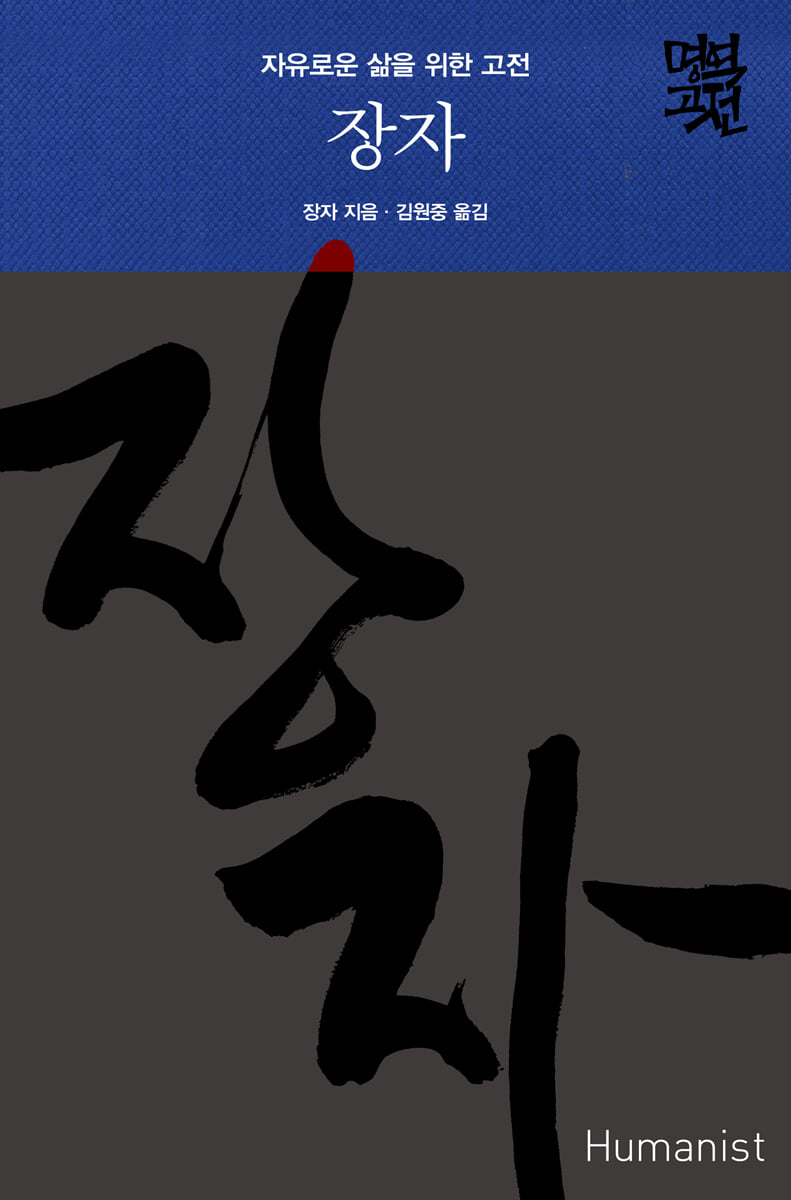
Jangja
 |
Description
Book Introduction
Can we live freely, without any restrictions or hesitation?
Zhuangzi, a treasure trove of thought that transcends common sense with its exceptional wit and satire
A free-spirited intellectual who lived a leisurely life during the chaotic Warring States period.
He spoke of inaction and futility, pursuing absolute freedom at a time when everyone was engaged in a fierce competition for survival and was absorbed in a war for hegemony.
His book, "Zhuangzi," may seem abstract and full of empty words at first glance, but hidden beneath it lies a sharp and blunt criticism of the age of greed.
Professor Kim Won-joong, a master of Eastern classics, guides readers into the world of Zhuangzi with a translation that accurately conveys the original text's meaning and a wealth of commentary that opens up diverse avenues for interpretation.
Zhuangzi, a treasure trove of thought that transcends common sense with its exceptional wit and satire
A free-spirited intellectual who lived a leisurely life during the chaotic Warring States period.
He spoke of inaction and futility, pursuing absolute freedom at a time when everyone was engaged in a fierce competition for survival and was absorbed in a war for hegemony.
His book, "Zhuangzi," may seem abstract and full of empty words at first glance, but hidden beneath it lies a sharp and blunt criticism of the age of greed.
Professor Kim Won-joong, a master of Eastern classics, guides readers into the world of Zhuangzi with a translation that accurately conveys the original text's meaning and a wealth of commentary that opens up diverse avenues for interpretation.
- You can preview some of the book's contents.
Preview
index
introduction
clear
My wife
Part 1: Soyouyu
Part 2: Theory of Jemul
Part 3: Yangsengju
Part 4: The Human World
Part 5: Deokchungbu
Part 6: The Great Master
Chapter 7: King Eungje
Extra
Part 8: The Ministry of Foreign Affairs
Part 9: The Magic
Chapter 10: The Great Hero
Chapter 11: Jae-yu
Chapter 12 Heaven and Earth
Chapter 13: The Transfer of the Capital
Chapter 14: Fortune
Part 15 Cabinet Meeting
Chapter 16: The Good
Chapter 17: Harvest
Chapter 18: The Fall
Chapter 19: Dalsaeng
Part 20: Mountain Trees
Part 21 Electronic Room
Chapter 22: The North Pole
Miscellaneous
Part 23 Gyeongsang Elementary School
Chapter 24: Seomugui
Chapter 25: Chikyang
Part 26: Foreign Objects
Part 27: Allegory
Chapter 28: The Two Kings
Chapter 29: Do-Cheok
Chapter 30: The Sword
Part 31: The Fisherman
Chapter 32: Opening
Chapter 33: The World
References
Search
clear
My wife
Part 1: Soyouyu
Part 2: Theory of Jemul
Part 3: Yangsengju
Part 4: The Human World
Part 5: Deokchungbu
Part 6: The Great Master
Chapter 7: King Eungje
Extra
Part 8: The Ministry of Foreign Affairs
Part 9: The Magic
Chapter 10: The Great Hero
Chapter 11: Jae-yu
Chapter 12 Heaven and Earth
Chapter 13: The Transfer of the Capital
Chapter 14: Fortune
Part 15 Cabinet Meeting
Chapter 16: The Good
Chapter 17: Harvest
Chapter 18: The Fall
Chapter 19: Dalsaeng
Part 20: Mountain Trees
Part 21 Electronic Room
Chapter 22: The North Pole
Miscellaneous
Part 23 Gyeongsang Elementary School
Chapter 24: Seomugui
Chapter 25: Chikyang
Part 26: Foreign Objects
Part 27: Allegory
Chapter 28: The Two Kings
Chapter 29: Do-Cheok
Chapter 30: The Sword
Part 31: The Fisherman
Chapter 32: Opening
Chapter 33: The World
References
Search
Detailed image

Publisher's Review
1.
Zhuangzi, a philosopher who longed for absolute freedom in the midst of war
- Encountering Zhuangzi, a unique giant in East Asian intellectual history
The status of Lao-tzu and Zhuang-tzu in Taoism is so unparalleled that Taoism is often referred to as the 'Thoughts of Laozi and Zhuang-tzu'.
As Taoism, along with Confucianism, constitutes the two major schools of thought among the Hundred Schools of Thought, the influence of Zhuangzi's thought on East Asia is enormous.
While accepting the concepts and principles of Lao-tzu, such as the Way and Wu-wei, he attempted to build his own unique ideology that transcended right and wrong and discrimination.
In other words, if Laozi is said to be the founder of thought who laid the foundation for Taoism, then Zhuangzi can be said to be the pioneer of thought who inherited Laozi, expanded Taoist thought, and developed various concepts.
The book "Zhuangzi", created by Zhuangzi and his disciples, is divided into three parts: the inner part, the outer part, and the miscellaneous part.
In a vast text of 33 chapters and 65,000 characters, Zhuangzi unfolds a colorful story filled with free-spirited and bold ideas.
The story of the giant bird Bung and the fish Gon criticizes the insignificant limitations of humans compared to nature, while the story argues that all things should freely exercise their innate abilities, saying that the legs of ducks and cranes, whether long or short, are all in accordance with their nature.
It is a request to those living in the harsh Warring States period to transcend narrow distinctions and subjective judgments, to find the origin and value of the world in the way of nature, and to pursue freedom by playing with an open mind.
The eldest son warns against being trapped in the worldly fences and pursuing wealth and honor, becoming mean and mean-spirited, or becoming like a bird in a cage, obsessed with fame and fame.
Zhuangzi emphasizes that we must become like a bird that can fly ten thousand miles once it takes flight.
The same is true in the 21st century, not the Warring States period in which Jangja lived.
Today, most of us are subject to common sense and worldly views, and we are always confined within strict frameworks, in the name of self-management, unable to escape the fence of success, which is wealth and fame.
It's worth reflecting on whether living better than others and having a better reputation have always been our top priorities.
The book "Zhuangzi" is imbued with the power to make us endlessly worry and question how fleeting and shabby the values and life goals set by humans or by the sages are.
To us who struggle to live a finite life, Zhuangzi constantly asks the question, "What kind of life should we live?"
Therefore, as we follow the questions raised by the elders and seek answers, our thinking cannot help but become grander.
- From the 'Preface' (pages 6-7)
2.
A sharp, cutting remark hidden behind a preposterous allegory
- A butterfly dream, a sea urchin, a fish, and a bird...
The bizarre and exciting story of Zhuangzi
In this book, Zhuangzi mainly conveys his thoughts through allegories.
The word allegory means 'borrowing from outside and discussing', and refers to expressing one's opinion indirectly through the story of a person or thing.
The most representative allegory appearing in the Zhuangzi is the famous 'Butterfly Dream', the story of a butterfly's dream.
In this story, Zhuangzi dreams of becoming a butterfly and flying freely, but in the dream he does not know that he is Zhuangzi.
So, can we really know whether Zhuangzi dreamed of becoming a butterfly, or whether the butterfly dreamed of becoming Zhuangzi? Beyond this, the Zhuangzi is filled with bizarre and fascinating stories, including the sword of a man who butchered thousands of oxen but still retains its pristine blade; the giant fish Kun and the bird Peng, whose size is incalculable; and the discussion of causality and righteousness between Confucius and Laozi.
At first glance, stories like these seem unrealistic and absurd.
But behind it all, there is a mixture of humor, satire, and cynicism thrown at the world, and sometimes, a sharp wit that chills the reader to the bone.
For example, the Butterfly Dream is a brief anecdote about Zhuangzi's dream, but it can also be interpreted as depicting a realm where there is no discrimination or difference and where all things are in harmony.
The story of Pojeong, the master of dismembering a cow, shows us how to follow the Tao, the law of nature, and how to find the path to health.
The stories of Confucius and Laozi very directly express Zhuangzi's idea that Confucianism's emphasis on benevolence and righteousness was disturbing people's nature.
The classic work Zhuangzi, which utilizes allegory in such a variety of ways, is a treasure trove of thought that allows one to derive richer meaning the more one reads it.
Long ago, Zhang Zhu dreamed of becoming a butterfly. It was a butterfly fluttering around, so he was delighted and it was in line with his wishes! [He] did not know that he was Zhang Zhu.
After a while, I woke up and saw Jangju suddenly in front of me.
I don't know, but did Zhuangzi dream of becoming a butterfly, or did the butterfly dream of becoming Zhuangzi? There must be a distinction between Zhuangzi and the butterfly, and this is called the harmony of all things.
- From Part 2, “Theory of the Day” (page 97)
Pojeong? When Ding butchered an ox for Prince Munhye, wherever his hands touched, his shoulders rested, his feet stepped, and his knees bent, a rustling sound was heard. When he moved his sword, a swoosh sound was heard, and there was nothing that did not fit the rhythm.
It was in line with the music of Sangrim [a musician during the reign of King Tang] and also suited the rhythm of Gyeongsu [a musician during the reign of King Yao].
Munhyegun said.
“Ah, that’s wonderful! How did technology get this far?”
Pojeong put down his sword and answered.
“What God likes is the road ahead of technology.
When God first dismembered the cow, there was nothing visible that was not the whole cow.
After three years, the entire cow became invisible, so now the god treats the cow with his mind and does not look at it with his eyes.
When the sense organs stop perceiving and the mind moves as it wishes, it follows the laws of nature to strike a large gap, and moves the sword in a large space to follow its original state. The technique of [using the sword] passes through the flesh attached to the bone without causing any harm, so how much more so would it be for a large bone!
- From Part 3, “Yangsaengju” (pp. 101-102)
Nodam said.
“Let me ask you, what do you mean by cause and effect?”
Confucius said:
“To rejoice in all things in one’s heart, to love all things, and to be selfless—this is the true nature of cause and effect.”
Nodam said.
“Ah, it is almost near, as I said later! To love all things is also not far from [the Way]! To be without selfishness is precisely what is selfish.
Do you intend to prevent the people of the world from losing what they have been nurtured by? If so, heaven and earth are inherently fixed, the sun and moon are inherently bright, the stars are inherently arranged, beasts are inherently herds, and trees are inherently standing. If you too act according to virtue and follow the Way, you will already be at the highest level.
"And why do you strive to uphold the principles of benevolence and righteousness, beating drums as if searching for a lost child? Ah, you, sir, are confusing human nature!"
- From Chapter 13, “Heaven” (page 319)
3.
Reading the Zhuangzi through fluent Korean and over 1,400 footnotes
- The profound flavor of Zhuangzi presented by Professor Kim Won-joong, a master of Eastern classics.
Beginning with the publication of “Han Feizi” in 2016, the series “Professor Kim Won-joong’s Classics of Our Time,” which has continued with “The Art of War,” “The Mirror of Mind,” “The Analects,” and “The Tao Te Ching of Lao Tzu,” is a representative series of Oriental classics that readers trust and purchase in bookstores.
Translator Professor Kim Won-joong had planned to conclude the "Famous Translations of Classics" series with the publication of "Mencius" in 2021, but decided to translate "Zhuangzi" after receiving numerous requests from readers to publish it.
Because the Zhuangzi is full of stories, metaphors, and allegories, his accurate and eloquent translation shines even brighter.
In addition to a clean translation, the introduction and commentary that outline the entire content of the Zhuangzi and provide direction for reading, and the footnotes that introduce the diverse views of ancient and modern commentators and open the way to rich interpretation, help readers understand the meaning of the Zhuangzi, which can be difficult to grasp.
Zhuangzi, a philosopher who longed for absolute freedom in the midst of war
- Encountering Zhuangzi, a unique giant in East Asian intellectual history
The status of Lao-tzu and Zhuang-tzu in Taoism is so unparalleled that Taoism is often referred to as the 'Thoughts of Laozi and Zhuang-tzu'.
As Taoism, along with Confucianism, constitutes the two major schools of thought among the Hundred Schools of Thought, the influence of Zhuangzi's thought on East Asia is enormous.
While accepting the concepts and principles of Lao-tzu, such as the Way and Wu-wei, he attempted to build his own unique ideology that transcended right and wrong and discrimination.
In other words, if Laozi is said to be the founder of thought who laid the foundation for Taoism, then Zhuangzi can be said to be the pioneer of thought who inherited Laozi, expanded Taoist thought, and developed various concepts.
The book "Zhuangzi", created by Zhuangzi and his disciples, is divided into three parts: the inner part, the outer part, and the miscellaneous part.
In a vast text of 33 chapters and 65,000 characters, Zhuangzi unfolds a colorful story filled with free-spirited and bold ideas.
The story of the giant bird Bung and the fish Gon criticizes the insignificant limitations of humans compared to nature, while the story argues that all things should freely exercise their innate abilities, saying that the legs of ducks and cranes, whether long or short, are all in accordance with their nature.
It is a request to those living in the harsh Warring States period to transcend narrow distinctions and subjective judgments, to find the origin and value of the world in the way of nature, and to pursue freedom by playing with an open mind.
The eldest son warns against being trapped in the worldly fences and pursuing wealth and honor, becoming mean and mean-spirited, or becoming like a bird in a cage, obsessed with fame and fame.
Zhuangzi emphasizes that we must become like a bird that can fly ten thousand miles once it takes flight.
The same is true in the 21st century, not the Warring States period in which Jangja lived.
Today, most of us are subject to common sense and worldly views, and we are always confined within strict frameworks, in the name of self-management, unable to escape the fence of success, which is wealth and fame.
It's worth reflecting on whether living better than others and having a better reputation have always been our top priorities.
The book "Zhuangzi" is imbued with the power to make us endlessly worry and question how fleeting and shabby the values and life goals set by humans or by the sages are.
To us who struggle to live a finite life, Zhuangzi constantly asks the question, "What kind of life should we live?"
Therefore, as we follow the questions raised by the elders and seek answers, our thinking cannot help but become grander.
- From the 'Preface' (pages 6-7)
2.
A sharp, cutting remark hidden behind a preposterous allegory
- A butterfly dream, a sea urchin, a fish, and a bird...
The bizarre and exciting story of Zhuangzi
In this book, Zhuangzi mainly conveys his thoughts through allegories.
The word allegory means 'borrowing from outside and discussing', and refers to expressing one's opinion indirectly through the story of a person or thing.
The most representative allegory appearing in the Zhuangzi is the famous 'Butterfly Dream', the story of a butterfly's dream.
In this story, Zhuangzi dreams of becoming a butterfly and flying freely, but in the dream he does not know that he is Zhuangzi.
So, can we really know whether Zhuangzi dreamed of becoming a butterfly, or whether the butterfly dreamed of becoming Zhuangzi? Beyond this, the Zhuangzi is filled with bizarre and fascinating stories, including the sword of a man who butchered thousands of oxen but still retains its pristine blade; the giant fish Kun and the bird Peng, whose size is incalculable; and the discussion of causality and righteousness between Confucius and Laozi.
At first glance, stories like these seem unrealistic and absurd.
But behind it all, there is a mixture of humor, satire, and cynicism thrown at the world, and sometimes, a sharp wit that chills the reader to the bone.
For example, the Butterfly Dream is a brief anecdote about Zhuangzi's dream, but it can also be interpreted as depicting a realm where there is no discrimination or difference and where all things are in harmony.
The story of Pojeong, the master of dismembering a cow, shows us how to follow the Tao, the law of nature, and how to find the path to health.
The stories of Confucius and Laozi very directly express Zhuangzi's idea that Confucianism's emphasis on benevolence and righteousness was disturbing people's nature.
The classic work Zhuangzi, which utilizes allegory in such a variety of ways, is a treasure trove of thought that allows one to derive richer meaning the more one reads it.
Long ago, Zhang Zhu dreamed of becoming a butterfly. It was a butterfly fluttering around, so he was delighted and it was in line with his wishes! [He] did not know that he was Zhang Zhu.
After a while, I woke up and saw Jangju suddenly in front of me.
I don't know, but did Zhuangzi dream of becoming a butterfly, or did the butterfly dream of becoming Zhuangzi? There must be a distinction between Zhuangzi and the butterfly, and this is called the harmony of all things.
- From Part 2, “Theory of the Day” (page 97)
Pojeong? When Ding butchered an ox for Prince Munhye, wherever his hands touched, his shoulders rested, his feet stepped, and his knees bent, a rustling sound was heard. When he moved his sword, a swoosh sound was heard, and there was nothing that did not fit the rhythm.
It was in line with the music of Sangrim [a musician during the reign of King Tang] and also suited the rhythm of Gyeongsu [a musician during the reign of King Yao].
Munhyegun said.
“Ah, that’s wonderful! How did technology get this far?”
Pojeong put down his sword and answered.
“What God likes is the road ahead of technology.
When God first dismembered the cow, there was nothing visible that was not the whole cow.
After three years, the entire cow became invisible, so now the god treats the cow with his mind and does not look at it with his eyes.
When the sense organs stop perceiving and the mind moves as it wishes, it follows the laws of nature to strike a large gap, and moves the sword in a large space to follow its original state. The technique of [using the sword] passes through the flesh attached to the bone without causing any harm, so how much more so would it be for a large bone!
- From Part 3, “Yangsaengju” (pp. 101-102)
Nodam said.
“Let me ask you, what do you mean by cause and effect?”
Confucius said:
“To rejoice in all things in one’s heart, to love all things, and to be selfless—this is the true nature of cause and effect.”
Nodam said.
“Ah, it is almost near, as I said later! To love all things is also not far from [the Way]! To be without selfishness is precisely what is selfish.
Do you intend to prevent the people of the world from losing what they have been nurtured by? If so, heaven and earth are inherently fixed, the sun and moon are inherently bright, the stars are inherently arranged, beasts are inherently herds, and trees are inherently standing. If you too act according to virtue and follow the Way, you will already be at the highest level.
"And why do you strive to uphold the principles of benevolence and righteousness, beating drums as if searching for a lost child? Ah, you, sir, are confusing human nature!"
- From Chapter 13, “Heaven” (page 319)
3.
Reading the Zhuangzi through fluent Korean and over 1,400 footnotes
- The profound flavor of Zhuangzi presented by Professor Kim Won-joong, a master of Eastern classics.
Beginning with the publication of “Han Feizi” in 2016, the series “Professor Kim Won-joong’s Classics of Our Time,” which has continued with “The Art of War,” “The Mirror of Mind,” “The Analects,” and “The Tao Te Ching of Lao Tzu,” is a representative series of Oriental classics that readers trust and purchase in bookstores.
Translator Professor Kim Won-joong had planned to conclude the "Famous Translations of Classics" series with the publication of "Mencius" in 2021, but decided to translate "Zhuangzi" after receiving numerous requests from readers to publish it.
Because the Zhuangzi is full of stories, metaphors, and allegories, his accurate and eloquent translation shines even brighter.
In addition to a clean translation, the introduction and commentary that outline the entire content of the Zhuangzi and provide direction for reading, and the footnotes that introduce the diverse views of ancient and modern commentators and open the way to rich interpretation, help readers understand the meaning of the Zhuangzi, which can be difficult to grasp.
GOODS SPECIFICS
- Date of issue: January 2, 2023
- Format: Hardcover book binding method guide
- Page count, weight, size: 808 pages | 1,094g | 140*210*40mm
- ISBN13: 9791160809497
- ISBN10: 1160809496
You may also like
카테고리
korean


korean

![GQ KOREA Mark (Monthly): December [2025]](http://librairie.coreenne.fr/cdn/shop/files/8ef265dbbfbf186523ed75ba7319009d.jpg?v=1765340328&width=3840)


