

Doolju Station lecture
 |
Description
Book Introduction
The protagonist is the philosophy of transformation!
Dool, finally talking about the 《Book of Changes》!
The Book of Changes, which explains the operating principles of the ever-changing universe, is the pinnacle of Eastern philosophy.
Do-ol Kim Yong-ok, the philosopher of our time, has finally reached the main character.
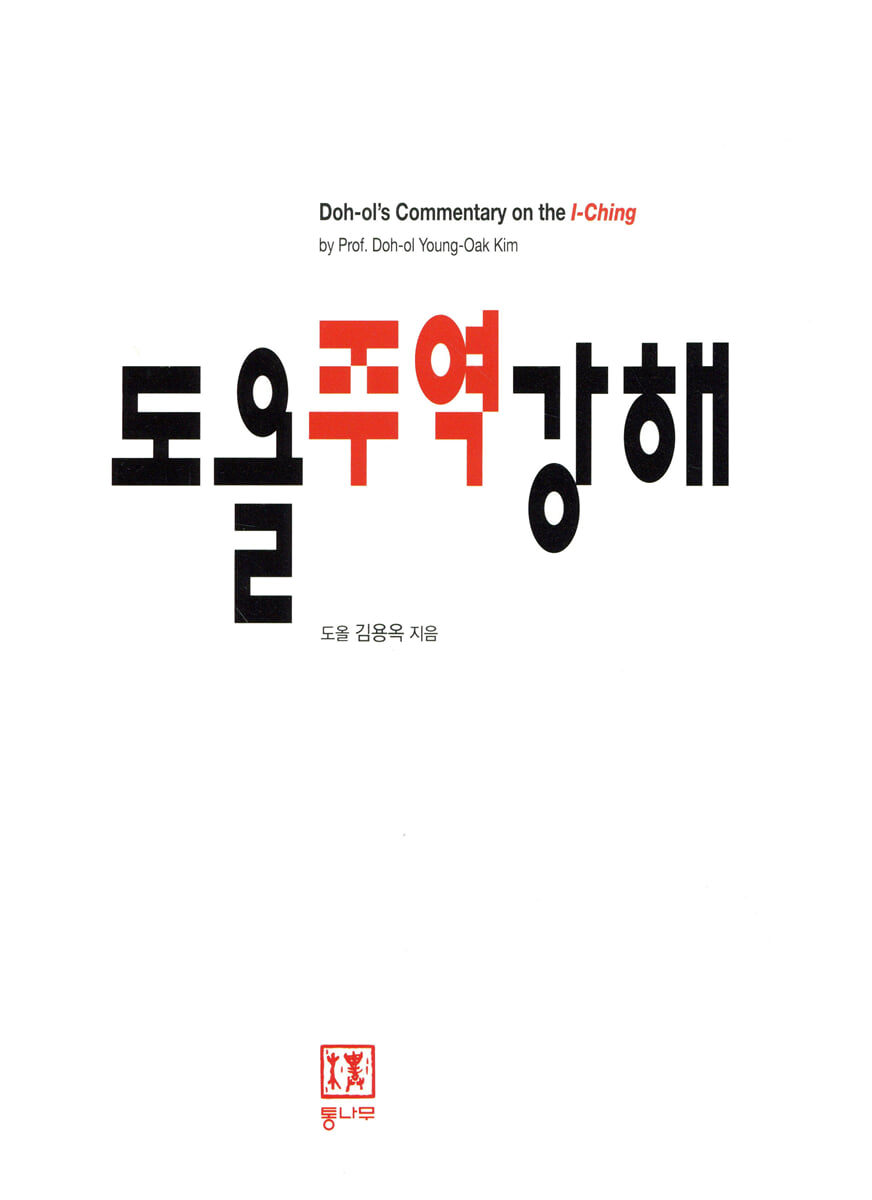
This book, “Dool Juyeok Lectures,” is a book in which Professor Dool meticulously researches the “Book of Changes” using all of his knowledge of classical studies and explains its meaning clearly in Korean.
In this book, Dool proclaims the Book of Changes as a philosophy of transformation and urges us to overcome this turbulent era with the wisdom of the Book of Changes.
He explains the original form of the Book of Changes in an easy-to-understand way, and allows the true meaning of the Book of Changes to be revealed on its own.
Through this, readers themselves will gain new strength to overcome the problems of reality.
The profound thinking of the Book of Changes became the root of all Eastern thought, including the Doctrine of the Mean, Lao-tzu, and Zhuang-tzu, and even today, it remains deeply rooted in the minds of Easterners, especially Koreans.
Such protagonists were misunderstood by modern people.
Dool's book liberates the protagonist from the influence of existing superstitious elements.
The protagonist is not bound by a given fate.
On the contrary, it is an idea that teaches us to forge and create anew our own destiny in a desirable direction, in opposition to fatalistic thinking.
The Book of Changes is a philosophy born to transform people and society.
Dool, finally talking about the 《Book of Changes》!
The Book of Changes, which explains the operating principles of the ever-changing universe, is the pinnacle of Eastern philosophy.
Do-ol Kim Yong-ok, the philosopher of our time, has finally reached the main character.
This book, “Dool Juyeok Lectures,” is a book in which Professor Dool meticulously researches the “Book of Changes” using all of his knowledge of classical studies and explains its meaning clearly in Korean.
In this book, Dool proclaims the Book of Changes as a philosophy of transformation and urges us to overcome this turbulent era with the wisdom of the Book of Changes.
He explains the original form of the Book of Changes in an easy-to-understand way, and allows the true meaning of the Book of Changes to be revealed on its own.
Through this, readers themselves will gain new strength to overcome the problems of reality.
The profound thinking of the Book of Changes became the root of all Eastern thought, including the Doctrine of the Mean, Lao-tzu, and Zhuang-tzu, and even today, it remains deeply rooted in the minds of Easterners, especially Koreans.
Such protagonists were misunderstood by modern people.
Dool's book liberates the protagonist from the influence of existing superstitious elements.
The protagonist is not bound by a given fate.
On the contrary, it is an idea that teaches us to forge and create anew our own destiny in a desirable direction, in opposition to fatalistic thinking.
The Book of Changes is a philosophy born to transform people and society.
- You can preview some of the book's contents.
Preview
index
Chapter 1: The Dokyeoksuji - 13 Essential Things to Know When Reading the Book of Changes
Why is "Yeok" so appealing? 15
Braille and Academic Translation 16
18 Sutras and Traditions in the Book of Changes
From oracle bone to yin-yang symbols 19
The station is change. What exactly is change? 20
Gojoseon civilization was centered around the postal system. 21
The Three Meanings of the Station 22
Immutability is not immutability! It's simply the continuation of a framework of change. 22
Yin and Yang and Strong and Wealthy 24
The meaning of the character 易 24
There is a Taegeuk in the station (=there is a Taegeuk in change) 25
The dynamic state of emptiness that moves constantly 26
Taegeuk is the union of Geon and Gon. 27
Courbet's Origin of the World 28
Impressionist Painters and Eastern Philosophy 29
Change, Creation, and Feeling 30
Factual and symbolic expressions 31
Problems with Kant's Categories 32
Categories and Yin-Yang Theory, Dead and Living Worlds 32
The Binary Universe 33
The fundamental motivation for writing this book 33
Juyeok, Yeonsan Station, Gwijang Station 34
The process of creating the Bagua 35
From 8 hexagrams to 64 hexagrams (8×8) 37
Leibniz's Binary System and the I Ching 39
The immutability of the Geon hexagram of Sunyang and the Gon hexagram of Sunyin 40
Western modernity has only freedom and no life. 40
Progress without a philosophy of progress will only lead to the destruction of civilization and nature. 41
Gam and Lee, Water and Fire Duet 42
Chak = Bangtong, Jong = Opposite 43
The meaning of Geon-Gon-Byeong-Geon 45
"The Book of Changes" isn't meant to be read! It's not meant to be read, part 46.
Liberation from the superstition of "Yeok" (traditional Korean rites), a synthesis of the ancestral rites and duties of the ancestors' mountain 47
The Denial of the Transcendent Being, 49
The Limits of the 64-Gwae, Levensvelt 50
The Violence of Science 51
Celestial and terrestrial motions are merely means of explanation. 52
Heaven and Earth, the Limited Circulation System of Qi 52
My Octopus Teacher 54
Basic Knowledge About the Eight Trigrams, Part 54
The Symbolic System of the Eight Trigrams 56
The four pillars that make up the sutra 58
Cross Sisters 59 in front of Pagoda Park
Cross Sisters Paper Shop and Hyosa 59
60 hexagrams and hexagrams
From Fuxi to Confucius 61
All texts are subject to analysis and criticism 62
Image and Proverb 62
The hexagrams, hexagram names, hexagram descriptions, and hexagram interpretations are each the result of unique traditions. 64
The Necessity and Chance of Our Lives, Constants and Romance 66
Now let's talk about the ten wings! 68
Basic Concepts of the Text "The Book of Changes" 75
Zhu Xi's "Shiguagoo" 80
When did Joo Hee write the "Book of Changes"? 81
The Long Formation of the Book of Changes, Part 82
The Meaning of the Book Title, "The Book of Changes" 84
The Problem of “Ri” and the Book of Changes 84
Jeong Icheon's Reverse Philosophy 85
Joohee's Counterattack 86
Divide the sutras and the traditions 87
The station originally included the book of boxing and even the science of mathematics.
Preface to "The Enlightenment of the Dynamics": Advocating the Interrelationship of Constants and Righteousness 89
Juhee's "Taegeukdosulhae" 90
Five essays titled "The Book of Changes" 91
92 A treatise titled "Seoui" summarizing Juhee's divination methods
The station is only a place for silence and inaction 93
Chapter 2: How to Count Points 95
Discussion of calligraphy is omitted, only specific methods are given.
Daeyeon Index 98
49 Origins 98
Just follow along.
It's not difficult 99
The Three Powers of Heaven, Earth, and Man, Chapter 1, Chapter 99
Side 2 101
Third Side 101
3×6 = 18, repeating 3 sides 6 times, 18 sides 103
Method of Interpretation 106
A Simple Method, The 107th Method
Chapter 3, The Book of Changes (上經), 109
[01] Dry Below Dry Above Middle Heaven Dry Creative Universe 111
Interpretation of the Four Virtues of Wonhyeongrijeong, Semiotics 112
The Sunyang Geon and Sunyin Gon trigrams are pure symbols, not the reality of change. 113
Formula 113 as told by Whalley
Language Genius Shuchutzki 113
Mantic Formula 114 as told by Shuchutzki
Dantian 115 of the Geon hexagram
Interpretation of Yuan in the "Danjeon" 117
Interpretation of Hyung in the "Danjeon" 117
Interpretation of Li and Jeong in the "Danjeon" 117
The famous sentence "Moon-eon" (118)
Zhu Xi's Commentary on the Literature, 120
The masterpiece, "Daesangjeon," and its compositional materials 123
The author's interpretation of the "Daesangjeon" 123
In the case of the Sa-Gwae, 125
In the case of the Mengmen hexagram, 125
Interpretation of the Geon hexagram (subject) 126
In the case of the Kun hexagram, 127
Natural Philosophical Moral Metaphysics 128
Demon King's Retreat White Paper Story 129
Maantui's Blue Fire 129
The O clan of Honam, Jangsa-guk 130
The Mawangdui Tomb artifacts are the ultimate expression of the Han Empire's civilization. 131
Lee Chang's son Lee Hee, and Lee Hee's younger brother Lee Deuk 133
The largest underground library in history 134
The Demon King's Retreat, 《White Book of Changes》 and the current edition of 《The Book of Changes》 135
Chapter 135 of the "Book of Changes" from the Demon King's Retreat
The order of the hexagrams in the Baekseojuyik cannot have original authority. 136
Kun and Cheon 136
From Concrete to Abstract 137
The original meaning of Won 138
The original meaning of Hyung 138
The Original Meaning of Li 139
The Original Meaning of Jeong 140
The final interpretation of the circular 141
[02] Gonha, Gon Sang, Gon Ji, Gon Receptive Universe 151
[03] Jinha, the trembling, Kansang, the torment, Jun, Difficulties of a New Beginning 161
[04] Gamha (坎下) Gan Sang (艮上) Mountains and Rivers Dream Youthful Folly, Enlightenment 172
[05] Dryness below, feeling above, thousands of needs, waiting, Nourishment 180
[06] Gamha, Geonsang, Cheonsoo Song, Lawsuit, Confrontation 186
[07] Gamha, Gon Sang, Ji Soo Sa, The Army 193
[08] Gonha, 坤下, 坎上, Suji, 比, Intimacy, Alliance 204
[09] Dryness, Sunsang, Pungcheon, Small Livestock The Accumulating Power of the Small 211
[10] Treading, Putting into Practice 219
[11] Peace, Penetration 230
[12] Obstruction, Standstill 244
[13] Liha, Geon Sang, Cheon Hwa, Dong In, Fellowship, Cooperation 254
[14] Abundance in Great Measure 262
[15] Modesty, Lowliness 270
[16] Kunha, Jinsang, Ji, Ye, Enthusiasm, Enjoyment 278
[17] Jinha, Jinha, Taesang, Taekrae, Su, Following, Pursuit of Universal Values 286
[18] Sonha (巽下) Gansang (艮上) Sanpung (蠱) Destruction and Restoration 295
[19] Approaching, Growing Upward 304
[20] Observation, Envisaging 312
[21] Jin-ha, Ji-sang, Lee-sang, Hwa-roe, Seo-hap?? Biting Through, Punishment 321
[22] Liha (離下) Gansang (艮上) Oxidation (賁) Embellishment, Civility 330
[23] Peeling Off, Collapse 339
[24] Jinha 震下 坤上 復 Returning, Elan Vital 349
[25] Truthfulness, Heavenly Sincerity 359
[26] The Accumulating Power of the Great, Great Nurturing 368
[27] Jinha, Gansang, Sanroe, Lee? The Jaws, Fostering 378
[28] The Excessiveness of the Great 388
[29] Gamha 坎下 Gamsang 坎上 Jungsu 坎 Quagmire, Continuous Adversity 398
[30] Liha (離下) Lisang (離上) Zhong Hua (離) Clinging, Brilliance 407
The Book of Changes (Ha-gyeong) 417
[31] Ganha, Taesang, Taesan, Ham, Feeling, Comprehension, Nuptial Bliss 418
[32] Sonha, Jinsang, Jinsang, Lightning, Hang? Duration, Constancy 437
[33] Ganha (艮下) Geonsang (乾上) Cheonsan Dun遯 Retreat, Seclusion 445
[34] The Exuberance of the Great 453
[35] Advancing, Shining 461
[36] A Time to Conceal Your Brilliance, The Hour of Darkness 469
[37] Liha, below, damage, above, wind, and fire Family Life, Family Morals 479
[38] Taiha, Lisang, Lisang, Hua-taek, Gui? Antagonism, Opposition 488
[39] Ganha 艮下, Gamsang 坎上, Susan 蹇, Destitution, Travails 497
[40] Dissolution, Overcoming Agony 505
[41] Taeha, Gansang, Santaek, Son, Decrease 515
[42] Jinha 震下 Damage 巽上 Wind and lightning benefit Increase 527
[43] Qianha 乾下 Taisang 兌上 Takcheon Kwai? Resoluteness, Decision 536
[44] Sonha, Geon-sang, Cheonpung, Gu? Encounter 546
[45] Gonha, Taesang, Taekji, Che, Gathering together 556
[46] Sonha (巽下) Gonsang (坤上) Jipung (升) Pushing Upward, Ascending 566
[47] Gamha坎下 Taesang兌上 Taeksu Gon困 Deprivation, Exhaustion 574
[48] Sonha (巽下) Kansang (坎上) Su-pung (井) The Well 586
[49] Liha, Taesang, Taekhwa, Revolution 598
[50] Sonha (巽下) Lisang (離上) Hwapung Jeong (鼎) The Caldron 612
[51] Thunder, Shaking, Apprehensiveness 628
[52] Ganha (艮下) Gansan (艮上) Zhongshan (艮山), Keeping Still, Cessation 638
[53] Ganha, Sonsang, Pungsan, Gradual Advance 648
[54] Taiha, Jinsang, Luoze, Guimai, The Marrying Maiden, Marriage 658
[55] Liha, Jinsang, Jinsang, Lightning, Wind? Abundance, Fullness 673
[56] The Wanderer, Life in Foreign Lands 685
[57] Sonha (巽下) Sonsang (巽上) Stroke Son (巽) Humbleness, Penetration, Wind 695
[58] Taishang (兌上) Taiha (兌下) Zhongtaek (兌 Lake), Joyfulness 704
[59] Gamha, 坎下, 巽上, 渙, Dispersion, Redemption 712
[60] Taeha 兌下 Gamsang 坎上 Sutaek 節 Moderation, Limitation, Sense of Order 721
[61] Taeha, 兌下, 巽上, 防時, 防時, 中孚, Truthfulness of the Heart, Cosmic Sincerity 730
[62] The Overflow of the Small 744
[63] Liha (離下) Kansang (坎上) Suhwa Gije (旣濟) The Finished, Completion, Perfection 755
[64] The Unfinished, Incompletion, Imperfection 767
64-hexagram Daesangjeon 777
Search 780
Why is "Yeok" so appealing? 15
Braille and Academic Translation 16
18 Sutras and Traditions in the Book of Changes
From oracle bone to yin-yang symbols 19
The station is change. What exactly is change? 20
Gojoseon civilization was centered around the postal system. 21
The Three Meanings of the Station 22
Immutability is not immutability! It's simply the continuation of a framework of change. 22
Yin and Yang and Strong and Wealthy 24
The meaning of the character 易 24
There is a Taegeuk in the station (=there is a Taegeuk in change) 25
The dynamic state of emptiness that moves constantly 26
Taegeuk is the union of Geon and Gon. 27
Courbet's Origin of the World 28
Impressionist Painters and Eastern Philosophy 29
Change, Creation, and Feeling 30
Factual and symbolic expressions 31
Problems with Kant's Categories 32
Categories and Yin-Yang Theory, Dead and Living Worlds 32
The Binary Universe 33
The fundamental motivation for writing this book 33
Juyeok, Yeonsan Station, Gwijang Station 34
The process of creating the Bagua 35
From 8 hexagrams to 64 hexagrams (8×8) 37
Leibniz's Binary System and the I Ching 39
The immutability of the Geon hexagram of Sunyang and the Gon hexagram of Sunyin 40
Western modernity has only freedom and no life. 40
Progress without a philosophy of progress will only lead to the destruction of civilization and nature. 41
Gam and Lee, Water and Fire Duet 42
Chak = Bangtong, Jong = Opposite 43
The meaning of Geon-Gon-Byeong-Geon 45
"The Book of Changes" isn't meant to be read! It's not meant to be read, part 46.
Liberation from the superstition of "Yeok" (traditional Korean rites), a synthesis of the ancestral rites and duties of the ancestors' mountain 47
The Denial of the Transcendent Being, 49
The Limits of the 64-Gwae, Levensvelt 50
The Violence of Science 51
Celestial and terrestrial motions are merely means of explanation. 52
Heaven and Earth, the Limited Circulation System of Qi 52
My Octopus Teacher 54
Basic Knowledge About the Eight Trigrams, Part 54
The Symbolic System of the Eight Trigrams 56
The four pillars that make up the sutra 58
Cross Sisters 59 in front of Pagoda Park
Cross Sisters Paper Shop and Hyosa 59
60 hexagrams and hexagrams
From Fuxi to Confucius 61
All texts are subject to analysis and criticism 62
Image and Proverb 62
The hexagrams, hexagram names, hexagram descriptions, and hexagram interpretations are each the result of unique traditions. 64
The Necessity and Chance of Our Lives, Constants and Romance 66
Now let's talk about the ten wings! 68
Basic Concepts of the Text "The Book of Changes" 75
Zhu Xi's "Shiguagoo" 80
When did Joo Hee write the "Book of Changes"? 81
The Long Formation of the Book of Changes, Part 82
The Meaning of the Book Title, "The Book of Changes" 84
The Problem of “Ri” and the Book of Changes 84
Jeong Icheon's Reverse Philosophy 85
Joohee's Counterattack 86
Divide the sutras and the traditions 87
The station originally included the book of boxing and even the science of mathematics.
Preface to "The Enlightenment of the Dynamics": Advocating the Interrelationship of Constants and Righteousness 89
Juhee's "Taegeukdosulhae" 90
Five essays titled "The Book of Changes" 91
92 A treatise titled "Seoui" summarizing Juhee's divination methods
The station is only a place for silence and inaction 93
Chapter 2: How to Count Points 95
Discussion of calligraphy is omitted, only specific methods are given.
Daeyeon Index 98
49 Origins 98
Just follow along.
It's not difficult 99
The Three Powers of Heaven, Earth, and Man, Chapter 1, Chapter 99
Side 2 101
Third Side 101
3×6 = 18, repeating 3 sides 6 times, 18 sides 103
Method of Interpretation 106
A Simple Method, The 107th Method
Chapter 3, The Book of Changes (上經), 109
[01] Dry Below Dry Above Middle Heaven Dry Creative Universe 111
Interpretation of the Four Virtues of Wonhyeongrijeong, Semiotics 112
The Sunyang Geon and Sunyin Gon trigrams are pure symbols, not the reality of change. 113
Formula 113 as told by Whalley
Language Genius Shuchutzki 113
Mantic Formula 114 as told by Shuchutzki
Dantian 115 of the Geon hexagram
Interpretation of Yuan in the "Danjeon" 117
Interpretation of Hyung in the "Danjeon" 117
Interpretation of Li and Jeong in the "Danjeon" 117
The famous sentence "Moon-eon" (118)
Zhu Xi's Commentary on the Literature, 120
The masterpiece, "Daesangjeon," and its compositional materials 123
The author's interpretation of the "Daesangjeon" 123
In the case of the Sa-Gwae, 125
In the case of the Mengmen hexagram, 125
Interpretation of the Geon hexagram (subject) 126
In the case of the Kun hexagram, 127
Natural Philosophical Moral Metaphysics 128
Demon King's Retreat White Paper Story 129
Maantui's Blue Fire 129
The O clan of Honam, Jangsa-guk 130
The Mawangdui Tomb artifacts are the ultimate expression of the Han Empire's civilization. 131
Lee Chang's son Lee Hee, and Lee Hee's younger brother Lee Deuk 133
The largest underground library in history 134
The Demon King's Retreat, 《White Book of Changes》 and the current edition of 《The Book of Changes》 135
Chapter 135 of the "Book of Changes" from the Demon King's Retreat
The order of the hexagrams in the Baekseojuyik cannot have original authority. 136
Kun and Cheon 136
From Concrete to Abstract 137
The original meaning of Won 138
The original meaning of Hyung 138
The Original Meaning of Li 139
The Original Meaning of Jeong 140
The final interpretation of the circular 141
[02] Gonha, Gon Sang, Gon Ji, Gon Receptive Universe 151
[03] Jinha, the trembling, Kansang, the torment, Jun, Difficulties of a New Beginning 161
[04] Gamha (坎下) Gan Sang (艮上) Mountains and Rivers Dream Youthful Folly, Enlightenment 172
[05] Dryness below, feeling above, thousands of needs, waiting, Nourishment 180
[06] Gamha, Geonsang, Cheonsoo Song, Lawsuit, Confrontation 186
[07] Gamha, Gon Sang, Ji Soo Sa, The Army 193
[08] Gonha, 坤下, 坎上, Suji, 比, Intimacy, Alliance 204
[09] Dryness, Sunsang, Pungcheon, Small Livestock The Accumulating Power of the Small 211
[10] Treading, Putting into Practice 219
[11] Peace, Penetration 230
[12] Obstruction, Standstill 244
[13] Liha, Geon Sang, Cheon Hwa, Dong In, Fellowship, Cooperation 254
[14] Abundance in Great Measure 262
[15] Modesty, Lowliness 270
[16] Kunha, Jinsang, Ji, Ye, Enthusiasm, Enjoyment 278
[17] Jinha, Jinha, Taesang, Taekrae, Su, Following, Pursuit of Universal Values 286
[18] Sonha (巽下) Gansang (艮上) Sanpung (蠱) Destruction and Restoration 295
[19] Approaching, Growing Upward 304
[20] Observation, Envisaging 312
[21] Jin-ha, Ji-sang, Lee-sang, Hwa-roe, Seo-hap?? Biting Through, Punishment 321
[22] Liha (離下) Gansang (艮上) Oxidation (賁) Embellishment, Civility 330
[23] Peeling Off, Collapse 339
[24] Jinha 震下 坤上 復 Returning, Elan Vital 349
[25] Truthfulness, Heavenly Sincerity 359
[26] The Accumulating Power of the Great, Great Nurturing 368
[27] Jinha, Gansang, Sanroe, Lee? The Jaws, Fostering 378
[28] The Excessiveness of the Great 388
[29] Gamha 坎下 Gamsang 坎上 Jungsu 坎 Quagmire, Continuous Adversity 398
[30] Liha (離下) Lisang (離上) Zhong Hua (離) Clinging, Brilliance 407
The Book of Changes (Ha-gyeong) 417
[31] Ganha, Taesang, Taesan, Ham, Feeling, Comprehension, Nuptial Bliss 418
[32] Sonha, Jinsang, Jinsang, Lightning, Hang? Duration, Constancy 437
[33] Ganha (艮下) Geonsang (乾上) Cheonsan Dun遯 Retreat, Seclusion 445
[34] The Exuberance of the Great 453
[35] Advancing, Shining 461
[36] A Time to Conceal Your Brilliance, The Hour of Darkness 469
[37] Liha, below, damage, above, wind, and fire Family Life, Family Morals 479
[38] Taiha, Lisang, Lisang, Hua-taek, Gui? Antagonism, Opposition 488
[39] Ganha 艮下, Gamsang 坎上, Susan 蹇, Destitution, Travails 497
[40] Dissolution, Overcoming Agony 505
[41] Taeha, Gansang, Santaek, Son, Decrease 515
[42] Jinha 震下 Damage 巽上 Wind and lightning benefit Increase 527
[43] Qianha 乾下 Taisang 兌上 Takcheon Kwai? Resoluteness, Decision 536
[44] Sonha, Geon-sang, Cheonpung, Gu? Encounter 546
[45] Gonha, Taesang, Taekji, Che, Gathering together 556
[46] Sonha (巽下) Gonsang (坤上) Jipung (升) Pushing Upward, Ascending 566
[47] Gamha坎下 Taesang兌上 Taeksu Gon困 Deprivation, Exhaustion 574
[48] Sonha (巽下) Kansang (坎上) Su-pung (井) The Well 586
[49] Liha, Taesang, Taekhwa, Revolution 598
[50] Sonha (巽下) Lisang (離上) Hwapung Jeong (鼎) The Caldron 612
[51] Thunder, Shaking, Apprehensiveness 628
[52] Ganha (艮下) Gansan (艮上) Zhongshan (艮山), Keeping Still, Cessation 638
[53] Ganha, Sonsang, Pungsan, Gradual Advance 648
[54] Taiha, Jinsang, Luoze, Guimai, The Marrying Maiden, Marriage 658
[55] Liha, Jinsang, Jinsang, Lightning, Wind? Abundance, Fullness 673
[56] The Wanderer, Life in Foreign Lands 685
[57] Sonha (巽下) Sonsang (巽上) Stroke Son (巽) Humbleness, Penetration, Wind 695
[58] Taishang (兌上) Taiha (兌下) Zhongtaek (兌 Lake), Joyfulness 704
[59] Gamha, 坎下, 巽上, 渙, Dispersion, Redemption 712
[60] Taeha 兌下 Gamsang 坎上 Sutaek 節 Moderation, Limitation, Sense of Order 721
[61] Taeha, 兌下, 巽上, 防時, 防時, 中孚, Truthfulness of the Heart, Cosmic Sincerity 730
[62] The Overflow of the Small 744
[63] Liha (離下) Kansang (坎上) Suhwa Gije (旣濟) The Finished, Completion, Perfection 755
[64] The Unfinished, Incompletion, Imperfection 767
64-hexagram Daesangjeon 777
Search 780
Into the book
The Book of Changes is change, and change is the Creative Advance of life in the universe, and the Creative Advance of life in the universe means the continuous circulation of the energy that makes up the universe.
--- p.21
The groundbreaking leap forward in history began with the discovery that the most fundamental categories that make this vitality possible were represented by two symbols: ? and ?.
--- p.23
Change meant the process of giving birth to a new being through the feeling of mutual demand and acceptance through the communication of yin and yang.
In other words, if yin and yang do not coexist, the Book of Changes does not exist.
--- p.40
In the world of reverse, nothing is fixed.
Nothing is materialized.
Because even the Supreme Ultimate cannot be realized, it is called Mugeuk (without polarity: without substantial limitations).
--- p.41
The universe that 《The Book of Changes》 refers to is not a physical universe, but basically means the “universe of life,” that is, Lebenswelt (the world of life).
--- p.51
What I want to say is that this worldview of the Book of Changes is something that humanity must embrace if it is to put into practice the ideals of ecology.
--- p.54
I have devoted myself to studying the Book of Changes since the year of Gapja (1804), and it has been ten years now, but I have never once counted the beginning of a day, made a hexagram, and had my fortune told about something (Yeoyu Dang Jeonseo, Volume 1, Volume 20).
--- p.94
In the human world, profit always brings about conflict.
Therefore, only when the conflict can be harmonized can Lee become a true Lee.
Lee must understand that it is not a personal value, but a social value.
--- p.139
Humans never grow alone under any circumstances.
The ethics of the Li Jian family became the core of the cultural value of Confucianism.
--- p.144
“Jeong” can be consistently interpreted as “point, question.”
--- p.292
Here, “형亨” is an example that proves that “亨” is originally a character that means “향享” in “to perform a ritual.”
… … “Prosperous” is only a secondary meaning derived from the emotions of God and humans.
--- p.21
The groundbreaking leap forward in history began with the discovery that the most fundamental categories that make this vitality possible were represented by two symbols: ? and ?.
--- p.23
Change meant the process of giving birth to a new being through the feeling of mutual demand and acceptance through the communication of yin and yang.
In other words, if yin and yang do not coexist, the Book of Changes does not exist.
--- p.40
In the world of reverse, nothing is fixed.
Nothing is materialized.
Because even the Supreme Ultimate cannot be realized, it is called Mugeuk (without polarity: without substantial limitations).
--- p.41
The universe that 《The Book of Changes》 refers to is not a physical universe, but basically means the “universe of life,” that is, Lebenswelt (the world of life).
--- p.51
What I want to say is that this worldview of the Book of Changes is something that humanity must embrace if it is to put into practice the ideals of ecology.
--- p.54
I have devoted myself to studying the Book of Changes since the year of Gapja (1804), and it has been ten years now, but I have never once counted the beginning of a day, made a hexagram, and had my fortune told about something (Yeoyu Dang Jeonseo, Volume 1, Volume 20).
--- p.94
In the human world, profit always brings about conflict.
Therefore, only when the conflict can be harmonized can Lee become a true Lee.
Lee must understand that it is not a personal value, but a social value.
--- p.139
Humans never grow alone under any circumstances.
The ethics of the Li Jian family became the core of the cultural value of Confucianism.
--- p.144
“Jeong” can be consistently interpreted as “point, question.”
--- p.292
Here, “형亨” is an example that proves that “亨” is originally a character that means “향享” in “to perform a ritual.”
… … “Prosperous” is only a secondary meaning derived from the emotions of God and humans.
--- p.570
Publisher's Review
A complete commentary on the entire Book of Changes!
64 hexagrams, 384 syllables, each and every sentence tells a story!
The highlight of this book is the detailed commentary by author Do-ol Kim Yong-ok on the entire Book of Changes, the most original text in the Book of Changes.
Each sentence of each filial piety, each letter more concise than the poems in the Book of Songs, unfolds into a long epic story.
Here, the groundbreaking work stands out by correcting the key terms of the Book of Changes, which have been conventionally misunderstood, to their original meanings.
And the author clearly explains what the main character of the Book of Changes is and how we should understand it from a modern perspective, examining the historical flow of the creation of the Book of Changes system.
This book also provides practical guidance on how to do divination, allowing any reader to do it themselves.
Through this, we can become free and liberated from fortune telling.
The most fascinating book in the East, 《The Book of Changes》!
The Book of Changes is a book of change!
Although Eastern civilization has produced so many great classics, none has had as direct an impact on all aspects of human life as the Book of Changes.
It has had a profound influence on various fields, including philosophy, ethics, literature, art, political theory, and even natural science.
In Eastern history, even the great reformers who sought political revolution could not help but utilize the logical system of the Book of Changes as the basis of their thinking.
It is said that our General Yi Sun-sin also focused on fortune telling in the midst of chaos before going on a campaign or in his relationships with other people.
The word "易" in the "Book of Changes" means change.
The English translation of the Book of Changes is “The Book of Changes.”
The Book of Changes correctly recognizes this constantly changing world of phenomena and tells us that humans must constantly change in accordance with the times in all relationships surrounding them.
Here, we are saying that change is a cycle, that the core of the cycle is moderation, and that the core of moderation is eternal self-transformation.
The main characters are divided into “Adversity” and “Reversal”!
"The Great Exhibition," the essence of moral metaphysics! Outstanding political philosophy!
The literature called 《Book of Changes》 is composed of 《Book of Changes》 and 《Book of Changes》.
The Book of Changes signifies the core doctrine that forms the basis of the Book of Changes, and is the original body of the Book of Changes.
〈Reverse〉 is a literature that explains and unfolds the adversities of the rice field.
If adversity is the torso, then reversal is likened to the wings.
There are ten texts in the book of Reverse, and they are called the Ten Wings.
This book, "Dooljuyeok Kanghae," focuses on the "Book of Changes" and traces its original meaning as a book of changes itself, but in addition, it comprehensively introduces the "Seogwaejeon" and "Daesangjeon" among the ten wings of the "Book of Changes" for each hexagram.
〈Seo-Gwa-Jeon〉 secures its own logical consistency by preaching the meaning of necessity regarding the order of the 64 hexagrams.
The Daesangjeon is a remarkable document that, though brief, conveys an excellent philosophical message.
Dool's book delves deeply into the "Daesangjeon" to provide a rich explanation of adversity.
〈Daesangjeon〉 attempts to explain the universe using only the eight hexagrams arranged vertically and the meaning of their names.
From the 64 hexagrams representing the great nature of heaven and earth, we derive the propositions of all the virtues that humans should possess.
It commands the ruling leaders to more actively observe nature, cultivate their inner self by emulating its virtues, and exercise public and universal leadership.
This is building a moral metaphysics based on natural philosophy, which holds that the search for the Way of Heaven should become the standard for the search for India.
And formalize it into the ruler's political philosophy.
It was this unique philosophical system of the Daesangjeon that triggered the tremendous system of thought called Confucianism.
The history of Chinese philosophy is the history of interpretation of the Book of Changes!
The newly completed Dool's "Zhouyi"!
This book, "Dooljuyik Lectures," features the greatest masters of Chinese philosophy who made great contributions to the interpretation of the Book of Changes in each era.
These include Confucius, who was absorbed in the Book of Changes until the end of his life during the Spring and Autumn Period; Wang Bi, a peerless genius thinker of the Wei and Jin Dynasties; Gong Yingda of the Tang Dynasty; Zheng Yichuan, who sowed the seeds of Neo-Confucianism during the Northern Song Dynasty; Zhu Xi of the Southern Song Dynasty, who was influenced by Zheng Yichuan and developed Neo-Confucianism; and Wang Fuzhi, an unstoppable and intense thinker of the late Ming and early Qing Dynasties.
The author meticulously analyzes and references the understanding of the Book of Changes by these masters, sometimes criticizing their interpretations, and at other times actively accepting them, to present Do-ol's "Book of Changes," newly completed with a modern sensibility.
Don't rely on the currently accepted interpretation of the Book of Changes!
A concrete example of Dool's interpretation: the gentleman's face of Hyeok-gwae, the small man's face!
This book, “Dooljuyik Lectures,” is different in many ways from the existing commonly used understanding of the I Ching.
It is not that the author has altered the main character's interpretation to make it more appealing to modern people.
Rather, the author devoted great effort to reviving the original meaning of the main character, and understanding the original meaning only makes the main character appear new.
Let's compare the 49th hexagram, Takhwa Hyuk, which deals with revolution as an example.
In the sixth hexagram of the Hyeok hexagram in the Book of Changes, there is a saying, “A gentleman changes his appearance” and “A small man changes his face”.
The word ‘pyobyeon’ in our language now has a negative connotation, meaning “something that has suddenly changed for the worse.”
But the original transformation is a great transformation, like a leopard shedding its own fur, transforming one's own being to reveal a splendid splendor and brilliance.
This is something everyone agrees on.
The problem is the small-person revolution.
Most of the commentaries currently in use explain the phrase “A gentleman changes his face, a small man changes his face” as follows: “In a time of innovation, a gentleman changes greatly through awakening and reflection, revealing a brilliant literary style, while an ordinary commoner, a small man, merely changes his face.”
However, according to Dool's interpretation, "revolution" here is not a verb, but the object of the verb "face."
In the language of the Book of Changes, the word order of subject-verb-object, which is different from the Chinese word order, is often found in the Korean word order of subject-object-verb.
Hyuk is a revolution.
The word 'myeon' means 'towards'.
Therefore, the phrase “small people are also free from revolution” means “small people are also free from revolution.”
It means that even a small person is facing a revolution, and that he is facing and confronting the revolution head on.
This book describes it as “a picture of gentlemen and petty people working together to establish a new system toward the completion of the revolution.
“Without the cooperation of the people, it is not a revolution,” he explains.
How moving and vivid is this interpretation of the main character?
The main character is Gojoseon!
The Taegeukgi is the flag of the protagonist!
This book, “Dooljuyik Lectures,” emphasizes the affinity between the I Ching and Gojoseon culture.
If we analyze the story of Hyosa in the Book of Changes closely, we can see that the cultural customs revealed in Hyosa's story cannot be explained as those of the Yellow River civilization of China, but are in line with the customs and traditions of our ancient culture.
These vivid examples appear countless times throughout the text of this book.
The author also says that the Book of Changes is not the Book of Changes of the Zhou Dynasty, but the Book of Changes of Gojoseon.
This book strongly argues that the cultural type of Gojoseon in Northeast Asia served as the foundation for the creation of the main character system.
Our people are truly the protagonists.
The Korean way of life is deeply rooted in the worldview of the protagonist.
Many words from the Book of Changes are also found in our language that we use every day, such as tourism, the people, reform, hositamtam, seokgwabulsik, seojeong (庶政), and the place name Icheon (利川) in Gyeonggi-do.
Just as we are a people of white, we can see the worship of white in many places in the Book of Changes.
Our Taegeukgi also uses the same hexagrams from the Book of Changes.
The flag of the protagonist was adopted as the national flag of the Republic of Korea.
The transformational ideology of Yeok accurately reflects the characteristics of Koreans, who are sensitive to change and whose social and political revolutionary consciousness is ahead of that of other countries.
The Book of Changes is not a magic or superstition!
A complete shift in perspective is needed regarding the protagonist!
The Book of Changes is the origin of Eastern humanities.
Because change is the main character, a desperate situation cannot remain as despair, and success cannot enjoy the joy of eternal success.
The language of “Adversity” always speaks of hope in despair and discusses communication in disconnection.
The more tragic the situation and the name of the hexagram are, the more hopeful and positive the hexagram's meaning is.
In times of seemingly optimistic expectations, there are many concerns and worries.
The protagonist adheres to the humanistic principle that all situations are changeable depending on the attitude and way in which a person responds.
Because it is not fatalistic, the main character teaches that humans must be faithful to every moment of their lives.
The Book of Changes tells us what human actions are auspicious and what have bad consequences.
It is determined by human actions.
Only wise actions that create beautiful relationships between humans and between humans and nature are important.
So, during the period when the ideas of the Book of Changes were properly spread, the people of the East could not easily fall into a religion that blindly relied on an absolute being.
Gaining strength from the Book of Changes means creating new fortune.
It starts with the will to transform my destiny for the better.
The act of fortune telling in the Book of Changes is not to predict one's future fate for one's own comfort and fulfillment of desires, but rather to establish one's piety and pray for an answer from heaven.
The greatness of the protagonist is that it ultimately teaches people to abandon arrogance, ask questions in everything, and put forth sincerity.
There are no absolute rules in the Book of Changes.
We can overcome any dire situation, even a fatal one.
Even if you step on a tiger's tail, there is a way to survive.
The search for new thoughts, new ideas, and new paths of enlightenment for our people must begin with a correct understanding of the Book of Changes.
64 hexagrams, 384 syllables, each and every sentence tells a story!
The highlight of this book is the detailed commentary by author Do-ol Kim Yong-ok on the entire Book of Changes, the most original text in the Book of Changes.
Each sentence of each filial piety, each letter more concise than the poems in the Book of Songs, unfolds into a long epic story.
Here, the groundbreaking work stands out by correcting the key terms of the Book of Changes, which have been conventionally misunderstood, to their original meanings.
And the author clearly explains what the main character of the Book of Changes is and how we should understand it from a modern perspective, examining the historical flow of the creation of the Book of Changes system.
This book also provides practical guidance on how to do divination, allowing any reader to do it themselves.
Through this, we can become free and liberated from fortune telling.
The most fascinating book in the East, 《The Book of Changes》!
The Book of Changes is a book of change!
Although Eastern civilization has produced so many great classics, none has had as direct an impact on all aspects of human life as the Book of Changes.
It has had a profound influence on various fields, including philosophy, ethics, literature, art, political theory, and even natural science.
In Eastern history, even the great reformers who sought political revolution could not help but utilize the logical system of the Book of Changes as the basis of their thinking.
It is said that our General Yi Sun-sin also focused on fortune telling in the midst of chaos before going on a campaign or in his relationships with other people.
The word "易" in the "Book of Changes" means change.
The English translation of the Book of Changes is “The Book of Changes.”
The Book of Changes correctly recognizes this constantly changing world of phenomena and tells us that humans must constantly change in accordance with the times in all relationships surrounding them.
Here, we are saying that change is a cycle, that the core of the cycle is moderation, and that the core of moderation is eternal self-transformation.
The main characters are divided into “Adversity” and “Reversal”!
"The Great Exhibition," the essence of moral metaphysics! Outstanding political philosophy!
The literature called 《Book of Changes》 is composed of 《Book of Changes》 and 《Book of Changes》.
The Book of Changes signifies the core doctrine that forms the basis of the Book of Changes, and is the original body of the Book of Changes.
〈Reverse〉 is a literature that explains and unfolds the adversities of the rice field.
If adversity is the torso, then reversal is likened to the wings.
There are ten texts in the book of Reverse, and they are called the Ten Wings.
This book, "Dooljuyeok Kanghae," focuses on the "Book of Changes" and traces its original meaning as a book of changes itself, but in addition, it comprehensively introduces the "Seogwaejeon" and "Daesangjeon" among the ten wings of the "Book of Changes" for each hexagram.
〈Seo-Gwa-Jeon〉 secures its own logical consistency by preaching the meaning of necessity regarding the order of the 64 hexagrams.
The Daesangjeon is a remarkable document that, though brief, conveys an excellent philosophical message.
Dool's book delves deeply into the "Daesangjeon" to provide a rich explanation of adversity.
〈Daesangjeon〉 attempts to explain the universe using only the eight hexagrams arranged vertically and the meaning of their names.
From the 64 hexagrams representing the great nature of heaven and earth, we derive the propositions of all the virtues that humans should possess.
It commands the ruling leaders to more actively observe nature, cultivate their inner self by emulating its virtues, and exercise public and universal leadership.
This is building a moral metaphysics based on natural philosophy, which holds that the search for the Way of Heaven should become the standard for the search for India.
And formalize it into the ruler's political philosophy.
It was this unique philosophical system of the Daesangjeon that triggered the tremendous system of thought called Confucianism.
The history of Chinese philosophy is the history of interpretation of the Book of Changes!
The newly completed Dool's "Zhouyi"!
This book, "Dooljuyik Lectures," features the greatest masters of Chinese philosophy who made great contributions to the interpretation of the Book of Changes in each era.
These include Confucius, who was absorbed in the Book of Changes until the end of his life during the Spring and Autumn Period; Wang Bi, a peerless genius thinker of the Wei and Jin Dynasties; Gong Yingda of the Tang Dynasty; Zheng Yichuan, who sowed the seeds of Neo-Confucianism during the Northern Song Dynasty; Zhu Xi of the Southern Song Dynasty, who was influenced by Zheng Yichuan and developed Neo-Confucianism; and Wang Fuzhi, an unstoppable and intense thinker of the late Ming and early Qing Dynasties.
The author meticulously analyzes and references the understanding of the Book of Changes by these masters, sometimes criticizing their interpretations, and at other times actively accepting them, to present Do-ol's "Book of Changes," newly completed with a modern sensibility.
Don't rely on the currently accepted interpretation of the Book of Changes!
A concrete example of Dool's interpretation: the gentleman's face of Hyeok-gwae, the small man's face!
This book, “Dooljuyik Lectures,” is different in many ways from the existing commonly used understanding of the I Ching.
It is not that the author has altered the main character's interpretation to make it more appealing to modern people.
Rather, the author devoted great effort to reviving the original meaning of the main character, and understanding the original meaning only makes the main character appear new.
Let's compare the 49th hexagram, Takhwa Hyuk, which deals with revolution as an example.
In the sixth hexagram of the Hyeok hexagram in the Book of Changes, there is a saying, “A gentleman changes his appearance” and “A small man changes his face”.
The word ‘pyobyeon’ in our language now has a negative connotation, meaning “something that has suddenly changed for the worse.”
But the original transformation is a great transformation, like a leopard shedding its own fur, transforming one's own being to reveal a splendid splendor and brilliance.
This is something everyone agrees on.
The problem is the small-person revolution.
Most of the commentaries currently in use explain the phrase “A gentleman changes his face, a small man changes his face” as follows: “In a time of innovation, a gentleman changes greatly through awakening and reflection, revealing a brilliant literary style, while an ordinary commoner, a small man, merely changes his face.”
However, according to Dool's interpretation, "revolution" here is not a verb, but the object of the verb "face."
In the language of the Book of Changes, the word order of subject-verb-object, which is different from the Chinese word order, is often found in the Korean word order of subject-object-verb.
Hyuk is a revolution.
The word 'myeon' means 'towards'.
Therefore, the phrase “small people are also free from revolution” means “small people are also free from revolution.”
It means that even a small person is facing a revolution, and that he is facing and confronting the revolution head on.
This book describes it as “a picture of gentlemen and petty people working together to establish a new system toward the completion of the revolution.
“Without the cooperation of the people, it is not a revolution,” he explains.
How moving and vivid is this interpretation of the main character?
The main character is Gojoseon!
The Taegeukgi is the flag of the protagonist!
This book, “Dooljuyik Lectures,” emphasizes the affinity between the I Ching and Gojoseon culture.
If we analyze the story of Hyosa in the Book of Changes closely, we can see that the cultural customs revealed in Hyosa's story cannot be explained as those of the Yellow River civilization of China, but are in line with the customs and traditions of our ancient culture.
These vivid examples appear countless times throughout the text of this book.
The author also says that the Book of Changes is not the Book of Changes of the Zhou Dynasty, but the Book of Changes of Gojoseon.
This book strongly argues that the cultural type of Gojoseon in Northeast Asia served as the foundation for the creation of the main character system.
Our people are truly the protagonists.
The Korean way of life is deeply rooted in the worldview of the protagonist.
Many words from the Book of Changes are also found in our language that we use every day, such as tourism, the people, reform, hositamtam, seokgwabulsik, seojeong (庶政), and the place name Icheon (利川) in Gyeonggi-do.
Just as we are a people of white, we can see the worship of white in many places in the Book of Changes.
Our Taegeukgi also uses the same hexagrams from the Book of Changes.
The flag of the protagonist was adopted as the national flag of the Republic of Korea.
The transformational ideology of Yeok accurately reflects the characteristics of Koreans, who are sensitive to change and whose social and political revolutionary consciousness is ahead of that of other countries.
The Book of Changes is not a magic or superstition!
A complete shift in perspective is needed regarding the protagonist!
The Book of Changes is the origin of Eastern humanities.
Because change is the main character, a desperate situation cannot remain as despair, and success cannot enjoy the joy of eternal success.
The language of “Adversity” always speaks of hope in despair and discusses communication in disconnection.
The more tragic the situation and the name of the hexagram are, the more hopeful and positive the hexagram's meaning is.
In times of seemingly optimistic expectations, there are many concerns and worries.
The protagonist adheres to the humanistic principle that all situations are changeable depending on the attitude and way in which a person responds.
Because it is not fatalistic, the main character teaches that humans must be faithful to every moment of their lives.
The Book of Changes tells us what human actions are auspicious and what have bad consequences.
It is determined by human actions.
Only wise actions that create beautiful relationships between humans and between humans and nature are important.
So, during the period when the ideas of the Book of Changes were properly spread, the people of the East could not easily fall into a religion that blindly relied on an absolute being.
Gaining strength from the Book of Changes means creating new fortune.
It starts with the will to transform my destiny for the better.
The act of fortune telling in the Book of Changes is not to predict one's future fate for one's own comfort and fulfillment of desires, but rather to establish one's piety and pray for an answer from heaven.
The greatness of the protagonist is that it ultimately teaches people to abandon arrogance, ask questions in everything, and put forth sincerity.
There are no absolute rules in the Book of Changes.
We can overcome any dire situation, even a fatal one.
Even if you step on a tiger's tail, there is a way to survive.
The search for new thoughts, new ideas, and new paths of enlightenment for our people must begin with a correct understanding of the Book of Changes.
GOODS SPECIFICS
- Publication date: July 25, 2022
- Format: Hardcover book binding method guide
- Page count, weight, size: 784 pages | 1,528g | 175*244*40mm
- ISBN13: 9788982641534
- ISBN10: 898264153X
You may also like
카테고리
korean


korean

![GQ KOREA Mark (Monthly): December [2025]](http://librairie.coreenne.fr/cdn/shop/files/8ef265dbbfbf186523ed75ba7319009d.jpg?v=1765340328&width=3840)


