

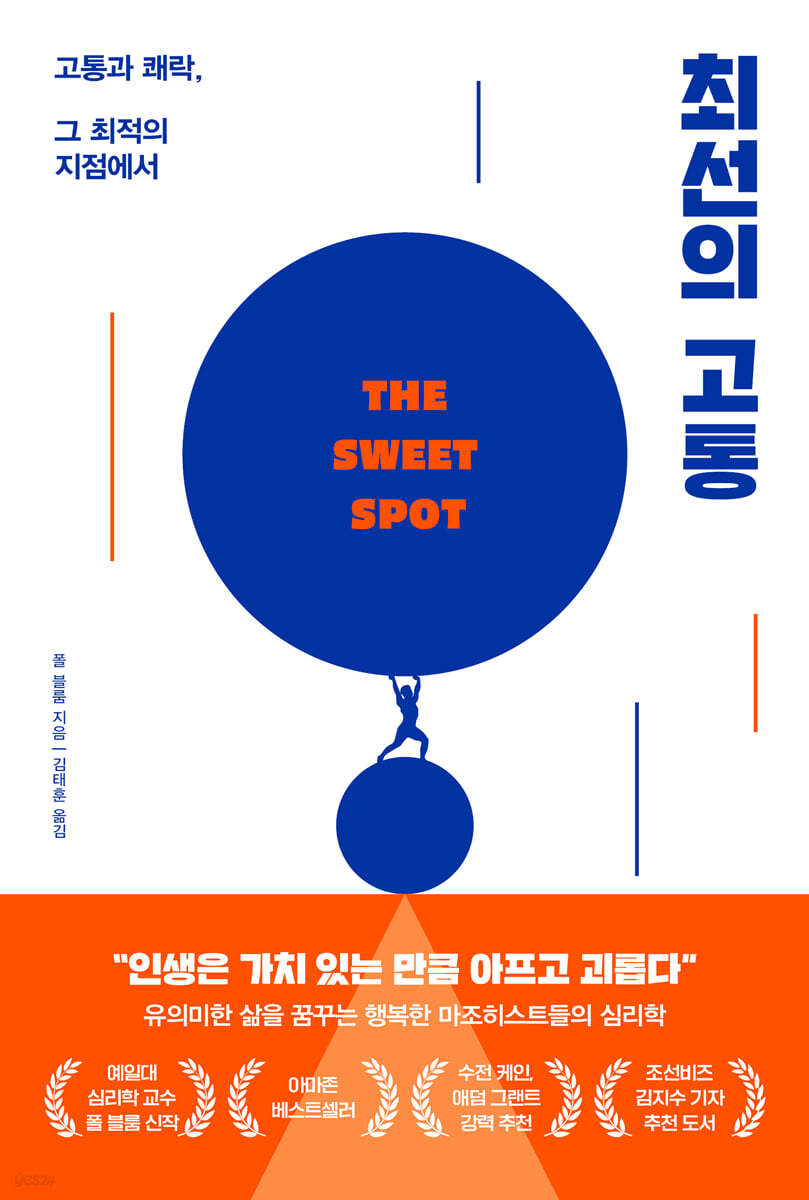
The best pain
 |
Description
Book Introduction
“Life is as painful and painful as it is valuable.”
The Psychology of Happy Masochists Who Dream of Meaningful Lives
Highly recommended by reporters Kim Ji-soo, Susan Cain, and Adam Grant!
A new book by Paul Bloom, a Yale psychology professor and authority on developmental psychology.
Why do some people scream at horrific horror movies, indulge in gut-wrenchingly spicy food, and participate in grueling triathlons that push their bodies to their limits? And who are the people who climb Mount Everest, volunteer for life-threatening combat, and dedicate their lives to helping others?
Yale University psychology professor Paul Bloom's new book, "The Best Pain," explores cutting-edge issues in modern psychology, focusing on "these benign pains that add pleasure to life, provide immersion, and help us discover true meaning."
Following the previous work, "Betrayal of Empathy," this work reveals the secrets of human nature by thoroughly uncovering the paradoxical psychology of pain and pleasure, which seemed impossible to reconcile.
Above all, it will help those who want to escape meaningless boredom and move towards a fulfilling life find the sweet spot between happiness and unhappiness.
The Psychology of Happy Masochists Who Dream of Meaningful Lives
Highly recommended by reporters Kim Ji-soo, Susan Cain, and Adam Grant!
A new book by Paul Bloom, a Yale psychology professor and authority on developmental psychology.
Why do some people scream at horrific horror movies, indulge in gut-wrenchingly spicy food, and participate in grueling triathlons that push their bodies to their limits? And who are the people who climb Mount Everest, volunteer for life-threatening combat, and dedicate their lives to helping others?
Yale University psychology professor Paul Bloom's new book, "The Best Pain," explores cutting-edge issues in modern psychology, focusing on "these benign pains that add pleasure to life, provide immersion, and help us discover true meaning."
Following the previous work, "Betrayal of Empathy," this work reveals the secrets of human nature by thoroughly uncovering the paradoxical psychology of pain and pleasure, which seemed impossible to reconcile.
Above all, it will help those who want to escape meaningless boredom and move towards a fulfilling life find the sweet spot between happiness and unhappiness.
- You can preview some of the book's contents.
Preview
index
Recommendation_ The enduring and indestructible beings
Introduction: The Illusion of a 'Happy' Life
Chapter 1.
Rebelling against hedonism
- The existence of sweet pain
- Beyond the 'horror'
- The type of happiness we desire
- Even pleasure has its own genre.
- The complex and multifaceted human desire system
Chapter 2.
Storytelling of Masochism
- The real cause of screams and tears
- The link between pain and pleasure
- The mysterious world of BDSM
- Self-punishment, self-harm
- To escape boredom
Chapter 3.
Pleasures born from imagination
- To avoid being trapped in the present
- Imagination that never stops
- At the border between reality and fiction
- Hate fiction and benign masochism
- So many sexual fantasies
Chapter 4.
Beyond effort, to immersion
- The value of physical labor
- Limits of mental effort
- The paradox of the law of least effort
- The sweet spot of immersion
Chapter 5.
To discover the meaning of life
- Humans will definitely climb the mountain.
- Instinctive desire for normalcy
- The Truth About Becoming a Parent
- Questions about finding the meaning of life
- What we truly pursue
Chapter 6: Which Suffering Will You Choose?
- Religion, its voluntary asceticism
- Non-selective suffering and fatalism
- Virtues nurtured through hardship
- Post-traumatic stress and growth
- Beyond all these hardships
Chapter 7.
Use sweet pain in your life
- Because we are all imperfect
- The dissonance between instinct and evolution
- Endless striving for happiness
- It's as painful as it is worth
Author's Note
main
Introduction: The Illusion of a 'Happy' Life
Chapter 1.
Rebelling against hedonism
- The existence of sweet pain
- Beyond the 'horror'
- The type of happiness we desire
- Even pleasure has its own genre.
- The complex and multifaceted human desire system
Chapter 2.
Storytelling of Masochism
- The real cause of screams and tears
- The link between pain and pleasure
- The mysterious world of BDSM
- Self-punishment, self-harm
- To escape boredom
Chapter 3.
Pleasures born from imagination
- To avoid being trapped in the present
- Imagination that never stops
- At the border between reality and fiction
- Hate fiction and benign masochism
- So many sexual fantasies
Chapter 4.
Beyond effort, to immersion
- The value of physical labor
- Limits of mental effort
- The paradox of the law of least effort
- The sweet spot of immersion
Chapter 5.
To discover the meaning of life
- Humans will definitely climb the mountain.
- Instinctive desire for normalcy
- The Truth About Becoming a Parent
- Questions about finding the meaning of life
- What we truly pursue
Chapter 6: Which Suffering Will You Choose?
- Religion, its voluntary asceticism
- Non-selective suffering and fatalism
- Virtues nurtured through hardship
- Post-traumatic stress and growth
- Beyond all these hardships
Chapter 7.
Use sweet pain in your life
- Because we are all imperfect
- The dissonance between instinct and evolution
- Endless striving for happiness
- It's as painful as it is worth
Author's Note
main
Detailed image

Into the book
As novelist Walker Percy wrote, “Fiction doesn’t tell us what we don’t know.
Instead, it tells us stories we know but don't know that we know." This saying is sometimes applied to psychology as well.
I'm going to tell you about things you didn't know you knew.
--- p.28
Psychologists who study benign masochism are fond of quoting a statement made by a woman who played a dominant role:
“A whip is a great way to make someone be in the moment,” she said.
“They can’t turn their eyes to anything else, they can’t think of anything else,” he said.
Rumi, the 13th-century Sufi mystic, agrees with this statement, asking, “Where is indifference when suffering intervenes?” (He also wrote:
“Pursue suffering! Pursue suffering, suffering, suffering!”).
This method has its own charm.
Pain can relieve anxiety by moving it away from consciousness.
In other words, it gets you out of your head.
--- p.97
Some people say that after crying a lot, their mind feels at ease.
However, it is generally wrong to say that negative emotions have a cleansing effect.
Many people have left the lights on at night for a while after being shocked and running away from a great horror movie.
In a recent survey of horror movie fans, the majority said they felt more scared after watching a movie.
Only one in 20 people reported feeling less scared.
Of all the dead psychological theories, the theory of catharsis is the most definitely dead.
--- p.146~147
To enjoy negative stories in fiction and reality, you need to keep a certain distance, not too close or too far.
You should only get so caught up in it that you worry, obsess, and fear it.
Especially in fiction, when things go wrong, we have to recognize that these characters aren't all real.
This way, empathy, anguish, and worry do not overwhelm the joy.
In this problem, the Goldilocks principle (a tendency to prefer not too much - translator's note) exists.
You could call it the sweet spot.
--- p.150
“Reality is defined by misfortune and suffering.” This phrase captures a theory that has endured through theology, philosophy, and countless college dorm room debates.
It also aligns with the core theme of this book.
A certain amount of unhappiness and suffering is essential to a rich and meaningful life.
--- p.214
I have many philosopher friends.
Some of them always ponder profound questions about meaning and purpose.
I like philosophers.
Still, they don't seem like better people than other people I know.
Also, I'm not sure what interesting significance there is in saying that their lives are more meaningful than everyone else's.
The overall point here is that you can achieve a meaningful life without even realizing that you're trying to achieve it, or conversely, without even thinking about it at all.
--- p.234
But somehow humans (and only humans) have done amazing things.
We can transcend limitations.
We have advanced science, technology, philosophy, literature, art, and law.
We created the Universal Declaration of Human Rights and went to the moon.
We use contraception to deliberately subvert the instinctive goal of reproductive success in order to pursue other goals.
Overcoming the physiological need to care for family and friends, they give some of their resources (not enough, but still some) to strangers.
--- p.295
The book concludes with a conversation between Mustapha Mond, who represents the system, and John, who resists the system.
Mond speaks passionately about the value of pleasure.
He goes on to say that neurological interventions have been developed to maximize human pleasure, and that it is all so easy and convenient.
And concludes, “We prefer a comfortable life.”
Then John responds:
“But I don’t want comfort.
I want God, poetry, true danger, freedom, goodness.
And I want sin.”
No words sum up human nature better than this.
Instead, it tells us stories we know but don't know that we know." This saying is sometimes applied to psychology as well.
I'm going to tell you about things you didn't know you knew.
--- p.28
Psychologists who study benign masochism are fond of quoting a statement made by a woman who played a dominant role:
“A whip is a great way to make someone be in the moment,” she said.
“They can’t turn their eyes to anything else, they can’t think of anything else,” he said.
Rumi, the 13th-century Sufi mystic, agrees with this statement, asking, “Where is indifference when suffering intervenes?” (He also wrote:
“Pursue suffering! Pursue suffering, suffering, suffering!”).
This method has its own charm.
Pain can relieve anxiety by moving it away from consciousness.
In other words, it gets you out of your head.
--- p.97
Some people say that after crying a lot, their mind feels at ease.
However, it is generally wrong to say that negative emotions have a cleansing effect.
Many people have left the lights on at night for a while after being shocked and running away from a great horror movie.
In a recent survey of horror movie fans, the majority said they felt more scared after watching a movie.
Only one in 20 people reported feeling less scared.
Of all the dead psychological theories, the theory of catharsis is the most definitely dead.
--- p.146~147
To enjoy negative stories in fiction and reality, you need to keep a certain distance, not too close or too far.
You should only get so caught up in it that you worry, obsess, and fear it.
Especially in fiction, when things go wrong, we have to recognize that these characters aren't all real.
This way, empathy, anguish, and worry do not overwhelm the joy.
In this problem, the Goldilocks principle (a tendency to prefer not too much - translator's note) exists.
You could call it the sweet spot.
--- p.150
“Reality is defined by misfortune and suffering.” This phrase captures a theory that has endured through theology, philosophy, and countless college dorm room debates.
It also aligns with the core theme of this book.
A certain amount of unhappiness and suffering is essential to a rich and meaningful life.
--- p.214
I have many philosopher friends.
Some of them always ponder profound questions about meaning and purpose.
I like philosophers.
Still, they don't seem like better people than other people I know.
Also, I'm not sure what interesting significance there is in saying that their lives are more meaningful than everyone else's.
The overall point here is that you can achieve a meaningful life without even realizing that you're trying to achieve it, or conversely, without even thinking about it at all.
--- p.234
But somehow humans (and only humans) have done amazing things.
We can transcend limitations.
We have advanced science, technology, philosophy, literature, art, and law.
We created the Universal Declaration of Human Rights and went to the moon.
We use contraception to deliberately subvert the instinctive goal of reproductive success in order to pursue other goals.
Overcoming the physiological need to care for family and friends, they give some of their resources (not enough, but still some) to strangers.
--- p.295
The book concludes with a conversation between Mustapha Mond, who represents the system, and John, who resists the system.
Mond speaks passionately about the value of pleasure.
He goes on to say that neurological interventions have been developed to maximize human pleasure, and that it is all so easy and convenient.
And concludes, “We prefer a comfortable life.”
Then John responds:
“But I don’t want comfort.
I want God, poetry, true danger, freedom, goodness.
And I want sin.”
No words sum up human nature better than this.
--- p.317~318
Publisher's Review
“Humans choose suffering to live a better life.”
Humanity is designed to experience pain and suffering in order to evolve.
A fresh, provocative, and humorous anti-hedonist manifesto.
The book begins with an anti-hedonist declaration that humans are not inherently hedonistic.
Numerous philosophers and psychologists have argued, vehemently refuting Freud's age-old claims, that "humanity was designed to experience pain and suffering in order to evolve."
The 'psychology of suffering' suggests that the 'happy' and 'good' life we truly desire is not a life of peace and comfort, but rather a life of risk and thrilling adventure, of immersion in oneself, of frequent failure and barely achieved growth.
Using accessible, engaging, and diverse cutting-edge research and evidence (from books, columns, films, and celebrity remarks), this book analyzes why human nature drives us to pursue stimuli that simultaneously include both pain and pleasure.
Furthermore, we reflect on what brings us complete happiness and how suffering can become the meaning of life, and seek a better direction for living by choosing the 'right suffering' among suffering, hardship, and asceticism.
“The Best Pain” is the book I’ve been most immersed in this year.
Because we are all the main characters in the 'disaster movie' called life.
Yet, how pitiful are humans, who constantly strive to strike a balance between a comfortable life and a meaningful life.
“I recommend this book to everyone going through hardship right now.”
- Reporter Kim Ji-soo, author of "Lee Eo-ryeong's Last Lesson"
The author is not arguing that we should simply and silently accept the countless sufferings we encounter in life.
A life of pursuing goals inevitably encounters difficulties, anxiety, and conflict, and hardship is an inevitable part of life's journey.
And he mentions a line from a eulogy: “Life is as painful as it is worth.”
This compresses the human being as a living being thrown alone into the field called life into a single line.
That is, the author advocates motivational pluralism by preaching the importance of selective suffering (at the right time, in the right way, and to the right degree) that adds value to life.
Exploring suffering reveals what we want and who we truly are.
Every individual is a complex, and therefore beautiful, being, with motivations and needs that can be fulfilled in a surprising variety of ways.
"The Best Suffering" ends with a quote from Aldous Huxley's classic "Brave New World."
The society that serves as the backdrop for the novel excludes all other factors in order to maximize happiness.
In the final part, there is a conversation between Mond, who represents the system, and John, who resists the system.
Mond argues passionately about the value of pleasure, concluding that “humans prefer a comfortable life.”
Then John responds:
“But I don’t want comfort.
I want God, poetry, true danger, freedom, goodness.
And I want sin.”
As the author puts it, 'nothing sums up human nature better than this.'
Humanity is designed to experience pain and suffering in order to evolve.
A fresh, provocative, and humorous anti-hedonist manifesto.
The book begins with an anti-hedonist declaration that humans are not inherently hedonistic.
Numerous philosophers and psychologists have argued, vehemently refuting Freud's age-old claims, that "humanity was designed to experience pain and suffering in order to evolve."
The 'psychology of suffering' suggests that the 'happy' and 'good' life we truly desire is not a life of peace and comfort, but rather a life of risk and thrilling adventure, of immersion in oneself, of frequent failure and barely achieved growth.
Using accessible, engaging, and diverse cutting-edge research and evidence (from books, columns, films, and celebrity remarks), this book analyzes why human nature drives us to pursue stimuli that simultaneously include both pain and pleasure.
Furthermore, we reflect on what brings us complete happiness and how suffering can become the meaning of life, and seek a better direction for living by choosing the 'right suffering' among suffering, hardship, and asceticism.
“The Best Pain” is the book I’ve been most immersed in this year.
Because we are all the main characters in the 'disaster movie' called life.
Yet, how pitiful are humans, who constantly strive to strike a balance between a comfortable life and a meaningful life.
“I recommend this book to everyone going through hardship right now.”
- Reporter Kim Ji-soo, author of "Lee Eo-ryeong's Last Lesson"
The author is not arguing that we should simply and silently accept the countless sufferings we encounter in life.
A life of pursuing goals inevitably encounters difficulties, anxiety, and conflict, and hardship is an inevitable part of life's journey.
And he mentions a line from a eulogy: “Life is as painful as it is worth.”
This compresses the human being as a living being thrown alone into the field called life into a single line.
That is, the author advocates motivational pluralism by preaching the importance of selective suffering (at the right time, in the right way, and to the right degree) that adds value to life.
Exploring suffering reveals what we want and who we truly are.
Every individual is a complex, and therefore beautiful, being, with motivations and needs that can be fulfilled in a surprising variety of ways.
"The Best Suffering" ends with a quote from Aldous Huxley's classic "Brave New World."
The society that serves as the backdrop for the novel excludes all other factors in order to maximize happiness.
In the final part, there is a conversation between Mond, who represents the system, and John, who resists the system.
Mond argues passionately about the value of pleasure, concluding that “humans prefer a comfortable life.”
Then John responds:
“But I don’t want comfort.
I want God, poetry, true danger, freedom, goodness.
And I want sin.”
As the author puts it, 'nothing sums up human nature better than this.'
GOODS SPECIFICS
- Publication date: April 25, 2022
- Page count, weight, size: 344 pages | 540g | 145*215*30mm
- ISBN13: 9788925578347
- ISBN10: 8925578344
You may also like
카테고리
korean


korean

![GQ KOREA Mark (Monthly): December [2025]](http://librairie.coreenne.fr/cdn/shop/files/8ef265dbbfbf186523ed75ba7319009d.jpg?v=1765340328&width=3840)


