

Save the Cat! Writing My First Novel
 |
Description
Book Introduction
“Jane Austen, Agatha Christie, J.
Up to K. Rowling
“All the stories we’ve been passionate about are made up of 15 core stories!”
15 Rules for Turning Your Ideas into Novels
Completing a novel is not as easy as you might think.
Sometimes, you get so immersed in the main character that your character collapses in the middle of the story, or you get stuck on a certain plot point and just stamp your feet, or you don't even know what to write and can't even get started.
But what if there were 15 rules that could help you deal with all these problems?
From the works of great classic authors like Jane Austen and Charles Dickens to Agatha Christie, Stephen King, and J.
15 core stories commonly found in the works of world-renowned authors representing each genre, such as K. Rowling.
Through this templated 'beat sheet', we will look at everything from the main character setting to the story structure, genre, and 'how to introduce your book' to capture the hearts of readers and industry insiders.
Up to K. Rowling
“All the stories we’ve been passionate about are made up of 15 core stories!”
15 Rules for Turning Your Ideas into Novels
Completing a novel is not as easy as you might think.
Sometimes, you get so immersed in the main character that your character collapses in the middle of the story, or you get stuck on a certain plot point and just stamp your feet, or you don't even know what to write and can't even get started.
But what if there were 15 rules that could help you deal with all these problems?
From the works of great classic authors like Jane Austen and Charles Dickens to Agatha Christie, Stephen King, and J.
15 core stories commonly found in the works of world-renowned authors representing each genre, such as K. Rowling.
Through this templated 'beat sheet', we will look at everything from the main character setting to the story structure, genre, and 'how to introduce your book' to capture the hearts of readers and industry insiders.
- You can preview some of the book's contents.
Preview
index
To begin with
Chapter 1.
What attracts the reader's attention?
: Creating a protagonist worth reading
Chapter 2.
Save the Cat Beat Sheet
: Plotting is no longer difficult.
Chapter 3.
Save the Cat: 10 Novel Genres
: Your novel is here too
Chapter 4.
First genre, mystery
: Detective, Trickster, Dark Side
Chapter 5.
Second genre, rite of passage
: When life becomes a stumbling block
Chapter 6.
Third genre, group story
: Will you join, will you leave, or will you destroy?
Chapter 7.
The fourth genre, superhero
: An extraordinary being in an ordinary world
Chapter 8.
The fifth genre: problems faced by ordinary people
: Survive the ultimate test
Chapter 9.
Sixth Genre, Triumph of the Fool
: Victory of the weak
Chapter 10.
Seventh genre, buddy love story
: The power of change in love and friendship
Chapter 11.
Eighth genre, magic lamp
: Small magic that makes a big difference
Chapter 12.
The ninth genre, the golden fleece
: Road trips, quests, and heists
Chapter 13.
Tenth Genre: Monsters in the House
: More than just a scary story
Chapter 14.
Seduce me!
: Writing Killer Loglines and Synopses
Chapter 15.
Save the writer!
: Where there is a problem, there will be an answer.
In closing
Acknowledgements
Chapter 1.
What attracts the reader's attention?
: Creating a protagonist worth reading
Chapter 2.
Save the Cat Beat Sheet
: Plotting is no longer difficult.
Chapter 3.
Save the Cat: 10 Novel Genres
: Your novel is here too
Chapter 4.
First genre, mystery
: Detective, Trickster, Dark Side
Chapter 5.
Second genre, rite of passage
: When life becomes a stumbling block
Chapter 6.
Third genre, group story
: Will you join, will you leave, or will you destroy?
Chapter 7.
The fourth genre, superhero
: An extraordinary being in an ordinary world
Chapter 8.
The fifth genre: problems faced by ordinary people
: Survive the ultimate test
Chapter 9.
Sixth Genre, Triumph of the Fool
: Victory of the weak
Chapter 10.
Seventh genre, buddy love story
: The power of change in love and friendship
Chapter 11.
Eighth genre, magic lamp
: Small magic that makes a big difference
Chapter 12.
The ninth genre, the golden fleece
: Road trips, quests, and heists
Chapter 13.
Tenth Genre: Monsters in the House
: More than just a scary story
Chapter 14.
Seduce me!
: Writing Killer Loglines and Synopses
Chapter 15.
Save the writer!
: Where there is a problem, there will be an answer.
In closing
Acknowledgements
Detailed image
Into the book
Humans respond to storytelling elements in a specific order. Something deeply ingrained in our DNA compels us to do so.
It's been that way since our primitive ancestors drew pictures on cave walls and sat around campfires telling stories to their tribes.
The Save the Cat Beat Sheet provides a simple blueprint for identifying those codes and creating a successful story.
It's like there's no need to reinvent the wheel, which has been around since it was first invented.
---From "Starting"
Let's think about it.
What does my protagonist want? Saying "I want happiness" isn't enough.
This is a common answer in the workshops I run, but it is not specific at all.
The more specific and clear a character's goals or desires are, the more effective they are.
The reader must be able to clearly see whether the protagonist has achieved what he or she wants and when the goal is achieved.
If you want to aim for happiness, the writer must at least specify what happiness is for the protagonist.
It should be something the reader can identify with and root for, like a nice house, a nice car, a million Twitter followers, winning a national championship, living in a new land across the border, having magical powers, or escaping from prison.
---From "What Attracts Readers' Attention?"
The protagonist's desires may change as the story progresses.
In fact, that's often the case.
In Frankenstein, Victor Frankenstein's first goal was to create life.
But later on, it changes to destroying the life forms it created.
Alice in Alice's Adventures in Wonderland by Lewis Carroll wants to find the white rabbit, but later on, she just wants to go home.
In Jojo Moyes's Me Before You, Louisa takes a job to earn money, but later wants to save Will's life.
In this way, desire, whether it changes or not, advances the story and keeps the plot moving.
If there is nothing the protagonist wants, he will just sit around and wait for something to happen.
Desire moves the protagonist.
It gets you off your butt and into action.
That's what the reader wants!
---From "What Attracts Readers' Attention?"
The beat sheet is a map.
These are road signs we place for ourselves so that we don't wander aimlessly across the country.
Likewise, Save the Cat Beat Sheet breaks down the daunting task of writing a 300-, 400-, or 500-page novel into bite-sized, achievable goals.
Small goals help you stay on track and keep moving steadily toward your ultimate destination.
Towards a satisfying ending where the character changes satisfactorily.
---From "Save the Cat Beat Sheet"
B Story characters guide the protagonist through life lessons in various ways.
For example, it could be the embodiment of a theme, like Peeta Mellark, a B-story character in The Hunger Games.
Just before the Hunger Games officially begin, Peeta tells Katniss:
“I want to figure out a way to show the Capitol that I don’t own it.
“I am more than just a small part of the Hunger Games.” This is the lesson (theme) that Katniss ultimately learns.
Resisting the rules of the Capitol in order to survive.
It is B-story character Peeta Mellark who helps her approach the lesson.
---From "Save the Cat Beat Sheet"
Whoever or whatever the villain, this genre of novels gives readers a sense of satisfaction when the protagonist ultimately uses something of his or her own to outwit the enemy.
This is only possible if the compatibility between the protagonist and the problem is perfect.
Mitch McDirt of "So They Went to Sea" may not be able to survive on Mars, but he can survive in a corrupt law firm.
Because he is a smart and ambitious lawyer.
It is important to pre-establish the abilities your protagonist needs to solve problems.
It's an ability engraved in the character's DNA.
But the protagonist must not realize what potential he has and how to utilize it until the ultimate ordeal comes.
---From "The Fifth Genre: Problems that Face Ordinary People"
In summary, superhero novels must contain the following three elements:
*Power: The protagonist has special powers.
It could be a mission to do good.
*Enemy: A character who directly opposes the protagonist.
Although they have similar (or greater!) powers, they have earned them through their own efforts and do not believe in being the 'chosen ones'.
*Curse: The price the protagonist must pay for being special.
It allows ordinary readers to empathize with extraordinary protagonists.
---From "The Fourth Genre, Superhero"
A monster story in the house must have an enclosed space where the monster exists.
We call this home.
Houses come in all shapes and sizes: they can be real houses like in The Exorcist or Shirley Jackson's The Haunting of Hill House, entire towns like Salem's Lot, isolated deserts like Prey, creepy underwater laboratories like The Deep, or even entire countries.
A monster's wrath must be specific or targeted in some way.
For example, the monster in Frankenstein can roam freely anywhere, but it only attacks Victor Frankenstein's closest friends and family.
His resentment is directed only at his Creator.
Therefore, the 'home' in this novel is Victor's family.
---From "The Tenth Genre, The Monster in the House"
We fear that our writing or plot will be bad.
So let's give in to that fear and let the writing and plot be bad.
Make a crappy, crappy beat sheet.
And persevere! So that your future self will have something to fix! Don't be afraid of not being good at writing.
Embrace the things that are bad! I like to say that.
“Don’t be afraid to write shit.
“Dung is a great fertilizer.”
It's been that way since our primitive ancestors drew pictures on cave walls and sat around campfires telling stories to their tribes.
The Save the Cat Beat Sheet provides a simple blueprint for identifying those codes and creating a successful story.
It's like there's no need to reinvent the wheel, which has been around since it was first invented.
---From "Starting"
Let's think about it.
What does my protagonist want? Saying "I want happiness" isn't enough.
This is a common answer in the workshops I run, but it is not specific at all.
The more specific and clear a character's goals or desires are, the more effective they are.
The reader must be able to clearly see whether the protagonist has achieved what he or she wants and when the goal is achieved.
If you want to aim for happiness, the writer must at least specify what happiness is for the protagonist.
It should be something the reader can identify with and root for, like a nice house, a nice car, a million Twitter followers, winning a national championship, living in a new land across the border, having magical powers, or escaping from prison.
---From "What Attracts Readers' Attention?"
The protagonist's desires may change as the story progresses.
In fact, that's often the case.
In Frankenstein, Victor Frankenstein's first goal was to create life.
But later on, it changes to destroying the life forms it created.
Alice in Alice's Adventures in Wonderland by Lewis Carroll wants to find the white rabbit, but later on, she just wants to go home.
In Jojo Moyes's Me Before You, Louisa takes a job to earn money, but later wants to save Will's life.
In this way, desire, whether it changes or not, advances the story and keeps the plot moving.
If there is nothing the protagonist wants, he will just sit around and wait for something to happen.
Desire moves the protagonist.
It gets you off your butt and into action.
That's what the reader wants!
---From "What Attracts Readers' Attention?"
The beat sheet is a map.
These are road signs we place for ourselves so that we don't wander aimlessly across the country.
Likewise, Save the Cat Beat Sheet breaks down the daunting task of writing a 300-, 400-, or 500-page novel into bite-sized, achievable goals.
Small goals help you stay on track and keep moving steadily toward your ultimate destination.
Towards a satisfying ending where the character changes satisfactorily.
---From "Save the Cat Beat Sheet"
B Story characters guide the protagonist through life lessons in various ways.
For example, it could be the embodiment of a theme, like Peeta Mellark, a B-story character in The Hunger Games.
Just before the Hunger Games officially begin, Peeta tells Katniss:
“I want to figure out a way to show the Capitol that I don’t own it.
“I am more than just a small part of the Hunger Games.” This is the lesson (theme) that Katniss ultimately learns.
Resisting the rules of the Capitol in order to survive.
It is B-story character Peeta Mellark who helps her approach the lesson.
---From "Save the Cat Beat Sheet"
Whoever or whatever the villain, this genre of novels gives readers a sense of satisfaction when the protagonist ultimately uses something of his or her own to outwit the enemy.
This is only possible if the compatibility between the protagonist and the problem is perfect.
Mitch McDirt of "So They Went to Sea" may not be able to survive on Mars, but he can survive in a corrupt law firm.
Because he is a smart and ambitious lawyer.
It is important to pre-establish the abilities your protagonist needs to solve problems.
It's an ability engraved in the character's DNA.
But the protagonist must not realize what potential he has and how to utilize it until the ultimate ordeal comes.
---From "The Fifth Genre: Problems that Face Ordinary People"
In summary, superhero novels must contain the following three elements:
*Power: The protagonist has special powers.
It could be a mission to do good.
*Enemy: A character who directly opposes the protagonist.
Although they have similar (or greater!) powers, they have earned them through their own efforts and do not believe in being the 'chosen ones'.
*Curse: The price the protagonist must pay for being special.
It allows ordinary readers to empathize with extraordinary protagonists.
---From "The Fourth Genre, Superhero"
A monster story in the house must have an enclosed space where the monster exists.
We call this home.
Houses come in all shapes and sizes: they can be real houses like in The Exorcist or Shirley Jackson's The Haunting of Hill House, entire towns like Salem's Lot, isolated deserts like Prey, creepy underwater laboratories like The Deep, or even entire countries.
A monster's wrath must be specific or targeted in some way.
For example, the monster in Frankenstein can roam freely anywhere, but it only attacks Victor Frankenstein's closest friends and family.
His resentment is directed only at his Creator.
Therefore, the 'home' in this novel is Victor's family.
---From "The Tenth Genre, The Monster in the House"
We fear that our writing or plot will be bad.
So let's give in to that fear and let the writing and plot be bad.
Make a crappy, crappy beat sheet.
And persevere! So that your future self will have something to fix! Don't be afraid of not being good at writing.
Embrace the things that are bad! I like to say that.
“Don’t be afraid to write shit.
“Dung is a great fertilizer.”
---From "Save the Writer!"
Publisher's Review
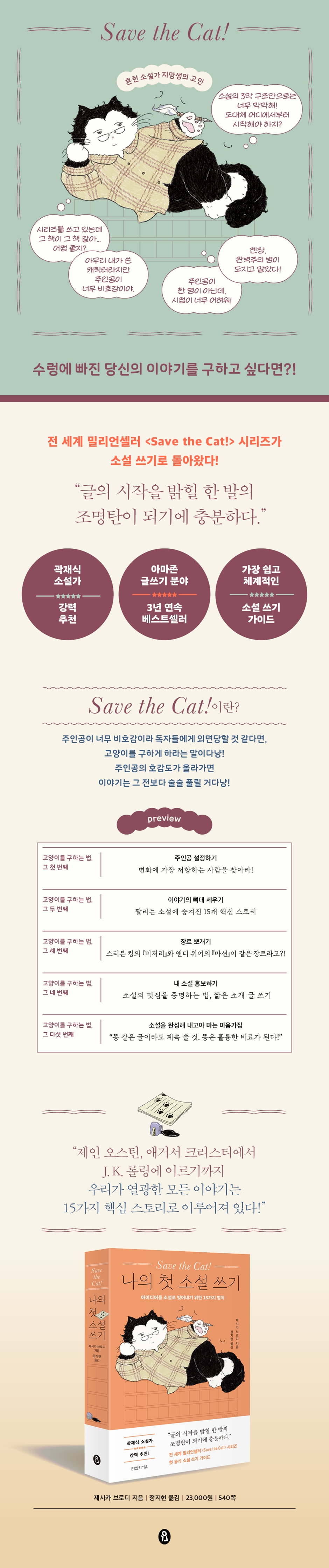
“It is enough to be a flare that illuminates the beginning of a story.”
The global best-selling "Save the Cat!" series returns to writing novels.
*Highly recommended by novelist Kwak Jae-sik
*Amazon Bestseller in Writing for 3 consecutive years
*The easiest and most systematic guide to writing a novel
As genre fiction enters the mainstream and the web novel market grows, we are entering a golden age of novel writing.
As if to prove this, a story that started as a way to relieve work stress went viral through Tumblbug support, selling 1 million copies, and works serialized on Kakao Page while working as a prosecutor have been viewed over 2 million times, and recent successful examples of (web)novel writing by writers who have made it to the top of the charts are noteworthy.
In some ways, aren't writers the most popular 'side characters' in the N-job era?
But completing a novel is not as easy as it sounds.
Sometimes, you get so immersed in the main character that your character collapses in the middle of the story, or you get stuck on a certain plot point and just stamp your feet, or you don't even know what to write and can't even get started.
"Save the Cat! Writing My First Novel" is the first novel-writing book in the world-renowned "Save the Cat!" series, a classic in screenwriting and plot writing. It offers simple, concise answers to the most common questions faced by those just beginning to write, whether for fun or for serious reasons.
Stephen King's 'Misery' and Andy Weir's 'The Martian' are in the same genre?!
Writing a complete novel in 15 core stories and 10 genres
In this book, the key events (story) that must occur in a story are called 'beats'.
The order in which these key events occur is the structure of the story, the 'beat sheet'.
To write an interesting and coherent novel, you need exactly 15 beats.
If you completely understand the purpose of each bit, and which bit should be where and in what amount, you won't have to rack your brain, wondering, "What the heck is wrong? Why is my story so boring?"
Moreover, this book organizes all the great novels published to date into 10 story categories, or genres, called the "Save the Cat Genre," for easy follow-up.
(In the Save the Cat genre, Stephen King's "Misery" and Andy Weir's "The Martian" fall into the same genre.) This is all we need to do to determine which genre our upcoming novel belongs to and whether it has the necessary elements for that genre.
Humans are hardwired to respond to certain types of storytelling elements.
When I read a story where the elements are connected in the right order, my heart sings and my inner humanity vibrates like a tuning fork.
15 bits, 10 story genres are templates of this storytelling code.
And this template is used not only by great classic authors like Jane Austen and Charles Dickens, but also by Agatha Christie, Stephen King, J.
It is found without exception in the works of world-renowned authors representing each genre, such as K. Rowling.
The days of suffering from not being able to write are over now
Writing a novel, this time I'm going to do it!
They say you can complete a novel if you know just 15 beats and 10 story genres, but once you actually start, you'll encounter obstacles big and small.
First of all, some people might find 15 bits too much.
To address these challenges, this book introduces a method for handling beat sheets using the so-called five basic beats, which set a new direction for the plot.
It also teaches you how to use beat sheets to prove your novel's appeal to readers and industry insiders, and how to write a short introduction.
If you can properly utilize beat sheets, you can not only complete a novel but also sell it.
Furthermore, while this book is faithful to the theoretical aspects of novel writing, it also provides advice on how to maintain the mindset necessary to finish a novel.
The most hopeful and actionable advice of all is this:
“Don’t be afraid to write shit.
“Dung is a great fertilizer!” A blank sheet of paper can’t be fixed anyway.
Rather than getting frustrated by comparing a novel in progress to a finished masterpiece, it's better to endure it by writing even one more poor word.
Didn't Octavia Butler, the author who won the Hugo, Nebula, and Locus Awards, say this? "People who want to write either write or don't.
My most important talent, or habit, is persistence.
It's amazing what we can accomplish simply by refusing to give up.
So hang on and hang on!”
The global best-selling "Save the Cat!" series returns to writing novels.
*Highly recommended by novelist Kwak Jae-sik
*Amazon Bestseller in Writing for 3 consecutive years
*The easiest and most systematic guide to writing a novel
As genre fiction enters the mainstream and the web novel market grows, we are entering a golden age of novel writing.
As if to prove this, a story that started as a way to relieve work stress went viral through Tumblbug support, selling 1 million copies, and works serialized on Kakao Page while working as a prosecutor have been viewed over 2 million times, and recent successful examples of (web)novel writing by writers who have made it to the top of the charts are noteworthy.
In some ways, aren't writers the most popular 'side characters' in the N-job era?
But completing a novel is not as easy as it sounds.
Sometimes, you get so immersed in the main character that your character collapses in the middle of the story, or you get stuck on a certain plot point and just stamp your feet, or you don't even know what to write and can't even get started.
"Save the Cat! Writing My First Novel" is the first novel-writing book in the world-renowned "Save the Cat!" series, a classic in screenwriting and plot writing. It offers simple, concise answers to the most common questions faced by those just beginning to write, whether for fun or for serious reasons.
Stephen King's 'Misery' and Andy Weir's 'The Martian' are in the same genre?!
Writing a complete novel in 15 core stories and 10 genres
In this book, the key events (story) that must occur in a story are called 'beats'.
The order in which these key events occur is the structure of the story, the 'beat sheet'.
To write an interesting and coherent novel, you need exactly 15 beats.
If you completely understand the purpose of each bit, and which bit should be where and in what amount, you won't have to rack your brain, wondering, "What the heck is wrong? Why is my story so boring?"
Moreover, this book organizes all the great novels published to date into 10 story categories, or genres, called the "Save the Cat Genre," for easy follow-up.
(In the Save the Cat genre, Stephen King's "Misery" and Andy Weir's "The Martian" fall into the same genre.) This is all we need to do to determine which genre our upcoming novel belongs to and whether it has the necessary elements for that genre.
Humans are hardwired to respond to certain types of storytelling elements.
When I read a story where the elements are connected in the right order, my heart sings and my inner humanity vibrates like a tuning fork.
15 bits, 10 story genres are templates of this storytelling code.
And this template is used not only by great classic authors like Jane Austen and Charles Dickens, but also by Agatha Christie, Stephen King, J.
It is found without exception in the works of world-renowned authors representing each genre, such as K. Rowling.
The days of suffering from not being able to write are over now
Writing a novel, this time I'm going to do it!
They say you can complete a novel if you know just 15 beats and 10 story genres, but once you actually start, you'll encounter obstacles big and small.
First of all, some people might find 15 bits too much.
To address these challenges, this book introduces a method for handling beat sheets using the so-called five basic beats, which set a new direction for the plot.
It also teaches you how to use beat sheets to prove your novel's appeal to readers and industry insiders, and how to write a short introduction.
If you can properly utilize beat sheets, you can not only complete a novel but also sell it.
Furthermore, while this book is faithful to the theoretical aspects of novel writing, it also provides advice on how to maintain the mindset necessary to finish a novel.
The most hopeful and actionable advice of all is this:
“Don’t be afraid to write shit.
“Dung is a great fertilizer!” A blank sheet of paper can’t be fixed anyway.
Rather than getting frustrated by comparing a novel in progress to a finished masterpiece, it's better to endure it by writing even one more poor word.
Didn't Octavia Butler, the author who won the Hugo, Nebula, and Locus Awards, say this? "People who want to write either write or don't.
My most important talent, or habit, is persistence.
It's amazing what we can accomplish simply by refusing to give up.
So hang on and hang on!”
GOODS SPECIFICS
- Publication date: November 30, 2021
- Page count, weight, size: 540 pages | 676g | 140*210*35mm
- ISBN13: 9791136291288
- ISBN10: 1136291288
You may also like
카테고리
korean


korean

![GQ KOREA Mark (Monthly): December [2025]](http://librairie.coreenne.fr/cdn/shop/files/8ef265dbbfbf186523ed75ba7319009d.jpg?v=1765340328&width=3840)


