

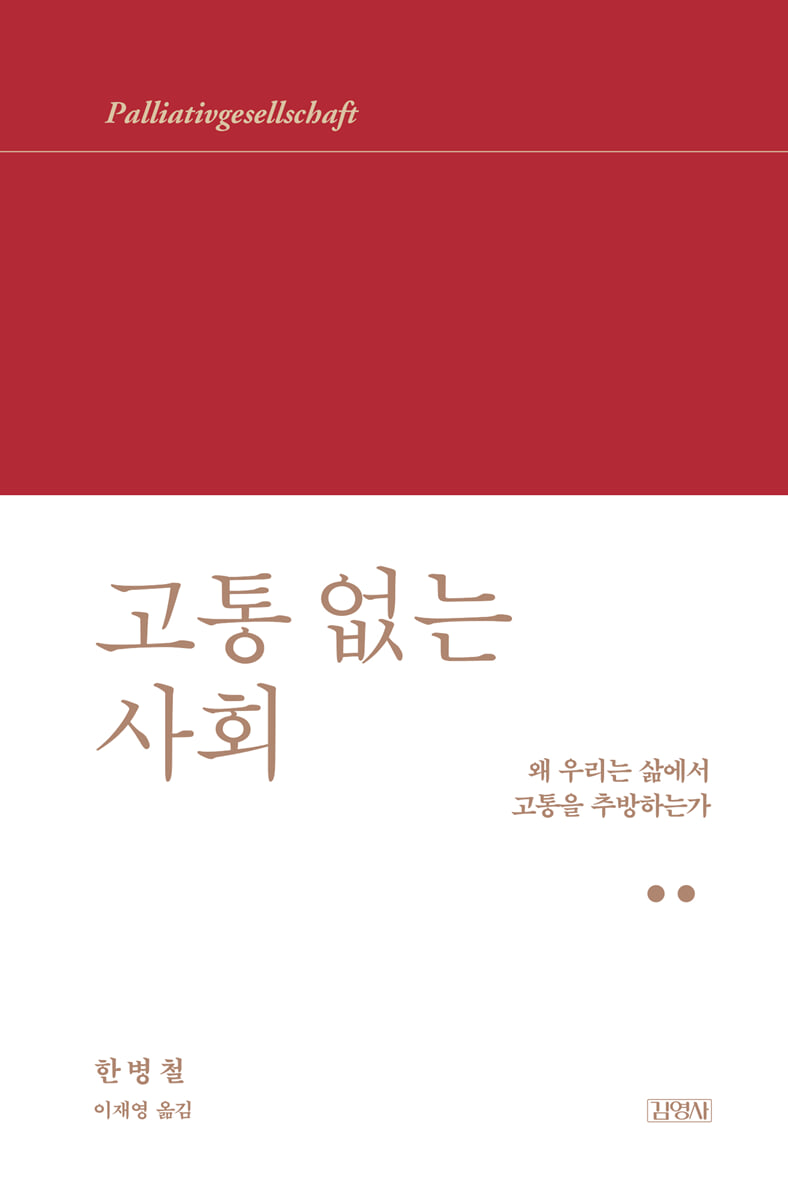
A pain-free society
 |
Description
Book Introduction
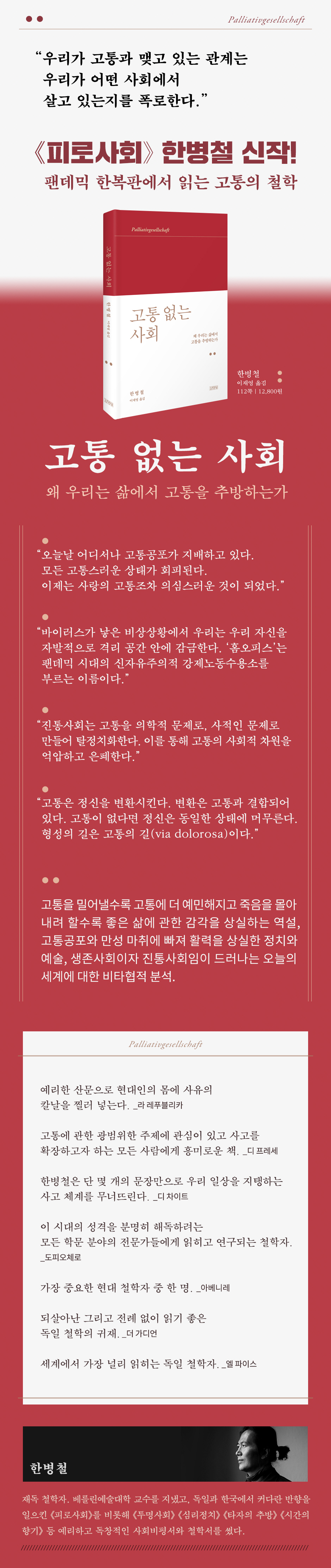
A new book by German-based philosopher Han Byung-chul! A philosophy of suffering in the pandemic era.
“Everywhere today there is a general fear of suffering.
Pain tolerance is also rapidly declining.
Pain fear leads to chronic anesthesia.
All painful conditions are avoided.
Even the pain of love became questionable.
The fear of pain also applies to social matters, and conflicts or arguments that could lead to painful confrontations are increasingly losing ground.
The fear of pain even dominates politics.
The pressure to conform and agree is intensifying.
Politics settles into a kind of limbo and loses all its vitality.
Post-democracy is spreading.
“De-democracy is a painful democracy.”
The more we push away pain, the more sensitive we become to it, and the more we try to drive out death, the more we lose our sense of a good life. This is an uncompromising analysis of a survival society where survival is absolute, and a pain-inducing society that is caught in the fear of pain and has fallen into chronic anesthesia.
A book like a dagger that “stabs the blade of thought into the bodies of modern people with sharp prose”!
“Everywhere today there is a general fear of suffering.
Pain tolerance is also rapidly declining.
Pain fear leads to chronic anesthesia.
All painful conditions are avoided.
Even the pain of love became questionable.
The fear of pain also applies to social matters, and conflicts or arguments that could lead to painful confrontations are increasingly losing ground.
The fear of pain even dominates politics.
The pressure to conform and agree is intensifying.
Politics settles into a kind of limbo and loses all its vitality.
Post-democracy is spreading.
“De-democracy is a painful democracy.”
The more we push away pain, the more sensitive we become to it, and the more we try to drive out death, the more we lose our sense of a good life. This is an uncompromising analysis of a survival society where survival is absolute, and a pain-inducing society that is caught in the fear of pain and has fallen into chronic anesthesia.
A book like a dagger that “stabs the blade of thought into the bodies of modern people with sharp prose”!
- You can preview some of the book's contents.
Preview
index
Pain fear
Force happiness
living
The meaninglessness of suffering
The pain of the liver
Pain as Truth
The Poetics of Pain
Dialectics of Pain
Ontology of Pain
The Ethics of Pain
The Last Human
main
Translator's Note
Force happiness
living
The meaninglessness of suffering
The pain of the liver
Pain as Truth
The Poetics of Pain
Dialectics of Pain
Ontology of Pain
The Ethics of Pain
The Last Human
main
Translator's Note
Detailed image
Into the book
A society of pain is a society of likes.
A society in pain falls into the madness of good.
Everything is smoothed out until you are satisfied.
Likes are both a sign and a painkiller of our times.
Likes dominate not only social media but all areas of culture.
Nothing should cause pain.
Not just art, but life itself should be Instagram-worthy.
---p.12
The culture of satisfaction lacks the possibility of catharsis.
As a result, we are suffocated by the dregs of positivity that accumulate beneath the surface of our culture of satisfaction.
---p.13
The unconditional desire to eradicate suffering also makes us forget that suffering is socially mediated.
Suffering reflects socioeconomic discord, and this discord is imprinted not only on people's psychology but also on their bodies.
Mass-prescribed painkillers mask the social conditions that create suffering.
Treating pain solely through medicine and pharmacology prevents pain from becoming language, and even criticism.
The objectivity of pain, and even more so its sociality, is eliminated.
---p.22
Happiness defies optimization logic.
The characteristic of happiness is that it cannot be used at will.
Happiness has inherent negativity.
True happiness is only possible when there is a crack.
Pain is what prevents happiness from becoming a commodity.
And suffering gives happiness its longevity.
Pain sustains happiness.
The phrase "painful happiness" is not an oxymoron.
All intensity is painful.
Passion combines pain and happiness.
Deep happiness has its roots in suffering.
---p.25
Today, we find it very difficult to die, because it has become impossible to end life meaningfully.
Life ends prematurely.
Those who cannot die in time must die prematurely and painfully.
We grow old without growing old.
---p.30
One of the key features of the experience of pain today is that it is perceived as meaningless.
There is no longer any meaningful connection to support us and give us direction in the face of suffering.
We have completely lost the skill of tolerating pain.
---p.34
In this modern age, when the pain our environment inflicts on us is decreasing, our pain nerves seem to be becoming more and more sensitive.
Hypersensitivity is growing.
It is none other than the fear of pain that makes us extremely sensitive.
Pain fear can even cause suffering.
---pp.40-41
It might be said that people today suffer from the “princess and the pea syndrome.”
The paradox of this pain syndrome is that we feel more pain for less.
...
When the pain-inducing peas disappear, humans suffer from soft mattresses.
It is the very persistent meaninglessness of life that causes us suffering.
---pp.41-42
Chronic pain has become unbearable because, above all, today's society has lost its meaning.
Chronic pain reflects a society that has lost its meaning, an era that has lost its stories.
In this society and era, life has become a bare survival.
There is little that painkillers or mind research can solve.
These merely obscure the sociocultural causes of suffering.
---p.49
Without suffering, valuation based on distinctions becomes impossible.
A world without pain is a hell of the same.
What rules this world is indiscriminate.
---p.53
The painkiller takes effect before the story and imagination, putting them to sleep.
Prescribed chronic anesthesia produces mental dullness.
The pain stops before the story even begins.
In a society of pain, suffering is no longer a river that leads people to the sea, a river that can be navigated on a boat, a river of stories.
Rather, suffering leads humans into a dead end.
---p.59
When like meets like, communication reaches its peak speed.
Likes accelerate communication.
The effect of pain is the opposite.
Pain tends to be silent.
But this very tendency allows something entirely different to emerge.
---p.60
The mind overcomes painful contradictions by developing into higher forms.
Pain is the driving force of the dialectical formation of the mind.
Pain transforms the mind.
Transformation (Verwandlung) is combined with suffering.
If there is no pain, the mind remains in the same state.
The path of formation is the path of suffering (via dolorosa).
---p.61
We travel to all kinds of places and yet have no experience at all.
We gain knowledge of all kinds of things, yet we do not reach awareness.
Information produces neither experience nor perception.
Information lacks the negativity of transformation.
---pp.62-63
In the age of pandemics, the suffering of others becomes increasingly distant.
The suffering of the typist is dismantled into the 'number of incidents'.
People die alone in intensive care units without any human warmth.
Proximity means contagion.
'Social distancing' is intensifying and leading to a loss of empathy.
It turns into mental distancing.
Now, the typist is a potential virus carrier who must keep his distance.
'Social distancing' leads to social distancing.
---pp.80-81
A life without pain, with eternal happiness, would no longer be a human life.
A life that suppresses and expels the negativity of life eliminates itself.
Death and suffering are inseparable.
Death is foreshadowed in suffering.
He who would eliminate all suffering would also have to eliminate death.
But a life without death and pain is not a human life, but a zombie life.
Humans abolish themselves in order to survive.
Humans may achieve immortality, but at the cost of life.
A society in pain falls into the madness of good.
Everything is smoothed out until you are satisfied.
Likes are both a sign and a painkiller of our times.
Likes dominate not only social media but all areas of culture.
Nothing should cause pain.
Not just art, but life itself should be Instagram-worthy.
---p.12
The culture of satisfaction lacks the possibility of catharsis.
As a result, we are suffocated by the dregs of positivity that accumulate beneath the surface of our culture of satisfaction.
---p.13
The unconditional desire to eradicate suffering also makes us forget that suffering is socially mediated.
Suffering reflects socioeconomic discord, and this discord is imprinted not only on people's psychology but also on their bodies.
Mass-prescribed painkillers mask the social conditions that create suffering.
Treating pain solely through medicine and pharmacology prevents pain from becoming language, and even criticism.
The objectivity of pain, and even more so its sociality, is eliminated.
---p.22
Happiness defies optimization logic.
The characteristic of happiness is that it cannot be used at will.
Happiness has inherent negativity.
True happiness is only possible when there is a crack.
Pain is what prevents happiness from becoming a commodity.
And suffering gives happiness its longevity.
Pain sustains happiness.
The phrase "painful happiness" is not an oxymoron.
All intensity is painful.
Passion combines pain and happiness.
Deep happiness has its roots in suffering.
---p.25
Today, we find it very difficult to die, because it has become impossible to end life meaningfully.
Life ends prematurely.
Those who cannot die in time must die prematurely and painfully.
We grow old without growing old.
---p.30
One of the key features of the experience of pain today is that it is perceived as meaningless.
There is no longer any meaningful connection to support us and give us direction in the face of suffering.
We have completely lost the skill of tolerating pain.
---p.34
In this modern age, when the pain our environment inflicts on us is decreasing, our pain nerves seem to be becoming more and more sensitive.
Hypersensitivity is growing.
It is none other than the fear of pain that makes us extremely sensitive.
Pain fear can even cause suffering.
---pp.40-41
It might be said that people today suffer from the “princess and the pea syndrome.”
The paradox of this pain syndrome is that we feel more pain for less.
...
When the pain-inducing peas disappear, humans suffer from soft mattresses.
It is the very persistent meaninglessness of life that causes us suffering.
---pp.41-42
Chronic pain has become unbearable because, above all, today's society has lost its meaning.
Chronic pain reflects a society that has lost its meaning, an era that has lost its stories.
In this society and era, life has become a bare survival.
There is little that painkillers or mind research can solve.
These merely obscure the sociocultural causes of suffering.
---p.49
Without suffering, valuation based on distinctions becomes impossible.
A world without pain is a hell of the same.
What rules this world is indiscriminate.
---p.53
The painkiller takes effect before the story and imagination, putting them to sleep.
Prescribed chronic anesthesia produces mental dullness.
The pain stops before the story even begins.
In a society of pain, suffering is no longer a river that leads people to the sea, a river that can be navigated on a boat, a river of stories.
Rather, suffering leads humans into a dead end.
---p.59
When like meets like, communication reaches its peak speed.
Likes accelerate communication.
The effect of pain is the opposite.
Pain tends to be silent.
But this very tendency allows something entirely different to emerge.
---p.60
The mind overcomes painful contradictions by developing into higher forms.
Pain is the driving force of the dialectical formation of the mind.
Pain transforms the mind.
Transformation (Verwandlung) is combined with suffering.
If there is no pain, the mind remains in the same state.
The path of formation is the path of suffering (via dolorosa).
---p.61
We travel to all kinds of places and yet have no experience at all.
We gain knowledge of all kinds of things, yet we do not reach awareness.
Information produces neither experience nor perception.
Information lacks the negativity of transformation.
---pp.62-63
In the age of pandemics, the suffering of others becomes increasingly distant.
The suffering of the typist is dismantled into the 'number of incidents'.
People die alone in intensive care units without any human warmth.
Proximity means contagion.
'Social distancing' is intensifying and leading to a loss of empathy.
It turns into mental distancing.
Now, the typist is a potential virus carrier who must keep his distance.
'Social distancing' leads to social distancing.
---pp.80-81
A life without pain, with eternal happiness, would no longer be a human life.
A life that suppresses and expels the negativity of life eliminates itself.
Death and suffering are inseparable.
Death is foreshadowed in suffering.
He who would eliminate all suffering would also have to eliminate death.
But a life without death and pain is not a human life, but a zombie life.
Humans abolish themselves in order to survive.
Humans may achieve immortality, but at the cost of life.
---p.93
Publisher's Review
A pain-inducing society trapped in a fear of pain and chronic anesthesia
An uncompromising analysis of a society where survival is absolute.
A new book by Byung-Chul Han, "the world's most widely read German philosopher."
Social critic Han Byung-chul, called “a genius of German philosophy who has been revived and is unprecedentedly readable” (The Guardian) and “the world’s most widely read living German philosopher” (El Pais).
He has sparked heated debates with each book he publishes, presenting sharp criticisms on self-exploitation in the neoliberal era (The Burnout Society), the dangers of transparency that can easily lead to totalitarianism (The Transparent Society), the exploitation of freedom in the neoliberal era (Psychopolitics), and the world that standardizes everything (The Expulsion of the Other). In his new work, The Painless Society, he once again presents a sharp analysis of today's society.
The world he sees in this book is a "pain society" where people avoid pain and cling to painkillers, and a "survival society" where people strive to survive even at the cost of losing the very things that give life meaning. Published in Germany in July 2020, as COVID-19 was spreading uncontrollably, the book was followed by a subsequent release in Italy, where it received enthusiastic responses.
"A survival society has completely lost its sense of the good life."
The author, who carries out social criticism through the interpretation of pain, using pain as a “code” and a “key to understanding society,” believes that today’s world is gripped by the fear of pain.
People avoid all pain, even the pain of love.
In a world where the phrase "Falling in love without pain is easy" is used as a tagline on dating portals (p. 51), pain is considered meaningless.
But the more we try to erase pain from our lives, the more sensitive we become to it.
As seen in the opioid crisis in the United States, where tens of thousands of people die each year from drug addiction caused by the misuse of narcotic painkillers, painkillers are being abused, and even art, not to mention social media full of “likes,” acts as a painkiller.
In politics, too, painful debates disappear.
Instead of arguing and fighting to find a better argument, they hide in a vague 'middle ground' of conflict.
As the original title suggests, it is a ‘Pain Society (Palliativgesellschaft)’, a ‘survival society’ where survival is considered the most important value.
In a society of pain, it becomes impossible to reach the truth of life, the prospect of a good life, new art, relationships with others, and true happiness.
In fact, the trigger for all of this is suffering.
Health is replaced by the things that make life meaningful.
As transhumanists suggest, a world of immortal new humans, a world free from all suffering, may come, but humanity will have to pay the price of real life.
A society in pain depoliticizes suffering.
A ‘pain society’ with the above characteristics is a natural consequence of a “society of positivity that seeks to shake off all forms of negativity” (p. 10).
The neoliberal performance society, in which the subject of achievement constantly exhausts himself through self-exploitation, as the author has consistently pointed out, is now taking the form of a society in pain.
The performance-based society adopts “be happy” as its new ruling formula, and popular positive psychology and happiness discourses actually serve to maintain the neoliberal order.
“The positivity of happiness pushes out the negativity of pain.
Happiness is positive emotional capital that should be used to ensure that performance capabilities are not weakened and can continue to be exerted.
“Self-motivation and self-optimization make the neoliberal happiness machine work so efficiently, because domination can be achieved without incurring any significant costs.” (p. 21)
The problem with this neoliberal happiness device is that it turns our gaze inward, blinding us to the existing power relations, and making us regard “suffering for which society must bear responsibility” as “a private and psychological problem” (p. 21). Moreover, the will to unconditionally eradicate suffering makes us forget that suffering is socially mediated, preventing it from being verbalized and leading to criticism (p. 23). “The happiness device individualizes people and leads to the depoliticization and de-solidarization of society.
Each person must pursue happiness for himself.
Happiness becomes a private matter.
Pain is also interpreted as a result of personal failure.
“So instead of revolution, there is depression.” (p. 24) This is a perception that is quite different from that of those like Slavoj Zizek, who expect that the current pandemic situation will become an opportunity for revolutionary change in the social system, because he is mindful of the reality that pain is depoliticized by making it a private and medical problem.
The Philosophy of Pain in the Pandemic Era
The book is peppered with the author's sharp and engaging assessments of the pandemic situation.
The viral epidemic can be described as a situation of "the return of the enemy," a resurgence of negativity in a society where the immunological barrier has disappeared. (p. 32) In such a situation, people are suspected of being potential virus carriers and treated like potential terrorists, as is often the case at airport security checkpoints.
“A quarantine society emerges, and a biopolitical surveillance system is established.
The pandemic does not create any different form of life.
In the war against viruses, life has become more survivable than ever before.
“The hysteria of survival is intensified by the virus.” (p. 33) Many things that were considered to make life meaningful are put on hold for the sake of survival.
Even the Easter service, the most important ritual in Christianity, is suspended, and theology hands over the interpretation of reality to virology.
Love of neighbor takes the form of social distancing (p. 29). “The home office is the name for the neoliberal forced labor camps of the pandemic era” (p. 28).
“The pandemic does not produce a counter-narrative against capitalism.
Capitalist production is not slowed down, it is only forcibly stopped.
An anxious pause reigns.
“Quarantine does not produce leisure, but only enforced suspension of activity.” (p. 31) The world facing the pandemic is “moving towards biopolitical surveillance power.” (p. 88) While there was strong resistance to data collection during past census periods, in this era, people readily comply with authorities’ guidelines for quarantine, even revealing intimate personal information.
Why Are We Numb to the Pain of Others?
The analysis of suffering from various angles leads to reflection on the ‘ethics of suffering.’
Today, when we have more access than ever to images of violence and suffering suffered by others, why are we becoming increasingly desensitized to the suffering of others? Individuals in a consumer society adopt a pornographic attitude toward the plethora of violent images: "The pornography of violence renders even murder a painless event.
Pornographic violence acts like a painkiller.
“Such images desensitize us to the suffering of others.” (p. 79) The phenomenon of our ability to empathize gradually diminishing indicates that “a fundamental event is occurring: the disappearance of the other.”
“A society that suffers eliminates the other as suffering.
The typist is objectified.
“The other who is the target does not cause pain.” (p. 80) The number of times when I am defenselessly and painfully exposed to the other who is different from me, the other who I cannot do as I please, the other who causes me pain is decreasing.
Especially in the pandemic era, the suffering of others is only disintegrated into a number of incidents.
“Our souls seem to be covered with calluses that make us completely insensitive and dull to others.
Digital bubbles also increasingly isolate us from others.
The obvious fear of others is completely replaced by a distracting fear of oneself.
“Without fear of the other, we cannot approach the suffering of the other at all.” (p. 84)
A book like a dagger that stabs the blade of thought with sharp prose
The book analyzes today's world by critically examining Ernst Junger's text on suffering, as well as Heidegger, Nietzsche, Benjamin, Adorno, Foucault, Hegel, Agamben, Badiou, Paul Valéry, Proust, Elias Canetti, Chantal Mouffe, Eva Illouz, Francis Fukuyama, and transhumanist David Peirce.
The quotes are interesting, but the author's characteristically short, concise sentences are incredibly insightful.
As the review from La Repubblica states, “With sharp prose, he stabs the blade of thought into the body of modern people”, the power of the sentences that strike a chord with modern people who are steeped in the ideology of pursuing constant comfort is tremendous.
It's a short book, only about 100 pages, so it can be read in one sitting, but the message it contains is weighty.
The author's analysis of how individuals and society deal with suffering is also very relevant to Korean society.
In these times, when we try to drive out pain but the total amount of pain seems to increase, when survival seems bleak and a meaningful life seems increasingly distant, I hope this book will be read like a dagger that pierces a reality that seems to have no exit.
An uncompromising analysis of a society where survival is absolute.
A new book by Byung-Chul Han, "the world's most widely read German philosopher."
Social critic Han Byung-chul, called “a genius of German philosophy who has been revived and is unprecedentedly readable” (The Guardian) and “the world’s most widely read living German philosopher” (El Pais).
He has sparked heated debates with each book he publishes, presenting sharp criticisms on self-exploitation in the neoliberal era (The Burnout Society), the dangers of transparency that can easily lead to totalitarianism (The Transparent Society), the exploitation of freedom in the neoliberal era (Psychopolitics), and the world that standardizes everything (The Expulsion of the Other). In his new work, The Painless Society, he once again presents a sharp analysis of today's society.
The world he sees in this book is a "pain society" where people avoid pain and cling to painkillers, and a "survival society" where people strive to survive even at the cost of losing the very things that give life meaning. Published in Germany in July 2020, as COVID-19 was spreading uncontrollably, the book was followed by a subsequent release in Italy, where it received enthusiastic responses.
"A survival society has completely lost its sense of the good life."
The author, who carries out social criticism through the interpretation of pain, using pain as a “code” and a “key to understanding society,” believes that today’s world is gripped by the fear of pain.
People avoid all pain, even the pain of love.
In a world where the phrase "Falling in love without pain is easy" is used as a tagline on dating portals (p. 51), pain is considered meaningless.
But the more we try to erase pain from our lives, the more sensitive we become to it.
As seen in the opioid crisis in the United States, where tens of thousands of people die each year from drug addiction caused by the misuse of narcotic painkillers, painkillers are being abused, and even art, not to mention social media full of “likes,” acts as a painkiller.
In politics, too, painful debates disappear.
Instead of arguing and fighting to find a better argument, they hide in a vague 'middle ground' of conflict.
As the original title suggests, it is a ‘Pain Society (Palliativgesellschaft)’, a ‘survival society’ where survival is considered the most important value.
In a society of pain, it becomes impossible to reach the truth of life, the prospect of a good life, new art, relationships with others, and true happiness.
In fact, the trigger for all of this is suffering.
Health is replaced by the things that make life meaningful.
As transhumanists suggest, a world of immortal new humans, a world free from all suffering, may come, but humanity will have to pay the price of real life.
A society in pain depoliticizes suffering.
A ‘pain society’ with the above characteristics is a natural consequence of a “society of positivity that seeks to shake off all forms of negativity” (p. 10).
The neoliberal performance society, in which the subject of achievement constantly exhausts himself through self-exploitation, as the author has consistently pointed out, is now taking the form of a society in pain.
The performance-based society adopts “be happy” as its new ruling formula, and popular positive psychology and happiness discourses actually serve to maintain the neoliberal order.
“The positivity of happiness pushes out the negativity of pain.
Happiness is positive emotional capital that should be used to ensure that performance capabilities are not weakened and can continue to be exerted.
“Self-motivation and self-optimization make the neoliberal happiness machine work so efficiently, because domination can be achieved without incurring any significant costs.” (p. 21)
The problem with this neoliberal happiness device is that it turns our gaze inward, blinding us to the existing power relations, and making us regard “suffering for which society must bear responsibility” as “a private and psychological problem” (p. 21). Moreover, the will to unconditionally eradicate suffering makes us forget that suffering is socially mediated, preventing it from being verbalized and leading to criticism (p. 23). “The happiness device individualizes people and leads to the depoliticization and de-solidarization of society.
Each person must pursue happiness for himself.
Happiness becomes a private matter.
Pain is also interpreted as a result of personal failure.
“So instead of revolution, there is depression.” (p. 24) This is a perception that is quite different from that of those like Slavoj Zizek, who expect that the current pandemic situation will become an opportunity for revolutionary change in the social system, because he is mindful of the reality that pain is depoliticized by making it a private and medical problem.
The Philosophy of Pain in the Pandemic Era
The book is peppered with the author's sharp and engaging assessments of the pandemic situation.
The viral epidemic can be described as a situation of "the return of the enemy," a resurgence of negativity in a society where the immunological barrier has disappeared. (p. 32) In such a situation, people are suspected of being potential virus carriers and treated like potential terrorists, as is often the case at airport security checkpoints.
“A quarantine society emerges, and a biopolitical surveillance system is established.
The pandemic does not create any different form of life.
In the war against viruses, life has become more survivable than ever before.
“The hysteria of survival is intensified by the virus.” (p. 33) Many things that were considered to make life meaningful are put on hold for the sake of survival.
Even the Easter service, the most important ritual in Christianity, is suspended, and theology hands over the interpretation of reality to virology.
Love of neighbor takes the form of social distancing (p. 29). “The home office is the name for the neoliberal forced labor camps of the pandemic era” (p. 28).
“The pandemic does not produce a counter-narrative against capitalism.
Capitalist production is not slowed down, it is only forcibly stopped.
An anxious pause reigns.
“Quarantine does not produce leisure, but only enforced suspension of activity.” (p. 31) The world facing the pandemic is “moving towards biopolitical surveillance power.” (p. 88) While there was strong resistance to data collection during past census periods, in this era, people readily comply with authorities’ guidelines for quarantine, even revealing intimate personal information.
Why Are We Numb to the Pain of Others?
The analysis of suffering from various angles leads to reflection on the ‘ethics of suffering.’
Today, when we have more access than ever to images of violence and suffering suffered by others, why are we becoming increasingly desensitized to the suffering of others? Individuals in a consumer society adopt a pornographic attitude toward the plethora of violent images: "The pornography of violence renders even murder a painless event.
Pornographic violence acts like a painkiller.
“Such images desensitize us to the suffering of others.” (p. 79) The phenomenon of our ability to empathize gradually diminishing indicates that “a fundamental event is occurring: the disappearance of the other.”
“A society that suffers eliminates the other as suffering.
The typist is objectified.
“The other who is the target does not cause pain.” (p. 80) The number of times when I am defenselessly and painfully exposed to the other who is different from me, the other who I cannot do as I please, the other who causes me pain is decreasing.
Especially in the pandemic era, the suffering of others is only disintegrated into a number of incidents.
“Our souls seem to be covered with calluses that make us completely insensitive and dull to others.
Digital bubbles also increasingly isolate us from others.
The obvious fear of others is completely replaced by a distracting fear of oneself.
“Without fear of the other, we cannot approach the suffering of the other at all.” (p. 84)
A book like a dagger that stabs the blade of thought with sharp prose
The book analyzes today's world by critically examining Ernst Junger's text on suffering, as well as Heidegger, Nietzsche, Benjamin, Adorno, Foucault, Hegel, Agamben, Badiou, Paul Valéry, Proust, Elias Canetti, Chantal Mouffe, Eva Illouz, Francis Fukuyama, and transhumanist David Peirce.
The quotes are interesting, but the author's characteristically short, concise sentences are incredibly insightful.
As the review from La Repubblica states, “With sharp prose, he stabs the blade of thought into the body of modern people”, the power of the sentences that strike a chord with modern people who are steeped in the ideology of pursuing constant comfort is tremendous.
It's a short book, only about 100 pages, so it can be read in one sitting, but the message it contains is weighty.
The author's analysis of how individuals and society deal with suffering is also very relevant to Korean society.
In these times, when we try to drive out pain but the total amount of pain seems to increase, when survival seems bleak and a meaningful life seems increasingly distant, I hope this book will be read like a dagger that pierces a reality that seems to have no exit.
GOODS SPECIFICS
- Publication date: April 15, 2021
- Format: Hardcover book binding method guide
- Page count, weight, size: 112 pages | 228g | 124*190*20mm
- ISBN13: 9788934988359
- ISBN10: 8934988355
You may also like
카테고리
korean


korean

![GQ KOREA Mark (Monthly): December [2025]](http://librairie.coreenne.fr/cdn/shop/files/8ef265dbbfbf186523ed75ba7319009d.jpg?v=1765340328&width=3840)


