

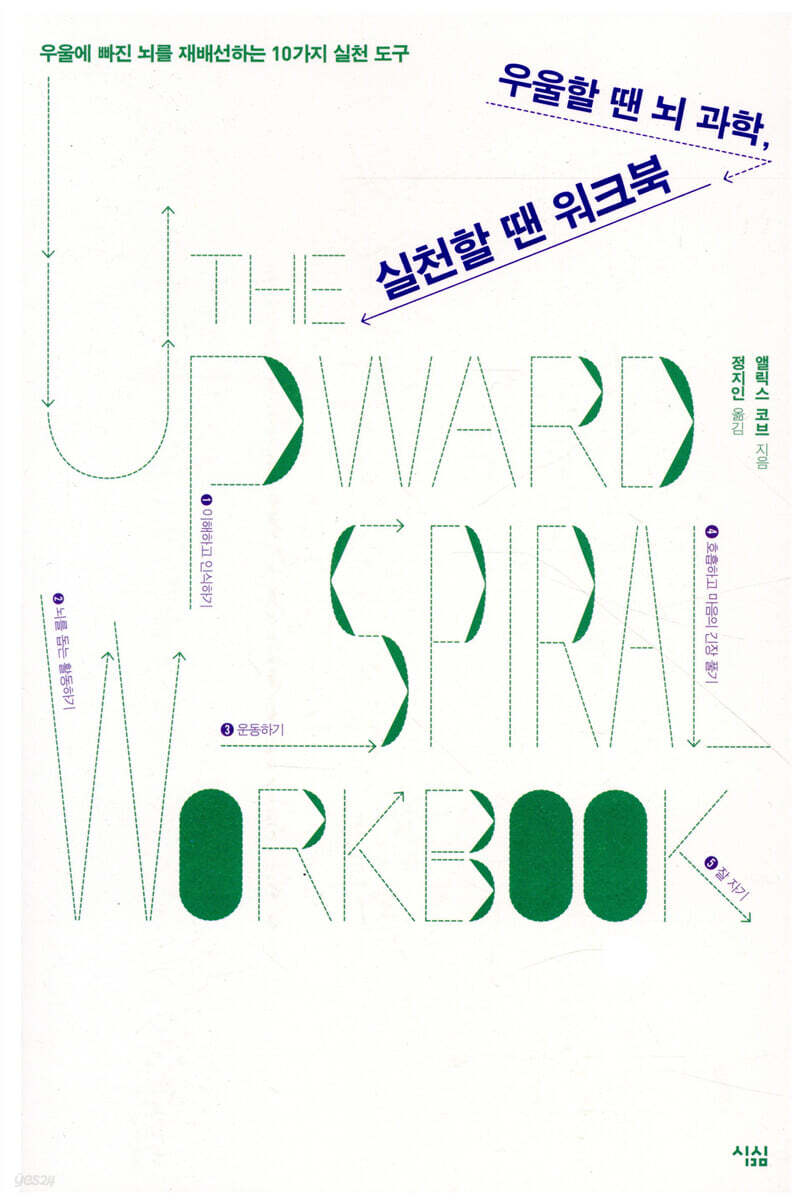
Brain Science for Depression, Workbook for Practice
 |
Description
Book Introduction
“Prescribing Brain Science to Your Life”
New work from the author of the best-selling book "Brain Science When You're Depressed"
From what you can do, to what you want to do, to what seems easy!
Practical and well-founded advice and guidance that will help you overcome depression before you know it.
"Brain Science When You're Depressed" is the first book to approach depression as a "brain problem, a biological problem," breaking away from the conventional view that attributes the cause of depression to individuals, such as "a sensitive personality" or "a disease caused by weak willpower."
In particular, it defined depression as a "byproduct of the brain's interaction process" and meticulously explained the reasons and mechanisms of depression from a neuroscientific perspective, receiving favorable reviews from those suffering from depression, such as "Just hearing that it wasn't my fault was reassuring," "I was able to objectify the problem," "This is the book that doesn't talk nonsense the most," and "A clear consolation from science," and establishing itself as a steady seller in the humanities field.
Neuroscientist Alex Korb, author of "The Brain Science of Depression," returns with practical tools to help you finally overcome depression.
If 『Brain Science When You're Depressed』 offered 'scientific comfort' to those suffering from depression, this book 『Brain Science When You're Depressed, Workbook for Practice』 goes beyond comfort and offers a 'scientific prescription' that can be directly applied in everyday life.
"Brain Science for Depression, Workbook for Practice" is not a book to read, but a book to read and practice.
This book presents ten practical and practical ways to help you overcome depression.
Some of these methods are relatively new, while others have been around for decades, even centuries, and have proven effective.
The book guides readers through numerous scientifically proven ways to improve mood, sleep quality, and stress reduction, starting with what they can do, want to do, what's easy to do, but at least one thing they must do—by writing it down, doing it, or putting it into practice.
New work from the author of the best-selling book "Brain Science When You're Depressed"
From what you can do, to what you want to do, to what seems easy!
Practical and well-founded advice and guidance that will help you overcome depression before you know it.
"Brain Science When You're Depressed" is the first book to approach depression as a "brain problem, a biological problem," breaking away from the conventional view that attributes the cause of depression to individuals, such as "a sensitive personality" or "a disease caused by weak willpower."
In particular, it defined depression as a "byproduct of the brain's interaction process" and meticulously explained the reasons and mechanisms of depression from a neuroscientific perspective, receiving favorable reviews from those suffering from depression, such as "Just hearing that it wasn't my fault was reassuring," "I was able to objectify the problem," "This is the book that doesn't talk nonsense the most," and "A clear consolation from science," and establishing itself as a steady seller in the humanities field.
Neuroscientist Alex Korb, author of "The Brain Science of Depression," returns with practical tools to help you finally overcome depression.
If 『Brain Science When You're Depressed』 offered 'scientific comfort' to those suffering from depression, this book 『Brain Science When You're Depressed, Workbook for Practice』 goes beyond comfort and offers a 'scientific prescription' that can be directly applied in everyday life.
"Brain Science for Depression, Workbook for Practice" is not a book to read, but a book to read and practice.
This book presents ten practical and practical ways to help you overcome depression.
Some of these methods are relatively new, while others have been around for decades, even centuries, and have proven effective.
The book guides readers through numerous scientifically proven ways to improve mood, sleep quality, and stress reduction, starting with what they can do, want to do, what's easy to do, but at least one thing they must do—by writing it down, doing it, or putting it into practice.
- You can preview some of the book's contents.
Preview
index
Recommendation
Preface | The Best Time to Get Out of Depression Is Right Now
Chapter 1 Understanding and Recognizing
The Roots of Depression
Checklist: Am I Depressed? | Checklist: Am I Anxious?
Brain Map of Depression
The striatum of habits and impulses | The limbic system of emotions | The prefrontal cortex of thought
The Chemicals of Depression
Applying neuroscience knowledge to life
Checklist: Labeling Your Emotions | Checklist: Recognizing Physical Symptoms | There Are No Broken Emotions
What you can and cannot control
How did my brain get like this? | Let's write it down: Examine your current life situation | Let's write it down: Identify your goals | What's wrong with my brain? | It's not your fault
To you who is putting too much effort into understanding
Chapter 2: Activities that Support Your Brain
Five Activities to Reverse the Progression of Depression
Let's write: Choosing an activity
Planning an activity schedule
Let's write it down: Activity Schedule
Weeding out useless thoughts
Black-and-white thinking | Unrealistic expectations | Selective attention | Positive downplaying | Predicting the future | Let's write it down: Recognizing unhelpful thoughts
Thoughts that block activities
The solution is simple
Chapter 3: Exercise
The beneficial effects of exercise on the brain
What effect will exercise have on me?
Just start
Just move
Checklist: Get Your Body Moving
Regularly, regardless of type
Right there, right now
You don't necessarily have to run a marathon.
The secret to making exercise easy
Tie your shoelaces | Set specific goals | Get involved with others | Write it down: Put it into action | Play it like a game | Just get started
Anything you do is better than nothing.
Chapter 4: Breathe and Relax
What Your Heart Beat Says
The power of breathing
Gentle and Slow | Let's Try: How to Breathe Slowly and Evenly | Let's Write It Down: Keep a Breathing Journal | Breathe in Stressful Situations | Improve Your Mood by Correcting Your Posture | Let's Try: Practice Sitting Upright
The mind is the mirror of the face
Frowning increases feelings of anger
Relax your muscles
Stretching | Progressive Muscle Relaxation | Let's Try: Progressive Muscle Relaxation Training
The Effects of Yoga on the Brain
Yoga is a Science | Let's Try It: Heart-Opening Poses Learned Through Attributes | Yoga Poses and Movements
Music tames the wild, wild limbic system.
Some ways to raise your body temperature
Being able to control your body
Chapter 5 Sleep well
The Brain Science of Sleep
Sleep Structure | The Brain's Built-in Clock | The Effects of Sleep on the Brain
Things that disturb your sleep
Checklist: Sleep Hygiene Checklist
Practice good sleep hygiene
Let's write: Preparing for a good night's sleep
The power of writing
Expressive writing to explore emotions | Let's write: Write about a difficult event | Put your worries into words | Let's write: Make a to-do list | Keep a sleep journal | Let's write: Keep a sleep journal
How to fall asleep more easily without trying
Wake up at a consistent time every day | Limit the time spent in bed | Practice stimulus control
Weeding out useless thoughts about sleep
Unrealistic Expectations | Selective Attention | Black-and-White Thinking | Catastrophizing | Thinking It Should Be | Let's Write It Down: Changing the Perspective of Unhelpful Thoughts
Even if you can't be happy just by going to sleep every night,
Chapter 6 Connecting with Others
The power of others to influence your brain and mood
loneliness and social isolation
Dealing with Loneliness | Taking Care of Yourself | Let's Write: Practicing Self-Care
Being around other people
Something you can only do by getting along with other people
Strengthening social support
Let's Write: Identifying Your Social Support Network | Leveraging Your Social Support Network | Let's Try: Making a Phone Call | Coping with Negative Judgments
Identifying Negative Relationships
Let's write: Identifying Toxic People
Untangling the knot of conflict
Let's write: Analyzing the conflict
Useless thoughts in human relationships
Let's Write It Down: Reviewing Useless Thoughts
How to increase physical contact
You don't have to have sex first.
Helping others helps me too
Harnessing the power of the group
Why Dogs Are Good for Your Brain
The brain evolved to connect with other beings.
Chapter 7: Making a Decision That's Okay
How to Make Satisfactory Decisions
Lowering the intensity of emotions | Utilizing the upward spiral | Let's write: Think about what's important | Don't make happiness your goal | Let's write: Define your values and goals | Choose what you like over what you fear | Let's write: Fear vs. values | Value over cost | Make an okay decision over the best decision
Decision-making strategies
Checklist: Maladaptive Decision-Making | Let's Write It Down: Adaptive Decision-Making | Focus on Actions, Not Emotions | Let's Write It Down: Coping with Worry | Focus on One Goal at a Time | Let's Write It Down: Completing Small Tasks
Goals change your mood
Write it down on a calendar | Break down your goals | Let's write it down: The goals I want to achieve | Focus my efforts | Let's try: The Pomodoro Technique | Make a ticket before making a plan | There's nothing you absolutely have to do | Let's write it down: Change the mindset of having to do something
Draw the best version of yourself you can imagine
Let's write it down: What would I look like at my best?
“I’m already two-thirds through this book.”
Chapter 8 Mindfulness and Acceptance
Acceptance is not resignation
Acceptance and the Brain
Mindfulness is not meditation
The Effects of Mindfulness on the Brain and Body
Misconceptions about mindfulness
Right now, at this moment
Practice mindfulness
Let's try: Graphing Your Mood | Let's try: Mindful Breathing | Let's write: Keeping a Mindful Breathing Journal
Mindfulness practice with an app
Let's Try: Body Scan | How to Practice Mindfulness in Everyday Life | Let's Try: Mindful Eating
When you are sick
You don't have to be positive every moment.
To avoid becoming a slave to emotions
Chapter 9: The Power of Habit
Identifying bad habits
Let's write it down: Keeping a Habit Journal
Creating new habits
Using Self-Affirmations | Let's Write It Down: Instilling Self-Affirmations | Recognizing the Triggers That Trigger Habits
What habit triggers do I have?
Let's write: Coping Habits Sentence Completion | Changing the Environment | Rewarding Yourself | Checklist: Rewarding Yourself
What You Can Learn from Bad Habits
The only way to eliminate fear and anxiety
A small voice in my head
Take a look at your eating habits
How to eat | Why to eat | What to eat
To take back control of your life from your habits
Chapter 10: Being Thankful
The Difficulties and Benefits of Gratitude
“A Summer No One Can Destroy”
Let's Write: Recall Happy Times | Let's Try: Visualize Happy Times
Be grateful for the future
Feeling grateful to others
Expressing Gratitude | Let's Write It Down: Writing a Gratitude Letter | Practice Gratitude Regularly | Let's Write It Down: Keeping a Gratitude Journal
Practicing gratitude
Let's write: Enjoying the Positive Side of Chores
Thank yourself
Self-compassion and forgiveness
Let's Write: Practicing Self-Compassion | Forgiving Yourself | Let's Write: Writing a Letter to Myself | How to Cope When You're Hurt | Let's Write: Seeing the Bright Side of Things
A rainbow of positive emotions
Awe and Wonder | Relying on the Power of Humor
Gratitude is the process of acknowledging my needs and desires.
Chapter 11 Even if your brain interferes with you
There's no need to solve all your problems at once.
Acknowledgements
Huzhou
Preface | The Best Time to Get Out of Depression Is Right Now
Chapter 1 Understanding and Recognizing
The Roots of Depression
Checklist: Am I Depressed? | Checklist: Am I Anxious?
Brain Map of Depression
The striatum of habits and impulses | The limbic system of emotions | The prefrontal cortex of thought
The Chemicals of Depression
Applying neuroscience knowledge to life
Checklist: Labeling Your Emotions | Checklist: Recognizing Physical Symptoms | There Are No Broken Emotions
What you can and cannot control
How did my brain get like this? | Let's write it down: Examine your current life situation | Let's write it down: Identify your goals | What's wrong with my brain? | It's not your fault
To you who is putting too much effort into understanding
Chapter 2: Activities that Support Your Brain
Five Activities to Reverse the Progression of Depression
Let's write: Choosing an activity
Planning an activity schedule
Let's write it down: Activity Schedule
Weeding out useless thoughts
Black-and-white thinking | Unrealistic expectations | Selective attention | Positive downplaying | Predicting the future | Let's write it down: Recognizing unhelpful thoughts
Thoughts that block activities
The solution is simple
Chapter 3: Exercise
The beneficial effects of exercise on the brain
What effect will exercise have on me?
Just start
Just move
Checklist: Get Your Body Moving
Regularly, regardless of type
Right there, right now
You don't necessarily have to run a marathon.
The secret to making exercise easy
Tie your shoelaces | Set specific goals | Get involved with others | Write it down: Put it into action | Play it like a game | Just get started
Anything you do is better than nothing.
Chapter 4: Breathe and Relax
What Your Heart Beat Says
The power of breathing
Gentle and Slow | Let's Try: How to Breathe Slowly and Evenly | Let's Write It Down: Keep a Breathing Journal | Breathe in Stressful Situations | Improve Your Mood by Correcting Your Posture | Let's Try: Practice Sitting Upright
The mind is the mirror of the face
Frowning increases feelings of anger
Relax your muscles
Stretching | Progressive Muscle Relaxation | Let's Try: Progressive Muscle Relaxation Training
The Effects of Yoga on the Brain
Yoga is a Science | Let's Try It: Heart-Opening Poses Learned Through Attributes | Yoga Poses and Movements
Music tames the wild, wild limbic system.
Some ways to raise your body temperature
Being able to control your body
Chapter 5 Sleep well
The Brain Science of Sleep
Sleep Structure | The Brain's Built-in Clock | The Effects of Sleep on the Brain
Things that disturb your sleep
Checklist: Sleep Hygiene Checklist
Practice good sleep hygiene
Let's write: Preparing for a good night's sleep
The power of writing
Expressive writing to explore emotions | Let's write: Write about a difficult event | Put your worries into words | Let's write: Make a to-do list | Keep a sleep journal | Let's write: Keep a sleep journal
How to fall asleep more easily without trying
Wake up at a consistent time every day | Limit the time spent in bed | Practice stimulus control
Weeding out useless thoughts about sleep
Unrealistic Expectations | Selective Attention | Black-and-White Thinking | Catastrophizing | Thinking It Should Be | Let's Write It Down: Changing the Perspective of Unhelpful Thoughts
Even if you can't be happy just by going to sleep every night,
Chapter 6 Connecting with Others
The power of others to influence your brain and mood
loneliness and social isolation
Dealing with Loneliness | Taking Care of Yourself | Let's Write: Practicing Self-Care
Being around other people
Something you can only do by getting along with other people
Strengthening social support
Let's Write: Identifying Your Social Support Network | Leveraging Your Social Support Network | Let's Try: Making a Phone Call | Coping with Negative Judgments
Identifying Negative Relationships
Let's write: Identifying Toxic People
Untangling the knot of conflict
Let's write: Analyzing the conflict
Useless thoughts in human relationships
Let's Write It Down: Reviewing Useless Thoughts
How to increase physical contact
You don't have to have sex first.
Helping others helps me too
Harnessing the power of the group
Why Dogs Are Good for Your Brain
The brain evolved to connect with other beings.
Chapter 7: Making a Decision That's Okay
How to Make Satisfactory Decisions
Lowering the intensity of emotions | Utilizing the upward spiral | Let's write: Think about what's important | Don't make happiness your goal | Let's write: Define your values and goals | Choose what you like over what you fear | Let's write: Fear vs. values | Value over cost | Make an okay decision over the best decision
Decision-making strategies
Checklist: Maladaptive Decision-Making | Let's Write It Down: Adaptive Decision-Making | Focus on Actions, Not Emotions | Let's Write It Down: Coping with Worry | Focus on One Goal at a Time | Let's Write It Down: Completing Small Tasks
Goals change your mood
Write it down on a calendar | Break down your goals | Let's write it down: The goals I want to achieve | Focus my efforts | Let's try: The Pomodoro Technique | Make a ticket before making a plan | There's nothing you absolutely have to do | Let's write it down: Change the mindset of having to do something
Draw the best version of yourself you can imagine
Let's write it down: What would I look like at my best?
“I’m already two-thirds through this book.”
Chapter 8 Mindfulness and Acceptance
Acceptance is not resignation
Acceptance and the Brain
Mindfulness is not meditation
The Effects of Mindfulness on the Brain and Body
Misconceptions about mindfulness
Right now, at this moment
Practice mindfulness
Let's try: Graphing Your Mood | Let's try: Mindful Breathing | Let's write: Keeping a Mindful Breathing Journal
Mindfulness practice with an app
Let's Try: Body Scan | How to Practice Mindfulness in Everyday Life | Let's Try: Mindful Eating
When you are sick
You don't have to be positive every moment.
To avoid becoming a slave to emotions
Chapter 9: The Power of Habit
Identifying bad habits
Let's write it down: Keeping a Habit Journal
Creating new habits
Using Self-Affirmations | Let's Write It Down: Instilling Self-Affirmations | Recognizing the Triggers That Trigger Habits
What habit triggers do I have?
Let's write: Coping Habits Sentence Completion | Changing the Environment | Rewarding Yourself | Checklist: Rewarding Yourself
What You Can Learn from Bad Habits
The only way to eliminate fear and anxiety
A small voice in my head
Take a look at your eating habits
How to eat | Why to eat | What to eat
To take back control of your life from your habits
Chapter 10: Being Thankful
The Difficulties and Benefits of Gratitude
“A Summer No One Can Destroy”
Let's Write: Recall Happy Times | Let's Try: Visualize Happy Times
Be grateful for the future
Feeling grateful to others
Expressing Gratitude | Let's Write It Down: Writing a Gratitude Letter | Practice Gratitude Regularly | Let's Write It Down: Keeping a Gratitude Journal
Practicing gratitude
Let's write: Enjoying the Positive Side of Chores
Thank yourself
Self-compassion and forgiveness
Let's Write: Practicing Self-Compassion | Forgiving Yourself | Let's Write: Writing a Letter to Myself | How to Cope When You're Hurt | Let's Write: Seeing the Bright Side of Things
A rainbow of positive emotions
Awe and Wonder | Relying on the Power of Humor
Gratitude is the process of acknowledging my needs and desires.
Chapter 11 Even if your brain interferes with you
There's no need to solve all your problems at once.
Acknowledgements
Huzhou
Detailed image

Into the book
This book is filled with simple activities that will transform your life, from moving your body to writing a gratitude journal.
Some of these may seem pointless, but they are all activities that have been proven effective through rigorous scientific research.
All of these activities will contribute to the purpose of this book.
The goal is to get you back on track, to live the life you want, and to become the type of person you want to be.
--- p.14
The roots of depression are biological.
What I'm saying is that it's not something you can just get out of in one breath by making up your mind.
If you can just snap out of a depressed state, it doesn't fit the definition of depression.
Let's give it a try. Just get out of that state! Did you get out? If so, great! You can close this book right here.
But if you haven't, read on.
If depression isn't something you can just get out of, what should you do? While depression has a biological basis, that doesn't mean it's etched in stone and immutable.
Rather, it would be more accurate to say that it is engraved on caramel.
A caramel that is firm but can be reshaped.
--- p.26~27
Physical symptoms are also linked to mood and anxiety.
Pain and suffering are not only the result of signals your body sends you, but also the way your brain processes those signals.
For example, communication between the insula and the limbic system is correlated with anxiety.
When we look at the brains of people suffering from depression or chronic pain, we see changes in communication between the insula and the limbic system.
This means that your brain becomes more sensitive, so you feel more pain and react to pain more intensely emotionally.
--- p.45
When you suffer from depression, you often think that you are broken.
In times like these, understanding the different areas of the brain can be very helpful.
If your arm is broken, you say your arm is broken, not you.
Everyone knows that your arms are not you.
You can raise your arms or wiggle your fingers.
Your arms are a part of you, not you.
But when you feel sad, depressed, or anxious, it's hard to separate those feelings from yourself.
But it is true that they are separate from you.
Those feelings are just how you experience the world in this moment.
Just because your emotions originate in a specific area of your brain that belongs to you doesn't mean that your amygdala or hypothalamus is you.
Those areas may belong to you and may cause problems at times, but they are not the essence of who you are.
--- p.47
Unhelpful thought patterns are common in depression.
It is a result of activity in the limbic system and striatum.
Fortunately, you don't have to eliminate all useless thoughts to engage in beneficial activities.
In fact, you can't control the thoughts that spontaneously pop into your head.
If you try to control things, things won't go your way, and you'll end up feeling frustrated and stressed out (plus, focusing on things you can't control will increase the reactivity of your limbic system).
First of all, recognize that your thoughts are just thoughts, not truth.
While it may be true or contain elements of truth, the thought is triggered, filtered, and distorted by your neural circuits.
Let's take the thought, 'A meteorite could hit my house and kill me.'
Strictly speaking, that's true, but it's so unlikely that it's almost meaningless.
--- p.69
Take a moment to stop reading, get up, and walk around the room.
Try doing 10 jumping jacks or shadowboxing, lightly punching the air for 15 seconds.
I'll be waiting here.
I'm not kidding.
If you don't move your body, I can't help you even if I talk for a hundred days.
Move your body, even if it's just for a little while.
It's not too late to read the rest of this book.
--- p.86
You don't have to run a marathon.
You don't even have to run a kilometer.
Again, the key is to walk out the door.
Because unlike when you're out on the open road and enjoying the deep sunset, running doesn't really appeal when you're sitting on the sofa.
--- p.96
Just like facial expressions, changing your posture won't dramatically change your mood, but it can enhance your current mood, whether positive or negative.
For example, if you are feeling down and you are hunched over or in a hunched position, it will get worse.
Conversely, if you feel good or have done something good and you are confident and poised, you can multiply those positive feelings.
--- p.114
In Camus' novel The Stranger, one day the protagonist squints in the bright sunlight on the beach and is seized with an inexplicable rage.
He keeps chewing on that anger.
When I read the novel, I didn't understand that scene, but brain science gave me the answer.
One study found that squinting in bright sunlight increased feelings of anger and hostility.
At this time, you can alleviate negative emotions by turning your face away from the sunlight or wearing sunglasses.
--- p.116
How can you avoid situations where you have trouble falling or staying asleep? The answer is to make yourself sleepy.
How can we make that happen? It's simple.
I'm getting less sleep.
This may sound counterintuitive, but by being mindful of your sleep structure and intentionally reducing your sleep, you can retrain your brain to fall asleep faster and stay asleep longer.
Easier said than done, this method is quite difficult to put into practice as it can make your condition worse for the first few days, and even for several weeks.
So, only use it if your insomnia is very severe.
Also, people with bipolar disorder, sleep apnea, or seizure disorders should never try this method.
This is actually a complex treatment and is best done under the guidance of a professional, but I'll simplify it a bit here.
--- p.152
Imagine you were living on Earth 30,000 years ago, wandering through the forests with your fellow tribesmen.
I found some fruit on the tree along the way and was so absorbed in picking it that when I looked up, I saw no one.
Where did everyone go?
I tried calling out, but no one answered.
You are lost in a deep, dark forest.
Thirty thousand years ago, being left alone in the forest meant being eaten by other animals or succumbing to the forces of nature.
So the human brain has evolved to make being left alone feel so horrible and terrifying that we try to avoid it as much as possible.
So it makes sense that when you're left alone, your amygdala fires off signals and your hypothalamus goes into hyper-vigilance.
--- p.164~165
It is precisely the loneliness and social isolation that causes depression to interfere with the social spiral.
These two are separate concepts.
Loneliness is an emotion or a perception.
It's a combination of a desire to be close to others and a fear that there's an unbridgeable gap between ourselves and them.
Social isolation, on the other hand, is a result of your actions or your environment.
Isolation is simply a state in which you do not get close to other people or interact with them.
--- p.167
The striatum and hippocampus, which are involved in feelings of loneliness and social isolation, react sensitively depending on the environment you are in.
So, just by changing your environment a little, you can feel closer to other people.
Place photos of people who are important to you or items that contain memories of them in a prominent place.
--- p.177
Every time you make a decision, you are given the opportunity to base your decision on what you want or don't want, what you like or what you fear.
Fear is an unpleasant emotion, but it shines a spotlight on something, helping you identify what's important to you.
Because what you fear is often what you value.
For example, 'I'm afraid that people close to me will leave me' means, 'Maintaining close relationships with people is important to me.'
Both approaches influence your decisions about what actions to take, but the directions those decisions lead are quite different.
--- p.211
Most people keep thinking about something until they make a decision that makes them feel good.
If you do that, the standards for selection will only get higher.
This is especially true when you're depressed, because no matter how much you think about it, it's hard to magically improve your mood.
That is precisely why action is paramount in decision-making.
If you don't know where to go, you should just move in any direction.
Of course, reflecting on your current situation and properly understanding the situation may help you find the right direction.
But if that doesn't give you an answer, you're just wasting your time.
Don't know the solution? Pick a direction and start moving.
--- p.222~223
Read the following sentence in a very angry voice.
“I don’t like being in this situation.
“I feel like I can never get out of here!” Then try reading the same sentence in a resigned voice or in a voice that conveys some other negative emotion.
And finally, read the following sentence without any emotion, just as if you were stating a fact:
“There is nothing I can do in this situation.” This is acceptance.
--- p.241
Stopping trying to control the uncontrollable is not giving up, it's acceptance.
Because whether you accept it or not, the fact that you have no control doesn't change.
Acceptance stops you from continuing to futilely try to do the impossible.
But accepting what is within our control is a whole other story.
That's not helpful.
If you're in a bad relationship or working at a job you hate, accepting it isn't necessarily the best option.
The best solution in that case is to correct the situation.
You may need to resolve a problem in your relationship or break up with that person altogether, request an improvement in your work environment at your workplace, or find a new job.
--- p.242
We often feel positive or excited about something enjoyable, but at the same time, we are afraid and sad that it will end.
Positive emotions can act as a guardian to keep you from drowning in depression.
But if you believe that positive emotions are the only thing that keeps you from drowning, you may end up worrying that they will disappear.
Rather, it's better to realize that while positive emotions can empower you, they aren't necessarily needed at all times.
--- p.260
The habit itself is not an obstacle to overcoming depression and living a happy life.
However, if you feel like you're being dragged into a predetermined routine rather than taking charge of your own life, then habits become the problem.
Fortunately, you are both a computer program (striatum) and a programmer (prefrontal cortex).
Even if you can't recode the entire program, you can work through it piecemeal and fix some errors.
--- p.266
If you want to change the activity of your ancestors, you have to speak their language.
Of course, you may be very concerned about whether that habit is good or bad, but again, remember that your striatum doesn't care.
That doesn't mean your ancestors will always go against your will.
I work for you too.
But to do that, you have to train your ancestral body like you train a dog.
The important thing here is consistency.
When your dog jumps up on the sofa, how confused would your dog be if sometimes you yelled at him to get down right away and other times you just plopped down next to him and gave him a hug?
--- p.274
When a bad habit is triggered by a simple trigger, such as an event or object, the solution is simpler.
Just remove that trigger.
For example, let's say you're trying to focus on your work at home, but your eyes keep going back to the TV.
You might be able to resist the temptation to watch TV with a strong will, but you can also just turn it off or leave the room.
It is better to avoid temptation than to confront it.
--- p.278
The existentialist novelist Albert Camus said that within us there exists “a summer that no one can destroy.”
It refers to positive memories that remain deep in the heart and help us endure difficult times.
What's interesting is that sometimes sadness can also bring us to such moments of gratitude.
When something ends, we feel sad that it's over, but also grateful that we experienced it.
In this way, sadness and gratitude are like two sides of the same coin.
--- p.299
Forgiving doesn't mean you have to like that person or be friends with them.
Forgiveness is an act of acceptance, and it actually changes the way the prefrontal cortex and limbic system communicate.
Forgiveness helps reduce depression and anxiety because it allows you to let go of anger and pain.
Forgiveness is a power you have, and it is your choice whether or not to wield it.
--- p.318
One thing I want you to remember as you go through life is that you are not broken.
You just happen to have a human brain full of miraculous wonders, and unfortunately, that brain has the potential to get stuck in a pattern of depression.
When you feel anxious, just think of it as your brain's amygdala sending signals alerting you to potential danger.
When your body and mind are in pain, I think your anterior cingulate cortex is telling you what it thinks is important for your journey.
If you're stuck in a worry loop, think about it: your prefrontal cortex has found a way to deal with your anxiety, but it's not yet perfect.
If you feel defeated, it's because your dorsal striatum is repeating emotional habits you've been practicing for years.
Besides, that habit can be retrained and changed.
Some of these may seem pointless, but they are all activities that have been proven effective through rigorous scientific research.
All of these activities will contribute to the purpose of this book.
The goal is to get you back on track, to live the life you want, and to become the type of person you want to be.
--- p.14
The roots of depression are biological.
What I'm saying is that it's not something you can just get out of in one breath by making up your mind.
If you can just snap out of a depressed state, it doesn't fit the definition of depression.
Let's give it a try. Just get out of that state! Did you get out? If so, great! You can close this book right here.
But if you haven't, read on.
If depression isn't something you can just get out of, what should you do? While depression has a biological basis, that doesn't mean it's etched in stone and immutable.
Rather, it would be more accurate to say that it is engraved on caramel.
A caramel that is firm but can be reshaped.
--- p.26~27
Physical symptoms are also linked to mood and anxiety.
Pain and suffering are not only the result of signals your body sends you, but also the way your brain processes those signals.
For example, communication between the insula and the limbic system is correlated with anxiety.
When we look at the brains of people suffering from depression or chronic pain, we see changes in communication between the insula and the limbic system.
This means that your brain becomes more sensitive, so you feel more pain and react to pain more intensely emotionally.
--- p.45
When you suffer from depression, you often think that you are broken.
In times like these, understanding the different areas of the brain can be very helpful.
If your arm is broken, you say your arm is broken, not you.
Everyone knows that your arms are not you.
You can raise your arms or wiggle your fingers.
Your arms are a part of you, not you.
But when you feel sad, depressed, or anxious, it's hard to separate those feelings from yourself.
But it is true that they are separate from you.
Those feelings are just how you experience the world in this moment.
Just because your emotions originate in a specific area of your brain that belongs to you doesn't mean that your amygdala or hypothalamus is you.
Those areas may belong to you and may cause problems at times, but they are not the essence of who you are.
--- p.47
Unhelpful thought patterns are common in depression.
It is a result of activity in the limbic system and striatum.
Fortunately, you don't have to eliminate all useless thoughts to engage in beneficial activities.
In fact, you can't control the thoughts that spontaneously pop into your head.
If you try to control things, things won't go your way, and you'll end up feeling frustrated and stressed out (plus, focusing on things you can't control will increase the reactivity of your limbic system).
First of all, recognize that your thoughts are just thoughts, not truth.
While it may be true or contain elements of truth, the thought is triggered, filtered, and distorted by your neural circuits.
Let's take the thought, 'A meteorite could hit my house and kill me.'
Strictly speaking, that's true, but it's so unlikely that it's almost meaningless.
--- p.69
Take a moment to stop reading, get up, and walk around the room.
Try doing 10 jumping jacks or shadowboxing, lightly punching the air for 15 seconds.
I'll be waiting here.
I'm not kidding.
If you don't move your body, I can't help you even if I talk for a hundred days.
Move your body, even if it's just for a little while.
It's not too late to read the rest of this book.
--- p.86
You don't have to run a marathon.
You don't even have to run a kilometer.
Again, the key is to walk out the door.
Because unlike when you're out on the open road and enjoying the deep sunset, running doesn't really appeal when you're sitting on the sofa.
--- p.96
Just like facial expressions, changing your posture won't dramatically change your mood, but it can enhance your current mood, whether positive or negative.
For example, if you are feeling down and you are hunched over or in a hunched position, it will get worse.
Conversely, if you feel good or have done something good and you are confident and poised, you can multiply those positive feelings.
--- p.114
In Camus' novel The Stranger, one day the protagonist squints in the bright sunlight on the beach and is seized with an inexplicable rage.
He keeps chewing on that anger.
When I read the novel, I didn't understand that scene, but brain science gave me the answer.
One study found that squinting in bright sunlight increased feelings of anger and hostility.
At this time, you can alleviate negative emotions by turning your face away from the sunlight or wearing sunglasses.
--- p.116
How can you avoid situations where you have trouble falling or staying asleep? The answer is to make yourself sleepy.
How can we make that happen? It's simple.
I'm getting less sleep.
This may sound counterintuitive, but by being mindful of your sleep structure and intentionally reducing your sleep, you can retrain your brain to fall asleep faster and stay asleep longer.
Easier said than done, this method is quite difficult to put into practice as it can make your condition worse for the first few days, and even for several weeks.
So, only use it if your insomnia is very severe.
Also, people with bipolar disorder, sleep apnea, or seizure disorders should never try this method.
This is actually a complex treatment and is best done under the guidance of a professional, but I'll simplify it a bit here.
--- p.152
Imagine you were living on Earth 30,000 years ago, wandering through the forests with your fellow tribesmen.
I found some fruit on the tree along the way and was so absorbed in picking it that when I looked up, I saw no one.
Where did everyone go?
I tried calling out, but no one answered.
You are lost in a deep, dark forest.
Thirty thousand years ago, being left alone in the forest meant being eaten by other animals or succumbing to the forces of nature.
So the human brain has evolved to make being left alone feel so horrible and terrifying that we try to avoid it as much as possible.
So it makes sense that when you're left alone, your amygdala fires off signals and your hypothalamus goes into hyper-vigilance.
--- p.164~165
It is precisely the loneliness and social isolation that causes depression to interfere with the social spiral.
These two are separate concepts.
Loneliness is an emotion or a perception.
It's a combination of a desire to be close to others and a fear that there's an unbridgeable gap between ourselves and them.
Social isolation, on the other hand, is a result of your actions or your environment.
Isolation is simply a state in which you do not get close to other people or interact with them.
--- p.167
The striatum and hippocampus, which are involved in feelings of loneliness and social isolation, react sensitively depending on the environment you are in.
So, just by changing your environment a little, you can feel closer to other people.
Place photos of people who are important to you or items that contain memories of them in a prominent place.
--- p.177
Every time you make a decision, you are given the opportunity to base your decision on what you want or don't want, what you like or what you fear.
Fear is an unpleasant emotion, but it shines a spotlight on something, helping you identify what's important to you.
Because what you fear is often what you value.
For example, 'I'm afraid that people close to me will leave me' means, 'Maintaining close relationships with people is important to me.'
Both approaches influence your decisions about what actions to take, but the directions those decisions lead are quite different.
--- p.211
Most people keep thinking about something until they make a decision that makes them feel good.
If you do that, the standards for selection will only get higher.
This is especially true when you're depressed, because no matter how much you think about it, it's hard to magically improve your mood.
That is precisely why action is paramount in decision-making.
If you don't know where to go, you should just move in any direction.
Of course, reflecting on your current situation and properly understanding the situation may help you find the right direction.
But if that doesn't give you an answer, you're just wasting your time.
Don't know the solution? Pick a direction and start moving.
--- p.222~223
Read the following sentence in a very angry voice.
“I don’t like being in this situation.
“I feel like I can never get out of here!” Then try reading the same sentence in a resigned voice or in a voice that conveys some other negative emotion.
And finally, read the following sentence without any emotion, just as if you were stating a fact:
“There is nothing I can do in this situation.” This is acceptance.
--- p.241
Stopping trying to control the uncontrollable is not giving up, it's acceptance.
Because whether you accept it or not, the fact that you have no control doesn't change.
Acceptance stops you from continuing to futilely try to do the impossible.
But accepting what is within our control is a whole other story.
That's not helpful.
If you're in a bad relationship or working at a job you hate, accepting it isn't necessarily the best option.
The best solution in that case is to correct the situation.
You may need to resolve a problem in your relationship or break up with that person altogether, request an improvement in your work environment at your workplace, or find a new job.
--- p.242
We often feel positive or excited about something enjoyable, but at the same time, we are afraid and sad that it will end.
Positive emotions can act as a guardian to keep you from drowning in depression.
But if you believe that positive emotions are the only thing that keeps you from drowning, you may end up worrying that they will disappear.
Rather, it's better to realize that while positive emotions can empower you, they aren't necessarily needed at all times.
--- p.260
The habit itself is not an obstacle to overcoming depression and living a happy life.
However, if you feel like you're being dragged into a predetermined routine rather than taking charge of your own life, then habits become the problem.
Fortunately, you are both a computer program (striatum) and a programmer (prefrontal cortex).
Even if you can't recode the entire program, you can work through it piecemeal and fix some errors.
--- p.266
If you want to change the activity of your ancestors, you have to speak their language.
Of course, you may be very concerned about whether that habit is good or bad, but again, remember that your striatum doesn't care.
That doesn't mean your ancestors will always go against your will.
I work for you too.
But to do that, you have to train your ancestral body like you train a dog.
The important thing here is consistency.
When your dog jumps up on the sofa, how confused would your dog be if sometimes you yelled at him to get down right away and other times you just plopped down next to him and gave him a hug?
--- p.274
When a bad habit is triggered by a simple trigger, such as an event or object, the solution is simpler.
Just remove that trigger.
For example, let's say you're trying to focus on your work at home, but your eyes keep going back to the TV.
You might be able to resist the temptation to watch TV with a strong will, but you can also just turn it off or leave the room.
It is better to avoid temptation than to confront it.
--- p.278
The existentialist novelist Albert Camus said that within us there exists “a summer that no one can destroy.”
It refers to positive memories that remain deep in the heart and help us endure difficult times.
What's interesting is that sometimes sadness can also bring us to such moments of gratitude.
When something ends, we feel sad that it's over, but also grateful that we experienced it.
In this way, sadness and gratitude are like two sides of the same coin.
--- p.299
Forgiving doesn't mean you have to like that person or be friends with them.
Forgiveness is an act of acceptance, and it actually changes the way the prefrontal cortex and limbic system communicate.
Forgiveness helps reduce depression and anxiety because it allows you to let go of anger and pain.
Forgiveness is a power you have, and it is your choice whether or not to wield it.
--- p.318
One thing I want you to remember as you go through life is that you are not broken.
You just happen to have a human brain full of miraculous wonders, and unfortunately, that brain has the potential to get stuck in a pattern of depression.
When you feel anxious, just think of it as your brain's amygdala sending signals alerting you to potential danger.
When your body and mind are in pain, I think your anterior cingulate cortex is telling you what it thinks is important for your journey.
If you're stuck in a worry loop, think about it: your prefrontal cortex has found a way to deal with your anxiety, but it's not yet perfect.
If you feel defeated, it's because your dorsal striatum is repeating emotional habits you've been practicing for years.
Besides, that habit can be retrained and changed.
--- p.334
Publisher's Review
The brain is not fixed
So you can get depressed, and you can also get out of depression.
"Brain Science When You're Depressed" is a book based on neuroscience principles, particularly neuroplasticity.
Neuroplasticity, simply put, is the concept that 'the human brain is not fixed, but changes throughout life through experience.'
In the past, it was generally accepted that the human brain did not change after the early stages of development, but the latest brain science, using magnetic resonance imaging techniques and other techniques, is continuously proving that the brain is reorganized even into old age.
Applying neuroplasticity to depression helps us understand more clearly the meaning of the "descending spiral of depression," a key concept in this book.
That is, negative or harmful experiences trigger depression, sweeping us away like a whirlpool and dragging us to the bottom of the swamp.
This concept—that the things that happen to us and the decisions we make change our brain chemistry—both explains the causes of depression and suggests ways to escape it.
The idea is that a few positive actions can turn a downward spiral into an upward spiral.
Recent studies show the power of upward spirals.
We've discovered that even small positive changes to our daily lives can trigger positive changes in our brains, altering their electrical activity and chemical makeup, and even creating new neurons.
Moreover, a positively changed brain makes it easier to make positive changes in life.
An upward spiral can reverse the downward progression of depression and anxiety.
(Page 10)
"Brain Science for Depression, Workbook for Practice" provides very specific and practical methods to turn your brain into an upward spiral in 10 aspects.
It provides a variety of effective tools that encourage immediate action on the book's contents, from a simple checklist for self-diagnosis of depression and anxiety (pages 28 and 30), to an activity schedule (page 67) that helps you put the workbook's contents into practice every day, to a sleep diary form (page 148) that helps you improve your sleep quality, to mindful breathing techniques (page 252) and a mindful breathing diary form (page 254), to a habit diary form (page 271) that helps you replace bad habits with good ones.
From what you can do, to what you want to do, to what seems easy!
Practical and well-founded advice and guidance that will help you overcome depression before you know it.
The book begins with a brief introduction to the brain circuits that cause depression and anxiety.
In the first chapter, the author explains the structure and function of each region of the brain, and explains in detail what state the brain falls into when depressed.
Various brain-related terms, such as hormones and neurotransmitters, may appear unfamiliar or difficult, but the book reassures readers by saying, "There's no need to worry if you can't memorize everything" or "Not knowing the terms will not hinder the effectiveness of the methods in this book."
The remaining chapters will step you through 10 core practices that will change your brain activity and chemistry, while providing you with the tools you need to overcome the challenges of depression.
The 10 practices are ‘Understanding and Recognizing (Chapter 1)’, ‘Doing Activities That Support the Brain (Chapter 2)’, ‘Exercising (Chapter 3)’, ‘Breathing and Relaxing the Mind (Chapter 4)’, ‘Sleeping Well (Chapter 5)’, ‘Connecting with Others (Chapter 6)’, ‘Making Decisions That Are Okay (Chapter 7)’, ‘Mindfulness and Acceptance (Chapter 8)’, ‘The Power of Habits (Chapter 9)’, and ‘Being Grateful (Chapter 10)’.
The final chapter, Chapter 11, “Even if Your Brain Holds You Back,” emphasizes “continuity” in practice.
Because the brain areas targeted by each method are interconnected, the effects of each method spread to other areas.
For example, expressing gratitude, sleep, and social interactions are each covered in separate chapters, but gratitude not only improves sleep quality but also makes you feel more connected to others.
Mindfulness can help you change your habits, and setting goals can make it easier to maintain your exercise routine, which in turn can improve your sleep quality.
To you who is putting too much effort into understanding
If you have depression, bring brain science into your life, and do it.
The greatest utility and differentiating factor of 『Brain Science When You're Depressed』 is that it confirms that depression is not something that can be overcome 'by thinking positively', and that it is not something that can 'just be cut off'.
For those suffering from depression, it provided 'self-understanding', which is the key to overcoming depression, and for the family and friends of those suffering from depression, it provided 'understanding' as to 'why they are like that'.
In "Brain Science for Depression, Workbook for Practice," the author takes up the weapon of brain science and cautiously but firmly thrusts it into our lives.
I firmly believe that if we incorporate brain science into our lives, like installing a boiler at our father's house on a cold day, we can live a much warmer life than we do now.
At the same time, it says this to us who are putting too much effort into understanding.
“Understanding is enough.
Now take action.”
Understanding is one of the two key elements needed to overcome depression.
The other is practice.
There's a big difference between understanding that physical activity is beneficial and actually going for a brisk walk as the sun sets, taking deep, calming breaths of air.
(Page 13)
“A few years ago, I attended a motivational workshop to revitalize myself.
The instructor talked about how to reframe the situation and what to do to get out of a depressed state.
I didn't quite understand, so I asked for a clearer explanation.
“I understand what you are saying, but I don’t understand how it helps me.”
Then the instructor answered like this.
“You're putting too much effort into understanding.
“Just give it a try.”
Understanding can help us solve problems, but it cannot be the solution itself.
Understanding can be incredibly powerful when it leads to action or acceptance, but trying to understand can often lead to overthinking.
The activities in this book will work whether you understand brain science or not.
So, if you're so caught up in trying to understand that you're stuck, put that thought aside for now.
Because the main use of brain science when it comes to depression is to help you move forward and take action.
(Pages 57-58)
Will this book really help me overcome depression? YES.
This book keeps asking you to do different things, write different things, and check off different checklists.
Sometimes you may make silly requests, but that's not just for fun.
If you implement the suggestions in this book, your brain will actually change in a 'measurable' way.
The way actions change the brain is different from the way thoughts change the brain.
To properly incorporate brain science into my life, I need to carefully acquire the knowledge and put it into practice.
Just as a washing machine won't do any laundry if you just leave it there and don't run it, even if you read the manual carefully after bringing it home, to properly utilize this book, you need to read the brain science knowledge thoroughly and put it into practice.
Do I have to do every single practice in this book? NO
What this book doesn't have is 'coercion'.
This book doesn't force you to do anything.
Provide a convincing reason for taking that action by presenting sound scientific evidence.
It's not that they just tell you to do it, but they urge you to do it 'because there's a reason for it.'
You can't, and don't need to, put into practice all the practices in this book.
If you do that, you might get crushed by the burden and fall out.
You can start by choosing something that piques your curiosity, challenges your existing way of thinking, or something you feel you can do well enough to do.
You don't have to read each chapter in order.
After trying one of the methods in Chapter 7, there is no problem trying the method in Chapter 3.
You can do them in whatever order is best for you right now, or you can just start with what seems easier.
However, once you have read a chapter, it is recommended that you practice at least one of the methods introduced in that chapter before moving on to another.
If you do that, you will gain the strength to try the method you missed last time.
Should I read this book after reading "Brain Science for Depression"? NO
You don't necessarily need to read "Brain Science When You're Depressed" before reading this book (or before applying it in real life).
This book alone contains enough detailed information to 'understand' the biological mechanisms and brain science of depression.
If 『Brain Science When You're Depressed』 allowed you to rationally 'understand' depression, 『Brain Science When You're Depressed, Workbook for Practice』 allows you to 'understand' and 'practice' it at the same time.
The two key elements needed to overcome depression are ‘understanding’ and ‘practice.’
There's a big difference between understanding that physical activity is beneficial and actually going for a walk and taking a deep breath of air as the sun sets.
This book captures both.
So you can get depressed, and you can also get out of depression.
"Brain Science When You're Depressed" is a book based on neuroscience principles, particularly neuroplasticity.
Neuroplasticity, simply put, is the concept that 'the human brain is not fixed, but changes throughout life through experience.'
In the past, it was generally accepted that the human brain did not change after the early stages of development, but the latest brain science, using magnetic resonance imaging techniques and other techniques, is continuously proving that the brain is reorganized even into old age.
Applying neuroplasticity to depression helps us understand more clearly the meaning of the "descending spiral of depression," a key concept in this book.
That is, negative or harmful experiences trigger depression, sweeping us away like a whirlpool and dragging us to the bottom of the swamp.
This concept—that the things that happen to us and the decisions we make change our brain chemistry—both explains the causes of depression and suggests ways to escape it.
The idea is that a few positive actions can turn a downward spiral into an upward spiral.
Recent studies show the power of upward spirals.
We've discovered that even small positive changes to our daily lives can trigger positive changes in our brains, altering their electrical activity and chemical makeup, and even creating new neurons.
Moreover, a positively changed brain makes it easier to make positive changes in life.
An upward spiral can reverse the downward progression of depression and anxiety.
(Page 10)
"Brain Science for Depression, Workbook for Practice" provides very specific and practical methods to turn your brain into an upward spiral in 10 aspects.
It provides a variety of effective tools that encourage immediate action on the book's contents, from a simple checklist for self-diagnosis of depression and anxiety (pages 28 and 30), to an activity schedule (page 67) that helps you put the workbook's contents into practice every day, to a sleep diary form (page 148) that helps you improve your sleep quality, to mindful breathing techniques (page 252) and a mindful breathing diary form (page 254), to a habit diary form (page 271) that helps you replace bad habits with good ones.
From what you can do, to what you want to do, to what seems easy!
Practical and well-founded advice and guidance that will help you overcome depression before you know it.
The book begins with a brief introduction to the brain circuits that cause depression and anxiety.
In the first chapter, the author explains the structure and function of each region of the brain, and explains in detail what state the brain falls into when depressed.
Various brain-related terms, such as hormones and neurotransmitters, may appear unfamiliar or difficult, but the book reassures readers by saying, "There's no need to worry if you can't memorize everything" or "Not knowing the terms will not hinder the effectiveness of the methods in this book."
The remaining chapters will step you through 10 core practices that will change your brain activity and chemistry, while providing you with the tools you need to overcome the challenges of depression.
The 10 practices are ‘Understanding and Recognizing (Chapter 1)’, ‘Doing Activities That Support the Brain (Chapter 2)’, ‘Exercising (Chapter 3)’, ‘Breathing and Relaxing the Mind (Chapter 4)’, ‘Sleeping Well (Chapter 5)’, ‘Connecting with Others (Chapter 6)’, ‘Making Decisions That Are Okay (Chapter 7)’, ‘Mindfulness and Acceptance (Chapter 8)’, ‘The Power of Habits (Chapter 9)’, and ‘Being Grateful (Chapter 10)’.
The final chapter, Chapter 11, “Even if Your Brain Holds You Back,” emphasizes “continuity” in practice.
Because the brain areas targeted by each method are interconnected, the effects of each method spread to other areas.
For example, expressing gratitude, sleep, and social interactions are each covered in separate chapters, but gratitude not only improves sleep quality but also makes you feel more connected to others.
Mindfulness can help you change your habits, and setting goals can make it easier to maintain your exercise routine, which in turn can improve your sleep quality.
To you who is putting too much effort into understanding
If you have depression, bring brain science into your life, and do it.
The greatest utility and differentiating factor of 『Brain Science When You're Depressed』 is that it confirms that depression is not something that can be overcome 'by thinking positively', and that it is not something that can 'just be cut off'.
For those suffering from depression, it provided 'self-understanding', which is the key to overcoming depression, and for the family and friends of those suffering from depression, it provided 'understanding' as to 'why they are like that'.
In "Brain Science for Depression, Workbook for Practice," the author takes up the weapon of brain science and cautiously but firmly thrusts it into our lives.
I firmly believe that if we incorporate brain science into our lives, like installing a boiler at our father's house on a cold day, we can live a much warmer life than we do now.
At the same time, it says this to us who are putting too much effort into understanding.
“Understanding is enough.
Now take action.”
Understanding is one of the two key elements needed to overcome depression.
The other is practice.
There's a big difference between understanding that physical activity is beneficial and actually going for a brisk walk as the sun sets, taking deep, calming breaths of air.
(Page 13)
“A few years ago, I attended a motivational workshop to revitalize myself.
The instructor talked about how to reframe the situation and what to do to get out of a depressed state.
I didn't quite understand, so I asked for a clearer explanation.
“I understand what you are saying, but I don’t understand how it helps me.”
Then the instructor answered like this.
“You're putting too much effort into understanding.
“Just give it a try.”
Understanding can help us solve problems, but it cannot be the solution itself.
Understanding can be incredibly powerful when it leads to action or acceptance, but trying to understand can often lead to overthinking.
The activities in this book will work whether you understand brain science or not.
So, if you're so caught up in trying to understand that you're stuck, put that thought aside for now.
Because the main use of brain science when it comes to depression is to help you move forward and take action.
(Pages 57-58)
Will this book really help me overcome depression? YES.
This book keeps asking you to do different things, write different things, and check off different checklists.
Sometimes you may make silly requests, but that's not just for fun.
If you implement the suggestions in this book, your brain will actually change in a 'measurable' way.
The way actions change the brain is different from the way thoughts change the brain.
To properly incorporate brain science into my life, I need to carefully acquire the knowledge and put it into practice.
Just as a washing machine won't do any laundry if you just leave it there and don't run it, even if you read the manual carefully after bringing it home, to properly utilize this book, you need to read the brain science knowledge thoroughly and put it into practice.
Do I have to do every single practice in this book? NO
What this book doesn't have is 'coercion'.
This book doesn't force you to do anything.
Provide a convincing reason for taking that action by presenting sound scientific evidence.
It's not that they just tell you to do it, but they urge you to do it 'because there's a reason for it.'
You can't, and don't need to, put into practice all the practices in this book.
If you do that, you might get crushed by the burden and fall out.
You can start by choosing something that piques your curiosity, challenges your existing way of thinking, or something you feel you can do well enough to do.
You don't have to read each chapter in order.
After trying one of the methods in Chapter 7, there is no problem trying the method in Chapter 3.
You can do them in whatever order is best for you right now, or you can just start with what seems easier.
However, once you have read a chapter, it is recommended that you practice at least one of the methods introduced in that chapter before moving on to another.
If you do that, you will gain the strength to try the method you missed last time.
Should I read this book after reading "Brain Science for Depression"? NO
You don't necessarily need to read "Brain Science When You're Depressed" before reading this book (or before applying it in real life).
This book alone contains enough detailed information to 'understand' the biological mechanisms and brain science of depression.
If 『Brain Science When You're Depressed』 allowed you to rationally 'understand' depression, 『Brain Science When You're Depressed, Workbook for Practice』 allows you to 'understand' and 'practice' it at the same time.
The two key elements needed to overcome depression are ‘understanding’ and ‘practice.’
There's a big difference between understanding that physical activity is beneficial and actually going for a walk and taking a deep breath of air as the sun sets.
This book captures both.
GOODS SPECIFICS
- Date of issue: January 17, 2020
- Page count, weight, size: 360 pages | 756g | 164*244*21mm
- ISBN13: 9791156758082
- ISBN10: 1156758084
You may also like
카테고리
korean


korean

![GQ KOREA Mark (Monthly): December [2025]](http://librairie.coreenne.fr/cdn/shop/files/8ef265dbbfbf186523ed75ba7319009d.jpg?v=1765340328&width=3840)


