

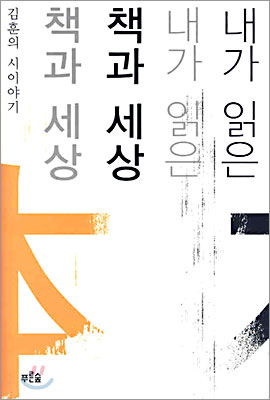
The books I read and the world
 |
Description
Book Introduction
Novelist Kim Hoon, who has been actively working, winning the Dong-in Literary Award and the Yi Sang Literary Award in succession for his novel “Song of the Sword” and his short story “Makeup,” was a newspaper reporter who kept many people captivated by his pen before becoming a writer, and an outstanding writer who made many poets and novelists nervous with his sharp and elegant sentences.
This book is a revised edition of Kim Hoon's first book, "The Books I Read and the World," published at that time.
From the existing manuscript, only the parts related to poetry were collected, and other poetry reviews were added to it, and it was presented anew with the subtitle ‘Kim Hoon’s Poetry Story.’
Part 1, 'Autumn Woven with Poetry', consists of an introduction to the people and landscapes encountered while traveling to the West Sea, East Sea, Eulsukdo Island, Gimje Man-gyeong Plain, and Seomjin River, as well as poems that sing of those places.
The consistent emotion that runs through the author's appreciation of each place and poem is the loneliness and longing conveyed by the season of 'autumn.'
Through him, we can feel a sharp and generous gaze that penetrates the meaning of life given to humans.
In Part 2, 'Summer and Poetry,' we read poems entangled with the media that brought about the representative poetry of the 1980s, namely birds, islands, seas, mountains, rivers, and blades of grass, and delicately capture the patterns drawn by each poem, while also expressing the author's own thoughts on birds, islands, and rivers.
Part 3, 'Poetry Collection Tour', is a collection of short reviews of poems and poetry collections published by representative young poets of the 1980s (Shin Kyeong-rim, Hwang Ji-woo, Lee Seong-bok, Ki Hyeong-do, Heo Su-gyeong, Lee Mun-jae, Ko Jeong-hee, Kwak Jae-gu, Kim Yong-taek, etc.) during that period.
You can catch a glimpse of the vibrant creative scene where the representative works of poets who are still widely read and have long been loved by readers and critics were written, as well as the resolute and pure aspirations of young poets as seen through the eyes of young reporter Kim Hoon.
These are not formal and tasteless reviews, but rather writings that allow you to read the poem and the poet at the same time, and that you read with your heart first, not your head.
This book is a revised edition of Kim Hoon's first book, "The Books I Read and the World," published at that time.
From the existing manuscript, only the parts related to poetry were collected, and other poetry reviews were added to it, and it was presented anew with the subtitle ‘Kim Hoon’s Poetry Story.’
Part 1, 'Autumn Woven with Poetry', consists of an introduction to the people and landscapes encountered while traveling to the West Sea, East Sea, Eulsukdo Island, Gimje Man-gyeong Plain, and Seomjin River, as well as poems that sing of those places.
The consistent emotion that runs through the author's appreciation of each place and poem is the loneliness and longing conveyed by the season of 'autumn.'
Through him, we can feel a sharp and generous gaze that penetrates the meaning of life given to humans.
In Part 2, 'Summer and Poetry,' we read poems entangled with the media that brought about the representative poetry of the 1980s, namely birds, islands, seas, mountains, rivers, and blades of grass, and delicately capture the patterns drawn by each poem, while also expressing the author's own thoughts on birds, islands, and rivers.
Part 3, 'Poetry Collection Tour', is a collection of short reviews of poems and poetry collections published by representative young poets of the 1980s (Shin Kyeong-rim, Hwang Ji-woo, Lee Seong-bok, Ki Hyeong-do, Heo Su-gyeong, Lee Mun-jae, Ko Jeong-hee, Kwak Jae-gu, Kim Yong-taek, etc.) during that period.
You can catch a glimpse of the vibrant creative scene where the representative works of poets who are still widely read and have long been loved by readers and critics were written, as well as the resolute and pure aspirations of young poets as seen through the eyes of young reporter Kim Hoon.
These are not formal and tasteless reviews, but rather writings that allow you to read the poem and the poet at the same time, and that you read with your heart first, not your head.
index
In publishing the revised edition
At the beginning of the book
Autumn woven with poetry
In the West Sea
In the East Sea
On the Seomjin River
In Eulsukdo
In the Man-gyeong Plain of Gimje
On Mt. Mudeung
In Mokpo
In Gyeongju
In Jeju
Summer and poetry
Countless arrows have flown so far, yet no bird has ever died.
There is an island among people. I want to go to that island.
The sea gently erases all the words of this world
The mountain is alone and with many more things.
Look at the river at sunset
Why do cows have horns?
Your loneliness, which cried for your supreme life and rejected everything, will now lie on the ground like a dry leaf.
Poetry Travelogue
The Grafting of Primordial Mythology and the Metaphysical World - Seo Jeong-ju's "Jilmajae Myth"
Reflecting on the "Lament of the Abandoned" - Shin Kyeong-rim's "Poor Love Song"
Translating Intangible Ideas into Tangible Language - Park Je-cheon's "Zhuangzi"
Expressing the "Wounds of Violence" Through the Power of Language - Lim Dong-hwak's "Burial Psalms"
Dance of the Godless Priest - Ha Jae-bong's "Fog and Fire"
A Station Where You Can't Go - Kihyungdo's "Advice at the Station"
A Blank Line Transformed into Life - Kim Myeong-in's "Hwacheon"
12 cards for hands
70 Poems Titled "Memories" - Poet Park Jae-sam
Poetry is just a story of life...
- Poet Kim Yong-taek
Singing Love, Not Pain - Poet Kwak Jae-gu
Dreaming of an emergency, singing about this life - Poet Hwang Ji-woo
The Professional Spirit of Poet Go Jeong-hee: Poetry as a "Work"
The Freedom of a Mad Beggar - 『Hansan Poetry Collection』
Abandonment, the Place of Salvation - Kim Shin-yong's "Abandoned People"
Beauty Stronger Than Fertility - Heo Su-gyeong, "Where Is There Fertilizer Like Sorrow?"
Song of Exile - Lee Seong-bu, "Leaving Behind an Empty Mountain"
Life Between Oppression and Freedom - Lee Moon-jae's "When I Take Off My Wet Shoes and Show Them to the Sun"
The Climax of Pure Poetry - Kim Jong-sam's Complete Works
Song of a Pathless World - Hwang Hak-ju's Poetry
Preface | Lee Moon-jae
At the beginning of the book
Autumn woven with poetry
In the West Sea
In the East Sea
On the Seomjin River
In Eulsukdo
In the Man-gyeong Plain of Gimje
On Mt. Mudeung
In Mokpo
In Gyeongju
In Jeju
Summer and poetry
Countless arrows have flown so far, yet no bird has ever died.
There is an island among people. I want to go to that island.
The sea gently erases all the words of this world
The mountain is alone and with many more things.
Look at the river at sunset
Why do cows have horns?
Your loneliness, which cried for your supreme life and rejected everything, will now lie on the ground like a dry leaf.
Poetry Travelogue
The Grafting of Primordial Mythology and the Metaphysical World - Seo Jeong-ju's "Jilmajae Myth"
Reflecting on the "Lament of the Abandoned" - Shin Kyeong-rim's "Poor Love Song"
Translating Intangible Ideas into Tangible Language - Park Je-cheon's "Zhuangzi"
Expressing the "Wounds of Violence" Through the Power of Language - Lim Dong-hwak's "Burial Psalms"
Dance of the Godless Priest - Ha Jae-bong's "Fog and Fire"
A Station Where You Can't Go - Kihyungdo's "Advice at the Station"
A Blank Line Transformed into Life - Kim Myeong-in's "Hwacheon"
12 cards for hands
70 Poems Titled "Memories" - Poet Park Jae-sam
Poetry is just a story of life...
- Poet Kim Yong-taek
Singing Love, Not Pain - Poet Kwak Jae-gu
Dreaming of an emergency, singing about this life - Poet Hwang Ji-woo
The Professional Spirit of Poet Go Jeong-hee: Poetry as a "Work"
The Freedom of a Mad Beggar - 『Hansan Poetry Collection』
Abandonment, the Place of Salvation - Kim Shin-yong's "Abandoned People"
Beauty Stronger Than Fertility - Heo Su-gyeong, "Where Is There Fertilizer Like Sorrow?"
Song of Exile - Lee Seong-bu, "Leaving Behind an Empty Mountain"
Life Between Oppression and Freedom - Lee Moon-jae's "When I Take Off My Wet Shoes and Show Them to the Sun"
The Climax of Pure Poetry - Kim Jong-sam's Complete Works
Song of a Pathless World - Hwang Hak-ju's Poetry
Preface | Lee Moon-jae
Into the book
“Gihyungdo is my friend.
It's difficult to write about a friend's writing.
Because that person's face is swollen.
I write this while telling that dwarf face to 'go away'.
(......) I can't tell my friend who is loitering at the station to stop and come into the world.
To say so would be nothing but a shameless morality.
In his station, all the paths that lead into and out of the world cannot meet again, and is it okay for my friend to grow old like this?
“I am covering the winter issue (1988) of Literature and Society, which contains his poetry.”
It's difficult to write about a friend's writing.
Because that person's face is swollen.
I write this while telling that dwarf face to 'go away'.
(......) I can't tell my friend who is loitering at the station to stop and come into the world.
To say so would be nothing but a shameless morality.
In his station, all the paths that lead into and out of the world cannot meet again, and is it okay for my friend to grow old like this?
“I am covering the winter issue (1988) of Literature and Society, which contains his poetry.”
--- p.201
“Hwang Ji-woo (32) is standing at the starting line.
(......) He endlessly wants to 'go', 'flow', and 'enter', but he also tries hard not to leave in the end.
The conflict at the starting line seems to be giving tension to his poetry.
(......) He lives at home, translating, writing reports, and occasionally writing poetry.
He is a young father who, while pushing his five-year-old daughter on a wooden cart in an empty lot, falls into the fantasy that his daughter, riding on the wooden horse, has entered a distant and unseen land.”
“Hwang Ji-woo (32) is standing at the starting line.
(......) He endlessly wants to 'go', 'flow', and 'enter', but he also tries hard not to leave in the end.
The conflict at the starting line seems to be giving tension to his poetry.
(......) He lives at home, translating, writing reports, and occasionally writing poetry.
He is a young father who, while pushing his five-year-old daughter on a wooden cart in an empty lot, falls into the fantasy that his daughter, riding on the wooden horse, has entered a distant and unseen land.”
(......) He endlessly wants to 'go', 'flow', and 'enter', but he also tries hard not to leave in the end.
The conflict at the starting line seems to be giving tension to his poetry.
(......) He lives at home, translating, writing reports, and occasionally writing poetry.
He is a young father who, while pushing his five-year-old daughter on a wooden cart in an empty lot, falls into the fantasy that his daughter, riding on the wooden horse, has entered a distant and unseen land.”
“Hwang Ji-woo (32) is standing at the starting line.
(......) He endlessly wants to 'go', 'flow', and 'enter', but he also tries hard not to leave in the end.
The conflict at the starting line seems to be giving tension to his poetry.
(......) He lives at home, translating, writing reports, and occasionally writing poetry.
He is a young father who, while pushing his five-year-old daughter on a wooden cart in an empty lot, falls into the fantasy that his daughter, riding on the wooden horse, has entered a distant and unseen land.”
--- p.233
“The poetry of Kwak Jae-gu (30) is powerful because it is pure.
Despite the fact that the contemporary reality his poetry portrays is by no means a cozy and abundant world, he says, "I will strive to sing of hope rather than despair, and love rather than pain."
(......) Since school was on winter break, he went on a few more trips.
He just said, 'I saw the mountains and the sea.'
His words sounded like he was preparing another lyric poem.”
“The poetry of Kwak Jae-gu (30) is powerful because it is pure.
Despite the fact that the contemporary reality his poetry portrays is by no means a cozy and abundant world, he says, "I will strive to sing of hope rather than despair, and love rather than pain."
(......) Since school was on winter break, he went on a few more trips.
He just said, 'I saw the mountains and the sea.'
His words sounded like he was preparing another lyric poem.”
Despite the fact that the contemporary reality his poetry portrays is by no means a cozy and abundant world, he says, "I will strive to sing of hope rather than despair, and love rather than pain."
(......) Since school was on winter break, he went on a few more trips.
He just said, 'I saw the mountains and the sea.'
His words sounded like he was preparing another lyric poem.”
“The poetry of Kwak Jae-gu (30) is powerful because it is pure.
Despite the fact that the contemporary reality his poetry portrays is by no means a cozy and abundant world, he says, "I will strive to sing of hope rather than despair, and love rather than pain."
(......) Since school was on winter break, he went on a few more trips.
He just said, 'I saw the mountains and the sea.'
His words sounded like he was preparing another lyric poem.”
-- p.227
GOODS SPECIFICS
- Date of issue: July 30, 2004
- Format: Hardcover book binding method guide
- Page count, weight, size: 295 pages | 566g | Checking size
- ISBN13: 9788971844113
- ISBN10: 8971844116
You may also like
카테고리
korean


korean

![GQ KOREA Mark (Monthly): December [2025]](http://librairie.coreenne.fr/cdn/shop/files/8ef265dbbfbf186523ed75ba7319009d.jpg?v=1765340328&width=3840)


