

Eleven steps
 |
Description
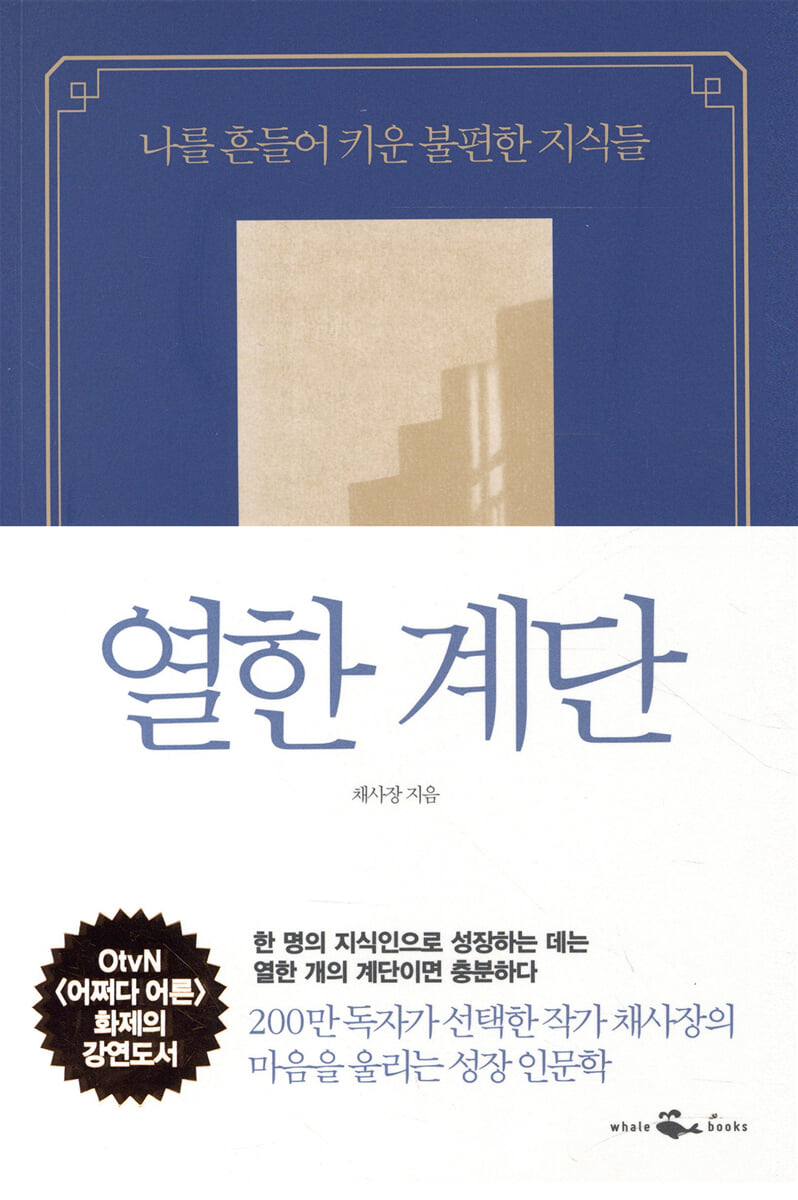
Book Introduction
Cha Sa-jang, the most talked-about writer in the humanities field in 2015 and 2016
A fierce intellectual journey until a new intellectual is born
One day, in his free daily life, a boy lying in his room with no goals or questions about life picks up a book for the first time in his life.
After a long, tedious time of not turning the pages, and after closing the last page, the boy realizes.
That he could no longer be the same as before.
A wave rises within the boy's stagnant inner self, and the boy's world shatters.
Everyone has those moments.
When life feels stagnant, when you've been stuck in one place for so long that it feels like you're rotting away.
Breaking free from oneself and pushing one's inner self outward, we call this 'growth'.
Growth is only possible with external forces.
That external force could be an event, a teacher, or a book.
Author Cha Sa-jang encountered uncomfortable questions through the book.
The question shattered his peaceful world.
Since then, he has continued to find discomfort and push his life up the stairs of growth.
I say that now, I have a little bit of a stronger confidence because of the intense process of repeating enlightenment and awakening.
Some reading broadens a person's horizons, while others trap him in a well.
That's why President Chae recommends 'uncomfortable' books.
Reading books isn't all about reading a lot. Some reading can broaden a person's horizons, but some reading can actually trap them in a well.
Only the knowledge that makes me uncomfortable can crack my hardened inner self and help me grow one step further.
Author Cha Sa-jang is known as an avid reader who read 1,000 books in three years, but the important thing is not the number.
The direction of his reading tells us where his reading began, where it has been, and where it is going.
What we need to pay attention to is the direction in which we break free from ourselves and move forward.
Author Cha Sa-jang, who has been at the forefront of the humanities and has met readers most closely, demonstrates through this book how books and the humanities can transform lives.
It tells how a person's vivid experiences and questions are intertwined to change his or her life.
Anyone who takes their own steps one by one can move in an unexpected direction and eventually discover a new self and a different life.
The uncomfortable staircase that writer Chae Sa-jang climbed encompasses the realms of literature, religion, philosophy, science, history, economics, and even art.
He says that the discomfort felt when confronted with unfamiliar knowledge is a 'crisis' felt when the 'correctness' existing within oneself comes face to face with the 'antithesis' that contradicts it.
However, overcoming that crisis and maturing into a new spirit that is neither 'Jeong' nor 'Ban' is 'Hap', and that sum becomes the 'Jeong' for the next step.
And he stands at the next step, a new type of intellectual we have never seen before.
As he climbs the stairs, the reader will encounter questions within himself and be able to reach his own staircase.
A fierce intellectual journey until a new intellectual is born
One day, in his free daily life, a boy lying in his room with no goals or questions about life picks up a book for the first time in his life.
After a long, tedious time of not turning the pages, and after closing the last page, the boy realizes.
That he could no longer be the same as before.
A wave rises within the boy's stagnant inner self, and the boy's world shatters.
Everyone has those moments.
When life feels stagnant, when you've been stuck in one place for so long that it feels like you're rotting away.
Breaking free from oneself and pushing one's inner self outward, we call this 'growth'.
Growth is only possible with external forces.
That external force could be an event, a teacher, or a book.
Author Cha Sa-jang encountered uncomfortable questions through the book.
The question shattered his peaceful world.
Since then, he has continued to find discomfort and push his life up the stairs of growth.
I say that now, I have a little bit of a stronger confidence because of the intense process of repeating enlightenment and awakening.
Some reading broadens a person's horizons, while others trap him in a well.
That's why President Chae recommends 'uncomfortable' books.
Reading books isn't all about reading a lot. Some reading can broaden a person's horizons, but some reading can actually trap them in a well.
Only the knowledge that makes me uncomfortable can crack my hardened inner self and help me grow one step further.
Author Cha Sa-jang is known as an avid reader who read 1,000 books in three years, but the important thing is not the number.
The direction of his reading tells us where his reading began, where it has been, and where it is going.
What we need to pay attention to is the direction in which we break free from ourselves and move forward.
Author Cha Sa-jang, who has been at the forefront of the humanities and has met readers most closely, demonstrates through this book how books and the humanities can transform lives.
It tells how a person's vivid experiences and questions are intertwined to change his or her life.
Anyone who takes their own steps one by one can move in an unexpected direction and eventually discover a new self and a different life.
The uncomfortable staircase that writer Chae Sa-jang climbed encompasses the realms of literature, religion, philosophy, science, history, economics, and even art.
He says that the discomfort felt when confronted with unfamiliar knowledge is a 'crisis' felt when the 'correctness' existing within oneself comes face to face with the 'antithesis' that contradicts it.
However, overcoming that crisis and maturing into a new spirit that is neither 'Jeong' nor 'Ban' is 'Hap', and that sum becomes the 'Jeong' for the next step.
And he stands at the next step, a new type of intellectual we have never seen before.
As he climbs the stairs, the reader will encounter questions within himself and be able to reach his own staircase.
- You can preview some of the book's contents.
Preview
index
First, the boy - standing in front of the stairs of discomfort
The First Step, Literature - Crime and Punishment
: At eighteen, I read a book for the first time in my life.
The Second Step, Christianity - The New Testament
: I cried a lot on the subway ride back home.
Third Step, Buddhism - Buddha
: I met the most perfect and beautiful moment in my life.
The Fourth Step, Philosophy - Thus Spoke Zarathustra
: I left home and wandered the world.
Fifth Step, Science - Space
: I read a book with no other choice but to indulge in luxury.
The Sixth Step, Ideal - Che Guevara
: I met the ideal person
The Seventh Step, Reality - The Communist Manifesto
: Became a realistic human being
The Eighth Step, Life - Mercedes Sosa
: One day, life suddenly came to a heavy halt.
The Ninth Step, Death - The Tibetan Book of the Dead
: On the day when everything was finally over, I decided to die.
The Tenth Step, I - Upanishad
: stood in the square
The Eleventh Step, Transcendence - Beyond the Boundaries
: The journey has begun
The First Step, Literature - Crime and Punishment
: At eighteen, I read a book for the first time in my life.
The Second Step, Christianity - The New Testament
: I cried a lot on the subway ride back home.
Third Step, Buddhism - Buddha
: I met the most perfect and beautiful moment in my life.
The Fourth Step, Philosophy - Thus Spoke Zarathustra
: I left home and wandered the world.
Fifth Step, Science - Space
: I read a book with no other choice but to indulge in luxury.
The Sixth Step, Ideal - Che Guevara
: I met the ideal person
The Seventh Step, Reality - The Communist Manifesto
: Became a realistic human being
The Eighth Step, Life - Mercedes Sosa
: One day, life suddenly came to a heavy halt.
The Ninth Step, Death - The Tibetan Book of the Dead
: On the day when everything was finally over, I decided to die.
The Tenth Step, I - Upanishad
: stood in the square
The Eleventh Step, Transcendence - Beyond the Boundaries
: The journey has begun
Detailed image

Into the book
“In-depth knowledge in a single field will feed us, gain recognition from others, and advance society.
But if that's all there is to my world, then that life is such a waste.
Because we are not here to work, but to enjoy, to travel, and to be amazed.
The best way to explore the world's diverse realms within the limited time we have in life is to read uncomfortable books.
“
“No one leaps to their ultimate self without being given sufficient time and experience.
Throughout the long journey of life, we must climb our own ladder.
I think you remember too.
The first time I witnessed the world crumble.
A time when cracks appeared in the solid world and the direction of life had to change drastically.
I remember it relatively accurately.
It was during winter break at the end of my second year of high school, when I finished the last chapter of Crime and Punishment.
“My first step was literature.”
“Discomfort is exciting.
If you feel uncomfortable in a book, it is an existential sign that you have just arrived on a new continent.
Now the old world will be dismantled, and a new world will be created, and my world will be reconstructed at a higher level.
It's one more step up.
Therefore, I recommend you to be uncomfortable.”
“I felt bad about sleeping.
When the lights went out and everyone was asleep, I left the ger alone.
The world was plunged into deep darkness without a single light.
But I wasn't scared at all.
It was because of the stars that seemed like they were going to pour down.
I used to think that the word "Milky Way", which I read in fairy tales when I was young, was a literary expression.
There can't be a river of stars in the night sky, can there?
But when I was twenty-one, I first knew exactly what the word Milky Way meant.
That was true.
There was actually a river of stars in the night sky.
It was a strikingly vivid, deep milky light, stretching from one side of the sky, over my head, and across the other side.
It was at that moment that I thought I could stop living.
At that moment, in a very clear mind, I could feel it exactly.
That this very moment is the happiest moment of my entire life, spanning past and future.
It felt like it transcended the limits of time.
It felt like I had briefly looked back on my entire life.
This perfect moment, spent with such wonderful people in such beautiful nature, will never be repeated.
It was clear that this was the most perfect moment prepared by God.
So, living any longer is meaningless.
How shameful it is to drag on a meaningless life.
My young thoughts were right.
Since then, I have never felt complete or fulfilled.
And I know there will never be another one.
Because now I know.
Ironically, perfection and fullness are just another expression of immaturity.
The further we get from reality, the less we understand the complexity of the world, the simpler and clearer it appears.
The problem is that we can only be happy when we see the world that simply.
That's why becoming an adult is sad.
Growing up as an adult means accepting the complexity of the world with detachment.
Embracing the complexity of the world means understanding the fiction of perfection and fullness.
“There is no happiness for those who have given up perfection and fullness.”
“And I looked at the people.
I saw middle-aged men repairing fishing boats anchored in the harbor and old women spreading out fish and calling out to customers.
I saw calves walking along a lush forest path and healthy necks wiping sweat from the stream water.
I saw the rough backs of the hands as they prayed silently, and I saw the deep wrinkles on the faces of those sitting in the chapel and sinking into their inner selves.
(...)
What I saw and learned through my travels were the concrete lives of people living in reality.
In the temple there was a chief priest, not Buddha; in the church there were believers, not God; in the market there were people, not products.
The world is not a space filled with something metaphysical, but has been filled with concrete life from the beginning.
I was blind to that self-evident and simple truth.
There are people who cannot see even if their eyes are open.
There are people who are rooted in reality, but are unable to live in reality and instead focus their minds on something beyond reality.
I wonder if I was that kind of person.
When I returned from my trip, I opened my eyes for the first time.
And I realized that my feet had been on the ground all this time.”
“The first person chooses a book he is familiar with.
After reading one book and gaining knowledge, I choose another book in a similar field to deepen my knowledge.
His knowledge in one field deepens, and he becomes an expert in that field.
This man has a soul that digs wells.
The second person chooses a book that makes him uncomfortable.
If you read one book and come to see the world through its wisdom, then choose the next book that shakes up the worldview you gained from the previous book.
He has the fortitude to tolerate discomfort.
He also has the courage to let go of the world he had previously held onto without any regrets.
The world's horizons are gradually expanding.
This man has a traveling soul.
What kind of soul do you possess? What does the world you've created look like? Is it an abyss of profound knowledge, or a vast land of wisdom? There is no right answer.
Whatever you choose is fine.
Because any path will help your soul grow.
But I hope you have a traveling soul.
Traveling souls are mostly hidden.
Because they are not welcome in a capitalist society.
Conversely, the soul that digs a well is relatively welcomed in society.
So, both the owner of the traveling soul and the owner of the well-digging soul act as if they are the well-digging soul.
Isn't that true? We're trying to be experts.
I want to delve into one field throughout my life.
The same goes for your parents, society, and the country.
They advise you to become an expert in one field.
But no one doubts.
“Why should everyone become an expert, why should they devote their entire lives to one specialty?”
“We must become travelers again.
Children, parents, and all souls who dig wells must embark on a journey again.
We must resist the obligations and evaluations demanded by society, the state, religion, family, school, and work.
Just because they force expertise on you and try to judge you only by what you can do, don't make it your life's goal and live blindly as if it were everything.
Society and the state do not care about your soul.
Society and the state only care about your labor.
You must remember this clearly.
You were not born here to live as a worker.
We must resist the demands of professionalism.
Only then will we be transformed from workers to ourselves, from beings defined by the state and society to beings who define themselves.
You have to start the journey first.
When you rise as an independent being, your children, family, and friends will also rise from their broken legs and spread their broken wings with strength.”
“There is an ideal human being.
Such people are usually hidden.
When extreme circumstances come, when even those who have been putting on airs because of the gaze of others become exhausted, it is revealed who the truly idealistic person is.
He does not make excuses for circumstances, does not complain about injustice, and does not neglect his life's mission.
An ideal person who practices, not just talks.
The legislator of one's own life.
“Sergeant Ahn was that kind of person.”
“I know now.
This means that even these anxious and impatient times are absolutely necessary for personal growth.
We have preconceived notions.
The preconception that inner maturity can only be achieved through noble means.
I believe that only the beautiful methods of reading Eastern and Western classics, tackling difficult philosophy books, studying in graduate school, and contemplating in quiet spaces will help us grow.
In some ways, that's true.
We actually grow in such times.
But that alone doesn't give you half the learning.
Experiences in a world that is not noble and that I would not want to encounter.
There are lessons that can only be learned by yielding to injustice, compromising with absurdity, rejecting righteous arguments, and writhing in one's own wretchedness.
Sadly, we need time to stay in this world.
Only then can we accurately understand our own and others' limitations, and only then can we become mature adults who are strict with ourselves and lenient with others.”
“I wish there were more libraries and better libraries.
I wish there were more books, more comfortable seats, and cheaper food.
Because that's where people who want to start something gather.
I hope society will protect their courage as they sink into silence and inwardness in the face of the world's wisdom.
It's comforting to have a library.
Even as the world and I change rapidly, the library remains unchanged and is always ready to welcome me.
“The familiar silence and the smell of books.”
“What I’m curious about is not academics, but you.
What about you? What is your outlook on the afterlife? Some people have difficulty distinguishing between the two.
There are people who cannot distinguish between their own subjective judgment and the objective judgment of the social community, and who constantly try to subordinate their subjective judgment to the objective judgment of the social community.
They are anxious that their thoughts may differ from the correct answers prescribed by society.
What I'm curious about is not whether you can guess the correct answer that science has revealed so far.
You are questioning your own perspective, which you have come to judge by carefully contemplating your life so far.
The reason we came to this world is not to remain within the realm of science and academia, which the modern era has defined, and to be recognized there.
We came into this world to encounter and be amazed by new things and to enrich our understanding of the meaning of life.
“I hope you don’t cram your vast soul into the modern and contemporary standards of rationalism.”
“There are people who believe that the more precious something is, the more it should be kept by your side.
Some people believe that families should live together, couples should have nothing to hide, children should tell their parents what's on their minds, lovers should share all their memories, friends should be closest to us, and the world should accept us.
But that's not the case.
Because human eyes and mouths are originally sharp, the closer an object is to us, the easier it is to find flaws and easily injure ourselves.
If they are precious to you, if they are someone you want to protect, you must push them away from you so that they can grow up healthy and without getting hurt.
The opposite is also true.
The way to protect yourself from the people you love and the world is to distance yourself from them.
What we need is not time with them, but time to miss them.
I need time to miss you.
“I need time to be alone, time to be deep inside and not say anything.”
But if that's all there is to my world, then that life is such a waste.
Because we are not here to work, but to enjoy, to travel, and to be amazed.
The best way to explore the world's diverse realms within the limited time we have in life is to read uncomfortable books.
“
“No one leaps to their ultimate self without being given sufficient time and experience.
Throughout the long journey of life, we must climb our own ladder.
I think you remember too.
The first time I witnessed the world crumble.
A time when cracks appeared in the solid world and the direction of life had to change drastically.
I remember it relatively accurately.
It was during winter break at the end of my second year of high school, when I finished the last chapter of Crime and Punishment.
“My first step was literature.”
“Discomfort is exciting.
If you feel uncomfortable in a book, it is an existential sign that you have just arrived on a new continent.
Now the old world will be dismantled, and a new world will be created, and my world will be reconstructed at a higher level.
It's one more step up.
Therefore, I recommend you to be uncomfortable.”
“I felt bad about sleeping.
When the lights went out and everyone was asleep, I left the ger alone.
The world was plunged into deep darkness without a single light.
But I wasn't scared at all.
It was because of the stars that seemed like they were going to pour down.
I used to think that the word "Milky Way", which I read in fairy tales when I was young, was a literary expression.
There can't be a river of stars in the night sky, can there?
But when I was twenty-one, I first knew exactly what the word Milky Way meant.
That was true.
There was actually a river of stars in the night sky.
It was a strikingly vivid, deep milky light, stretching from one side of the sky, over my head, and across the other side.
It was at that moment that I thought I could stop living.
At that moment, in a very clear mind, I could feel it exactly.
That this very moment is the happiest moment of my entire life, spanning past and future.
It felt like it transcended the limits of time.
It felt like I had briefly looked back on my entire life.
This perfect moment, spent with such wonderful people in such beautiful nature, will never be repeated.
It was clear that this was the most perfect moment prepared by God.
So, living any longer is meaningless.
How shameful it is to drag on a meaningless life.
My young thoughts were right.
Since then, I have never felt complete or fulfilled.
And I know there will never be another one.
Because now I know.
Ironically, perfection and fullness are just another expression of immaturity.
The further we get from reality, the less we understand the complexity of the world, the simpler and clearer it appears.
The problem is that we can only be happy when we see the world that simply.
That's why becoming an adult is sad.
Growing up as an adult means accepting the complexity of the world with detachment.
Embracing the complexity of the world means understanding the fiction of perfection and fullness.
“There is no happiness for those who have given up perfection and fullness.”
“And I looked at the people.
I saw middle-aged men repairing fishing boats anchored in the harbor and old women spreading out fish and calling out to customers.
I saw calves walking along a lush forest path and healthy necks wiping sweat from the stream water.
I saw the rough backs of the hands as they prayed silently, and I saw the deep wrinkles on the faces of those sitting in the chapel and sinking into their inner selves.
(...)
What I saw and learned through my travels were the concrete lives of people living in reality.
In the temple there was a chief priest, not Buddha; in the church there were believers, not God; in the market there were people, not products.
The world is not a space filled with something metaphysical, but has been filled with concrete life from the beginning.
I was blind to that self-evident and simple truth.
There are people who cannot see even if their eyes are open.
There are people who are rooted in reality, but are unable to live in reality and instead focus their minds on something beyond reality.
I wonder if I was that kind of person.
When I returned from my trip, I opened my eyes for the first time.
And I realized that my feet had been on the ground all this time.”
“The first person chooses a book he is familiar with.
After reading one book and gaining knowledge, I choose another book in a similar field to deepen my knowledge.
His knowledge in one field deepens, and he becomes an expert in that field.
This man has a soul that digs wells.
The second person chooses a book that makes him uncomfortable.
If you read one book and come to see the world through its wisdom, then choose the next book that shakes up the worldview you gained from the previous book.
He has the fortitude to tolerate discomfort.
He also has the courage to let go of the world he had previously held onto without any regrets.
The world's horizons are gradually expanding.
This man has a traveling soul.
What kind of soul do you possess? What does the world you've created look like? Is it an abyss of profound knowledge, or a vast land of wisdom? There is no right answer.
Whatever you choose is fine.
Because any path will help your soul grow.
But I hope you have a traveling soul.
Traveling souls are mostly hidden.
Because they are not welcome in a capitalist society.
Conversely, the soul that digs a well is relatively welcomed in society.
So, both the owner of the traveling soul and the owner of the well-digging soul act as if they are the well-digging soul.
Isn't that true? We're trying to be experts.
I want to delve into one field throughout my life.
The same goes for your parents, society, and the country.
They advise you to become an expert in one field.
But no one doubts.
“Why should everyone become an expert, why should they devote their entire lives to one specialty?”
“We must become travelers again.
Children, parents, and all souls who dig wells must embark on a journey again.
We must resist the obligations and evaluations demanded by society, the state, religion, family, school, and work.
Just because they force expertise on you and try to judge you only by what you can do, don't make it your life's goal and live blindly as if it were everything.
Society and the state do not care about your soul.
Society and the state only care about your labor.
You must remember this clearly.
You were not born here to live as a worker.
We must resist the demands of professionalism.
Only then will we be transformed from workers to ourselves, from beings defined by the state and society to beings who define themselves.
You have to start the journey first.
When you rise as an independent being, your children, family, and friends will also rise from their broken legs and spread their broken wings with strength.”
“There is an ideal human being.
Such people are usually hidden.
When extreme circumstances come, when even those who have been putting on airs because of the gaze of others become exhausted, it is revealed who the truly idealistic person is.
He does not make excuses for circumstances, does not complain about injustice, and does not neglect his life's mission.
An ideal person who practices, not just talks.
The legislator of one's own life.
“Sergeant Ahn was that kind of person.”
“I know now.
This means that even these anxious and impatient times are absolutely necessary for personal growth.
We have preconceived notions.
The preconception that inner maturity can only be achieved through noble means.
I believe that only the beautiful methods of reading Eastern and Western classics, tackling difficult philosophy books, studying in graduate school, and contemplating in quiet spaces will help us grow.
In some ways, that's true.
We actually grow in such times.
But that alone doesn't give you half the learning.
Experiences in a world that is not noble and that I would not want to encounter.
There are lessons that can only be learned by yielding to injustice, compromising with absurdity, rejecting righteous arguments, and writhing in one's own wretchedness.
Sadly, we need time to stay in this world.
Only then can we accurately understand our own and others' limitations, and only then can we become mature adults who are strict with ourselves and lenient with others.”
“I wish there were more libraries and better libraries.
I wish there were more books, more comfortable seats, and cheaper food.
Because that's where people who want to start something gather.
I hope society will protect their courage as they sink into silence and inwardness in the face of the world's wisdom.
It's comforting to have a library.
Even as the world and I change rapidly, the library remains unchanged and is always ready to welcome me.
“The familiar silence and the smell of books.”
“What I’m curious about is not academics, but you.
What about you? What is your outlook on the afterlife? Some people have difficulty distinguishing between the two.
There are people who cannot distinguish between their own subjective judgment and the objective judgment of the social community, and who constantly try to subordinate their subjective judgment to the objective judgment of the social community.
They are anxious that their thoughts may differ from the correct answers prescribed by society.
What I'm curious about is not whether you can guess the correct answer that science has revealed so far.
You are questioning your own perspective, which you have come to judge by carefully contemplating your life so far.
The reason we came to this world is not to remain within the realm of science and academia, which the modern era has defined, and to be recognized there.
We came into this world to encounter and be amazed by new things and to enrich our understanding of the meaning of life.
“I hope you don’t cram your vast soul into the modern and contemporary standards of rationalism.”
“There are people who believe that the more precious something is, the more it should be kept by your side.
Some people believe that families should live together, couples should have nothing to hide, children should tell their parents what's on their minds, lovers should share all their memories, friends should be closest to us, and the world should accept us.
But that's not the case.
Because human eyes and mouths are originally sharp, the closer an object is to us, the easier it is to find flaws and easily injure ourselves.
If they are precious to you, if they are someone you want to protect, you must push them away from you so that they can grow up healthy and without getting hurt.
The opposite is also true.
The way to protect yourself from the people you love and the world is to distance yourself from them.
What we need is not time with them, but time to miss them.
I need time to miss you.
“I need time to be alone, time to be deep inside and not say anything.”
--- From the text
Publisher's Review
[Eleven Steps]
Cha Sa-jang, the most talked-about writer in the humanities field in 2015 and 2016
A fierce intellectual journey until a new intellectual is born
One small question can twist the course of a person's life, and ultimately determine their fate.
“How do you organize it so well?”
“What books did you read, what did you study, and how did you live to get to where you are today?”
This is the question that writer Cha Sa-jang has heard the most over the past two years.
That makes sense.
One day, he suddenly appeared and became a million-selling author with his first book under a pseudonym.
I didn't study much, nor was I a genius. At first glance, I'm just an ordinary person who has been struggling and working hard like everyone else.
But if you look closely, there is something special.
The author, CEO Cha, has lived his life by asking fierce questions.
From my high school days when I barely avoided being last in the class, to my days as a repeat student, to my social life where I couldn't read a single book because I was struggling to make ends meet, to the desperate moments after a major car accident.
Let's go back a little, not too far, to my school days.
No matter what kind of child I was, there would have been questions inside me.
I just hadn't thought about it carefully, but that question must have twisted the angle of my life a little.
Writer Cha Sa-jang remembers those questions relatively accurately.
So, I organized the questions I encountered at every turn of life, and the common thread I came up with was 'discomfort.'
A cycle of awakening and awakening, a fierce process of questioning that an ordinary person goes through.
One day, in his free daily life, a boy lying in his room with no goals or questions about life picks up a book for the first time in his life.
After a long, tedious time of not turning the pages, and after closing the last page, the boy realizes.
That he could no longer be the same as before.
A wave rises within the boy's stagnant inner self, and the boy's world shatters.
Everyone has those moments.
When life feels stagnant, when you've been stuck in one place for so long that it feels like you're rotting away.
Breaking free from oneself and pushing one's inner self outward, we call this 'growth'.
Growth is only possible with external forces.
That external force could be an event, a teacher, or a book.
Author Cha Sa-jang encountered uncomfortable questions through the book.
The question shattered his peaceful world.
Since then, he has continued to find discomfort and push his life up the stairs of growth.
I say that now, I have a little bit of a stronger confidence because of the intense process of repeating enlightenment and awakening.
Some reading broadens a person's horizons, while others trap him in a well.
That's why President Chae recommends 'uncomfortable' books.
Reading books isn't all about reading a lot. Some reading can broaden a person's horizons, but some reading can actually trap them in a well.
Only the knowledge that makes me uncomfortable can crack my hardened inner self and help me grow one step further.
Author Cha Sa-jang is known as an avid reader who read 1,000 books in three years, but the important thing is not the number.
The direction of his reading tells us where his reading began, where it has been, and where it is going.
What we need to pay attention to is the direction in which we break free from ourselves and move forward.
Author Cha Sa-jang, who has been at the forefront of the humanities and has met readers most closely, demonstrates through this book how books and the humanities can transform lives.
It tells how a person's vivid experiences and questions are intertwined to change his or her life.
Anyone who takes their own steps one by one can move in an unexpected direction and eventually discover a new self and a different life.
Ask questions, discomfort is the process of antithesis that pushes life forward.
[Literature-Christianity-Buddhism-Philosophy-Science-History-Economy-Art-Religion-Transcendence]
The uncomfortable staircase that writer Chae Sa-jang climbed encompasses the realms of literature, religion, philosophy, science, history, economics, and even art.
He says that the discomfort felt when confronted with unfamiliar knowledge is a 'crisis' felt when the 'correctness' existing within oneself comes face to face with the 'antithesis' that contradicts it.
However, overcoming that crisis and maturing into a new spirit that is neither 'Jeong' nor 'Ban' is 'Hap', and that sum becomes the 'Jeong' for the next step.
And he stands at the next step, a new type of intellectual we have never seen before.
As he climbs the stairs, the reader will encounter questions within himself and be able to reach his own staircase.
Cha Sa-jang, the most talked-about writer in the humanities field in 2015 and 2016
A fierce intellectual journey until a new intellectual is born
One small question can twist the course of a person's life, and ultimately determine their fate.
“How do you organize it so well?”
“What books did you read, what did you study, and how did you live to get to where you are today?”
This is the question that writer Cha Sa-jang has heard the most over the past two years.
That makes sense.
One day, he suddenly appeared and became a million-selling author with his first book under a pseudonym.
I didn't study much, nor was I a genius. At first glance, I'm just an ordinary person who has been struggling and working hard like everyone else.
But if you look closely, there is something special.
The author, CEO Cha, has lived his life by asking fierce questions.
From my high school days when I barely avoided being last in the class, to my days as a repeat student, to my social life where I couldn't read a single book because I was struggling to make ends meet, to the desperate moments after a major car accident.
Let's go back a little, not too far, to my school days.
No matter what kind of child I was, there would have been questions inside me.
I just hadn't thought about it carefully, but that question must have twisted the angle of my life a little.
Writer Cha Sa-jang remembers those questions relatively accurately.
So, I organized the questions I encountered at every turn of life, and the common thread I came up with was 'discomfort.'
A cycle of awakening and awakening, a fierce process of questioning that an ordinary person goes through.
One day, in his free daily life, a boy lying in his room with no goals or questions about life picks up a book for the first time in his life.
After a long, tedious time of not turning the pages, and after closing the last page, the boy realizes.
That he could no longer be the same as before.
A wave rises within the boy's stagnant inner self, and the boy's world shatters.
Everyone has those moments.
When life feels stagnant, when you've been stuck in one place for so long that it feels like you're rotting away.
Breaking free from oneself and pushing one's inner self outward, we call this 'growth'.
Growth is only possible with external forces.
That external force could be an event, a teacher, or a book.
Author Cha Sa-jang encountered uncomfortable questions through the book.
The question shattered his peaceful world.
Since then, he has continued to find discomfort and push his life up the stairs of growth.
I say that now, I have a little bit of a stronger confidence because of the intense process of repeating enlightenment and awakening.
Some reading broadens a person's horizons, while others trap him in a well.
That's why President Chae recommends 'uncomfortable' books.
Reading books isn't all about reading a lot. Some reading can broaden a person's horizons, but some reading can actually trap them in a well.
Only the knowledge that makes me uncomfortable can crack my hardened inner self and help me grow one step further.
Author Cha Sa-jang is known as an avid reader who read 1,000 books in three years, but the important thing is not the number.
The direction of his reading tells us where his reading began, where it has been, and where it is going.
What we need to pay attention to is the direction in which we break free from ourselves and move forward.
Author Cha Sa-jang, who has been at the forefront of the humanities and has met readers most closely, demonstrates through this book how books and the humanities can transform lives.
It tells how a person's vivid experiences and questions are intertwined to change his or her life.
Anyone who takes their own steps one by one can move in an unexpected direction and eventually discover a new self and a different life.
Ask questions, discomfort is the process of antithesis that pushes life forward.
[Literature-Christianity-Buddhism-Philosophy-Science-History-Economy-Art-Religion-Transcendence]
The uncomfortable staircase that writer Chae Sa-jang climbed encompasses the realms of literature, religion, philosophy, science, history, economics, and even art.
He says that the discomfort felt when confronted with unfamiliar knowledge is a 'crisis' felt when the 'correctness' existing within oneself comes face to face with the 'antithesis' that contradicts it.
However, overcoming that crisis and maturing into a new spirit that is neither 'Jeong' nor 'Ban' is 'Hap', and that sum becomes the 'Jeong' for the next step.
And he stands at the next step, a new type of intellectual we have never seen before.
As he climbs the stairs, the reader will encounter questions within himself and be able to reach his own staircase.
GOODS SPECIFICS
- Date of issue: December 8, 2016
- Page count, weight, size: 416 pages | 506g | 140*205*30mm
- ISBN13: 9791195677153
- ISBN10: 1195677154
You may also like
카테고리
korean


korean

![GQ KOREA Mark (Monthly): December [2025]](http://librairie.coreenne.fr/cdn/shop/files/8ef265dbbfbf186523ed75ba7319009d.jpg?v=1765340328&width=3840)


