

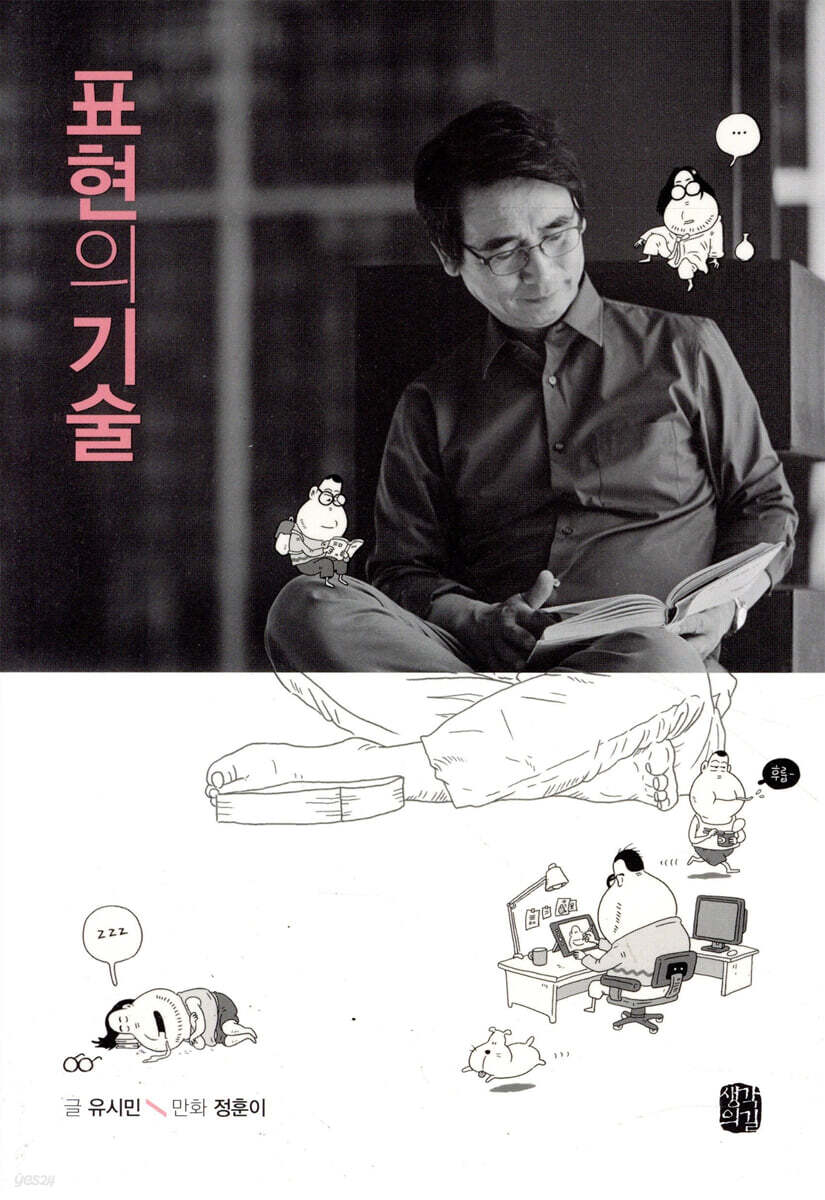
The art of expression
 |
Description
Book Introduction
The art of expression comes from the heart!
Returning to the art of expression
The secrets of expression as told by the genius of expression, Yoo Si-min!
Whether it's writing or debate, writer Yoo Si-min, who is currently enjoying great popularity on the political entertainment program JTBC's "Ssulzun," has returned with a book that shares the secrets of expression with readers.
Expressing what you want to say without hesitation and making the other person empathize with it may seem easy, but it requires a fairly sophisticated 'skill'.
Expressing thoughts and feelings in any form requires acquiring the necessary skills.
Many readers have been asking about writing, speaking, debating, and dealing with anti-fans, and all their questions about expressing themselves well, both online and offline. Representative Korean author Yoo Si-min, who has no hesitation in sharing his unique "art of expression," will answer them without hesitation.
Returning to the art of expression
The secrets of expression as told by the genius of expression, Yoo Si-min!
Whether it's writing or debate, writer Yoo Si-min, who is currently enjoying great popularity on the political entertainment program JTBC's "Ssulzun," has returned with a book that shares the secrets of expression with readers.
Expressing what you want to say without hesitation and making the other person empathize with it may seem easy, but it requires a fairly sophisticated 'skill'.
Expressing thoughts and feelings in any form requires acquiring the necessary skills.
Many readers have been asking about writing, speaking, debating, and dealing with anti-fans, and all their questions about expressing themselves well, both online and offline. Representative Korean author Yoo Si-min, who has no hesitation in sharing his unique "art of expression," will answer them without hesitation.
- You can preview some of the book's contents.
Preview
index
As I write, the art of expression comes from the heart.
Chapter 1: Why Write?
Chapter 2: Am I Progressive?
Chapter 3: What to Do About Malicious Comments
Chapter 4: Who Will Listen to Me?
Chapter 5: Who Can Tell Who I Am?
Chapter 6: Bestsellers Have Something Special
Chapter 7: Empathy? What Can I Do?
Chapter 8: What is Plagiarism?
Chapter 9 Who criticizes?
Chapter 10 Oh my goodness, I have to write too!
Chapter 11: Jeong Hoon's "The Art of Expression" - How I Became a Cartoonist
Chapter 1: Why Write?
Chapter 2: Am I Progressive?
Chapter 3: What to Do About Malicious Comments
Chapter 4: Who Will Listen to Me?
Chapter 5: Who Can Tell Who I Am?
Chapter 6: Bestsellers Have Something Special
Chapter 7: Empathy? What Can I Do?
Chapter 8: What is Plagiarism?
Chapter 9 Who criticizes?
Chapter 10 Oh my goodness, I have to write too!
Chapter 11: Jeong Hoon's "The Art of Expression" - How I Became a Cartoonist
Detailed image

Publisher's Review
The art of expression comes from the heart!
Returning to the art of expression
1.
The secrets of expression as told by the genius of expression, Yoo Si-min!
Whether it's writing or debate, writer Yoo Si-min, who is currently enjoying great popularity on the political entertainment program JTBC's "Ssulzun," has returned with a book that shares the secrets of expression with readers.
After the lecture and Q&A session, a young man came up to me and said this while greeting me.
"thank you.
It was exactly the same problem I encountered while designing.
“It helped me a lot in solving my problems.” Those words inspired me to write this book.
Writing is ultimately about expressing your inner self.
Like designing a house, composing a song, or drawing a picture.
Expressing thoughts and feelings in any form requires learning the necessary skills.
So, I wanted to talk more deeply about the art of expression, so I organized the questions from the lecture and the conversations we had in the online counseling room and added to the content.
-From the author's words
Expressing what you want to say without hesitation and making the other person empathize with it may seem easy, but it requires a fairly sophisticated 'skill'.
Expressing thoughts and feelings in any form requires acquiring the necessary skills.
Many readers have been asking about writing, speaking, debating, and dealing with anti-fans, and all their questions about expressing themselves well, both online and offline. Representative Korean author Yoo Si-min, who has no hesitation in sharing his unique "art of expression," will answer them without hesitation.
2.
Why do I write?
If we interpret the word 'politics' so broadly, there is no need to refute Orwell's claim that every writer has his or her own 'political bias'.
Needless to say, I am a writer with a distinct 'political bias'.
But I never forget for a moment that writing is self-expression.
That's only natural.
To write about issues that can change the world for the better, you need to have your own ideas and the ability to express them accurately and coherently.
Writing for public opinion and writing for self-expression are actually two sides of the same coin.
I don't understand why you're trying to separate them.
-From the text
Politics and art do not exclude each other.
Rather, they want each other.
At least in writing, that's definitely the case.
A writer must see the world as it is, base his writing on facts, and strive to convey truth and sincerity.
Only writing like that can move the hearts of many readers and leave a lasting impression.
It is said that the author Orwell's wish was to 'make political writing into art.'
I have had the same aspirations, but I have not yet achieved the success of Orwell.
But I won't completely give up on that hope.
Compared to Orwell, I am a very ordinary philistine.
I do not consider worldly success as human failure.
I want to achieve both political goals and artistic achievements.
If you write like that, commercial success will follow.
I don't like George Orwell because he lived like a saint.
Even if I hadn't been that kind of person, I would have been a huge Orwell fan.
Because he is the one who made political writing into an art.
-From the text
I mainly write logical essays.
Yet, we rely more heavily on moral intuition than on logical reasoning.
That's not true! You might be surprised, but it's true.
The ability to make judgments without logical reasoning is called intuition.
“Good! Cool!” “No! Feels uncomfortable!” Moral and aesthetic intuition makes itself known through these feelings.
I first feel it, and then I look for reasons why I feel that way.
It's not about first reasoning logically and then feeling the appropriate emotions.
So sometimes, no matter how much I think about it, I can't figure out why, but I just like it or I don't like it.
It's because my reasoning ability doesn't keep up with my intuitive judgment.
It is said that everyone has moral and aesthetic intuition.
Unfortunately, there are many people who suppress and eliminate it on their own.
-From the text
The author clearly answers the question of why he writes.
To pursue meaning and beauty with passion, to make political writing an art, so that my writing can help create a better world, but in all cases, to be honest with my feelings, and to express my thoughts and emotions with my own unique perspective and color, not with clichés or stereotypes.
He does not distinguish between self-expression and political writing, and he does not suppress his mind and emotions for any purpose.
Through the author's explanation of why he writes, we are led to ask ourselves:
“Then why do we write?”
Asking yourself questions and finding your own answers—isn't that ultimately the core of expression?
This may be because the process is directly connected to the journey of our lives.
3. Why can't we express ourselves well?
The essence of expression, the mind, empathy, and who am I?
Who am I? I'm not asking for your name.
I am asking what the characteristics of the philosophical self called 'I' are.
It is to say that he has established something of his own on top of the general human nature.
The question is simple, but the answer is difficult.
To say who I am, I must first and foremost recognize myself objectively.
We need to know our attitude toward nature and humanity, our perspective on society, the way we relate to others, the desires that are important to us and how we choose to realize them, what emotions we feel as we live, and how and how these differ from those of others.
If you don't know this, you can only write articles that imitate others.
-From the text
Expressing thoughts and feelings in any form requires learning the necessary skills.
That doesn't mean technology is everything.
The thoughts and feelings expressed in good sentences must be excellent.
If you don't have knowledge, information, logic, emotions, and thoughts worth expressing, your writing will not improve no matter how much you learn writing skills.
You need to know who you are.
That way you can express yourself in your own way.
If you don't know who you are, you won't be able to tell what's yours and what's someone else's, and you'll only use stereotypical, clichéd, and conventional expressions.
So, I always write with this in mind.
“I must write my thoughts and feelings with my own perspective and colors.
I have to make my voice heard.
“We must move away from clichéd and conventional ideas and expressions.” - From the text
If you want to write something that resonates with your readers, you must develop the ability to empathize with what others have written.
This means that you must learn how to induce empathy in your readers by empathizing with other people's writing.
Do unto others as you would have them do unto you! This is the Golden Rule we all know.
This rule also applies to writing.
This is how I use it to get a 'feel'.
-From the text
When I was a child, I read books to learn something.
But as the days went by, what became more precious was the feeling rather than the learning.
I hope you too will try to go beyond 'reading books to learn' and instead try 'reading books to feel'.
As you feel broadly, deeply, and delicately, you will develop the ability to communicate and empathize with others through text without even realizing it.
-From the text
In an age where writing is the norm, tens of thousands of pieces of writing are produced and consumed every day.
Some writings are read by hundreds of millions of people.
On the other hand, some writings disappear without even attracting the attention of a few people.
Why is that?
All expressions are ultimately a process of finding myself, creating myself, and communicating that with others.
You need to know who you are to express yourself differently from others. You need to be able to express your thoughts and feelings appropriately. You need to be able to empathize with the views of others to write empathetic pieces.
In this way, at the root of all expressions are the perception and mind of oneself, others, and the world.
This book helps us think about the essence of everything we want to express.
Maybe that's why we can't express ourselves well.
This book opens the way to broadening our ontological thinking about ourselves and others through the medium of expressive techniques.
4.
Everything about expression, from conversations and discussions to writing and responding to malicious comments.
Don't force them, don't try to change them, don't try to win them over, don't ignore them. Just respect their opinions and express your differing views verbally and in writing.
There's no way someone will change their mind right away after hearing what I say.
But if even one piece of it sticks in the person's mind and causes him to have even the slightest doubt about what he's thinking, then the conversation is a success.
This actually happens.
There are people who have no intention of changing themselves, but there are also many people who live with the will and ability to change.
It doesn't always work out, but I try to understand the other person first.
I express as much empathy as I can and then tell you what I think.
'I think this fact is important and this interpretation and judgment is correct,' that's what I'm saying.
Anyone who feels that the other person acknowledges and respects them will listen more seriously to what they say.
-From the text
Reason and emotion work together.
People get angry when they hear an incorrect argument, but they also agree when someone who likes the same thing says it.
Of course, when arguing, the instinct to win comes to the fore.
It's not as easy as it sounds to discuss things rationally and logically, while remaining calm, controlling your emotions, and avoiding personal attacks.
I know I have to do it, but as we discuss, my emotions keep rising.
Some people ask me how to win an argument.
I understand that feeling.
Whether it's a fist fight or a 'keyboard battle', we all want to win.
However, it is difficult to determine victory or defeat through words or writing.
-From the text
Malicious comments are not the fault of the person targeted, nor are they the problem they need to solve.
It's just evidence of how shabby and desolate the inner self of the person who wrote the malicious comment is.
Why should I worry about other people's problems? There's no reason for me to.
The malicious comments introduced above only reveal the personality and inner self of the person who wrote them, and have nothing to do with me.
I just think this way.
“It takes passion to write malicious comments, but I guess I’m really trying hard and living diligently.” With that, I focus on doing what I have to do and what I want to do.
I don't waste a single second fighting malicious comments.
-From the text
If there's something I need to fix, I fix it, but if no matter how much I think about it, I can't fix it, I just ignore it.
Comments like that are like arrows shot at me.
There's no way to stop it from shooting.
But those people are not close to me and I don't even know who they are.
Even if I know who they are, they are far away, so the arrows they shoot cannot reach me.
I am not foolish enough to pick up that arrow and shoot it at myself.
Getting angry, upset, or depressed because of malicious comments is no different from picking up the arrow shot by the malicious commenter and stabbing it into your own heart.
The arrows shot by malicious commenters should be left to roll on the ground and be kicked by people's feet.
-From the text
What is needed to empathize and communicate with different thoughts and feelings with dignity?
We try to connect with others with sincerity and sincerity, but we may get angry when we meet someone who just doesn't seem to listen, or we may get upset when a discussion continues and we may be driven by the desire to win, or we may be hurt by malicious comments.
All these reasons come together to make us fearful of expressing ourselves.
The author, who has experienced all kinds of debates and been a 'cloud anti' about the difficulties in expression that most people face, suggests a method of 'expression' that can control one's mind, continue conversation, and thereby bring about even small changes.
5. Expressions in all areas are interconnected.
A collaboration between writer Yoo Si-min and artist Jeong Hoon-i
We've known each other for a long time, but this is our first time doing something together.
Readers will quickly realize that Jeonghoon's cartoons are not illustrations used to decorate the text.
I made this book with the hope that Yoo Si-min's writing and Jeong Hoon's cartoons, each with their own highbrows, would become good friends, and the results don't seem too bad.
Although the genres are different, we are reminded that the techniques of expression are essentially the same.
-From the author's words
Even though the genres are different, the techniques of expression are common.
A collaboration between Korea's representative writer, Yoo Si-min, and artist Jeong Hoon-i, who has been serializing cartoons in Cine 21 for over 20 years.
Recognized as representative artists in their respective fields, they present a unique collaboration because their content, methods, and techniques are all different.
Through the witty and honest life journey of a cartoonist that has never been revealed before, you can get a glimpse into the artist Jeong Hoon's unique 'art of expression.'
Yoo Si-min's 'The Art of Expression' and Jeong Hoon-i's 'The Art of Expression' are naturally mixed into one book, and although the genres are different, we can see that the 'art of expression' that each person uses to express their thoughts and emotions is connected to each other.
Returning to the art of expression
1.
The secrets of expression as told by the genius of expression, Yoo Si-min!
Whether it's writing or debate, writer Yoo Si-min, who is currently enjoying great popularity on the political entertainment program JTBC's "Ssulzun," has returned with a book that shares the secrets of expression with readers.
After the lecture and Q&A session, a young man came up to me and said this while greeting me.
"thank you.
It was exactly the same problem I encountered while designing.
“It helped me a lot in solving my problems.” Those words inspired me to write this book.
Writing is ultimately about expressing your inner self.
Like designing a house, composing a song, or drawing a picture.
Expressing thoughts and feelings in any form requires learning the necessary skills.
So, I wanted to talk more deeply about the art of expression, so I organized the questions from the lecture and the conversations we had in the online counseling room and added to the content.
-From the author's words
Expressing what you want to say without hesitation and making the other person empathize with it may seem easy, but it requires a fairly sophisticated 'skill'.
Expressing thoughts and feelings in any form requires acquiring the necessary skills.
Many readers have been asking about writing, speaking, debating, and dealing with anti-fans, and all their questions about expressing themselves well, both online and offline. Representative Korean author Yoo Si-min, who has no hesitation in sharing his unique "art of expression," will answer them without hesitation.
2.
Why do I write?
If we interpret the word 'politics' so broadly, there is no need to refute Orwell's claim that every writer has his or her own 'political bias'.
Needless to say, I am a writer with a distinct 'political bias'.
But I never forget for a moment that writing is self-expression.
That's only natural.
To write about issues that can change the world for the better, you need to have your own ideas and the ability to express them accurately and coherently.
Writing for public opinion and writing for self-expression are actually two sides of the same coin.
I don't understand why you're trying to separate them.
-From the text
Politics and art do not exclude each other.
Rather, they want each other.
At least in writing, that's definitely the case.
A writer must see the world as it is, base his writing on facts, and strive to convey truth and sincerity.
Only writing like that can move the hearts of many readers and leave a lasting impression.
It is said that the author Orwell's wish was to 'make political writing into art.'
I have had the same aspirations, but I have not yet achieved the success of Orwell.
But I won't completely give up on that hope.
Compared to Orwell, I am a very ordinary philistine.
I do not consider worldly success as human failure.
I want to achieve both political goals and artistic achievements.
If you write like that, commercial success will follow.
I don't like George Orwell because he lived like a saint.
Even if I hadn't been that kind of person, I would have been a huge Orwell fan.
Because he is the one who made political writing into an art.
-From the text
I mainly write logical essays.
Yet, we rely more heavily on moral intuition than on logical reasoning.
That's not true! You might be surprised, but it's true.
The ability to make judgments without logical reasoning is called intuition.
“Good! Cool!” “No! Feels uncomfortable!” Moral and aesthetic intuition makes itself known through these feelings.
I first feel it, and then I look for reasons why I feel that way.
It's not about first reasoning logically and then feeling the appropriate emotions.
So sometimes, no matter how much I think about it, I can't figure out why, but I just like it or I don't like it.
It's because my reasoning ability doesn't keep up with my intuitive judgment.
It is said that everyone has moral and aesthetic intuition.
Unfortunately, there are many people who suppress and eliminate it on their own.
-From the text
The author clearly answers the question of why he writes.
To pursue meaning and beauty with passion, to make political writing an art, so that my writing can help create a better world, but in all cases, to be honest with my feelings, and to express my thoughts and emotions with my own unique perspective and color, not with clichés or stereotypes.
He does not distinguish between self-expression and political writing, and he does not suppress his mind and emotions for any purpose.
Through the author's explanation of why he writes, we are led to ask ourselves:
“Then why do we write?”
Asking yourself questions and finding your own answers—isn't that ultimately the core of expression?
This may be because the process is directly connected to the journey of our lives.
3. Why can't we express ourselves well?
The essence of expression, the mind, empathy, and who am I?
Who am I? I'm not asking for your name.
I am asking what the characteristics of the philosophical self called 'I' are.
It is to say that he has established something of his own on top of the general human nature.
The question is simple, but the answer is difficult.
To say who I am, I must first and foremost recognize myself objectively.
We need to know our attitude toward nature and humanity, our perspective on society, the way we relate to others, the desires that are important to us and how we choose to realize them, what emotions we feel as we live, and how and how these differ from those of others.
If you don't know this, you can only write articles that imitate others.
-From the text
Expressing thoughts and feelings in any form requires learning the necessary skills.
That doesn't mean technology is everything.
The thoughts and feelings expressed in good sentences must be excellent.
If you don't have knowledge, information, logic, emotions, and thoughts worth expressing, your writing will not improve no matter how much you learn writing skills.
You need to know who you are.
That way you can express yourself in your own way.
If you don't know who you are, you won't be able to tell what's yours and what's someone else's, and you'll only use stereotypical, clichéd, and conventional expressions.
So, I always write with this in mind.
“I must write my thoughts and feelings with my own perspective and colors.
I have to make my voice heard.
“We must move away from clichéd and conventional ideas and expressions.” - From the text
If you want to write something that resonates with your readers, you must develop the ability to empathize with what others have written.
This means that you must learn how to induce empathy in your readers by empathizing with other people's writing.
Do unto others as you would have them do unto you! This is the Golden Rule we all know.
This rule also applies to writing.
This is how I use it to get a 'feel'.
-From the text
When I was a child, I read books to learn something.
But as the days went by, what became more precious was the feeling rather than the learning.
I hope you too will try to go beyond 'reading books to learn' and instead try 'reading books to feel'.
As you feel broadly, deeply, and delicately, you will develop the ability to communicate and empathize with others through text without even realizing it.
-From the text
In an age where writing is the norm, tens of thousands of pieces of writing are produced and consumed every day.
Some writings are read by hundreds of millions of people.
On the other hand, some writings disappear without even attracting the attention of a few people.
Why is that?
All expressions are ultimately a process of finding myself, creating myself, and communicating that with others.
You need to know who you are to express yourself differently from others. You need to be able to express your thoughts and feelings appropriately. You need to be able to empathize with the views of others to write empathetic pieces.
In this way, at the root of all expressions are the perception and mind of oneself, others, and the world.
This book helps us think about the essence of everything we want to express.
Maybe that's why we can't express ourselves well.
This book opens the way to broadening our ontological thinking about ourselves and others through the medium of expressive techniques.
4.
Everything about expression, from conversations and discussions to writing and responding to malicious comments.
Don't force them, don't try to change them, don't try to win them over, don't ignore them. Just respect their opinions and express your differing views verbally and in writing.
There's no way someone will change their mind right away after hearing what I say.
But if even one piece of it sticks in the person's mind and causes him to have even the slightest doubt about what he's thinking, then the conversation is a success.
This actually happens.
There are people who have no intention of changing themselves, but there are also many people who live with the will and ability to change.
It doesn't always work out, but I try to understand the other person first.
I express as much empathy as I can and then tell you what I think.
'I think this fact is important and this interpretation and judgment is correct,' that's what I'm saying.
Anyone who feels that the other person acknowledges and respects them will listen more seriously to what they say.
-From the text
Reason and emotion work together.
People get angry when they hear an incorrect argument, but they also agree when someone who likes the same thing says it.
Of course, when arguing, the instinct to win comes to the fore.
It's not as easy as it sounds to discuss things rationally and logically, while remaining calm, controlling your emotions, and avoiding personal attacks.
I know I have to do it, but as we discuss, my emotions keep rising.
Some people ask me how to win an argument.
I understand that feeling.
Whether it's a fist fight or a 'keyboard battle', we all want to win.
However, it is difficult to determine victory or defeat through words or writing.
-From the text
Malicious comments are not the fault of the person targeted, nor are they the problem they need to solve.
It's just evidence of how shabby and desolate the inner self of the person who wrote the malicious comment is.
Why should I worry about other people's problems? There's no reason for me to.
The malicious comments introduced above only reveal the personality and inner self of the person who wrote them, and have nothing to do with me.
I just think this way.
“It takes passion to write malicious comments, but I guess I’m really trying hard and living diligently.” With that, I focus on doing what I have to do and what I want to do.
I don't waste a single second fighting malicious comments.
-From the text
If there's something I need to fix, I fix it, but if no matter how much I think about it, I can't fix it, I just ignore it.
Comments like that are like arrows shot at me.
There's no way to stop it from shooting.
But those people are not close to me and I don't even know who they are.
Even if I know who they are, they are far away, so the arrows they shoot cannot reach me.
I am not foolish enough to pick up that arrow and shoot it at myself.
Getting angry, upset, or depressed because of malicious comments is no different from picking up the arrow shot by the malicious commenter and stabbing it into your own heart.
The arrows shot by malicious commenters should be left to roll on the ground and be kicked by people's feet.
-From the text
What is needed to empathize and communicate with different thoughts and feelings with dignity?
We try to connect with others with sincerity and sincerity, but we may get angry when we meet someone who just doesn't seem to listen, or we may get upset when a discussion continues and we may be driven by the desire to win, or we may be hurt by malicious comments.
All these reasons come together to make us fearful of expressing ourselves.
The author, who has experienced all kinds of debates and been a 'cloud anti' about the difficulties in expression that most people face, suggests a method of 'expression' that can control one's mind, continue conversation, and thereby bring about even small changes.
5. Expressions in all areas are interconnected.
A collaboration between writer Yoo Si-min and artist Jeong Hoon-i
We've known each other for a long time, but this is our first time doing something together.
Readers will quickly realize that Jeonghoon's cartoons are not illustrations used to decorate the text.
I made this book with the hope that Yoo Si-min's writing and Jeong Hoon's cartoons, each with their own highbrows, would become good friends, and the results don't seem too bad.
Although the genres are different, we are reminded that the techniques of expression are essentially the same.
-From the author's words
Even though the genres are different, the techniques of expression are common.
A collaboration between Korea's representative writer, Yoo Si-min, and artist Jeong Hoon-i, who has been serializing cartoons in Cine 21 for over 20 years.
Recognized as representative artists in their respective fields, they present a unique collaboration because their content, methods, and techniques are all different.
Through the witty and honest life journey of a cartoonist that has never been revealed before, you can get a glimpse into the artist Jeong Hoon's unique 'art of expression.'
Yoo Si-min's 'The Art of Expression' and Jeong Hoon-i's 'The Art of Expression' are naturally mixed into one book, and although the genres are different, we can see that the 'art of expression' that each person uses to express their thoughts and emotions is connected to each other.
GOODS SPECIFICS
- Date of issue: June 8, 2016
- Page count, weight, size: 368 pages | 578g | 145*210*30mm
- ISBN13: 9788965133759
- ISBN10: 8965133750
You may also like
카테고리
korean


korean

![GQ KOREA Mark (Monthly): December [2025]](http://librairie.coreenne.fr/cdn/shop/files/8ef265dbbfbf186523ed75ba7319009d.jpg?v=1765340328&width=3840)


