

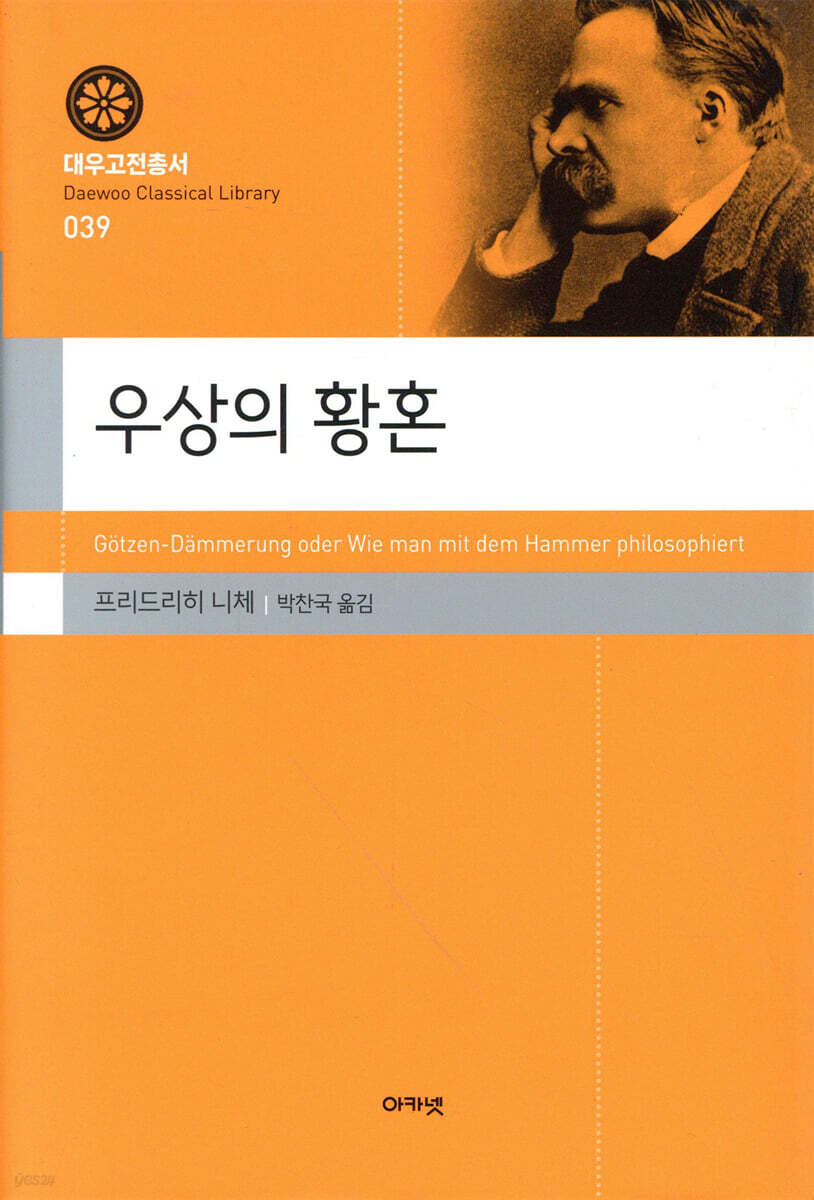
Twilight of the Idol
 |
Description
Book Introduction
Along with "The Antichrist," Nietzsche's book most fiercely reassesses all values.
"The Twilight of the Idols," subtitled "Or How to Philosophy with a Hammer," is one of Nietzsche's later works, written a year before he went mad in 1888. Together with "The Antichrist," also written in 1888, it contains the ideas Nietzsche reached in his later years.
As the title of this book suggests, Nietzsche is here announcing that the idols that Westerners have worshipped are nearing their twilight, and he is trying to hasten this twilight by smashing them with a 'sledgehammer'.... The reason Nietzsche wants to destroy idols is because they have a decadent nature.
In other words, while they are blindly worshipped by people, they are actually making people's lives sick and weakening their vitality.
Nietzsche also calls this work of destroying idols ‘a reevaluation of all values.’
It is a task of re-evaluating traditional values such as goodness, happiness, and God, and redefining them.
"The Twilight of the Idols," subtitled "Or How to Philosophy with a Hammer," is one of Nietzsche's later works, written a year before he went mad in 1888. Together with "The Antichrist," also written in 1888, it contains the ideas Nietzsche reached in his later years.
As the title of this book suggests, Nietzsche is here announcing that the idols that Westerners have worshipped are nearing their twilight, and he is trying to hasten this twilight by smashing them with a 'sledgehammer'.... The reason Nietzsche wants to destroy idols is because they have a decadent nature.
In other words, while they are blindly worshipped by people, they are actually making people's lives sick and weakening their vitality.
Nietzsche also calls this work of destroying idols ‘a reevaluation of all values.’
It is a task of re-evaluating traditional values such as goodness, happiness, and God, and redefining them.
index
Author's Preface | 9
Proverbs and Arrows | 11
Socrates' Problem | 27
Reason in Philosophy | 40
How the "True World" Finally Became a Fable - A History of Error | 50
Morality as Anti-Nature | 54
Four Big Mistakes | 63
Those Who 'Improve' Humanity | 78
What Germans Lack | 85
The Wanderings of an Untimely Man | 97
What I Owe to the Old Ones | 166
Hammer says:
| 177
Release | 179
Search | 239
Proverbs and Arrows | 11
Socrates' Problem | 27
Reason in Philosophy | 40
How the "True World" Finally Became a Fable - A History of Error | 50
Morality as Anti-Nature | 54
Four Big Mistakes | 63
Those Who 'Improve' Humanity | 78
What Germans Lack | 85
The Wanderings of an Untimely Man | 97
What I Owe to the Old Ones | 166
Hammer says:
| 177
Release | 179
Search | 239
Publisher's Review
1.
Socrates' problem
Nietzsche begins 『Twilight of the Idols』 with a critique of Socrates.
In "Twilight of Idols," Nietzsche destroys Western metaphysics and religion by viewing them as idols.
Therefore, it can be seen as natural that Nietzsche begins this destruction of icons with a critique of Socrates.
Because Socrates is the person who laid the cornerstone of Western traditional metaphysics.
In this sense, Nietzsche's critique of Socrates can be said to be a critique not of Socrates as an individual, but of the entire Western traditional metaphysics defined by Socrates' thought.
2.
Reason in Philosophy
Here, Nietzsche is criticizing rationalism, which has dominated Western philosophy.
This rationalism ignores and suppresses the senses, instincts, and passions.
This rationalism believes that what is created and changed is merely virtual, and that only what exists eternally and unchanging is real.
According to Nietzsche, the dualistic worldview that originated from Socrates and Plato was formed on the basis of this rationalistic logic.
In Plato's philosophy, the world of ideas is a true and perfect world that can only be grasped by reason.
To enter this world of ideas, we must break free from the senses and body that belong to the phenomenal world and realize pure reason and spirit.
3.
How the 'True World' Finally Became a Fable: A History of Error
In this chapter, Nietzsche describes the process in which the supersensible world that traditional metaphysics aimed for gradually loses its credibility and becomes a mere allegory, while the inner sensible world that had been ignored by metaphysics is recovering its original profound meaning.
Nietzsche believes that the history of metaphysics, which establishes the supersensible world as reality, began with Plato.
Elsewhere, Nietzsche viewed Platonic, Christian, and Kantian dualisms as essentially the same, without clearly revealing the nuanced differences between them.
However, this chapter explores the differences between them quite delicately.
4.
Morality as something against nature
Nietzsche is often known as a philosopher who ignores reason and values passion.
But even Nietzsche acknowledges that we can be blinded by passion and cause irreparable harm.
Therefore, Nietzsche does not argue that we should give ourselves over to passion, but rather advocates the spiritualization of passion.
But traditional morality, focusing only on the folly of passion, fought against it and tried to kill it.
Nietzsche viewed traditional morality, which sought to eliminate passion itself, as a moral monster (Moral-Unthiere).
5.
Four Big Mistakes
Nietzsche is often understood as a philosopher who denied causality.
Indeed, Nietzsche's ideas, which view the essence of reality as a creative process of creation, and the law of causality seem incompatible.
However, it seems unlikely that Nietzsche denied the law of causality itself.
Nietzsche himself constantly uses causality when developing his ideas.
For example, he argues that the reason Western metaphysics fell into dualism was because Westerners' will to power was weak, and he argues based on the law of causality.
The causality that Nietzsche criticizes is a specific form of causality, namely, a causality that regards causes as free and independent entities.
Therefore, rather than denying causality itself, Nietzsche is only denying a specific metaphysical theory of causality.
In “The Four Great Errors,” Nietzsche discusses common mistakes made regarding causality.
We are reviewing four errors.
6.
Those who improve humanity
Nietzsche begins the chapter "The Improvers of Mankind" with the famous statement that "there are no moral facts, only moral interpretations of particular phenomena."
In this case, Nietzsche refers to the 'unnatural morality' we examined above by the word 'morality'.
People believe that these anti-natural morals exist as self-evident truths, but I see them as nothing more than an interpretation of human behavior.
And these interpretations are only signs of the interpreter's physiological state.
Morality is merely a symbolic language.
Unnatural morality is an extreme measure taken by a weak person who cannot freely control his instincts and desires.
The weak fear the instincts and desires they cannot control, and they condemn them as evil and try to eradicate them.
7.
What Germans lack
In this chapter, Nietzsche sharply criticizes the reality of the new German Empire established with the unification of Germany.
Germany's military might may have been strengthened, but its spirit was declining.
Of course, Nietzsche acknowledges that Germany, more than any other European nation, possesses masculine virtues such as 'strong courage and self-respect, trustworthiness, industry, patience, moderation, submission without feeling humiliated, and not despising one's enemies'.
However, Nietzsche believed that as Germany's national power grew stronger, delicate tastes and noble instincts were disappearing day by day.
The German people, once called a nation of poets and thinkers, have exhausted all the seriousness they need for truly spiritual things in politics.
8.
The wanderings of an anachronistic man
In this chapter, Nietzsche criticizes the idols that appear in contemporary philosophy, art, politics, and culture.
As such idols, Nietzsche cites various figures such as Rousseau, Kant, Schiller, Hugo, and the Concours brothers, as well as the various artistic movements and political ideologies they represent.
In this part, Nietzsche is talking about these idols
In addition to the work of destroying the fields, we are also working to create new values by establishing new concepts of art and genius.
Socrates' problem
Nietzsche begins 『Twilight of the Idols』 with a critique of Socrates.
In "Twilight of Idols," Nietzsche destroys Western metaphysics and religion by viewing them as idols.
Therefore, it can be seen as natural that Nietzsche begins this destruction of icons with a critique of Socrates.
Because Socrates is the person who laid the cornerstone of Western traditional metaphysics.
In this sense, Nietzsche's critique of Socrates can be said to be a critique not of Socrates as an individual, but of the entire Western traditional metaphysics defined by Socrates' thought.
2.
Reason in Philosophy
Here, Nietzsche is criticizing rationalism, which has dominated Western philosophy.
This rationalism ignores and suppresses the senses, instincts, and passions.
This rationalism believes that what is created and changed is merely virtual, and that only what exists eternally and unchanging is real.
According to Nietzsche, the dualistic worldview that originated from Socrates and Plato was formed on the basis of this rationalistic logic.
In Plato's philosophy, the world of ideas is a true and perfect world that can only be grasped by reason.
To enter this world of ideas, we must break free from the senses and body that belong to the phenomenal world and realize pure reason and spirit.
3.
How the 'True World' Finally Became a Fable: A History of Error
In this chapter, Nietzsche describes the process in which the supersensible world that traditional metaphysics aimed for gradually loses its credibility and becomes a mere allegory, while the inner sensible world that had been ignored by metaphysics is recovering its original profound meaning.
Nietzsche believes that the history of metaphysics, which establishes the supersensible world as reality, began with Plato.
Elsewhere, Nietzsche viewed Platonic, Christian, and Kantian dualisms as essentially the same, without clearly revealing the nuanced differences between them.
However, this chapter explores the differences between them quite delicately.
4.
Morality as something against nature
Nietzsche is often known as a philosopher who ignores reason and values passion.
But even Nietzsche acknowledges that we can be blinded by passion and cause irreparable harm.
Therefore, Nietzsche does not argue that we should give ourselves over to passion, but rather advocates the spiritualization of passion.
But traditional morality, focusing only on the folly of passion, fought against it and tried to kill it.
Nietzsche viewed traditional morality, which sought to eliminate passion itself, as a moral monster (Moral-Unthiere).
5.
Four Big Mistakes
Nietzsche is often understood as a philosopher who denied causality.
Indeed, Nietzsche's ideas, which view the essence of reality as a creative process of creation, and the law of causality seem incompatible.
However, it seems unlikely that Nietzsche denied the law of causality itself.
Nietzsche himself constantly uses causality when developing his ideas.
For example, he argues that the reason Western metaphysics fell into dualism was because Westerners' will to power was weak, and he argues based on the law of causality.
The causality that Nietzsche criticizes is a specific form of causality, namely, a causality that regards causes as free and independent entities.
Therefore, rather than denying causality itself, Nietzsche is only denying a specific metaphysical theory of causality.
In “The Four Great Errors,” Nietzsche discusses common mistakes made regarding causality.
We are reviewing four errors.
6.
Those who improve humanity
Nietzsche begins the chapter "The Improvers of Mankind" with the famous statement that "there are no moral facts, only moral interpretations of particular phenomena."
In this case, Nietzsche refers to the 'unnatural morality' we examined above by the word 'morality'.
People believe that these anti-natural morals exist as self-evident truths, but I see them as nothing more than an interpretation of human behavior.
And these interpretations are only signs of the interpreter's physiological state.
Morality is merely a symbolic language.
Unnatural morality is an extreme measure taken by a weak person who cannot freely control his instincts and desires.
The weak fear the instincts and desires they cannot control, and they condemn them as evil and try to eradicate them.
7.
What Germans lack
In this chapter, Nietzsche sharply criticizes the reality of the new German Empire established with the unification of Germany.
Germany's military might may have been strengthened, but its spirit was declining.
Of course, Nietzsche acknowledges that Germany, more than any other European nation, possesses masculine virtues such as 'strong courage and self-respect, trustworthiness, industry, patience, moderation, submission without feeling humiliated, and not despising one's enemies'.
However, Nietzsche believed that as Germany's national power grew stronger, delicate tastes and noble instincts were disappearing day by day.
The German people, once called a nation of poets and thinkers, have exhausted all the seriousness they need for truly spiritual things in politics.
8.
The wanderings of an anachronistic man
In this chapter, Nietzsche criticizes the idols that appear in contemporary philosophy, art, politics, and culture.
As such idols, Nietzsche cites various figures such as Rousseau, Kant, Schiller, Hugo, and the Concours brothers, as well as the various artistic movements and political ideologies they represent.
In this part, Nietzsche is talking about these idols
In addition to the work of destroying the fields, we are also working to create new values by establishing new concepts of art and genius.
GOODS SPECIFICS
- Date of issue: August 3, 2015
- Format: Hardcover book binding method guide
- Page count, weight, size: 244 pages | 128*188*20mm
- ISBN13: 9788957334515
- ISBN10: 8957334513
You may also like
카테고리
korean


korean

![GQ KOREA Mark (Monthly): December [2025]](http://librairie.coreenne.fr/cdn/shop/files/8ef265dbbfbf186523ed75ba7319009d.jpg?v=1765340328&width=3840)


