

Organizing Brain
 |
Description
Book Introduction
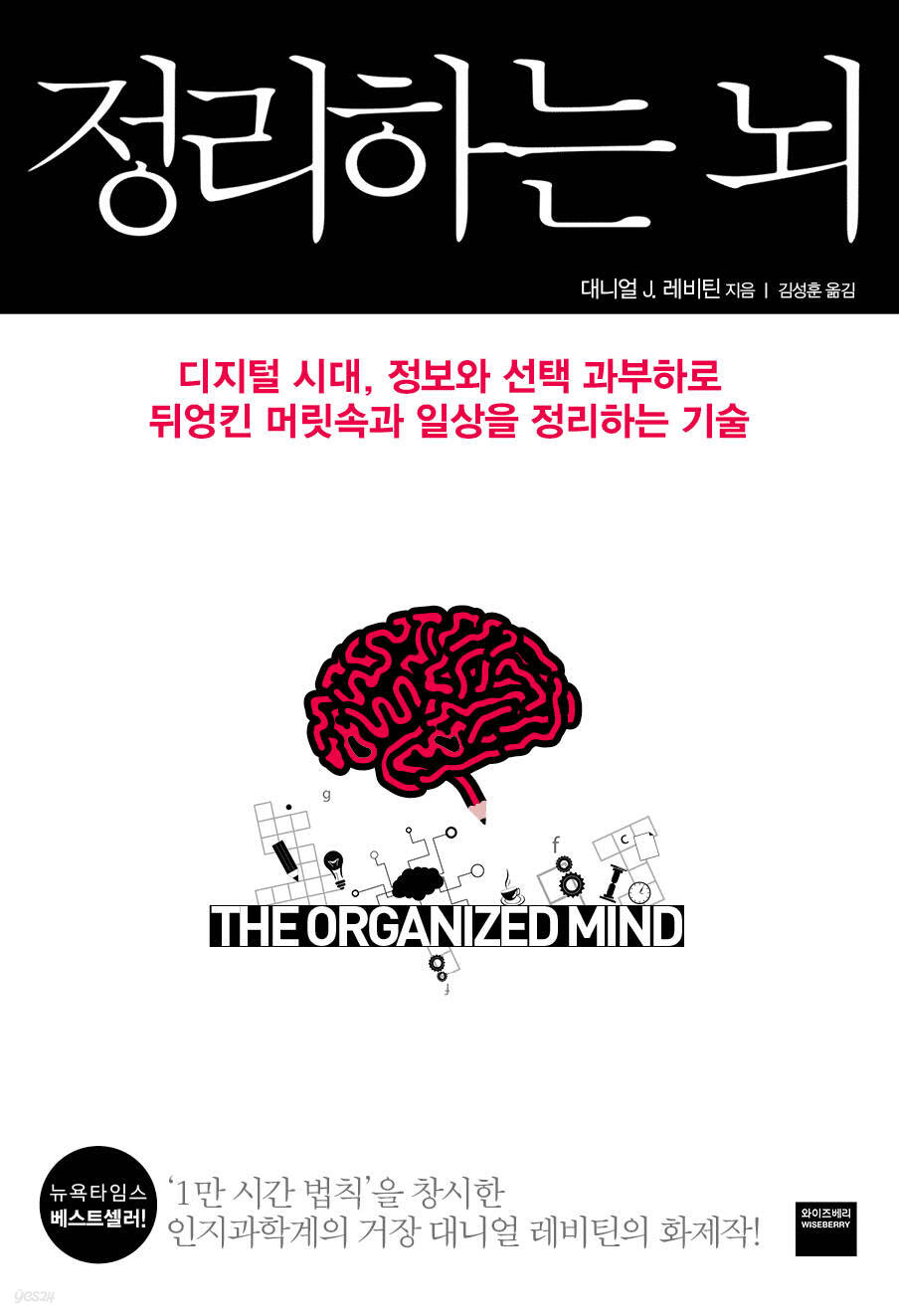
In an age of information overload and over-choice, can we find our bearings on our thoughts and lives? The latest research in cognitive psychology and brain science reveals how to organize information, thoughts, and life. We once believed that as society became computerized, computers would handle all the repetitive and monotonous tasks, leaving humans free to pursue nobler pursuits and secure more leisure time. But the prediction was wrong. Our brains have become more and more hectic. According to research, Americans processed five times more information per day in 2011 than they did in 1981, equivalent to 175 newspapers. The quality of information has not improved as much as its accessibility. “We are being bombarded with facts, lies, nonsense, rumors, and all sorts of things that are presented as information.” The workload has also increased tremendously. Just 30 years ago, travel agencies would take care of all our flight and train reservations, and store clerks would help us find our items, but now we have to do most of these things ourselves. As we enter the digital age, there has been a rapid increase in "shadow work," where we do the work that experts or companies in the field used to provide as an additional service, and our expected leisure time has actually decreased. The number of items and options has exploded. In 1976, when shopping at the supermarket, you had to choose between 9,000 different products; now you have to choose between 40,000 different products. Our brains are highly developed, but because they evolved to accommodate the prehistoric hunter-gatherer lifestyle that occupied most of human history, the information, material, and decision-making overload of our time is bound to be overwhelming. Cognitive overload symptoms result in our minds and our surroundings becoming distracted. Clutter piles up in our homes and offices, we forget where we put important items, we're blinded by misinformation, and we make mistakes and errors in important decisions. Professor Daniel Levitin of McGill University, a neuroscientist and cognitive psychologist, has stepped forward to identify and address the problem of cognitive overload in the information age. Professor Levitin is the person who scientifically explained the '10,000-hour rule' that became a worldwide topic of conversation after being mentioned in Malcolm Gladwell's book 'Outliers', and is famous for his books on brain science, such as 'Brain Waltz', which was number one on the New York Times bestseller list for 15 weeks. He emphasizes that in an age of cognitive overload, the key to organizing information, thoughts, and the surrounding environment and making efficient decisions is understanding how the brain works and developing the habit of organizing accordingly. And based on the latest research in various fields such as neuroscience, cognitive psychology, and behavioral economics, it suggests a method to systematically organize your home, business, time, society, and interpersonal relationships, starting from your mind. This book covers the A to Z of organization in the digital age, including how to systematically organize everything in our daily lives so that we don't lose them, from personal items like car keys and documents to digital information like online site IDs and passwords, how to organize our time and relationships more creatively and productively, how to organize business tasks and organizational structures more efficiently, and how to think systematically about information and situations for better judgment and choice. |
- You can preview some of the book's contents.
Preview
index
Introduction_Information and Honest Organization
Part 1
01 Information overload, too many decisions to make: The inside story of cognitive overload
Information Overload, Past and Present
Mental categorization in prehistoric times
The outstanding categorization ability of successful people
02 The first thing to understand: How attention and memory work
The Neurochemical Principles of Attention
Where do memories come from?
Why categorization is important
Offload the burden on your brain to your surroundings.
Part 2
03 Organizing the House: Organizing starts at home.
From junk drawer to filing cabinet, from filing cabinet to junk drawer
Organizing Digital Information at Home
A house organized just the way I want it
04 Sorting Out the Social World: How Are People Connected Today?
Modern social relations are too complex to be organized
Why do people beat around the bush?
What influences social judgment?
When you want to escape the social world
05 Hour Summary: What is the Mystery?
The biological nature of time
Conquering a seesaw-like event
Sleep time and memory organization
The habit of procrastinating
Make time for creativity
For the time of your life
06 Organizing Information for Difficult Decisions: Moments When Life is at Risk
Why You Need to Understand Probability
No, it just came back positive!
Either way, there is risk involved
What doctors offer
Alternative Medicine: Violation of the Principle of Informed Consent
Your way of thinking and acting
Medicine, Mathematics, and Meaningful Choices
07 Business World Summary: How to Create Value
Hierarchical organization and decision-making
Who should take on what responsibility?
Organizing documents for productivity and efficiency
From multitasking to planning for failure
Part 3
08 What to Teach Children: The Future of Organized Minds
Information literacy
Can you guess it roughly as "about that much"?
“What else can you do with a pencil besides writing?”
Things to check about where to get information
09 Organizing Everything Else: The Power of the Junk Drawer
Appendix: Creating Your Own Quadrant
Comments on comments
main
Search
Part 1
01 Information overload, too many decisions to make: The inside story of cognitive overload
Information Overload, Past and Present
Mental categorization in prehistoric times
The outstanding categorization ability of successful people
02 The first thing to understand: How attention and memory work
The Neurochemical Principles of Attention
Where do memories come from?
Why categorization is important
Offload the burden on your brain to your surroundings.
Part 2
03 Organizing the House: Organizing starts at home.
From junk drawer to filing cabinet, from filing cabinet to junk drawer
Organizing Digital Information at Home
A house organized just the way I want it
04 Sorting Out the Social World: How Are People Connected Today?
Modern social relations are too complex to be organized
Why do people beat around the bush?
What influences social judgment?
When you want to escape the social world
05 Hour Summary: What is the Mystery?
The biological nature of time
Conquering a seesaw-like event
Sleep time and memory organization
The habit of procrastinating
Make time for creativity
For the time of your life
06 Organizing Information for Difficult Decisions: Moments When Life is at Risk
Why You Need to Understand Probability
No, it just came back positive!
Either way, there is risk involved
What doctors offer
Alternative Medicine: Violation of the Principle of Informed Consent
Your way of thinking and acting
Medicine, Mathematics, and Meaningful Choices
07 Business World Summary: How to Create Value
Hierarchical organization and decision-making
Who should take on what responsibility?
Organizing documents for productivity and efficiency
From multitasking to planning for failure
Part 3
08 What to Teach Children: The Future of Organized Minds
Information literacy
Can you guess it roughly as "about that much"?
“What else can you do with a pencil besides writing?”
Things to check about where to get information
09 Organizing Everything Else: The Power of the Junk Drawer
Appendix: Creating Your Own Quadrant
Comments on comments
main
Search
Into the book
A recent study found that when people were asked to make a series of meaningless decisions, such as whether to write with a ballpoint pen or a felt-tip pen, their impulse control and judgment were impaired in subsequent decisions.
It appears that our brains are wired to only be able to make a certain number of decisions per day, and once that limit is reached, we are no longer able to make any more decisions, regardless of their importance.
One of the most useful recent discoveries in neuroscience is this:
“The neural networks in our brain that make decisions don’t prioritize which decision takes precedence.” --- p.32
A globalized economy means we are exposed to vast amounts of information that our grandparents were unaware of.
We hear news of revolutions or economic problems occurring in countries halfway around the world as soon as they happen.
We see images of places we've never been and hear languages we've never heard.
Then our brain sucks all this up as if it were starving.
Because it was designed that way from the beginning.
But this requires a resource called attention, and that resource is limited.
--- p.51
The most important principle that keeps us from forgetting things or losing things is to shift the burden of 'organization' from our brain to the outside world.
If we can offload some or all of the organizing process from the brain to the physical world, we will be less likely to make mistakes.
This is not because the brain's capacity is limited.
This is because of the brain's ability to store and retrieve memories.
Memory processes are easily distracted and confused when similar items are present.
--- p.72
Memory is imperfect.
Because the instructions for which neurons to engage and how to excite them are weakened and degraded, the representation often ends up being blurred and inaccurately replicates actual experience.
Memory is fiction.
Although we pretend it is true, memories are extremely susceptible to distortion.
Memory is not just ‘replay’ but ‘rewriting’.
There is a fact that adds to the difficulty here.
Many of our experiences share similarities, so our brains can be tricked into thinking that several items are competing with each other when replaying those experiences in memory.
So most of our memories are of poor quality.
This is due to the nature of memory retrieval rather than the brain's limited information storage capacity.
Searching can easily become distracted and confusing due to other similar items.
--- p.93
People who reach the top of their fields, especially those known for their creativity and efficiency, make the most of attention and memory systems outside the brain.
Among them, there are surprisingly many people who boldly utilize low-level technologies to manage everything thoroughly.
People working in high-tech fields are no exception.
… … Among these people, there were many who always carried a pen and notepad or card and wrote notes by hand, claiming that this method was much more efficient and satisfying than using the electronic devices that are so common these days.
--- p.115
Efficiency expert David Allen found that writing down everything on his mind in a big list helped him relax and focus better on his work.
This observation has a neurological basis.
When you have something important in mind, especially something you absolutely must do, your brain starts to repeat it over and over again out of fear of forgetting it.
Cognitive psychologists call the place where this happens the "replay loop."
… … Putting this into writing gives you implicit and explicit permission to put it down in the loop of repetition.
Then, as that neural circuit relaxes, we can focus on something else.
--- p.116~117
Having a box or shelf for your smartphone can help you motivate yourself to always keep it in a certain place.
The same goes for other electronic devices and newspapers.
… … These products function as behavioral guides that help you keep difficult-to-organize items in their proper places.
Cognitive psychology theory tells us to spend as much money as we can on these items.
After spending a lot of money on boxes to store your belongings, it becomes difficult to keep your letters and other things from getting scattered around.
You can achieve similar functionality without necessarily having to buy something new.
If you have books, CDs, DVDs, and the like organized well and want to remember where to put something you just took out of a bookshelf or record drawer, move the item immediately to the left of the one you just took out forward by about 2cm.
It can be a simple and great incentive to get things back.
--- p.138
Stanford University neuroscientist Russ Poldrock has found that when you learn new information while multitasking, the information goes to the wrong part of the brain.
For example, if students are allowed to study and watch TV at the same time, the information they gain from their schoolwork will be transferred to the striatum.
This is a brain region specialized for storing new processes and skills, not facts and concepts. If the TV hadn't distracted you, the information would have gone to the hippocampus.
--- p.156
The biggest obstacle to resolving medical errors is that instead of letting doctors explain why mistakes occurred, people try to find out what doctors were thinking through litigation.
When we understand the constraints doctors have to follow, the difficulties they face, and the human elements, we are more likely to understand and forgive their position.
--- p.207
Dozens of experiments have shown that initially unaware knowledge of something's error can influence judgment long after it is known to be incorrect.
It is impossible to press the reset button.
Lawyers are well aware of this fact and often plant the seeds of false ideas in the minds of jurors and judges.
After the opposing counsel raises an objection, the judge warns, "The jury is advised to disregard closing arguments," but it is too late to influence the impressions and judgments already established.
--- p.228
Graduate students tend to suffer from this perfectionism.
This happens because you compare yourself to your advisor and compare your draft of your thesis with your advisor's finished thesis.
Of course, this is an unfair comparison.
The advisor has far more experience, and he or she may have had his or her share of setbacks, rejections, and poor drafts, but these aspects are invisible to the graduate student.
All a graduate student sees is his or her advisor's completed thesis and the gap between it and his or her own.
This is a classic example of failing to appreciate the power of the situation itself and mistaking it all for a fixed characteristic.
--- p.297
Even if plane crashes occur independently, the idea that it is now time for a safe flight because the accident just happened is a gambler's fallacy (a logical error that arises from the illusion that independently occurring probabilistic events affect each other's probabilities? Translator's note)
The god of probability doesn't wait a million flights to count down until the next crash.
They don't even care if the next crash is evenly distributed among the remaining aircraft.
Therefore, the probability of an airline experiencing two consecutive crashes cannot be considered independent.
--- p.334
If you look at the companies that are winning the productivity war, they usually provide their employees with productivity time, nap time, exercise time, and a calm, quiet, and orderly environment in which to work.
It's difficult to develop deep insight in a stressful environment where you're constantly being pressured to do more.
It appears that our brains are wired to only be able to make a certain number of decisions per day, and once that limit is reached, we are no longer able to make any more decisions, regardless of their importance.
One of the most useful recent discoveries in neuroscience is this:
“The neural networks in our brain that make decisions don’t prioritize which decision takes precedence.” --- p.32
A globalized economy means we are exposed to vast amounts of information that our grandparents were unaware of.
We hear news of revolutions or economic problems occurring in countries halfway around the world as soon as they happen.
We see images of places we've never been and hear languages we've never heard.
Then our brain sucks all this up as if it were starving.
Because it was designed that way from the beginning.
But this requires a resource called attention, and that resource is limited.
--- p.51
The most important principle that keeps us from forgetting things or losing things is to shift the burden of 'organization' from our brain to the outside world.
If we can offload some or all of the organizing process from the brain to the physical world, we will be less likely to make mistakes.
This is not because the brain's capacity is limited.
This is because of the brain's ability to store and retrieve memories.
Memory processes are easily distracted and confused when similar items are present.
--- p.72
Memory is imperfect.
Because the instructions for which neurons to engage and how to excite them are weakened and degraded, the representation often ends up being blurred and inaccurately replicates actual experience.
Memory is fiction.
Although we pretend it is true, memories are extremely susceptible to distortion.
Memory is not just ‘replay’ but ‘rewriting’.
There is a fact that adds to the difficulty here.
Many of our experiences share similarities, so our brains can be tricked into thinking that several items are competing with each other when replaying those experiences in memory.
So most of our memories are of poor quality.
This is due to the nature of memory retrieval rather than the brain's limited information storage capacity.
Searching can easily become distracted and confusing due to other similar items.
--- p.93
People who reach the top of their fields, especially those known for their creativity and efficiency, make the most of attention and memory systems outside the brain.
Among them, there are surprisingly many people who boldly utilize low-level technologies to manage everything thoroughly.
People working in high-tech fields are no exception.
… … Among these people, there were many who always carried a pen and notepad or card and wrote notes by hand, claiming that this method was much more efficient and satisfying than using the electronic devices that are so common these days.
--- p.115
Efficiency expert David Allen found that writing down everything on his mind in a big list helped him relax and focus better on his work.
This observation has a neurological basis.
When you have something important in mind, especially something you absolutely must do, your brain starts to repeat it over and over again out of fear of forgetting it.
Cognitive psychologists call the place where this happens the "replay loop."
… … Putting this into writing gives you implicit and explicit permission to put it down in the loop of repetition.
Then, as that neural circuit relaxes, we can focus on something else.
--- p.116~117
Having a box or shelf for your smartphone can help you motivate yourself to always keep it in a certain place.
The same goes for other electronic devices and newspapers.
… … These products function as behavioral guides that help you keep difficult-to-organize items in their proper places.
Cognitive psychology theory tells us to spend as much money as we can on these items.
After spending a lot of money on boxes to store your belongings, it becomes difficult to keep your letters and other things from getting scattered around.
You can achieve similar functionality without necessarily having to buy something new.
If you have books, CDs, DVDs, and the like organized well and want to remember where to put something you just took out of a bookshelf or record drawer, move the item immediately to the left of the one you just took out forward by about 2cm.
It can be a simple and great incentive to get things back.
--- p.138
Stanford University neuroscientist Russ Poldrock has found that when you learn new information while multitasking, the information goes to the wrong part of the brain.
For example, if students are allowed to study and watch TV at the same time, the information they gain from their schoolwork will be transferred to the striatum.
This is a brain region specialized for storing new processes and skills, not facts and concepts. If the TV hadn't distracted you, the information would have gone to the hippocampus.
--- p.156
The biggest obstacle to resolving medical errors is that instead of letting doctors explain why mistakes occurred, people try to find out what doctors were thinking through litigation.
When we understand the constraints doctors have to follow, the difficulties they face, and the human elements, we are more likely to understand and forgive their position.
--- p.207
Dozens of experiments have shown that initially unaware knowledge of something's error can influence judgment long after it is known to be incorrect.
It is impossible to press the reset button.
Lawyers are well aware of this fact and often plant the seeds of false ideas in the minds of jurors and judges.
After the opposing counsel raises an objection, the judge warns, "The jury is advised to disregard closing arguments," but it is too late to influence the impressions and judgments already established.
--- p.228
Graduate students tend to suffer from this perfectionism.
This happens because you compare yourself to your advisor and compare your draft of your thesis with your advisor's finished thesis.
Of course, this is an unfair comparison.
The advisor has far more experience, and he or she may have had his or her share of setbacks, rejections, and poor drafts, but these aspects are invisible to the graduate student.
All a graduate student sees is his or her advisor's completed thesis and the gap between it and his or her own.
This is a classic example of failing to appreciate the power of the situation itself and mistaking it all for a fixed characteristic.
--- p.297
Even if plane crashes occur independently, the idea that it is now time for a safe flight because the accident just happened is a gambler's fallacy (a logical error that arises from the illusion that independently occurring probabilistic events affect each other's probabilities? Translator's note)
The god of probability doesn't wait a million flights to count down until the next crash.
They don't even care if the next crash is evenly distributed among the remaining aircraft.
Therefore, the probability of an airline experiencing two consecutive crashes cannot be considered independent.
--- p.334
If you look at the companies that are winning the productivity war, they usually provide their employees with productivity time, nap time, exercise time, and a calm, quiet, and orderly environment in which to work.
It's difficult to develop deep insight in a stressful environment where you're constantly being pressured to do more.
--- p.446
Publisher's Review
In an age of information overload and over-choice, can we find our bearings on our thoughts and lives?
The latest research in cognitive psychology and brain science reveals how to organize information, thoughts, and life.
We once believed that as society became computerized, computers would handle all the repetitive and monotonous tasks, leaving humans free to pursue nobler pursuits and secure more leisure time.
But the prediction was wrong.
Our brains have become more and more hectic.
According to research, Americans processed five times more information per day in 2011 than they did in 1981, equivalent to 175 newspapers.
The quality of information has not improved as much as its accessibility.
“We are being bombarded with facts, lies, nonsense, rumors, and all sorts of things that are presented as information.” The workload has also increased tremendously.
Just 30 years ago, travel agencies would take care of all our flight and train reservations, and store clerks would help us find our items, but now we have to do most of these things ourselves.
As we enter the digital age, there has been a rapid increase in "shadow work," where we do the work that experts or companies in the field used to provide as an additional service, and our expected leisure time has actually decreased.
The number of items and options has exploded.
In 1976, when shopping at the supermarket, you had to choose between 9,000 different products; now you have to choose between 40,000 different products.
Our brains are highly developed, but because they evolved to accommodate the prehistoric hunter-gatherer lifestyle that occupied most of human history, the information, material, and decision-making overload of our time is bound to be overwhelming.
Cognitive overload symptoms result in our minds and our surroundings becoming distracted.
Clutter piles up in our homes and offices, we forget where we put important items, we're blinded by misinformation, and we make mistakes and errors in important decisions.
Professor Daniel Levitin of McGill University, a neuroscientist and cognitive psychologist, has stepped forward to identify and address the problem of cognitive overload in the information age.
Professor Levitin is the person who scientifically explained the '10,000-hour rule' that became a worldwide topic of conversation after being mentioned in Malcolm Gladwell's book 'Outliers', and is famous for his books on brain science, such as 'Brain Waltz', which was number one on the New York Times bestseller list for 15 weeks.
He emphasizes that in an age of cognitive overload, the key to organizing information, thoughts, and the surrounding environment and making efficient decisions is understanding how the brain works and developing the habit of organizing accordingly.
And based on the latest research in various fields such as neuroscience, cognitive psychology, and behavioral economics, it suggests a method to systematically organize your home, business, time, society, and interpersonal relationships, starting from your mind.
This book covers the A to Z of organization in the digital age, including how to systematically organize everything in our daily lives so that we don't lose them, from personal items like car keys and documents to digital information like online site IDs and passwords, how to organize our time and relationships more creatively and productively, how to organize business tasks and organizational structures more efficiently, and how to think systematically about information and situations for better judgment and choice.
Transfer the burden of your brain, which is suffering from information bombardment, to the outside world!
How to organize your mind and daily life to fit your brain's way of working
In the information age, where all kinds of information compete in our brains for our attention, the most important ability is 'attention', the ability to focus only on what is important.
To activate the attention system, millions of neurons in the prefrontal cortex of the brain constantly monitor the environment and perform the attention filter function of selecting the things we need to focus on and passing them to consciousness.
Professor Levitin points out that many of the cases where we lose our car keys or wallets or forget important appointments occur when this attention system is overloaded.
So how do executives, politicians, and artists successfully accomplish their tasks without falling into the trap of cognitive overload, despite handling enormous workloads and schedules and constantly encountering new information and people?
Professor Levitin has provided cognitive science management consulting to companies such as Sony, Apple, and the U.S. Navy, and has also worked as a record producer for world-renowned musicians such as Stevie Wonder and Sting.
Along the way, he witnesses successful people become completely absorbed in their work without losing focus, resulting in incredible creativity and productivity.
The key to this amazing focus is to offload the brain's attention filter function to the outside world.
In other words, you can have a secretary or assistant handle the tedious and trivial tasks for you, and use your time and attention solely for more valuable 'current tasks'.
Most ordinary people don't have that luxury, but Professor Levitin explains that they can apply similar methods and reap just as many benefits.
And this book advises on various organizing methods that use various external devices and electronic devices in daily life, or apply the results of brain science and cognitive psychology research to transfer the burden of an overloaded brain to an external source and improve memory and attention.
From how secretaries of CEOs of Fortune 500 companies manage their schedules and organize their files, to the idea recording and memory recall secrets used by executives of cutting-edge IT companies like Google and Facebook, to renowned psychologist B.
It is interesting to see how scientific information organization methods used by various people are presented, from F. Skinner's method of not forgetting to packing up one's belongings.
Professor Levitin says that multitasking is a natural behavior that we engage in when we are overwhelmed by information and cannot focus our attention.
The socio-cultural climate also encourages multitasking.
The biggest culprits that force us to multitask are email, text messages, and social media.
There are many organizations where employees constantly check emails and have to respond to their superiors' questions immediately even during work hours, and countless individuals scroll through Facebook to see what their friends are up to even while eating with friends.
But our brains aren't designed for this kind of multitasking.
“People think they are multitasking, but in reality they are just switching their attention very quickly from one task to another.”
Moreover, this shift in attention comes at a tremendous biological cost.
Rapid, continuous attention-switching can quickly "run out of fuel for the brain, leaving you exhausted and disoriented." Even the mere opportunity to multitask can negatively impact cognitive performance.
According to research by Glen Wilson of Gresham College, London, “trying to focus on a task and knowing that an unread email is sitting in your inbox lowers your effective IQ by 10 points.” Email, texting, and social media that force you to multitask are addictive to your brain.
Receiving a text message activates the brain's novelty center, so responding to it, no matter how trivial, gives the brain a sense of accomplishment and a rewarding dopamine rush.
Professor Levitin recommends setting "productivity time and space"—times when you can focus on work without interruption.
During that time, I recommend turning off your smartphone and email, setting aside a specific space where you can focus on your work, and working there.
If all of this is difficult, I recommend using an email filtering feature to check only emails from urgent and important business partners or people, and collecting the rest of the emails and checking them all at once later.
Also, as seen in the secrets of successful people's immersion, we introduce various daily strategies to avoid multitasking and recover attention, such as focusing with the mindset that 'what you are doing now is the most important thing you can do' and grouping small tasks that can be done within 5 minutes and doing them all at once.
In this book, the concept of organization is applied not only to objects and situations, but also to the social world and human relationships.
It's easy to think we have a pretty perfect grasp of the situations or people we encounter, but our brains, by their very nature, often make cognitive "illusions" about this.
For example, we are more tolerant of the group we belong to and recognize the diversity of each individual in the group, while we reject other groups as a kind of lump with a consistent character without considering the diversity of each individual.
These in-group/out-group effects involve neurological biases.
“In a region of the brain called the medial prefrontal cortex, there is a group of neurons that become excited when we think about ourselves or people who resemble us.” The author explains, from a cognitive psychological perspective, various situations in which the brain’s illusions lead to misprocessing of information about others and the world, and the formation of assumptions and prejudices. This helps readers draw out their potential and diversity in human relationships in the social world.
Deciphering Patterns and Meaning in the Big Data Era
Organizing techniques for everything from time management to decision-making about information flow
While most people seek ways to utilize and organize their waking hours, this book points out that sleep, which accounts for one-third of our lives, is the golden time needed for organizing, storing, and learning information, and encourages us to actively utilize this time.
“For a memory to solidify, the neural circuits that first encountered the new experience must be fine-tuned, and research shows that this happens while we sleep.
… … The fine-tuning, retrieval, and consolidation of memories do not occur overnight, but over several consecutive nights.” Therefore, if you have trouble sleeping for two or three days after an experience, you may have difficulty recalling that memory later.
Additionally, one night's sleep has been shown to more than double the likelihood of solving insightful problems and has been shown to enhance learning.
Musicians who learned a new melody improved significantly after sleeping on it overnight, and students solved calculus problems they couldn't solve the first day more easily after sleeping on it than if they had stayed awake for the same amount of time.
The key to effective time management is to combat distractions and maintain focus. To achieve this, he advises, “writing down everything that catches our attention, without missing a single one.”
This is a neuroscience-based idea that prevents thoughts about a particular project or situation from constantly replaying in your mind, while also preventing you from missing out on potentially useful ideas.
This is also a strategy to transfer the functions of the frontal lobe to the outside world, that is, the work of externalizing information.
Professor Levitin emphasizes that the attitude and ability to handle information, or “information literacy,” is now more important than the amount of knowledge, and that “the ability to estimate results and make decisions with incomplete information” is more important than simply getting the “right answer.”
It is precisely these information literacy and decision-making skills that we must teach our children.
“The Internet is like the Wild West, where you had to take care of yourself.
“It is up to each Internet user to protect themselves from the scammers, liars, and bogus salespeople of the digital age.” While publishers, editors, librarians, and academic journals used to be the censors of information, the proliferation of individual Internet editors with all sorts of agendas, and free academic journals that publish even unverified and bogus research, has made most of the censorship the responsibility of individuals.
This book uses a variety of scientific data, including psychology and statistics, to teach you how to objectively judge unverified information floating around the Internet, advertisements disguised as science or medicine, and news that cleverly utilizes statistics and data to present biased claims as fact.
It also introduces important decision-making methods in the information age and digital age.
One of them is 'guessing', which allows one to draw conclusions that are similar to the facts by making inferences based on insufficient information within a limited time. This book examines the reasoning process of guessing through questions such as 'Guess the weight of the Empire State Building', which was a question in Google's job interview.
There are times when we need to calculate the probability of an event occurring relatively accurately using more precise inference than guesswork.
This type of reasoning is absolutely necessary for issues involving numerous variables and risks, especially surgical decisions that may have serious side effects.
However, because doctors are not provided with education on how to think about these situations, both doctors and patients are struggling when faced with difficult medical decisions.
The author introduces thinking methods such as Bayesian inference to help people draw more accurate and objective conclusions based on probability and statistics, without being swayed by emotions or biases, regarding such important issues.
These ways of thinking are even more important in the era of big data because they foster the ability to break down randomly tangled masses of information into smaller pieces or to reassemble relationships between pieces of information to read patterns and meaning.
It also covers essential information management techniques for the digital age, from advice on the optimal amount of information to consider when making decisions as consumers or business managers to technical methods for safely backing up data in case electronic devices like computers break down or become outdated and incompatible with other devices.
Recommendation
Each page is packed with insights that no neuroscientist can match.
It's a smart, important, and well-written book.
-Daniel Gilbert, Professor of Psychology at Harvard University and author of Stumbling on Happiness
Daniel Levitin, our neuroscience's eloquent spokesman, writes fascinatingly about the brain in a familiar and accessible style.
-The late David Hubble, neuroscientist and Nobel Prize winner in Physiology or Medicine
This book neatly organizes neuroscience and cognitive psychology.
… … provides valuable insights into the world of family, society, time, decision-making, and business.
-Nadine Castle, President of the American Psychological Association and Professor and Vice Dean of the Emory University School of Medicine
It offers valuable advice on how to leverage the emerging world of big data and fosters a deeper understanding of the human mind.
-Mark Hurd, Oracle Co-CEO
It's a book brimming with wit and charm, and packed with scientific information.
Shows how principles of psychology and cognitive science can help us organize our daily lives.
-Gary Altman, professor of psychology at the University of Connecticut and author of The Talking Brain
From "How to avoid losing your keys" to "Medical choices like deciding whether surgery is worth the risk," it teaches you how to intelligently process the constant stream of information your brain must face.
-[Washington Post]
This book contains both broad and deep knowledge.
… … The book is rich in interesting facts and examples, making it a useful read from a variety of perspectives.
-The Wall Street Journal
With his signature clear prose and scientific insights, Daniel Levitin offers tips on how to declutter our mental closets.
-Joseph LeDoux, Professor, New York University Center for Neuroscience, author of Synapses and the Self
This book is a novel combination of neuroscience and self-development.
-〈Kirkus Review〉
The result of combining true knowledge and scholarship with common sense is a book truly worth reading, like "The Organizing Brain."
-George Shultz, former U.S. Secretary of State
An extraordinary work by one of the most talented writers of our time.
-The late Phil Ramone, album producer for Bob Dylan, Elton John, and Luciano Pavarotti
It's fascinating to read, as if a neuroscientist friend were telling us how creating a little order in our brains can free up so much creativity.
-Len Blum, screenwriter of The Pink Panther and Meatballs
The Organizing Brain is the perfect antidote to information overload.
—Scott Turow, New York Times bestselling author of Identical and Innocence
It can be considered a manual for my mind that will help me manage the fire hose of information and choices that pours out every day and direct me towards my goals.
-Alan Grayson, U.S. Representative
We present a series of ideas on how to organize your life and business using the latest information about the brain and how it works.
This is a must-read for anyone who aspires to become a competent person.
David Edelman, Dean of McGill University School of Medicine
The latest research in cognitive psychology and brain science reveals how to organize information, thoughts, and life.
We once believed that as society became computerized, computers would handle all the repetitive and monotonous tasks, leaving humans free to pursue nobler pursuits and secure more leisure time.
But the prediction was wrong.
Our brains have become more and more hectic.
According to research, Americans processed five times more information per day in 2011 than they did in 1981, equivalent to 175 newspapers.
The quality of information has not improved as much as its accessibility.
“We are being bombarded with facts, lies, nonsense, rumors, and all sorts of things that are presented as information.” The workload has also increased tremendously.
Just 30 years ago, travel agencies would take care of all our flight and train reservations, and store clerks would help us find our items, but now we have to do most of these things ourselves.
As we enter the digital age, there has been a rapid increase in "shadow work," where we do the work that experts or companies in the field used to provide as an additional service, and our expected leisure time has actually decreased.
The number of items and options has exploded.
In 1976, when shopping at the supermarket, you had to choose between 9,000 different products; now you have to choose between 40,000 different products.
Our brains are highly developed, but because they evolved to accommodate the prehistoric hunter-gatherer lifestyle that occupied most of human history, the information, material, and decision-making overload of our time is bound to be overwhelming.
Cognitive overload symptoms result in our minds and our surroundings becoming distracted.
Clutter piles up in our homes and offices, we forget where we put important items, we're blinded by misinformation, and we make mistakes and errors in important decisions.
Professor Daniel Levitin of McGill University, a neuroscientist and cognitive psychologist, has stepped forward to identify and address the problem of cognitive overload in the information age.
Professor Levitin is the person who scientifically explained the '10,000-hour rule' that became a worldwide topic of conversation after being mentioned in Malcolm Gladwell's book 'Outliers', and is famous for his books on brain science, such as 'Brain Waltz', which was number one on the New York Times bestseller list for 15 weeks.
He emphasizes that in an age of cognitive overload, the key to organizing information, thoughts, and the surrounding environment and making efficient decisions is understanding how the brain works and developing the habit of organizing accordingly.
And based on the latest research in various fields such as neuroscience, cognitive psychology, and behavioral economics, it suggests a method to systematically organize your home, business, time, society, and interpersonal relationships, starting from your mind.
This book covers the A to Z of organization in the digital age, including how to systematically organize everything in our daily lives so that we don't lose them, from personal items like car keys and documents to digital information like online site IDs and passwords, how to organize our time and relationships more creatively and productively, how to organize business tasks and organizational structures more efficiently, and how to think systematically about information and situations for better judgment and choice.
Transfer the burden of your brain, which is suffering from information bombardment, to the outside world!
How to organize your mind and daily life to fit your brain's way of working
In the information age, where all kinds of information compete in our brains for our attention, the most important ability is 'attention', the ability to focus only on what is important.
To activate the attention system, millions of neurons in the prefrontal cortex of the brain constantly monitor the environment and perform the attention filter function of selecting the things we need to focus on and passing them to consciousness.
Professor Levitin points out that many of the cases where we lose our car keys or wallets or forget important appointments occur when this attention system is overloaded.
So how do executives, politicians, and artists successfully accomplish their tasks without falling into the trap of cognitive overload, despite handling enormous workloads and schedules and constantly encountering new information and people?
Professor Levitin has provided cognitive science management consulting to companies such as Sony, Apple, and the U.S. Navy, and has also worked as a record producer for world-renowned musicians such as Stevie Wonder and Sting.
Along the way, he witnesses successful people become completely absorbed in their work without losing focus, resulting in incredible creativity and productivity.
The key to this amazing focus is to offload the brain's attention filter function to the outside world.
In other words, you can have a secretary or assistant handle the tedious and trivial tasks for you, and use your time and attention solely for more valuable 'current tasks'.
Most ordinary people don't have that luxury, but Professor Levitin explains that they can apply similar methods and reap just as many benefits.
And this book advises on various organizing methods that use various external devices and electronic devices in daily life, or apply the results of brain science and cognitive psychology research to transfer the burden of an overloaded brain to an external source and improve memory and attention.
From how secretaries of CEOs of Fortune 500 companies manage their schedules and organize their files, to the idea recording and memory recall secrets used by executives of cutting-edge IT companies like Google and Facebook, to renowned psychologist B.
It is interesting to see how scientific information organization methods used by various people are presented, from F. Skinner's method of not forgetting to packing up one's belongings.
Professor Levitin says that multitasking is a natural behavior that we engage in when we are overwhelmed by information and cannot focus our attention.
The socio-cultural climate also encourages multitasking.
The biggest culprits that force us to multitask are email, text messages, and social media.
There are many organizations where employees constantly check emails and have to respond to their superiors' questions immediately even during work hours, and countless individuals scroll through Facebook to see what their friends are up to even while eating with friends.
But our brains aren't designed for this kind of multitasking.
“People think they are multitasking, but in reality they are just switching their attention very quickly from one task to another.”
Moreover, this shift in attention comes at a tremendous biological cost.
Rapid, continuous attention-switching can quickly "run out of fuel for the brain, leaving you exhausted and disoriented." Even the mere opportunity to multitask can negatively impact cognitive performance.
According to research by Glen Wilson of Gresham College, London, “trying to focus on a task and knowing that an unread email is sitting in your inbox lowers your effective IQ by 10 points.” Email, texting, and social media that force you to multitask are addictive to your brain.
Receiving a text message activates the brain's novelty center, so responding to it, no matter how trivial, gives the brain a sense of accomplishment and a rewarding dopamine rush.
Professor Levitin recommends setting "productivity time and space"—times when you can focus on work without interruption.
During that time, I recommend turning off your smartphone and email, setting aside a specific space where you can focus on your work, and working there.
If all of this is difficult, I recommend using an email filtering feature to check only emails from urgent and important business partners or people, and collecting the rest of the emails and checking them all at once later.
Also, as seen in the secrets of successful people's immersion, we introduce various daily strategies to avoid multitasking and recover attention, such as focusing with the mindset that 'what you are doing now is the most important thing you can do' and grouping small tasks that can be done within 5 minutes and doing them all at once.
In this book, the concept of organization is applied not only to objects and situations, but also to the social world and human relationships.
It's easy to think we have a pretty perfect grasp of the situations or people we encounter, but our brains, by their very nature, often make cognitive "illusions" about this.
For example, we are more tolerant of the group we belong to and recognize the diversity of each individual in the group, while we reject other groups as a kind of lump with a consistent character without considering the diversity of each individual.
These in-group/out-group effects involve neurological biases.
“In a region of the brain called the medial prefrontal cortex, there is a group of neurons that become excited when we think about ourselves or people who resemble us.” The author explains, from a cognitive psychological perspective, various situations in which the brain’s illusions lead to misprocessing of information about others and the world, and the formation of assumptions and prejudices. This helps readers draw out their potential and diversity in human relationships in the social world.
Deciphering Patterns and Meaning in the Big Data Era
Organizing techniques for everything from time management to decision-making about information flow
While most people seek ways to utilize and organize their waking hours, this book points out that sleep, which accounts for one-third of our lives, is the golden time needed for organizing, storing, and learning information, and encourages us to actively utilize this time.
“For a memory to solidify, the neural circuits that first encountered the new experience must be fine-tuned, and research shows that this happens while we sleep.
… … The fine-tuning, retrieval, and consolidation of memories do not occur overnight, but over several consecutive nights.” Therefore, if you have trouble sleeping for two or three days after an experience, you may have difficulty recalling that memory later.
Additionally, one night's sleep has been shown to more than double the likelihood of solving insightful problems and has been shown to enhance learning.
Musicians who learned a new melody improved significantly after sleeping on it overnight, and students solved calculus problems they couldn't solve the first day more easily after sleeping on it than if they had stayed awake for the same amount of time.
The key to effective time management is to combat distractions and maintain focus. To achieve this, he advises, “writing down everything that catches our attention, without missing a single one.”
This is a neuroscience-based idea that prevents thoughts about a particular project or situation from constantly replaying in your mind, while also preventing you from missing out on potentially useful ideas.
This is also a strategy to transfer the functions of the frontal lobe to the outside world, that is, the work of externalizing information.
Professor Levitin emphasizes that the attitude and ability to handle information, or “information literacy,” is now more important than the amount of knowledge, and that “the ability to estimate results and make decisions with incomplete information” is more important than simply getting the “right answer.”
It is precisely these information literacy and decision-making skills that we must teach our children.
“The Internet is like the Wild West, where you had to take care of yourself.
“It is up to each Internet user to protect themselves from the scammers, liars, and bogus salespeople of the digital age.” While publishers, editors, librarians, and academic journals used to be the censors of information, the proliferation of individual Internet editors with all sorts of agendas, and free academic journals that publish even unverified and bogus research, has made most of the censorship the responsibility of individuals.
This book uses a variety of scientific data, including psychology and statistics, to teach you how to objectively judge unverified information floating around the Internet, advertisements disguised as science or medicine, and news that cleverly utilizes statistics and data to present biased claims as fact.
It also introduces important decision-making methods in the information age and digital age.
One of them is 'guessing', which allows one to draw conclusions that are similar to the facts by making inferences based on insufficient information within a limited time. This book examines the reasoning process of guessing through questions such as 'Guess the weight of the Empire State Building', which was a question in Google's job interview.
There are times when we need to calculate the probability of an event occurring relatively accurately using more precise inference than guesswork.
This type of reasoning is absolutely necessary for issues involving numerous variables and risks, especially surgical decisions that may have serious side effects.
However, because doctors are not provided with education on how to think about these situations, both doctors and patients are struggling when faced with difficult medical decisions.
The author introduces thinking methods such as Bayesian inference to help people draw more accurate and objective conclusions based on probability and statistics, without being swayed by emotions or biases, regarding such important issues.
These ways of thinking are even more important in the era of big data because they foster the ability to break down randomly tangled masses of information into smaller pieces or to reassemble relationships between pieces of information to read patterns and meaning.
It also covers essential information management techniques for the digital age, from advice on the optimal amount of information to consider when making decisions as consumers or business managers to technical methods for safely backing up data in case electronic devices like computers break down or become outdated and incompatible with other devices.
Recommendation
Each page is packed with insights that no neuroscientist can match.
It's a smart, important, and well-written book.
-Daniel Gilbert, Professor of Psychology at Harvard University and author of Stumbling on Happiness
Daniel Levitin, our neuroscience's eloquent spokesman, writes fascinatingly about the brain in a familiar and accessible style.
-The late David Hubble, neuroscientist and Nobel Prize winner in Physiology or Medicine
This book neatly organizes neuroscience and cognitive psychology.
… … provides valuable insights into the world of family, society, time, decision-making, and business.
-Nadine Castle, President of the American Psychological Association and Professor and Vice Dean of the Emory University School of Medicine
It offers valuable advice on how to leverage the emerging world of big data and fosters a deeper understanding of the human mind.
-Mark Hurd, Oracle Co-CEO
It's a book brimming with wit and charm, and packed with scientific information.
Shows how principles of psychology and cognitive science can help us organize our daily lives.
-Gary Altman, professor of psychology at the University of Connecticut and author of The Talking Brain
From "How to avoid losing your keys" to "Medical choices like deciding whether surgery is worth the risk," it teaches you how to intelligently process the constant stream of information your brain must face.
-[Washington Post]
This book contains both broad and deep knowledge.
… … The book is rich in interesting facts and examples, making it a useful read from a variety of perspectives.
-The Wall Street Journal
With his signature clear prose and scientific insights, Daniel Levitin offers tips on how to declutter our mental closets.
-Joseph LeDoux, Professor, New York University Center for Neuroscience, author of Synapses and the Self
This book is a novel combination of neuroscience and self-development.
-〈Kirkus Review〉
The result of combining true knowledge and scholarship with common sense is a book truly worth reading, like "The Organizing Brain."
-George Shultz, former U.S. Secretary of State
An extraordinary work by one of the most talented writers of our time.
-The late Phil Ramone, album producer for Bob Dylan, Elton John, and Luciano Pavarotti
It's fascinating to read, as if a neuroscientist friend were telling us how creating a little order in our brains can free up so much creativity.
-Len Blum, screenwriter of The Pink Panther and Meatballs
The Organizing Brain is the perfect antidote to information overload.
—Scott Turow, New York Times bestselling author of Identical and Innocence
It can be considered a manual for my mind that will help me manage the fire hose of information and choices that pours out every day and direct me towards my goals.
-Alan Grayson, U.S. Representative
We present a series of ideas on how to organize your life and business using the latest information about the brain and how it works.
This is a must-read for anyone who aspires to become a competent person.
David Edelman, Dean of McGill University School of Medicine
GOODS SPECIFICS
- Date of publication: June 22, 2015
- Page count, weight, size: 636 pages | 902g | 153*224*35mm
- ISBN13: 9788937837654
- ISBN10: 893783765X
You may also like
카테고리
korean


korean

![GQ KOREA Mark (Monthly): December [2025]](http://librairie.coreenne.fr/cdn/shop/files/8ef265dbbfbf186523ed75ba7319009d.jpg?v=1765340328&width=3840)


