

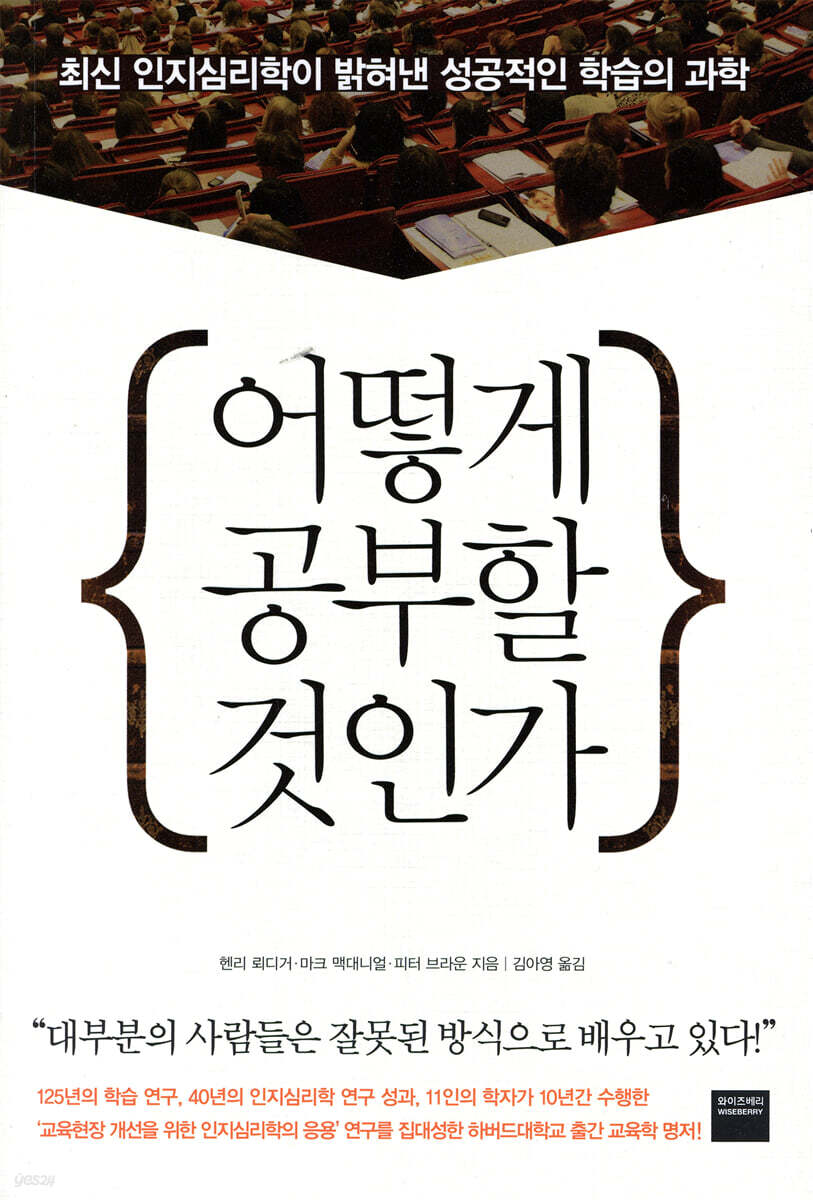
How to study
 |
Description
Book Introduction
Learning ability creates a happy life until the age of 100.
Change your study habits before it's too late!
125 years of learning research, 40 years of cognitive psychology research, and 10 years of research by 11 scholars
A renowned educational book published by Harvard University that compiles research on "Application of Cognitive Psychology to Improve Education"!
Futurists agree that we are entering an era where everyone will have to change jobs five or six times in their lifetime.
The half-life of knowledge is getting shorter and shorter, and the industrial order is being overturned in an instant, causing many jobs to disappear.
The upcoming commercialization of 3D printing technology and the Internet of Things is expected to bring about massive disruptive innovations not only in high-tech industries but also in general industries.
However, in our country, all students are driven to get into prestigious universities or universities in Seoul, and most of their time and energy are spent studying to get into a prestigious university that doesn't even play a certain role in getting their first job.
However, as the self-deprecating joke "Chicken Map of Korea" suggests, which states that liberal arts majors tend to fry chicken right after graduation, while science majors start ventures that go bankrupt, then commit suicide or open chicken restaurants, suggesting that liberal arts majors have an advantage over science majors, everyone knows that even if you get into the university you want, you're just passing one hurdle.
Meanwhile, we have entered an era where we can acquire world-class knowledge anytime, anywhere without having to pay expensive tuition fees, thanks to non-profit educational organizations like Khan Academy, which provides free video lectures, and Massive Open Online Courses (MOOCs).
In these times, those who have the ability to effectively learn knowledge and skills will have a clear advantage in life.
Moreover, remarkable advances in brain science have revealed that the human brain is capable of far greater capabilities than was thought possible just a few decades ago.
Learning changes the brain, and when the brain changes, it can accumulate more knowledge more effectively.
Learning is a field where the gap between the rich and the poor is extreme.
While there's still much to learn about learning and its neural underpinnings, there are already practical strategies and principles that can be applied immediately and see remarkable results without side effects.
Learning research, which began 125 years ago and has largely achieved results recently, has given us a new understanding of learning.
The research achievements of cognitive psychology, which began over 40 years ago, have established learning research as the 'science of learning.'
This has led us to increasingly learn about truly effective learning methods that replace myths based on success stories and personal experience.
The writing of this book, which compiles the 'science of learning,' was a large-scale collaborative project.
It was written over three years by a team of renowned cognitive scientists Henry Roediger and Mark McDaniel, both of whom have dedicated their lives to the study of learning and memory, and author Peter Brown, with the help of numerous individuals and organizations.
This book was published in 2002 by James S.
It was born from research funded by the McDonald's Foundation called 'Applying Cognitive Psychology to Improve Educational Practices.'
A research team of nine scholars, including lead researcher Henry Roediger and Mark McDaniel, conducted a joint study over the course of ten years applying cognitive science to education.
In addition, the book includes research on learning at Columbia Middle School and Columbia High School, supported by the U.S. Department of Education, and research on memory athletes, supported by Dart Neuroscience.
Additionally, Harvard University Press appointed five cognitive scientists to thoroughly review the manuscript's details before publication.
Thanks to the concrete examples shared by people from all walks of life—college students, doctors, professors, pilots, writers, musicians, athletes, soldiers, police officers, insurance companies, auto repair shops, and more—this book is not just a list of research findings, but rather a collection of living, breathing stories of people who have discovered how to master complex knowledge and skills.
This book is for readers who urgently need effective learning methods, including students, teachers, educators in business, government, and the military, leaders of professional groups providing job training, and coaches.
Meanwhile, it is also a book for office workers trying to adapt to changes in the business environment and lifelong learners designing a new life.
Learn knowledge and skills better, remember them longer,
What is the best learning method that allows you to recall things immediately when needed?
Self-directed learning is wrong.
The best players have great coaches.
Underlining, highlighting, cramming, repetitive study, and concentrated practice only create the illusion of knowledge, and the knowledge acquired in this way quickly disappears from the mind.
The myth that learning styles are the most effective when each person studies in a way that suits them has never been proven.
Success stories of outstanding students or geniuses, or subjective learning methods derived from personal experience, are far from the truth.
This book compiles learning methods proven effective through research, experimentation, and scientific verification, and shares vivid examples from the lives of a neurosurgeon with unparalleled skills, a coach of a championship football team, a medical student who went from last place to first place, a gardener who taught himself agricultural skills, an 88-year-old pianist, and a memory contest winner.
Just as cognitive psychology, applied to economics in behavioral economics, has revealed cognitive errors that hinder rational decision-making, effective learning strategies often run counter to our intuitions and feelings.
In that respect, self-directed learning, which is gaining popularity these days, can easily become a particularly inefficient method.
Metacognition, which allows students to accurately assess their own abilities and distinguish between what they know and what they don't know, is more prominent in excellent students, while it is less prominent in poor students.
The phenomenon of incompetent people overestimating themselves is called the Dunning-Kruger effect (p. 160) and is widely known in the field of psychology.
Even excellent students can study more effectively when they are evaluated objectively and receive appropriate feedback.
It's the same reason why the best athletes don't train alone, but rather get help from great coaches.
We have a hard time distinguishing between when we are learning well and when we are not.
When the learning process feels slow and difficult, we tend to gravitate toward strategies that seem more productive.
However, knowledge learned easily is like writing on sand, if you learn it today it will disappear tomorrow.
The most common learning strategies are 'repeatedly reading the textbook' and 'intensively practicing' skills or new knowledge.
Typically, we think that to learn something, you have to 'practice, practice, and practice again.'
Although you may feel like your skills have improved by reading repeatedly and practicing intensively, this method has several fatal flaws.
It takes a lot of time, and you fall into the trap of deluding yourself into thinking you know what you're doing, making it difficult to identify where you lack skill.
Retrieval practice, which involves recalling facts or concepts from your mind, is much more effective than reviewing them by reading them over and over again.
There are methods for recall practice, such as flashcards or tests.
The phenomenon in which the test itself becomes an effective learning method is called the 'test effect'.
At one middle school, researchers administered three simple tests to students covering a specific range of material and reported the results to them.
In another range, instead of taking the test, students were asked to review the material three times.
On the test a month later, which section of the material did the students remember better? The average score for the section that had a simple test was an A-, while the average score for the section that had only a review and no test was a C+ (p. 55).
Even if it is frustrating, the more effort you put into learning the knowledge, the deeper it will remain and the longer it will last.
Practice spaced out over time is more effective than intensive training for one or two days.
Thirty-eight surgical residents attended four short training sessions on microvascular surgery.
Half of the students took all classes in one day, while the rest took the same four classes, but with a week between classes.
As a result, the group that received classes one week apart achieved better results in all aspects (p. 71).
A consolidation process is necessary to imprint new knowledge into long-term memory.
This process of strengthening, giving meaning to, and connecting the memory trace (the brain's representation of new knowledge) to prior knowledge occurs over hours to days.
After a period of forgetting, it takes more effort to retrieve knowledge, so spaced learning strengthens memory and promotes further consolidation.
During gym class, eight-year-olds practiced throwing bean bags into a basket.
Half of them threw their bags from 90 centimeters away from the basket.
The other half threw the bags alternately from 60 and 120 centimeters away.
When all the children were later tested on bean bag tossing from 90 centimeters away, the children who performed significantly better were those who practiced at 60 and 120 centimeters and never practiced at 90 centimeters (p. 68).
Mixing up different forms of practice, such as spaced practice, is much more effective in improving your skills.
This learning style is similar to our reality and is more advantageous in drawing out knowledge and skills when they are actually needed.
For example, a math textbook is structured so that students focus on studying the content of each unit, solve practice problems related to that unit, and then move on to the next unit. However, in the final exam, all of the content is mixed together.
Students who study by unit are bound to be confused about which unit the final exam questions are from and which formulas to apply.
In fact, it has been shown that students who study a mixture of different types of geometric problems in mathematics have difficulty learning them, but perform much better on later tests (p. 72).
As brain science advances, it has been discovered that the human brain changes and reorganizes through life experiences and intentional learning (neuroplasticity).
In an experiment where the sensor for detecting visual information was replaced with the tongue instead of the eyes, the subject was able to find an entrance, catch a ball rolling towards him, and play rock-paper-scissors with his daughter for the first time in 20 years.
The brain “rewired itself” to perceive information perceived by the tongue as visual information (p. 220).
If you put in the effort to remember and practice by mixing things up, various parts of the brain will be activated, allowing you to learn more deeply.
A study of street vendors in Brazil found that those who were good at math for business were unable to solve the same problems when presented in an abstract format, like a school exam.
Meanwhile, the IQ of horse racing experts who calculate very complex variables to predict the winning horse was only average (p. 197).
It is well known that average IQ has continued to rise in industrialized countries.
It is now common knowledge that human potential cannot be measured by fixed standards.
Moreover, it has been found that the growth mindset itself, which states that intelligence can be improved through one's own efforts, improves learning performance (p. 231).
This book also introduces the principles of memory techniques that utilize the brain's amazing abilities.
Among them, the 'memory palace' technique applied by a student named Malis to the British university entrance exam will be of great help to those who need to memorize a large amount of knowledge in a short period of time, such as students taking exams or medical students (p. 246).
When we work hard and learn new things, our brains form new connections, and over time, these new connections make us smarter, allowing us to learn more, faster.
In an age of change where knowledge and information once monopolized by experts are now freely shared, while the very stability of life is fundamentally threatened, the research findings of cognitive psychology have put effective learning tools in our hands.
The hope that we can become better tomorrow than we were today through continuous learning is what will sustain us through the daily anxieties and crises.
Change your study habits before it's too late!
125 years of learning research, 40 years of cognitive psychology research, and 10 years of research by 11 scholars
A renowned educational book published by Harvard University that compiles research on "Application of Cognitive Psychology to Improve Education"!
Futurists agree that we are entering an era where everyone will have to change jobs five or six times in their lifetime.
The half-life of knowledge is getting shorter and shorter, and the industrial order is being overturned in an instant, causing many jobs to disappear.
The upcoming commercialization of 3D printing technology and the Internet of Things is expected to bring about massive disruptive innovations not only in high-tech industries but also in general industries.
However, in our country, all students are driven to get into prestigious universities or universities in Seoul, and most of their time and energy are spent studying to get into a prestigious university that doesn't even play a certain role in getting their first job.
However, as the self-deprecating joke "Chicken Map of Korea" suggests, which states that liberal arts majors tend to fry chicken right after graduation, while science majors start ventures that go bankrupt, then commit suicide or open chicken restaurants, suggesting that liberal arts majors have an advantage over science majors, everyone knows that even if you get into the university you want, you're just passing one hurdle.
Meanwhile, we have entered an era where we can acquire world-class knowledge anytime, anywhere without having to pay expensive tuition fees, thanks to non-profit educational organizations like Khan Academy, which provides free video lectures, and Massive Open Online Courses (MOOCs).
In these times, those who have the ability to effectively learn knowledge and skills will have a clear advantage in life.
Moreover, remarkable advances in brain science have revealed that the human brain is capable of far greater capabilities than was thought possible just a few decades ago.
Learning changes the brain, and when the brain changes, it can accumulate more knowledge more effectively.
Learning is a field where the gap between the rich and the poor is extreme.
While there's still much to learn about learning and its neural underpinnings, there are already practical strategies and principles that can be applied immediately and see remarkable results without side effects.
Learning research, which began 125 years ago and has largely achieved results recently, has given us a new understanding of learning.
The research achievements of cognitive psychology, which began over 40 years ago, have established learning research as the 'science of learning.'
This has led us to increasingly learn about truly effective learning methods that replace myths based on success stories and personal experience.
The writing of this book, which compiles the 'science of learning,' was a large-scale collaborative project.
It was written over three years by a team of renowned cognitive scientists Henry Roediger and Mark McDaniel, both of whom have dedicated their lives to the study of learning and memory, and author Peter Brown, with the help of numerous individuals and organizations.
This book was published in 2002 by James S.
It was born from research funded by the McDonald's Foundation called 'Applying Cognitive Psychology to Improve Educational Practices.'
A research team of nine scholars, including lead researcher Henry Roediger and Mark McDaniel, conducted a joint study over the course of ten years applying cognitive science to education.
In addition, the book includes research on learning at Columbia Middle School and Columbia High School, supported by the U.S. Department of Education, and research on memory athletes, supported by Dart Neuroscience.
Additionally, Harvard University Press appointed five cognitive scientists to thoroughly review the manuscript's details before publication.
Thanks to the concrete examples shared by people from all walks of life—college students, doctors, professors, pilots, writers, musicians, athletes, soldiers, police officers, insurance companies, auto repair shops, and more—this book is not just a list of research findings, but rather a collection of living, breathing stories of people who have discovered how to master complex knowledge and skills.
This book is for readers who urgently need effective learning methods, including students, teachers, educators in business, government, and the military, leaders of professional groups providing job training, and coaches.
Meanwhile, it is also a book for office workers trying to adapt to changes in the business environment and lifelong learners designing a new life.
Learn knowledge and skills better, remember them longer,
What is the best learning method that allows you to recall things immediately when needed?
Self-directed learning is wrong.
The best players have great coaches.
Underlining, highlighting, cramming, repetitive study, and concentrated practice only create the illusion of knowledge, and the knowledge acquired in this way quickly disappears from the mind.
The myth that learning styles are the most effective when each person studies in a way that suits them has never been proven.
Success stories of outstanding students or geniuses, or subjective learning methods derived from personal experience, are far from the truth.
This book compiles learning methods proven effective through research, experimentation, and scientific verification, and shares vivid examples from the lives of a neurosurgeon with unparalleled skills, a coach of a championship football team, a medical student who went from last place to first place, a gardener who taught himself agricultural skills, an 88-year-old pianist, and a memory contest winner.
Just as cognitive psychology, applied to economics in behavioral economics, has revealed cognitive errors that hinder rational decision-making, effective learning strategies often run counter to our intuitions and feelings.
In that respect, self-directed learning, which is gaining popularity these days, can easily become a particularly inefficient method.
Metacognition, which allows students to accurately assess their own abilities and distinguish between what they know and what they don't know, is more prominent in excellent students, while it is less prominent in poor students.
The phenomenon of incompetent people overestimating themselves is called the Dunning-Kruger effect (p. 160) and is widely known in the field of psychology.
Even excellent students can study more effectively when they are evaluated objectively and receive appropriate feedback.
It's the same reason why the best athletes don't train alone, but rather get help from great coaches.
We have a hard time distinguishing between when we are learning well and when we are not.
When the learning process feels slow and difficult, we tend to gravitate toward strategies that seem more productive.
However, knowledge learned easily is like writing on sand, if you learn it today it will disappear tomorrow.
The most common learning strategies are 'repeatedly reading the textbook' and 'intensively practicing' skills or new knowledge.
Typically, we think that to learn something, you have to 'practice, practice, and practice again.'
Although you may feel like your skills have improved by reading repeatedly and practicing intensively, this method has several fatal flaws.
It takes a lot of time, and you fall into the trap of deluding yourself into thinking you know what you're doing, making it difficult to identify where you lack skill.
Retrieval practice, which involves recalling facts or concepts from your mind, is much more effective than reviewing them by reading them over and over again.
There are methods for recall practice, such as flashcards or tests.
The phenomenon in which the test itself becomes an effective learning method is called the 'test effect'.
At one middle school, researchers administered three simple tests to students covering a specific range of material and reported the results to them.
In another range, instead of taking the test, students were asked to review the material three times.
On the test a month later, which section of the material did the students remember better? The average score for the section that had a simple test was an A-, while the average score for the section that had only a review and no test was a C+ (p. 55).
Even if it is frustrating, the more effort you put into learning the knowledge, the deeper it will remain and the longer it will last.
Practice spaced out over time is more effective than intensive training for one or two days.
Thirty-eight surgical residents attended four short training sessions on microvascular surgery.
Half of the students took all classes in one day, while the rest took the same four classes, but with a week between classes.
As a result, the group that received classes one week apart achieved better results in all aspects (p. 71).
A consolidation process is necessary to imprint new knowledge into long-term memory.
This process of strengthening, giving meaning to, and connecting the memory trace (the brain's representation of new knowledge) to prior knowledge occurs over hours to days.
After a period of forgetting, it takes more effort to retrieve knowledge, so spaced learning strengthens memory and promotes further consolidation.
During gym class, eight-year-olds practiced throwing bean bags into a basket.
Half of them threw their bags from 90 centimeters away from the basket.
The other half threw the bags alternately from 60 and 120 centimeters away.
When all the children were later tested on bean bag tossing from 90 centimeters away, the children who performed significantly better were those who practiced at 60 and 120 centimeters and never practiced at 90 centimeters (p. 68).
Mixing up different forms of practice, such as spaced practice, is much more effective in improving your skills.
This learning style is similar to our reality and is more advantageous in drawing out knowledge and skills when they are actually needed.
For example, a math textbook is structured so that students focus on studying the content of each unit, solve practice problems related to that unit, and then move on to the next unit. However, in the final exam, all of the content is mixed together.
Students who study by unit are bound to be confused about which unit the final exam questions are from and which formulas to apply.
In fact, it has been shown that students who study a mixture of different types of geometric problems in mathematics have difficulty learning them, but perform much better on later tests (p. 72).
As brain science advances, it has been discovered that the human brain changes and reorganizes through life experiences and intentional learning (neuroplasticity).
In an experiment where the sensor for detecting visual information was replaced with the tongue instead of the eyes, the subject was able to find an entrance, catch a ball rolling towards him, and play rock-paper-scissors with his daughter for the first time in 20 years.
The brain “rewired itself” to perceive information perceived by the tongue as visual information (p. 220).
If you put in the effort to remember and practice by mixing things up, various parts of the brain will be activated, allowing you to learn more deeply.
A study of street vendors in Brazil found that those who were good at math for business were unable to solve the same problems when presented in an abstract format, like a school exam.
Meanwhile, the IQ of horse racing experts who calculate very complex variables to predict the winning horse was only average (p. 197).
It is well known that average IQ has continued to rise in industrialized countries.
It is now common knowledge that human potential cannot be measured by fixed standards.
Moreover, it has been found that the growth mindset itself, which states that intelligence can be improved through one's own efforts, improves learning performance (p. 231).
This book also introduces the principles of memory techniques that utilize the brain's amazing abilities.
Among them, the 'memory palace' technique applied by a student named Malis to the British university entrance exam will be of great help to those who need to memorize a large amount of knowledge in a short period of time, such as students taking exams or medical students (p. 246).
When we work hard and learn new things, our brains form new connections, and over time, these new connections make us smarter, allowing us to learn more, faster.
In an age of change where knowledge and information once monopolized by experts are now freely shared, while the very stability of life is fundamentally threatened, the research findings of cognitive psychology have put effective learning tools in our hands.
The hope that we can become better tomorrow than we were today through continuous learning is what will sustain us through the daily anxieties and crises.
- You can preview some of the book's contents.
Preview
index
preface
Chapter 1: We're Learning the Wrong Way
Chapter 2: To learn, first withdraw
Practice mixing up Chapter 3
Chapter 4: Learning through hardships will last a long time.
Chapter 5: Break free from the illusion of knowing
Chapter 6 The Myth of Learning Styles
Chapter 7: Consistent Effort Changes the Brain
Chapter 8: How to Study
Acknowledgements
main
Search
Chapter 1: We're Learning the Wrong Way
Chapter 2: To learn, first withdraw
Practice mixing up Chapter 3
Chapter 4: Learning through hardships will last a long time.
Chapter 5: Break free from the illusion of knowing
Chapter 6 The Myth of Learning Styles
Chapter 7: Consistent Effort Changes the Brain
Chapter 8: How to Study
Acknowledgements
main
Search
Detailed image

Into the book
Einstein once said, “Creativity is more important than knowledge.”
How could groundbreaking advancements in science, society, and economics be possible without creativity? While accumulating knowledge can feel tedious, anything involving creativity seems more exciting.
But this dichotomy is wrong.
No one would want a surgeon or an airline pilot wearing a T-shirt that says, “Creativity is more important than knowledge.”
We must develop knowledge and creativity together.
Without knowledge, you cannot lay the foundation for higher-order skills such as analysis, synthesis, and creative problem solving.
---From "Chapter 1: We Are Learning the Wrong Way"
“When I come home after a difficult surgery, I think about what happened that day, what I could have done better, for example, if there was a way to do the suture better.
How can I make the stitches smaller? Should I make the stitches tighter? What if I change it this way? The next day, I put my thoughts into practice and see if they work." The cognitive activities involved in reflection, or the act of looking back, lead to robust learning.
Ebersold says that to be able to use your newly acquired knowledge when needed, you need to “memorize and practice the A, B, C, and D issues you need to worry about in that situation.”
When an emergency actually arises, you must reflexively take the right action.
“Like a race car driver in a critical situation, you have to act before you think.”
---From "To learn Chapter 2, withdraw first"
Incompetent people lack the skills to improve their abilities.
Because it is impossible to distinguish between incompetence and competence.
This phenomenon is called the Dunning-Kruger effect.
Given our vulnerability to mistakes and misjudgments, we need to reexamine the popular "self-directed learning" among parents and educators.
The argument is that students are the ones who best decide what to study, how to plan their schedule, and how to study.
However, it is extremely rare for students to use effective learning strategies.
According to the Dunning-Kruger effect, students who use the least effective learning strategies are the most self-critical and are least willing to change their study habits.
Most students achieve better academically when they receive guidance from an educator who identifies areas of weakness and helps them develop a practice plan to address those areas.
---From "Chapter 5: Break Free from the Illusion of Knowing"
The hippocampus, which consolidates memories and knowledge, can create new neurons throughout life.
This phenomenon appears to play a central role in the brain's ability to recover from physical damage and in the human capacity for lifelong learning.
While the relationship between neurogenesis and learning and memory remains an area of ongoing exploration, scientists have already shown that associative learning—learning the relationships between unrelated items, such as names and faces—stimulates the hippocampus to produce more new neurons.
The fact that increased neurogenesis begins before new learning is undertaken suggests that the very intention to learn influences the brain.
Furthermore, the fact that increased neurogenesis persists for some time after the learning activity ends suggests that spaced, effortful retrieval practice contributes to long-term memory.
---From "Chapter 7: Consistent Effort Changes the Brain"
Jiffy Lube, an automotive repair chain with over 2,000 franchise stores, offers a training program called Jiffy Lube University.
Employees participate in an active learning program that combines e-learning with on-the-job training, including quizzes, feedback, spaced practice, and cross-training.
When I interviewed the company representative, he was finishing up a computer-based simulation game called "A Day in the Life of a Store Manager."
In this game, the manager faces various problems and must choose one of the possible strategies to solve the situation.
GP Lube University has received numerous awards in the field of training and is accredited by the American Council on Education.
Employees who are certified in all positions will receive 7 credits and can enroll in educational institutions beyond secondary school.
Since the program began, employee turnover has decreased and customer satisfaction has increased.
How could groundbreaking advancements in science, society, and economics be possible without creativity? While accumulating knowledge can feel tedious, anything involving creativity seems more exciting.
But this dichotomy is wrong.
No one would want a surgeon or an airline pilot wearing a T-shirt that says, “Creativity is more important than knowledge.”
We must develop knowledge and creativity together.
Without knowledge, you cannot lay the foundation for higher-order skills such as analysis, synthesis, and creative problem solving.
---From "Chapter 1: We Are Learning the Wrong Way"
“When I come home after a difficult surgery, I think about what happened that day, what I could have done better, for example, if there was a way to do the suture better.
How can I make the stitches smaller? Should I make the stitches tighter? What if I change it this way? The next day, I put my thoughts into practice and see if they work." The cognitive activities involved in reflection, or the act of looking back, lead to robust learning.
Ebersold says that to be able to use your newly acquired knowledge when needed, you need to “memorize and practice the A, B, C, and D issues you need to worry about in that situation.”
When an emergency actually arises, you must reflexively take the right action.
“Like a race car driver in a critical situation, you have to act before you think.”
---From "To learn Chapter 2, withdraw first"
Incompetent people lack the skills to improve their abilities.
Because it is impossible to distinguish between incompetence and competence.
This phenomenon is called the Dunning-Kruger effect.
Given our vulnerability to mistakes and misjudgments, we need to reexamine the popular "self-directed learning" among parents and educators.
The argument is that students are the ones who best decide what to study, how to plan their schedule, and how to study.
However, it is extremely rare for students to use effective learning strategies.
According to the Dunning-Kruger effect, students who use the least effective learning strategies are the most self-critical and are least willing to change their study habits.
Most students achieve better academically when they receive guidance from an educator who identifies areas of weakness and helps them develop a practice plan to address those areas.
---From "Chapter 5: Break Free from the Illusion of Knowing"
The hippocampus, which consolidates memories and knowledge, can create new neurons throughout life.
This phenomenon appears to play a central role in the brain's ability to recover from physical damage and in the human capacity for lifelong learning.
While the relationship between neurogenesis and learning and memory remains an area of ongoing exploration, scientists have already shown that associative learning—learning the relationships between unrelated items, such as names and faces—stimulates the hippocampus to produce more new neurons.
The fact that increased neurogenesis begins before new learning is undertaken suggests that the very intention to learn influences the brain.
Furthermore, the fact that increased neurogenesis persists for some time after the learning activity ends suggests that spaced, effortful retrieval practice contributes to long-term memory.
---From "Chapter 7: Consistent Effort Changes the Brain"
Jiffy Lube, an automotive repair chain with over 2,000 franchise stores, offers a training program called Jiffy Lube University.
Employees participate in an active learning program that combines e-learning with on-the-job training, including quizzes, feedback, spaced practice, and cross-training.
When I interviewed the company representative, he was finishing up a computer-based simulation game called "A Day in the Life of a Store Manager."
In this game, the manager faces various problems and must choose one of the possible strategies to solve the situation.
GP Lube University has received numerous awards in the field of training and is accredited by the American Council on Education.
Employees who are certified in all positions will receive 7 credits and can enroll in educational institutions beyond secondary school.
Since the program began, employee turnover has decreased and customer satisfaction has increased.
---From “Chapter 8 How to Study”
Publisher's Review
Learning ability creates a happy life until the age of 100.
Change your study habits before it's too late!
125 years of learning research, 40 years of cognitive psychology research, and 10 years of research by 11 scholars
A renowned educational book published by Harvard University that compiles research on "Application of Cognitive Psychology to Improve Education"!
Futurists agree that we are entering an era where everyone will have to change jobs five or six times in their lifetime.
The half-life of knowledge is getting shorter and shorter, and the industrial order is being overturned in an instant, causing many jobs to disappear.
The upcoming commercialization of 3D printing technology and the Internet of Things is expected to bring about massive disruptive innovations not only in high-tech industries but also in general industries.
However, in our country, all students are driven to get into prestigious universities or universities in Seoul, and most of their time and energy are spent studying to get into a prestigious university that doesn't even play a certain role in getting their first job.
However, as the self-deprecating joke "Chicken Map of Korea" suggests, which states that liberal arts majors tend to fry chicken right after graduation, while science majors start ventures that go bankrupt, then commit suicide or open chicken restaurants, suggesting that liberal arts majors have an advantage over science majors, everyone knows that even if you get into the university you want, you're just passing one hurdle.
Meanwhile, we have entered an era where we can acquire world-class knowledge anytime, anywhere without having to pay expensive tuition fees, thanks to non-profit educational organizations like Khan Academy, which provides free video lectures, and Massive Open Online Courses (MOOCs).
In these times, those who have the ability to effectively learn knowledge and skills will have a clear advantage in life.
Moreover, remarkable advances in brain science have revealed that the human brain is capable of far greater capabilities than was thought possible just a few decades ago.
Learning changes the brain, and when the brain changes, it can accumulate more knowledge more effectively.
Learning is a field where the gap between the rich and the poor is extreme.
While there's still much to learn about learning and its neural underpinnings, there are already practical strategies and principles that can be applied immediately and see remarkable results without side effects.
Learning research, which began 125 years ago and has largely achieved results recently, has given us a new understanding of learning.
The research achievements of cognitive psychology, which began over 40 years ago, have established learning research as the 'science of learning.'
This has led us to increasingly learn about truly effective learning methods that replace myths based on success stories and personal experience.
The writing of this book, which encapsulates the "science of learning," was a large-scale collaborative project.
It was written over three years by a team of renowned cognitive scientists Henry Roediger and Mark McDaniel, both of whom have dedicated their lives to the study of learning and memory, and author Peter Brown, with the help of numerous individuals and organizations.
This book was published in 2002 by James S.
It was born from research funded by the McDonald's Foundation called 'Applying Cognitive Psychology to Improve Educational Practices.'
A research team of nine scholars, including lead researcher Henry Roediger and Mark McDaniel, conducted a joint study over the course of ten years applying cognitive science to education.
In addition, the book includes research on learning at Columbia Middle School and Columbia High School, supported by the U.S. Department of Education, and research on memory athletes, supported by Dart Neuroscience.
Additionally, Harvard University Press appointed five cognitive scientists to thoroughly review the manuscript's details before publication.
Thanks to the concrete examples shared by people from all walks of life—college students, doctors, professors, pilots, writers, musicians, athletes, soldiers, police officers, insurance companies, auto repair shops, and more—this book is not just a list of research findings, but rather a collection of living, breathing stories of people who have discovered how to master complex knowledge and skills.
This book is for readers who urgently need effective learning methods, including students, teachers, educators in business, government, and the military, leaders of professional groups providing job training, and coaches.
Meanwhile, it is also a book for office workers trying to adapt to changes in the business environment and lifelong learners designing a new life.
Learn knowledge and skills better, remember them longer,
What is the best learning method that allows you to recall things immediately when needed?
Self-directed learning is wrong.
The best players have great coaches.
Underlining, highlighting, cramming, repetitive study, and concentrated practice only create the illusion of knowledge, and the knowledge acquired in this way quickly disappears from the mind.
The myth that learning styles are the most effective when each person studies in a way that suits them has never been proven.
Success stories of outstanding students or geniuses, or subjective learning methods derived from personal experience, are far from the truth.
This book compiles learning methods proven effective through research, experimentation, and scientific verification, and shares vivid examples from the lives of a neurosurgeon with unparalleled skills, a coach of a championship football team, a medical student who went from last place to first place, a gardener who taught himself agricultural skills, an 88-year-old pianist, and a memory contest winner.
Just as cognitive psychology, applied to economics in behavioral economics, has revealed cognitive errors that hinder rational decision-making, effective learning strategies often run counter to our intuitions and feelings.
In that respect, self-directed learning, which is gaining popularity these days, can easily become a particularly inefficient method.
Metacognition, which allows students to accurately assess their own abilities and distinguish between what they know and what they don't know, is more prominent in excellent students, while it is less prominent in poor students.
The phenomenon of incompetent people overestimating themselves is called the Dunning-Kruger effect (p. 160) and is widely known in the field of psychology.
Even excellent students can study more effectively when they are evaluated objectively and receive appropriate feedback.
It's the same reason why the best athletes don't train alone, but rather get help from great coaches.
We have a hard time distinguishing between when we are learning well and when we are not.
When the learning process feels slow and difficult, we tend to gravitate toward strategies that seem more productive.
However, knowledge learned easily is like writing on sand, if you learn it today it will disappear tomorrow.
The most common learning strategies are 'repeatedly reading the textbook' and 'intensively practicing' skills or new knowledge.
Typically, we think that to learn something, you have to 'practice, practice, and practice again.'
Although you may feel like your skills have improved by reading repeatedly and practicing intensively, this method has several fatal flaws.
It takes a lot of time, and you fall into the trap of deluding yourself into thinking you know what you're doing, making it difficult to identify where you lack skill.
Retrieval practice, which involves recalling facts or concepts from your mind, is much more effective than reviewing them by reading them over and over again.
There are methods for recall practice, such as flashcards or tests.
The phenomenon in which the test itself becomes an effective learning method is called the 'test effect'.
At one middle school, researchers administered three simple tests to students covering a specific range of material and reported the results to them.
In another range, instead of taking the test, students were asked to review the material three times.
On the test a month later, which section of the material did the students remember better? The average score for the section that had a simple test was an A-, while the average score for the section that had only a review and no test was a C+ (p. 55).
Even if it is frustrating, the more effort you put into learning the knowledge, the deeper it will remain and the longer it will last.
Practice spaced out over time is more effective than intensive training for one or two days.
Thirty-eight surgical residents attended four short training sessions on microvascular surgery.
Half of the students took all classes in one day, while the rest took the same four classes, but with a week between classes.
As a result, the group that received classes one week apart achieved better results in all aspects (p. 71).
A consolidation process is necessary to imprint new knowledge into long-term memory.
This process of strengthening, giving meaning to, and connecting the memory trace (the brain's representation of new knowledge) to prior knowledge occurs over hours to days.
After a period of forgetting, it takes more effort to retrieve knowledge, so spaced learning strengthens memory and promotes further consolidation.
During gym class, eight-year-olds practiced throwing bean bags into a basket.
Half of them threw their bags from 90 centimeters away from the basket.
The other half threw the bags alternately from 60 and 120 centimeters away.
When all the children were later tested on bean bag tossing from 90 centimeters away, the children who performed significantly better were those who practiced at 60 and 120 centimeters and never practiced at 90 centimeters (p. 68).
Mixing up different forms of practice, such as spaced practice, is much more effective in improving your skills.
This learning style is similar to our reality and is more advantageous in drawing out knowledge and skills when they are actually needed.
For example, a math textbook is structured so that students focus on studying the content of each unit, solve practice problems related to that unit, and then move on to the next unit. However, in the final exam, all of the content is mixed together.
Students who study by unit are bound to be confused about which unit the final exam questions are from and which formulas to apply.
In fact, it has been shown that students who study a mixture of different types of geometric problems in mathematics have difficulty learning them, but perform much better on later tests (p. 72).
As brain science advances, it has been discovered that the human brain changes and reorganizes through life experiences and intentional learning (neuroplasticity).
In an experiment where the sensor for detecting visual information was replaced with the tongue instead of the eyes, the subject was able to find an entrance, catch a ball rolling towards him, and play rock-paper-scissors with his daughter for the first time in 20 years.
The brain “rewired itself” to perceive information perceived by the tongue as visual information (p. 220).
If you put in the effort to remember and practice by mixing things up, various parts of the brain will be activated, allowing you to learn more deeply.
A study of street vendors in Brazil found that those who were good at math for business were unable to solve the same problems when presented in an abstract format, like a school exam.
Meanwhile, the IQ of horse racing experts who calculate very complex variables to predict the winning horse was only average (p. 197).
It is well known that average IQ has continued to rise in industrialized countries.
It is now common knowledge that human potential cannot be measured by fixed standards.
Moreover, it has been found that the growth mindset itself, which states that intelligence can be improved through one's own efforts, improves learning performance (p. 231).
This book also introduces the principles of memory techniques that utilize the brain's amazing abilities.
Among them, the 'memory palace' technique applied by a student named Malis to the British university entrance exam will be of great help to those who need to memorize a large amount of knowledge in a short period of time, such as students taking exams or medical students (p. 246).
When we work hard and learn new things, our brains form new connections, and over time, these new connections make us smarter, allowing us to learn more, faster.
In an age of change where knowledge and information once monopolized by experts are now freely shared, while the very stability of life is fundamentally threatened, the research findings of cognitive psychology have put effective learning tools in our hands.
The hope that we can become better tomorrow than we were today through continuous learning is what will sustain us through the daily anxieties and crises.
Change your study habits before it's too late!
125 years of learning research, 40 years of cognitive psychology research, and 10 years of research by 11 scholars
A renowned educational book published by Harvard University that compiles research on "Application of Cognitive Psychology to Improve Education"!
Futurists agree that we are entering an era where everyone will have to change jobs five or six times in their lifetime.
The half-life of knowledge is getting shorter and shorter, and the industrial order is being overturned in an instant, causing many jobs to disappear.
The upcoming commercialization of 3D printing technology and the Internet of Things is expected to bring about massive disruptive innovations not only in high-tech industries but also in general industries.
However, in our country, all students are driven to get into prestigious universities or universities in Seoul, and most of their time and energy are spent studying to get into a prestigious university that doesn't even play a certain role in getting their first job.
However, as the self-deprecating joke "Chicken Map of Korea" suggests, which states that liberal arts majors tend to fry chicken right after graduation, while science majors start ventures that go bankrupt, then commit suicide or open chicken restaurants, suggesting that liberal arts majors have an advantage over science majors, everyone knows that even if you get into the university you want, you're just passing one hurdle.
Meanwhile, we have entered an era where we can acquire world-class knowledge anytime, anywhere without having to pay expensive tuition fees, thanks to non-profit educational organizations like Khan Academy, which provides free video lectures, and Massive Open Online Courses (MOOCs).
In these times, those who have the ability to effectively learn knowledge and skills will have a clear advantage in life.
Moreover, remarkable advances in brain science have revealed that the human brain is capable of far greater capabilities than was thought possible just a few decades ago.
Learning changes the brain, and when the brain changes, it can accumulate more knowledge more effectively.
Learning is a field where the gap between the rich and the poor is extreme.
While there's still much to learn about learning and its neural underpinnings, there are already practical strategies and principles that can be applied immediately and see remarkable results without side effects.
Learning research, which began 125 years ago and has largely achieved results recently, has given us a new understanding of learning.
The research achievements of cognitive psychology, which began over 40 years ago, have established learning research as the 'science of learning.'
This has led us to increasingly learn about truly effective learning methods that replace myths based on success stories and personal experience.
The writing of this book, which encapsulates the "science of learning," was a large-scale collaborative project.
It was written over three years by a team of renowned cognitive scientists Henry Roediger and Mark McDaniel, both of whom have dedicated their lives to the study of learning and memory, and author Peter Brown, with the help of numerous individuals and organizations.
This book was published in 2002 by James S.
It was born from research funded by the McDonald's Foundation called 'Applying Cognitive Psychology to Improve Educational Practices.'
A research team of nine scholars, including lead researcher Henry Roediger and Mark McDaniel, conducted a joint study over the course of ten years applying cognitive science to education.
In addition, the book includes research on learning at Columbia Middle School and Columbia High School, supported by the U.S. Department of Education, and research on memory athletes, supported by Dart Neuroscience.
Additionally, Harvard University Press appointed five cognitive scientists to thoroughly review the manuscript's details before publication.
Thanks to the concrete examples shared by people from all walks of life—college students, doctors, professors, pilots, writers, musicians, athletes, soldiers, police officers, insurance companies, auto repair shops, and more—this book is not just a list of research findings, but rather a collection of living, breathing stories of people who have discovered how to master complex knowledge and skills.
This book is for readers who urgently need effective learning methods, including students, teachers, educators in business, government, and the military, leaders of professional groups providing job training, and coaches.
Meanwhile, it is also a book for office workers trying to adapt to changes in the business environment and lifelong learners designing a new life.
Learn knowledge and skills better, remember them longer,
What is the best learning method that allows you to recall things immediately when needed?
Self-directed learning is wrong.
The best players have great coaches.
Underlining, highlighting, cramming, repetitive study, and concentrated practice only create the illusion of knowledge, and the knowledge acquired in this way quickly disappears from the mind.
The myth that learning styles are the most effective when each person studies in a way that suits them has never been proven.
Success stories of outstanding students or geniuses, or subjective learning methods derived from personal experience, are far from the truth.
This book compiles learning methods proven effective through research, experimentation, and scientific verification, and shares vivid examples from the lives of a neurosurgeon with unparalleled skills, a coach of a championship football team, a medical student who went from last place to first place, a gardener who taught himself agricultural skills, an 88-year-old pianist, and a memory contest winner.
Just as cognitive psychology, applied to economics in behavioral economics, has revealed cognitive errors that hinder rational decision-making, effective learning strategies often run counter to our intuitions and feelings.
In that respect, self-directed learning, which is gaining popularity these days, can easily become a particularly inefficient method.
Metacognition, which allows students to accurately assess their own abilities and distinguish between what they know and what they don't know, is more prominent in excellent students, while it is less prominent in poor students.
The phenomenon of incompetent people overestimating themselves is called the Dunning-Kruger effect (p. 160) and is widely known in the field of psychology.
Even excellent students can study more effectively when they are evaluated objectively and receive appropriate feedback.
It's the same reason why the best athletes don't train alone, but rather get help from great coaches.
We have a hard time distinguishing between when we are learning well and when we are not.
When the learning process feels slow and difficult, we tend to gravitate toward strategies that seem more productive.
However, knowledge learned easily is like writing on sand, if you learn it today it will disappear tomorrow.
The most common learning strategies are 'repeatedly reading the textbook' and 'intensively practicing' skills or new knowledge.
Typically, we think that to learn something, you have to 'practice, practice, and practice again.'
Although you may feel like your skills have improved by reading repeatedly and practicing intensively, this method has several fatal flaws.
It takes a lot of time, and you fall into the trap of deluding yourself into thinking you know what you're doing, making it difficult to identify where you lack skill.
Retrieval practice, which involves recalling facts or concepts from your mind, is much more effective than reviewing them by reading them over and over again.
There are methods for recall practice, such as flashcards or tests.
The phenomenon in which the test itself becomes an effective learning method is called the 'test effect'.
At one middle school, researchers administered three simple tests to students covering a specific range of material and reported the results to them.
In another range, instead of taking the test, students were asked to review the material three times.
On the test a month later, which section of the material did the students remember better? The average score for the section that had a simple test was an A-, while the average score for the section that had only a review and no test was a C+ (p. 55).
Even if it is frustrating, the more effort you put into learning the knowledge, the deeper it will remain and the longer it will last.
Practice spaced out over time is more effective than intensive training for one or two days.
Thirty-eight surgical residents attended four short training sessions on microvascular surgery.
Half of the students took all classes in one day, while the rest took the same four classes, but with a week between classes.
As a result, the group that received classes one week apart achieved better results in all aspects (p. 71).
A consolidation process is necessary to imprint new knowledge into long-term memory.
This process of strengthening, giving meaning to, and connecting the memory trace (the brain's representation of new knowledge) to prior knowledge occurs over hours to days.
After a period of forgetting, it takes more effort to retrieve knowledge, so spaced learning strengthens memory and promotes further consolidation.
During gym class, eight-year-olds practiced throwing bean bags into a basket.
Half of them threw their bags from 90 centimeters away from the basket.
The other half threw the bags alternately from 60 and 120 centimeters away.
When all the children were later tested on bean bag tossing from 90 centimeters away, the children who performed significantly better were those who practiced at 60 and 120 centimeters and never practiced at 90 centimeters (p. 68).
Mixing up different forms of practice, such as spaced practice, is much more effective in improving your skills.
This learning style is similar to our reality and is more advantageous in drawing out knowledge and skills when they are actually needed.
For example, a math textbook is structured so that students focus on studying the content of each unit, solve practice problems related to that unit, and then move on to the next unit. However, in the final exam, all of the content is mixed together.
Students who study by unit are bound to be confused about which unit the final exam questions are from and which formulas to apply.
In fact, it has been shown that students who study a mixture of different types of geometric problems in mathematics have difficulty learning them, but perform much better on later tests (p. 72).
As brain science advances, it has been discovered that the human brain changes and reorganizes through life experiences and intentional learning (neuroplasticity).
In an experiment where the sensor for detecting visual information was replaced with the tongue instead of the eyes, the subject was able to find an entrance, catch a ball rolling towards him, and play rock-paper-scissors with his daughter for the first time in 20 years.
The brain “rewired itself” to perceive information perceived by the tongue as visual information (p. 220).
If you put in the effort to remember and practice by mixing things up, various parts of the brain will be activated, allowing you to learn more deeply.
A study of street vendors in Brazil found that those who were good at math for business were unable to solve the same problems when presented in an abstract format, like a school exam.
Meanwhile, the IQ of horse racing experts who calculate very complex variables to predict the winning horse was only average (p. 197).
It is well known that average IQ has continued to rise in industrialized countries.
It is now common knowledge that human potential cannot be measured by fixed standards.
Moreover, it has been found that the growth mindset itself, which states that intelligence can be improved through one's own efforts, improves learning performance (p. 231).
This book also introduces the principles of memory techniques that utilize the brain's amazing abilities.
Among them, the 'memory palace' technique applied by a student named Malis to the British university entrance exam will be of great help to those who need to memorize a large amount of knowledge in a short period of time, such as students taking exams or medical students (p. 246).
When we work hard and learn new things, our brains form new connections, and over time, these new connections make us smarter, allowing us to learn more, faster.
In an age of change where knowledge and information once monopolized by experts are now freely shared, while the very stability of life is fundamentally threatened, the research findings of cognitive psychology have put effective learning tools in our hands.
The hope that we can become better tomorrow than we were today through continuous learning is what will sustain us through the daily anxieties and crises.
GOODS SPECIFICS
- Date of issue: December 5, 2014
- Page count, weight, size: 356 pages | 618g | 148*220*21mm
- ISBN13: 9788937834868
- ISBN10: 8937834863
You may also like
카테고리
korean


korean

![GQ KOREA Mark (Monthly): December [2025]](http://librairie.coreenne.fr/cdn/shop/files/8ef265dbbfbf186523ed75ba7319009d.jpg?v=1765340328&width=3840)


