

Perpetual Peace Theory
 |
Description
Book Introduction
Ancient people accepted war as an inevitable fate, and from the modern Age of Enlightenment onward, people began to think that war could and should be avoided.
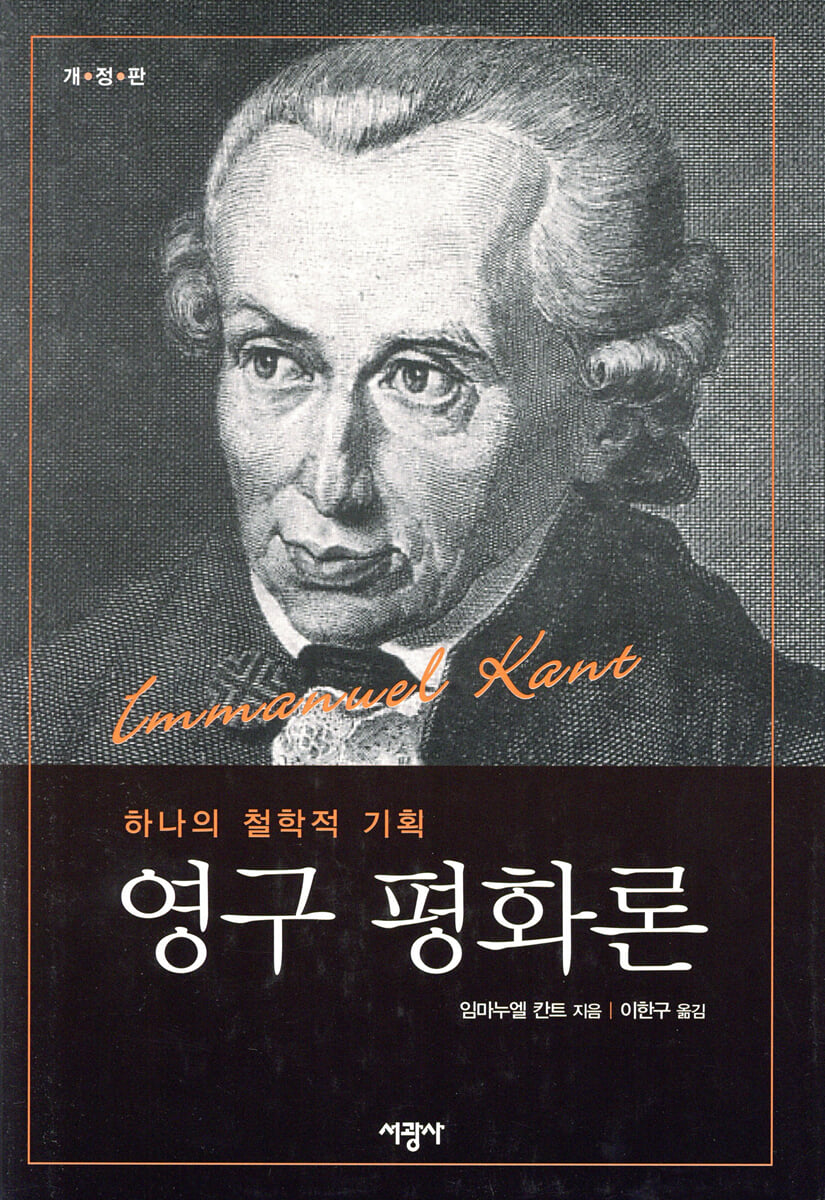
Immanuel Kant's 'Perpetual Peace' is a book created based on this historical background.
This paper, published in 1795, was revised and published again the following year, and it is said that the revised paper in 1786 included a "secret article for perpetual peace."
This paper does not provide specific action guidelines for achieving peace immediately, but it does outline the direction and goals that must be pursued to achieve true peace.
Therefore, it can be said to be an important classic in the process of discussing the issue of peace.
The author discussed the possibility of permanent peace from the perspectives of historical philosophy, moral philosophy, and political philosophy in the book.
Immanuel Kant's 'Perpetual Peace' is a book created based on this historical background.
This paper, published in 1795, was revised and published again the following year, and it is said that the revised paper in 1786 included a "secret article for perpetual peace."
This paper does not provide specific action guidelines for achieving peace immediately, but it does outline the direction and goals that must be pursued to achieve true peace.
Therefore, it can be said to be an important classic in the process of discussing the issue of peace.
The author discussed the possibility of permanent peace from the perspectives of historical philosophy, moral philosophy, and political philosophy in the book.
index
In publishing a revised edition
Preface For Permanent Peace
Chapter 1: Preliminary Provisions for Permanent Peace Between Nations
Chapter 2: Definitive Articles for Permanent Peace Between Nations
Supplementary Article 1: On the Guarantee of Perpetual Peace
Supplementary Article 2: Secret Articles for Perpetual Peace
Appendix 1: On the Conflict Between Morality and Politics Regarding Perpetual Peace
Appendix 2: On the Harmony Between Politics and Morality According to the A priori Concept of Public Law
Translator's Note
Preface For Permanent Peace
Chapter 1: Preliminary Provisions for Permanent Peace Between Nations
Chapter 2: Definitive Articles for Permanent Peace Between Nations
Supplementary Article 1: On the Guarantee of Perpetual Peace
Supplementary Article 2: Secret Articles for Perpetual Peace
Appendix 1: On the Conflict Between Morality and Politics Regarding Perpetual Peace
Appendix 2: On the Harmony Between Politics and Morality According to the A priori Concept of Public Law
Translator's Note
Publisher's Review
Kant's "Perpetual Peace," which argues that only perpetual peace is the highest political good and a moral practice that humanity must continue to strive for as long as it possesses reason, has been published in a revised edition by Seogwangsa Publishing, a publishing company specializing in philosophy books.
Wars have occurred continuously in the past under the pretext of preserving individuals and species.
It was only in the modern Enlightenment, the age of reason, that people began to think that war should be avoided, and various ideas were put forward in response.
In this atmosphere, Kant's 『Perpetual Peace』, first published in 1795, explains 'how' peace, which means the end, rather than the ceasefire, of hostilities between nations, should be achieved through "preliminary provisions for perpetual peace between nations."
“Definitive Articles for Perpetual Peace among Nations” discusses the legal mechanisms for establishing a state of peace.
In particular, this provision argues that, contrary to the idea of peace by the world's most powerful international state, each nation should maintain peace and guarantee its own rights under a republican system, which is reminiscent of today's United Nations.
Also in 1796, he added a "Secret Article for Perpetual Peace," which called on nations to take the advice of philosophers on principles of conduct.
The significance of Kant's theory of peace lies in the fact that it does not simply address current issues at the level of common sense, but rather discusses them academically from the perspectives of historical philosophy, moral philosophy, and political philosophy, and theoretically argues for the possibility of eternal peace.
Although "Perpetual Peace" does not provide specific guidelines for immediate peace, it is a classic work that must be read in that it suggests the direction and goals we must pursue to achieve true peace.
This will have significant implications, especially for the reality of the Korean Peninsula, which has suffered the devastation of war and still faces the risk of war.
Wars have occurred continuously in the past under the pretext of preserving individuals and species.
It was only in the modern Enlightenment, the age of reason, that people began to think that war should be avoided, and various ideas were put forward in response.
In this atmosphere, Kant's 『Perpetual Peace』, first published in 1795, explains 'how' peace, which means the end, rather than the ceasefire, of hostilities between nations, should be achieved through "preliminary provisions for perpetual peace between nations."
“Definitive Articles for Perpetual Peace among Nations” discusses the legal mechanisms for establishing a state of peace.
In particular, this provision argues that, contrary to the idea of peace by the world's most powerful international state, each nation should maintain peace and guarantee its own rights under a republican system, which is reminiscent of today's United Nations.
Also in 1796, he added a "Secret Article for Perpetual Peace," which called on nations to take the advice of philosophers on principles of conduct.
The significance of Kant's theory of peace lies in the fact that it does not simply address current issues at the level of common sense, but rather discusses them academically from the perspectives of historical philosophy, moral philosophy, and political philosophy, and theoretically argues for the possibility of eternal peace.
Although "Perpetual Peace" does not provide specific guidelines for immediate peace, it is a classic work that must be read in that it suggests the direction and goals we must pursue to achieve true peace.
This will have significant implications, especially for the reality of the Korean Peninsula, which has suffered the devastation of war and still faces the risk of war.
GOODS SPECIFICS
- Date of issue: December 20, 2008
- Format: Hardcover book binding method guide
- Page count, weight, size: 112 pages | 346g | 153*224*20mm
- ISBN13: 9788930610438
- ISBN10: 8930610439
You may also like
카테고리
korean


korean

![GQ KOREA Mark (Monthly): December [2025]](http://librairie.coreenne.fr/cdn/shop/files/8ef265dbbfbf186523ed75ba7319009d.jpg?v=1765340328&width=3840)


