

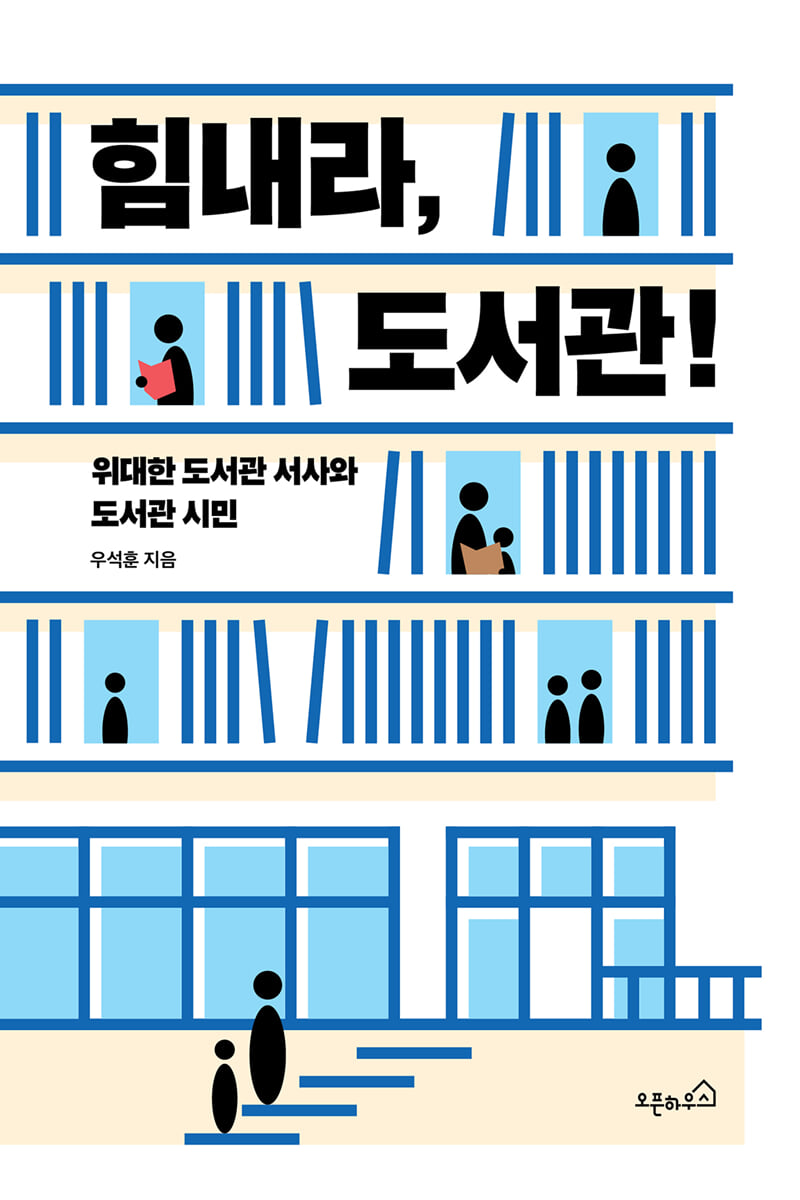
Cheer up, library!
 |
Description
Book Introduction
How much do we know about libraries?
As we can ask AI questions and easily access books in the form of e-books, the existence of libraries is gradually being forgotten.
In these times, economist Woo Seok-hoon wrote this book to highlight the economic impact of libraries and to preach the value that only libraries can offer.
Why do we need libraries?
That's because the creation of a library creates a space for citizens to discuss and collaborate in the area, and it becomes a real infrastructure that allows the area to function as a place for people to live.
Libraries, once simply places to read or borrow books for free, now serve as shelters and cultural centers for local residents, as well as providing care for the underprivileged.
The more economically difficult an area is, the fewer spaces there are where residents can gather and public power can operate.
Libraries can play that role.
This book examines how libraries first emerged in countries like the United States, Korea, and Japan, and how their growth has contributed to national economic development. It also delves into the true role of libraries and librarians, a topic we have largely overlooked.
We also explore solutions to the library crisis caused by the advent of the AI era and the disappearance of local communities, as well as how to improve policies for neglected libraries.
As we can ask AI questions and easily access books in the form of e-books, the existence of libraries is gradually being forgotten.
In these times, economist Woo Seok-hoon wrote this book to highlight the economic impact of libraries and to preach the value that only libraries can offer.
Why do we need libraries?
That's because the creation of a library creates a space for citizens to discuss and collaborate in the area, and it becomes a real infrastructure that allows the area to function as a place for people to live.
Libraries, once simply places to read or borrow books for free, now serve as shelters and cultural centers for local residents, as well as providing care for the underprivileged.
The more economically difficult an area is, the fewer spaces there are where residents can gather and public power can operate.
Libraries can play that role.
This book examines how libraries first emerged in countries like the United States, Korea, and Japan, and how their growth has contributed to national economic development. It also delves into the true role of libraries and librarians, a topic we have largely overlooked.
We also explore solutions to the library crisis caused by the advent of the AI era and the disappearance of local communities, as well as how to improve policies for neglected libraries.
- You can preview some of the book's contents.
Preview
index
Opening remarks
Chapter 1: How Did the United States Become an Economic Power?
A 17-year-old American boy who ran away from home
Things Benjamin Franklin Made
The Birth of the Library Citizen and the American Library Revolution
A retired colonel and a library boy
What is a public library?
The American Economy and the Library Revolution
Success Factors of the U.S. Economic Powerhouse and Library Citizens
Chapter 2: How did Korea become an economic powerhouse?
Japanese Libraries: A Brief History
Colonial India and the Five Laws of Library Science
The first governor-general's policy of no library
Injeong Library, the first full-fledged private public library
The President and the Library
The Beginning of the Great Library Epic: The Park Chung-hee Era
From the Chun Doo-hwan era to the Kim Dae-jung era
The Age of the Great Library Narrative
Chapter 3: Overflowing, Overflowing, Overflowing Again
Humanities of Mathematics
Foundation, Library and Personal Study
The 'overflow effect', knowledge, and endogenous growth
Water, Air, and Library Citizens
Literacy Gap and Library Gap
Will Books Survive in the AI Era?
Think long and read in piles
The Value of a Certain 'Sexy Novel' and the Value of a Library
Do you know the four books?
Chapter 4: Cheer up, Library!
Who plays with the library?
Miracle Library and Small Library
student gap
Uijeongbu Music Library: The World of Specialized Libraries
Is the National Assembly Library the opposition party's share?
Dream Library: A Library That Transforms Space into Place
Libraries for the Disabled and Braille Books
Library Citizens and the 'Living Library'
The Economy of Libraries and Care
A Short Library Sketch for Hikikomori
Closing the book
Chapter 1: How Did the United States Become an Economic Power?
A 17-year-old American boy who ran away from home
Things Benjamin Franklin Made
The Birth of the Library Citizen and the American Library Revolution
A retired colonel and a library boy
What is a public library?
The American Economy and the Library Revolution
Success Factors of the U.S. Economic Powerhouse and Library Citizens
Chapter 2: How did Korea become an economic powerhouse?
Japanese Libraries: A Brief History
Colonial India and the Five Laws of Library Science
The first governor-general's policy of no library
Injeong Library, the first full-fledged private public library
The President and the Library
The Beginning of the Great Library Epic: The Park Chung-hee Era
From the Chun Doo-hwan era to the Kim Dae-jung era
The Age of the Great Library Narrative
Chapter 3: Overflowing, Overflowing, Overflowing Again
Humanities of Mathematics
Foundation, Library and Personal Study
The 'overflow effect', knowledge, and endogenous growth
Water, Air, and Library Citizens
Literacy Gap and Library Gap
Will Books Survive in the AI Era?
Think long and read in piles
The Value of a Certain 'Sexy Novel' and the Value of a Library
Do you know the four books?
Chapter 4: Cheer up, Library!
Who plays with the library?
Miracle Library and Small Library
student gap
Uijeongbu Music Library: The World of Specialized Libraries
Is the National Assembly Library the opposition party's share?
Dream Library: A Library That Transforms Space into Place
Libraries for the Disabled and Braille Books
Library Citizens and the 'Living Library'
The Economy of Libraries and Care
A Short Library Sketch for Hikikomori
Closing the book
Into the book
The book club that began in the Junto, a gathering of Benjamin Franklin and his associates, quickly became a membership library, and this model quickly spread throughout the New World.
In the new world, which was made up of immigrants, an unexpected reading craze swept through.
The reading group Junto, founded by Franklin, later became the Philadelphia Library.
The city became a temporary base for the independent government and also served as the National Library.
This small library, which started out as a small group of people each contributing a few shillings, gradually developed into a central institution in the area, lending books free of charge to local workers and students.
--- p.31
Among Carnegie's many philanthropic endeavors, the library endowment was the first, and although it involved only a small portion of his financial resources, the establishment of public libraries would later change the very nature of capitalism.
The United States, which had been building libraries like crazy throughout the 19th century, has now become a library powerhouse in the public library sector that no other capitalist country can match.
With one or more libraries in each region, the United States stands out as a symbol of innovation.
Throughout the 20th century and even today, American companies have driven innovation in the global economy.
--- p.71
It is difficult for poor students or those who have never found math fun to attend a private academy.
However, I thought that if there are students who are determined to study on their own with the help of books, a math library for them could be of help.
If you find it difficult to get past the first step with just a book, you can create a library lecture program that provides fun, step-by-step explanations of the context and flow.
If I had to give this program a name, it would be something like 'Humanities of Mathematics.'
Here, students who have given up on mathematics may find themselves drawn back to the world of practical mathematics by hearing stories about its history, origins, and practical applications.
You can't do this at a school that charges you money and forces you to do functional, repetitive training, but a library can.
--- p.169
As I began to understand libraries a little better, I began to think that a good library is actually a noisy place with lots of children.
I saw in a library in the US that there was a large door for adults to enter and a smaller door next to it that was the right size for children.
It was a small device that reminded children that they were the owners of this place.
A library like that is a better library.
The same goes for university libraries.
A library where friends can talk and discuss with each other is a better library, but a library so quiet that you can hear even the sound of a mosquito is not necessarily a good library.
--- p.192
A library, seen through the eyes of books, is a place where users dream of new dreams for a better life, but as a space, the library also has strong welfare characteristics.
The library is a kind of local welfare facility.
The recent convergence of multiple functions within local public libraries reflects the economic reality that makes it difficult to create separate spaces for residents in struggling areas.
Another function of the library can be considered as an extension of local welfare or resident welfare.
This is especially true in the current reality where people are gathering in the metropolitan area and many things are concentrated there, especially in areas that are becoming increasingly marginalized.
In rural areas, libraries are a basic facility for everything from childcare to youth and seniors.
--- p.327
I have a small wish that Korean teenagers will make one or two happy memories related to libraries that they will cherish for the rest of their lives as adults.
There are so many fun and interesting things to do.
Still, fond memories of the library will have special meaning in life.
For anyone living in Korea, the library is the easiest and most convenient public space to visit.
It's a brilliant system created by capitalism, and it's America's greatest contribution to humanity.
Isn't it because something very special happened that we can easily go to the library?
In the new world, which was made up of immigrants, an unexpected reading craze swept through.
The reading group Junto, founded by Franklin, later became the Philadelphia Library.
The city became a temporary base for the independent government and also served as the National Library.
This small library, which started out as a small group of people each contributing a few shillings, gradually developed into a central institution in the area, lending books free of charge to local workers and students.
--- p.31
Among Carnegie's many philanthropic endeavors, the library endowment was the first, and although it involved only a small portion of his financial resources, the establishment of public libraries would later change the very nature of capitalism.
The United States, which had been building libraries like crazy throughout the 19th century, has now become a library powerhouse in the public library sector that no other capitalist country can match.
With one or more libraries in each region, the United States stands out as a symbol of innovation.
Throughout the 20th century and even today, American companies have driven innovation in the global economy.
--- p.71
It is difficult for poor students or those who have never found math fun to attend a private academy.
However, I thought that if there are students who are determined to study on their own with the help of books, a math library for them could be of help.
If you find it difficult to get past the first step with just a book, you can create a library lecture program that provides fun, step-by-step explanations of the context and flow.
If I had to give this program a name, it would be something like 'Humanities of Mathematics.'
Here, students who have given up on mathematics may find themselves drawn back to the world of practical mathematics by hearing stories about its history, origins, and practical applications.
You can't do this at a school that charges you money and forces you to do functional, repetitive training, but a library can.
--- p.169
As I began to understand libraries a little better, I began to think that a good library is actually a noisy place with lots of children.
I saw in a library in the US that there was a large door for adults to enter and a smaller door next to it that was the right size for children.
It was a small device that reminded children that they were the owners of this place.
A library like that is a better library.
The same goes for university libraries.
A library where friends can talk and discuss with each other is a better library, but a library so quiet that you can hear even the sound of a mosquito is not necessarily a good library.
--- p.192
A library, seen through the eyes of books, is a place where users dream of new dreams for a better life, but as a space, the library also has strong welfare characteristics.
The library is a kind of local welfare facility.
The recent convergence of multiple functions within local public libraries reflects the economic reality that makes it difficult to create separate spaces for residents in struggling areas.
Another function of the library can be considered as an extension of local welfare or resident welfare.
This is especially true in the current reality where people are gathering in the metropolitan area and many things are concentrated there, especially in areas that are becoming increasingly marginalized.
In rural areas, libraries are a basic facility for everything from childcare to youth and seniors.
--- p.327
I have a small wish that Korean teenagers will make one or two happy memories related to libraries that they will cherish for the rest of their lives as adults.
There are so many fun and interesting things to do.
Still, fond memories of the library will have special meaning in life.
For anyone living in Korea, the library is the easiest and most convenient public space to visit.
It's a brilliant system created by capitalism, and it's America's greatest contribution to humanity.
Isn't it because something very special happened that we can easily go to the library?
--- p.377
Publisher's Review
If there were no libraries, the United States, the economic powerhouse it is today, would not exist!
Libraries are not inefficient entities that just consume money.
It is an essential system that continuously creates national wealth.
In 1717, at the age of 17, Benjamin Franklin left home and settled in Philadelphia. While working as a printer, he formed a reading group called "Junto" with his colleagues.
This model, which became the prototype of today's 'membership library,' quickly spread throughout the United States and played a major role in accelerating the country's independence from Britain.
The United States, a latecomer to industrialization, was able to rise to become the world's leading economic power because it was the first country in the world to build large-scale public libraries.
Factories make products, and libraries make people to make those products.
A society rich in libraries creates its own unique strengths.
This is called 'innovation capacity'.
In the latter half of the 20th century, with the emergence of the concept of 'human capital', these abilities began to receive serious attention.
And even in the 21st century, the United States remains the most active country in creating and operating libraries.
The library clearly played a significant role in the background of Franklin, a printer who became a journalist by reading books without any special formal education and who became a founding father of the United States.
A small village library created by a retired colonel led Carnegie from a young laborer to a world-famous steel magnate.
Each and every Franklin and Carnegie who simply wanted to read books and needed books came together to form and lead the United States of today.
Libraries also played an important role during Korea's economic boom.
Korea also became an economic powerhouse as libraries served as a focal point for local communities and helped raise the level of knowledge among the people.
No country in the capitalist system has ever achieved long-term economic prosperity without expanding its libraries.
In Korea, paradoxically, a boom in library construction occurred during the military regime.
The number of public libraries, which was only 18 in 1960, increased to 119 during the Park Chung-hee era and then to 232 during the Chun Doo-hwan era.
It is not well known that the Five-Year Economic Development Plan and the Five-Year Public Library Establishment Plan were implemented almost simultaneously.
The library was included as an element at the center of the Korean planned economy.
It is also impressive that the current Kyunghee University Central Library began during the Korean War.
It is heartbreaking to learn that during the difficult evacuation, some universities, including Yonsei University, Seoul National University, and Korea University, operated small temporary libraries in Busan and Daegu.
The narrative of Korean libraries has continued its great journey even in these challenging times.
Economist Woo Seok-hoon diagnosed
The value and raison d'être of libraries
How much do we know about libraries?
For most people, a library is simply a place where they can read and borrow books for free, find hard-to-find articles and academic materials, or study in a quiet environment.
So when was the last time you went to the library?
Most people would probably answer that their school days were the last time.
As we can ask AI questions and easily access books in the form of e-books, the existence of libraries is gradually being forgotten.
In these times, economist Woo Seok-hoon wrote this book to highlight the economic impact of libraries and to preach the value that only libraries can offer.
Why do we need libraries?
That's because the creation of a library creates a space for citizens to discuss and collaborate in the area, and it becomes a real infrastructure that allows the area to function as a place for people to live.
Libraries, once simply places to read or borrow books for free, now serve as shelters and cultural centers for local residents, as well as providing care for the underprivileged.
The more economically difficult an area is, the fewer spaces there are where residents can gather and public power can operate.
Libraries can play that role.
This book examines how libraries first emerged in countries like the United States, Korea, and Japan, and how their growth has contributed to national economic development. It also delves into the true role of libraries and librarians, a topic we have largely overlooked.
We also explore solutions to the library crisis caused by the advent of the AI era and the disappearance of local communities, as well as how to improve policies for neglected libraries.
Libraries are not inefficient entities that just consume money.
It is an essential system that continuously creates national wealth.
In 1717, at the age of 17, Benjamin Franklin left home and settled in Philadelphia. While working as a printer, he formed a reading group called "Junto" with his colleagues.
This model, which became the prototype of today's 'membership library,' quickly spread throughout the United States and played a major role in accelerating the country's independence from Britain.
The United States, a latecomer to industrialization, was able to rise to become the world's leading economic power because it was the first country in the world to build large-scale public libraries.
Factories make products, and libraries make people to make those products.
A society rich in libraries creates its own unique strengths.
This is called 'innovation capacity'.
In the latter half of the 20th century, with the emergence of the concept of 'human capital', these abilities began to receive serious attention.
And even in the 21st century, the United States remains the most active country in creating and operating libraries.
The library clearly played a significant role in the background of Franklin, a printer who became a journalist by reading books without any special formal education and who became a founding father of the United States.
A small village library created by a retired colonel led Carnegie from a young laborer to a world-famous steel magnate.
Each and every Franklin and Carnegie who simply wanted to read books and needed books came together to form and lead the United States of today.
Libraries also played an important role during Korea's economic boom.
Korea also became an economic powerhouse as libraries served as a focal point for local communities and helped raise the level of knowledge among the people.
No country in the capitalist system has ever achieved long-term economic prosperity without expanding its libraries.
In Korea, paradoxically, a boom in library construction occurred during the military regime.
The number of public libraries, which was only 18 in 1960, increased to 119 during the Park Chung-hee era and then to 232 during the Chun Doo-hwan era.
It is not well known that the Five-Year Economic Development Plan and the Five-Year Public Library Establishment Plan were implemented almost simultaneously.
The library was included as an element at the center of the Korean planned economy.
It is also impressive that the current Kyunghee University Central Library began during the Korean War.
It is heartbreaking to learn that during the difficult evacuation, some universities, including Yonsei University, Seoul National University, and Korea University, operated small temporary libraries in Busan and Daegu.
The narrative of Korean libraries has continued its great journey even in these challenging times.
Economist Woo Seok-hoon diagnosed
The value and raison d'être of libraries
How much do we know about libraries?
For most people, a library is simply a place where they can read and borrow books for free, find hard-to-find articles and academic materials, or study in a quiet environment.
So when was the last time you went to the library?
Most people would probably answer that their school days were the last time.
As we can ask AI questions and easily access books in the form of e-books, the existence of libraries is gradually being forgotten.
In these times, economist Woo Seok-hoon wrote this book to highlight the economic impact of libraries and to preach the value that only libraries can offer.
Why do we need libraries?
That's because the creation of a library creates a space for citizens to discuss and collaborate in the area, and it becomes a real infrastructure that allows the area to function as a place for people to live.
Libraries, once simply places to read or borrow books for free, now serve as shelters and cultural centers for local residents, as well as providing care for the underprivileged.
The more economically difficult an area is, the fewer spaces there are where residents can gather and public power can operate.
Libraries can play that role.
This book examines how libraries first emerged in countries like the United States, Korea, and Japan, and how their growth has contributed to national economic development. It also delves into the true role of libraries and librarians, a topic we have largely overlooked.
We also explore solutions to the library crisis caused by the advent of the AI era and the disappearance of local communities, as well as how to improve policies for neglected libraries.
GOODS SPECIFICS
- Date of issue: October 24, 2025
- Page count, weight, size: 380 pages | 420g | 140*210*20mm
- ISBN13: 9791192385396
- ISBN10: 119238539X
You may also like
카테고리
korean


korean

![GQ KOREA Mark (Monthly): December [2025]](http://librairie.coreenne.fr/cdn/shop/files/8ef265dbbfbf186523ed75ba7319009d.jpg?v=1765340328&width=3840)


