

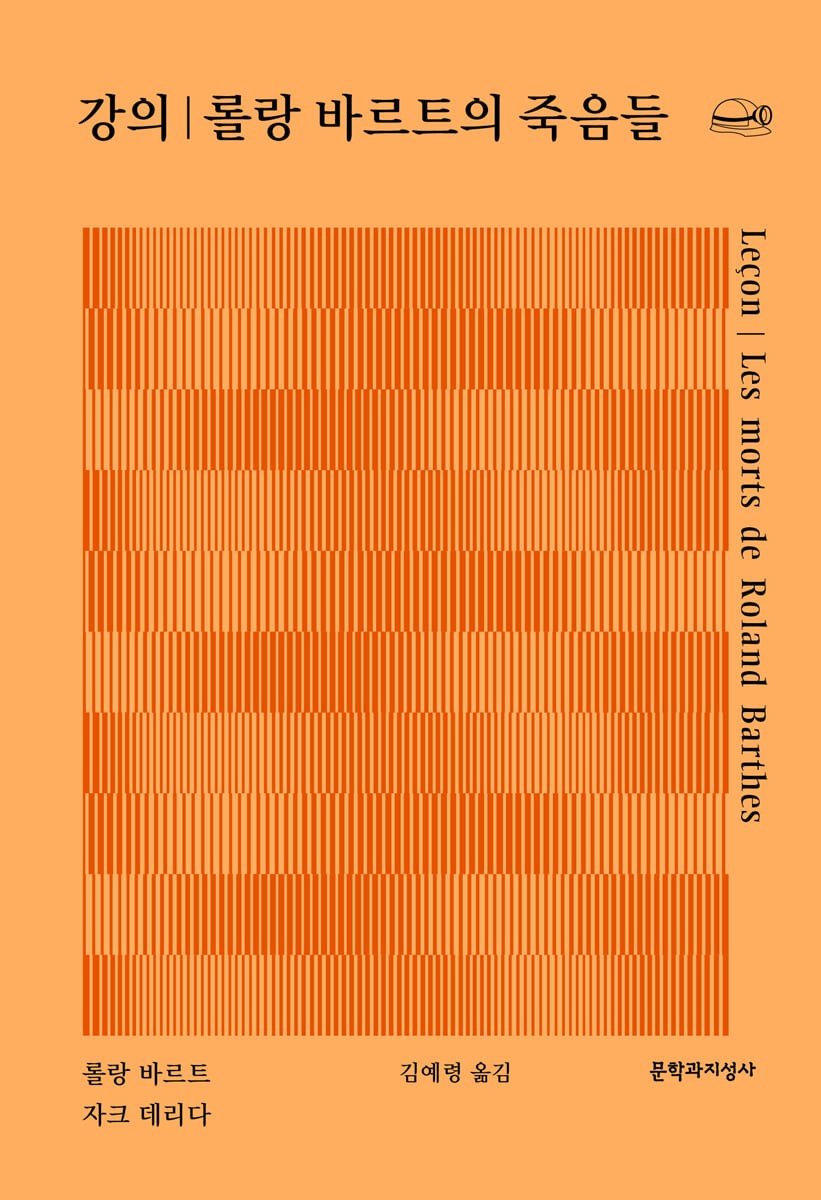
Lecture│Roland Barthes' Deaths
 |
Description
Book Introduction
“In the radiance of the permanent revolution of language,
This beneficial trick that allows you to hear what's outside of power,
So to speak, a subtle evasion, that wonderful trick, I did it in my own way.
“It is called literature.”
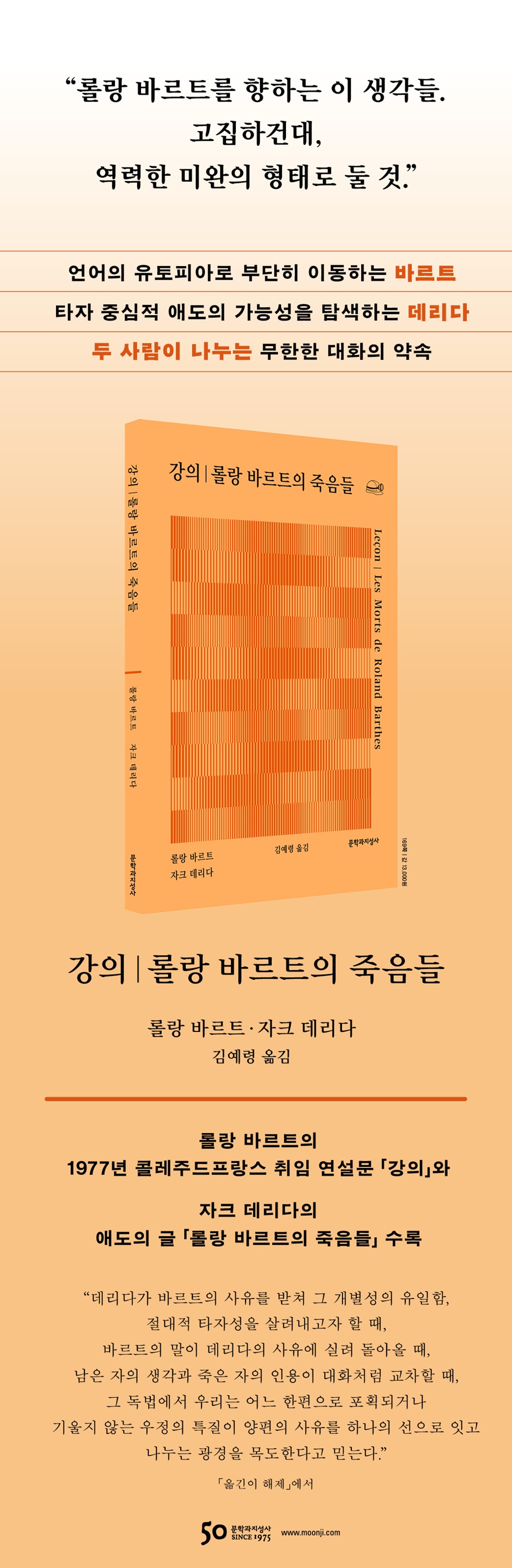
The book "Lectures? The Deaths of Roland Barthes" (translated by Kim Ye-ryeong), which compiles the inaugural address of the Collège de France by French semiotician and literary critic Roland Barthes, "Lectures," and the condolence essay "The Deaths of Roland Barthes" published by Jacques Derrida the year after Barthes's death, has been published as part of Munhak-kwa-Jiseongsa's "Quarry Series."
These two texts, one written at the beginning of Barthes and the other at the end of Barthes, have the interesting commonality of tracing the trajectory of Barthes's thought.
Barthes devoted himself to structuralism in the early stages of his intellectual career, but after a transitional period in which he explored new possibilities in textual analysis, he later underwent an ideological shift, opposing reductive systems and embracing the play of signs.
This movement is also illuminated by Derrida, who closely examines and cites his books in “The Deaths of Roland Barthes.”
Reading these intersections in these two concise yet profound texts not only allows us to gauge the academic friendship shared between Barthes and Derrida, but also enables new readings by examining Barthes and Derrida from different angles.
This beneficial trick that allows you to hear what's outside of power,
So to speak, a subtle evasion, that wonderful trick, I did it in my own way.
“It is called literature.”
The book "Lectures? The Deaths of Roland Barthes" (translated by Kim Ye-ryeong), which compiles the inaugural address of the Collège de France by French semiotician and literary critic Roland Barthes, "Lectures," and the condolence essay "The Deaths of Roland Barthes" published by Jacques Derrida the year after Barthes's death, has been published as part of Munhak-kwa-Jiseongsa's "Quarry Series."
These two texts, one written at the beginning of Barthes and the other at the end of Barthes, have the interesting commonality of tracing the trajectory of Barthes's thought.
Barthes devoted himself to structuralism in the early stages of his intellectual career, but after a transitional period in which he explored new possibilities in textual analysis, he later underwent an ideological shift, opposing reductive systems and embracing the play of signs.
This movement is also illuminated by Derrida, who closely examines and cites his books in “The Deaths of Roland Barthes.”
Reading these intersections in these two concise yet profound texts not only allows us to gauge the academic friendship shared between Barthes and Derrida, but also enables new readings by examining Barthes and Derrida from different angles.
- You can preview some of the book's contents.
Preview
index
lecture
The Deaths of Roland Barthes
Translator's Note: B/D
The Deaths of Roland Barthes
Translator's Note: B/D
Detailed image
Into the book
As a linguistic practice, language is neither reactionary nor progressive.
It's just fascist.
Because, as you know, fascism is not about suppressing speech, but about forcing speech.
--- From "Lecture"
As many languages as there are desires.
This is a utopian proposal, in that no society has yet been prepared to accept the existence of multiple desires.
I hope that one language, whatever it may be, will not oppress the other, and that the subject to come will be able to enjoy both levels of language freely without any sense of guilt or oppression, and that he will be able to speak this or that language by virtue rather than by law.
--- p.32
The constant return to text, and the regular commitment to writing as the most complex of semiotic practices (since it operates from already formed signs), compels semiotics to explore differences.
Moreover, it prevents semiotics from becoming dogmatic and 'captive', from presenting itself as a universal discourse, contrary to what it actually is.
Conversely, the semiotic gaze that is embedded in the text forces us to reject the myth of pure creativity, which we often rely on to rescue literature from the brain-busting words that surround and oppress it.
After all, a symbol is something that is thought to better conform to expectations, and should be rethought for that purpose.
--- p.43
Old values are no longer passed down, circulated, or stimulated.
Literature has been stripped of its sacredness, and institutions are now powerless to protect it or to impose it as an implicit model of humanity.
But well, literature isn't destroyed.
It's just not guarded anymore.
So now is the time to turn to literature.
Perhaps literary semiotics will be just such a journey, allowing us to land in a landscape liberated by the absence of heirs.
There will be no angels or dragons to stop it now.
Thus, the gaze can still be directed towards old and beautiful things that have become abstracted after their expiration date, while still retaining their depravity.
This will be a downfall, but also a prophetic moment, a moment of gentle eschatology, and a historical moment of the greatest joy.
--- p.49
There is an age when we teach ourselves what we know.
But soon another time will come, and in that time we will teach what we do not know.
We call this exploring.
Perhaps now is the time for another experience.
It is the age when we forget what we have just learned, the age when we allow the unpredictable rearrangements that forgetting brings to bear on the sediment of knowledge, culture, and beliefs we have accumulated over the years.
I think this experience has a very famous and outdated name.
Now, standing at the very crossroads of etymology, I dare to adopt that name without any hesitation.
Wisdom, that is, no power at all, a little knowledge, a little cleverness, the greatest possible taste.
--- p.54~55
His technique.
His way of revealing, operating and interpreting the studium/punctum pair, while simultaneously telling us what he is doing and transmitting notes.
From there we will hear music.
This technique is truly his way.
The studium/punctum opposition, a superficial contrast indicated by a diagonal line.
[...] This apparent opposition (of studium/punctum) does not prohibit, but rather encourages, a certain composition that occurs between the two concepts.
How should we understand this term "composition"? It implies two things, and both are again compromises.
First, 1) when two concepts separated by an impassable boundary mediate each other and one compromises with the other, we will soon see metonymic manipulation.
--- From "The Deaths of Roland Barthes"
Two betrayals, impossible choices.
On the one hand, there is a way of saying nothing at all that is attributed only to oneself, only to one's own voice.
[...] On the other hand, there is a way of avoiding all quotation, identification, or even comparison, so that what is said to or about Roland Barthes really comes from his counterpart, his living friend.
Even in that case, we still run the risk of making him disappear.
All of this is a rude revenge of death by adding death to death.
The only way left is to either do both or neither.
That is, the work of correcting one side's betrayal with the other side's betrayal.
From the death of one to the death of the other.
Is it the anxiety that comes from that very place that compels me to begin writing in the plural?
--- p.85~86
The Deaths of Roland Barthes.
Some might think that I was trying to oppose the only one because of the somewhat rude violence of this plural.
That I tried to avoid, deny, and erase his death.
Again, as a sign of protection or protest, he resented his death and gave it over to the process of nothing other than studium metonymy.
Maybe it could have been.
But how else can we say it, without taking that risk?
How, without pluralizing the unique, without generalizing even the most irreplaceable thing he possesses: his own death?
--- p.118~19
Could the act of enunciation, "I am dead," which he called impossible, perhaps belong to the system he elsewhere calls utopian? And if so, isn't that utopia located precisely where a metonymy already operates me in relation to myself, precisely where I designate nothing else but myself, present here and now, speaking.
It's just fascist.
Because, as you know, fascism is not about suppressing speech, but about forcing speech.
--- From "Lecture"
As many languages as there are desires.
This is a utopian proposal, in that no society has yet been prepared to accept the existence of multiple desires.
I hope that one language, whatever it may be, will not oppress the other, and that the subject to come will be able to enjoy both levels of language freely without any sense of guilt or oppression, and that he will be able to speak this or that language by virtue rather than by law.
--- p.32
The constant return to text, and the regular commitment to writing as the most complex of semiotic practices (since it operates from already formed signs), compels semiotics to explore differences.
Moreover, it prevents semiotics from becoming dogmatic and 'captive', from presenting itself as a universal discourse, contrary to what it actually is.
Conversely, the semiotic gaze that is embedded in the text forces us to reject the myth of pure creativity, which we often rely on to rescue literature from the brain-busting words that surround and oppress it.
After all, a symbol is something that is thought to better conform to expectations, and should be rethought for that purpose.
--- p.43
Old values are no longer passed down, circulated, or stimulated.
Literature has been stripped of its sacredness, and institutions are now powerless to protect it or to impose it as an implicit model of humanity.
But well, literature isn't destroyed.
It's just not guarded anymore.
So now is the time to turn to literature.
Perhaps literary semiotics will be just such a journey, allowing us to land in a landscape liberated by the absence of heirs.
There will be no angels or dragons to stop it now.
Thus, the gaze can still be directed towards old and beautiful things that have become abstracted after their expiration date, while still retaining their depravity.
This will be a downfall, but also a prophetic moment, a moment of gentle eschatology, and a historical moment of the greatest joy.
--- p.49
There is an age when we teach ourselves what we know.
But soon another time will come, and in that time we will teach what we do not know.
We call this exploring.
Perhaps now is the time for another experience.
It is the age when we forget what we have just learned, the age when we allow the unpredictable rearrangements that forgetting brings to bear on the sediment of knowledge, culture, and beliefs we have accumulated over the years.
I think this experience has a very famous and outdated name.
Now, standing at the very crossroads of etymology, I dare to adopt that name without any hesitation.
Wisdom, that is, no power at all, a little knowledge, a little cleverness, the greatest possible taste.
--- p.54~55
His technique.
His way of revealing, operating and interpreting the studium/punctum pair, while simultaneously telling us what he is doing and transmitting notes.
From there we will hear music.
This technique is truly his way.
The studium/punctum opposition, a superficial contrast indicated by a diagonal line.
[...] This apparent opposition (of studium/punctum) does not prohibit, but rather encourages, a certain composition that occurs between the two concepts.
How should we understand this term "composition"? It implies two things, and both are again compromises.
First, 1) when two concepts separated by an impassable boundary mediate each other and one compromises with the other, we will soon see metonymic manipulation.
--- From "The Deaths of Roland Barthes"
Two betrayals, impossible choices.
On the one hand, there is a way of saying nothing at all that is attributed only to oneself, only to one's own voice.
[...] On the other hand, there is a way of avoiding all quotation, identification, or even comparison, so that what is said to or about Roland Barthes really comes from his counterpart, his living friend.
Even in that case, we still run the risk of making him disappear.
All of this is a rude revenge of death by adding death to death.
The only way left is to either do both or neither.
That is, the work of correcting one side's betrayal with the other side's betrayal.
From the death of one to the death of the other.
Is it the anxiety that comes from that very place that compels me to begin writing in the plural?
--- p.85~86
The Deaths of Roland Barthes.
Some might think that I was trying to oppose the only one because of the somewhat rude violence of this plural.
That I tried to avoid, deny, and erase his death.
Again, as a sign of protection or protest, he resented his death and gave it over to the process of nothing other than studium metonymy.
Maybe it could have been.
But how else can we say it, without taking that risk?
How, without pluralizing the unique, without generalizing even the most irreplaceable thing he possesses: his own death?
--- p.118~19
Could the act of enunciation, "I am dead," which he called impossible, perhaps belong to the system he elsewhere calls utopian? And if so, isn't that utopia located precisely where a metonymy already operates me in relation to myself, precisely where I designate nothing else but myself, present here and now, speaking.
--- p.135
Publisher's Review
Lecture: Towards Utopias of Language
So moving means:
Going where people don't expect you, or, to put it more radically, officially abandoning what you've written before when the powers that be are using and subjugating it.
(p.
34)
"Lecture" is a lecture given by Roland Barthes on January 7, 1977, at the opening of his first semester as professor of literary semiotics at the Collège de France.
Barthes's appointment to the Collège de France attracted so much attention that the lecture hall was filled on the first day with scholars, students, the general public, and reporters, and the enthusiasm continued with the three lectures Barthes gave at the Collège de France until 1980: "How to Live Together," "Neutrality," and "Preparing the Novel."
In this lecture, which summarizes and organizes his academic journey and becomes a symbolic event that announces the beginning of his activities at the Collège de France, he argues that language is fundamentally “fascist” (p.
20) makes a controversial statement.
He argues that “our real struggle” lies in opposing the “powers” that are inseparable from the inseparable relationship between language and power, which was a major issue in 20th-century French intellectual society, and he posits literature as a tactic to deceive language, as it cannot go outside of it.
Founded in 1530, the Collège de France has been committed to providing open education to all since its inception, and is considered a privileged place outside of power.
To stand on the podium here, one must be recommended by a professor from the Academy and the Collège de France, and Barthes was recommended by Michel Foucault, who had been teaching at the Collège de France since 1970.
However, this was controversial at the time.
Barthes's style, which was based on his writing outside of traditional institutions, crossing over various contemporary theories, including classical literature, rhetoric, linguistics, and semiotics, and his inability to "obtain a formal degree" due to tuberculosis, raised suspicions in institutional criticism circles and university lecture halls.
The "Lecture" submitted in this tension contains the small and soft resistance of the question mark that Barthes creates as a "writer who only writes essays," an ambiguous being, a subject who is subtly shaken in any place or system.
In this article, Barthes poses the question of how to create a utopia, a space of liberation for language.
If humans cannot completely go outside of language, then, on the contrary, we can dream of a utopia of language, a space of words that extends and moves infinitely according to the individuality and plurality of desires.
However, “the utopia of language is recovered as the language of utopia” (p.
32) As Barth points out, any attempt to resist power is bound to be co-opted by power.
That is precisely why authors are required to stubbornly move themselves, to abandon their attempts if they are exploited by those in power.
This is no exception even at the Collège de France, which is outside of power and institutions, and thus Barthes says:
“I truly believe that when I begin a lecture like this, I must always be willing to make room for fantasy.” (p.
52) The audience who attended Barthes' lectures at the Collège de France from 1977 to 1980 were thus involved in a scene that was constantly moving toward utopia.
"The Deaths of Roland Barthes": Sharing with a Friend Who Has Passed Away
The promise of endless conversation, condolences
The second text in this book, "The Deaths of Roland Barthes," is a eulogy published by Jacques Derrida in the magazine Poétique in 1981, the year after Roland Barthes passed away.
Beginning with his eulogy for Barthes, Derrida wrote farewells in various forms to his academic friends, including Michel Foucault, Emmanuel Levinas, Jean-François Lyotard, and Maurice Blanchot, whenever they passed away over the next 20 years.
These mourning essays illustrate the themes of friendship, mourning, and otherness in Derrida's philosophy, as the French title of the book that compiles these essays, "The End of the World, Each Time Unique," suggests: for Derrida, the death of a friend is always the end of the entire world, in that each and every one of them is an utterly unique and irreplaceable other.
“People say that grief is a gradual process of slowly erasing pain.
Resonating with the quote from The Bright Room, “I could not believe that and still do not believe it,” Derrida in this passage questions the ordinary mourning process that eliminates the otherness of the other through the subject’s memory.
In the work of mourning, the living cannot help but betray the dead.
The dead die once more, each one of them being organized into the one-sided memories of the living.
Derrida resists this conventional mourning work, but rather than remain silent, he chooses to write about Barthes.
“How else can I say it, without taking that risk?
“Without pluralizing the unique, without generalizing even the most irreplaceable thing he possesses, his own death.” (p.
119) To enable a friend who cannot answer when called to speak in a way other than vocalization, Derrida opens Barthes's books instead.
Derrida's perspective, which focuses on metonymy as the force that allows Barthes's body to be transformed and disseminated into Barthes's book, provides us with an opportunity to explore the possibility of other-centered mourning.
In "The Deaths of Roland Barthes," Derrida performs a faithful reading that seeks to prevent the tyranny of the living, who judge the dead as they please, and to return the right to speak to the words of a friend.
This allows us to discern the subtle interconnected principles of Barth's thought that we had not previously noticed, and to identify Barth's subtle tones.
When Barthes' words return to Derrida's thoughts, when the thoughts of the survivors and the quotations of the dead intersect like a conversation, the reading depicts a scene where a friendship that does not lean to either side connects and divides the thoughts of the two as a single line.
So moving means:
Going where people don't expect you, or, to put it more radically, officially abandoning what you've written before when the powers that be are using and subjugating it.
(p.
34)
"Lecture" is a lecture given by Roland Barthes on January 7, 1977, at the opening of his first semester as professor of literary semiotics at the Collège de France.
Barthes's appointment to the Collège de France attracted so much attention that the lecture hall was filled on the first day with scholars, students, the general public, and reporters, and the enthusiasm continued with the three lectures Barthes gave at the Collège de France until 1980: "How to Live Together," "Neutrality," and "Preparing the Novel."
In this lecture, which summarizes and organizes his academic journey and becomes a symbolic event that announces the beginning of his activities at the Collège de France, he argues that language is fundamentally “fascist” (p.
20) makes a controversial statement.
He argues that “our real struggle” lies in opposing the “powers” that are inseparable from the inseparable relationship between language and power, which was a major issue in 20th-century French intellectual society, and he posits literature as a tactic to deceive language, as it cannot go outside of it.
Founded in 1530, the Collège de France has been committed to providing open education to all since its inception, and is considered a privileged place outside of power.
To stand on the podium here, one must be recommended by a professor from the Academy and the Collège de France, and Barthes was recommended by Michel Foucault, who had been teaching at the Collège de France since 1970.
However, this was controversial at the time.
Barthes's style, which was based on his writing outside of traditional institutions, crossing over various contemporary theories, including classical literature, rhetoric, linguistics, and semiotics, and his inability to "obtain a formal degree" due to tuberculosis, raised suspicions in institutional criticism circles and university lecture halls.
The "Lecture" submitted in this tension contains the small and soft resistance of the question mark that Barthes creates as a "writer who only writes essays," an ambiguous being, a subject who is subtly shaken in any place or system.
In this article, Barthes poses the question of how to create a utopia, a space of liberation for language.
If humans cannot completely go outside of language, then, on the contrary, we can dream of a utopia of language, a space of words that extends and moves infinitely according to the individuality and plurality of desires.
However, “the utopia of language is recovered as the language of utopia” (p.
32) As Barth points out, any attempt to resist power is bound to be co-opted by power.
That is precisely why authors are required to stubbornly move themselves, to abandon their attempts if they are exploited by those in power.
This is no exception even at the Collège de France, which is outside of power and institutions, and thus Barthes says:
“I truly believe that when I begin a lecture like this, I must always be willing to make room for fantasy.” (p.
52) The audience who attended Barthes' lectures at the Collège de France from 1977 to 1980 were thus involved in a scene that was constantly moving toward utopia.
"The Deaths of Roland Barthes": Sharing with a Friend Who Has Passed Away
The promise of endless conversation, condolences
The second text in this book, "The Deaths of Roland Barthes," is a eulogy published by Jacques Derrida in the magazine Poétique in 1981, the year after Roland Barthes passed away.
Beginning with his eulogy for Barthes, Derrida wrote farewells in various forms to his academic friends, including Michel Foucault, Emmanuel Levinas, Jean-François Lyotard, and Maurice Blanchot, whenever they passed away over the next 20 years.
These mourning essays illustrate the themes of friendship, mourning, and otherness in Derrida's philosophy, as the French title of the book that compiles these essays, "The End of the World, Each Time Unique," suggests: for Derrida, the death of a friend is always the end of the entire world, in that each and every one of them is an utterly unique and irreplaceable other.
“People say that grief is a gradual process of slowly erasing pain.
Resonating with the quote from The Bright Room, “I could not believe that and still do not believe it,” Derrida in this passage questions the ordinary mourning process that eliminates the otherness of the other through the subject’s memory.
In the work of mourning, the living cannot help but betray the dead.
The dead die once more, each one of them being organized into the one-sided memories of the living.
Derrida resists this conventional mourning work, but rather than remain silent, he chooses to write about Barthes.
“How else can I say it, without taking that risk?
“Without pluralizing the unique, without generalizing even the most irreplaceable thing he possesses, his own death.” (p.
119) To enable a friend who cannot answer when called to speak in a way other than vocalization, Derrida opens Barthes's books instead.
Derrida's perspective, which focuses on metonymy as the force that allows Barthes's body to be transformed and disseminated into Barthes's book, provides us with an opportunity to explore the possibility of other-centered mourning.
In "The Deaths of Roland Barthes," Derrida performs a faithful reading that seeks to prevent the tyranny of the living, who judge the dead as they please, and to return the right to speak to the words of a friend.
This allows us to discern the subtle interconnected principles of Barth's thought that we had not previously noticed, and to identify Barth's subtle tones.
When Barthes' words return to Derrida's thoughts, when the thoughts of the survivors and the quotations of the dead intersect like a conversation, the reading depicts a scene where a friendship that does not lean to either side connects and divides the thoughts of the two as a single line.
GOODS SPECIFICS
- Date of issue: August 29, 2025
- Page count, weight, size: 169 pages | 194g | 129*187*9mm
- ISBN13: 9788932044361
- ISBN10: 8932044368
You may also like
카테고리
korean


korean

![GQ KOREA Mark (Monthly): December [2025]](http://librairie.coreenne.fr/cdn/shop/files/8ef265dbbfbf186523ed75ba7319009d.jpg?v=1765340328&width=3840)


