

How to catch and how to let go
 |
Description
Book Introduction
Psychology for people who hold on to things they should let go of, or easily let go of things they should hold on to.
This book explores the personality traits of dependent and avoidant tendencies.
People with strong dependency tend to hold on to relationships, emotions, and a need for recognition to reduce their anxiety.
On the other hand, people with avoidant tendencies let go of things they need to hold on to, such as responsibility, intimacy, choice, and self-esteem.
This book aims to understand the complex workings of dependence and avoidance, and to restore the balance between them so that we can become comfortable and free.
As a psychologist and therapist who is trusted by clients for his insightful reading of emotions and the unconscious, the author helps them cultivate the strength to face the joys and sorrows of life and existential pain as they are.
This book is the culmination of my research and training, as well as my clinical treatment of over 3,000 patients, which have led me to a perspective that integrates the conscious and unconscious mind. This book is a compilation of personality psychology theories and psychological techniques.
This book explores the personality traits of dependent and avoidant tendencies.
People with strong dependency tend to hold on to relationships, emotions, and a need for recognition to reduce their anxiety.
On the other hand, people with avoidant tendencies let go of things they need to hold on to, such as responsibility, intimacy, choice, and self-esteem.
This book aims to understand the complex workings of dependence and avoidance, and to restore the balance between them so that we can become comfortable and free.
As a psychologist and therapist who is trusted by clients for his insightful reading of emotions and the unconscious, the author helps them cultivate the strength to face the joys and sorrows of life and existential pain as they are.
This book is the culmination of my research and training, as well as my clinical treatment of over 3,000 patients, which have led me to a perspective that integrates the conscious and unconscious mind. This book is a compilation of personality psychology theories and psychological techniques.
- You can preview some of the book's contents.
Preview
index
Introduction_To you who are learning balance
Part 1.
What is personality?
How was my personality formed?
Chapter 1.
Maturity is ultimately a matter of character.
Chapter 2.
Two perspectives on personality
Chapter 3.
Basic check for a mature personality
Part 2.
dependence
_What and how do I hold on to it?
Chapter 4.
Understanding Dependency
Chapter 5.
The inner voice caught in dependence
Chapter 6.
Check my dependencies
Chapter 7.
Emotions that coexist with dependence
Part 3.
evasion
_What and how do I put it?
Chapter 8.
Understanding Avoidance
Chapter 9.
The inner voice caught in avoidance
Chapter 10.
My evasiveness check
Chapter 11.
The psychology behind avoidance
Part 4.
balance
_How to catch and let go of what
Chapter 12.
Self-awareness, knowing myself
Chapter 13.
Restoring balance
Chapter 14.
Goodbye to the shadow
Part 5.
What is a mature life?
_Understand and live with myself
Chapter 15.
self-acceptance
Chapter 16.
Identity also develops
Chapter 17.
Towards true growth
Outgoing Writing_My World Opens Through Others
Part 1.
What is personality?
How was my personality formed?
Chapter 1.
Maturity is ultimately a matter of character.
Chapter 2.
Two perspectives on personality
Chapter 3.
Basic check for a mature personality
Part 2.
dependence
_What and how do I hold on to it?
Chapter 4.
Understanding Dependency
Chapter 5.
The inner voice caught in dependence
Chapter 6.
Check my dependencies
Chapter 7.
Emotions that coexist with dependence
Part 3.
evasion
_What and how do I put it?
Chapter 8.
Understanding Avoidance
Chapter 9.
The inner voice caught in avoidance
Chapter 10.
My evasiveness check
Chapter 11.
The psychology behind avoidance
Part 4.
balance
_How to catch and let go of what
Chapter 12.
Self-awareness, knowing myself
Chapter 13.
Restoring balance
Chapter 14.
Goodbye to the shadow
Part 5.
What is a mature life?
_Understand and live with myself
Chapter 15.
self-acceptance
Chapter 16.
Identity also develops
Chapter 17.
Towards true growth
Outgoing Writing_My World Opens Through Others
Detailed image
Into the book
Moments when life becomes difficult usually come when the balance is lost.
Unresolved emotions collide in my heart, and the wounds of repeated relationships shake me.
Things you want to do but don't want to, things you like but hate, things you're attracted to but are afraid of at the same time.
Everyone has these ambivalent feelings.
The problem is when this condition repeats itself almost constantly.
When our inner core is shaken and our thoughts and actions are not aligned, the confusion will have a negative impact not only on ourselves but also on others.
These imbalances are the remains of uncontrolled emotions and traces of unconscious conflicts.
To regain balance, we must ask ourselves:
'What am I holding on to right now?', 'Am I missing something I absolutely must hold on to?'
--- From the "Introductory Note"
Anxiety is not a defect.
It's the default in life.
You can live well even with anxiety.
Choosing to heal and grow ultimately means continually confronting my vulnerability.
There are times when you feel disappointed or afraid during the process.
Following values inevitably carries the possibility of suffering.
Psychologist Stephen Hayes said in “Get Out of Your Mind, Get Into Your Life” that “walking in the direction of values is not about feeling good, but about living good.”
--- From "Basic Checklist for a Mature Personality"
Dependency is not something to be suppressed or hidden.
When we acknowledge that we need someone, we no longer need to prove ourselves strong, but rather we can share a more human warmth and security.
When there is this recognition, the door to the world of the mind opens.
Our subconscious already knows.
That you avoided doing what was wrong for you, that is, having the courage to choose and take responsibility for it.
So, deep down inside, a feeling of unease remains and self-distrust grows.
Then, if I am not trusted, it will be difficult for me to take on challenges, be immersed, and achieve anything.
Even the small joys and gratitude of everyday life fade away.
The unconscious mind does not miss this state and sends signals to find oneself through uncomfortable feelings such as emptiness, futility, and depression.
--- From "Understanding Dependence"
"Why do I want to avoid something? What am I afraid of?" This is the question that begins the exploration.
Avoidance is not simply an escape from discomfort.
It might be an inner voice saying, 'I can't handle this part yet.'
Understanding what it means to want to avoid something and let go of it is what builds true courage.
--- From "Understanding Avoidance"
"I'm comfortable being alone." This voice cherishes the stability and freedom of being alone more than avoiding the discomfort that comes from interpersonal relationships.
But there is still a fear inside that 'if you get close, you will get hurt'.
While it may be true that you like being alone, it can sometimes act as a defense mechanism to avoid getting hurt.
Because of this, you may be blocking out the comfort and understanding that you really need.
'Am I really comfortable being alone, or do I want to avoid the burden of relationships?
If you have a habit of putting off decisions, it's important to accept that there is no such thing as a perfect choice.
Even if you make a wrong decision, there is usually a way to correct it.
And it's helpful to practice making decisions quickly by setting a time limit, such as 'making a decision in 3 minutes'.
It is a good way to reduce unnecessary worries and restore self-confidence.
When fear arises or self-criticism recur, positive self-talk can help manage anxiety and restore self-esteem.
Let's say to ourselves:
“I’m doing well enough now,” “This feeling will pass,” “Life is inherently difficult and complicated.
“Cheer up!” These words may seem simple and obvious, but they are the most fundamental resource that can comfort and restore me.
Let's not forget.
Trusting yourself is only possible within warm language directed towards me.
--- From "The Inner Voice Caught in Avoidance"
The desire for autonomy and independence is a human instinct inherent to everyone.
It's just that I've been suppressing it for a long time, or living without even realizing it.
Jung said that 'living my life' is the most important ethical duty given to human beings.
Therefore, ‘living my life’ is not just something ‘nice to do’, but something ‘must do’.
Are you perhaps living your life suppressing your desire to be happy, to love, and to live a better life?
Now is the time to accept all those feelings as valid and give back control of my life.
--- From "My Evasion Check"
Let's think of a seesaw with 'dependence' and 'independence' at either end.
Maintaining balance requires a moderate amount of flexibility.
However, if dependence is suppressed too much, the reaction will be a push towards independence.
Eventually the seesaw loses its balance.
The independence that emerges in this way is no longer a natural and flexible state, but rather a rigid and unnatural attitude.
Repressed desires tend to resurface in an exaggerated way.
--- From "The Psychology Hidden in Avoidance"
Life shows us the face it deserves based on how we treat ourselves.
So the world is like a mirror that reflects my heart.
When we look within ourselves honestly, reflect, and calmly accept our imperfections, life responds to that honesty and grows us.
--- From "Self-Awareness, Knowing Myself"
"Even if it's me, how could I possibly understand everything? That would feel like over-rationalizing and make me seem shameless."
Whenever I hear stories like this, I always respond like this.
“Yes, please understand unconditionally.
Even if I seem so foolish and weak, it's because I'm tired, scared, and lonely.
Don't blame them for their weaknesses, not their faults.
It's okay to be a little shameless.
“Please hug me warmly.”
The rest of me cannot understand unconditionally.
So, I must always understand myself first.
When we understand ourselves enough, we can then reflect on ourselves.
Self-understanding leads to self-reflection, and positive changes naturally occur.
That way, you build real power, not fake power.
We are all clumsy.
Ultimately, life is a process of moving from one problem to another, and in the process we are always inevitably immature and imperfect.
When we accept that we cannot avoid the big and small problems and suffering we face in life, we seek a better way even in the midst of difficulties.
Clumsiness itself is not the problem.
The problem is the fear and dislike of clumsiness.
We can't be good at anything from the beginning, and we improve little by little by making mistakes.
Self-hatred is simply a reaction of a certain personality (ego) within me.
For example, the perfectionist self might urge you, saying, "It's not enough yet," or the pushy self might become impatient, saying, "You can't stop now."
Everything these personalities do, ironically, is an attempt to 'protect me'.
Sometimes it's rough and painful, but it's what's right for me.
Even when we are overwhelmed by negative emotions, or when we feel like we have nothing to want and everything seems meaningless, the truth is that we have never completely let ourselves go.
Unresolved emotions collide in my heart, and the wounds of repeated relationships shake me.
Things you want to do but don't want to, things you like but hate, things you're attracted to but are afraid of at the same time.
Everyone has these ambivalent feelings.
The problem is when this condition repeats itself almost constantly.
When our inner core is shaken and our thoughts and actions are not aligned, the confusion will have a negative impact not only on ourselves but also on others.
These imbalances are the remains of uncontrolled emotions and traces of unconscious conflicts.
To regain balance, we must ask ourselves:
'What am I holding on to right now?', 'Am I missing something I absolutely must hold on to?'
--- From the "Introductory Note"
Anxiety is not a defect.
It's the default in life.
You can live well even with anxiety.
Choosing to heal and grow ultimately means continually confronting my vulnerability.
There are times when you feel disappointed or afraid during the process.
Following values inevitably carries the possibility of suffering.
Psychologist Stephen Hayes said in “Get Out of Your Mind, Get Into Your Life” that “walking in the direction of values is not about feeling good, but about living good.”
--- From "Basic Checklist for a Mature Personality"
Dependency is not something to be suppressed or hidden.
When we acknowledge that we need someone, we no longer need to prove ourselves strong, but rather we can share a more human warmth and security.
When there is this recognition, the door to the world of the mind opens.
Our subconscious already knows.
That you avoided doing what was wrong for you, that is, having the courage to choose and take responsibility for it.
So, deep down inside, a feeling of unease remains and self-distrust grows.
Then, if I am not trusted, it will be difficult for me to take on challenges, be immersed, and achieve anything.
Even the small joys and gratitude of everyday life fade away.
The unconscious mind does not miss this state and sends signals to find oneself through uncomfortable feelings such as emptiness, futility, and depression.
--- From "Understanding Dependence"
"Why do I want to avoid something? What am I afraid of?" This is the question that begins the exploration.
Avoidance is not simply an escape from discomfort.
It might be an inner voice saying, 'I can't handle this part yet.'
Understanding what it means to want to avoid something and let go of it is what builds true courage.
--- From "Understanding Avoidance"
"I'm comfortable being alone." This voice cherishes the stability and freedom of being alone more than avoiding the discomfort that comes from interpersonal relationships.
But there is still a fear inside that 'if you get close, you will get hurt'.
While it may be true that you like being alone, it can sometimes act as a defense mechanism to avoid getting hurt.
Because of this, you may be blocking out the comfort and understanding that you really need.
'Am I really comfortable being alone, or do I want to avoid the burden of relationships?
If you have a habit of putting off decisions, it's important to accept that there is no such thing as a perfect choice.
Even if you make a wrong decision, there is usually a way to correct it.
And it's helpful to practice making decisions quickly by setting a time limit, such as 'making a decision in 3 minutes'.
It is a good way to reduce unnecessary worries and restore self-confidence.
When fear arises or self-criticism recur, positive self-talk can help manage anxiety and restore self-esteem.
Let's say to ourselves:
“I’m doing well enough now,” “This feeling will pass,” “Life is inherently difficult and complicated.
“Cheer up!” These words may seem simple and obvious, but they are the most fundamental resource that can comfort and restore me.
Let's not forget.
Trusting yourself is only possible within warm language directed towards me.
--- From "The Inner Voice Caught in Avoidance"
The desire for autonomy and independence is a human instinct inherent to everyone.
It's just that I've been suppressing it for a long time, or living without even realizing it.
Jung said that 'living my life' is the most important ethical duty given to human beings.
Therefore, ‘living my life’ is not just something ‘nice to do’, but something ‘must do’.
Are you perhaps living your life suppressing your desire to be happy, to love, and to live a better life?
Now is the time to accept all those feelings as valid and give back control of my life.
--- From "My Evasion Check"
Let's think of a seesaw with 'dependence' and 'independence' at either end.
Maintaining balance requires a moderate amount of flexibility.
However, if dependence is suppressed too much, the reaction will be a push towards independence.
Eventually the seesaw loses its balance.
The independence that emerges in this way is no longer a natural and flexible state, but rather a rigid and unnatural attitude.
Repressed desires tend to resurface in an exaggerated way.
--- From "The Psychology Hidden in Avoidance"
Life shows us the face it deserves based on how we treat ourselves.
So the world is like a mirror that reflects my heart.
When we look within ourselves honestly, reflect, and calmly accept our imperfections, life responds to that honesty and grows us.
--- From "Self-Awareness, Knowing Myself"
"Even if it's me, how could I possibly understand everything? That would feel like over-rationalizing and make me seem shameless."
Whenever I hear stories like this, I always respond like this.
“Yes, please understand unconditionally.
Even if I seem so foolish and weak, it's because I'm tired, scared, and lonely.
Don't blame them for their weaknesses, not their faults.
It's okay to be a little shameless.
“Please hug me warmly.”
The rest of me cannot understand unconditionally.
So, I must always understand myself first.
When we understand ourselves enough, we can then reflect on ourselves.
Self-understanding leads to self-reflection, and positive changes naturally occur.
That way, you build real power, not fake power.
We are all clumsy.
Ultimately, life is a process of moving from one problem to another, and in the process we are always inevitably immature and imperfect.
When we accept that we cannot avoid the big and small problems and suffering we face in life, we seek a better way even in the midst of difficulties.
Clumsiness itself is not the problem.
The problem is the fear and dislike of clumsiness.
We can't be good at anything from the beginning, and we improve little by little by making mistakes.
Self-hatred is simply a reaction of a certain personality (ego) within me.
For example, the perfectionist self might urge you, saying, "It's not enough yet," or the pushy self might become impatient, saying, "You can't stop now."
Everything these personalities do, ironically, is an attempt to 'protect me'.
Sometimes it's rough and painful, but it's what's right for me.
Even when we are overwhelmed by negative emotions, or when we feel like we have nothing to want and everything seems meaningless, the truth is that we have never completely let ourselves go.
--- From "What is a Mature Life"
Publisher's Review
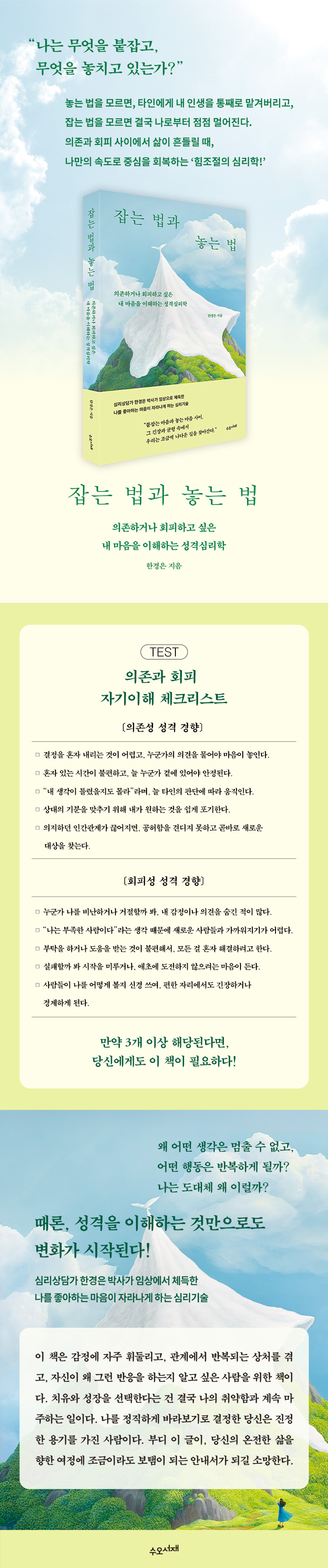
“What am I holding on to, and what am I missing?”
If you don't know how to let go, you will end up handing your entire life over to others.
If you don't know how to catch it, you will eventually get further and further away from me!
When life teeters between dependence and avoidance,
The Psychology of Strength Control: Recovering your center at your own pace!
This book explores the personality traits of dependent and avoidant tendencies.
The desire to depend on someone and the desire to avoid doing things we don't want to do, that is, the desire to depend or avoid, are human characteristics that everyone has.
The problem is when these traits recur excessively and run wild in my life.
People with strong dependence tend to have a hard time letting go of things that need to be let go.
They continue to maintain relationships that should be broken off even when they are in pain, try to reduce anxiety by excessively holding on to emotions or a need for recognition, or are excessively independent and shoulder everything on their own.
On the other hand, people with strong avoidance tendencies easily let go of things they should be holding on to.
In interpersonal relationships, they act as if they are not there, giving up responsibility, intimacy, and choice, and even avoiding their own feelings.
This book aims to understand the complex workings of dependence and avoidance, and to help us find a balance between them so we can become more comfortable and free.
As a psychologist and therapist who is trusted by clients for his insightful reading of emotions and the unconscious, the author helps them cultivate the strength to face the joys and sorrows of life and existential pain as they are.
This book is the culmination of my research and training, as well as my clinical treatment of over 3,000 patients, which have led me to a perspective that integrates the conscious and unconscious mind. This book is a compilation of personality psychology theories and psychological techniques.
“Why can’t I stop thinking about something, and why do I repeat certain actions?”
“Why on earth am I like this?”
How well we understand our personality and how we deal with it determines our lives.
The reason why many people cannot live comfortably as themselves is because of personality problems.
Personality is a fixed way of life.
Therefore, if you have an immature personality, your way of life will also be immature, which will cause you pain and confuse those around you.
With a blunt, indifferent, and cold personality, you may unknowingly hurt others, or on the contrary, you may be too sensitive and easily hurt, making life always difficult.
The author describes this book as “for anyone who is frequently swayed by emotions, experiences recurring hurt in relationships, and wants to understand why they react the way they do.”
We will explore the personality traits that support your life and introduce ways to develop your immature personality to live as a complete person.
To this end, this book is structured step-by-step into five parts.
Part 1 examines personality theoretically.
We examine both classical and modern psychological theories that seek to understand personality.
It also addresses the philosophical and spiritual perspectives that ask profound questions about “what makes me who I am” to understand character traits that cannot be explained through mere understanding.
Parts 2 and 3 explore dependence and avoidance tendencies in earnest.
We will examine the typical characteristics of dependent and avoidant personalities and our own tendencies, and specifically discuss the inner voice that controls us and how to deal with it.
In Part 4, you will learn several psychological techniques to restore balance between the two tendencies.
The final five parts explore diverse approaches to living an integrated life through self-acceptance and identity development.
In a competitive society, in a world of rapid change and uncertainty,
The dependence and avoidance that sometimes protected me,
Now, get hints from that inner voice to restore your freedom and live a free life!
*Dependent Personality Tendency - Self-Understanding Checklist
□ It is difficult for me to make decisions on my own, and I feel more at ease when I ask someone else's opinion.
□ I feel uncomfortable being alone and need someone by my side to feel more secure.
□ “I might be wrong,” he says, always acting based on other people’s judgment.
□ I easily give up what I want to please the other person.
□ When a relationship you depend on breaks up, you cannot bear the emptiness and immediately look for a new partner.
*Avoidant Personality Tendency - Self-Understanding Checklist
□ I have often hidden my feelings or opinions for fear that someone will criticize or reject me.
□ It is difficult for me to get close to new people because I think, “I am a lacking person.”
□ I feel uncomfortable asking for favors or receiving help, so I try to solve everything on my own.
□ I postpone starting out for fear of failure, or I feel like I don't want to try in the first place.
□ I worry about how people see me, so I become nervous or wary even in comfortable situations.
※ If three or more of these apply to you, you need this book too!
Dependency and avoidance tendencies can make life miserable, but they can also manifest as self-preservation instincts.
In a society where comparison and competition are the norm, the inner voice that tells us to depend and avoid comes from a desire to protect ourselves.
If dependence is about getting as close to others as possible to ensure safety, avoidance is about withdrawing and trying to avoid getting hurt in the first place.
However, because that method sometimes limits my life, I need to understand the hidden mind within dependence and avoidance and get hints for making better choices.
If you don't learn to react differently, your inner voice will eventually lose its power and gradually push you to the margins of life.
To this end, this book introduces in detail various techniques provided by psychology, such as self-acceptance practices for self-awareness, self-reflection training, feedback, mindfulness practice, healthy compensation methods, how to set boundaries in relationships, how to use personas, how to face the shadow within myself, and how to communicate with my inner self.
“I want to be understood.”
The courage to love clumsiness, the power to interpret life
Developing the strength to stay within the imperfect days I live in, and gradually establishing my own standards even without clear answers.
That's how we accept our existence and life.
_From the text
We are all clumsy.
The problem is not clumsiness itself, but the fear and dislike of clumsiness.
The author says, "Growth is not just about focusing on solving problems, but about changing your attitude and approach to them."
That is, when a person with a well-developed personality experiences something that did not go well, they do not interpret it as “failure” but rather say “learned.”
As such, “Life shows us the face it deserves based on how we treat ourselves.” Through various psychological theories and honest observations, this book allows us to look into our true selves reflected in our hearts, reflect on them, and accept the clumsiness within them.
In fact, humans need each other because of their clumsiness and dependence.
In other words, dependence and avoidance are not deficiencies, but rather the most human instincts, the inner voice that honestly says, 'This part is still difficult to handle.'
This book will gently guide you toward a balanced and integrated personality by helping you recognize and respond to these voices in a new way.
If you don't know how to let go, you will end up handing your entire life over to others.
If you don't know how to catch it, you will eventually get further and further away from me!
When life teeters between dependence and avoidance,
The Psychology of Strength Control: Recovering your center at your own pace!
This book explores the personality traits of dependent and avoidant tendencies.
The desire to depend on someone and the desire to avoid doing things we don't want to do, that is, the desire to depend or avoid, are human characteristics that everyone has.
The problem is when these traits recur excessively and run wild in my life.
People with strong dependence tend to have a hard time letting go of things that need to be let go.
They continue to maintain relationships that should be broken off even when they are in pain, try to reduce anxiety by excessively holding on to emotions or a need for recognition, or are excessively independent and shoulder everything on their own.
On the other hand, people with strong avoidance tendencies easily let go of things they should be holding on to.
In interpersonal relationships, they act as if they are not there, giving up responsibility, intimacy, and choice, and even avoiding their own feelings.
This book aims to understand the complex workings of dependence and avoidance, and to help us find a balance between them so we can become more comfortable and free.
As a psychologist and therapist who is trusted by clients for his insightful reading of emotions and the unconscious, the author helps them cultivate the strength to face the joys and sorrows of life and existential pain as they are.
This book is the culmination of my research and training, as well as my clinical treatment of over 3,000 patients, which have led me to a perspective that integrates the conscious and unconscious mind. This book is a compilation of personality psychology theories and psychological techniques.
“Why can’t I stop thinking about something, and why do I repeat certain actions?”
“Why on earth am I like this?”
How well we understand our personality and how we deal with it determines our lives.
The reason why many people cannot live comfortably as themselves is because of personality problems.
Personality is a fixed way of life.
Therefore, if you have an immature personality, your way of life will also be immature, which will cause you pain and confuse those around you.
With a blunt, indifferent, and cold personality, you may unknowingly hurt others, or on the contrary, you may be too sensitive and easily hurt, making life always difficult.
The author describes this book as “for anyone who is frequently swayed by emotions, experiences recurring hurt in relationships, and wants to understand why they react the way they do.”
We will explore the personality traits that support your life and introduce ways to develop your immature personality to live as a complete person.
To this end, this book is structured step-by-step into five parts.
Part 1 examines personality theoretically.
We examine both classical and modern psychological theories that seek to understand personality.
It also addresses the philosophical and spiritual perspectives that ask profound questions about “what makes me who I am” to understand character traits that cannot be explained through mere understanding.
Parts 2 and 3 explore dependence and avoidance tendencies in earnest.
We will examine the typical characteristics of dependent and avoidant personalities and our own tendencies, and specifically discuss the inner voice that controls us and how to deal with it.
In Part 4, you will learn several psychological techniques to restore balance between the two tendencies.
The final five parts explore diverse approaches to living an integrated life through self-acceptance and identity development.
In a competitive society, in a world of rapid change and uncertainty,
The dependence and avoidance that sometimes protected me,
Now, get hints from that inner voice to restore your freedom and live a free life!
*Dependent Personality Tendency - Self-Understanding Checklist
□ It is difficult for me to make decisions on my own, and I feel more at ease when I ask someone else's opinion.
□ I feel uncomfortable being alone and need someone by my side to feel more secure.
□ “I might be wrong,” he says, always acting based on other people’s judgment.
□ I easily give up what I want to please the other person.
□ When a relationship you depend on breaks up, you cannot bear the emptiness and immediately look for a new partner.
*Avoidant Personality Tendency - Self-Understanding Checklist
□ I have often hidden my feelings or opinions for fear that someone will criticize or reject me.
□ It is difficult for me to get close to new people because I think, “I am a lacking person.”
□ I feel uncomfortable asking for favors or receiving help, so I try to solve everything on my own.
□ I postpone starting out for fear of failure, or I feel like I don't want to try in the first place.
□ I worry about how people see me, so I become nervous or wary even in comfortable situations.
※ If three or more of these apply to you, you need this book too!
Dependency and avoidance tendencies can make life miserable, but they can also manifest as self-preservation instincts.
In a society where comparison and competition are the norm, the inner voice that tells us to depend and avoid comes from a desire to protect ourselves.
If dependence is about getting as close to others as possible to ensure safety, avoidance is about withdrawing and trying to avoid getting hurt in the first place.
However, because that method sometimes limits my life, I need to understand the hidden mind within dependence and avoidance and get hints for making better choices.
If you don't learn to react differently, your inner voice will eventually lose its power and gradually push you to the margins of life.
To this end, this book introduces in detail various techniques provided by psychology, such as self-acceptance practices for self-awareness, self-reflection training, feedback, mindfulness practice, healthy compensation methods, how to set boundaries in relationships, how to use personas, how to face the shadow within myself, and how to communicate with my inner self.
“I want to be understood.”
The courage to love clumsiness, the power to interpret life
Developing the strength to stay within the imperfect days I live in, and gradually establishing my own standards even without clear answers.
That's how we accept our existence and life.
_From the text
We are all clumsy.
The problem is not clumsiness itself, but the fear and dislike of clumsiness.
The author says, "Growth is not just about focusing on solving problems, but about changing your attitude and approach to them."
That is, when a person with a well-developed personality experiences something that did not go well, they do not interpret it as “failure” but rather say “learned.”
As such, “Life shows us the face it deserves based on how we treat ourselves.” Through various psychological theories and honest observations, this book allows us to look into our true selves reflected in our hearts, reflect on them, and accept the clumsiness within them.
In fact, humans need each other because of their clumsiness and dependence.
In other words, dependence and avoidance are not deficiencies, but rather the most human instincts, the inner voice that honestly says, 'This part is still difficult to handle.'
This book will gently guide you toward a balanced and integrated personality by helping you recognize and respond to these voices in a new way.
GOODS SPECIFICS
- Date of issue: September 20, 2025
- Page count, weight, size: 284 pages | 135*210*20mm
- ISBN13: 9791193238752
- ISBN10: 1193238757
You may also like
카테고리
korean


korean

![GQ KOREA Mark (Monthly): December [2025]](http://librairie.coreenne.fr/cdn/shop/files/8ef265dbbfbf186523ed75ba7319009d.jpg?v=1765340328&width=3840)


