

Daughters of Yalta
 |
Description
Book Introduction
Churchill, Roosevelt, and Harriman's daughters tell us
The untold story of the Yalta Conference
The Yalta Conference, considered the most important conference of the 20th century, was attended by hundreds of diplomatic and military advisors, including the "Big Three" Churchill, Roosevelt, and Stalin.
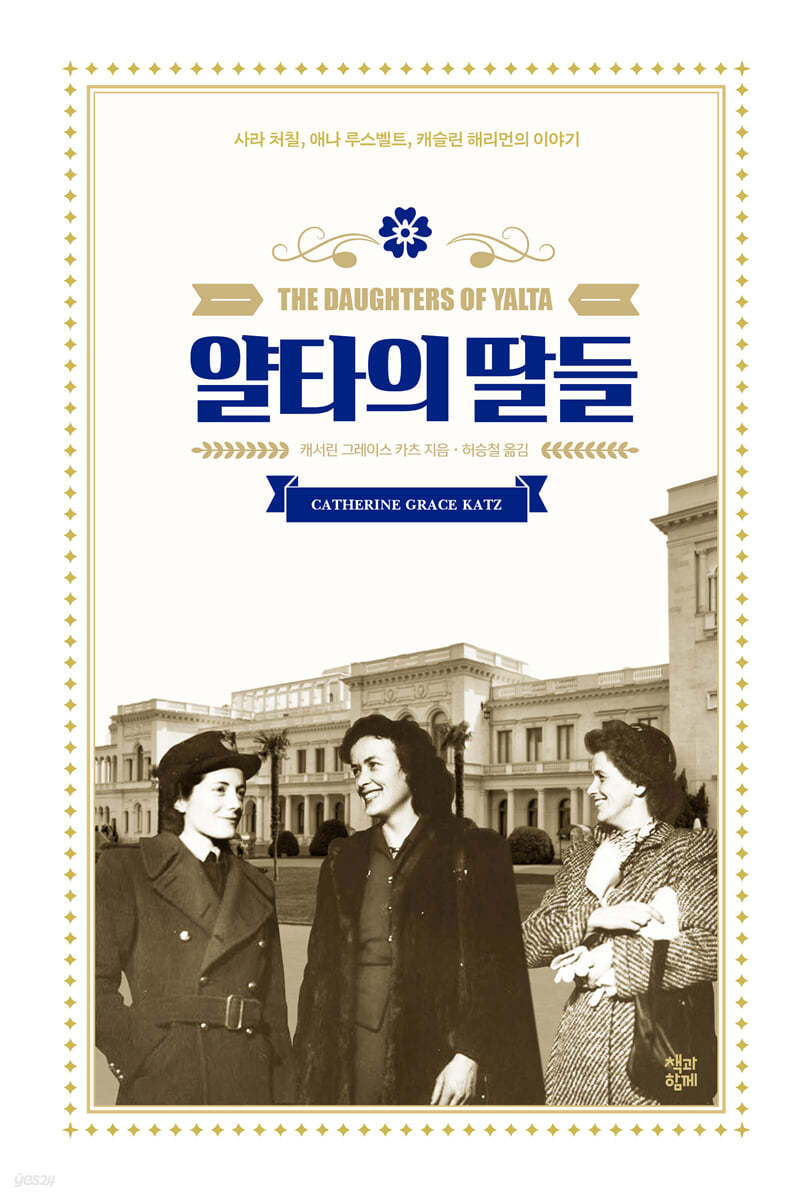
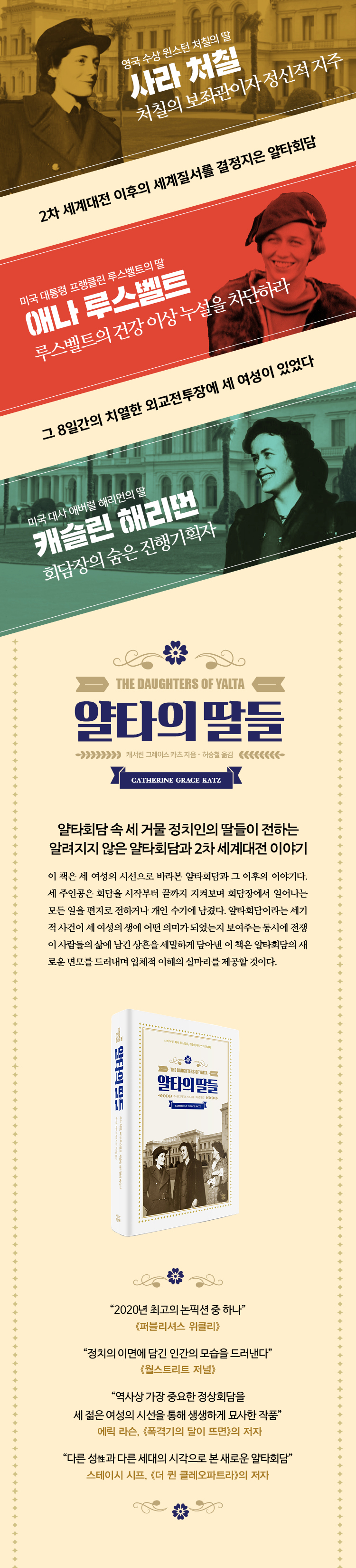
Also attending the meeting were three women: Anna Roosevelt, daughter of U.S. President Franklin Roosevelt; Sarah Churchill, daughter of British Prime Minister Winston Churchill; and Kathleen Harriman, daughter of U.S. Ambassador to the Soviet Union Averell Harriman.
This book tells the story of the Yalta Conference and its aftermath through the eyes of three women.
The three protagonists watched the meeting from beginning to end, recording everything that happened in the room and sending letters to their families and friends or keeping personal journals.
This book, which shows what significance the historic event of the Yalta Conference had on the lives of three women, while also meticulously depicting the scars that war left on people's lives, will reveal a new side of the Yalta Conference and provide clues to a three-dimensional understanding.
The untold story of the Yalta Conference
The Yalta Conference, considered the most important conference of the 20th century, was attended by hundreds of diplomatic and military advisors, including the "Big Three" Churchill, Roosevelt, and Stalin.
Also attending the meeting were three women: Anna Roosevelt, daughter of U.S. President Franklin Roosevelt; Sarah Churchill, daughter of British Prime Minister Winston Churchill; and Kathleen Harriman, daughter of U.S. Ambassador to the Soviet Union Averell Harriman.
This book tells the story of the Yalta Conference and its aftermath through the eyes of three women.
The three protagonists watched the meeting from beginning to end, recording everything that happened in the room and sending letters to their families and friends or keeping personal journals.
This book, which shows what significance the historic event of the Yalta Conference had on the lives of three women, while also meticulously depicting the scars that war left on people's lives, will reveal a new side of the Yalta Conference and provide clues to a three-dimensional understanding.
- You can preview some of the book's contents.
Preview
index
Main characters
Part 1: “She can handle them, so I’m taking her.”
Chapter 1 February 1, 1945
Chapter 2 February 2, 1945
Chapter 3 February 2, 1945
Chapter 4 February 2, 1945
Chapter 5: February 2–3, 1945
Chapter 6 February 3, 1945
Chapter 7 February 3, 1945
Part 2: "It's as if… the meeting isn't as important as other things."
Chapter 8 February 4, 1945
Chapter 9 February 4, 1945
Chapter 10 February 5, 1945
Chapter 11 February 5, 1945
Chapter 12 February 6, 1945
Chapter 13: February 6–7, 1945
Chapter 14 February 8, 1945
Chapter 15 February 8, 1945
Chapter 16 February 9–10, 1945
Chapter 17: February 10–11, 1945
Part 3: “I Will Cherish All This and More Forever”
Chapter 18: April 12–July 27, 1945
After Yalta
pictorial
Acknowledgements
Translator's Note
Americas
References
Search
Part 1: “She can handle them, so I’m taking her.”
Chapter 1 February 1, 1945
Chapter 2 February 2, 1945
Chapter 3 February 2, 1945
Chapter 4 February 2, 1945
Chapter 5: February 2–3, 1945
Chapter 6 February 3, 1945
Chapter 7 February 3, 1945
Part 2: "It's as if… the meeting isn't as important as other things."
Chapter 8 February 4, 1945
Chapter 9 February 4, 1945
Chapter 10 February 5, 1945
Chapter 11 February 5, 1945
Chapter 12 February 6, 1945
Chapter 13: February 6–7, 1945
Chapter 14 February 8, 1945
Chapter 15 February 8, 1945
Chapter 16 February 9–10, 1945
Chapter 17: February 10–11, 1945
Part 3: “I Will Cherish All This and More Forever”
Chapter 18: April 12–July 27, 1945
After Yalta
pictorial
Acknowledgements
Translator's Note
Americas
References
Search
Detailed image
Into the book
Although it would still take time for the war to be completely won, by the end of 1944 the Anglo-American Allies had driven the Germans and Italians out of Rome, Paris, Brussels, and Athens.
Meanwhile, Soviet troops were advancing westward across Poland and Romania.
In December of that year, the Germans launched a powerful counteroffensive in Belgium, France, and Luxembourg, nearly breaking the Western Allied defenses in the Ardennes Forest, but it was clear that the Allies had gained the upper hand.
Even on the Pacific front, the war was still far from over.
American generals estimated that the war would last more than 18 months unless they unleashed a secret, untested weapon that could change the course of events.
British Prime Minister Winston Churchill, U.S. President Franklin Roosevelt, and Soviet General Secretary Joseph Stalin realized that the war in Europe had reached a critical turning point.
As their armies raced toward Berlin, the complex problem of ending the war on the European continent loomed before them. This problem could only be resolved through face-to-face discussion.
---From "Chapter 1, February 1, 1945"
It was ironic that it became Kathleen's job to inspect the living environment and prepare for guests.
She had come to London as a journalist when the war began and had repeatedly emphasized that she was not her father's governess.
In fact, in her last letter to her sister Mary before coming to Moscow, she wrote, “I hope there will be no more parties and entertainment.”
But Kathleen was incredibly disappointed.
In Moscow, there were endless parties overflowing with caviar and vodka.
Now she found that managing the huge staff working in the palace and entertaining the guests was part of her job in Yalta.
But as time went on, she realized that her role as her father's hostess and second-in-command was much more complex than simply organizing parties and managing the house.
Although Kathleen never held an official title, she served as an important ceremonial officer for the Americans.
---From "Chapter 1, February 1, 1945"
From a young age, Sarah grew up feeling like an outcast.
Sarah was sensitive and shy, so she had difficulty socializing and forming friendships with other girls her age.
Even as a teenager, she spent her time holed up in the bathhouse playing cards with her cousin, Mitford, rather than chatting with other girls her age.
From a young age, she felt timid and awkward around her father.
Even when Sarah tried to muster up the courage to tell her father, she had to “collect” her thoughts before opening her mouth.
Important messages were written down in notes and delivered.
She knew that her father was much more eloquent and sensible than she was, but she believed that she understood him well, and that even when she remained silent, her father understood her.
When other family members tried to make fun of her reticence, her father would immediately step in and interrupt them, saying, “Sarah is like a clam, keeping her secrets inside.”
---From "Chapter 2, February 2, 1945"
But before the next page of history could be written, Franklin Roosevelt first had to survive the trip.
Something big could have happened before he got to Yalta.
For eleven days, Roosevelt was under the close observation of those aboard the Quincy.
Among them were friends like Watson, who had long been devoted to Roosevelt, as well as those with distinct political ambitions of their own.
Only a few days after the President's party set sail, people began asking about Roosevelt's health.
James Burns, a former South Carolina senator, Supreme Court associate justice, and Secretary of War Mobilization who attended the Yalta Conference, privately told Anna that Roosevelt's health did not appear to be improving.
He said that Roosevelt's pale face and perpetually open mouth suggested that he had more than just chronic sinusitis.
Anna dismissed his claims, saying Roosevelt simply suffered from a persistent sinus infection.
Although Roosevelt explained that he sat with his mouth open to breathe more easily, Burns did not take this at face value.
---From "Chapter 3, February 2, 1945"
Harriman was shocked when he learned that the Soviets were sitting quietly on the banks of the Vistula River, watching the Germans crush the Polish resistance.
He did not understand why the Soviet Union stood by and watched as the Germans recaptured Warsaw.
So, when the Soviet government asked Stalin to allow American and British military aircraft to use Soviet airbases to airlift supplies to the Polish resistance, Stalin refused.19 No amount of personal persuasion was going to work.
Harriman realized that the West had misread Soviet intentions.
The West had misunderstood Stalin, whom they jokingly called "Uncle Joe."
Churchill ordered the Royal Air Force to use all available means to deliver supplies to Stalin.
Harriman tried to persuade Roosevelt, who was then campaigning for a fourth term, to take a hard line against Stalin before the Soviet Union took over Eastern Europe.
But Roosevelt and the State Department had other priorities.
---From "Chapter 4, February 2, 1945"
But Stalin did not stop talking.
He had one more regret for the Poles in London.
“As a soldier, I demand of the countries liberated by the Soviet Red Army:
“There should be no civil war in the rear,” he continued.
“The Red Army soldiers are indifferent to the form of government as long as the new government maintains order and does not shoot them in the back.” According to him, the Lublin government has maintained order relatively well.
But this could not be applied to the Polish government-in-exile in London.
“The Poles in London claim to be the commanding officers of the underground resistance in Poland, but (…) this resistance has committed many atrocities.
(…) They killed 212 of our soldiers.
They attacked our supply base to seize weapons.
We have arrested some of them, and if they continue to disturb our rear, we will kill them all according to military law.” (…)
Churchill, determined to make his final remarks, emphasized one more point before the meeting ended.
“I would like to note in the meeting records that Britain and the Soviet Union have different sources of information and different facts within Poland,” he said.
For a time, the British had intelligence agents inside Poland.
According to their reports, the Soviet troops were drinking, pillaging, and, undoubtedly, raping as they advanced westward.
---From "Chapter 13, February 6-7, 1945"
“I am speaking on behalf of the three women here,” Kathleen began to speak in Russian.
She first proposed a toast “to those who have made such great efforts to ensure our comfortable stay in Crimea.”
She saw this work with her own eyes.
Politics aside, the Soviet effort to prepare the most basic needs at Yalta was remarkable.
“Seeing the destruction the Germans wrought here, I could fully understand what a great achievement had been made,” she said.
Kathleen expressed herself briefly and clearly.
I couldn't speak for long because I was nervous.
But her words were elegant, intimate, and not overly political, which suited her role in the conference well.
By pointing out the atrocities committed by the German army, she reaffirmed the solidarity of the Allies.
This was a very effective soft diplomacy.
---From "Chapter 15, February 8, 1945"
The next morning, Sarah woke up still wanting to share her impressions of Churchill's speech with him.
During the war, her confidence grew and she no longer hesitated to express her honest opinions to her father.
“Did you ask me if I was influenced by the speech?” Sarah began to make her case in the letter.
“If I was thinking of voting Labour, I’m not sure I’d vote Conservative after hearing this speech.”
Sarah knew Churchill's fear of socialism, especially after the Yalta conference.
Churchill's speeches may have made people think abstractly about socialism and accept his views, but abstractions meant little to voters struggling to feed their children.
“The Labour supporters I know don’t vote for Labour because of their ideals or beliefs.
“I just vote for that party because life is tough,” Sarah explained.
“They think that voting for the Labour Party will make their daily struggles easier.
(…) Socialism, which emerged during the war, did no harm to anyone and benefited quite a few people.
(…) milk is distributed fairly, and the rich don't die because they don't get as much meat as the poor.
Clearly, this shared sense of sacrifice was the strongest bond that united us.
And they say there is no reason why this universal sense of sacrifice should not work effectively in times of peace.”
Meanwhile, Soviet troops were advancing westward across Poland and Romania.
In December of that year, the Germans launched a powerful counteroffensive in Belgium, France, and Luxembourg, nearly breaking the Western Allied defenses in the Ardennes Forest, but it was clear that the Allies had gained the upper hand.
Even on the Pacific front, the war was still far from over.
American generals estimated that the war would last more than 18 months unless they unleashed a secret, untested weapon that could change the course of events.
British Prime Minister Winston Churchill, U.S. President Franklin Roosevelt, and Soviet General Secretary Joseph Stalin realized that the war in Europe had reached a critical turning point.
As their armies raced toward Berlin, the complex problem of ending the war on the European continent loomed before them. This problem could only be resolved through face-to-face discussion.
---From "Chapter 1, February 1, 1945"
It was ironic that it became Kathleen's job to inspect the living environment and prepare for guests.
She had come to London as a journalist when the war began and had repeatedly emphasized that she was not her father's governess.
In fact, in her last letter to her sister Mary before coming to Moscow, she wrote, “I hope there will be no more parties and entertainment.”
But Kathleen was incredibly disappointed.
In Moscow, there were endless parties overflowing with caviar and vodka.
Now she found that managing the huge staff working in the palace and entertaining the guests was part of her job in Yalta.
But as time went on, she realized that her role as her father's hostess and second-in-command was much more complex than simply organizing parties and managing the house.
Although Kathleen never held an official title, she served as an important ceremonial officer for the Americans.
---From "Chapter 1, February 1, 1945"
From a young age, Sarah grew up feeling like an outcast.
Sarah was sensitive and shy, so she had difficulty socializing and forming friendships with other girls her age.
Even as a teenager, she spent her time holed up in the bathhouse playing cards with her cousin, Mitford, rather than chatting with other girls her age.
From a young age, she felt timid and awkward around her father.
Even when Sarah tried to muster up the courage to tell her father, she had to “collect” her thoughts before opening her mouth.
Important messages were written down in notes and delivered.
She knew that her father was much more eloquent and sensible than she was, but she believed that she understood him well, and that even when she remained silent, her father understood her.
When other family members tried to make fun of her reticence, her father would immediately step in and interrupt them, saying, “Sarah is like a clam, keeping her secrets inside.”
---From "Chapter 2, February 2, 1945"
But before the next page of history could be written, Franklin Roosevelt first had to survive the trip.
Something big could have happened before he got to Yalta.
For eleven days, Roosevelt was under the close observation of those aboard the Quincy.
Among them were friends like Watson, who had long been devoted to Roosevelt, as well as those with distinct political ambitions of their own.
Only a few days after the President's party set sail, people began asking about Roosevelt's health.
James Burns, a former South Carolina senator, Supreme Court associate justice, and Secretary of War Mobilization who attended the Yalta Conference, privately told Anna that Roosevelt's health did not appear to be improving.
He said that Roosevelt's pale face and perpetually open mouth suggested that he had more than just chronic sinusitis.
Anna dismissed his claims, saying Roosevelt simply suffered from a persistent sinus infection.
Although Roosevelt explained that he sat with his mouth open to breathe more easily, Burns did not take this at face value.
---From "Chapter 3, February 2, 1945"
Harriman was shocked when he learned that the Soviets were sitting quietly on the banks of the Vistula River, watching the Germans crush the Polish resistance.
He did not understand why the Soviet Union stood by and watched as the Germans recaptured Warsaw.
So, when the Soviet government asked Stalin to allow American and British military aircraft to use Soviet airbases to airlift supplies to the Polish resistance, Stalin refused.19 No amount of personal persuasion was going to work.
Harriman realized that the West had misread Soviet intentions.
The West had misunderstood Stalin, whom they jokingly called "Uncle Joe."
Churchill ordered the Royal Air Force to use all available means to deliver supplies to Stalin.
Harriman tried to persuade Roosevelt, who was then campaigning for a fourth term, to take a hard line against Stalin before the Soviet Union took over Eastern Europe.
But Roosevelt and the State Department had other priorities.
---From "Chapter 4, February 2, 1945"
But Stalin did not stop talking.
He had one more regret for the Poles in London.
“As a soldier, I demand of the countries liberated by the Soviet Red Army:
“There should be no civil war in the rear,” he continued.
“The Red Army soldiers are indifferent to the form of government as long as the new government maintains order and does not shoot them in the back.” According to him, the Lublin government has maintained order relatively well.
But this could not be applied to the Polish government-in-exile in London.
“The Poles in London claim to be the commanding officers of the underground resistance in Poland, but (…) this resistance has committed many atrocities.
(…) They killed 212 of our soldiers.
They attacked our supply base to seize weapons.
We have arrested some of them, and if they continue to disturb our rear, we will kill them all according to military law.” (…)
Churchill, determined to make his final remarks, emphasized one more point before the meeting ended.
“I would like to note in the meeting records that Britain and the Soviet Union have different sources of information and different facts within Poland,” he said.
For a time, the British had intelligence agents inside Poland.
According to their reports, the Soviet troops were drinking, pillaging, and, undoubtedly, raping as they advanced westward.
---From "Chapter 13, February 6-7, 1945"
“I am speaking on behalf of the three women here,” Kathleen began to speak in Russian.
She first proposed a toast “to those who have made such great efforts to ensure our comfortable stay in Crimea.”
She saw this work with her own eyes.
Politics aside, the Soviet effort to prepare the most basic needs at Yalta was remarkable.
“Seeing the destruction the Germans wrought here, I could fully understand what a great achievement had been made,” she said.
Kathleen expressed herself briefly and clearly.
I couldn't speak for long because I was nervous.
But her words were elegant, intimate, and not overly political, which suited her role in the conference well.
By pointing out the atrocities committed by the German army, she reaffirmed the solidarity of the Allies.
This was a very effective soft diplomacy.
---From "Chapter 15, February 8, 1945"
The next morning, Sarah woke up still wanting to share her impressions of Churchill's speech with him.
During the war, her confidence grew and she no longer hesitated to express her honest opinions to her father.
“Did you ask me if I was influenced by the speech?” Sarah began to make her case in the letter.
“If I was thinking of voting Labour, I’m not sure I’d vote Conservative after hearing this speech.”
Sarah knew Churchill's fear of socialism, especially after the Yalta conference.
Churchill's speeches may have made people think abstractly about socialism and accept his views, but abstractions meant little to voters struggling to feed their children.
“The Labour supporters I know don’t vote for Labour because of their ideals or beliefs.
“I just vote for that party because life is tough,” Sarah explained.
“They think that voting for the Labour Party will make their daily struggles easier.
(…) Socialism, which emerged during the war, did no harm to anyone and benefited quite a few people.
(…) milk is distributed fairly, and the rich don't die because they don't get as much meat as the poor.
Clearly, this shared sense of sacrifice was the strongest bond that united us.
And they say there is no reason why this universal sense of sacrifice should not work effectively in times of peace.”
---From "Chapter 18, April 12 - July 27, 1945"
Publisher's Review
Churchill, Roosevelt, and Harriman's daughters tell us
The untold story of the Yalta Conference
In February 1945, with the Allied victory in World War II almost certain, the "Big Three"—Franklin Roosevelt, Winston Churchill, and Joseph Stalin—held the Yalta Conference to agree to end the war and promote postwar peace.
It is a well-known fact that the Yalta Conference, which lasted eight days, created the world order of the 20th century and opened the door to the Cold War.
However, the intimate details of what the people involved and those around them who created the decisive moment in history thought and what the atmosphere was like at the time are still shrouded in mystery.
Catherine Grace Katz, a young female historian and author, noticed the three daughters that the three big politicians brought to the meeting.
The author, who came into contact with previously unpublished Churchill family materials through a relationship that began at Manhattan's Chartwell Bookstore, embarked on a journey to collect the records of Sarah Churchill, daughter of British Prime Minister Winston Churchill; Anna Roosevelt, daughter of US President Franklin Roosevelt; and Kathleen Harriman, daughter of US Ambassador to the Soviet Union Averell Harriman.
The result of that journey, "Daughters of Yalta," is a story about the "three little people" that has never been published before, and a story that looks at the Yalta Conference and the post-war world from a new perspective.
The dedication of the three daughters who assisted their father
Their intimate and vivid description of the meeting process
The main agenda of the Yalta Conference included the occupation issue after Germany's defeat, the establishment of a Polish government, the border issue in Europe, the Soviet Union's entry into the war against Japan, and the establishment of the United Nations as a world peace organization.
The negotiations between the three countries, which had different interests under the common goal of overthrowing Nazi Germany, were a fierce battle of nerves, diplomacy, and strategy.
Although the three daughters did not directly participate in the negotiations between the three countries or influence policy decisions, they observed the talks from beginning to end and recorded everything that happened in detail in the conference room, which they sent to their families and friends in letters or wrote in their personal journals.
Based on this record, the author vividly recreated the breathless eight-day meeting, which alternated between hot and cold water, as if he were watching it from the sidelines.
The three daughters assisted their father in various ways according to their personalities and roles.
Averell's daughter, Kathleen Harriman, was a war correspondent and champion skier, with an independent and bold personality.
Kathleen, who studied Russian to help her father, decorated the Yalta Conference venue, took charge of the seating arrangements and protocol for the attendees, and decided on the details that took place at the conference.
Sarah Churchill, who worked as a stage actress before joining the Royal Air Force and serving as a squadron leader in aerial photography, was a daughter who supported her father with her quick temper and inspired his political decisions.
Winston Churchill, who was under political pressure due to Britain's standing in Europe and his responsibilities to the Polish government-in-exile in London, was emotionally quite dependent on Sarah during the conference.
Anna Roosevelt, a mother of three and a newspaper editor, attended the meeting to keep her father's health, diagnosed with acute congestive heart failure, under wraps.
Since the success or failure of the Yalta Conference depended on the president's diplomacy and social skills, his father's health problems could have been a fatal blow.
The author further details the poor sanitary conditions of the Livadia Palace where the meeting took place, the rumors surrounding the meeting, and the diplomatic dynamics between the three leaders and other politicians.
These stories, which flow out amidst massive political events, make us realize once again that even the most defining moments in history are ultimately created by humans.
It is a record of the scars that war leaves on human lives.
A story of survival and growth for strong women
The three daughters visited the war-torn town of Yalta while their fathers were holding talks.
Anna was shocked to see the ghost town of Sevastopol, where only “six buildings in the whole city” remained, and Sarah was heartbroken to see the lines of Romanian prisoners of war waiting for food rations, thinking, “Reality is worse than the movies.”
Kathleen, a war correspondent, calmly reported in a letter the scene where even statues were destroyed and targeted for artillery practice.
The author delicately depicts the horrors of World War II and the lives of the Crimean people, scene by scene, through the eyes of three women.
"Even though the war had taken everything, the people were still proud of their city, their community, their homes and their children.
Whatever her father decided with Roosevelt and Stalin in the stone palace at Yalta, and whether they parted as enemies or friends, they would rebuild the city and life as they had done before." (p. 386)
After the Yalta Conference, the war ended and the world fell into the Cold War.
The Yalta Conference, which handed over half of Europe to totalitarian regimes and erected barriers between Germany and the Korean Peninsula, was seen as the cornerstone of ideological conflict.
Meanwhile, many changes occurred in the Churchill, Roosevelt, and Harriman families.
Roosevelt, whose health had deteriorated rapidly after the Yalta Conference, died in April 1945, and Churchill was defeated in the general election.
Averell became increasingly isolated in the Truman administration, serving as ambassador in name only.
The war left deep and long-standing scars on their lives.
Sarah lost loved ones to suicide and serious illness, and Anna and Kathleen's husbands also attempted suicide.
All of them were caused by war trauma and bipolar disorder.
As daughters of political heavyweights, they were in the public eye, plagued by numerous scandals and suffering the aftermath of war. However, they overcame these trials and moved forward, finding their own paths in life.
Returning to New York in 1946, Kathleen Harriman returned to journalism, finding the diplomatic service "a lot of tea and cake," while Anna devoted herself to honoring her mother and father's legacy.
Sarah was heartbroken by the deaths of her loved ones and became an alcoholic, but she overcame her grief and devoted herself to writing and drawing.
In any big event, there are usually leading and supporting actors.
The camera usually focuses on the main character, but when the story unfolds by focusing on the supporting characters, new aspects of the incident are revealed.
The three women who are the main characters of this book may be considered supporting actors at the Yalta Conference, but they were also celebrities who received great attention from the media at the time, and they were figures who played the role of 'first daughters' and sometimes 'first ladies.'
Their story is not only an important record that reveals a new side of the Yalta Conference, but also a story of survival and growth of strong women who persevered through difficult times without losing themselves.
The untold story of the Yalta Conference
In February 1945, with the Allied victory in World War II almost certain, the "Big Three"—Franklin Roosevelt, Winston Churchill, and Joseph Stalin—held the Yalta Conference to agree to end the war and promote postwar peace.
It is a well-known fact that the Yalta Conference, which lasted eight days, created the world order of the 20th century and opened the door to the Cold War.
However, the intimate details of what the people involved and those around them who created the decisive moment in history thought and what the atmosphere was like at the time are still shrouded in mystery.
Catherine Grace Katz, a young female historian and author, noticed the three daughters that the three big politicians brought to the meeting.
The author, who came into contact with previously unpublished Churchill family materials through a relationship that began at Manhattan's Chartwell Bookstore, embarked on a journey to collect the records of Sarah Churchill, daughter of British Prime Minister Winston Churchill; Anna Roosevelt, daughter of US President Franklin Roosevelt; and Kathleen Harriman, daughter of US Ambassador to the Soviet Union Averell Harriman.
The result of that journey, "Daughters of Yalta," is a story about the "three little people" that has never been published before, and a story that looks at the Yalta Conference and the post-war world from a new perspective.
The dedication of the three daughters who assisted their father
Their intimate and vivid description of the meeting process
The main agenda of the Yalta Conference included the occupation issue after Germany's defeat, the establishment of a Polish government, the border issue in Europe, the Soviet Union's entry into the war against Japan, and the establishment of the United Nations as a world peace organization.
The negotiations between the three countries, which had different interests under the common goal of overthrowing Nazi Germany, were a fierce battle of nerves, diplomacy, and strategy.
Although the three daughters did not directly participate in the negotiations between the three countries or influence policy decisions, they observed the talks from beginning to end and recorded everything that happened in detail in the conference room, which they sent to their families and friends in letters or wrote in their personal journals.
Based on this record, the author vividly recreated the breathless eight-day meeting, which alternated between hot and cold water, as if he were watching it from the sidelines.
The three daughters assisted their father in various ways according to their personalities and roles.
Averell's daughter, Kathleen Harriman, was a war correspondent and champion skier, with an independent and bold personality.
Kathleen, who studied Russian to help her father, decorated the Yalta Conference venue, took charge of the seating arrangements and protocol for the attendees, and decided on the details that took place at the conference.
Sarah Churchill, who worked as a stage actress before joining the Royal Air Force and serving as a squadron leader in aerial photography, was a daughter who supported her father with her quick temper and inspired his political decisions.
Winston Churchill, who was under political pressure due to Britain's standing in Europe and his responsibilities to the Polish government-in-exile in London, was emotionally quite dependent on Sarah during the conference.
Anna Roosevelt, a mother of three and a newspaper editor, attended the meeting to keep her father's health, diagnosed with acute congestive heart failure, under wraps.
Since the success or failure of the Yalta Conference depended on the president's diplomacy and social skills, his father's health problems could have been a fatal blow.
The author further details the poor sanitary conditions of the Livadia Palace where the meeting took place, the rumors surrounding the meeting, and the diplomatic dynamics between the three leaders and other politicians.
These stories, which flow out amidst massive political events, make us realize once again that even the most defining moments in history are ultimately created by humans.
It is a record of the scars that war leaves on human lives.
A story of survival and growth for strong women
The three daughters visited the war-torn town of Yalta while their fathers were holding talks.
Anna was shocked to see the ghost town of Sevastopol, where only “six buildings in the whole city” remained, and Sarah was heartbroken to see the lines of Romanian prisoners of war waiting for food rations, thinking, “Reality is worse than the movies.”
Kathleen, a war correspondent, calmly reported in a letter the scene where even statues were destroyed and targeted for artillery practice.
The author delicately depicts the horrors of World War II and the lives of the Crimean people, scene by scene, through the eyes of three women.
"Even though the war had taken everything, the people were still proud of their city, their community, their homes and their children.
Whatever her father decided with Roosevelt and Stalin in the stone palace at Yalta, and whether they parted as enemies or friends, they would rebuild the city and life as they had done before." (p. 386)
After the Yalta Conference, the war ended and the world fell into the Cold War.
The Yalta Conference, which handed over half of Europe to totalitarian regimes and erected barriers between Germany and the Korean Peninsula, was seen as the cornerstone of ideological conflict.
Meanwhile, many changes occurred in the Churchill, Roosevelt, and Harriman families.
Roosevelt, whose health had deteriorated rapidly after the Yalta Conference, died in April 1945, and Churchill was defeated in the general election.
Averell became increasingly isolated in the Truman administration, serving as ambassador in name only.
The war left deep and long-standing scars on their lives.
Sarah lost loved ones to suicide and serious illness, and Anna and Kathleen's husbands also attempted suicide.
All of them were caused by war trauma and bipolar disorder.
As daughters of political heavyweights, they were in the public eye, plagued by numerous scandals and suffering the aftermath of war. However, they overcame these trials and moved forward, finding their own paths in life.
Returning to New York in 1946, Kathleen Harriman returned to journalism, finding the diplomatic service "a lot of tea and cake," while Anna devoted herself to honoring her mother and father's legacy.
Sarah was heartbroken by the deaths of her loved ones and became an alcoholic, but she overcame her grief and devoted herself to writing and drawing.
In any big event, there are usually leading and supporting actors.
The camera usually focuses on the main character, but when the story unfolds by focusing on the supporting characters, new aspects of the incident are revealed.
The three women who are the main characters of this book may be considered supporting actors at the Yalta Conference, but they were also celebrities who received great attention from the media at the time, and they were figures who played the role of 'first daughters' and sometimes 'first ladies.'
Their story is not only an important record that reveals a new side of the Yalta Conference, but also a story of survival and growth of strong women who persevered through difficult times without losing themselves.
GOODS SPECIFICS
- Publication date: February 14, 2022
- Page count, weight, size: 536 pages | 772g | 152*225*35mm
- ISBN13: 9791191432343
- ISBN10: 1191432343
You may also like
카테고리
korean


korean

![GQ KOREA Mark (Monthly): December [2025]](http://librairie.coreenne.fr/cdn/shop/files/8ef265dbbfbf186523ed75ba7319009d.jpg?v=1765340328&width=3840)


