

The Philosopher and the Platypus
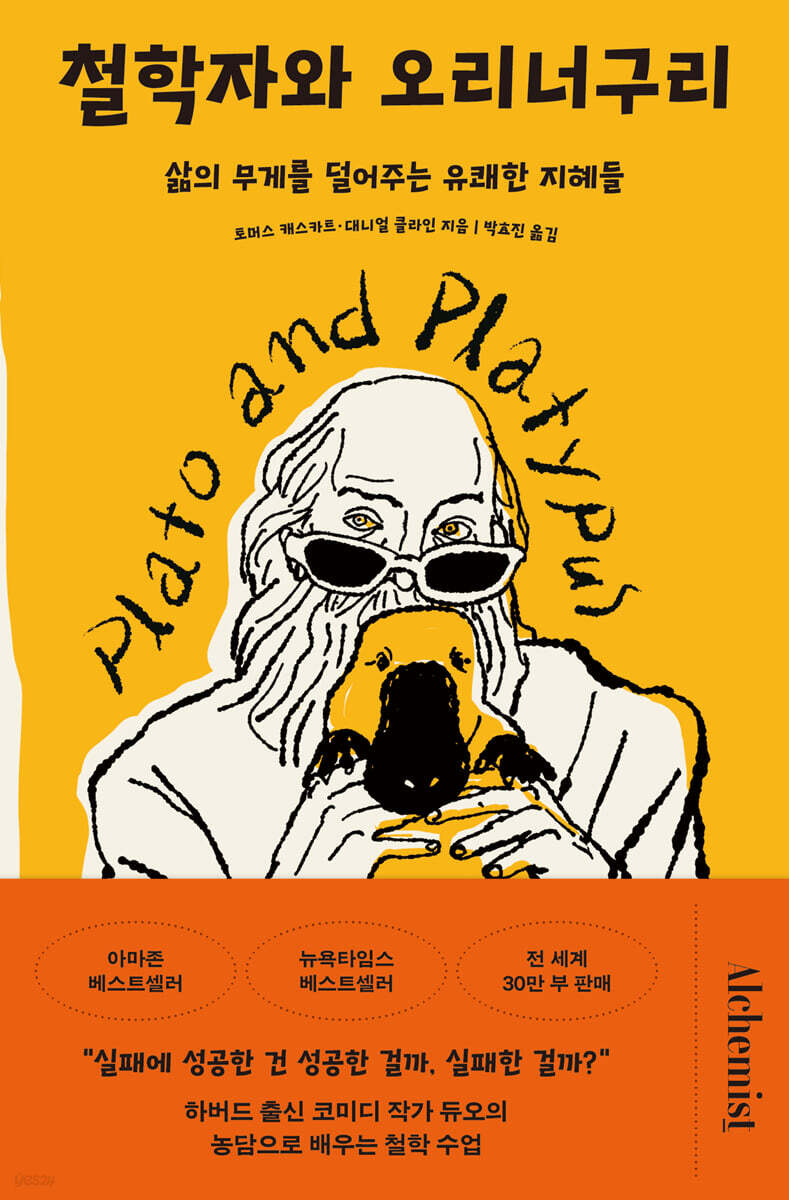 |
Description
Book Introduction
A comedy writing duo from Harvard's philosophy department
Philosophy Lessons Learned Through Jokes
“Is success in failure a success or a failure?”
“Wow, what is this world like?”, “Is this the right way to live?”
There are moments in life when questions like this suddenly arise.
It is precisely at this moment, when life requires new answers, that we need philosophy.
Good questions are essential to finding good answers, because questions are the specialty of philosophy.
Who was Socrates, the "Father of Philosophy"? Wasn't he Athens' greatest "question mark murderer"?
But no matter how good the medicine may be, when you encounter even more daunting philosophical concepts in your quest for answers to life... you find yourself shaking your head.
For these people, a duo of Harvard philosophy graduates and long-time comedy writers have joined forces.
Instead of approaching philosophy in a serious and rigid manner, they decide to have fun with it, throwing out all sorts of silly jokes.
"How much free will do office workers have?", "Are people who succeed at failure successful or failed?", "Do jokes make sense to aliens?", "Is philosophy really just a play on words?" This book freely unravels ten philosophical topics related to these unique questions, along with delightful jokes.
Just reading this book, which may be an introduction to comedy or an introduction to philosophy, while giggling, will make your difficult daily life a little lighter.
You'll also become familiar with ten major philosophical disciplines, including metaphysics, logic, ethics, phenomenology, existentialism, and metaphilosophy. So, are you ready to dive into the world of philosophy, as explored by the philosopher and platypus duo?
Philosophy Lessons Learned Through Jokes
“Is success in failure a success or a failure?”
“Wow, what is this world like?”, “Is this the right way to live?”
There are moments in life when questions like this suddenly arise.
It is precisely at this moment, when life requires new answers, that we need philosophy.
Good questions are essential to finding good answers, because questions are the specialty of philosophy.
Who was Socrates, the "Father of Philosophy"? Wasn't he Athens' greatest "question mark murderer"?
But no matter how good the medicine may be, when you encounter even more daunting philosophical concepts in your quest for answers to life... you find yourself shaking your head.
For these people, a duo of Harvard philosophy graduates and long-time comedy writers have joined forces.
Instead of approaching philosophy in a serious and rigid manner, they decide to have fun with it, throwing out all sorts of silly jokes.
"How much free will do office workers have?", "Are people who succeed at failure successful or failed?", "Do jokes make sense to aliens?", "Is philosophy really just a play on words?" This book freely unravels ten philosophical topics related to these unique questions, along with delightful jokes.
Just reading this book, which may be an introduction to comedy or an introduction to philosophy, while giggling, will make your difficult daily life a little lighter.
You'll also become familiar with ten major philosophical disciplines, including metaphysics, logic, ethics, phenomenology, existentialism, and metaphilosophy. So, are you ready to dive into the world of philosophy, as explored by the philosopher and platypus duo?
- You can preview some of the book's contents.
Preview
index
Translator's Note | Can you become familiar with philosophy while laughing?
Introduction | The Most Pleasant Way to Deal with Life's Problems
Chapter 1: Do Office Workers Have Free Will? _Metaphysical Jokes About Everything
Chapter 2: Are those who succeed at failure truly successful or unsuccessful? _Logic for those who would rather win an argument than lose a friend.
Chapter 3: Is the Platypus a Duck or a Raccoon? _Viewing the World Through the Lenses of Epistemology
Chapter 4: Is It Wrong to Tell White Lies? _Ethical Debates on Right and Wrong
Chapter 5: Can God Gamble? _Bold Questions About God and Religion
Chapter 6: Thinking about death every morning? _How to relieve life's anxiety with existentialism
Chapter 7: Is Philosophy Just Wordplay? _Viewing the World Through the Philosophy of Language
Chapter 8: Should Jokes Follow Utilitarianism or PCism? _The Art of Talking About Society and Politics While Laughing
Chapter 9: Do Aliens Get the Joke? _Understanding the World Through Relativity
Chapter 10: Can We Learn Philosophy Through Jokes? _On What Philosophy Is
Going Out | Time to Review Everything You've Learned in This Book
Great Moments in Western Philosophy
Glossary of Terms
Introduction | The Most Pleasant Way to Deal with Life's Problems
Chapter 1: Do Office Workers Have Free Will? _Metaphysical Jokes About Everything
Chapter 2: Are those who succeed at failure truly successful or unsuccessful? _Logic for those who would rather win an argument than lose a friend.
Chapter 3: Is the Platypus a Duck or a Raccoon? _Viewing the World Through the Lenses of Epistemology
Chapter 4: Is It Wrong to Tell White Lies? _Ethical Debates on Right and Wrong
Chapter 5: Can God Gamble? _Bold Questions About God and Religion
Chapter 6: Thinking about death every morning? _How to relieve life's anxiety with existentialism
Chapter 7: Is Philosophy Just Wordplay? _Viewing the World Through the Philosophy of Language
Chapter 8: Should Jokes Follow Utilitarianism or PCism? _The Art of Talking About Society and Politics While Laughing
Chapter 9: Do Aliens Get the Joke? _Understanding the World Through Relativity
Chapter 10: Can We Learn Philosophy Through Jokes? _On What Philosophy Is
Going Out | Time to Review Everything You've Learned in This Book
Great Moments in Western Philosophy
Glossary of Terms
Detailed image
.jpg)
Into the book
Does the universe have a purpose? According to Aristotle, every being has an inner purpose, a telos.
For example, a puppy has a telos called being a dog, and over time, it naturally becomes a dog.
The same goes for the relationship between eggs and chickens, and between caterpillars and butterflies.
This is a fact that no one can deny.
To make it easier to understand, let's look at the following story.
Goldstein was walking down the street with his two grandchildren.
A friend I met by chance asked me how old my grandchildren were.
Goldstein answered.
“The child who will become a doctor is five years old, and the child who will become a lawyer is seven years old.”
Oh my.
Goldstein clearly misunderstands Aristotle.
--- From Chapter 1, "Do Office Workers Have Free Will?" 'Teleology'
Illogical reasoning has long been a headache for philosophers.
But let me be clear, it is something that can be used often in everyday life.
There is a story that clearly demonstrates its effect.
An Irishman walked into a bar in Dublin, ordered three pints of Guinness, and downed them all.
After drinking a little of the first glass, I picked up the glass next to me and drank from it, and so on, until I had drunk all three glasses.
Then he ordered three more glasses.
The bartender said.
“You should order one glass at a time so it doesn’t get flatter,” said the Irishman.
"i know.
But I have two brothers.
They are now in the US and Australia respectively.
We promised when we broke up.
When we drink, let's drink like this, remembering the days when the three of us drank together.
“Two glasses for you brothers, and one for me,” said the impressed bartender.
“That’s really cool!” After that, the Irishman would often stop by the bar and order a beer in the same way.
But one day he came in and ordered only two drinks.
The bartender and other regulars watched this scene, and for a moment silence fell over the bar.
When he ordered two more drinks, the bartender spoke cautiously.
“It seems like one of your brothers has gone through something unfortunate.
“I’m so sorry,” the Irishman replied with a puzzled expression.
“Oh, nothing much.
“My wife just told me not to drink, so I only order my brothers’ share.”
Okay, so you know how to use it?
--- From "Chapter 2, "Is a person who succeeds at failure a success or a failure?" 'Illogical Reasoning'"
The 19th-century German philosopher Nietzsche had the formidable nickname of “the philosopher with the hammer.”
And, living up to its nickname, it makes a shocking declaration that overturns traditional Christian ethics.
He starts by announcing the death of God.
“God is dead!” Then God repaid him by posting Nietzsche’s death on a men’s bathroom stall in a college town.
“Nietzsche, you’re dead too!” Of course, from the janitor’s perspective, both of them must have been annoyed.
“If we get caught, we both die!” The reason Nietzsche declared the death of God was because he believed that the long-standing Western cultural tradition based on Christian ethics had come to an end.
Do not harm others, it is harder for a rich man to enter heaven than for a camel to pass through the eye of a needle, love your enemies…
He called this 'unnatural' ethics spread by Christianity 'mob morality' or 'slave morality'.
And this Christian ethics was replaced with the 'will to power', an ethics of power that is more faithful to life.
The Übermensch (superhuman) with the will to power transcends the morality of the crowd, creates a new ethics, and enjoys his superior power to the fullest.
Nietzsche would certainly have sided with mafia man Tony Soprano when it came to the Golden Rule.
--- From Chapter 4, "Is It Wrong to Tell White Lies?" "The Will to Power"
There are important doctrinal differences between denominations.
For example, the joke below is for Catholics.
As Jesus was walking along, he saw people about to stone a woman caught in adultery.
Jesus looked at them and said,
“Let anyone who is without sin throw the first stone.” The crowd looked at each other and put down stones one by one.
But suddenly a stone flew from behind.
Jesus looked back and cried out urgently.
“Mom?”
--- From "Chapter 5, "Can God Gamble?" "Theological Differences"
For Heidegger, living with the shadow of death is very important.
It's not just a matter of having a little more courage, it's the only way to live life authentically.
Well, there is no order to where we go.
Painter: Did any of my paintings sell?
Gallery Owner: Oh, I have good news and bad news.
The good news is, someone came to me and asked about you.
I wonder if the price of the work will increase after death.
When I said I thought so, he bought all your works in our gallery.
Painter: That's great! So what's the bad news?
Gallery Owner: He's your doctor.
--- From "Chapter 6, "Think of Death Every Morning?" 'Existentialism'"
It is better for a ruler to be feared than loved, but he must not be hated either.
Because power could be at risk.
The best way is to appear to be moral on the outside, while actually pursuing practicality.
For example, like this.
Politician Harding sued a man for defamation.
The reason was that the man called Harding a pig in public.
The man was found guilty and fined.
After the trial, the man spoke to the judge.
“I shouldn’t call him a pig again, should I?” said the judge.
“Yes,” said the man, after a moment of hesitation.
“So you call the pig Mr. Harding?” the judge said.
“That’s okay.
“You’re free,” the man said to Harding with a smile.
“Hello, Mr. Harding.”
--- From "Chapter 8, "Do Jokes Follow Utilitarianism or PCism?" 'Machiavellianism'"
A philosopher and a platypus entered a bar.
Everyone inside looked at him with curiosity, and finally the bartender, unable to contain his curiosity, approached the philosopher and asked him.
“Excuse me, is the person you’re with a duck or a raccoon?” “A platypus,” said the philosopher with a bitter expression.
“Obviously, either way, it was perfect inside the cave.”
For example, a puppy has a telos called being a dog, and over time, it naturally becomes a dog.
The same goes for the relationship between eggs and chickens, and between caterpillars and butterflies.
This is a fact that no one can deny.
To make it easier to understand, let's look at the following story.
Goldstein was walking down the street with his two grandchildren.
A friend I met by chance asked me how old my grandchildren were.
Goldstein answered.
“The child who will become a doctor is five years old, and the child who will become a lawyer is seven years old.”
Oh my.
Goldstein clearly misunderstands Aristotle.
--- From Chapter 1, "Do Office Workers Have Free Will?" 'Teleology'
Illogical reasoning has long been a headache for philosophers.
But let me be clear, it is something that can be used often in everyday life.
There is a story that clearly demonstrates its effect.
An Irishman walked into a bar in Dublin, ordered three pints of Guinness, and downed them all.
After drinking a little of the first glass, I picked up the glass next to me and drank from it, and so on, until I had drunk all three glasses.
Then he ordered three more glasses.
The bartender said.
“You should order one glass at a time so it doesn’t get flatter,” said the Irishman.
"i know.
But I have two brothers.
They are now in the US and Australia respectively.
We promised when we broke up.
When we drink, let's drink like this, remembering the days when the three of us drank together.
“Two glasses for you brothers, and one for me,” said the impressed bartender.
“That’s really cool!” After that, the Irishman would often stop by the bar and order a beer in the same way.
But one day he came in and ordered only two drinks.
The bartender and other regulars watched this scene, and for a moment silence fell over the bar.
When he ordered two more drinks, the bartender spoke cautiously.
“It seems like one of your brothers has gone through something unfortunate.
“I’m so sorry,” the Irishman replied with a puzzled expression.
“Oh, nothing much.
“My wife just told me not to drink, so I only order my brothers’ share.”
Okay, so you know how to use it?
--- From "Chapter 2, "Is a person who succeeds at failure a success or a failure?" 'Illogical Reasoning'"
The 19th-century German philosopher Nietzsche had the formidable nickname of “the philosopher with the hammer.”
And, living up to its nickname, it makes a shocking declaration that overturns traditional Christian ethics.
He starts by announcing the death of God.
“God is dead!” Then God repaid him by posting Nietzsche’s death on a men’s bathroom stall in a college town.
“Nietzsche, you’re dead too!” Of course, from the janitor’s perspective, both of them must have been annoyed.
“If we get caught, we both die!” The reason Nietzsche declared the death of God was because he believed that the long-standing Western cultural tradition based on Christian ethics had come to an end.
Do not harm others, it is harder for a rich man to enter heaven than for a camel to pass through the eye of a needle, love your enemies…
He called this 'unnatural' ethics spread by Christianity 'mob morality' or 'slave morality'.
And this Christian ethics was replaced with the 'will to power', an ethics of power that is more faithful to life.
The Übermensch (superhuman) with the will to power transcends the morality of the crowd, creates a new ethics, and enjoys his superior power to the fullest.
Nietzsche would certainly have sided with mafia man Tony Soprano when it came to the Golden Rule.
--- From Chapter 4, "Is It Wrong to Tell White Lies?" "The Will to Power"
There are important doctrinal differences between denominations.
For example, the joke below is for Catholics.
As Jesus was walking along, he saw people about to stone a woman caught in adultery.
Jesus looked at them and said,
“Let anyone who is without sin throw the first stone.” The crowd looked at each other and put down stones one by one.
But suddenly a stone flew from behind.
Jesus looked back and cried out urgently.
“Mom?”
--- From "Chapter 5, "Can God Gamble?" "Theological Differences"
For Heidegger, living with the shadow of death is very important.
It's not just a matter of having a little more courage, it's the only way to live life authentically.
Well, there is no order to where we go.
Painter: Did any of my paintings sell?
Gallery Owner: Oh, I have good news and bad news.
The good news is, someone came to me and asked about you.
I wonder if the price of the work will increase after death.
When I said I thought so, he bought all your works in our gallery.
Painter: That's great! So what's the bad news?
Gallery Owner: He's your doctor.
--- From "Chapter 6, "Think of Death Every Morning?" 'Existentialism'"
It is better for a ruler to be feared than loved, but he must not be hated either.
Because power could be at risk.
The best way is to appear to be moral on the outside, while actually pursuing practicality.
For example, like this.
Politician Harding sued a man for defamation.
The reason was that the man called Harding a pig in public.
The man was found guilty and fined.
After the trial, the man spoke to the judge.
“I shouldn’t call him a pig again, should I?” said the judge.
“Yes,” said the man, after a moment of hesitation.
“So you call the pig Mr. Harding?” the judge said.
“That’s okay.
“You’re free,” the man said to Harding with a smile.
“Hello, Mr. Harding.”
--- From "Chapter 8, "Do Jokes Follow Utilitarianism or PCism?" 'Machiavellianism'"
A philosopher and a platypus entered a bar.
Everyone inside looked at him with curiosity, and finally the bartender, unable to contain his curiosity, approached the philosopher and asked him.
“Excuse me, is the person you’re with a duck or a raccoon?” “A platypus,” said the philosopher with a bitter expression.
“Obviously, either way, it was perfect inside the cave.”
--- From "Going Out, 〈Review Time for Everything You Learned in This Book〉"
Publisher's Review
300,000 copies sold worldwide!
A philosophy book that would make even Socrates laugh and sigh
"Is there a philosophy book I can read comfortably and with a smile?"
Thomas Cathcart and Daniel Klein, graduates of Harvard's philosophy department and long-time writers for television and comedy, suddenly thought of this question one day.
And finally, they decided to write a book that would make people familiar with philosophy through all kinds of jokes, using their major and career.
Introduction to gags… no, this is the background of the birth of the introduction to philosophy, 『The Philosopher and the Platypus』.
The authors' debut philosophy book, published just before their 70th birthday, received an explosive response.
It was a bestseller on Amazon in the US (4.4 rating, over 1,700 reviews) and the New York Times bestseller, and was exported to countries around the world, receiving love from over 300,000 readers.
This is because it sometimes brings light laughter, and sometimes deep laughter and reflection, allowing readers to fully immerse themselves in the charm of philosophy.
Some may wonder whether philosophy can be learned in this way.
Of course, you can't just read this book and memorize all the philosophical concepts.
But surprisingly, it is very helpful in developing philosophical thinking.
Because jokes and philosophy have something in common.
They twist our familiar perspectives, crack open our closed thoughts, turn our world upside down, and sometimes reveal unpleasant truths about life.
That is, because there is laughter and philosophy, we can live as we think for ourselves, rather than just thinking as others tell us to live.
The noisier the world gets,
We need laughter + a spoonful of philosophy…!
The world is so noisy these days.
And things happen all over the place that are beyond the control of individuals.
How should we respond in such times? Should we simply live helplessly, burdened by a sense of frustration and emptiness? Philosopher Nietzsche once said, "A day without dancing is a day lost.
He also said, “Any truth that has never made people laugh is a lie.”
A book that brings both laughter and insight, "The Philosopher and the Platypus" is exactly what we need in this day and age.
The joke, “Does the person who succeeds at failure succeed or fail?” teaches us how to effectively apply the key concepts of logic to real-world situations through paradoxical situations.
And the following joke reminds us of the important realization that even what we consider "common sense" can vary greatly depending on the person and the situation, through the concept of relativity in philosophy.
Platypus: I'm on the highway right now, talking on the phone.
Philosopher: Be careful.
They just said on the radio, there's a crazy guy driving in reverse over there right now.
Platypus: One? No.
How many crazy people are there here?
You'll be surprised when you see it?
For a joke to work, both the speaker and the listener need to be relaxed and understanding.
One-sided jokes only make the atmosphere colder, not to mention making people laugh.
Jokes not only make us laugh, but they also help us reflect on ourselves and understand others.
This is why Wittgenstein, the philosopher famous for remaining silent rather than talking nonsense, said, “A great work of philosophy can be written with just jokes.”
If you want to lighten the burden of life and find laughter in this noisy world, and if you want to live wisely through philosophical thinking, then let's meet the world's most delightful introduction to philosophy.
A philosophy book that would make even Socrates laugh and sigh
"Is there a philosophy book I can read comfortably and with a smile?"
Thomas Cathcart and Daniel Klein, graduates of Harvard's philosophy department and long-time writers for television and comedy, suddenly thought of this question one day.
And finally, they decided to write a book that would make people familiar with philosophy through all kinds of jokes, using their major and career.
Introduction to gags… no, this is the background of the birth of the introduction to philosophy, 『The Philosopher and the Platypus』.
The authors' debut philosophy book, published just before their 70th birthday, received an explosive response.
It was a bestseller on Amazon in the US (4.4 rating, over 1,700 reviews) and the New York Times bestseller, and was exported to countries around the world, receiving love from over 300,000 readers.
This is because it sometimes brings light laughter, and sometimes deep laughter and reflection, allowing readers to fully immerse themselves in the charm of philosophy.
Some may wonder whether philosophy can be learned in this way.
Of course, you can't just read this book and memorize all the philosophical concepts.
But surprisingly, it is very helpful in developing philosophical thinking.
Because jokes and philosophy have something in common.
They twist our familiar perspectives, crack open our closed thoughts, turn our world upside down, and sometimes reveal unpleasant truths about life.
That is, because there is laughter and philosophy, we can live as we think for ourselves, rather than just thinking as others tell us to live.
The noisier the world gets,
We need laughter + a spoonful of philosophy…!
The world is so noisy these days.
And things happen all over the place that are beyond the control of individuals.
How should we respond in such times? Should we simply live helplessly, burdened by a sense of frustration and emptiness? Philosopher Nietzsche once said, "A day without dancing is a day lost.
He also said, “Any truth that has never made people laugh is a lie.”
A book that brings both laughter and insight, "The Philosopher and the Platypus" is exactly what we need in this day and age.
The joke, “Does the person who succeeds at failure succeed or fail?” teaches us how to effectively apply the key concepts of logic to real-world situations through paradoxical situations.
And the following joke reminds us of the important realization that even what we consider "common sense" can vary greatly depending on the person and the situation, through the concept of relativity in philosophy.
Platypus: I'm on the highway right now, talking on the phone.
Philosopher: Be careful.
They just said on the radio, there's a crazy guy driving in reverse over there right now.
Platypus: One? No.
How many crazy people are there here?
You'll be surprised when you see it?
For a joke to work, both the speaker and the listener need to be relaxed and understanding.
One-sided jokes only make the atmosphere colder, not to mention making people laugh.
Jokes not only make us laugh, but they also help us reflect on ourselves and understand others.
This is why Wittgenstein, the philosopher famous for remaining silent rather than talking nonsense, said, “A great work of philosophy can be written with just jokes.”
If you want to lighten the burden of life and find laughter in this noisy world, and if you want to live wisely through philosophical thinking, then let's meet the world's most delightful introduction to philosophy.
GOODS SPECIFICS
- Date of issue: March 28, 2025
- Page count, weight, size: 288 pages | 314g | 125*190*20mm
- ISBN13: 9791199037601
- ISBN10: 1199037605
You may also like
카테고리
korean


korean

![GQ KOREA Mark (Monthly): December [2025]](http://librairie.coreenne.fr/cdn/shop/files/8ef265dbbfbf186523ed75ba7319009d.jpg?v=1765340328&width=3840)


