

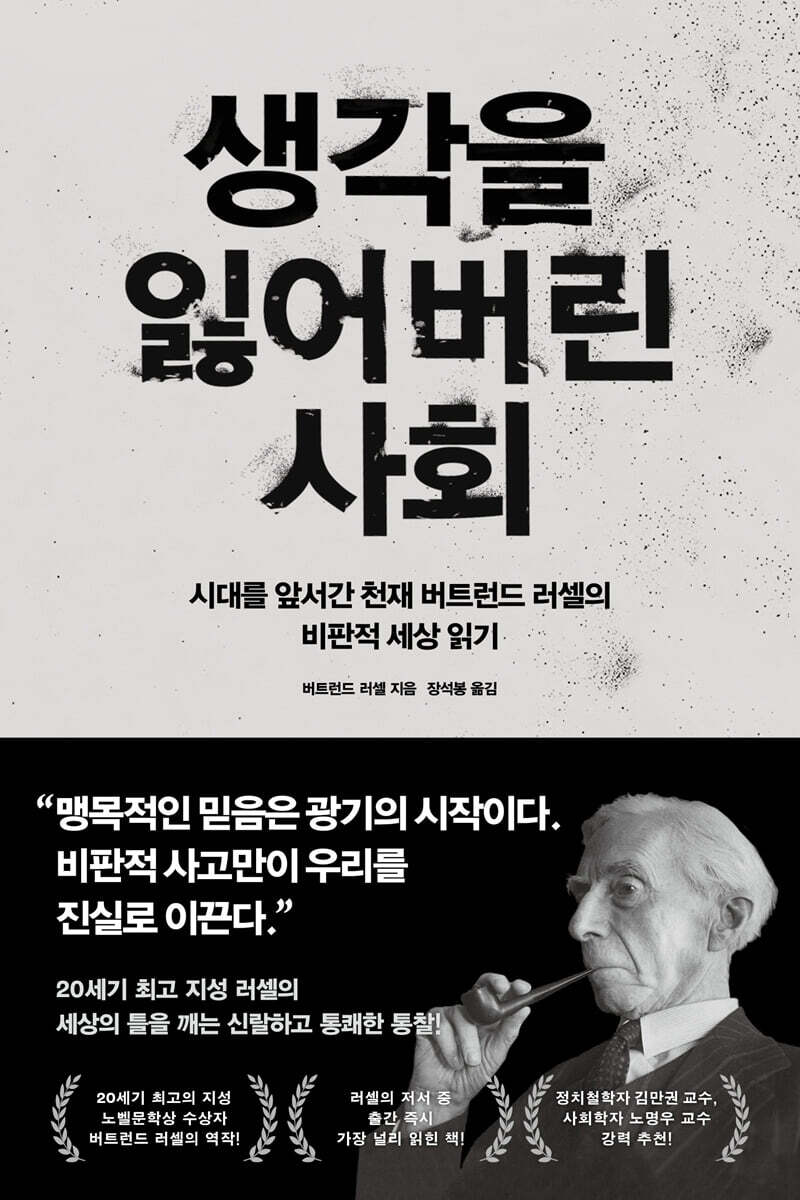
A society that has lost its way
 |
Description
Book Introduction
“Blind faith is the beginning of madness.
“Only critical thinking leads us to the truth.”
"The Society That Lost Its Mind" is a collection of philosophical essays by Bertrand Russell, a Nobel Prize winner in Literature and one of the greatest intellectuals of the 20th century.
When this book was published in 1950, it caused a stir with its sharp critiques that challenged social conventions and authority, and to this day, it is regarded as a classic that transcends time and offers profound insight.
Russell covers a wide range of topics, including war, dogmatism, ideological conflicts, and educational issues, criticizing dogmatism, blind faith, and authoritarianism, and emphasizing the importance of rational and critical thinking.
In particular, his keen insight into the problems of contemporary society has great implications for Korean society today.
Throughout the book, Russell asks the following questions:
"Why do we blindly obey authority? How can we create a better world?" Instead of providing answers to these questions, Russell invites readers to find their own answers.
He emphasizes that critical thinking is the most powerful weapon against the world's lies and absurdities, and the only path that leads us to the truth.
Reading this book is like an intellectual adventure.
Readers will be able to see the world through new eyes by following Russell's brilliant intellect and insight, and broaden their understanding of the world through his cool criticism and warm humanity.
“Only critical thinking leads us to the truth.”
"The Society That Lost Its Mind" is a collection of philosophical essays by Bertrand Russell, a Nobel Prize winner in Literature and one of the greatest intellectuals of the 20th century.
When this book was published in 1950, it caused a stir with its sharp critiques that challenged social conventions and authority, and to this day, it is regarded as a classic that transcends time and offers profound insight.
Russell covers a wide range of topics, including war, dogmatism, ideological conflicts, and educational issues, criticizing dogmatism, blind faith, and authoritarianism, and emphasizing the importance of rational and critical thinking.
In particular, his keen insight into the problems of contemporary society has great implications for Korean society today.
Throughout the book, Russell asks the following questions:
"Why do we blindly obey authority? How can we create a better world?" Instead of providing answers to these questions, Russell invites readers to find their own answers.
He emphasizes that critical thinking is the most powerful weapon against the world's lies and absurdities, and the only path that leads us to the truth.
Reading this book is like an intellectual adventure.
Readers will be able to see the world through new eyes by following Russell's brilliant intellect and insight, and broaden their understanding of the world through his cool criticism and warm humanity.
- You can preview some of the book's contents.
Preview
index
Recommended Reading | What Do We Need in the Post-Truth Era?
Recommended Reading | A Voice for the "Inconvenient Truths" Needed in Modern Society
Introduction | Bertrand Russell, a philosopher who blossomed amidst the storms of his time
Preface | Clarification of the Original Title
Chapter 1: A Cool, Philosophical Perspective on the World
Chapter 2: The Power to Withstand Uncertainty and Suspend Judgment
Chapter 3: Philosophical Suggestions for the Future of Humanity
Chapter 4: The Power to See Through Wrong Thinking
: What does philosophy dream of?
Chapter 5: The Hidden Power of the Weak Against Oppression and Exploitation
Chapter 6: How to Avoid Being Swept Away by the Times
Chapter 7: A Fierce Indictment of Folly
: Why do humans constantly make mistakes?
Chapter 8: How to Develop Critical Thinking and a Creative Spirit
Chapter 9: A History of Progress: Great Ideas That Advanced Humanity
Chapter 10: A History of Destruction: Dangerous Ideas That Are Driving Humanity to Crisis
Chapter 11: Two-Faced Celebrities I've Met
Chapter 12 My Life, My Beliefs
: My Obituary (1937)
Recommended Reading | A Voice for the "Inconvenient Truths" Needed in Modern Society
Introduction | Bertrand Russell, a philosopher who blossomed amidst the storms of his time
Preface | Clarification of the Original Title
Chapter 1: A Cool, Philosophical Perspective on the World
Chapter 2: The Power to Withstand Uncertainty and Suspend Judgment
Chapter 3: Philosophical Suggestions for the Future of Humanity
Chapter 4: The Power to See Through Wrong Thinking
: What does philosophy dream of?
Chapter 5: The Hidden Power of the Weak Against Oppression and Exploitation
Chapter 6: How to Avoid Being Swept Away by the Times
Chapter 7: A Fierce Indictment of Folly
: Why do humans constantly make mistakes?
Chapter 8: How to Develop Critical Thinking and a Creative Spirit
Chapter 9: A History of Progress: Great Ideas That Advanced Humanity
Chapter 10: A History of Destruction: Dangerous Ideas That Are Driving Humanity to Crisis
Chapter 11: Two-Faced Celebrities I've Met
Chapter 12 My Life, My Beliefs
: My Obituary (1937)
Detailed image

Publisher's Review
★A masterpiece by Bertrand Russell, the 20th century's greatest intellectual and Nobel Prize winner in Literature!★
★Highly recommended by political philosopher Professor Kim Man-kwon and sociologist Professor Noh Myung-woo!★
★Russell's most widely read book upon publication!★
“Humans are trusting animals, and they have to believe in something.
“When there is no credible evidence, even bad evidence is believed blindly.”
Bertrand Russell's remarkable insights into an age that has lost the ability to think critically!
Bertrand Russell, a Nobel Prize winner in Literature, is a philosopher who has deeply engaged with real-world issues while also receiving academic recognition.
He spent his life fighting for universal human values, preaching anti-war, women's liberation, freedom, progress, democracy, and rationality, but starting with World War I, he suffered the ordeal of dismissal, imprisonment, and exile due to his fierce anti-war movement.
However, Russell did not give up and continued his fierce fight, and after the end of the World War in 1945, his anti-war philosophy was recognized by the world and he gained the greatest respect and fame.
"The Society That Lost Its Mind" compiles Russell's writings while reflecting on the history of the struggles of that time, explaining not only his philosophy but also his practical ideas and progressiveness.
Russell says that we must never give up our passion and will to seek the truth, while maintaining a critical attitude that not only the opinions of others but also our own claims can be wrong at any time.
Russell's philosophy involves constantly asking questions that have practical definitions about oneself and the world around oneself, and through this, he hopes to advance critical thinking activities in the pursuit of knowledge.
Russell's philosophy is the process of the present self constantly conversing with the past and the future, from self and society, humanity and philosophy, to conflict and coexistence.
Only through this will philosophy provide an antidote to the present anxiety and anguish and bring stability.
“Why did we stop thinking?”
Only critical thinking leads us to the truth.
“Man is a rational animal.
At least that's what I was taught.
Over the years I've been searching tirelessly for evidence to support this claim, but despite searching countless countries across three continents, I've been unlucky and haven't found it yet.
“In fact, I witnessed the world descending further into madness.”
-Chapter 7: A Fierce Indictment of Foolishness
“Man is a rational animal.” At least that’s what we were taught.
However, Bertrand Russell, a representative philosopher of the 20th century, questioned this statement.
During his long life, he traveled to countless countries across three continents, searching for evidence that humans are rational animals, but he found none.
Rather, we have only witnessed the world descend into madness.
Russell points out that modern society is pervasive with ideology, nationalism, and religious fanaticism, paralyzing human reason.
He also criticizes modern education for failing to foster critical thinking skills, and demonstrates its foolishness through various examples.
He illustrates with an example the tendency of people to easily fall into faith.
In the past, people believed that when a person sneezed, their soul left the body and the devil took advantage of the gap to enter the body.
Today, we laugh at these superstitions, but we still hold to baseless beliefs like "blood is thicker than water."
Even during World War II, the American Red Cross declared that it would not transfuse black blood, and in Germany, Aryan blood was not to be contaminated with Jewish blood.
He also criticizes people for their tendency to accept only evidence that aligns with their beliefs, rather than seeking evidence that supports them.
He points out that this human foolishness is the root cause of social problems.
Dogmatism further aggravates this human stupidity.
Dogmatism asserts an absolute system of truth and rejects anything that contradicts it.
Dogmatists have absolute confidence in their beliefs and are unacceptable to differing opinions or criticisms.
They blindly follow their beliefs and consider anyone who questions or criticizes them as an enemy.
Russell emphasizes that such dogmatism is a major cause of rigidifying society, suppressing diversity, and deepening conflict, and warns of the dangers of such dogmatism and emphasizes the importance of critical thinking.
He argues that we can escape dogmatism and reach the truth by constantly questioning, doubting, and criticizing.
Now, rereading Russell's message
The voice of intelligence that reveals inconvenient truths
Russell's writing is sometimes uncomfortable.
Because he reveals the truth we would rather ignore.
He points out our biases and blind spots, questions what we take for granted, and criticizes what we want to believe.
But his criticism is neither cynical nor destructive.
It is based on a deep trust in human reason and wisdom.
Russell believes that through critical thinking we can better understand the world and create a better world.
In particular, Chapter 12, My Life, My Beliefs, is an obituary written by Russell himself.
He described himself as "the last survivor of an era that has already passed away."
But his message transcends time and resonates deeply with us today.
In this book, he hoped that readers would break free from dogmatic thinking, develop critical thinking skills, view the world objectively, and use reason and wisdom for the future of humanity.
He addresses a wide range of topics, including war, nuclear weapons, ideological conflicts, and educational issues, criticizing dogmatism, blind faith, and authoritarianism, and emphasizing the importance of rational and critical thinking.
In particular, his keen insight into the problems of modern society has great implications for Korean society today.
Through this book, we can find our own answers to our questions, rather than simply accepting the given answers, and gain the wisdom to create a better future.
Now, let's encounter Russell's message through "The Lost Society" and experience the power of his sharp insight.
★Highly recommended by political philosopher Professor Kim Man-kwon and sociologist Professor Noh Myung-woo!★
★Russell's most widely read book upon publication!★
“Humans are trusting animals, and they have to believe in something.
“When there is no credible evidence, even bad evidence is believed blindly.”
Bertrand Russell's remarkable insights into an age that has lost the ability to think critically!
Bertrand Russell, a Nobel Prize winner in Literature, is a philosopher who has deeply engaged with real-world issues while also receiving academic recognition.
He spent his life fighting for universal human values, preaching anti-war, women's liberation, freedom, progress, democracy, and rationality, but starting with World War I, he suffered the ordeal of dismissal, imprisonment, and exile due to his fierce anti-war movement.
However, Russell did not give up and continued his fierce fight, and after the end of the World War in 1945, his anti-war philosophy was recognized by the world and he gained the greatest respect and fame.
"The Society That Lost Its Mind" compiles Russell's writings while reflecting on the history of the struggles of that time, explaining not only his philosophy but also his practical ideas and progressiveness.
Russell says that we must never give up our passion and will to seek the truth, while maintaining a critical attitude that not only the opinions of others but also our own claims can be wrong at any time.
Russell's philosophy involves constantly asking questions that have practical definitions about oneself and the world around oneself, and through this, he hopes to advance critical thinking activities in the pursuit of knowledge.
Russell's philosophy is the process of the present self constantly conversing with the past and the future, from self and society, humanity and philosophy, to conflict and coexistence.
Only through this will philosophy provide an antidote to the present anxiety and anguish and bring stability.
“Why did we stop thinking?”
Only critical thinking leads us to the truth.
“Man is a rational animal.
At least that's what I was taught.
Over the years I've been searching tirelessly for evidence to support this claim, but despite searching countless countries across three continents, I've been unlucky and haven't found it yet.
“In fact, I witnessed the world descending further into madness.”
-Chapter 7: A Fierce Indictment of Foolishness
“Man is a rational animal.” At least that’s what we were taught.
However, Bertrand Russell, a representative philosopher of the 20th century, questioned this statement.
During his long life, he traveled to countless countries across three continents, searching for evidence that humans are rational animals, but he found none.
Rather, we have only witnessed the world descend into madness.
Russell points out that modern society is pervasive with ideology, nationalism, and religious fanaticism, paralyzing human reason.
He also criticizes modern education for failing to foster critical thinking skills, and demonstrates its foolishness through various examples.
He illustrates with an example the tendency of people to easily fall into faith.
In the past, people believed that when a person sneezed, their soul left the body and the devil took advantage of the gap to enter the body.
Today, we laugh at these superstitions, but we still hold to baseless beliefs like "blood is thicker than water."
Even during World War II, the American Red Cross declared that it would not transfuse black blood, and in Germany, Aryan blood was not to be contaminated with Jewish blood.
He also criticizes people for their tendency to accept only evidence that aligns with their beliefs, rather than seeking evidence that supports them.
He points out that this human foolishness is the root cause of social problems.
Dogmatism further aggravates this human stupidity.
Dogmatism asserts an absolute system of truth and rejects anything that contradicts it.
Dogmatists have absolute confidence in their beliefs and are unacceptable to differing opinions or criticisms.
They blindly follow their beliefs and consider anyone who questions or criticizes them as an enemy.
Russell emphasizes that such dogmatism is a major cause of rigidifying society, suppressing diversity, and deepening conflict, and warns of the dangers of such dogmatism and emphasizes the importance of critical thinking.
He argues that we can escape dogmatism and reach the truth by constantly questioning, doubting, and criticizing.
Now, rereading Russell's message
The voice of intelligence that reveals inconvenient truths
Russell's writing is sometimes uncomfortable.
Because he reveals the truth we would rather ignore.
He points out our biases and blind spots, questions what we take for granted, and criticizes what we want to believe.
But his criticism is neither cynical nor destructive.
It is based on a deep trust in human reason and wisdom.
Russell believes that through critical thinking we can better understand the world and create a better world.
In particular, Chapter 12, My Life, My Beliefs, is an obituary written by Russell himself.
He described himself as "the last survivor of an era that has already passed away."
But his message transcends time and resonates deeply with us today.
In this book, he hoped that readers would break free from dogmatic thinking, develop critical thinking skills, view the world objectively, and use reason and wisdom for the future of humanity.
He addresses a wide range of topics, including war, nuclear weapons, ideological conflicts, and educational issues, criticizing dogmatism, blind faith, and authoritarianism, and emphasizing the importance of rational and critical thinking.
In particular, his keen insight into the problems of modern society has great implications for Korean society today.
Through this book, we can find our own answers to our questions, rather than simply accepting the given answers, and gain the wisdom to create a better future.
Now, let's encounter Russell's message through "The Lost Society" and experience the power of his sharp insight.
GOODS SPECIFICS
- Date of issue: March 14, 2025
- Page count, weight, size: 292 pages | 140*210*19mm
- ISBN13: 9791173571015
- ISBN10: 1173571019
You may also like
카테고리
korean


korean

![GQ KOREA Mark (Monthly): December [2025]](http://librairie.coreenne.fr/cdn/shop/files/8ef265dbbfbf186523ed75ba7319009d.jpg?v=1765340328&width=3840)


