

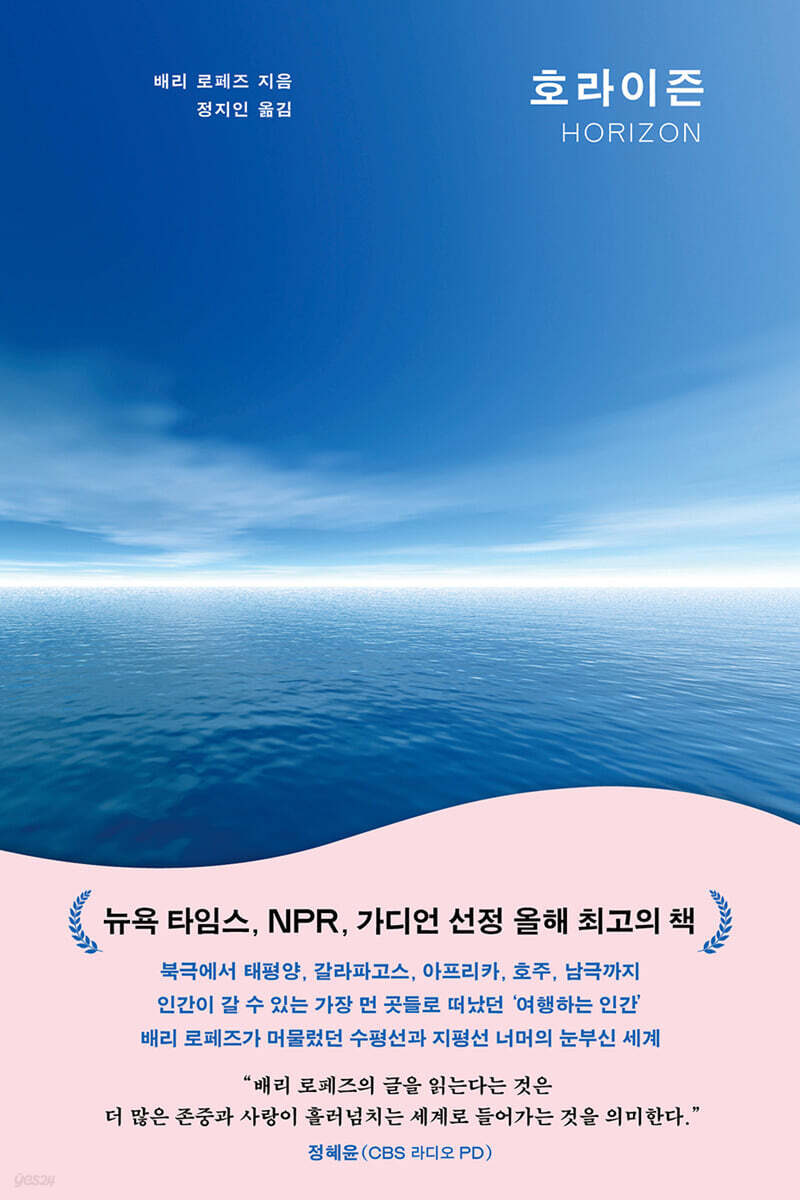
Horizon
 |
Description
Book Introduction
“If someone were to run away, where would their destination be?”
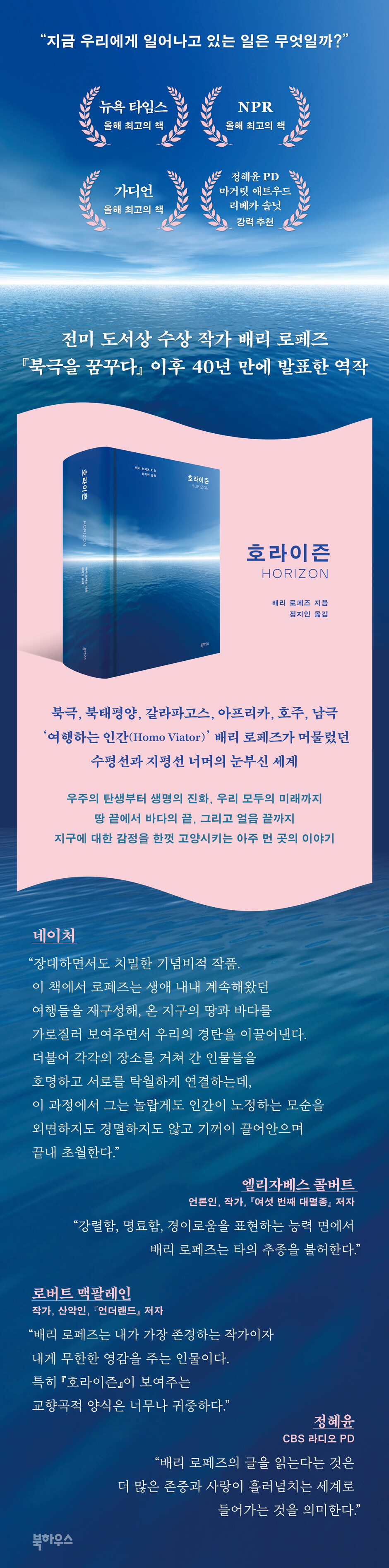
From the Arctic to the Pacific, the Galapagos, Africa, Australia, and Antarctica
Homo Viator, the traveler who set out to the farthest places humans can go
The dazzling world beyond the horizon where Barry Lopez resided
* Selected as one of the best books of the year by the New York Times, NPR, and The Guardian
* National Book Award-winning author Barry Lopez's last masterpiece
National Book Award-winning author Barry Lopez's last masterpiece, Horizon, has been translated and published in Korea.
This book is a compilation of Barry Lopez's travel experiences, and is his most extensive nonfiction work, densely weaving together places and thoughts.
It is a beautiful and meticulously reconstructed symphony, covering six regions: the Arctic, Antarctica, the North Pacific, the South Pacific, Africa, and Australia.
Using these places as a backdrop, Lopez weaves together the long history of human exploration and travel, including the prehistoric people who braved the Arctic, the colonialists who invaded Africa, the Enlightenment Europeans who sailed the Pacific, and the Americans who crossed into Asia after diplomatic doors were closed.
Meanwhile, it explores topics from various fields, such as the origins of humanity (anthropology), the history of the earth (geology), the intermingling of living things (biology), exploration and colonialism (politics), and ethical and scientific reflections on climate change (ethics and science).
The keyword of this book, ‘travel,’ is for Lopez an activity of gathering wisdom and an action of changing himself.
He constantly set out on the road to cross the boundaries of the familiar and head toward the unknown, willingly being captivated by the wonder of the landscape before his eyes, and believing that the unfamiliar things we encounter along the way can transform us.
Moreover, he calls out the names of the people who have passed through each place and connects them with each other in an excellent way. In the process, he neither ignores nor despises the contradictions that humans face, but rather willingly embraces them and ultimately transcends them.
The author's vivid and beautiful prose depicts the landscapes and people of the world, past and present, leaving a deep resonance in readers.
From the Arctic to the Pacific, the Galapagos, Africa, Australia, and Antarctica
Homo Viator, the traveler who set out to the farthest places humans can go
The dazzling world beyond the horizon where Barry Lopez resided
* Selected as one of the best books of the year by the New York Times, NPR, and The Guardian
* National Book Award-winning author Barry Lopez's last masterpiece
National Book Award-winning author Barry Lopez's last masterpiece, Horizon, has been translated and published in Korea.
This book is a compilation of Barry Lopez's travel experiences, and is his most extensive nonfiction work, densely weaving together places and thoughts.
It is a beautiful and meticulously reconstructed symphony, covering six regions: the Arctic, Antarctica, the North Pacific, the South Pacific, Africa, and Australia.
Using these places as a backdrop, Lopez weaves together the long history of human exploration and travel, including the prehistoric people who braved the Arctic, the colonialists who invaded Africa, the Enlightenment Europeans who sailed the Pacific, and the Americans who crossed into Asia after diplomatic doors were closed.
Meanwhile, it explores topics from various fields, such as the origins of humanity (anthropology), the history of the earth (geology), the intermingling of living things (biology), exploration and colonialism (politics), and ethical and scientific reflections on climate change (ethics and science).
The keyword of this book, ‘travel,’ is for Lopez an activity of gathering wisdom and an action of changing himself.
He constantly set out on the road to cross the boundaries of the familiar and head toward the unknown, willingly being captivated by the wonder of the landscape before his eyes, and believing that the unfamiliar things we encounter along the way can transform us.
Moreover, he calls out the names of the people who have passed through each place and connects them with each other in an excellent way. In the process, he neither ignores nor despises the contradictions that humans face, but rather willingly embraces them and ultimately transcends them.
The author's vivid and beautiful prose depicts the landscapes and people of the world, past and present, leaving a deep resonance in readers.
- You can preview some of the book's contents.
Preview
index
Author's Note
prolog
Entering: Finding the Ship
Cape Foulweather
Oregon coast, eastern North Pacific coast, western North America
Screlling Island
Entrance to Alexandra Fjord, east coast of Ellesmere Island, Nunavut, Canada
Puerto Ayora
Santa Cruz Island, Colon Islands, eastern equatorial Pacific Ocean
Jackal Camp
Turkwell River Basin, Western Highlands of Lake Turkana, Eastern Equatorial Africa
From Port Arthur to Botany Bay
Tasmania, southeastern Australia, northern coast of the Southern Ocean
New South Wales, southeastern Australia, west coast of the South Pacific
From Gravesnunatax to Port Pamin Road
Queen Maud Mountains, central part of the Transantarctic Mountains, northern edge of the Antarctic Plateau, Antarctica
Brunswick Peninsula, off the coast of the Strait of Magellan in southern Chile
main
References
Scientific name
map
Acknowledgements
prolog
Entering: Finding the Ship
Cape Foulweather
Oregon coast, eastern North Pacific coast, western North America
Screlling Island
Entrance to Alexandra Fjord, east coast of Ellesmere Island, Nunavut, Canada
Puerto Ayora
Santa Cruz Island, Colon Islands, eastern equatorial Pacific Ocean
Jackal Camp
Turkwell River Basin, Western Highlands of Lake Turkana, Eastern Equatorial Africa
From Port Arthur to Botany Bay
Tasmania, southeastern Australia, northern coast of the Southern Ocean
New South Wales, southeastern Australia, west coast of the South Pacific
From Gravesnunatax to Port Pamin Road
Queen Maud Mountains, central part of the Transantarctic Mountains, northern edge of the Antarctic Plateau, Antarctica
Brunswick Peninsula, off the coast of the Strait of Magellan in southern Chile
main
References
Scientific name
map
Acknowledgements
Detailed image
Into the book
No matter how meticulously one pays attention to a place on many levels, no matter how many times one travels there, one can never fully understand a place.
This is because places themselves are always changing, but also because all places are by their very nature opaque and unclear.
I've never been drawn to the idea of writing definitively about anything.
This is especially true given the ever-changing nature of cultural geography.
So when I revisited places, I was more interested in how I could reflect on my previous experiences there and discover a different truth from what I had initially written.
I was also intrigued by how memories of a place could spark new emotions, and how the truth contained in those emotions could transform the facts I had once so carefully collected.
---- p.49
The desire to know ourselves better, especially to understand the source and nature of our fears, is now upon us.
A dark scene of slaughter—the unbreathable air, the human diaspora, the sixth mass extinction, an uncontrollable political mob—like a ghost hovering in the strange dawn that dawns above.
---- p.86
In Western culture, the authority of art, its special power to illuminate the world, has been partially eclipsed by the scientific revolution.
Since then, the place of art in everyday life has become increasingly decorative, its influence has declined under the certitude of science, and its authority has been reduced to little more than a polite nod to it.
Although the history of separating art from the world of nature is older than that of separating art from the world of reason, the latter has also had a profound impact on the way humans grapple with their own destiny.
Art does not aspire to give pleasure.
What art longs for is conversation.
Art is also about life's destiny, as Clausius said about the second law of thermodynamics, the law of entropy.
---- p.124~125
What had long been an image of fear to me had now been transformed into something else, an image of perfection.
There was a fundamental wildness of the earth here, a sense of the sacredness in chaos that William Blake spoke of.
---- p.187
One morning I found a pale-crowned buzzard sitting on the top of a dead tree there.
These birds of prey hunt reptiles and small mammals, as well as other birds.
As with all predatory birds of this type, the success of this falcon's hunting depends on its depth perception.
As I approached, the bird kept turning its back to me.
I imagined this bird staring intently at the vast savannah before it, looking for prey to swoop down and snatch.
As I got closer, the bird turned its head and looked down at me.
The bird's right eyeball was gone, and blood was clotted on the feathers surrounding the eye socket.
The falcon ignored me and turned its head again to survey the savannah.
Whenever I feel like giving up, I think of that bird.
How many birds in the world are there that are still hunting despite being so badly injured?
---- p.282~283
The water was very deep.
It was a place that sailors on the sea called 'blue water' because of its cobalt hue.
What appeared below me were not dolphins, but something I never expected to see.
Ten meters below, a dark blue-gray female whale, about 15 meters long, was caring for a calf.
When faced with such moments, even after the mind has regained composure, the heart does not return to its normal rhythm for a long time.
The moment when the lines that make up the light, shadows, and underwater shapes fit together to create a single, consistent image.
---- p.406
When we look back at our origins, there are two misconceptions we often fall into.
One is the misconception that Homo sapiens has evolved toward perfection (rather than simply changing in response to environmental changes), and the other is the misconception that whatever modern humans have lost as they passed from one era to the next is a good thing.
The idea that paper 'improves' over time is a completely baseless concept in evolutionary theory.
And what Homo sapiens 'lost' in the process of coming to the modern era, such as the willingness to cooperate closely with others in everyday life, is something that Homo sapiens can easily regain.
Because Homo sapiens, unlike other animals, have a knack for historical imagination and innovation.
---- p.526
Evolution, in a word, is endless modification, change without reason or purpose.
In the 21st century, the notion of protecting racial purity or maintaining a biologically stable environment—one that categorizes all new arrivals as “invaders” or “foreign” and thus prevents their entry—is untenable.
Even leaving aside the obvious ethical issues, this argument denies the passage of time.
The saying that landscapes transcend time is only metaphorical; in reality, landscapes do not transcend time.
And the era we live in is an era of unprecedented cultural exchange, an era of incoming and outgoing migration.
If we maintain a conservative, hostile attitude toward race and culture, there is no future but war.
And every landscape is always changing into something else, whether it be a slow, accumulating change or a change at a terrifying pace.
--- p.675
I told John.
“A theology professor once said that having a religion is not about having certainty, but about living with uncertainty.
“It’s about being comfortable with doubt, and maintaining the respect you’ve always had for some profound mystery.” I couldn’t tell if John heard me.
He was lying in his sleeping bag, and I could only see the lower part of his legs beyond the pile of equipment.
I might have already fallen asleep.
Because it was a long and tiring day.
“We are gaining deeper knowledge,” John answered.
“That doesn’t guarantee that we’re getting any closer to wisdom.”
This is because places themselves are always changing, but also because all places are by their very nature opaque and unclear.
I've never been drawn to the idea of writing definitively about anything.
This is especially true given the ever-changing nature of cultural geography.
So when I revisited places, I was more interested in how I could reflect on my previous experiences there and discover a different truth from what I had initially written.
I was also intrigued by how memories of a place could spark new emotions, and how the truth contained in those emotions could transform the facts I had once so carefully collected.
---- p.49
The desire to know ourselves better, especially to understand the source and nature of our fears, is now upon us.
A dark scene of slaughter—the unbreathable air, the human diaspora, the sixth mass extinction, an uncontrollable political mob—like a ghost hovering in the strange dawn that dawns above.
---- p.86
In Western culture, the authority of art, its special power to illuminate the world, has been partially eclipsed by the scientific revolution.
Since then, the place of art in everyday life has become increasingly decorative, its influence has declined under the certitude of science, and its authority has been reduced to little more than a polite nod to it.
Although the history of separating art from the world of nature is older than that of separating art from the world of reason, the latter has also had a profound impact on the way humans grapple with their own destiny.
Art does not aspire to give pleasure.
What art longs for is conversation.
Art is also about life's destiny, as Clausius said about the second law of thermodynamics, the law of entropy.
---- p.124~125
What had long been an image of fear to me had now been transformed into something else, an image of perfection.
There was a fundamental wildness of the earth here, a sense of the sacredness in chaos that William Blake spoke of.
---- p.187
One morning I found a pale-crowned buzzard sitting on the top of a dead tree there.
These birds of prey hunt reptiles and small mammals, as well as other birds.
As with all predatory birds of this type, the success of this falcon's hunting depends on its depth perception.
As I approached, the bird kept turning its back to me.
I imagined this bird staring intently at the vast savannah before it, looking for prey to swoop down and snatch.
As I got closer, the bird turned its head and looked down at me.
The bird's right eyeball was gone, and blood was clotted on the feathers surrounding the eye socket.
The falcon ignored me and turned its head again to survey the savannah.
Whenever I feel like giving up, I think of that bird.
How many birds in the world are there that are still hunting despite being so badly injured?
---- p.282~283
The water was very deep.
It was a place that sailors on the sea called 'blue water' because of its cobalt hue.
What appeared below me were not dolphins, but something I never expected to see.
Ten meters below, a dark blue-gray female whale, about 15 meters long, was caring for a calf.
When faced with such moments, even after the mind has regained composure, the heart does not return to its normal rhythm for a long time.
The moment when the lines that make up the light, shadows, and underwater shapes fit together to create a single, consistent image.
---- p.406
When we look back at our origins, there are two misconceptions we often fall into.
One is the misconception that Homo sapiens has evolved toward perfection (rather than simply changing in response to environmental changes), and the other is the misconception that whatever modern humans have lost as they passed from one era to the next is a good thing.
The idea that paper 'improves' over time is a completely baseless concept in evolutionary theory.
And what Homo sapiens 'lost' in the process of coming to the modern era, such as the willingness to cooperate closely with others in everyday life, is something that Homo sapiens can easily regain.
Because Homo sapiens, unlike other animals, have a knack for historical imagination and innovation.
---- p.526
Evolution, in a word, is endless modification, change without reason or purpose.
In the 21st century, the notion of protecting racial purity or maintaining a biologically stable environment—one that categorizes all new arrivals as “invaders” or “foreign” and thus prevents their entry—is untenable.
Even leaving aside the obvious ethical issues, this argument denies the passage of time.
The saying that landscapes transcend time is only metaphorical; in reality, landscapes do not transcend time.
And the era we live in is an era of unprecedented cultural exchange, an era of incoming and outgoing migration.
If we maintain a conservative, hostile attitude toward race and culture, there is no future but war.
And every landscape is always changing into something else, whether it be a slow, accumulating change or a change at a terrifying pace.
--- p.675
I told John.
“A theology professor once said that having a religion is not about having certainty, but about living with uncertainty.
“It’s about being comfortable with doubt, and maintaining the respect you’ve always had for some profound mystery.” I couldn’t tell if John heard me.
He was lying in his sleeping bag, and I could only see the lower part of his legs beyond the pile of equipment.
I might have already fallen asleep.
Because it was a long and tiring day.
“We are gaining deeper knowledge,” John answered.
“That doesn’t guarantee that we’re getting any closer to wisdom.”
--- p.751
Publisher's Review
From the ends of the earth to the ends of the sea, and to the ends of the ice caps
A book about almost everything about travel and places
“You have to know where you came from to avoid feeling lost.” In Horizon, Barry Lopez reveals hidden signs and fragments of the Earth, hoping to help people avoid getting lost.
He is filled with awe as he travels to places on Earth most of us will never see, yet amidst all this scenery, there is a gentle sadness for those who have strayed or lost their way.
Certainly, this world is not a place where one can live in peace for long, yet surprisingly, his tone is hopeful throughout.
He soothes the sadness with moment-by-moment awareness, helping readers find their own path by refocusing their attention on what they need to pay attention to and what they need to see.
Lopez features places that have beckoned and called to him throughout his life, from the remains of Arctic indigenous settlements to the edge of the Antarctic plateau where meteorite fragments are hidden.
It also takes us to places where we can discover new layers of terror in the nation's history, from the west coast of North America, where 18th-century British explorer James Cook first landed, to the south coast of Tasmania, Australia, where colonial prison sites were built.
However, time does not flow linearly in books.
It is rare to find a specific date mentioned or described across hundreds of pages.
Lopez is a very kind guide, but the only real direction he gives the reader is location.
This suggests that place is what has a fundamental impact on our lives.
The core of this book is, above all, to explore the nature of travel and why Homo sapiens have been compelled to travel from the beginning.
But this book is not just travel literature.
Horizons is not a book about stepping back and observing the majesty of nature, but about understanding the context within which we exist and how, as a violent and curious species, we aggressively and persistently reshape that context.
“Travel stimulates us to revise common sense and shake off preconceived notions that have persisted from the past.
It also forces our minds to consider context and frees them from the tyranny of absolute truths about humanity.
It also helps us understand that not everyone wants the same path.
“People want to go their own way rather than following the same path.”
One question at the end of my journey: What have I learned?
Earnest suggestions for resolving the problems caused by humanity.
Meanwhile, this book seriously approaches the crisis faced by humans living on Earth.
In the mid-1980s, when Barry Lopez published Dreaming of the North, most of the dangers facing the ecosystems, animals, and people of the Far North stemmed from nature—from the fundamental challenges of living in such rugged terrain.
But as oil exploration and mining began to boom, roads and heavy equipment began to explode.
The community was feeling the effects of the rude invasion.
Lopez was concerned about the future of the region and the planet, but concluded that if we acted with respect for all that is on this earth, we could imagine the stifling ignorance that lies ahead.
But if we look back over the past few decades, we might want to shout out to the world that we need to act differently.
Let's stop destroying our ecosystems, stop burning fossil fuels, and start working together before everything falls apart.
As we watch the cascading effects of industrial development and climate change transform many other parts of the globe today, we are reminded of the reality that Lopez's concerns not so long ago have become reality.
This book is also Lopez's answer to the questions he himself asked about humanity.
“After seeing so many places in the world, what have I learned about human dangers, human triumphs, and human failures?”
The answer comes as a dreamy yet desperate appeal spread across 900 pages.
Wherever Lopez goes, he cannot escape the sorrow he feels for humanity's ruthless behavior and the desperate desire to awaken people to their sense of alarm.
But strangely enough, the constant reminder of human atrocities doesn't diminish the allure of seeing the world through Lopez's eyes.
Even as we explore the world's corners, even the most shameful historical sites, we find ourselves reading with an irresistible curiosity and pull.
That's thanks to Lopez's unique strategy of hope.
Faced with a very real environmental and existential crisis, Lopez draws on both his memories and meticulously recorded field notes to reconstruct his experiences, mine accumulated wisdom, and transport us to distant places where he spent his time in search of a glimmer of hope.
“If you can’t write like Barry Lopez, stop describing nature.”
Special writing that highlights the vitality of the Earth
Lopez is known for his beautifully written and captivating prose, which is as much about the brilliance of his stories as it is about his content.
In this book, too, the author writes elegantly and with a surprisingly relaxed tone.
In the six chapters of the text, each chapter has a specific geographical anchor, which W.
It also reminds me of G. Sebald's 'The Rings of Saturn'.
Lopez depicts the lifeless beauty of Antarctica, but the ice cathedrals, the clear waters, and the harsh winds cut through our bodies with sentences more alive than any other being.
It also takes readers to the sea and shares the experience of feeling the breath of a seal fill their nostrils and lungs. The sentences that unfold from the small to the universe and back again to the smallest are so skillfully and beautifully expressed that you will feel regret as the end approaches.
This unprecedented technique has had a great influence on other writers as well.
Countless writers writing about humanity on Earth have emulated Lopez's special skill in capturing the unseen details of the landscape around us with generosity, wonder, and specificity.
The message that comes to mind when I close the last page of the book is that we don't have much time, but we still have time to prepare.
Even as we become aware that, like all other living beings, our existence is ultimately moving towards darkness, and that none of us can escape that darkness alive, that very hope embraces us.
So, what Lopez has gifted us is a generous perspective on the present, a message that even in the darkness, possibilities lie before us.
There is hope in it and things worth preserving.
If we embrace this truth, our days might become a little less difficult.
A book about almost everything about travel and places
“You have to know where you came from to avoid feeling lost.” In Horizon, Barry Lopez reveals hidden signs and fragments of the Earth, hoping to help people avoid getting lost.
He is filled with awe as he travels to places on Earth most of us will never see, yet amidst all this scenery, there is a gentle sadness for those who have strayed or lost their way.
Certainly, this world is not a place where one can live in peace for long, yet surprisingly, his tone is hopeful throughout.
He soothes the sadness with moment-by-moment awareness, helping readers find their own path by refocusing their attention on what they need to pay attention to and what they need to see.
Lopez features places that have beckoned and called to him throughout his life, from the remains of Arctic indigenous settlements to the edge of the Antarctic plateau where meteorite fragments are hidden.
It also takes us to places where we can discover new layers of terror in the nation's history, from the west coast of North America, where 18th-century British explorer James Cook first landed, to the south coast of Tasmania, Australia, where colonial prison sites were built.
However, time does not flow linearly in books.
It is rare to find a specific date mentioned or described across hundreds of pages.
Lopez is a very kind guide, but the only real direction he gives the reader is location.
This suggests that place is what has a fundamental impact on our lives.
The core of this book is, above all, to explore the nature of travel and why Homo sapiens have been compelled to travel from the beginning.
But this book is not just travel literature.
Horizons is not a book about stepping back and observing the majesty of nature, but about understanding the context within which we exist and how, as a violent and curious species, we aggressively and persistently reshape that context.
“Travel stimulates us to revise common sense and shake off preconceived notions that have persisted from the past.
It also forces our minds to consider context and frees them from the tyranny of absolute truths about humanity.
It also helps us understand that not everyone wants the same path.
“People want to go their own way rather than following the same path.”
One question at the end of my journey: What have I learned?
Earnest suggestions for resolving the problems caused by humanity.
Meanwhile, this book seriously approaches the crisis faced by humans living on Earth.
In the mid-1980s, when Barry Lopez published Dreaming of the North, most of the dangers facing the ecosystems, animals, and people of the Far North stemmed from nature—from the fundamental challenges of living in such rugged terrain.
But as oil exploration and mining began to boom, roads and heavy equipment began to explode.
The community was feeling the effects of the rude invasion.
Lopez was concerned about the future of the region and the planet, but concluded that if we acted with respect for all that is on this earth, we could imagine the stifling ignorance that lies ahead.
But if we look back over the past few decades, we might want to shout out to the world that we need to act differently.
Let's stop destroying our ecosystems, stop burning fossil fuels, and start working together before everything falls apart.
As we watch the cascading effects of industrial development and climate change transform many other parts of the globe today, we are reminded of the reality that Lopez's concerns not so long ago have become reality.
This book is also Lopez's answer to the questions he himself asked about humanity.
“After seeing so many places in the world, what have I learned about human dangers, human triumphs, and human failures?”
The answer comes as a dreamy yet desperate appeal spread across 900 pages.
Wherever Lopez goes, he cannot escape the sorrow he feels for humanity's ruthless behavior and the desperate desire to awaken people to their sense of alarm.
But strangely enough, the constant reminder of human atrocities doesn't diminish the allure of seeing the world through Lopez's eyes.
Even as we explore the world's corners, even the most shameful historical sites, we find ourselves reading with an irresistible curiosity and pull.
That's thanks to Lopez's unique strategy of hope.
Faced with a very real environmental and existential crisis, Lopez draws on both his memories and meticulously recorded field notes to reconstruct his experiences, mine accumulated wisdom, and transport us to distant places where he spent his time in search of a glimmer of hope.
“If you can’t write like Barry Lopez, stop describing nature.”
Special writing that highlights the vitality of the Earth
Lopez is known for his beautifully written and captivating prose, which is as much about the brilliance of his stories as it is about his content.
In this book, too, the author writes elegantly and with a surprisingly relaxed tone.
In the six chapters of the text, each chapter has a specific geographical anchor, which W.
It also reminds me of G. Sebald's 'The Rings of Saturn'.
Lopez depicts the lifeless beauty of Antarctica, but the ice cathedrals, the clear waters, and the harsh winds cut through our bodies with sentences more alive than any other being.
It also takes readers to the sea and shares the experience of feeling the breath of a seal fill their nostrils and lungs. The sentences that unfold from the small to the universe and back again to the smallest are so skillfully and beautifully expressed that you will feel regret as the end approaches.
This unprecedented technique has had a great influence on other writers as well.
Countless writers writing about humanity on Earth have emulated Lopez's special skill in capturing the unseen details of the landscape around us with generosity, wonder, and specificity.
The message that comes to mind when I close the last page of the book is that we don't have much time, but we still have time to prepare.
Even as we become aware that, like all other living beings, our existence is ultimately moving towards darkness, and that none of us can escape that darkness alive, that very hope embraces us.
So, what Lopez has gifted us is a generous perspective on the present, a message that even in the darkness, possibilities lie before us.
There is hope in it and things worth preserving.
If we embrace this truth, our days might become a little less difficult.
GOODS SPECIFICS
- Date of issue: December 25, 2024
- Format: Hardcover book binding method guide
- Page count, weight, size: 928 pages | 1,176g | 137*203*62mm
- ISBN13: 9791164052967
You may also like
카테고리
korean


korean

![GQ KOREA Mark (Monthly): December [2025]](http://librairie.coreenne.fr/cdn/shop/files/8ef265dbbfbf186523ed75ba7319009d.jpg?v=1765340328&width=3840)


