

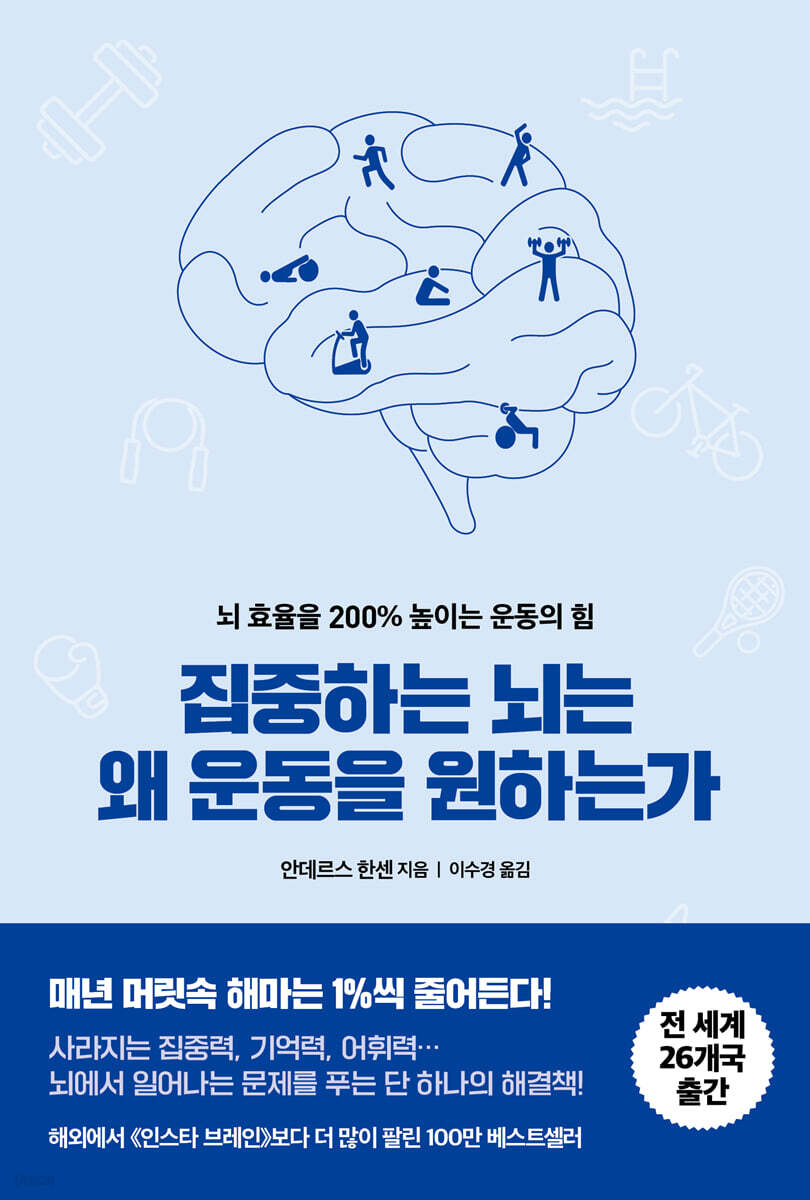
Why the Focused Brain Wants Exercise
 |
Description
Book Introduction
- A word from MD
- What Anders Hansen, author of 'Insta Brain', emphasizes in this book is 'exercise'.
Losing your smartphone in the corner of the room isn't just about concentration.
The pleasure and utility of exercising are also taken away.
Our brain and body need exercise.
Exercise is great for learning, stress relief, and creativity.
- Son Min-gyu, humanities PD
Not being able to concentrate because you're just touching your smartphone,
Missing important things while thinking about other things
“It’s not a lack of concentration, it’s a lack of exercise!”
We easily lose focus for a variety of reasons, including lack of sleep, overwork, and smartphone use.
In addition, with the influx of information, there is too much to remember, and brain function declines due to aging.
All the problems inside and outside our brains prevent us from focusing properly.
But the solution is simple.
The most effective way to optimize and streamline our brain is to move our bodies.
Every time we move our bodies, our brain produces reward substances, which in turn changes both our brain and our body for the better.
Author Anders Hansen is Sweden's national doctor and the international bestselling author of "Insta Brain."
And this book is his masterpiece, and one in four Swedish citizens have read it.
It contains many studies and case studies on what specific exercises we need to do to make our brain work efficiently and what changes occur in the brain.
In particular, this book explains in detail the parts that help improve concentration.
The reason exercise is so important for improving focus is because physical activity boosts dopamine levels and fine-tunes your reward system.
When you start exercising, dopamine levels increase and remain there for hours.
So after exercising, I feel more focused and calmer.
Additionally, depending on the type of exercise, it can affect various memory functions.
Running improves your vocabulary memorization, and weight training helps improve your associative memory.
Our hippocampus shrinks by about 1% each year.
However, the results of the experiment showed that the brain volume of the group that participated in endurance training did not decrease at all; rather, it grew and increased by 2%.
Exercise stimulates the hippocampus region of the brain, which increases concentration and improves learning ability.
Your brain gets better oxygen and nutrients, which improves your creativity and problem-solving skills.
Beyond explaining the benefits of exercise, this book also provides practical information on which exercises to do and at what intensity, helping you develop a natural exercise habit.
Missing important things while thinking about other things
“It’s not a lack of concentration, it’s a lack of exercise!”
We easily lose focus for a variety of reasons, including lack of sleep, overwork, and smartphone use.
In addition, with the influx of information, there is too much to remember, and brain function declines due to aging.
All the problems inside and outside our brains prevent us from focusing properly.
But the solution is simple.
The most effective way to optimize and streamline our brain is to move our bodies.
Every time we move our bodies, our brain produces reward substances, which in turn changes both our brain and our body for the better.
Author Anders Hansen is Sweden's national doctor and the international bestselling author of "Insta Brain."
And this book is his masterpiece, and one in four Swedish citizens have read it.
It contains many studies and case studies on what specific exercises we need to do to make our brain work efficiently and what changes occur in the brain.
In particular, this book explains in detail the parts that help improve concentration.
The reason exercise is so important for improving focus is because physical activity boosts dopamine levels and fine-tunes your reward system.
When you start exercising, dopamine levels increase and remain there for hours.
So after exercising, I feel more focused and calmer.
Additionally, depending on the type of exercise, it can affect various memory functions.
Running improves your vocabulary memorization, and weight training helps improve your associative memory.
Our hippocampus shrinks by about 1% each year.
However, the results of the experiment showed that the brain volume of the group that participated in endurance training did not decrease at all; rather, it grew and increased by 2%.
Exercise stimulates the hippocampus region of the brain, which increases concentration and improves learning ability.
Your brain gets better oxygen and nutrients, which improves your creativity and problem-solving skills.
Beyond explaining the benefits of exercise, this book also provides practical information on which exercises to do and at what intensity, helping you develop a natural exercise habit.
- You can preview some of the book's contents.
Preview
index
Introduction_Tools to upgrade our brain
Chapter 1: The Brain Can Change at Any Time. Can an Aged Brain Rejuvenate? │ Today's Brain Is Different from Yesterday's │ The Brain Changes Itself │ The Brain's Program Can Be Modified
Chapter 2: Dealing with Anxiety and Stress
Is stress necessary sometimes? │A healthy body is resistant to stress │The best medicine for the hippocampus │Does more muscle mean less stress? │The power of exercise to relieve anxiety │Our body's stress system, the amygdala │Build stress resistance │How to manage 'anxiety,' a danger that doesn't exist
Chapter 3: Modern Diseases: Distraction
Selective Attention and ADHD│The Brain's Engine: The Reward System│Regulate Dopamine Levels│Exercise is Necessary for ADHD Treatment│Human Survival Mechanisms and Concentration
Chapter 4: There's a Real Treatment for Depression
Am I Depressed? Prozac vs. Exercise | The 'Miracle Substance' That Makes Your Brain Younger
Chapter 5: How to Grow Your Brain and Improve Your Memory 163
Our Brains Are Getting Smaller | Exercises to Boost Memory | The Brain That Regenerates Itself
Chapter 6: Conditions for Creating Creativity
The Correlation Between Running and Creativity | Divergent Thinking vs. Convergent Thinking | How Creativity Works
Chapter 7: The Growing and Achieving Brain
Does good physical education lead to good math scores? │ Evidence that intelligence is proportional to physical strength
Chapter 8: The Brain That Never Ages
Can brain aging be prevented? │ Mutant genes that prevent the brain from aging │ Memory: What makes me age │ How to age healthily without dementia
Chapter 9: The Stone Age Brain in the Digital Age
From Survival to Space Travel: A History of the Cognitive Revolution | Massive Changes, Lazy Evolution | The Secrets of Health Revealed by the History of Evolution
Chapter 10: The Best Prescription for the Brain
Coming out
Acknowledgements
Glossary
References
Chapter 1: The Brain Can Change at Any Time. Can an Aged Brain Rejuvenate? │ Today's Brain Is Different from Yesterday's │ The Brain Changes Itself │ The Brain's Program Can Be Modified
Chapter 2: Dealing with Anxiety and Stress
Is stress necessary sometimes? │A healthy body is resistant to stress │The best medicine for the hippocampus │Does more muscle mean less stress? │The power of exercise to relieve anxiety │Our body's stress system, the amygdala │Build stress resistance │How to manage 'anxiety,' a danger that doesn't exist
Chapter 3: Modern Diseases: Distraction
Selective Attention and ADHD│The Brain's Engine: The Reward System│Regulate Dopamine Levels│Exercise is Necessary for ADHD Treatment│Human Survival Mechanisms and Concentration
Chapter 4: There's a Real Treatment for Depression
Am I Depressed? Prozac vs. Exercise | The 'Miracle Substance' That Makes Your Brain Younger
Chapter 5: How to Grow Your Brain and Improve Your Memory 163
Our Brains Are Getting Smaller | Exercises to Boost Memory | The Brain That Regenerates Itself
Chapter 6: Conditions for Creating Creativity
The Correlation Between Running and Creativity | Divergent Thinking vs. Convergent Thinking | How Creativity Works
Chapter 7: The Growing and Achieving Brain
Does good physical education lead to good math scores? │ Evidence that intelligence is proportional to physical strength
Chapter 8: The Brain That Never Ages
Can brain aging be prevented? │ Mutant genes that prevent the brain from aging │ Memory: What makes me age │ How to age healthily without dementia
Chapter 9: The Stone Age Brain in the Digital Age
From Survival to Space Travel: A History of the Cognitive Revolution | Massive Changes, Lazy Evolution | The Secrets of Health Revealed by the History of Evolution
Chapter 10: The Best Prescription for the Brain
Coming out
Acknowledgements
Glossary
References
Detailed image

Into the book
Focus on cardiovascular strengthening exercises at first.
Aerobic exercise is more effective than weight training for stress relief.
Do it for at least 20 minutes at a time.
If your stamina allows, increase the time to 30-45 minutes.
Make exercise a habit.
Exercise is most effective when done consistently.
This is because it takes time for the hippocampus and prefrontal cortex, the brain's stress brakes, to become stronger.
Do heart-rate-boosting exercises at least two or three times a week.
Then, your body learns that an increased heart rate is not something to be afraid of, but rather a phenomenon that brings about positive change.
This is especially important for people who suffer from severe anxiety disorders and panic attacks.
--- From "Chapter 2: How to Deal with Anxiety and Stress"
The most important reason exercise is good for focus, whether you have ADHD or not, is that it boosts dopamine levels, which fine-tunes your attention and reward systems.
Dopamine levels in the body rise within minutes of finishing exercise and remain at that level for several hours.
So, after exercising, your mind becomes clearer, your concentration improves, and your heart becomes more stable.
When you feel better, it's naturally easier to concentrate.
Because the noise is quiet.
--- From "Chapter 3 Modern People's Disease, Distraction"
The hippocampus, a memory center that resembles a seahorse and is the size of a thumb, is one of the brain regions that shrinks with age. There are two of them, one on each side of the brain, located on the inside of the temporal lobe.
The hippocampus shrinks by about 1 percent each year.
Because the hippocampus gradually continues to shrink, our memory deteriorates as we age.
For a long time, people believed that brain development was only negatively affected by substances such as alcohol and drugs, and not positively affected by any external factors.
Alcohol and drugs accelerate brain aging and shrinkage of the hippocampus.
It was thought impossible to stop or reverse this process.
But there's strong evidence that exercise has a surprising effect on your memory, as well as your entire brain.
A research team in the United States measured the size of the hippocampus of 120 subjects by taking MRI scans of their brains twice, one year apart.
For one year, the subjects were randomly divided into two groups and each group performed different exercises.
One group did endurance exercise, while the other did easy exercises that didn't raise their heart rate, such as stretching.
--- From "Chapter 5: How to Grow Your Brain and Improve Your Memory"
Many highly creative people have proven that exercise has a remarkable effect on creativity.
Einstein came up with the theory of relativity while riding a bicycle.
The great musical genius Beethoven composed three symphonies despite losing his hearing in his 40s.
Whenever he had time to rest during the day, he would take long walks to get inspiration.
Charles Darwin used to walk around his home, Down House, for an hour each way, and he called this walk his "Walk of Meditation."
It was during one of his long walks that he developed what is arguably his most important work in biology: his groundbreaking study of the origin of species.
More recently, there is Steve Jobs, co-founder and CEO of Apple.
He enjoyed having meetings while walking, believing that conversations were more productive when they were walking together than when they were sitting in a conference room.
Many innovators in Silicon Valley, such as Mark Zuckerberg, founder of Meta (Facebook), and Jack Dorsey, founder of X (Twitter), also hold walking meetings because they were directly influenced by Jobs.
--- From “Chapter 6: Conditions for Creating Creativity”
Currently, scientists and doctors are mainly focused on other research, such as finding the genes that cause Alzheimer's disease, the most common type of dementia.
Of course, genetic research is very interesting, and genetic factors also play a role in Alzheimer's disease, and having a family member with the disease increases your risk of developing it.
However, for most people, physical activity is more important than genetic predisposition.
Research to date has clearly shown that the people who should be concerned about dementia are not those who have parents or grandparents with the disease, but rather those who do not move much.
--- From "Chapter 8: The Brain That Never Ages"
The same goes for nutritional supplements or other "miracle methods" that claim to cause amazing changes in the brain.
Don't even look at it because it doesn't work.
Instead, invest time in something scientifically proven to boost your brain: physical activity.
Plus, physical activity is free.
It doesn't matter where or what kind of exercise you do.
The important thing is to 'exercise in some way'.
Exercise has an immediate effect on happiness and mental performance.
And you'll see the greatest results if you exercise regularly over a long period of time.
Aerobic exercise is more effective than weight training for stress relief.
Do it for at least 20 minutes at a time.
If your stamina allows, increase the time to 30-45 minutes.
Make exercise a habit.
Exercise is most effective when done consistently.
This is because it takes time for the hippocampus and prefrontal cortex, the brain's stress brakes, to become stronger.
Do heart-rate-boosting exercises at least two or three times a week.
Then, your body learns that an increased heart rate is not something to be afraid of, but rather a phenomenon that brings about positive change.
This is especially important for people who suffer from severe anxiety disorders and panic attacks.
--- From "Chapter 2: How to Deal with Anxiety and Stress"
The most important reason exercise is good for focus, whether you have ADHD or not, is that it boosts dopamine levels, which fine-tunes your attention and reward systems.
Dopamine levels in the body rise within minutes of finishing exercise and remain at that level for several hours.
So, after exercising, your mind becomes clearer, your concentration improves, and your heart becomes more stable.
When you feel better, it's naturally easier to concentrate.
Because the noise is quiet.
--- From "Chapter 3 Modern People's Disease, Distraction"
The hippocampus, a memory center that resembles a seahorse and is the size of a thumb, is one of the brain regions that shrinks with age. There are two of them, one on each side of the brain, located on the inside of the temporal lobe.
The hippocampus shrinks by about 1 percent each year.
Because the hippocampus gradually continues to shrink, our memory deteriorates as we age.
For a long time, people believed that brain development was only negatively affected by substances such as alcohol and drugs, and not positively affected by any external factors.
Alcohol and drugs accelerate brain aging and shrinkage of the hippocampus.
It was thought impossible to stop or reverse this process.
But there's strong evidence that exercise has a surprising effect on your memory, as well as your entire brain.
A research team in the United States measured the size of the hippocampus of 120 subjects by taking MRI scans of their brains twice, one year apart.
For one year, the subjects were randomly divided into two groups and each group performed different exercises.
One group did endurance exercise, while the other did easy exercises that didn't raise their heart rate, such as stretching.
--- From "Chapter 5: How to Grow Your Brain and Improve Your Memory"
Many highly creative people have proven that exercise has a remarkable effect on creativity.
Einstein came up with the theory of relativity while riding a bicycle.
The great musical genius Beethoven composed three symphonies despite losing his hearing in his 40s.
Whenever he had time to rest during the day, he would take long walks to get inspiration.
Charles Darwin used to walk around his home, Down House, for an hour each way, and he called this walk his "Walk of Meditation."
It was during one of his long walks that he developed what is arguably his most important work in biology: his groundbreaking study of the origin of species.
More recently, there is Steve Jobs, co-founder and CEO of Apple.
He enjoyed having meetings while walking, believing that conversations were more productive when they were walking together than when they were sitting in a conference room.
Many innovators in Silicon Valley, such as Mark Zuckerberg, founder of Meta (Facebook), and Jack Dorsey, founder of X (Twitter), also hold walking meetings because they were directly influenced by Jobs.
--- From “Chapter 6: Conditions for Creating Creativity”
Currently, scientists and doctors are mainly focused on other research, such as finding the genes that cause Alzheimer's disease, the most common type of dementia.
Of course, genetic research is very interesting, and genetic factors also play a role in Alzheimer's disease, and having a family member with the disease increases your risk of developing it.
However, for most people, physical activity is more important than genetic predisposition.
Research to date has clearly shown that the people who should be concerned about dementia are not those who have parents or grandparents with the disease, but rather those who do not move much.
--- From "Chapter 8: The Brain That Never Ages"
The same goes for nutritional supplements or other "miracle methods" that claim to cause amazing changes in the brain.
Don't even look at it because it doesn't work.
Instead, invest time in something scientifically proven to boost your brain: physical activity.
Plus, physical activity is free.
It doesn't matter where or what kind of exercise you do.
The important thing is to 'exercise in some way'.
Exercise has an immediate effect on happiness and mental performance.
And you'll see the greatest results if you exercise regularly over a long period of time.
--- From "Chapter 9: The Stone Age Brain in the Digital Age"
Publisher's Review
Exercise is for the brain, not the body!
The simplest way to regain lost concentration
“The brain is not like a finished pottery, but like clay before it is molded.”
The brain, as the author says, is like clay before it is molded, and is constantly changing.
Old cells die, new cells are created, and connections between cells are broken and then re-formed.
So yesterday's brain is different from today's brain.
And there are ways to make better changes by improving the connections between these brain regions.
It's not a specific food or medicine, it's exercise.
After a walk, I sometimes feel like my complicated thoughts have been sorted out.
This is no coincidence.
From Steve Jobs to Mark Zuckerberg, founder of Meta (Facebook), and Jack Dorsey, founder of X (Twitter), everyone loved walking meetings because they knew that moving the body stimulates the brain.
Exercise plays an essential role in improving brain function, not just physical health.
Physical activity is particularly important for improving concentration and memory because it boosts dopamine levels and fine-tunes reward systems.
When you start exercising, dopamine increases and stays that way for hours.
So after exercising, I feel more focused and calmer.
Previously, people believed that doing things like solving puzzles or math problems would improve their brain power.
However, this book presents research and case studies that overturn this view, persuasively conveying that physical exercise is a fundamental way to change the brain.
A world where many things can be solved with a single touch
Why should we move anyway?
In a world where many things can be solved with a single touch, the reason we have to move our bodies in a cumbersome manner is for the sake of our brains.
Because our bodies are alive today, but our brains are still stuck in the hunter-gatherer era.
For millions of years, humans have been constantly moving and physically active to find food, shelter, and survive.
So the brain evolved to be adapted for movement.
So, every time we move our bodies, our brain produces reward substances, which in turn changes both our brain and our body for the better.
We no longer need to hunt for food and can order it with our smartphones, but for our brains, we need to move.
This book provides an easy-to-understand explanation of the processes that occur in our minds when we exercise, as well as the relationships between hormones.
While presenting scientific evidence that exercise improves memory and concentration, it also offers specific suggestions on how to apply this knowledge in real life.
The author emphasizes that “exercise doesn’t have to be high-intensity activity done at the gym,” and suggests simple methods that anyone can start in their daily lives.
Just 30 minutes of walking a day is enough to supply blood and oxygen to the brain and improve brain cell function.
Additionally, at the end of each chapter, there are exercise prescriptions to help improve anxiety, stress, attention, and memory.
Even though it is called exercise, it covers how to do it easily and efficiently, naturally drawing readers into the world of exercise.
Depression, stress, lack of concentration, aging
Solve many of life's problems with one method!
As we become adults, the hippocampus in our brains shrinks by about 1% per year.
The hippocampus is the brain region responsible for storing memories and learning, which is why we naturally lose focus and forget things as we age.
Exercise is known to activate the function of the hippocampus and increase its volume.
A study of 120 adults over 60 reported that those who regularly walked maintained or increased hippocampal volume after one year, while those who did not exercise had an average decrease in hippocampal volume.
This suggests that exercise may slow and even reverse age-related memory decline.
Additionally, depending on the type of exercise, it can affect various memory functions.
Running improves your vocabulary memorization, and weight training helps improve your associative memory.
Above all, the greatest advantage of exercise is that it provides both immediate and long-term benefits.
Studies have shown that even just 30 minutes of light walking can increase connectivity between the hippocampus and the frontal lobe, leading to immediate improvements in memory performance.
The research team analyzed that exercise increased blood flow to the brain and increased information processing speed.
In particular, it was confirmed that increased activation of the frontal lobe improved concentration and decision-making ability.
Additionally, the fact that exercise regulates levels of the stress hormone cortisol, thereby suppressing factors that interfere with memory, is even more significant in today's stressful society.
These small changes can add up to big changes in brain health.
And if you exercise consistently for several months, you can prevent age-related brain decline by improving long-term memory and changing the brain's structure.
The authors explain these effects by saying, “Exercise is the most natural way to keep your brain young and vibrant.”
The book's message is clear.
“If you want to solve many of life’s problems, such as depression, anxiety, stress, lack of concentration, and brain aging, move your body.”
The simplest way to regain lost concentration
“The brain is not like a finished pottery, but like clay before it is molded.”
The brain, as the author says, is like clay before it is molded, and is constantly changing.
Old cells die, new cells are created, and connections between cells are broken and then re-formed.
So yesterday's brain is different from today's brain.
And there are ways to make better changes by improving the connections between these brain regions.
It's not a specific food or medicine, it's exercise.
After a walk, I sometimes feel like my complicated thoughts have been sorted out.
This is no coincidence.
From Steve Jobs to Mark Zuckerberg, founder of Meta (Facebook), and Jack Dorsey, founder of X (Twitter), everyone loved walking meetings because they knew that moving the body stimulates the brain.
Exercise plays an essential role in improving brain function, not just physical health.
Physical activity is particularly important for improving concentration and memory because it boosts dopamine levels and fine-tunes reward systems.
When you start exercising, dopamine increases and stays that way for hours.
So after exercising, I feel more focused and calmer.
Previously, people believed that doing things like solving puzzles or math problems would improve their brain power.
However, this book presents research and case studies that overturn this view, persuasively conveying that physical exercise is a fundamental way to change the brain.
A world where many things can be solved with a single touch
Why should we move anyway?
In a world where many things can be solved with a single touch, the reason we have to move our bodies in a cumbersome manner is for the sake of our brains.
Because our bodies are alive today, but our brains are still stuck in the hunter-gatherer era.
For millions of years, humans have been constantly moving and physically active to find food, shelter, and survive.
So the brain evolved to be adapted for movement.
So, every time we move our bodies, our brain produces reward substances, which in turn changes both our brain and our body for the better.
We no longer need to hunt for food and can order it with our smartphones, but for our brains, we need to move.
This book provides an easy-to-understand explanation of the processes that occur in our minds when we exercise, as well as the relationships between hormones.
While presenting scientific evidence that exercise improves memory and concentration, it also offers specific suggestions on how to apply this knowledge in real life.
The author emphasizes that “exercise doesn’t have to be high-intensity activity done at the gym,” and suggests simple methods that anyone can start in their daily lives.
Just 30 minutes of walking a day is enough to supply blood and oxygen to the brain and improve brain cell function.
Additionally, at the end of each chapter, there are exercise prescriptions to help improve anxiety, stress, attention, and memory.
Even though it is called exercise, it covers how to do it easily and efficiently, naturally drawing readers into the world of exercise.
Depression, stress, lack of concentration, aging
Solve many of life's problems with one method!
As we become adults, the hippocampus in our brains shrinks by about 1% per year.
The hippocampus is the brain region responsible for storing memories and learning, which is why we naturally lose focus and forget things as we age.
Exercise is known to activate the function of the hippocampus and increase its volume.
A study of 120 adults over 60 reported that those who regularly walked maintained or increased hippocampal volume after one year, while those who did not exercise had an average decrease in hippocampal volume.
This suggests that exercise may slow and even reverse age-related memory decline.
Additionally, depending on the type of exercise, it can affect various memory functions.
Running improves your vocabulary memorization, and weight training helps improve your associative memory.
Above all, the greatest advantage of exercise is that it provides both immediate and long-term benefits.
Studies have shown that even just 30 minutes of light walking can increase connectivity between the hippocampus and the frontal lobe, leading to immediate improvements in memory performance.
The research team analyzed that exercise increased blood flow to the brain and increased information processing speed.
In particular, it was confirmed that increased activation of the frontal lobe improved concentration and decision-making ability.
Additionally, the fact that exercise regulates levels of the stress hormone cortisol, thereby suppressing factors that interfere with memory, is even more significant in today's stressful society.
These small changes can add up to big changes in brain health.
And if you exercise consistently for several months, you can prevent age-related brain decline by improving long-term memory and changing the brain's structure.
The authors explain these effects by saying, “Exercise is the most natural way to keep your brain young and vibrant.”
The book's message is clear.
“If you want to solve many of life’s problems, such as depression, anxiety, stress, lack of concentration, and brain aging, move your body.”
GOODS SPECIFICS
- Date of issue: December 19, 2024
- Page count, weight, size: 296 pages | 490g | 146*216*18mm
- ISBN13: 9788947549875
- ISBN10: 8947549878
You may also like
카테고리
korean


korean

![GQ KOREA Mark (Monthly): December [2025]](http://librairie.coreenne.fr/cdn/shop/files/8ef265dbbfbf186523ed75ba7319009d.jpg?v=1765340328&width=3840)


