

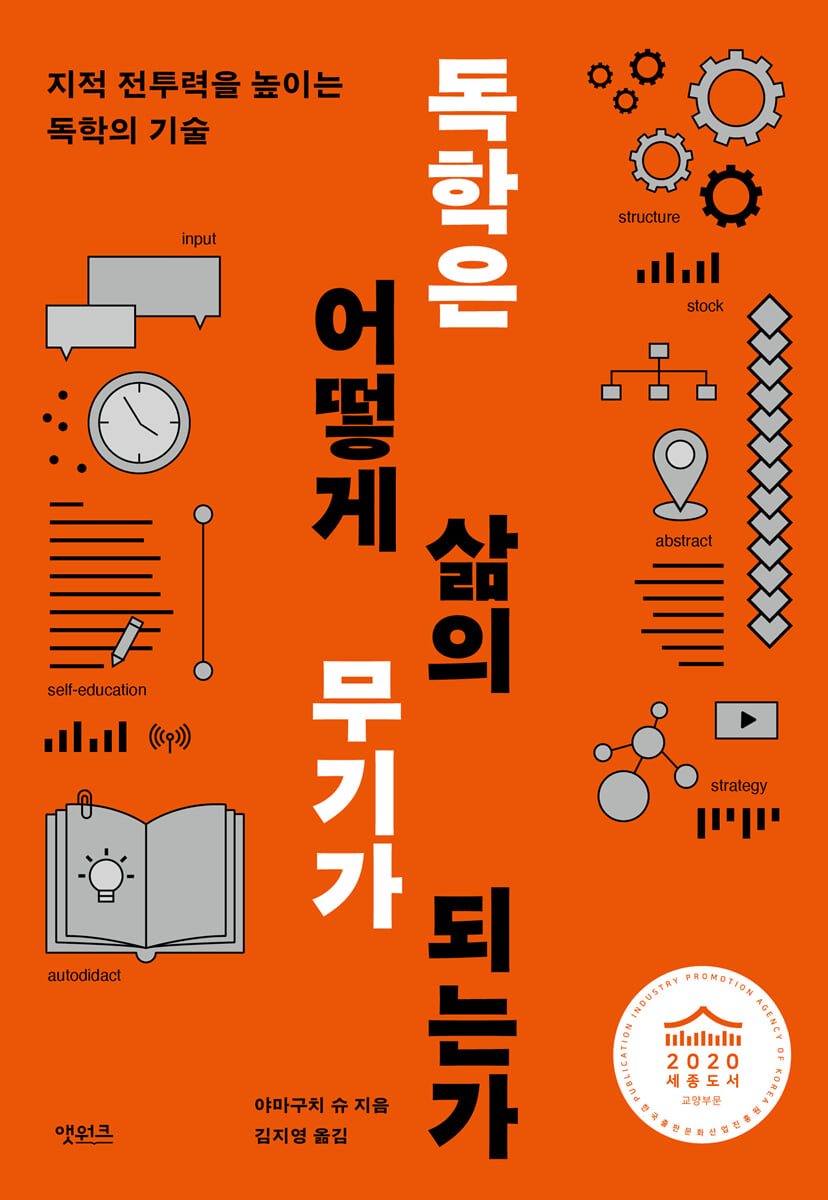
How Self-Study Becomes a Weapon for Life
 |
Description
Book Introduction
In an era where existing industries are evaporating,
A must-read for those wondering "how to learn."
Shu Yamaguchi, author of "How Philosophy Becomes a Weapon for Life," now shows us how to transform philosophy and other liberal arts from mere decorative knowledge into practical, usable weapons.
In an age where knowledge learned at school is insufficient, the way to increase intellectual combat power is through ‘self-study.’
Most people think that self-study means reading a lot of books on various fields.
However, the author, who claims that self-study is not a reading skill or a library use skill, says that there is a separate mechanism for self-study that maximizes intellectual production.
This book details how to gather weapons that increase your value in a limited time, how to maximize output without swallowing garbage, and finally, how to transform knowledge into a weapon you can use immediately.
The author hopes that readers of this book will become leaders who drive social change by acquiring a more fundamental and solid intellect through proper self-study.
A must-read for those wondering "how to learn."
Shu Yamaguchi, author of "How Philosophy Becomes a Weapon for Life," now shows us how to transform philosophy and other liberal arts from mere decorative knowledge into practical, usable weapons.
In an age where knowledge learned at school is insufficient, the way to increase intellectual combat power is through ‘self-study.’
Most people think that self-study means reading a lot of books on various fields.
However, the author, who claims that self-study is not a reading skill or a library use skill, says that there is a separate mechanism for self-study that maximizes intellectual production.
This book details how to gather weapons that increase your value in a limited time, how to maximize output without swallowing garbage, and finally, how to transform knowledge into a weapon you can use immediately.
The author hopes that readers of this book will become leaders who drive social change by acquiring a more fundamental and solid intellect through proper self-study.
- You can preview some of the book's contents.
Preview
index
Entering
Chapter 0: The Mechanism of Self-Study that Maximizes Intellectual Productivity
Four modules that make self-study effective
Self-Study System ① Strategy: Study to collect weapons.
Self-study System ② Input: Intellectual production through the five senses from a wide range of sources
Self-Study System ③ Abstraction and Structuring: Questions and Combinations Leading to Insight
Self-Study System ④ Accumulation: Building a System for Efficient Knowledge Extraction
Chapter 1: Strategy: How to Collect Weapons to Increase Your Value in a Limited Time
What is the strategy of self-study?
Crossover of themes and genres
The multiplication called Produce
Developing a self-study strategy will increase your antenna sensitivity.
Chapter 2: Input: Maximizing Output Without Ingesting Waste
Four Purposes of Input
Input is sufficient for a short-term perspective.
Studying without a purpose is what will later become light.
Be careful with inputs that are too similar to yours.
Garbage in, garbage out
Reading classics to create the future
Make sure to read the relevant fields
Don't fall into the trap of culturalism
Information is more about density than quantity.
The most effective self-study medium for people
Where there are no questions, there is no learning.
Chapter 3: Abstraction and Structuring: How to Turn Knowledge into a Usable Weapon
Abstraction and structuring to handle knowledge freely
The thought process of abstraction
A one-skilled fool vs.
Renaissance man
Chapter 4: Accumulation: An Intellectual Production System That Enhances Creativity
Let the fish called information swim alive in the aquarium.
What does intellectual accumulation mean?
Underlining, the beginning of aquarium creation
Select nine locations and copy and paste them.
If you have any concerns, underline them.
When transcribing, include business and real-life implications.
Tagging creates unexpected combinations
In this rapidly changing era, we need 'unrun'.
Chapter 5: Why does liberal arts become a 'weapon of knowledge'?
Why you should learn liberal arts
The Meaning of Learning Liberal Arts ① Becoming a Weapon for Innovation
The Meaning of Learning Liberal Arts ② It Becomes a Weapon to Protect Your Career
The meaning of learning liberal arts ③ It becomes a weapon of communication.
The meaning of learning liberal arts④ It becomes a weapon that encompasses all areas.
The meaning of learning liberal arts⑤ Becoming a weapon that changes the world
1.
History: Learn to predict the future through the spiral of human development.
2.
Economics: Understanding the principles of the market to win the competition.
3.
Philosophy: Question the current rules and train your ability to think for yourself.
4.
Business Administration: Learn the common language of business by experiencing the thought process indirectly.
5.
Psychology: Uncovering the "irrationality" of how humans feel, think, and act.
6.
Music: Develop the ability to intuitively judge the good and bad of an overall concept.
7.
Neuroscience: Accurately Understanding and Predicting Common Human Errors
8.
Literature: Deeply Understanding Humanity Through "Honest Lies"
9.
Poetry: Expanding the rhetoric drawer and mastering the power of words.
10.
Religion: Understanding the thought and behavior patterns of a particular organization or individual.
11.
Natural Science: New discoveries and hypotheses provide clues to solving business problems.
Going out
Chapter 0: The Mechanism of Self-Study that Maximizes Intellectual Productivity
Four modules that make self-study effective
Self-Study System ① Strategy: Study to collect weapons.
Self-study System ② Input: Intellectual production through the five senses from a wide range of sources
Self-Study System ③ Abstraction and Structuring: Questions and Combinations Leading to Insight
Self-Study System ④ Accumulation: Building a System for Efficient Knowledge Extraction
Chapter 1: Strategy: How to Collect Weapons to Increase Your Value in a Limited Time
What is the strategy of self-study?
Crossover of themes and genres
The multiplication called Produce
Developing a self-study strategy will increase your antenna sensitivity.
Chapter 2: Input: Maximizing Output Without Ingesting Waste
Four Purposes of Input
Input is sufficient for a short-term perspective.
Studying without a purpose is what will later become light.
Be careful with inputs that are too similar to yours.
Garbage in, garbage out
Reading classics to create the future
Make sure to read the relevant fields
Don't fall into the trap of culturalism
Information is more about density than quantity.
The most effective self-study medium for people
Where there are no questions, there is no learning.
Chapter 3: Abstraction and Structuring: How to Turn Knowledge into a Usable Weapon
Abstraction and structuring to handle knowledge freely
The thought process of abstraction
A one-skilled fool vs.
Renaissance man
Chapter 4: Accumulation: An Intellectual Production System That Enhances Creativity
Let the fish called information swim alive in the aquarium.
What does intellectual accumulation mean?
Underlining, the beginning of aquarium creation
Select nine locations and copy and paste them.
If you have any concerns, underline them.
When transcribing, include business and real-life implications.
Tagging creates unexpected combinations
In this rapidly changing era, we need 'unrun'.
Chapter 5: Why does liberal arts become a 'weapon of knowledge'?
Why you should learn liberal arts
The Meaning of Learning Liberal Arts ① Becoming a Weapon for Innovation
The Meaning of Learning Liberal Arts ② It Becomes a Weapon to Protect Your Career
The meaning of learning liberal arts ③ It becomes a weapon of communication.
The meaning of learning liberal arts④ It becomes a weapon that encompasses all areas.
The meaning of learning liberal arts⑤ Becoming a weapon that changes the world
1.
History: Learn to predict the future through the spiral of human development.
2.
Economics: Understanding the principles of the market to win the competition.
3.
Philosophy: Question the current rules and train your ability to think for yourself.
4.
Business Administration: Learn the common language of business by experiencing the thought process indirectly.
5.
Psychology: Uncovering the "irrationality" of how humans feel, think, and act.
6.
Music: Develop the ability to intuitively judge the good and bad of an overall concept.
7.
Neuroscience: Accurately Understanding and Predicting Common Human Errors
8.
Literature: Deeply Understanding Humanity Through "Honest Lies"
9.
Poetry: Expanding the rhetoric drawer and mastering the power of words.
10.
Religion: Understanding the thought and behavior patterns of a particular organization or individual.
11.
Natural Science: New discoveries and hypotheses provide clues to solving business problems.
Going out
Into the book
This is because most of the knowledge input today passes its 'prime time as knowledge' within a short period of time.
This is where this book differs from other books on self-study methods.
This book was written with the aim of thoroughly enhancing 'intellectual combat power' by understanding self-study as a 'dynamic system'.
Through this book, I hope to spread the self-taught skills I've developed and foster many intellectual revolutionaries who will drive social change within companies.
During World War II, the United States dropped over a million firearms from the sky to support resistance movements in countries under Axis rule.
This is exactly what I want to do.
There would be no greater joy if someone who has learned through this book through self-study eventually becomes a leader who drives social change.
---From "Entering"
When people talk about self-study, they tend to focus only on the 'input' part of the process.
It seems to demand an immediate answer to the question 'WHAT=what to read' or 'HOW=how to read'.
However, such self-study only increases general knowledge and does little to achieve the goal of this book, which is to "strengthen the intellectual fighting power to survive."
---From "Four Modules to Make Self-Study Effective"
The time we have is limited.
If I have to devote this limited time to self-study, how meaningful is it to input knowledge already known to the majority? Again, strategy inevitably demands differentiation.
In other words, deciding how to input information that is different from that of others is the most important point of a self-study strategy, and the important thing here is not 'what to input' but 'what not to input'.
---From "Studying to Collect Weapons"
If there are no questions, there is no learning.
To put it extremely, we teach ourselves to create new questions.
It could be said that the purpose of self-study is not to gain new knowledge, but to ask new questions.
---From "Questions and Combinations that Lead to Insight"
Bricolage, as named by Levi-Strauss, refers to the feeling that, like DIYers, one is trying to make something oneself, and that even if one does not know when one will use it, if one keeps it at home, it will be of use later.
If we think about applying this to a self-study system, the important thing is to have the feeling that 'I don't know if it will be of any help right now, but this book is great.'
To put it extremely, how well one can connect reading to one's unique intellectual combat power largely depends on one's sensitivity to this sensation.
---From "Input is sufficient for a short-term perspective"
We need to think about what we are trying to gain by acquiring culture, and whether it is simply to cover up a complex.
We must not forget that taking refuge in easy-going culturalism has the potential to make our lives even more trivial.
The same goes for Steve Jobs' famous quote, “True artists put out a product.”
This provocation, which encourages us to shock the world with actual products rather than just giving speeches about design, could be translated as, “A truly cultured person leads a rich life.”
---From "Don't Fall into the Trap of Culturalism"
The power to generate ideas can vary by a factor of 100 or 1000, depending on the amount of accumulation.
While physical ability is at best only twice that of an average person no matter how much you train, creativity can be improved by 100 or 1000 times with training.
---From "What is the meaning of intellectual accumulation?"
What is lacking now is not experts who are proficient in one area, but crossover talents who can transcend that area.
And that demand is growing stronger.
As specialization progresses, the need for ‘free people’ who can move beyond individual specialized fields is increasing.
And the only thing that grants this ‘freedom’ is education.
---From “The Meaning of Learning Liberal Arts ④: Becoming a Weapon that Covers All Areas”
In today's world, mind control centered on meditation is becoming a trend.
Mindfulness and philosophy may seem to have little in common, but they share a common root: the importance of recognizing the subtle discomfort that arises within oneself.
This is where this book differs from other books on self-study methods.
This book was written with the aim of thoroughly enhancing 'intellectual combat power' by understanding self-study as a 'dynamic system'.
Through this book, I hope to spread the self-taught skills I've developed and foster many intellectual revolutionaries who will drive social change within companies.
During World War II, the United States dropped over a million firearms from the sky to support resistance movements in countries under Axis rule.
This is exactly what I want to do.
There would be no greater joy if someone who has learned through this book through self-study eventually becomes a leader who drives social change.
---From "Entering"
When people talk about self-study, they tend to focus only on the 'input' part of the process.
It seems to demand an immediate answer to the question 'WHAT=what to read' or 'HOW=how to read'.
However, such self-study only increases general knowledge and does little to achieve the goal of this book, which is to "strengthen the intellectual fighting power to survive."
---From "Four Modules to Make Self-Study Effective"
The time we have is limited.
If I have to devote this limited time to self-study, how meaningful is it to input knowledge already known to the majority? Again, strategy inevitably demands differentiation.
In other words, deciding how to input information that is different from that of others is the most important point of a self-study strategy, and the important thing here is not 'what to input' but 'what not to input'.
---From "Studying to Collect Weapons"
If there are no questions, there is no learning.
To put it extremely, we teach ourselves to create new questions.
It could be said that the purpose of self-study is not to gain new knowledge, but to ask new questions.
---From "Questions and Combinations that Lead to Insight"
Bricolage, as named by Levi-Strauss, refers to the feeling that, like DIYers, one is trying to make something oneself, and that even if one does not know when one will use it, if one keeps it at home, it will be of use later.
If we think about applying this to a self-study system, the important thing is to have the feeling that 'I don't know if it will be of any help right now, but this book is great.'
To put it extremely, how well one can connect reading to one's unique intellectual combat power largely depends on one's sensitivity to this sensation.
---From "Input is sufficient for a short-term perspective"
We need to think about what we are trying to gain by acquiring culture, and whether it is simply to cover up a complex.
We must not forget that taking refuge in easy-going culturalism has the potential to make our lives even more trivial.
The same goes for Steve Jobs' famous quote, “True artists put out a product.”
This provocation, which encourages us to shock the world with actual products rather than just giving speeches about design, could be translated as, “A truly cultured person leads a rich life.”
---From "Don't Fall into the Trap of Culturalism"
The power to generate ideas can vary by a factor of 100 or 1000, depending on the amount of accumulation.
While physical ability is at best only twice that of an average person no matter how much you train, creativity can be improved by 100 or 1000 times with training.
---From "What is the meaning of intellectual accumulation?"
What is lacking now is not experts who are proficient in one area, but crossover talents who can transcend that area.
And that demand is growing stronger.
As specialization progresses, the need for ‘free people’ who can move beyond individual specialized fields is increasing.
And the only thing that grants this ‘freedom’ is education.
---From “The Meaning of Learning Liberal Arts ④: Becoming a Weapon that Covers All Areas”
In today's world, mind control centered on meditation is becoming a trend.
Mindfulness and philosophy may seem to have little in common, but they share a common root: the importance of recognizing the subtle discomfort that arises within oneself.
---From "Questioning the current rules and training the power to think for yourself"
Publisher's Review
Now is the time when self-study is more necessary than ever.
What do countless innovators like Steve Jobs, Albert Einstein, Charles Darwin, Graham Bell, Ludwig Wittgenstein, Thomas Edison, and the Wright Brothers have in common? They were all self-taught in their revolutionary achievements.
Einstein, who published the special theory of relativity, was an amateur researcher working in a patent office, and Darwin, who wrote “The Origin of Species,” was a geologist who taught himself biology.
Bell, who invented the telephone, was originally a professor of phonetics, the philosopher Wittgenstein was a mathematics major, the inventor Edison was a newspaper deliveryman who dropped out of elementary school, and the Wright brothers, who invented the airplane, were bicycle shop clerks.
When we look at the stories of those who have achieved creative and revolutionary achievements through self-education, we can say that world history is a battle between 'autodidacts with revolutionary ideas' and 'stuffed-out experts.'
Shu Yamaguchi says that there has never been a time when self-study was more necessary than now.
The reason is that the knowledge learned in school is rapidly becoming outdated, and an era of innovation that will fundamentally overturn the current structure has arrived.
Additionally, the working period has become longer, the golden age of companies has become shorter, and we have entered an era where knowledge that can encompass and combine two fields is needed.
In an era where traditional industries are disappearing, what is desperately needed for those who are wondering 'how to learn' is 'self-study.'
“I taught myself everything of value!”
― Yamaguchi Shu shares his self-study techniques for increasing intellectual combat power.
So, how should self-study be achieved? Is it enough to simply read a wide range of books on various subjects? Most existing self-study books focus on the simple process of acquiring knowledge, often referred to as reading skills or library utilization. Is the goal of self-study, to enrich knowledge through extensive reading? The author argues that it should be about enhancing intellectual prowess so that it can be directly applied in real life.
He also says that there is a separate mechanism for self-study that maximizes intellectual combat power.
Shu Yamaguchi studied philosophy at university and art history at graduate school.
He has had an unusual career, starting with Dentsu, Japan's leading advertising firm, then moving on to Boston Consulting Group and Conferryhei Group, where he worked on organizational development, talent development, and leadership development. Having become a foreign consultant without an MBA, the author pondered how to effectively navigate limited time, ultimately developing his own "self-study system."
He introduces it as four modules: 'Strategy - Input - Abstraction and Structuring - Accumulation'.
It details how to gather weapons that increase your value in a limited time, how to maximize your output without swallowing trash, and finally, how to transform knowledge into a weapon that can be used immediately.
Why should we acquire these self-study skills? Is it solely for self-satisfaction? The author states, "Through this book, I hope to widely disseminate the self-study skills I've developed and foster many intellectual revolutionaries who will drive social change within companies."
In other words, I hope that readers will enhance their intellectual fighting power through proper self-study, thereby developing a more fundamental and solid intellect, and further, become leaders who drive social change.
Why and how does education become a weapon?
― The meaning of learning liberal arts, and 99 recommended books in 11 genres.
The author speaks of 'culture' as a weapon of knowledge.
However, I am wary of being caught up in 'culture-ism' and using it as a tool to disparage someone or hide one's own incompetence.
The author argues that liberal arts are essential for innovation, a weapon that protects one's career, a weapon for communication, a weapon that encompasses various fields, and a weapon that changes the world.
The author not only explains how eleven genres—history, economics, philosophy, business administration, psychology, music, neuroscience, literature, poetry, religion, and natural science—are useful for enhancing readers' intellectual prowess, but also introduces 99 recommended books that fit these genres, helping readers equip themselves with the knowledge of liberal arts.
What do countless innovators like Steve Jobs, Albert Einstein, Charles Darwin, Graham Bell, Ludwig Wittgenstein, Thomas Edison, and the Wright Brothers have in common? They were all self-taught in their revolutionary achievements.
Einstein, who published the special theory of relativity, was an amateur researcher working in a patent office, and Darwin, who wrote “The Origin of Species,” was a geologist who taught himself biology.
Bell, who invented the telephone, was originally a professor of phonetics, the philosopher Wittgenstein was a mathematics major, the inventor Edison was a newspaper deliveryman who dropped out of elementary school, and the Wright brothers, who invented the airplane, were bicycle shop clerks.
When we look at the stories of those who have achieved creative and revolutionary achievements through self-education, we can say that world history is a battle between 'autodidacts with revolutionary ideas' and 'stuffed-out experts.'
Shu Yamaguchi says that there has never been a time when self-study was more necessary than now.
The reason is that the knowledge learned in school is rapidly becoming outdated, and an era of innovation that will fundamentally overturn the current structure has arrived.
Additionally, the working period has become longer, the golden age of companies has become shorter, and we have entered an era where knowledge that can encompass and combine two fields is needed.
In an era where traditional industries are disappearing, what is desperately needed for those who are wondering 'how to learn' is 'self-study.'
“I taught myself everything of value!”
― Yamaguchi Shu shares his self-study techniques for increasing intellectual combat power.
So, how should self-study be achieved? Is it enough to simply read a wide range of books on various subjects? Most existing self-study books focus on the simple process of acquiring knowledge, often referred to as reading skills or library utilization. Is the goal of self-study, to enrich knowledge through extensive reading? The author argues that it should be about enhancing intellectual prowess so that it can be directly applied in real life.
He also says that there is a separate mechanism for self-study that maximizes intellectual combat power.
Shu Yamaguchi studied philosophy at university and art history at graduate school.
He has had an unusual career, starting with Dentsu, Japan's leading advertising firm, then moving on to Boston Consulting Group and Conferryhei Group, where he worked on organizational development, talent development, and leadership development. Having become a foreign consultant without an MBA, the author pondered how to effectively navigate limited time, ultimately developing his own "self-study system."
He introduces it as four modules: 'Strategy - Input - Abstraction and Structuring - Accumulation'.
It details how to gather weapons that increase your value in a limited time, how to maximize your output without swallowing trash, and finally, how to transform knowledge into a weapon that can be used immediately.
Why should we acquire these self-study skills? Is it solely for self-satisfaction? The author states, "Through this book, I hope to widely disseminate the self-study skills I've developed and foster many intellectual revolutionaries who will drive social change within companies."
In other words, I hope that readers will enhance their intellectual fighting power through proper self-study, thereby developing a more fundamental and solid intellect, and further, become leaders who drive social change.
Why and how does education become a weapon?
― The meaning of learning liberal arts, and 99 recommended books in 11 genres.
The author speaks of 'culture' as a weapon of knowledge.
However, I am wary of being caught up in 'culture-ism' and using it as a tool to disparage someone or hide one's own incompetence.
The author argues that liberal arts are essential for innovation, a weapon that protects one's career, a weapon for communication, a weapon that encompasses various fields, and a weapon that changes the world.
The author not only explains how eleven genres—history, economics, philosophy, business administration, psychology, music, neuroscience, literature, poetry, religion, and natural science—are useful for enhancing readers' intellectual prowess, but also introduces 99 recommended books that fit these genres, helping readers equip themselves with the knowledge of liberal arts.
GOODS SPECIFICS
- Date of issue: June 28, 2024
- Page count, weight, size: 264 pages | 145*210*14mm
- ISBN13: 9791157063574
- ISBN10: 1157063578
You may also like
카테고리
korean


korean

![GQ KOREA Mark (Monthly): December [2025]](http://librairie.coreenne.fr/cdn/shop/files/8ef265dbbfbf186523ed75ba7319009d.jpg?v=1765340328&width=3840)


