

Full-fledged Korean-Chinese-Japanese World History 19
 |
Description
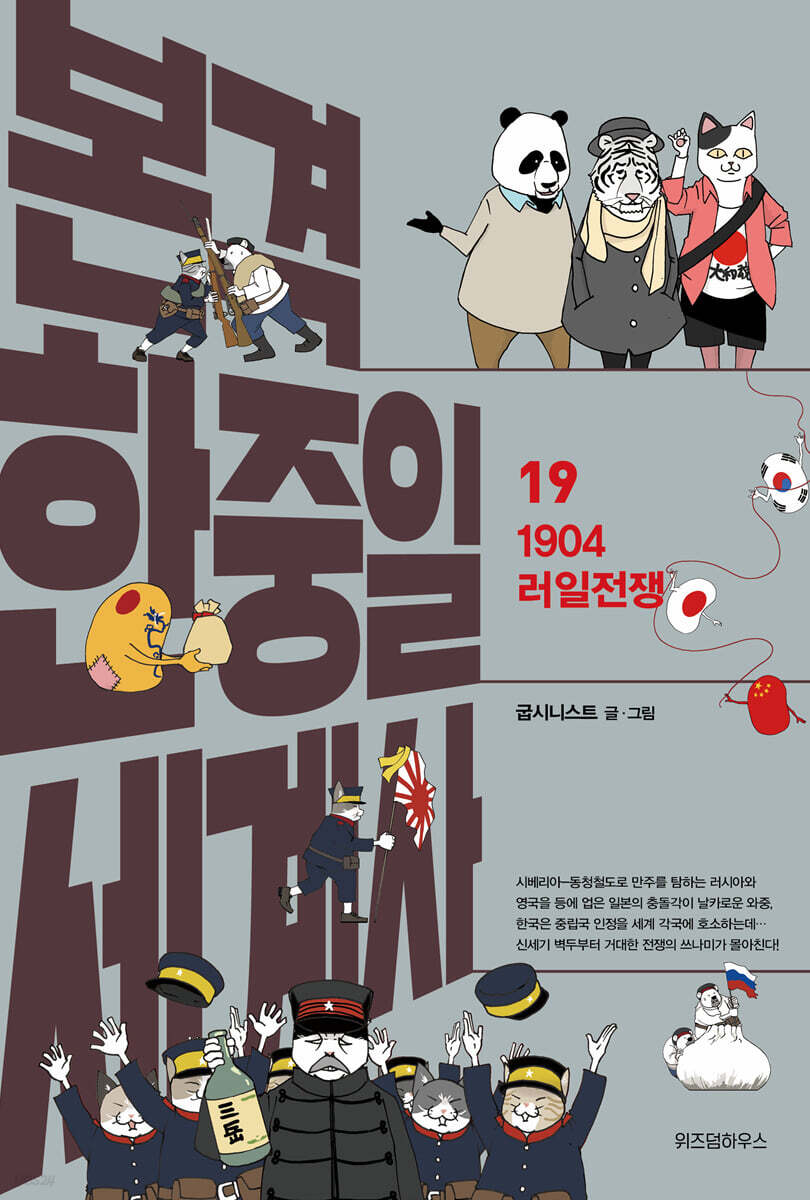
Book Introduction
The war of nerves between Russia and Japan over Manchuria is heading towards war.
Korea is in desperate 'prayer meta' as the ferry gets caught in a huge typhoon!
Volume 19 deals with the full-scale conflict between Russia and Japan.
After the Boxer Rebellion, the Qing Dynasty completely surrendered to the great powers, and Russia attempted to swallow up Manchuria, which had lost its owner.
Japan, which viewed this as a threat to the Korean Peninsula, took active measures to contain it… .
Meanwhile, Korea took advantage of the chaotic situation to occupy the North Gando region on the Tumen River, but as the dark clouds of the Russo-Japanese War grew, it changed its stance and began appealing to neutral countries.
Korea is in desperate 'prayer meta' as the ferry gets caught in a huge typhoon!
Volume 19 deals with the full-scale conflict between Russia and Japan.
After the Boxer Rebellion, the Qing Dynasty completely surrendered to the great powers, and Russia attempted to swallow up Manchuria, which had lost its owner.
Japan, which viewed this as a threat to the Korean Peninsula, took active measures to contain it… .
Meanwhile, Korea took advantage of the chaotic situation to occupy the North Gando region on the Tumen River, but as the dark clouds of the Russo-Japanese War grew, it changed its stance and began appealing to neutral countries.
- You can preview some of the book's contents.
Preview
index
preface
Chapter 1: DEUS VULT
Chapter 2 Shanghai Congress
Chapter 3 Negotiation
Chapter 4 Boxer Protocol
Chapter 5 秋風寶劍
Chapter 6 Constitutional Political Friends Association
Chapter 7 ISLAND
Chapter 8: Lee Jae-su's Rebellion
Chapter 9 Tamra Roselle
Chapter 10: The Descendants of the Teutons
Chapter 11 Anglo-Japanese Alliance
Chapter 12 The Yalu River is a turbulent river
Chapter 13: Goto Recovery!
Chapter 14 Romantically ♥ Diplomatic
Chapter 15 Neutral Countries
Chapter 16: Reassessing Height
Chapter 17 Final Negotiations
Chapter 18: The Thousand-Year-Old Man?
Chapter 19: The Eve of the Opening of the River
Chapter 20: The Opening of the War
Chapter 21: Declaration of War
Chapter 22 [Korea-Japan Protocol]
Chapter 23: Luck 7th Stage 3
Chapter 24: Eokka
Chapter 25: The Hitachi Maru Incident
Chapter 26: The Great Wall Collapses
Chapter 27: Battle of the Yellow Sea
Chapter 28: The First All-Out Attack on Lushun
Chapter 29: The Liao Dynasty
Chapter 30: Saha Rotation
Chapter 31: The Stars of the North Sea
Chapter 32: Welcome to Hill 203
Chapter 33: The End of Port Arthur
Major events and people
Chapter 1: DEUS VULT
Chapter 2 Shanghai Congress
Chapter 3 Negotiation
Chapter 4 Boxer Protocol
Chapter 5 秋風寶劍
Chapter 6 Constitutional Political Friends Association
Chapter 7 ISLAND
Chapter 8: Lee Jae-su's Rebellion
Chapter 9 Tamra Roselle
Chapter 10: The Descendants of the Teutons
Chapter 11 Anglo-Japanese Alliance
Chapter 12 The Yalu River is a turbulent river
Chapter 13: Goto Recovery!
Chapter 14 Romantically ♥ Diplomatic
Chapter 15 Neutral Countries
Chapter 16: Reassessing Height
Chapter 17 Final Negotiations
Chapter 18: The Thousand-Year-Old Man?
Chapter 19: The Eve of the Opening of the River
Chapter 20: The Opening of the War
Chapter 21: Declaration of War
Chapter 22 [Korea-Japan Protocol]
Chapter 23: Luck 7th Stage 3
Chapter 24: Eokka
Chapter 25: The Hitachi Maru Incident
Chapter 26: The Great Wall Collapses
Chapter 27: Battle of the Yellow Sea
Chapter 28: The First All-Out Attack on Lushun
Chapter 29: The Liao Dynasty
Chapter 30: Saha Rotation
Chapter 31: The Stars of the North Sea
Chapter 32: Welcome to Hill 203
Chapter 33: The End of Port Arthur
Major events and people
Detailed image

Into the book
Empress Dowager Cixi and her party, who were leaving Beijing and heading to Xi'an, thought, "Now, to handle the situation, we must send forward people from the south who can communicate with the Westerners.
… The fact that the governors of the ten southeastern provinces ignored the court’s orders and independently made agreements with the foreigners, but no disciplinary action was taken, was a safety measure in this case.
“I have already appointed Li Hongzhang as the Minister of the Northern Ocean in July. So, let him come up to Beijing immediately and negotiate with the Westerners.”
---From "Chapter 1 DEUS VULT"
We must impose a "fine" on every Chinese person for this incident! Each Chinese person will be assessed one tael (nyang)! That's 450 million tael (nyang) in punitive compensation.
450 million nyang was equivalent to about 70 million pounds in gold at the time.
In 1900 the British naval budget was 22 million pounds.
In 21st-century terms, that would be roughly 250 trillion won. "Oh, well, we're not just going to pay all of that compensation. We're also investing some of it in China's education, so please take it easy."
---From Chapter 4, Boxer Protocol
So, Catholic priests began missionary work in earnest on Jeju Island in 1898-1899.
Of course, not only did Jeju Confucian scholars strongly oppose it, but Jeju shamans also strongly opposed it.
Some Catholics acted violently out of self-righteousness.
Catholics are in collusion with the Bongse-gwan.
They are at the forefront of harassing the residents with taxes.
On May 6, 1901, the Daejeong County Citizens' Association was held to denounce corruption in education and taxation.
With Oh Dae-hyeon as the leader, they head towards Jeju Castle.
On May 14, armed Catholics attacked Oh Dae-hyeon and his party in Hanrim.
Accordingly, the mood of the citizens is rapidly turning towards hardline stance.
“The time for patience is over! Let’s fatten our tangerine trees with the blood of our fellow Koreans!”
---From Chapter 7, ISLAND
“Don’t focus too much on Manchuria, but look at the Korean Peninsula below.
In fact, even without completely annexing Manchuria, if we seize control of the northern part of the Korean Peninsula, we can maintain Manchuria entirely within the Russian sphere of influence through the northern part of the Korean Peninsula! We can scoop up Manchuria with the Korean Peninsula as a ladle! If the northern part of the Korean Peninsula becomes a Russian defensive line, we can completely control all access to Manchuria by land and sea!” The Bezobrazzov group, backed by the Tsar, won the line struggle.
---From "Chapter 12, The Yalu River is a murmur"
Regarding the Gando issue, many government leaders in Seoul were reluctant to actively advance, but with the push of Minister of Finance Lee Yong-ik, who had the support of the emperor, the argument for advancement became the mainstream.
“Yuan Shikai, even if you beat him to death, he won’t come down!! What will future generations say if we just blow this chance to recover our homeland?!” With Lee Yong-ik’s support, Lee Beom-yoon organized a militia (probably mixed with regular troops).
In July 1903, the operation began by crossing the Tumen River at Jongseong.
“Ah, this is truly the Great Britain of the 20th century!” By the end of 1903, the entire North Gando region was occupied.
---From "Chapter 13: Return to Goto!"
Throughout the second half of 1903, public opinion in Japan exploded with fervent anti-Russian sentiment! "Lunch in Port Arthur! Dinner in Vladivostok!" Even in the parliament, all political parties condemned the outbreak of war.
Public criticism of Ito, who advocated for war avoidance and negotiations with Russia, reached the point of assassination threats.
“If the ending is surrender without war, you will be pierced in the stomach!”
---From "Chapter 17 Final Negotiations"
On February 4, 1904, the declaration of war against Russia was confirmed at the Imperial Conference.
“We tried our best to resolve the issue through dialogue and persevered until the very end, but given the current situation, there is no other option.” February 6, Combined Fleet & Sub-Fleet set sail.
The main force of the Combined Fleet goes to Port Arthur to capture the Russian Pacific Fleet.
The Incheon-bound squadron escorts the troops to subdue Seoul.
The Busan-bound squadron occupied key locations on the southern coast of the Korean Peninsula.
On February 8, at the Imperial Conference, the Russian leadership was still circulating hopes of avoiding war.
On the night of February 8th, while the Russian army in Port Arthur was preparing countermeasures.
Taking advantage of the darkness, a Japanese destroyer squadron approaches the outer harbor of Port Arthur.
Ten Japanese destroyers fired 16 torpedoes.
“This is… definitely war now, right?;;;”
---From Chapter 20, The Beginning of the War
February 23, 1904, the [Korea-Japan Protocol] was signed in Seoul.
“Wow, the Korea-Japan alliance is strong!!” ‘… In the event of a rebellion in Korea, Japan may take military measures to ensure Korea’s security, and for this purpose, may expropriate and use any necessary land within the Korean Peninsula.’ ‘… From now on, Korea cannot enter into agreements with other countries that violate this treaty without Japan’s approval.’ The international community interpreted this [Korea-Japan Protocol] as Korea becoming a Japanese protectorate.
“Yeah, Korea has become a Japanese protectorate.”
---From Chapter 20, The Beginning of the War
At 4:30 a.m. on August 10, 1904, the Russian Pacific Fleet departed Port Arthur.
The Japanese side soon detected the departure of the entire Russian fleet.
“The entire Loske fleet is fleeing in the middle of the night!! This is our chance to capture them all at once in a fleet battle!!” From around 1:30 PM, the two sides exchanged fire.
At 17:30, Asahi's first shell hit the bridge of the Tsesarevich.
Admiral Bitgeft and his fleet command were annihilated.
The Russian Pacific Fleet is in chaos! "Ugh!! Everyone, find your own way!!!"
---From Chapter 27, Battle of the Yellow Sea
August 22, 1904, [Korea-Japan Agreement on the Employment of Foreign Advisors] signed.
The so-called first Korea-Japan Agreement.
Each Korean government ministry shall have a foreign advisor, and each ministry's major affairs shall require the foreign advisor's deliberation and approval.
“This is the beginning of torture politics!!”
---From Chapter 29, Liao Dynasty
In Lushun, the second attack by the 3rd Army was underway... "This time, we will proceed with the correct method of attacking the fortress! Digging and bombardment!" From mid-September, work began on digging trenches and tunnels toward the fortress.
Eighteen 280mm guns were transferred from the forts in Tokyo Bay and Osaka Bay, and bombardment began on October 1.
There was even a moment when the Japanese flag was planted on the summit of Hill 203.
They were immediately repelled by a counterattack by the Russian army.
In the end, the attack on Hill 203 was abandoned.
So the second attack by the worms also ended in failure... On October 30th, the offensive was stopped.
Casualties: approximately 1,300.
“At this point, a fundamental question arises… Why was it necessary to take Lushun while causing such chaos?”
---From Chapter 31, "The Stars of the North Sea"
The Battle of Hill 203 lasted for five days starting on December 1st.
“Tenno Heika Uraa!!!” “Char Banzai!!!” The owner of the summit changed several times.
Finally, on the fifth day, the final Russian counterattack was blocked, and on December 5, 1904, the Japanese army captured Hill 203.
It is said that there were 8,000 casualties in this five-day highland battle alone;; On December 15, the Japanese army blew up the Donggyegwansan fort through a tunnel under it.
Then, on January 1, 1905, Fort No. 2, which had been so ruthlessly attacked, was also blown up through a tunnel.
On January 5, 1905, the Russian forces in Port Arthur formally surrendered, ending the Siege of Port Arthur after four and a half months.
… The fact that the governors of the ten southeastern provinces ignored the court’s orders and independently made agreements with the foreigners, but no disciplinary action was taken, was a safety measure in this case.
“I have already appointed Li Hongzhang as the Minister of the Northern Ocean in July. So, let him come up to Beijing immediately and negotiate with the Westerners.”
---From "Chapter 1 DEUS VULT"
We must impose a "fine" on every Chinese person for this incident! Each Chinese person will be assessed one tael (nyang)! That's 450 million tael (nyang) in punitive compensation.
450 million nyang was equivalent to about 70 million pounds in gold at the time.
In 1900 the British naval budget was 22 million pounds.
In 21st-century terms, that would be roughly 250 trillion won. "Oh, well, we're not just going to pay all of that compensation. We're also investing some of it in China's education, so please take it easy."
---From Chapter 4, Boxer Protocol
So, Catholic priests began missionary work in earnest on Jeju Island in 1898-1899.
Of course, not only did Jeju Confucian scholars strongly oppose it, but Jeju shamans also strongly opposed it.
Some Catholics acted violently out of self-righteousness.
Catholics are in collusion with the Bongse-gwan.
They are at the forefront of harassing the residents with taxes.
On May 6, 1901, the Daejeong County Citizens' Association was held to denounce corruption in education and taxation.
With Oh Dae-hyeon as the leader, they head towards Jeju Castle.
On May 14, armed Catholics attacked Oh Dae-hyeon and his party in Hanrim.
Accordingly, the mood of the citizens is rapidly turning towards hardline stance.
“The time for patience is over! Let’s fatten our tangerine trees with the blood of our fellow Koreans!”
---From Chapter 7, ISLAND
“Don’t focus too much on Manchuria, but look at the Korean Peninsula below.
In fact, even without completely annexing Manchuria, if we seize control of the northern part of the Korean Peninsula, we can maintain Manchuria entirely within the Russian sphere of influence through the northern part of the Korean Peninsula! We can scoop up Manchuria with the Korean Peninsula as a ladle! If the northern part of the Korean Peninsula becomes a Russian defensive line, we can completely control all access to Manchuria by land and sea!” The Bezobrazzov group, backed by the Tsar, won the line struggle.
---From "Chapter 12, The Yalu River is a murmur"
Regarding the Gando issue, many government leaders in Seoul were reluctant to actively advance, but with the push of Minister of Finance Lee Yong-ik, who had the support of the emperor, the argument for advancement became the mainstream.
“Yuan Shikai, even if you beat him to death, he won’t come down!! What will future generations say if we just blow this chance to recover our homeland?!” With Lee Yong-ik’s support, Lee Beom-yoon organized a militia (probably mixed with regular troops).
In July 1903, the operation began by crossing the Tumen River at Jongseong.
“Ah, this is truly the Great Britain of the 20th century!” By the end of 1903, the entire North Gando region was occupied.
---From "Chapter 13: Return to Goto!"
Throughout the second half of 1903, public opinion in Japan exploded with fervent anti-Russian sentiment! "Lunch in Port Arthur! Dinner in Vladivostok!" Even in the parliament, all political parties condemned the outbreak of war.
Public criticism of Ito, who advocated for war avoidance and negotiations with Russia, reached the point of assassination threats.
“If the ending is surrender without war, you will be pierced in the stomach!”
---From "Chapter 17 Final Negotiations"
On February 4, 1904, the declaration of war against Russia was confirmed at the Imperial Conference.
“We tried our best to resolve the issue through dialogue and persevered until the very end, but given the current situation, there is no other option.” February 6, Combined Fleet & Sub-Fleet set sail.
The main force of the Combined Fleet goes to Port Arthur to capture the Russian Pacific Fleet.
The Incheon-bound squadron escorts the troops to subdue Seoul.
The Busan-bound squadron occupied key locations on the southern coast of the Korean Peninsula.
On February 8, at the Imperial Conference, the Russian leadership was still circulating hopes of avoiding war.
On the night of February 8th, while the Russian army in Port Arthur was preparing countermeasures.
Taking advantage of the darkness, a Japanese destroyer squadron approaches the outer harbor of Port Arthur.
Ten Japanese destroyers fired 16 torpedoes.
“This is… definitely war now, right?;;;”
---From Chapter 20, The Beginning of the War
February 23, 1904, the [Korea-Japan Protocol] was signed in Seoul.
“Wow, the Korea-Japan alliance is strong!!” ‘… In the event of a rebellion in Korea, Japan may take military measures to ensure Korea’s security, and for this purpose, may expropriate and use any necessary land within the Korean Peninsula.’ ‘… From now on, Korea cannot enter into agreements with other countries that violate this treaty without Japan’s approval.’ The international community interpreted this [Korea-Japan Protocol] as Korea becoming a Japanese protectorate.
“Yeah, Korea has become a Japanese protectorate.”
---From Chapter 20, The Beginning of the War
At 4:30 a.m. on August 10, 1904, the Russian Pacific Fleet departed Port Arthur.
The Japanese side soon detected the departure of the entire Russian fleet.
“The entire Loske fleet is fleeing in the middle of the night!! This is our chance to capture them all at once in a fleet battle!!” From around 1:30 PM, the two sides exchanged fire.
At 17:30, Asahi's first shell hit the bridge of the Tsesarevich.
Admiral Bitgeft and his fleet command were annihilated.
The Russian Pacific Fleet is in chaos! "Ugh!! Everyone, find your own way!!!"
---From Chapter 27, Battle of the Yellow Sea
August 22, 1904, [Korea-Japan Agreement on the Employment of Foreign Advisors] signed.
The so-called first Korea-Japan Agreement.
Each Korean government ministry shall have a foreign advisor, and each ministry's major affairs shall require the foreign advisor's deliberation and approval.
“This is the beginning of torture politics!!”
---From Chapter 29, Liao Dynasty
In Lushun, the second attack by the 3rd Army was underway... "This time, we will proceed with the correct method of attacking the fortress! Digging and bombardment!" From mid-September, work began on digging trenches and tunnels toward the fortress.
Eighteen 280mm guns were transferred from the forts in Tokyo Bay and Osaka Bay, and bombardment began on October 1.
There was even a moment when the Japanese flag was planted on the summit of Hill 203.
They were immediately repelled by a counterattack by the Russian army.
In the end, the attack on Hill 203 was abandoned.
So the second attack by the worms also ended in failure... On October 30th, the offensive was stopped.
Casualties: approximately 1,300.
“At this point, a fundamental question arises… Why was it necessary to take Lushun while causing such chaos?”
---From Chapter 31, "The Stars of the North Sea"
The Battle of Hill 203 lasted for five days starting on December 1st.
“Tenno Heika Uraa!!!” “Char Banzai!!!” The owner of the summit changed several times.
Finally, on the fifth day, the final Russian counterattack was blocked, and on December 5, 1904, the Japanese army captured Hill 203.
It is said that there were 8,000 casualties in this five-day highland battle alone;; On December 15, the Japanese army blew up the Donggyegwansan fort through a tunnel under it.
Then, on January 1, 1905, Fort No. 2, which had been so ruthlessly attacked, was also blown up through a tunnel.
On January 5, 1905, the Russian forces in Port Arthur formally surrendered, ending the Siege of Port Arthur after four and a half months.
---From "Chapter 33: End of Lushun"
Publisher's Review
Korea, united by King Gojong and unified national opinion
Is it finally showing the power befitting the national name 'Korean Empire'?
In 1900, when the new century began, Korea was experiencing a relatively peaceful time.
Thanks to Emperor Gojong's possessed public sentiment, both the reformists and the Independence Association were expelled, and the government was formed only with the emperor's confidants and close associates, resulting in domestic stability.
Among them, the competition for loyalty between the head of finance, Lee Yong-ik, and the head of public security, Lee Geun-taek, is so intense that they even put on a ridiculous show of pointing guns at each other for the position of the emperor's right-hand man.
Meanwhile, in 1901, the 'Lee Jae-su Rebellion' broke out on Jeju Island.
Catholics, who had been relying solely on French missionaries and engaging in atrocities, were massacred by non-believing Jeju residents! This almost led to a second season of the Byeong-in Yangyo, but since a government that prioritized the separation of church and state came to power in France, it didn't escalate into a diplomatic issue.
Could it be that these peaceful times have led to a "Midsummer Night's Dream"? The Korean Empire, too, is attempting to expand its territory.
In 1721, when the Qing Dynasty established its border with Joseon, it made the mistake of writing the 'Duman River' as the 'Tomun River'.
If this is taken seriously, the territory of North Gando above the Tumen River becomes Joseon territory, and in 1901, Korea steps forward to 'recover' that territory.
In the aftermath of the Boxer Rebellion, during a chaotic period when the Qing lost control of Manchuria, they hoped that planting a flag, even on a small piece of land, would give them a voice in the future.
Eventually, they succeeded in occupying the entire North Gando in 1903… .
Letting down your guard is a foregone conclusion! A massive crisis is looming. What will become of Korea's fate?
At the end of a bloody melee, the tip of Japan's sword reached Russia's neck,
Is this the arrival of a puppy or the birth of a new power?
While the eyes of the great powers were focused on the Boxer Rebellion, Russia showed particular interest in Port Arthur, a port city at the tip of the Liaodong Peninsula, which jutted out toward Balhae in western Manchuria.
Then and now, Lushun is not only an ice-free port, but also a perfect strategic point.
This is because it is easy to advance to various parts of Asia as it leads directly to the Pacific Ocean by passing through the West Sea.
As a first step to take back Lushun, Russia gradually took control of Manchuria.
At the same time, the Siberian-Eastern Qing Railway was laid to connect mainland Russia and Lushun.
Russia's eternal rival, Britain, and its 'warm' ally, Japan, are deeply embarrassed by these actions.
Japan, in particular, is very uncomfortable with the situation where Russia is nestled right above the Korean Peninsula.
He then claimed to be a hitman and asked Britain to support him, which eventually led to the signing of the Anglo-Japanese Alliance in 1902.
The following year, Japan and Russia entered into marathon negotiations over the establishment of a demilitarized zone between the Korean Peninsula and Manchuria, but they only confirmed each other's positions.
As the war crisis escalates, Korea falls into panic.
If war really breaks out, Korea, caught between Russia and Japan, will inevitably be reduced to rubble.
In October 1903, Emperor Gojong's secret envoy, Hyeon Sang-geon, traveled to various European countries, and in January 1904, he sent telegrams to countries around the world, appealing to them for neutrality and requesting protection.
But surprisingly, no one cares.
On February 6, 1904, the Russo-Japanese War finally broke out.
Japan, which dispatched a large army to the Korean Peninsula without declaring war, occupied Korea in three days and began to attack the Russian army in Manchuria from both land and sea.
Japan, which had established Korea as a logistics base through the Korea-Japan Protocol on the 23rd, began occupying Dalian in early June and succeeded in completely taking control of the Liaodong Peninsula and besieging Port Arthur by October.
Meanwhile, Japan, which had fired the signal for the forced annexation of Korea by concluding the First Japan-Korea Agreement in August, was putting all its efforts into occupying Port Arthur before the end of 1904...
Russia launches a Buster Call on the Baltic Fleet in the face of Japan's demonic appearance, which has already shed the blood of over 70,000 soldiers. Who will be the ultimate victor?
Is it finally showing the power befitting the national name 'Korean Empire'?
In 1900, when the new century began, Korea was experiencing a relatively peaceful time.
Thanks to Emperor Gojong's possessed public sentiment, both the reformists and the Independence Association were expelled, and the government was formed only with the emperor's confidants and close associates, resulting in domestic stability.
Among them, the competition for loyalty between the head of finance, Lee Yong-ik, and the head of public security, Lee Geun-taek, is so intense that they even put on a ridiculous show of pointing guns at each other for the position of the emperor's right-hand man.
Meanwhile, in 1901, the 'Lee Jae-su Rebellion' broke out on Jeju Island.
Catholics, who had been relying solely on French missionaries and engaging in atrocities, were massacred by non-believing Jeju residents! This almost led to a second season of the Byeong-in Yangyo, but since a government that prioritized the separation of church and state came to power in France, it didn't escalate into a diplomatic issue.
Could it be that these peaceful times have led to a "Midsummer Night's Dream"? The Korean Empire, too, is attempting to expand its territory.
In 1721, when the Qing Dynasty established its border with Joseon, it made the mistake of writing the 'Duman River' as the 'Tomun River'.
If this is taken seriously, the territory of North Gando above the Tumen River becomes Joseon territory, and in 1901, Korea steps forward to 'recover' that territory.
In the aftermath of the Boxer Rebellion, during a chaotic period when the Qing lost control of Manchuria, they hoped that planting a flag, even on a small piece of land, would give them a voice in the future.
Eventually, they succeeded in occupying the entire North Gando in 1903… .
Letting down your guard is a foregone conclusion! A massive crisis is looming. What will become of Korea's fate?
At the end of a bloody melee, the tip of Japan's sword reached Russia's neck,
Is this the arrival of a puppy or the birth of a new power?
While the eyes of the great powers were focused on the Boxer Rebellion, Russia showed particular interest in Port Arthur, a port city at the tip of the Liaodong Peninsula, which jutted out toward Balhae in western Manchuria.
Then and now, Lushun is not only an ice-free port, but also a perfect strategic point.
This is because it is easy to advance to various parts of Asia as it leads directly to the Pacific Ocean by passing through the West Sea.
As a first step to take back Lushun, Russia gradually took control of Manchuria.
At the same time, the Siberian-Eastern Qing Railway was laid to connect mainland Russia and Lushun.
Russia's eternal rival, Britain, and its 'warm' ally, Japan, are deeply embarrassed by these actions.
Japan, in particular, is very uncomfortable with the situation where Russia is nestled right above the Korean Peninsula.
He then claimed to be a hitman and asked Britain to support him, which eventually led to the signing of the Anglo-Japanese Alliance in 1902.
The following year, Japan and Russia entered into marathon negotiations over the establishment of a demilitarized zone between the Korean Peninsula and Manchuria, but they only confirmed each other's positions.
As the war crisis escalates, Korea falls into panic.
If war really breaks out, Korea, caught between Russia and Japan, will inevitably be reduced to rubble.
In October 1903, Emperor Gojong's secret envoy, Hyeon Sang-geon, traveled to various European countries, and in January 1904, he sent telegrams to countries around the world, appealing to them for neutrality and requesting protection.
But surprisingly, no one cares.
On February 6, 1904, the Russo-Japanese War finally broke out.
Japan, which dispatched a large army to the Korean Peninsula without declaring war, occupied Korea in three days and began to attack the Russian army in Manchuria from both land and sea.
Japan, which had established Korea as a logistics base through the Korea-Japan Protocol on the 23rd, began occupying Dalian in early June and succeeded in completely taking control of the Liaodong Peninsula and besieging Port Arthur by October.
Meanwhile, Japan, which had fired the signal for the forced annexation of Korea by concluding the First Japan-Korea Agreement in August, was putting all its efforts into occupying Port Arthur before the end of 1904...
Russia launches a Buster Call on the Baltic Fleet in the face of Japan's demonic appearance, which has already shed the blood of over 70,000 soldiers. Who will be the ultimate victor?
GOODS SPECIFICS
- Date of issue: December 4, 2024
- Page count, weight, size: 500 pages | 914g | 152*225*30mm
- ISBN13: 9791171713332
- ISBN10: 1171713339
You may also like
카테고리
korean


korean

![GQ KOREA Mark (Monthly): December [2025]](http://librairie.coreenne.fr/cdn/shop/files/8ef265dbbfbf186523ed75ba7319009d.jpg?v=1765340328&width=3840)


