

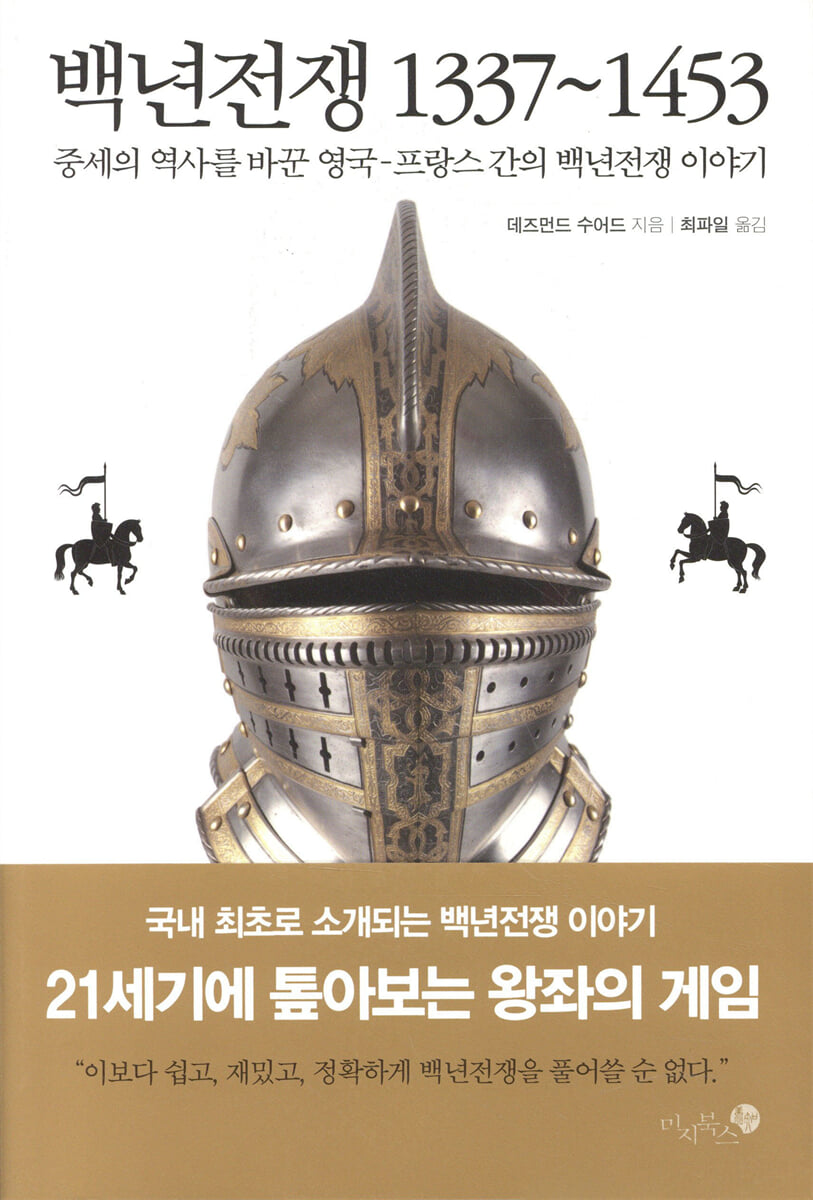
Hundred Years' War 1337–1453
 |
Description
Book Introduction
The story of the Hundred Years' War, introduced for the first time in Korea
Game of Thrones in the 21st Century
“There is no easier, more fun, or more accurate account of the Hundred Years’ War.”
The Hundred Years' War, which began as a dispute over the right to succeed to the throne, ultimately gave birth to the seeds of a modern nation.
A century-old epic, a blend of noble chivalry and bloody battlefields, is revived in the 21st century.
Edward III, who claimed the right to the French throne and initiated the Hundred Years' War,
Charles V, who was physically weak but wisely navigated the war with his outstanding intelligence and insight.
Henry V, who was on the verge of conquering France, but ultimately knelt before death.
Joan of Arc, the true star of the Hundred Years' War.
The most colorful figures from European medieval history come back to life in the 21st century, vividly telling the turbulent tales of the struggle for hegemony in medieval Europe.
Game of Thrones in the 21st Century
“There is no easier, more fun, or more accurate account of the Hundred Years’ War.”
The Hundred Years' War, which began as a dispute over the right to succeed to the throne, ultimately gave birth to the seeds of a modern nation.
A century-old epic, a blend of noble chivalry and bloody battlefields, is revived in the 21st century.
Edward III, who claimed the right to the French throne and initiated the Hundred Years' War,
Charles V, who was physically weak but wisely navigated the war with his outstanding intelligence and insight.
Henry V, who was on the verge of conquering France, but ultimately knelt before death.
Joan of Arc, the true star of the Hundred Years' War.
The most colorful figures from European medieval history come back to life in the 21st century, vividly telling the turbulent tales of the struggle for hegemony in medieval Europe.
- You can preview some of the book's contents.
Preview
index
Chapter 1: The Prelude to War, 1328–1340
Chapter 2: Battle of Crécy, 1340–1350
Chapter 3: The Battle of Poitiers and the Black Prince, 1350–1360
Chapter 4 Charles the Wise, 1360–1380
Chapter 5: Lost Peace, 1380–1399
Chapter 6: England's Opportunity, 1399–1413
Chapter 7: Henry V and the Battle of Agincourt, 1413–1422
Chapter 8: The Duke of Bedford, Regent of France, 1422–1429
Chapter 9 The Witches of Orléans, 1429–1435
Chapter 10: Secrets 1435–1450
Chapter 11: The Dark Battle, 1450–1453
Epilogue
Acknowledgements
A brief explanation of currency units
Hundred Years' War Timeline
Selected References
Search
Chapter 2: Battle of Crécy, 1340–1350
Chapter 3: The Battle of Poitiers and the Black Prince, 1350–1360
Chapter 4 Charles the Wise, 1360–1380
Chapter 5: Lost Peace, 1380–1399
Chapter 6: England's Opportunity, 1399–1413
Chapter 7: Henry V and the Battle of Agincourt, 1413–1422
Chapter 8: The Duke of Bedford, Regent of France, 1422–1429
Chapter 9 The Witches of Orléans, 1429–1435
Chapter 10: Secrets 1435–1450
Chapter 11: The Dark Battle, 1450–1453
Epilogue
Acknowledgements
A brief explanation of currency units
Hundred Years' War Timeline
Selected References
Search
Into the book
Western European countries have been systematically plundering other Western European countries for over a century.
One prominent historian wrote that the English viewed the Hundred Years' War as "a risky but, if successful, extremely profitable enterprise, enjoyed by all who joined the mercenary armies of Edward III and Henry V."
He adds that around 1450, “among those who profited most from the war were the great landed families,” while “many even among the poor adventurers of humble birth and no inherited wealth made fortunes.”
Indeed, generations of Englishmen from all walks of life had gone to France in pursuit of great wealth.
Just as their descendants later went to India or Africa.
--- p.12
The Lutiers were still visible in many places even after the Treaty of Brétigny.
“The English, Gascons and Germans refused to withdraw from their forts, saying they needed to eat,” and exacted protection money, and after draining the area of its vitality, they moved to new castles and took over.
They were simply practicing the English inventions of shubous and patisse.
The Free Corps became more dangerous as they formed larger units—Grand Companies—which were divided into routes (units) by ethnicity.
In 1361, one Grand Company rode down the Rhone to Avignon, effectively taking the Pope hostage and demanding ransom, while another particularly vicious group, the Tard-Venus (meaning "the latecomers"), terrorized Lyon.
--- p.143~144
In 1396, Richard had forced a marriage between himself and Isabella, the nine-year-old daughter of Charles VI, for a dowry of 170,000 pounds.
At a wedding near Calais, the Field of the Cloth of Gold of an earlier era, he was so moved by his meeting with Charles that he made the terrible mistake of promising to persuade the Church of England to submit to Avignon and to work to depose Pope Urban in Rome.
Historians have undoubtedly underestimated the shock and horror this promise caused among Richard's subjects.
Some English clergymen said, “Our king has become French.
“He is determined to bring us shame and ruin, but that will never happen!” he muttered.
Ordinary Londoners complained that Richard had “a French heart”.
expressed.
--- p.189~190
Every Parisian who remembered the reign of terror of the Armagnacs feared the massacre that would surely follow the return of the Dauphin, and this fear spread throughout all the cities of Anglo-Burgundian France.
Even before the Lancastrian conquest, the Parisian bourgeoisie preferred to be prisoners of the English than of the Dauphin and the "Armagnacs."
Later, the Parisian bourgeoisie described the Armagnac campaign as committing crimes worse than “any man or devil could have committed.”
This rational and decent observer, presumably a member of the Notre Dame Cathedral's governing body, uses expressions like "worse than the Saracens" and "unbridled demons."
One prominent historian wrote that the English viewed the Hundred Years' War as "a risky but, if successful, extremely profitable enterprise, enjoyed by all who joined the mercenary armies of Edward III and Henry V."
He adds that around 1450, “among those who profited most from the war were the great landed families,” while “many even among the poor adventurers of humble birth and no inherited wealth made fortunes.”
Indeed, generations of Englishmen from all walks of life had gone to France in pursuit of great wealth.
Just as their descendants later went to India or Africa.
--- p.12
The Lutiers were still visible in many places even after the Treaty of Brétigny.
“The English, Gascons and Germans refused to withdraw from their forts, saying they needed to eat,” and exacted protection money, and after draining the area of its vitality, they moved to new castles and took over.
They were simply practicing the English inventions of shubous and patisse.
The Free Corps became more dangerous as they formed larger units—Grand Companies—which were divided into routes (units) by ethnicity.
In 1361, one Grand Company rode down the Rhone to Avignon, effectively taking the Pope hostage and demanding ransom, while another particularly vicious group, the Tard-Venus (meaning "the latecomers"), terrorized Lyon.
--- p.143~144
In 1396, Richard had forced a marriage between himself and Isabella, the nine-year-old daughter of Charles VI, for a dowry of 170,000 pounds.
At a wedding near Calais, the Field of the Cloth of Gold of an earlier era, he was so moved by his meeting with Charles that he made the terrible mistake of promising to persuade the Church of England to submit to Avignon and to work to depose Pope Urban in Rome.
Historians have undoubtedly underestimated the shock and horror this promise caused among Richard's subjects.
Some English clergymen said, “Our king has become French.
“He is determined to bring us shame and ruin, but that will never happen!” he muttered.
Ordinary Londoners complained that Richard had “a French heart”.
expressed.
--- p.189~190
Every Parisian who remembered the reign of terror of the Armagnacs feared the massacre that would surely follow the return of the Dauphin, and this fear spread throughout all the cities of Anglo-Burgundian France.
Even before the Lancastrian conquest, the Parisian bourgeoisie preferred to be prisoners of the English than of the Dauphin and the "Armagnacs."
Later, the Parisian bourgeoisie described the Armagnac campaign as committing crimes worse than “any man or devil could have committed.”
This rational and decent observer, presumably a member of the Notre Dame Cathedral's governing body, uses expressions like "worse than the Saracens" and "unbridled demons."
--- p.273
Publisher's Review
The term 'Hundred Years' War', which only came into widespread use in the late 19th century, refers to a series of wars that lasted over 100 years.
This series of wars, which began in 1337 when Philip VI of France 'confiscated' the English-held Duchy of Guyenne from Edward III, then claimant to the French throne, ended in 1453 when England finally lost Bordeaux in Guyenne.
The series of wars includes the Battle of Sluys (1340), the Battle of Crécy (1346), the Battle of Poitiers (1356), the Battle of Agincourt (1415), the Rise of Joan of Arc (1429), and the Battle of Castillon (1453).
This series of wars, which began in 1337 when Philip VI of France 'confiscated' the English-held Duchy of Guyenne from Edward III, then claimant to the French throne, ended in 1453 when England finally lost Bordeaux in Guyenne.
The series of wars includes the Battle of Sluys (1340), the Battle of Crécy (1346), the Battle of Poitiers (1356), the Battle of Agincourt (1415), the Rise of Joan of Arc (1429), and the Battle of Castillon (1453).
GOODS SPECIFICS
- Date of issue: March 10, 2018
- Page count, weight, size: 416 pages | 576g | 147*215*22mm
- ISBN13: 9788994142692
- ISBN10: 899414269X
You may also like
카테고리
korean


korean

![GQ KOREA Mark (Monthly): December [2025]](http://librairie.coreenne.fr/cdn/shop/files/8ef265dbbfbf186523ed75ba7319009d.jpg?v=1765340328&width=3840)


