

Spring of Revolution
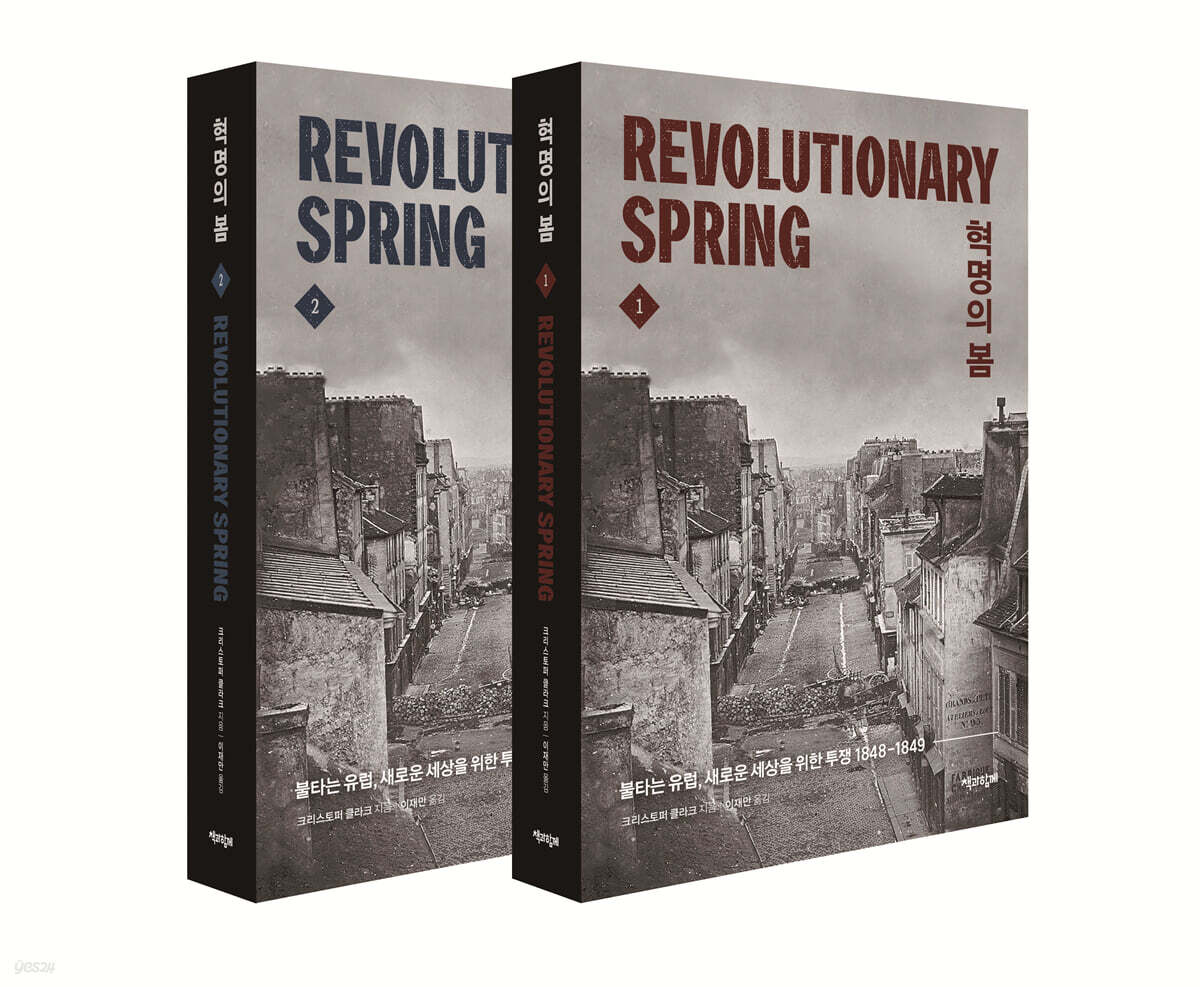 |
Description
Book Introduction
“In terms of intensity and geographical scope, the Revolution of 1848 was unique.
It was the only revolution that truly encompassed all of Europe.”
A new book by Christopher Clarke, author of "The Sleepwalkers"
"Spring of Revolution" is the new work of Christopher Clarke, who rose to the ranks of a master with "The Sleepwalkers," which is considered a standard work on the causes of World War I. It traces the flames of the 1848 revolution that spread like wildfire across Europe in a short period of time.
The Revolution of 1848 was not a singular 'revolution' but plural 'revolutions'.
For example, it was not a national phenomenon that occurred in isolation in France or Germany, but an international phenomenon connected by a network of revolutionaries.
Revolutionaries sought international cooperation by working in many countries and places through migration, exile, travel, joint struggles, and secret societies.
For this reason, a chain of political transformations occurred not only in Paris and Berlin, which were well known as the stages of the 1848 revolution, but also in Switzerland, Sicily, Naples, northern Italy, Rome, the German Confederation, Austria, Wallachia and Moldova, Hungary, and the Iberian Peninsula, and Europe became a completely different place from before.
Even places that managed to avoid a coup d'état could not escape the powerful influence of the revolution.
Christopher Clarke, a master of public historiography, travels across Europe, presenting a clear panorama of the unprecedented upheaval that unfolded explosively in a short period of time.
In the process, it depicts from various angles how various ideologies, such as socialism, radicalism, liberalism, and nationalism, and the people and groups that share them, collided and were tested against each other, bringing about profound changes in Europe.
Through this, the numerous branches of revolutions that had been fragmented throughout the history of each country under the stigma of being a "failed revolution" are revived as a single, large flow, providing insight into the true meaning of the 1848 Revolution.
It was the only revolution that truly encompassed all of Europe.”
A new book by Christopher Clarke, author of "The Sleepwalkers"
"Spring of Revolution" is the new work of Christopher Clarke, who rose to the ranks of a master with "The Sleepwalkers," which is considered a standard work on the causes of World War I. It traces the flames of the 1848 revolution that spread like wildfire across Europe in a short period of time.
The Revolution of 1848 was not a singular 'revolution' but plural 'revolutions'.
For example, it was not a national phenomenon that occurred in isolation in France or Germany, but an international phenomenon connected by a network of revolutionaries.
Revolutionaries sought international cooperation by working in many countries and places through migration, exile, travel, joint struggles, and secret societies.
For this reason, a chain of political transformations occurred not only in Paris and Berlin, which were well known as the stages of the 1848 revolution, but also in Switzerland, Sicily, Naples, northern Italy, Rome, the German Confederation, Austria, Wallachia and Moldova, Hungary, and the Iberian Peninsula, and Europe became a completely different place from before.
Even places that managed to avoid a coup d'état could not escape the powerful influence of the revolution.
Christopher Clarke, a master of public historiography, travels across Europe, presenting a clear panorama of the unprecedented upheaval that unfolded explosively in a short period of time.
In the process, it depicts from various angles how various ideologies, such as socialism, radicalism, liberalism, and nationalism, and the people and groups that share them, collided and were tested against each other, bringing about profound changes in Europe.
Through this, the numerous branches of revolutions that had been fragmented throughout the history of each country under the stigma of being a "failed revolution" are revived as a single, large flow, providing insight into the true meaning of the 1848 Revolution.
- You can preview some of the book's contents.
Preview
index
introduction
Chapter 1 Social Issues
The Politics of Description | Precarious Livelihoods and Crisis | Weavers | Galicia, 1846 | Conclusion
Chapter 2: Speculations on Order
It's a Man's World | The Liberty Party | Radicals | Conservatives | Religion | Patriots and Nation | Freedom and Illiberalism | Place in History
Chapter 3 Confrontation
Glorious Days: Paris in July | The Liberal Revolution | The Unfinished Business | The Social Revolutionaries | The Cult of Secrecy | The Apostles of National Revolt | Political Unrest in Germany | The Swiss Culture War | The Radicalization of Hungary | The Decline of the Bourgeois Monarchy | The Triumph of the Moderates: Italy | The Rock of Order | The Crack in the Dam | The Avalanche
Chapter 4 Explosion
I Predict an Uprising | 'Various News' | The February Revolution | We Are Dead | Are We Going to Become Slaves? | Out, Troops! | Five Days in Milan | Dogs That Don't Bark | The End of the Beginning
Chapter 5 System Change
Space for Revolution | Honoring the Dead | Establishing a Government | Electing a National Assembly | Drafting a Constitution
Chapter 6 Liberation
Abolitionist Day | Black 1848 | Waving from a Window | Freedom and Danger | The Emancipation of the 'Gypsy Slaves' | Time for Emancipation
Chapter 7 Entropy
Wandering Sovereignty | The Departure of the Radicals | City and Country | The National Question | A Revolution Halted by Itself | In the Heat of the Century
Chapter 8 Counterrevolution
Naples in Summer | Empire Strikes Back | The Barbed Wire Comes Down | Counterrevolution in a Tiny Place | The Second Wave | Geopolitics | Realism Born from the Spirit of Counterrevolution | The Dead
Chapter 9 After 1848
A Strange Land Now | The Global Year of 1848 | A New Power Structure | The Age of Circulation | Material Progress | The Post-Revolutionary City | From Censorship to Publicity | Conclusion
conclusion
Acknowledgements
Translator's Note
main
Source of the illustration
Search
Chapter 1 Social Issues
The Politics of Description | Precarious Livelihoods and Crisis | Weavers | Galicia, 1846 | Conclusion
Chapter 2: Speculations on Order
It's a Man's World | The Liberty Party | Radicals | Conservatives | Religion | Patriots and Nation | Freedom and Illiberalism | Place in History
Chapter 3 Confrontation
Glorious Days: Paris in July | The Liberal Revolution | The Unfinished Business | The Social Revolutionaries | The Cult of Secrecy | The Apostles of National Revolt | Political Unrest in Germany | The Swiss Culture War | The Radicalization of Hungary | The Decline of the Bourgeois Monarchy | The Triumph of the Moderates: Italy | The Rock of Order | The Crack in the Dam | The Avalanche
Chapter 4 Explosion
I Predict an Uprising | 'Various News' | The February Revolution | We Are Dead | Are We Going to Become Slaves? | Out, Troops! | Five Days in Milan | Dogs That Don't Bark | The End of the Beginning
Chapter 5 System Change
Space for Revolution | Honoring the Dead | Establishing a Government | Electing a National Assembly | Drafting a Constitution
Chapter 6 Liberation
Abolitionist Day | Black 1848 | Waving from a Window | Freedom and Danger | The Emancipation of the 'Gypsy Slaves' | Time for Emancipation
Chapter 7 Entropy
Wandering Sovereignty | The Departure of the Radicals | City and Country | The National Question | A Revolution Halted by Itself | In the Heat of the Century
Chapter 8 Counterrevolution
Naples in Summer | Empire Strikes Back | The Barbed Wire Comes Down | Counterrevolution in a Tiny Place | The Second Wave | Geopolitics | Realism Born from the Spirit of Counterrevolution | The Dead
Chapter 9 After 1848
A Strange Land Now | The Global Year of 1848 | A New Power Structure | The Age of Circulation | Material Progress | The Post-Revolutionary City | From Censorship to Publicity | Conclusion
conclusion
Acknowledgements
Translator's Note
main
Source of the illustration
Search
Into the book
The Revolution of 1848 was unique in its intensity and geographical scope.
At least in European history, that's the case.
Neither the French Revolution of 1789, nor the July Revolution of 1830, nor the Paris Commune of 1870, nor the Russian Revolutions of 1905 and 1917, caused a chain reaction that spread across the European continent to the extent that the Revolution of 1848 did.
The events of 1989 seem a more comparable case, but whether the uprisings at that time can be characterized as a "revolution" remains a matter of debate.
In contrast, in 1848, political unrest erupted simultaneously across the European continent, from Switzerland and Portugal to Wallachia and Moldova, from Norway, Denmark, and Sweden to Palermo and the Ionian Islands.
It was the only revolution that truly encompassed all of Europe.
--- p.15 From the Introduction
The chapter includes scenes of economic instability, widespread insecurity, a nutritional crisis, and extreme violence.
Looking at European societies before 1848, we focus on the areas of pressure, movement, blockade, and conflict.
Social discontent does not 'cause' revolution (if it did, revolutions would be much more frequent).
Yet, the material hardships of Europeans in the mid-19th century were an essential backdrop to the political polarization that made revolution possible.
For many who participated in the urban uprising, that hardship became a key motivation.
Just as important as the reality and extent of suffering was the way people in this era viewed and accepted social dysfunction.
The 'social problems' that captivated Europeans in the mid-19th century were a sum total of real-world problems, but they were also a way of looking at the state of affairs.
--- p.39 From “Chapter 1 Social Issues”
Even among radicals, liberals, and conservatives across Europe, one can find a sense that the course of history cannot be turned back.
Italian patriots Francesco Saverio Salpi, Decio Valentini, and Fedele Bono recognized that the French Revolution was more than an event.
In any case, this revolution had a transformative effect on society as part of a world-historical process, and its effects were still unfolding in a process of regeneration in Italy.
The proliferation of European constitutions in the early nineteenth century—from Naples to Cadiz, Paris, Baden, Bavaria, Piedmont-Sardinia, Portugal, and Brussels—bolstered liberal confidence in the ultimate triumph of the liberal constitutional order.
--- p.274-275 From “Chapter 2: Speculations on Order”
Already in 1830 one can see the chain of political upheavals that would later become a prominent feature of the revolutions of 1848.
Just a few weeks after the July Days in Paris, riots broke out in the southern Dutch cities of Brussels, Namur, Liège, and other cities, followed by a full-scale revolution that overthrew Dutch rule in the south and created the independent Kingdom of Belgium with a liberal constitution.
Between the autumn of 1830 and the summer of 1831, uprisings broke out in Switzerland, Germany, and Italy, and a large-scale rebellion broke out in the Russian Kingdom of Poland.
These events (with the exception of the large-scale Polish revolt against Russian rule, which was doomed to fail) were relatively limited and short-lived upheavals.
The geographical scope was also far from that of the continental revolution of 1848.
But these events demonstrated the vulnerability of Europe's elites and the continent's societies' vulnerability to revolution.
Europe would spend the next 18 years mulling over the implications of 1830.
--- p.304 From “Chapter 3 Confrontation”
“We stand at a turning point in the destiny of Europe,” wrote the Prussian officer and diplomat Josef von Radowitz to his wife on February 28, 1848.
“What began in Switzerland and has now spread through Italy is now entering a pan-European phase.” The February events in Paris did not initiate the chain of revolutions that shook Europe in 1848, but they did usher in a period of greatly increased momentum and complexity.
From March 1848 onwards it became impossible to trace the revolutions as a linear chain from one stage of turmoil to another.
We are entering a fission phase, a phase where multiple explosions occur almost simultaneously, creating complex feedback loops.
Reports of political upheaval in Cologne, Mannheim, Darmstadt, Nassau, Munich, Dresden, Vienna, Pest, Berlin, Milan, Venice, and elsewhere melt into one all-encompassing crisis.
When the narrative bursts its dam and overflows, the historian despairs and uses the adverb 'in the meantime' most frequently.
--- p.481-482 From "Chapter 4 Explosion"
The city came to life as if its very architectural structure were participating in the events, like the exoskeleton of a sentient being.
Arriving in Paris on March 12, two weeks after the February events, writer Fanny Levald was startled by the incessant sound of singing.
While walking through the city, she saw “groups of thirty or forty men, almost all workers,” singing “La Marseillaise” and old Girondin songs in a military style to honor those who died in battle for their country.
Every few minutes, shouts of “Long live the Republic!” rang out.
Even at night, I couldn't sleep because of the singing and chanting.
Carriages were largely invisible, but pedestrians were everywhere, and everyone seemed “unashamedly engaged in asserting themselves and making their intentions known.”
As one observer wrote, the plague was so vibrant with the spirit of the March Revolution that it seemed as if the Danube would join in the celebration.
Heinrich Brockhaus, visiting Frankfurt on April 6, 1848, saw “a truly lovely sight.”
“Everything was cheerfully decorated, there was not a single house without flags and flowers, flags were planted on every church tower, the whole city was in motion, and people were cheering and greeting each other everywhere.”
--- p.561-562 From “Chapter 5 System Change”
But the emancipation of women, the emancipation of African slaves, the emancipation of 'Gypsy slaves', and the emancipation of the Jews were never harmoniously intertwined in a way that lived up to the inflated connotations of this word in the 19th century.
The fate of various groups was deeply rooted in specific histories and social logics.
Racial and ethnic differences, gender differences, and the special predicament of the Jewish people—a mixture of theology, eschatology, xenophobia, and social anxiety that gave rise to a resilient form of suspicion and hatred—were each reasons for discrimination, not reducible to one another, nor were they functions of one another.
The three kinds of difference were each so deeply rooted in modern European culture that they seemed primitive, natural, and divine.
The upheaval that threw open the gates of freedom unleashed the opposing forces: competing anger, xenophobia, misogyny, fear of disorder, and the desire to discipline and control.
Acknowledging this does not mean downgrading the events of 1848 as a 'failure', nor does it mean overlooking the progress that was actually made, particularly in the area of advocacy for emancipation.
But the ambivalence and volatility of the liberation process at the time remind us of the unique rebelliousness of the political sphere of action that contests racial and gender inequalities, then and now.
--- p.750 From Chapter 6, Liberation
Marx was saying that the dream that had begun in February, the dream of a revolutionary front united under the banner of "universal suffrage," was now over because of the violence of June.
The June events showed that the February myth (which was in some ways a new version of the July myth of 1830) could be maintained only by postponing the social demands that had helped bring about the revolutions of 1848.
More importantly, as Marx observed, the bloodshed of June revealed that the effectiveness of the February myth ultimately rested not on the beauty of its core ideology but on the threat of naked violence.
The triumph of liberty, property, and order was the triumph of one force over another.
--- p.899 From Chapter 7 Entropy
Contemporaries recognized the deeper significance of this result.
In a series of essays written for the Neue Rheinische Zeitung in 1850, Marx and Engels looked back on the chain of counterrevolutions and noted how weak the influence of ideology—whether revolutionary or reactionary—seemed in the political world after 1848.
The pleasant words of the revolutionary era—progress, association, morality, freedom, equality, brotherhood, family, community—were just words.
Those words actually had nothing to do with the success or failure of the revolution, since a “true revolution” is “possible only when two factors, modern productive forces and bourgeois forms of production, come into conflict with each other.”
The factions can engage in “all kinds of arguments” (i.e. political debates) among themselves because they are all firmly tied to the same (bourgeois) production system.
This primacy of power over political ideology was a source of bitter irony.
Marx and Engels pointed out that the bourgeoisie won because it called in forces beyond its control.
The real mother of the counterrevolution, they argued, was not political ideology but the return of “industrial prosperity.”
--- p.1072-1073 From “Chapter 8 Counterrevolution”
Many of the cities that had experienced the uprisings of 1848 made a concerted effort to erase the memory of the rebellion from public consciousness.
However, there was no return to the pre-revolutionary state.
Too much had changed for that to happen.
The most notable of these was the new constitution.
In countries that had no constitution before 1848, the new constitution brought with it the full machinery of modern representative government: parliaments, political parties, election campaigns, and open parliamentary debate.
And almost everywhere the advent or amendment of a constitution has had the effect of stabilizing the system.
…in all these countries there has been a profound change in the political climate and landscape.
In the parliaments of Prussia, Piedmont, and the Netherlands, alliances of interest were formed, with flexible conservatives and liberals often cooperating on reform projects.
--- p.1126-1128 From “Chapter 9 After 1848”
The revolutions of 1848, however chaotic, brought about profound change.
Those who entered the collision chamber in 1848 came out changed.
The liberals who came to power through urban revolts strengthened their hegemony through new political institutions, most of which survived the revolution.
Through assemblies, associations, and above all, parliamentary debate, liberals, radicals, and conservatives acquired the skills of modern politics.
Conservatives learned to live with the Constitution and Congress, and they broadened their social base by using the techniques of mass mobilization.
The Catholic Church began a kind of sectarian politics centered around the Vatican, and its influence continued into the 20th century.
The new form of leftist politics that emerged after the revolution focused more on the provision of social goods than on conspiracy and the seizure of power.
Most radicals overcame their ambivalence toward universal suffrage and became its staunchest advocates in the decades following 1848.
Liberals have learned to unite with potential allies on both the right and the left, and to find complex compromises between power and freedom.
The process of advocating for universal suffrage has given rise to new networks, ideas, and arguments, particularly among women seeking to challenge patriarchal gender politics.
And the face of government and administration changed as officials and politicians struggled to understand the upheaval of 1848, to harness its momentum, and to absorb the ideas and techniques most appropriate to prevent further unrest.
At least in European history, that's the case.
Neither the French Revolution of 1789, nor the July Revolution of 1830, nor the Paris Commune of 1870, nor the Russian Revolutions of 1905 and 1917, caused a chain reaction that spread across the European continent to the extent that the Revolution of 1848 did.
The events of 1989 seem a more comparable case, but whether the uprisings at that time can be characterized as a "revolution" remains a matter of debate.
In contrast, in 1848, political unrest erupted simultaneously across the European continent, from Switzerland and Portugal to Wallachia and Moldova, from Norway, Denmark, and Sweden to Palermo and the Ionian Islands.
It was the only revolution that truly encompassed all of Europe.
--- p.15 From the Introduction
The chapter includes scenes of economic instability, widespread insecurity, a nutritional crisis, and extreme violence.
Looking at European societies before 1848, we focus on the areas of pressure, movement, blockade, and conflict.
Social discontent does not 'cause' revolution (if it did, revolutions would be much more frequent).
Yet, the material hardships of Europeans in the mid-19th century were an essential backdrop to the political polarization that made revolution possible.
For many who participated in the urban uprising, that hardship became a key motivation.
Just as important as the reality and extent of suffering was the way people in this era viewed and accepted social dysfunction.
The 'social problems' that captivated Europeans in the mid-19th century were a sum total of real-world problems, but they were also a way of looking at the state of affairs.
--- p.39 From “Chapter 1 Social Issues”
Even among radicals, liberals, and conservatives across Europe, one can find a sense that the course of history cannot be turned back.
Italian patriots Francesco Saverio Salpi, Decio Valentini, and Fedele Bono recognized that the French Revolution was more than an event.
In any case, this revolution had a transformative effect on society as part of a world-historical process, and its effects were still unfolding in a process of regeneration in Italy.
The proliferation of European constitutions in the early nineteenth century—from Naples to Cadiz, Paris, Baden, Bavaria, Piedmont-Sardinia, Portugal, and Brussels—bolstered liberal confidence in the ultimate triumph of the liberal constitutional order.
--- p.274-275 From “Chapter 2: Speculations on Order”
Already in 1830 one can see the chain of political upheavals that would later become a prominent feature of the revolutions of 1848.
Just a few weeks after the July Days in Paris, riots broke out in the southern Dutch cities of Brussels, Namur, Liège, and other cities, followed by a full-scale revolution that overthrew Dutch rule in the south and created the independent Kingdom of Belgium with a liberal constitution.
Between the autumn of 1830 and the summer of 1831, uprisings broke out in Switzerland, Germany, and Italy, and a large-scale rebellion broke out in the Russian Kingdom of Poland.
These events (with the exception of the large-scale Polish revolt against Russian rule, which was doomed to fail) were relatively limited and short-lived upheavals.
The geographical scope was also far from that of the continental revolution of 1848.
But these events demonstrated the vulnerability of Europe's elites and the continent's societies' vulnerability to revolution.
Europe would spend the next 18 years mulling over the implications of 1830.
--- p.304 From “Chapter 3 Confrontation”
“We stand at a turning point in the destiny of Europe,” wrote the Prussian officer and diplomat Josef von Radowitz to his wife on February 28, 1848.
“What began in Switzerland and has now spread through Italy is now entering a pan-European phase.” The February events in Paris did not initiate the chain of revolutions that shook Europe in 1848, but they did usher in a period of greatly increased momentum and complexity.
From March 1848 onwards it became impossible to trace the revolutions as a linear chain from one stage of turmoil to another.
We are entering a fission phase, a phase where multiple explosions occur almost simultaneously, creating complex feedback loops.
Reports of political upheaval in Cologne, Mannheim, Darmstadt, Nassau, Munich, Dresden, Vienna, Pest, Berlin, Milan, Venice, and elsewhere melt into one all-encompassing crisis.
When the narrative bursts its dam and overflows, the historian despairs and uses the adverb 'in the meantime' most frequently.
--- p.481-482 From "Chapter 4 Explosion"
The city came to life as if its very architectural structure were participating in the events, like the exoskeleton of a sentient being.
Arriving in Paris on March 12, two weeks after the February events, writer Fanny Levald was startled by the incessant sound of singing.
While walking through the city, she saw “groups of thirty or forty men, almost all workers,” singing “La Marseillaise” and old Girondin songs in a military style to honor those who died in battle for their country.
Every few minutes, shouts of “Long live the Republic!” rang out.
Even at night, I couldn't sleep because of the singing and chanting.
Carriages were largely invisible, but pedestrians were everywhere, and everyone seemed “unashamedly engaged in asserting themselves and making their intentions known.”
As one observer wrote, the plague was so vibrant with the spirit of the March Revolution that it seemed as if the Danube would join in the celebration.
Heinrich Brockhaus, visiting Frankfurt on April 6, 1848, saw “a truly lovely sight.”
“Everything was cheerfully decorated, there was not a single house without flags and flowers, flags were planted on every church tower, the whole city was in motion, and people were cheering and greeting each other everywhere.”
--- p.561-562 From “Chapter 5 System Change”
But the emancipation of women, the emancipation of African slaves, the emancipation of 'Gypsy slaves', and the emancipation of the Jews were never harmoniously intertwined in a way that lived up to the inflated connotations of this word in the 19th century.
The fate of various groups was deeply rooted in specific histories and social logics.
Racial and ethnic differences, gender differences, and the special predicament of the Jewish people—a mixture of theology, eschatology, xenophobia, and social anxiety that gave rise to a resilient form of suspicion and hatred—were each reasons for discrimination, not reducible to one another, nor were they functions of one another.
The three kinds of difference were each so deeply rooted in modern European culture that they seemed primitive, natural, and divine.
The upheaval that threw open the gates of freedom unleashed the opposing forces: competing anger, xenophobia, misogyny, fear of disorder, and the desire to discipline and control.
Acknowledging this does not mean downgrading the events of 1848 as a 'failure', nor does it mean overlooking the progress that was actually made, particularly in the area of advocacy for emancipation.
But the ambivalence and volatility of the liberation process at the time remind us of the unique rebelliousness of the political sphere of action that contests racial and gender inequalities, then and now.
--- p.750 From Chapter 6, Liberation
Marx was saying that the dream that had begun in February, the dream of a revolutionary front united under the banner of "universal suffrage," was now over because of the violence of June.
The June events showed that the February myth (which was in some ways a new version of the July myth of 1830) could be maintained only by postponing the social demands that had helped bring about the revolutions of 1848.
More importantly, as Marx observed, the bloodshed of June revealed that the effectiveness of the February myth ultimately rested not on the beauty of its core ideology but on the threat of naked violence.
The triumph of liberty, property, and order was the triumph of one force over another.
--- p.899 From Chapter 7 Entropy
Contemporaries recognized the deeper significance of this result.
In a series of essays written for the Neue Rheinische Zeitung in 1850, Marx and Engels looked back on the chain of counterrevolutions and noted how weak the influence of ideology—whether revolutionary or reactionary—seemed in the political world after 1848.
The pleasant words of the revolutionary era—progress, association, morality, freedom, equality, brotherhood, family, community—were just words.
Those words actually had nothing to do with the success or failure of the revolution, since a “true revolution” is “possible only when two factors, modern productive forces and bourgeois forms of production, come into conflict with each other.”
The factions can engage in “all kinds of arguments” (i.e. political debates) among themselves because they are all firmly tied to the same (bourgeois) production system.
This primacy of power over political ideology was a source of bitter irony.
Marx and Engels pointed out that the bourgeoisie won because it called in forces beyond its control.
The real mother of the counterrevolution, they argued, was not political ideology but the return of “industrial prosperity.”
--- p.1072-1073 From “Chapter 8 Counterrevolution”
Many of the cities that had experienced the uprisings of 1848 made a concerted effort to erase the memory of the rebellion from public consciousness.
However, there was no return to the pre-revolutionary state.
Too much had changed for that to happen.
The most notable of these was the new constitution.
In countries that had no constitution before 1848, the new constitution brought with it the full machinery of modern representative government: parliaments, political parties, election campaigns, and open parliamentary debate.
And almost everywhere the advent or amendment of a constitution has had the effect of stabilizing the system.
…in all these countries there has been a profound change in the political climate and landscape.
In the parliaments of Prussia, Piedmont, and the Netherlands, alliances of interest were formed, with flexible conservatives and liberals often cooperating on reform projects.
--- p.1126-1128 From “Chapter 9 After 1848”
The revolutions of 1848, however chaotic, brought about profound change.
Those who entered the collision chamber in 1848 came out changed.
The liberals who came to power through urban revolts strengthened their hegemony through new political institutions, most of which survived the revolution.
Through assemblies, associations, and above all, parliamentary debate, liberals, radicals, and conservatives acquired the skills of modern politics.
Conservatives learned to live with the Constitution and Congress, and they broadened their social base by using the techniques of mass mobilization.
The Catholic Church began a kind of sectarian politics centered around the Vatican, and its influence continued into the 20th century.
The new form of leftist politics that emerged after the revolution focused more on the provision of social goods than on conspiracy and the seizure of power.
Most radicals overcame their ambivalence toward universal suffrage and became its staunchest advocates in the decades following 1848.
Liberals have learned to unite with potential allies on both the right and the left, and to find complex compromises between power and freedom.
The process of advocating for universal suffrage has given rise to new networks, ideas, and arguments, particularly among women seeking to challenge patriarchal gender politics.
And the face of government and administration changed as officials and politicians struggled to understand the upheaval of 1848, to harness its momentum, and to absorb the ideas and techniques most appropriate to prevent further unrest.
--- From "Conclusion" on p.1182-1183
Publisher's Review
“In terms of intensity and geographical scope, the Revolution of 1848 was unique.
…it was the only revolution that truly encompassed all of Europe.”
A new book by Christopher Clarke, author of "The Sleepwalkers"
"Spring of Revolution" is the new work of Christopher Clarke, who rose to the ranks of a master with "The Sleepwalkers," which is considered a standard work on the causes of World War I. It traces the flames of the 1848 revolution that spread like wildfire across Europe in a short period of time.
The Revolution of 1848 was not a singular 'revolution' but plural 'revolutions'.
For example, it was not a national phenomenon that occurred in isolation in France or Germany, but an international phenomenon connected by a network of revolutionaries.
Revolutionaries sought international cooperation by working in many countries and places through migration, exile, travel, joint struggles, and secret societies.
For this reason, a chain of political transformations occurred not only in Paris and Berlin, which were well known as the stages of the 1848 revolution, but also in Switzerland, Sicily, Naples, northern Italy, Rome, the German Confederation, Austria, Wallachia and Moldova, Hungary, and the Iberian Peninsula, and Europe became a completely different place from before.
Even places that managed to avoid a coup d'état could not escape the powerful influence of the revolution.
Despite its impact, the 1848 revolution has been underestimated and branded a failed revolution.
This is because it was not interpreted comprehensively and was perceived negatively as it was fragmented into the history of each nation-state.
However, author Clark resurrects the numerous branches of the 1848 revolutions as a single, large-scale flow, reassessing this revolution as a unique pan-European revolution that was more powerful and had a wider impact than the French Revolution of 1789, the July Revolution of 1830, the Paris Commune of 1870, and the Russian Revolution of 1917.
It provides insight into the true meaning of the 1848 Revolution, paying particular attention to the issues that gave rise to the revolution and the profound changes it brought about.
Christopher Clark, a master of historical narrative that transcends time and space
Clearly unraveling a vast and complex subject
Christopher Clarke is the Honorable Professor of History at Cambridge University in England, and has been examining modern and contemporary history from a uniquely macroscopic perspective that encompasses the entire European continent.
What makes him stand out as a historian is his ability to move freely across timelines of hundreds of years and spacelines of thousands of kilometers, while skillfully and appropriately using both telescopes and magnifying glasses.
If 『Prussia, the Iron Kingdom』 looked at German history from the 14th to the 20th century from a diachronic perspective, focusing on the Prussian region, 『The Sleepwalkers』 looked at the short-term crisis in which the polarization of Europe, which had been intensifying since the late 19th century, passed the boiling point and escalated into a world war with the Sarajevo assassination as a trigger, from a synchronic perspective.
Clark's abilities have been proven numerous times, including through the Wolfson Prize for History, the German History Society Prize, and the Laura Shannon Prize.
The '1848 Revolution' covered in 'Spring of Revolution' is characterized by the simultaneous occurrence of events exploding across a wide area in a short period of time, the unpredictable interaction of numerous forces, and a sudden division rather than a smooth transition.
This topic presents a significant challenge for historians, as it is difficult to trace events in a linear chain, and narratives that flow like a single stream can burst their banks and overflow, branching out in numerous directions.
Yet, as in The Sleepwalkers, which exemplifies the epitome of public narrative, Clarke demonstrates a masterful skill in tracing each of these strands from multiple perspectives and positioning them within an overall picture.
Furthermore, by being wary of conventional evaluations and criticisms and focusing on the dynamism, subjectivity, and uniqueness of the actors, it vividly conveys the situation at the time of the 1848 Revolution by focusing on what the actors of the time experienced, what judgments and predictions they made in response to the situation at hand, and what changes and futures they attempted to create.
From the background before the revolution to its subsequent impact
A Comprehensive Account of the Revolution of 1848
The first half of the book examines the pre-revolutionary background.
Chapter 1 examines the social climate, including the famine, labor movements, and nationalist demands for the restoration of national sovereignty. Chapter 2 analyzes various ideologies, including liberalism, radicalism, conservatism, religion, nationalism, and the abolition of slavery. Chapter 3 examines the political, social, and economic situations and turmoil in each European country.
The second half focuses on the revolutions themselves, comprehensively revealing their powerful force and achievements, as well as the structural and socio-psychological vulnerabilities that contribute to their failure.
Chapter 4 shows the outbreak of revolution and the process of regime change across Europe, starting in Palermo, Italy in February 1848. Chapter 5 shows the newly seized power of the revolutionaries as they established parliaments and governments, and the pain of that. Chapter 6 traces the reality of African slaves, women, Jews, and Gypsies who were oppressed at the time, and assesses the achievements and limitations of the revolution.
The second half follows the downward curve of the revolution.
Chapter 7 depicts the process by which the revolutionary energy gradually depletes due to conflict, division, and fragmentation among the revolutionary forces, and Chapter 8 analyzes how the counterrevolutionary forces were able to successfully counterattack by taking advantage of this.
Finally, Chapter 9 examines the impact of the 1848 revolutions outside Europe and the changes brought about in Europe after 1848.
The Europe of Revolution in 1848, like a giant particle collider
A field of experimentation where various ideas, groups, and people are intertwined
The revolutions of 1848 across Europe were like a particle collision chamber.
All kinds of people, groups, and ideas flowed into the particle collision chamber, colliding with each other and breaking or tangling together, and in the decades that followed, a large number of new entities emerged.
A wide range of political movements and ideologies, from socialism and democratic radicalism to liberalism, nationalism, and conservatism, were tested in this clashing chamber, and all of them transformed, profoundly influencing modern European history.
It also brought about a transformation of political and administrative practices across the continent, a pan-European 'revolution in governance'.
At the time of the revolution, the main players were largely divided into moderates, radicals, and conservatives over the issues of the revolution's goals and future direction.
The moderates believed that the revolution had already been completed with a change of government, and that the remaining task was to stabilize the results of the revolution.
The moderates, who were largely liberal, were pushed to support the revolution amidst the rapidly changing political situation, but their support was ambivalent and conditional. They wanted to differentiate freedom and rights according to the level of individual wealth, and, fearing the lower classes of the social pyramid, they tried to somehow block the turbulent transition from “political reform” to “social reform.”
On the other hand, the radicals believed that the revolution had only just begun and that the social structure itself that created inequality needed to be reformed.
Radicals, a diverse group of people including democrats and socialists, sought to gain representation and political rights in the form of universal male suffrage, prioritized equality and distribution over private freedom and rights, and did not distinguish between "political reform" and "social reform" but rather tried to combine them.
Conservatives opposed revolution and reform, and sought to maintain the established natural order and hierarchical structure and to prevent the tyranny of history.
A brief victory, but soon division followed.
And ideologies that crumble before real power
Clarke meticulously describes, using numerous examples of actors, how the conflict, cooperation, and clashes between these three factions shaped the revolution's origins, development, climax, and conclusion.
For Clark, what was unique about the 1848 revolution was the speed and magnitude with which it moved from a phase of unity to a phase of conflict.
In the early days of the revolution, when the established power was overthrown through armed uprising and a new one took power, “the people felt a dizzying sense of unity and unanimity, immersed in an oceanic collective self.” But those who rallied to the cause of revolution, expressing long-standing grievances, soon discovered that the spectrum of social aspirations was vast and contained countless differences.
Their plans, ideologies, and claims clashed with each other and created discord.
The revolutionaries' efforts were dispersed, and before we knew it, the revolution's thermodynamic death had arrived.
Beyond the temporary victory of the revolutionaries in 1848, there were several potential cracks that could shatter the revolutionary solidarity.
First, nationalism served as a force for solidarity by elevating the present and inspiring a willingness to take risks, but through the awakening of national consciousness, it also caused “forgotten history to enter memory and the door to the nation’s future to open, while other things disappeared from sight.”
Another rift was between those who risked their lives to join the revolution, only to find themselves marginalized and excluded from the political landscape without gaining much.
Women who built barricades and fought alongside men were denied the right to vote.
The liberation of the Eastern European Gypsies was revoked after the counter-revolution.
Slaves faced a sluggish process of liberation and the logic of imperialism that perpetuated further discrimination.
Jews had to suffer from a new anti-Semitism.
Peasants were looked down upon by city dwellers who did not sympathize with the plight of the countryside and were seen as lacking revolutionary zeal.
This discrimination soon led to a backlash.
The most direct cause of the collapse of the revolution was the geopolitical dimension that Clark emphasized.
The fuse of the revolution was ignited in Switzerland, and the Swiss federal constitution was a product of the Vienna system.
In this system, because treaties between nations and domestic constitutional agreements were intertwined, a constitutional crisis in a particular country was seen as a threat to the 'European order' and provoked an international response.
The radicals and liberals of the revolutionary period built remarkable transnational networks that crossed national borders, but these networks were horizontal and lacked the vertical structures and resources necessary to exert decisive power.
In the geopolitical landscape of the time, when the "vertical" forces of the counterrevolutionary camp consolidated their power internationally, the defeat of the "horizontal" forces of the revolutionary camp was an inevitable consequence.
Clarke summarizes the outcome of the revolution, which ultimately brought about a shift toward realism in domestic and international relations:
“The tower has conquered the square.
Hierarchy has defeated networks.
“Power triumphed over ideology and argument.”
How did Europe change after the revolutions of 1848?
The revolution that began in 1848 lost its momentum in less than two years, but Clarke emphasizes that Europe became a very different place after the revolution.
The institutions established by the liberals when they seized power through revolution largely survived, and conservatives learned to accept and coexist with the constitution and parliament.
In other words, it is an important step forward toward modern representative democracy.
Liberals and conservatives compromised with each other to establish a new capitalist order using commodities, public transportation, money, laws, and sophisticated security measures.
But this compromise worked by continuing to politically exclude the common people who had made the revolution possible and marginalizing the democratic politics that represented them.
After the suppression of the revolution, the socialists were divided into a reformist majority and a revolutionary minority.
In particular, Marx and Engels, who witnessed the power of the counter-revolution that emphasized force, pointed out the impotence of ideologies such as 'progress' and 'equality' during the revolutionary period and sought realistic alternatives.
Clarke assesses that the revolution also had profound geopolitical implications.
The emergence of the Italian and German nation-states between 1859 and 1871 was a consequence of the revolutions of 1848.
The impact of the revolution is more evident in the two countries' starkly different political structures.
In Germany, after the Revolution of 1848, most of the states of the federation embarked on a project of modernizing the nation, and as a result, the empire that emerged from the wars of German unification was not a single state, but a "confederation of princes" in which each state had sovereignty and a parliament.
In contrast, unification in Italy took place through the absorption of the economically advanced northern Kingdom of Piedmont-Sardinia, which embraced the liberal elite, into the Papal States and the Kingdom of the Two Sicilies in the south, which were less developed.
The new tensions and asymmetries that this inconvenient solution created are still felt in Italy today.
The birth of the Romanian nation-state and the outbreak of the Crimean War, as well as the deepening divisions between Russia and Western Europe, were also aftermaths of the 1848 revolution.
Still unresolved issues
Reading Today from the Turmoil of Europe in 1848
“The widespread sense of social instability and the obsession with the weakening of social cohesion are reminiscent of the grim diagnoses of the 1840s.
…if revolution comes, it will look like the revolution of 1848.
In other words, it would appear to be a poorly planned revolution, a fragmented revolution, a patchwork revolution, and a revolution full of contradictions.
“While any historian must resist the temptation to see himself in people of the past, I was struck in writing this book by the feeling that the people of 1848 could see themselves in us.” - From the Conclusion
Clarke argues that the problems faced by the revolutionaries of 1848 are still relevant today.
These are the issues that revolutionaries raised in 1848 regarding the right to work, the balance between labor and capital, the plight of the working poor, deepening inequality, the social crisis in cities, and racial and gender equality: labor, inequality, discrimination, the slow politics inside parliament and the fast politics outside parliament, the functionality of liberal institutions, and the demand for social justice.
The same goes for the structural problems they faced.
How do we synchronize the fast-paced politics of protests, Twitter, flash mobs, and extra-parliamentary movements with the slow-paced politics of parliament? If violence is justified, in what political form? How do we optimize the functionality of liberal institutions while also accommodating the demands for social justice or the profound but potentially unpopular changes needed to address the challenges of climate change?
In particular, 1848 and today are similar in that they are both periods of transition, when the old is disappearing and the new has not yet taken hold.
The era of advanced industrialization, the leap toward sustained growth, the emergence of large-scale party political organizations, the ascendance of the nation-state and welfare state, the era of secularization, the emergence of large newspapers and national television audiences—what we used to call "modernity" is now in flux, gradually losing its hold on us.
The traditional right-wing vs. left-wing structure no longer works.
The bewilderment generated by new movements like the Trump rallies, Occupy Wall Street protests, far-right conspiracy theories, and anti-vaccine protests are signs of this shift.
In the storming of the U.S. Capitol on January 6, 2021, an unruly mob stormed the Capitol and (this time, not the “left,” but the “right”) dismissed the election process as a fraud and a lie.
All these actions are reminiscent of the turmoil of 1848 and also have similarities to the situation at home.
In that respect, this book will be even more meaningful to readers who have experienced the turbulent modern history of Korea, which has seen its system change repeatedly, triggered by revolutions.
…it was the only revolution that truly encompassed all of Europe.”
A new book by Christopher Clarke, author of "The Sleepwalkers"
"Spring of Revolution" is the new work of Christopher Clarke, who rose to the ranks of a master with "The Sleepwalkers," which is considered a standard work on the causes of World War I. It traces the flames of the 1848 revolution that spread like wildfire across Europe in a short period of time.
The Revolution of 1848 was not a singular 'revolution' but plural 'revolutions'.
For example, it was not a national phenomenon that occurred in isolation in France or Germany, but an international phenomenon connected by a network of revolutionaries.
Revolutionaries sought international cooperation by working in many countries and places through migration, exile, travel, joint struggles, and secret societies.
For this reason, a chain of political transformations occurred not only in Paris and Berlin, which were well known as the stages of the 1848 revolution, but also in Switzerland, Sicily, Naples, northern Italy, Rome, the German Confederation, Austria, Wallachia and Moldova, Hungary, and the Iberian Peninsula, and Europe became a completely different place from before.
Even places that managed to avoid a coup d'état could not escape the powerful influence of the revolution.
Despite its impact, the 1848 revolution has been underestimated and branded a failed revolution.
This is because it was not interpreted comprehensively and was perceived negatively as it was fragmented into the history of each nation-state.
However, author Clark resurrects the numerous branches of the 1848 revolutions as a single, large-scale flow, reassessing this revolution as a unique pan-European revolution that was more powerful and had a wider impact than the French Revolution of 1789, the July Revolution of 1830, the Paris Commune of 1870, and the Russian Revolution of 1917.
It provides insight into the true meaning of the 1848 Revolution, paying particular attention to the issues that gave rise to the revolution and the profound changes it brought about.
Christopher Clark, a master of historical narrative that transcends time and space
Clearly unraveling a vast and complex subject
Christopher Clarke is the Honorable Professor of History at Cambridge University in England, and has been examining modern and contemporary history from a uniquely macroscopic perspective that encompasses the entire European continent.
What makes him stand out as a historian is his ability to move freely across timelines of hundreds of years and spacelines of thousands of kilometers, while skillfully and appropriately using both telescopes and magnifying glasses.
If 『Prussia, the Iron Kingdom』 looked at German history from the 14th to the 20th century from a diachronic perspective, focusing on the Prussian region, 『The Sleepwalkers』 looked at the short-term crisis in which the polarization of Europe, which had been intensifying since the late 19th century, passed the boiling point and escalated into a world war with the Sarajevo assassination as a trigger, from a synchronic perspective.
Clark's abilities have been proven numerous times, including through the Wolfson Prize for History, the German History Society Prize, and the Laura Shannon Prize.
The '1848 Revolution' covered in 'Spring of Revolution' is characterized by the simultaneous occurrence of events exploding across a wide area in a short period of time, the unpredictable interaction of numerous forces, and a sudden division rather than a smooth transition.
This topic presents a significant challenge for historians, as it is difficult to trace events in a linear chain, and narratives that flow like a single stream can burst their banks and overflow, branching out in numerous directions.
Yet, as in The Sleepwalkers, which exemplifies the epitome of public narrative, Clarke demonstrates a masterful skill in tracing each of these strands from multiple perspectives and positioning them within an overall picture.
Furthermore, by being wary of conventional evaluations and criticisms and focusing on the dynamism, subjectivity, and uniqueness of the actors, it vividly conveys the situation at the time of the 1848 Revolution by focusing on what the actors of the time experienced, what judgments and predictions they made in response to the situation at hand, and what changes and futures they attempted to create.
From the background before the revolution to its subsequent impact
A Comprehensive Account of the Revolution of 1848
The first half of the book examines the pre-revolutionary background.
Chapter 1 examines the social climate, including the famine, labor movements, and nationalist demands for the restoration of national sovereignty. Chapter 2 analyzes various ideologies, including liberalism, radicalism, conservatism, religion, nationalism, and the abolition of slavery. Chapter 3 examines the political, social, and economic situations and turmoil in each European country.
The second half focuses on the revolutions themselves, comprehensively revealing their powerful force and achievements, as well as the structural and socio-psychological vulnerabilities that contribute to their failure.
Chapter 4 shows the outbreak of revolution and the process of regime change across Europe, starting in Palermo, Italy in February 1848. Chapter 5 shows the newly seized power of the revolutionaries as they established parliaments and governments, and the pain of that. Chapter 6 traces the reality of African slaves, women, Jews, and Gypsies who were oppressed at the time, and assesses the achievements and limitations of the revolution.
The second half follows the downward curve of the revolution.
Chapter 7 depicts the process by which the revolutionary energy gradually depletes due to conflict, division, and fragmentation among the revolutionary forces, and Chapter 8 analyzes how the counterrevolutionary forces were able to successfully counterattack by taking advantage of this.
Finally, Chapter 9 examines the impact of the 1848 revolutions outside Europe and the changes brought about in Europe after 1848.
The Europe of Revolution in 1848, like a giant particle collider
A field of experimentation where various ideas, groups, and people are intertwined
The revolutions of 1848 across Europe were like a particle collision chamber.
All kinds of people, groups, and ideas flowed into the particle collision chamber, colliding with each other and breaking or tangling together, and in the decades that followed, a large number of new entities emerged.
A wide range of political movements and ideologies, from socialism and democratic radicalism to liberalism, nationalism, and conservatism, were tested in this clashing chamber, and all of them transformed, profoundly influencing modern European history.
It also brought about a transformation of political and administrative practices across the continent, a pan-European 'revolution in governance'.
At the time of the revolution, the main players were largely divided into moderates, radicals, and conservatives over the issues of the revolution's goals and future direction.
The moderates believed that the revolution had already been completed with a change of government, and that the remaining task was to stabilize the results of the revolution.
The moderates, who were largely liberal, were pushed to support the revolution amidst the rapidly changing political situation, but their support was ambivalent and conditional. They wanted to differentiate freedom and rights according to the level of individual wealth, and, fearing the lower classes of the social pyramid, they tried to somehow block the turbulent transition from “political reform” to “social reform.”
On the other hand, the radicals believed that the revolution had only just begun and that the social structure itself that created inequality needed to be reformed.
Radicals, a diverse group of people including democrats and socialists, sought to gain representation and political rights in the form of universal male suffrage, prioritized equality and distribution over private freedom and rights, and did not distinguish between "political reform" and "social reform" but rather tried to combine them.
Conservatives opposed revolution and reform, and sought to maintain the established natural order and hierarchical structure and to prevent the tyranny of history.
A brief victory, but soon division followed.
And ideologies that crumble before real power
Clarke meticulously describes, using numerous examples of actors, how the conflict, cooperation, and clashes between these three factions shaped the revolution's origins, development, climax, and conclusion.
For Clark, what was unique about the 1848 revolution was the speed and magnitude with which it moved from a phase of unity to a phase of conflict.
In the early days of the revolution, when the established power was overthrown through armed uprising and a new one took power, “the people felt a dizzying sense of unity and unanimity, immersed in an oceanic collective self.” But those who rallied to the cause of revolution, expressing long-standing grievances, soon discovered that the spectrum of social aspirations was vast and contained countless differences.
Their plans, ideologies, and claims clashed with each other and created discord.
The revolutionaries' efforts were dispersed, and before we knew it, the revolution's thermodynamic death had arrived.
Beyond the temporary victory of the revolutionaries in 1848, there were several potential cracks that could shatter the revolutionary solidarity.
First, nationalism served as a force for solidarity by elevating the present and inspiring a willingness to take risks, but through the awakening of national consciousness, it also caused “forgotten history to enter memory and the door to the nation’s future to open, while other things disappeared from sight.”
Another rift was between those who risked their lives to join the revolution, only to find themselves marginalized and excluded from the political landscape without gaining much.
Women who built barricades and fought alongside men were denied the right to vote.
The liberation of the Eastern European Gypsies was revoked after the counter-revolution.
Slaves faced a sluggish process of liberation and the logic of imperialism that perpetuated further discrimination.
Jews had to suffer from a new anti-Semitism.
Peasants were looked down upon by city dwellers who did not sympathize with the plight of the countryside and were seen as lacking revolutionary zeal.
This discrimination soon led to a backlash.
The most direct cause of the collapse of the revolution was the geopolitical dimension that Clark emphasized.
The fuse of the revolution was ignited in Switzerland, and the Swiss federal constitution was a product of the Vienna system.
In this system, because treaties between nations and domestic constitutional agreements were intertwined, a constitutional crisis in a particular country was seen as a threat to the 'European order' and provoked an international response.
The radicals and liberals of the revolutionary period built remarkable transnational networks that crossed national borders, but these networks were horizontal and lacked the vertical structures and resources necessary to exert decisive power.
In the geopolitical landscape of the time, when the "vertical" forces of the counterrevolutionary camp consolidated their power internationally, the defeat of the "horizontal" forces of the revolutionary camp was an inevitable consequence.
Clarke summarizes the outcome of the revolution, which ultimately brought about a shift toward realism in domestic and international relations:
“The tower has conquered the square.
Hierarchy has defeated networks.
“Power triumphed over ideology and argument.”
How did Europe change after the revolutions of 1848?
The revolution that began in 1848 lost its momentum in less than two years, but Clarke emphasizes that Europe became a very different place after the revolution.
The institutions established by the liberals when they seized power through revolution largely survived, and conservatives learned to accept and coexist with the constitution and parliament.
In other words, it is an important step forward toward modern representative democracy.
Liberals and conservatives compromised with each other to establish a new capitalist order using commodities, public transportation, money, laws, and sophisticated security measures.
But this compromise worked by continuing to politically exclude the common people who had made the revolution possible and marginalizing the democratic politics that represented them.
After the suppression of the revolution, the socialists were divided into a reformist majority and a revolutionary minority.
In particular, Marx and Engels, who witnessed the power of the counter-revolution that emphasized force, pointed out the impotence of ideologies such as 'progress' and 'equality' during the revolutionary period and sought realistic alternatives.
Clarke assesses that the revolution also had profound geopolitical implications.
The emergence of the Italian and German nation-states between 1859 and 1871 was a consequence of the revolutions of 1848.
The impact of the revolution is more evident in the two countries' starkly different political structures.
In Germany, after the Revolution of 1848, most of the states of the federation embarked on a project of modernizing the nation, and as a result, the empire that emerged from the wars of German unification was not a single state, but a "confederation of princes" in which each state had sovereignty and a parliament.
In contrast, unification in Italy took place through the absorption of the economically advanced northern Kingdom of Piedmont-Sardinia, which embraced the liberal elite, into the Papal States and the Kingdom of the Two Sicilies in the south, which were less developed.
The new tensions and asymmetries that this inconvenient solution created are still felt in Italy today.
The birth of the Romanian nation-state and the outbreak of the Crimean War, as well as the deepening divisions between Russia and Western Europe, were also aftermaths of the 1848 revolution.
Still unresolved issues
Reading Today from the Turmoil of Europe in 1848
“The widespread sense of social instability and the obsession with the weakening of social cohesion are reminiscent of the grim diagnoses of the 1840s.
…if revolution comes, it will look like the revolution of 1848.
In other words, it would appear to be a poorly planned revolution, a fragmented revolution, a patchwork revolution, and a revolution full of contradictions.
“While any historian must resist the temptation to see himself in people of the past, I was struck in writing this book by the feeling that the people of 1848 could see themselves in us.” - From the Conclusion
Clarke argues that the problems faced by the revolutionaries of 1848 are still relevant today.
These are the issues that revolutionaries raised in 1848 regarding the right to work, the balance between labor and capital, the plight of the working poor, deepening inequality, the social crisis in cities, and racial and gender equality: labor, inequality, discrimination, the slow politics inside parliament and the fast politics outside parliament, the functionality of liberal institutions, and the demand for social justice.
The same goes for the structural problems they faced.
How do we synchronize the fast-paced politics of protests, Twitter, flash mobs, and extra-parliamentary movements with the slow-paced politics of parliament? If violence is justified, in what political form? How do we optimize the functionality of liberal institutions while also accommodating the demands for social justice or the profound but potentially unpopular changes needed to address the challenges of climate change?
In particular, 1848 and today are similar in that they are both periods of transition, when the old is disappearing and the new has not yet taken hold.
The era of advanced industrialization, the leap toward sustained growth, the emergence of large-scale party political organizations, the ascendance of the nation-state and welfare state, the era of secularization, the emergence of large newspapers and national television audiences—what we used to call "modernity" is now in flux, gradually losing its hold on us.
The traditional right-wing vs. left-wing structure no longer works.
The bewilderment generated by new movements like the Trump rallies, Occupy Wall Street protests, far-right conspiracy theories, and anti-vaccine protests are signs of this shift.
In the storming of the U.S. Capitol on January 6, 2021, an unruly mob stormed the Capitol and (this time, not the “left,” but the “right”) dismissed the election process as a fraud and a lie.
All these actions are reminiscent of the turmoil of 1848 and also have similarities to the situation at home.
In that respect, this book will be even more meaningful to readers who have experienced the turbulent modern history of Korea, which has seen its system change repeatedly, triggered by revolutions.
GOODS SPECIFICS
- Date of issue: August 31, 2025
- Page count, weight, size: 1,348 pages | 1,726g | 145*210*65mm
- ISBN13: 9791194263548
- ISBN10: 1194263542
You may also like
카테고리
korean


korean

![GQ KOREA Mark (Monthly): December [2025]](http://librairie.coreenne.fr/cdn/shop/files/8ef265dbbfbf186523ed75ba7319009d.jpg?v=1765340328&width=3840)


