

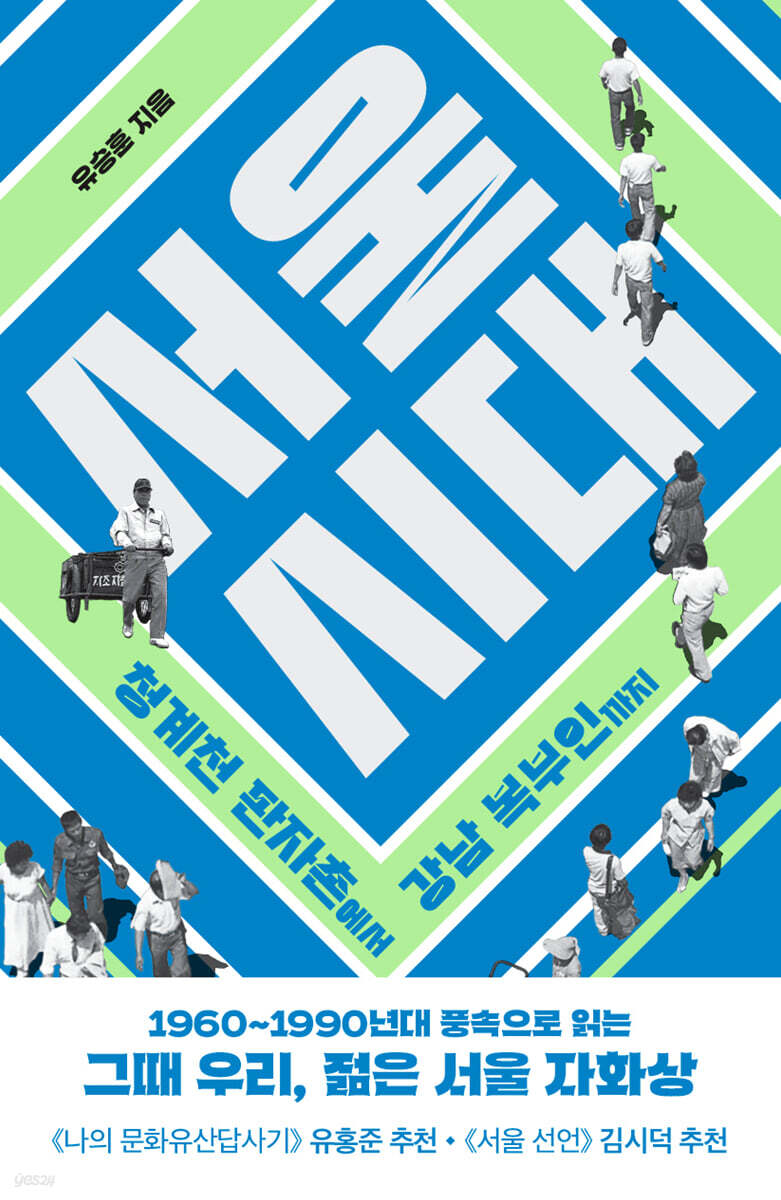
Seoul era
 |
Description
Book Introduction
- A word from MD
-
Times become customs, and customs become times.A self-portrait of Seoul and us, read through the customs of the 1960s to 1990s.
We explore the flow of time through Seoul, a city in turmoil created by the intermingling of rural areas, urban areas, and industrialization.
Even now, when we still shout "To Seoul, to Seoul," the "Seoul Era" reflects the lives of those who lived through that era and the lives we continue to lead.
March 14, 2025. History PD Ahn Hyun-jae
From the 1960s to the 1990s, South Korea experienced rapid growth after overcoming the ruins of the post-war era.
As the past and present, rural and urban areas, and the rivers of industrialization and migration surged with the influx of people, the unique "hybrid customs" of this era emerged and disappeared in the vortex that formed.
This book, "Seoul Era," examines the customs of Seoul from the 1960s to the 1990s, delves into the era, and confronts its people.
It reveals how the era of industrialization and urbanization interacted with the space of Seoul through small, specific aspects of the lives and customs of the people at the time.
The 115 photographs, including previously unpublished materials held by the National Archives of Korea and other institutions, vividly portray Seoul at that time.
As we delve into the historical moments and the growing pains of Seoul's "youth," the hopes of those days will reach us today as a legacy of intergenerational understanding and empathy.
As the past and present, rural and urban areas, and the rivers of industrialization and migration surged with the influx of people, the unique "hybrid customs" of this era emerged and disappeared in the vortex that formed.
This book, "Seoul Era," examines the customs of Seoul from the 1960s to the 1990s, delves into the era, and confronts its people.
It reveals how the era of industrialization and urbanization interacted with the space of Seoul through small, specific aspects of the lives and customs of the people at the time.
The 115 photographs, including previously unpublished materials held by the National Archives of Korea and other institutions, vividly portray Seoul at that time.
As we delve into the historical moments and the growing pains of Seoul's "youth," the hopes of those days will reach us today as a legacy of intergenerational understanding and empathy.
- You can preview some of the book's contents.
Preview
index
prolog
Part 1: The Seoul Era: Emerging Customs, Disappearing Customs
Chapter 1: People Who Went to Daldongne
1. Wangsimni Dung Flies and Parasite Eradication - The End of the Pooseki Era
The Birth of a 2-Moon Village - An Invention Born in an Age of Ruins and Suffering
The era of briquettes, where we hugged and rode together - only those who have changed briquettes know.
4 With the Lost God - In the Age of Development, the God Who Left Home Never Returns
Chapter 2: Seoul Becomes a Forest of Apartments
1. Moving Without Hands - The Long and Difficult Road to Moving in the Age of Seoul Migration
2 Apartment Living and the Life Revolution - A Change in Space Leads to a New Culture
3. Everyone's a Gangnam bachelor - Seoul falling into a black hole of speculation
Part 2: Living in Seoul: For a Better Life
Chapter 3: Seoul is Full
1. Traffic Hell, Crowded Buses, Bus Guides - The Dangerous Era of Open-Door Departures
2. Car accidents in the Mica era - The kingdom of traffic accidents is scary.
3 The lost waterway of the Han River, the bridge over it - The people of Seoul who became giants, walking across the Han River in one step
Chapter 4: Bean Sprout Class and First-Class Soldiers
1. Do you pass the exam by sticking taffy? - The era of taffy when you had to pass through a narrow gate.
2 The World's Best Bean Sprout Classroom - Schools Are Short, Education Fever Is Too High
3 A rough graduation ceremony where school uniforms were torn - a coming-of-age ceremony and liberation ceremony for the generation that wore school uniforms.
Part 3: Seoul: Everyday Life Blended with Past and Present
Chapter 5: The Glamorous Marriage Journey of a Seoulite
1 Matchmaking and Dating, Marriage Counseling Centers and Madame Tu - Are Love and Marriage Separate?
2. Going to the wedding hall, getting married, going to the wedding hall - Seoul's wedding halls were like flea markets.
Let's have two children and raise them well, regardless of whether they are sons or daughters - From a shamanistic perspective to a scientific preference for sons
Chapter 6: From Birth to Death: The Life Trials of Seoulites
1 The Transformation of Seoul's Baby's Birthplace - From Samshin Halmeoni to Midwife, From Birth Center to Obstetrics and Gynecology Clinic
2. Fortune-telling and Fortune-telling for Seoulites - Why Did Seoulites' Fortunes Go to Mia-ri?
3. Ten thousand won in this world, ten thousand won in the next - There is no resting place for Seoulites in Seoul.
main
Part 1: The Seoul Era: Emerging Customs, Disappearing Customs
Chapter 1: People Who Went to Daldongne
1. Wangsimni Dung Flies and Parasite Eradication - The End of the Pooseki Era
The Birth of a 2-Moon Village - An Invention Born in an Age of Ruins and Suffering
The era of briquettes, where we hugged and rode together - only those who have changed briquettes know.
4 With the Lost God - In the Age of Development, the God Who Left Home Never Returns
Chapter 2: Seoul Becomes a Forest of Apartments
1. Moving Without Hands - The Long and Difficult Road to Moving in the Age of Seoul Migration
2 Apartment Living and the Life Revolution - A Change in Space Leads to a New Culture
3. Everyone's a Gangnam bachelor - Seoul falling into a black hole of speculation
Part 2: Living in Seoul: For a Better Life
Chapter 3: Seoul is Full
1. Traffic Hell, Crowded Buses, Bus Guides - The Dangerous Era of Open-Door Departures
2. Car accidents in the Mica era - The kingdom of traffic accidents is scary.
3 The lost waterway of the Han River, the bridge over it - The people of Seoul who became giants, walking across the Han River in one step
Chapter 4: Bean Sprout Class and First-Class Soldiers
1. Do you pass the exam by sticking taffy? - The era of taffy when you had to pass through a narrow gate.
2 The World's Best Bean Sprout Classroom - Schools Are Short, Education Fever Is Too High
3 A rough graduation ceremony where school uniforms were torn - a coming-of-age ceremony and liberation ceremony for the generation that wore school uniforms.
Part 3: Seoul: Everyday Life Blended with Past and Present
Chapter 5: The Glamorous Marriage Journey of a Seoulite
1 Matchmaking and Dating, Marriage Counseling Centers and Madame Tu - Are Love and Marriage Separate?
2. Going to the wedding hall, getting married, going to the wedding hall - Seoul's wedding halls were like flea markets.
Let's have two children and raise them well, regardless of whether they are sons or daughters - From a shamanistic perspective to a scientific preference for sons
Chapter 6: From Birth to Death: The Life Trials of Seoulites
1 The Transformation of Seoul's Baby's Birthplace - From Samshin Halmeoni to Midwife, From Birth Center to Obstetrics and Gynecology Clinic
2. Fortune-telling and Fortune-telling for Seoulites - Why Did Seoulites' Fortunes Go to Mia-ri?
3. Ten thousand won in this world, ten thousand won in the next - There is no resting place for Seoulites in Seoul.
main
Detailed image
.jpg)
Into the book
Looking back, the times become customs, and customs become the times.
The 'MyCar era' gave rise to the automobile test, and the era of the student explosion gave rise to the bean sprout school.
The Seoul era was not necessarily a brilliant era.
It was the 'age of briquettes' and the 'age of moon villages', when tradition and modernity, rural and urban cultures were mixed and clashed.
As the competitive spirit to beat others in college entrance exams and the speculative spirit to become richer than others intensified, we rushed from the 'Era of Candy' to the 'Era of the Rich Woman.'
Meanwhile, the Seoul era is not a story limited to Seoul.
The Seoul era was the 'era of growth and development' in South Korea.
During the 'Seoul Expansion Era', when people from all over the country gathered and administrative districts expanded, we could even witness the growing pains of the ever-changing Republic of Korea.
This book is a self-portrait of Seoul during the industrialization period, and for me, who lived through the same period, it is no different from a self-portrait of my youth.
---From the "Prologue"
Even until the 1990s, Seoul's Dal-dongnae was a treasure trove of the lives and sorrows of the common people, and was also synonymous with poor neighborhoods.
In fact, the period when the term "dal-dongne" was popular was the 1960s and 1970s, but the term became popular in the 1980s.
How did this temporal gap arise? Until the 1970s, Daldongne was referred to as a shantytown, a substandard housing complex, or a redevelopment site.
However, starting in 1980, when the TV drama “Daldongne” was aired on Dongyang Broadcasting, the “highland village where common people live” began to be called Daldongne.
This drama was a huge hit, with viewership ratings reaching nearly 60%.
On days when "Daldongnae" was shown, the people of Daldongnae would gather together in houses with TVs, laughing and chatting, which became a Daldongnae custom.
The reason this drama became a huge hit was not only because it humorously portrayed the daily lives of poor people, but also because Dal-dongnae actually broadly covered the bottom of Korean society.
---From "The Birth of the Moon Village"
Nangok (蘭谷) is a village that was formed in the 1960s when people from Ichon-dong and Daebang-dong moved in. The residents also called it ‘Nakgol’ or ‘Nakgul.’
Until the late 1990s, people who were evicted from Dal-dongnae gathered in this valley, so this place was like the last nest of the evicted Dal-dongnae people.
However, Nango also disappeared due to the redevelopment project that began in 2001.
So where did those driven to the brink of life go? Because the sun and the shade are intertwined, the shadows of the city can never completely disappear.
Some residents were given basement studio apartments in downtown areas, while others, without even a few million won in deposits, had to move to small studio apartments or greenhouses.
The Dal-dongne of the industrial era has disappeared, but in the shadow of the glamorous Seoul, another Dal-dongne with a different name is growing.
---From "The Birth of the Moon Village"
Meanwhile, in Seoul, starting in the mid-1970s, the 19-hole bullets were replaced with the 22-hole bullets.
As the hole increased, combustion improved, but the combustion time was shortened to 6 to 7 hours.
There was a time when people could get through the day with just two briquettes, but now the three-day briquette system is not enough, so the people of Seoul are complaining that the four-day briquette system is becoming more and more common.
Housewives also expressed their discontent, saying that they felt like they were living in this world just to grind briquettes.
In fact, changing the briquettes four times a day meant waking up in the middle of the night and getting up again at dawn, which further worsened the quality of sleep for Seoul residents.
---From "The Era of Coal Briquettes, Where We Embraced and Ride Together"
Even in the early 2000s, the area around the Han River had not completely transformed into a forest of apartments, and there were quite a few natives who had lived there for generations.
They also showed a strong will to pass down the tradition of Bugundanggut.
The Bamseom Bugundanggut is an example of a ritual that has continued through the will of the Bamseom natives.
The Bamseom Bugundanggut is an example of a ritual that has continued through the will of the Bamseom natives.
When Bamseom Island in the Han River was blown up in 1968, the people of Bamseom Island first evacuated the Bugundang Party and crossed the frozen Han River with their husband to Changjeon-dong, Mapo-gu.
Having lost their hometown and become displaced people, they organized the Bamseom Hyangwoohoe and continued to perform the Bugundanggut.
---From "Along with the Lost God"
The 1970s, when there was a surge in moving from Seoul, was a time when the old and the new coexisted.
Even salarymen who had weekends off moved to days off rather than holidays.
In some houses, when moving out, people would even tear up the paper and wallpaper on the doors and windows.
This kind of person is not necessarily a slacker.
In our country, there was a custom of tearing up the materials on the door or floor when leaving a house, saying that it would take good luck with it.
This custom still persists, and people who move in have a hard time patching up and repairing the torn parts because they take away even the nails and lights.
---From "Moving on a Handless Day"
The lack of a yard in the apartment was also a major problem.
Even in Seoul, it was customary to hold a three-day funeral at home rather than at a funeral hall when someone lost their loved one.
There was a time when if a person died outside the home, it was considered a bad thing and was called a ‘guest death.’
However, since it was impossible to receive mourners in a small room when my parents passed away, I had to resort to renting a rooftop to hold the funeral.
During the transitional period when apartment life was becoming established, the rooftop served several functions.
There were also many cases where wedding receptions and even 60th birthday parties were held on the rooftop.
---From "Apartment Life and Life Revolution"
The biggest problem with real estate transactions in the 1970s was preferential treatment.
Above the lottery there is speculation, and above speculation there is preferential treatment.
At the time, the media also asked this question to those who criticized Bok-in.
“Although Mrs. Bok may seek speculation, she never seeks special treatment.
You have to run to every apartment lottery to be a concubine.
However, this does not mean that you can get an apartment without a lottery.” A representative example of preferential treatment was the ‘special sale’ by a construction company.
Special distribution refers to distributing general distribution apartments to a privileged class for employee use or other special purposes.
It's called special distribution, but this is actually a special privilege.
A rumor spread that the authorities had exercised great power in the approval process for special distribution, and that several apartments were given to Mr. Mo and Mrs. Mo.
Moreover, it would be fortunate if the privileged class moved into the apartment, but most of them went to real estate agencies with a premium attached.
In some apartments, 10% of the units were handed over to an unknown privileged class under the pretext of special sale before even receiving approval for sale during the construction process.
If the rich are those who rely on fate and try to win the lottery, the privileged class are those who make even the will of God pale in comparison.
They were criminals who disrupted the economic order and created a large number of people who were unfairly treated and marginalized in the housing market.
---From "You and I Are Gangnam Women"
Even in the 1980s, bus conductors' working conditions remained dangerous.
Most bus guides were working hard labor, more than 18 hours a day and 90 hours a week.
They often skipped meals due to overwork.
The quality of the company-provided group meals was also poor, and the meals consisted of rice mixed in water and slurped down for about five minutes.
Their snack money was usually spent on stimulants and coffee to chase away sleepiness or recover from fatigue.
Bus attendants in the 1980s showed signs of malnutrition and were found to be taller and heavier than their peers.
He also suffered from anemia, headaches, stomach problems, and leg and back pain.
---From "Traffic Hell, Crowded Buses, Bus Guides"
In fact, cars and fire were an unusual combination.
In a time when modernization was being advocated, automobiles were cutting-edge devices, and it was awkward to perform traditional rites in front of these cutting-edge devices.
A family ritual is a rite held to pray to the spirits for the safety of the family and for the family to do well in their work.
Ultimately, the rite of passage is an act of praying to God for one's wishes and entrusting one's fate to Him.
So, does a car have a god? This was also the fundamental question at the time of the ritual.
But, strangely enough, the idea of God is absent from the car accident.
Even though I'm going through the car test, I don't think there's a guardian angel protecting my car.
If one believed in a guardian deity, a body representing the deity would have been placed somewhere in the internal storage space.
---From "Car Accidents in the My Car Era"
When the sea route was cut off due to the monsoon season, the current Banpo-dong and Jamwon-dong areas of Seocho-gu and Sinsa-dong of Gangnam-gu were isolated like islands, and the residents were in a state of near-panic.
Because during the rainy season that lasts about a month, you will be unable to go anywhere.
Even on normal days, I was anxious.
In the morning, housewives were out at the ferry crossing, watching their husbands cross the river to go to work and their children go to school.
These people would go to the ferry several times and fidget whenever their family was even a little late.
After 11 p.m., the ferry service would stop, and guests with nowhere to sleep would go to a nearby police station and ask to be allowed to stay the night.
---From "The Lost Boat Route of the Han River and the Bridge Above It"
Since the abolition of the college entrance exam in 1980, everything was decided by a single college entrance exam, so the 'eye-catching operation' became so sophisticated that it was called 'Operation 007'.
In the operation of the sense of sight, the goal was to stick with it no matter what, and it was important to get a business card from a first-class school.
The virtue of the persevering tactician was to know how to wait until the end without wavering.
They didn't submit their applications until just before the deadline, but waited and found departments with low enrollment or low competition rates.
There was also a surge in the circulation of so-called 'blank applications' that only received the principal's seal and did not specify the department of application.
The method was to find a department with few applicants, wait for it, and then fill out the application on the spot without considering the applicant's aptitude and interest.
At that time, each university announced the status of admissions from time to time.
I mobilized my family and friends to check the application status of each university and then submitted my application at the last minute, so on the last day of application, the application counters at the universities would often become a chaotic scene with people pushing and shoving each other.
---From "Will you pass the exam if you stick a stick on it?"
In the 1970s, in order to secure funds for school operation, parents were required to pay money under the name of ‘school tuition.’
In 1972, the membership fee was 7,200 won per person.
The cost of education that was passed on to the common people who enrolled their children in elementary school, believing that it was compulsory education, was not small.
If you were to pay the tuition fees for several children at once while living a difficult life, you would hear the sound of one side of the household's finances being torn apart.
Perhaps middle-aged and older people have at least one painful memory of having to pay school fees during elementary school.
Children who failed to pay their tuition fees were scolded and punished by their teachers, and teachers who were pressured by the school to collect the tuition fees quickly were also stressed.
---From "The World's Best Bean Sprout Class"
The rough graduation ceremony, in which students tore their uniforms or threw flour on them, began in earnest in the 1970s.
As the graduation ceremony venue turned into a flea market, the school also strengthened its crackdown.
Police officers and teachers were stationed at the school gate, and only parents were allowed to enter. They searched bags and coats, stealing bags of flour and shoe polish.
But no matter how thoroughly they cracked down, they could not neutralize the students' excited sense of liberation.
As soon as the meal was over, a bag of flour burst from somewhere, and someone took out some shoe polish and rubbed it all over his face and hair.
Students who looked like mice ran around the playground, grumbling.
On one side, school uniforms were torn and sleeves were pulled off, and on the other side, eggs were flying and bursting everywhere, leaving a yellow glow.
Even if teachers tried to restrain students or even grab them by the collar, they could not stop the rush of the high school graduation ceremony, which had already become a liberated space.
---From "A Rough Graduation Ceremony That Tore School Uniforms"
The coffee shops of famous hotels near Jangchung-dong, Jung-gu, Seoul were often used as blind dates, and there was a rumor going around that if you went to one of these places, you would succeed and if you went to another place, you would fail.
Even today, it is considered bad luck to go on a date near Deoksugung Palace after a blind date, as is said to be a taboo for lovers.
It is said that this was because the family court was established in the Seoul Metropolitan Government building in Seosomun.
---From "Matchmaking and Dating, Marriage Counseling Centers and Madame Tu"
For Madame Tu, the notebook was like a lifeline.
This notebook was filled with the names and contact information of children of wealthy conglomerates, people who passed the civil service exam, doctors, and elite employees of large corporations who graduated from prestigious universities.
They went to great lengths to extract personal information.
University yearbooks were used as primary sources, and milk salesmen who visited households were also recruited, as well as human resources managers from government agencies and large corporations.
Thus, it was common for single men and women with promising futures to secretly become marriage products without their knowledge.
---From "Matchmaking and Dating, Marriage Counseling Centers and Madame Tu"
The profession that emerged during this time was 'professional officiant' at a wedding hall.
Large wedding halls in Seoul have dedicated officiants and even have contract staff to fill in when the officiants are busy.
The preferred officiant was someone who had served as a village head, school principal, or mid-level civil servant, and in remote wedding halls, they even used a eloquent fortune teller.
In the early 1960s, there were about 80 full-time officiants working in Seoul, and the qualifications were reportedly strict.
First of all, the person had to have a clean and high career, have a good appearance such as a high forehead or a dignified appearance, and have a loud voice and good speaking skills.
---From "Getting Married, Getting Married, Going to the Wedding Hall"
In 1976, the government officially announced a program to give sterilization patients priority in public housing.
Simply put, this means giving priority to couples who do not have children in purchasing housing, which is the complete opposite of what is done now.
It may have been an effective project from the government's perspective, but it set a precedent for aligning family childbirth with real estate profits.
It could also have the counterproductive effect of fanning speculation in Seoul, where real estate speculation is rampant.
---From "Let's not discriminate between a son and a daughter, but have two children and raise them well"
As women's social advancement has become more active, the worldview that views family and society from a self-centered perspective has been strengthened.
Accordingly, it is said that the number of married women who go to fortune tellers to ask about their own business or fortune rather than their husband's business or health as their first priority has increased.
In the past, it was common for mothers and married older sisters to go and read fortunes on their behalf, but now there are quite a few unmarried women who go to fortune tellers with friends or even alone.
This was because fortune telling was just one piece of information and going to a fortune teller was considered a leisure activity.
---From "The Fate and Fortune-telling of Seoul People"
It was obvious as day that the afterlife in Seoul was full and there was no room to enter.
Ironically, the Seoul Metropolitan Government's public cemetery was located outside of Seoul in Gyeonggi Province, and 90% of the deceased buried in this cemetery were from Seoul.
The 'MyCar era' gave rise to the automobile test, and the era of the student explosion gave rise to the bean sprout school.
The Seoul era was not necessarily a brilliant era.
It was the 'age of briquettes' and the 'age of moon villages', when tradition and modernity, rural and urban cultures were mixed and clashed.
As the competitive spirit to beat others in college entrance exams and the speculative spirit to become richer than others intensified, we rushed from the 'Era of Candy' to the 'Era of the Rich Woman.'
Meanwhile, the Seoul era is not a story limited to Seoul.
The Seoul era was the 'era of growth and development' in South Korea.
During the 'Seoul Expansion Era', when people from all over the country gathered and administrative districts expanded, we could even witness the growing pains of the ever-changing Republic of Korea.
This book is a self-portrait of Seoul during the industrialization period, and for me, who lived through the same period, it is no different from a self-portrait of my youth.
---From the "Prologue"
Even until the 1990s, Seoul's Dal-dongnae was a treasure trove of the lives and sorrows of the common people, and was also synonymous with poor neighborhoods.
In fact, the period when the term "dal-dongne" was popular was the 1960s and 1970s, but the term became popular in the 1980s.
How did this temporal gap arise? Until the 1970s, Daldongne was referred to as a shantytown, a substandard housing complex, or a redevelopment site.
However, starting in 1980, when the TV drama “Daldongne” was aired on Dongyang Broadcasting, the “highland village where common people live” began to be called Daldongne.
This drama was a huge hit, with viewership ratings reaching nearly 60%.
On days when "Daldongnae" was shown, the people of Daldongnae would gather together in houses with TVs, laughing and chatting, which became a Daldongnae custom.
The reason this drama became a huge hit was not only because it humorously portrayed the daily lives of poor people, but also because Dal-dongnae actually broadly covered the bottom of Korean society.
---From "The Birth of the Moon Village"
Nangok (蘭谷) is a village that was formed in the 1960s when people from Ichon-dong and Daebang-dong moved in. The residents also called it ‘Nakgol’ or ‘Nakgul.’
Until the late 1990s, people who were evicted from Dal-dongnae gathered in this valley, so this place was like the last nest of the evicted Dal-dongnae people.
However, Nango also disappeared due to the redevelopment project that began in 2001.
So where did those driven to the brink of life go? Because the sun and the shade are intertwined, the shadows of the city can never completely disappear.
Some residents were given basement studio apartments in downtown areas, while others, without even a few million won in deposits, had to move to small studio apartments or greenhouses.
The Dal-dongne of the industrial era has disappeared, but in the shadow of the glamorous Seoul, another Dal-dongne with a different name is growing.
---From "The Birth of the Moon Village"
Meanwhile, in Seoul, starting in the mid-1970s, the 19-hole bullets were replaced with the 22-hole bullets.
As the hole increased, combustion improved, but the combustion time was shortened to 6 to 7 hours.
There was a time when people could get through the day with just two briquettes, but now the three-day briquette system is not enough, so the people of Seoul are complaining that the four-day briquette system is becoming more and more common.
Housewives also expressed their discontent, saying that they felt like they were living in this world just to grind briquettes.
In fact, changing the briquettes four times a day meant waking up in the middle of the night and getting up again at dawn, which further worsened the quality of sleep for Seoul residents.
---From "The Era of Coal Briquettes, Where We Embraced and Ride Together"
Even in the early 2000s, the area around the Han River had not completely transformed into a forest of apartments, and there were quite a few natives who had lived there for generations.
They also showed a strong will to pass down the tradition of Bugundanggut.
The Bamseom Bugundanggut is an example of a ritual that has continued through the will of the Bamseom natives.
The Bamseom Bugundanggut is an example of a ritual that has continued through the will of the Bamseom natives.
When Bamseom Island in the Han River was blown up in 1968, the people of Bamseom Island first evacuated the Bugundang Party and crossed the frozen Han River with their husband to Changjeon-dong, Mapo-gu.
Having lost their hometown and become displaced people, they organized the Bamseom Hyangwoohoe and continued to perform the Bugundanggut.
---From "Along with the Lost God"
The 1970s, when there was a surge in moving from Seoul, was a time when the old and the new coexisted.
Even salarymen who had weekends off moved to days off rather than holidays.
In some houses, when moving out, people would even tear up the paper and wallpaper on the doors and windows.
This kind of person is not necessarily a slacker.
In our country, there was a custom of tearing up the materials on the door or floor when leaving a house, saying that it would take good luck with it.
This custom still persists, and people who move in have a hard time patching up and repairing the torn parts because they take away even the nails and lights.
---From "Moving on a Handless Day"
The lack of a yard in the apartment was also a major problem.
Even in Seoul, it was customary to hold a three-day funeral at home rather than at a funeral hall when someone lost their loved one.
There was a time when if a person died outside the home, it was considered a bad thing and was called a ‘guest death.’
However, since it was impossible to receive mourners in a small room when my parents passed away, I had to resort to renting a rooftop to hold the funeral.
During the transitional period when apartment life was becoming established, the rooftop served several functions.
There were also many cases where wedding receptions and even 60th birthday parties were held on the rooftop.
---From "Apartment Life and Life Revolution"
The biggest problem with real estate transactions in the 1970s was preferential treatment.
Above the lottery there is speculation, and above speculation there is preferential treatment.
At the time, the media also asked this question to those who criticized Bok-in.
“Although Mrs. Bok may seek speculation, she never seeks special treatment.
You have to run to every apartment lottery to be a concubine.
However, this does not mean that you can get an apartment without a lottery.” A representative example of preferential treatment was the ‘special sale’ by a construction company.
Special distribution refers to distributing general distribution apartments to a privileged class for employee use or other special purposes.
It's called special distribution, but this is actually a special privilege.
A rumor spread that the authorities had exercised great power in the approval process for special distribution, and that several apartments were given to Mr. Mo and Mrs. Mo.
Moreover, it would be fortunate if the privileged class moved into the apartment, but most of them went to real estate agencies with a premium attached.
In some apartments, 10% of the units were handed over to an unknown privileged class under the pretext of special sale before even receiving approval for sale during the construction process.
If the rich are those who rely on fate and try to win the lottery, the privileged class are those who make even the will of God pale in comparison.
They were criminals who disrupted the economic order and created a large number of people who were unfairly treated and marginalized in the housing market.
---From "You and I Are Gangnam Women"
Even in the 1980s, bus conductors' working conditions remained dangerous.
Most bus guides were working hard labor, more than 18 hours a day and 90 hours a week.
They often skipped meals due to overwork.
The quality of the company-provided group meals was also poor, and the meals consisted of rice mixed in water and slurped down for about five minutes.
Their snack money was usually spent on stimulants and coffee to chase away sleepiness or recover from fatigue.
Bus attendants in the 1980s showed signs of malnutrition and were found to be taller and heavier than their peers.
He also suffered from anemia, headaches, stomach problems, and leg and back pain.
---From "Traffic Hell, Crowded Buses, Bus Guides"
In fact, cars and fire were an unusual combination.
In a time when modernization was being advocated, automobiles were cutting-edge devices, and it was awkward to perform traditional rites in front of these cutting-edge devices.
A family ritual is a rite held to pray to the spirits for the safety of the family and for the family to do well in their work.
Ultimately, the rite of passage is an act of praying to God for one's wishes and entrusting one's fate to Him.
So, does a car have a god? This was also the fundamental question at the time of the ritual.
But, strangely enough, the idea of God is absent from the car accident.
Even though I'm going through the car test, I don't think there's a guardian angel protecting my car.
If one believed in a guardian deity, a body representing the deity would have been placed somewhere in the internal storage space.
---From "Car Accidents in the My Car Era"
When the sea route was cut off due to the monsoon season, the current Banpo-dong and Jamwon-dong areas of Seocho-gu and Sinsa-dong of Gangnam-gu were isolated like islands, and the residents were in a state of near-panic.
Because during the rainy season that lasts about a month, you will be unable to go anywhere.
Even on normal days, I was anxious.
In the morning, housewives were out at the ferry crossing, watching their husbands cross the river to go to work and their children go to school.
These people would go to the ferry several times and fidget whenever their family was even a little late.
After 11 p.m., the ferry service would stop, and guests with nowhere to sleep would go to a nearby police station and ask to be allowed to stay the night.
---From "The Lost Boat Route of the Han River and the Bridge Above It"
Since the abolition of the college entrance exam in 1980, everything was decided by a single college entrance exam, so the 'eye-catching operation' became so sophisticated that it was called 'Operation 007'.
In the operation of the sense of sight, the goal was to stick with it no matter what, and it was important to get a business card from a first-class school.
The virtue of the persevering tactician was to know how to wait until the end without wavering.
They didn't submit their applications until just before the deadline, but waited and found departments with low enrollment or low competition rates.
There was also a surge in the circulation of so-called 'blank applications' that only received the principal's seal and did not specify the department of application.
The method was to find a department with few applicants, wait for it, and then fill out the application on the spot without considering the applicant's aptitude and interest.
At that time, each university announced the status of admissions from time to time.
I mobilized my family and friends to check the application status of each university and then submitted my application at the last minute, so on the last day of application, the application counters at the universities would often become a chaotic scene with people pushing and shoving each other.
---From "Will you pass the exam if you stick a stick on it?"
In the 1970s, in order to secure funds for school operation, parents were required to pay money under the name of ‘school tuition.’
In 1972, the membership fee was 7,200 won per person.
The cost of education that was passed on to the common people who enrolled their children in elementary school, believing that it was compulsory education, was not small.
If you were to pay the tuition fees for several children at once while living a difficult life, you would hear the sound of one side of the household's finances being torn apart.
Perhaps middle-aged and older people have at least one painful memory of having to pay school fees during elementary school.
Children who failed to pay their tuition fees were scolded and punished by their teachers, and teachers who were pressured by the school to collect the tuition fees quickly were also stressed.
---From "The World's Best Bean Sprout Class"
The rough graduation ceremony, in which students tore their uniforms or threw flour on them, began in earnest in the 1970s.
As the graduation ceremony venue turned into a flea market, the school also strengthened its crackdown.
Police officers and teachers were stationed at the school gate, and only parents were allowed to enter. They searched bags and coats, stealing bags of flour and shoe polish.
But no matter how thoroughly they cracked down, they could not neutralize the students' excited sense of liberation.
As soon as the meal was over, a bag of flour burst from somewhere, and someone took out some shoe polish and rubbed it all over his face and hair.
Students who looked like mice ran around the playground, grumbling.
On one side, school uniforms were torn and sleeves were pulled off, and on the other side, eggs were flying and bursting everywhere, leaving a yellow glow.
Even if teachers tried to restrain students or even grab them by the collar, they could not stop the rush of the high school graduation ceremony, which had already become a liberated space.
---From "A Rough Graduation Ceremony That Tore School Uniforms"
The coffee shops of famous hotels near Jangchung-dong, Jung-gu, Seoul were often used as blind dates, and there was a rumor going around that if you went to one of these places, you would succeed and if you went to another place, you would fail.
Even today, it is considered bad luck to go on a date near Deoksugung Palace after a blind date, as is said to be a taboo for lovers.
It is said that this was because the family court was established in the Seoul Metropolitan Government building in Seosomun.
---From "Matchmaking and Dating, Marriage Counseling Centers and Madame Tu"
For Madame Tu, the notebook was like a lifeline.
This notebook was filled with the names and contact information of children of wealthy conglomerates, people who passed the civil service exam, doctors, and elite employees of large corporations who graduated from prestigious universities.
They went to great lengths to extract personal information.
University yearbooks were used as primary sources, and milk salesmen who visited households were also recruited, as well as human resources managers from government agencies and large corporations.
Thus, it was common for single men and women with promising futures to secretly become marriage products without their knowledge.
---From "Matchmaking and Dating, Marriage Counseling Centers and Madame Tu"
The profession that emerged during this time was 'professional officiant' at a wedding hall.
Large wedding halls in Seoul have dedicated officiants and even have contract staff to fill in when the officiants are busy.
The preferred officiant was someone who had served as a village head, school principal, or mid-level civil servant, and in remote wedding halls, they even used a eloquent fortune teller.
In the early 1960s, there were about 80 full-time officiants working in Seoul, and the qualifications were reportedly strict.
First of all, the person had to have a clean and high career, have a good appearance such as a high forehead or a dignified appearance, and have a loud voice and good speaking skills.
---From "Getting Married, Getting Married, Going to the Wedding Hall"
In 1976, the government officially announced a program to give sterilization patients priority in public housing.
Simply put, this means giving priority to couples who do not have children in purchasing housing, which is the complete opposite of what is done now.
It may have been an effective project from the government's perspective, but it set a precedent for aligning family childbirth with real estate profits.
It could also have the counterproductive effect of fanning speculation in Seoul, where real estate speculation is rampant.
---From "Let's not discriminate between a son and a daughter, but have two children and raise them well"
As women's social advancement has become more active, the worldview that views family and society from a self-centered perspective has been strengthened.
Accordingly, it is said that the number of married women who go to fortune tellers to ask about their own business or fortune rather than their husband's business or health as their first priority has increased.
In the past, it was common for mothers and married older sisters to go and read fortunes on their behalf, but now there are quite a few unmarried women who go to fortune tellers with friends or even alone.
This was because fortune telling was just one piece of information and going to a fortune teller was considered a leisure activity.
---From "The Fate and Fortune-telling of Seoul People"
It was obvious as day that the afterlife in Seoul was full and there was no room to enter.
Ironically, the Seoul Metropolitan Government's public cemetery was located outside of Seoul in Gyeonggi Province, and 90% of the deceased buried in this cemetery were from Seoul.
---From "10,000 won in this world, 10,000 won in the next world"
Publisher's Review
How was the Republic of Korea born in the 21st century?
How have Korean lives swayed through the turbulent currents of the times?
A Self-Portrait of Young Seoul: Reading Us Through the Eyes of the 1960s and 1990s
The bean sprout classroom where 90 students grew densely like bean sprouts, the moon village where a cart loaded with dreams and hopes climbed the hill, the kitchen stove that became a mess when the briquettes underneath were accidentally broken while being taken out, and the crowded bus that opened its doors and departed while the bus conductor and passengers on their way to work were arguing.
This is a scene from Seoul 60 years ago, 30 years ago.
From the 1960s to the 1990s, South Korea experienced rapid growth after overcoming the ruins of the post-war era.
The era of rural guidance, the era of urbanization, the era of industrialization… .
During this period, 'Seoul' was a special place beyond the capital.
Song lyrics, movies, and TV dramas all talked about Seoul, and 'Seoul-naegi' and 'Seoul-gwakjaengi' were somehow different, and everyone headed to Seoul with dreams and hopes for tomorrow.
Today, 30 years later, the media revisit the 'period of economic growth' as a faded glory and consume it as a fond memory.
The songs from the university festivals of that time became symbols of youth that transcended the times, and the MZ generation is enjoying 'retro' as a 'hip' play culture.
So, was Seoul in this era truly as splendid, beautiful, and prosperous as we remember it today? No, it wasn't.
As people flocked to the streams of rural development and industrialization, the past and present, rural and urban areas, intertwined, and in the whirlpool that emerged, the unique 'hybrid customs' of this era appeared and disappeared.
Amidst the coexistence of growth and growing pains, progress and aftereffects, tearful hopes and overheated desires seethed.
Folklorist Yoo Seung-hoon, who is interested in the small and insignificant things that “give up the living room of history to macro history and sit quietly in the other room,” gladly calls this era the “Seoul Period.”
Folklorist Yoo Seung-hoon,
Seeing humans in the times
Author Yoo Seung-hoon reveals, “The only things I care about are the Wangsimni dung flies, Gangnam housewives, handless days, car accidents, blind dates, Madame Tu, and other trivial things.”
The author, who has worked at Seoul City Hall, Busan City Hall, and Busan Museum and is currently the Operations Team Leader of the Busan Modern and Contemporary History Museum, won the 53rd Korea Publishing Culture Award in 2012 for “Small but Big Korean History, Salt.” He has also published several works that vividly portray the inner workings of Busan, including “The Birth of Busan” and “Busan is Wide.”
“Seoul Era,” which he published with his hometown of Seoul as its setting, looks at the Republic of Korea within Seoul and the people within the era.
As Professor Yoo Hong-jun of Myongji University said, “I felt as if the scent and emotions of life that I had lost while living were coming back to life,” and as urban literature scholar Kim Si-deok said, “I learned how to see familiar things as unfamiliar,” the history of customs and customs of Seoul that he explored as a folklorist is full of warm humanity, but also has a cool sensation.
“The times become customs, and customs become the times.”
The smallest and most insignificant things of any era contain the deepest secrets of that era.
This book, "Seoul Era," examines the customs of Seoul from the 1960s to the 1990s, delves into the era, and confronts its people.
With 115 photos and maps
Those days that I vividly encountered
The Seoul era is truly an era of growing pains.
The author reveals how the era of industrialization and urbanization corresponded with the space of Seoul through small, specific glimpses of the lives and customs of the people at the time.
The growth he brought to life in the lives of people from the 1960s to the 1990s was chaotic, turbulent, hectic, and hectic.
It is full of new cultures born in the midst of the chaos of the clash between tradition and modernity, rural and urban areas ('the automobile death' and the 'apartment life revolution'), small and old things that were not included in the large and grand Seoul ('house gods' and 'village gods', 'Han River ferry boats'), and things that are now traditional but were not then ('wedding rites' and 'pebaek', 'wedding hall weddings').
There is also a moment where overheated competition ('entrance exam customs'), overheated speculation ('Gangnam women'), and overheated preference for sons ('selective abortion of female children') are condensed.
Above all, it is full of the fierce lives of people who dreamed of a better future ('Daldongnae', 'Shanjachon', 'Bean Sprout Classroom').
115 photographs, including both public and private materials approved by 10 related organizations, including the National Archives of Korea, National Folk Museum of Korea, National Museum of Korean History, Seoul Museum of History, and Seoul Archives, vividly portray Seoul at that time.
The "Seoul Customs Map," which contains all the customs introduced in the book, will serve as an easy-to-understand guide for both readers familiar with Seoul and those unfamiliar with it.
Those who made today possible
Remembering your youth
Why should we rediscover Seoul? To understand its customs and customs is to reread our growth from the ground up.
This book portrays the lives of migrant farmers in the 1960s who had just arrived in Seoul, a city still scarred by war, housewives in the 1970s who changed coal briquettes every morning, bus conductors in the 1980s who hung on with their delicate arms between the gaps in crowded buses, and college students in the 1990s who endured the hell of bean sprout classrooms and college entrance exams, not as a boring past, but as "vivid struggles" for today's readers.
Furthermore, it makes us realize that the Republic of Korea we enjoy is the result of all the small lives we live, each striving, yearning, and struggling in our own places.
It makes us realize that the vast metropolis of Seoul was built on the foundation of 'their today', sacrificed by those who lived proudly despite their shortcomings, to provide the next generation with a taste of a 'better tomorrow'.
The Seoul era is not over.
Even now, people are heading to “Seoul, Seoul” and filling their own small rooms under the vast Seoul sky.
We are still living in our own era of Seoul.
As we delve into the historical moments and the growing pains of Seoul's "youth," the hopes of those days will reach us today as a legacy of intergenerational understanding and empathy.
In an age where hope for tomorrow has been lost, we will convey the strength of the people of old who endured today while dreaming of tomorrow.
How have Korean lives swayed through the turbulent currents of the times?
A Self-Portrait of Young Seoul: Reading Us Through the Eyes of the 1960s and 1990s
The bean sprout classroom where 90 students grew densely like bean sprouts, the moon village where a cart loaded with dreams and hopes climbed the hill, the kitchen stove that became a mess when the briquettes underneath were accidentally broken while being taken out, and the crowded bus that opened its doors and departed while the bus conductor and passengers on their way to work were arguing.
This is a scene from Seoul 60 years ago, 30 years ago.
From the 1960s to the 1990s, South Korea experienced rapid growth after overcoming the ruins of the post-war era.
The era of rural guidance, the era of urbanization, the era of industrialization… .
During this period, 'Seoul' was a special place beyond the capital.
Song lyrics, movies, and TV dramas all talked about Seoul, and 'Seoul-naegi' and 'Seoul-gwakjaengi' were somehow different, and everyone headed to Seoul with dreams and hopes for tomorrow.
Today, 30 years later, the media revisit the 'period of economic growth' as a faded glory and consume it as a fond memory.
The songs from the university festivals of that time became symbols of youth that transcended the times, and the MZ generation is enjoying 'retro' as a 'hip' play culture.
So, was Seoul in this era truly as splendid, beautiful, and prosperous as we remember it today? No, it wasn't.
As people flocked to the streams of rural development and industrialization, the past and present, rural and urban areas, intertwined, and in the whirlpool that emerged, the unique 'hybrid customs' of this era appeared and disappeared.
Amidst the coexistence of growth and growing pains, progress and aftereffects, tearful hopes and overheated desires seethed.
Folklorist Yoo Seung-hoon, who is interested in the small and insignificant things that “give up the living room of history to macro history and sit quietly in the other room,” gladly calls this era the “Seoul Period.”
Folklorist Yoo Seung-hoon,
Seeing humans in the times
Author Yoo Seung-hoon reveals, “The only things I care about are the Wangsimni dung flies, Gangnam housewives, handless days, car accidents, blind dates, Madame Tu, and other trivial things.”
The author, who has worked at Seoul City Hall, Busan City Hall, and Busan Museum and is currently the Operations Team Leader of the Busan Modern and Contemporary History Museum, won the 53rd Korea Publishing Culture Award in 2012 for “Small but Big Korean History, Salt.” He has also published several works that vividly portray the inner workings of Busan, including “The Birth of Busan” and “Busan is Wide.”
“Seoul Era,” which he published with his hometown of Seoul as its setting, looks at the Republic of Korea within Seoul and the people within the era.
As Professor Yoo Hong-jun of Myongji University said, “I felt as if the scent and emotions of life that I had lost while living were coming back to life,” and as urban literature scholar Kim Si-deok said, “I learned how to see familiar things as unfamiliar,” the history of customs and customs of Seoul that he explored as a folklorist is full of warm humanity, but also has a cool sensation.
“The times become customs, and customs become the times.”
The smallest and most insignificant things of any era contain the deepest secrets of that era.
This book, "Seoul Era," examines the customs of Seoul from the 1960s to the 1990s, delves into the era, and confronts its people.
With 115 photos and maps
Those days that I vividly encountered
The Seoul era is truly an era of growing pains.
The author reveals how the era of industrialization and urbanization corresponded with the space of Seoul through small, specific glimpses of the lives and customs of the people at the time.
The growth he brought to life in the lives of people from the 1960s to the 1990s was chaotic, turbulent, hectic, and hectic.
It is full of new cultures born in the midst of the chaos of the clash between tradition and modernity, rural and urban areas ('the automobile death' and the 'apartment life revolution'), small and old things that were not included in the large and grand Seoul ('house gods' and 'village gods', 'Han River ferry boats'), and things that are now traditional but were not then ('wedding rites' and 'pebaek', 'wedding hall weddings').
There is also a moment where overheated competition ('entrance exam customs'), overheated speculation ('Gangnam women'), and overheated preference for sons ('selective abortion of female children') are condensed.
Above all, it is full of the fierce lives of people who dreamed of a better future ('Daldongnae', 'Shanjachon', 'Bean Sprout Classroom').
115 photographs, including both public and private materials approved by 10 related organizations, including the National Archives of Korea, National Folk Museum of Korea, National Museum of Korean History, Seoul Museum of History, and Seoul Archives, vividly portray Seoul at that time.
The "Seoul Customs Map," which contains all the customs introduced in the book, will serve as an easy-to-understand guide for both readers familiar with Seoul and those unfamiliar with it.
Those who made today possible
Remembering your youth
Why should we rediscover Seoul? To understand its customs and customs is to reread our growth from the ground up.
This book portrays the lives of migrant farmers in the 1960s who had just arrived in Seoul, a city still scarred by war, housewives in the 1970s who changed coal briquettes every morning, bus conductors in the 1980s who hung on with their delicate arms between the gaps in crowded buses, and college students in the 1990s who endured the hell of bean sprout classrooms and college entrance exams, not as a boring past, but as "vivid struggles" for today's readers.
Furthermore, it makes us realize that the Republic of Korea we enjoy is the result of all the small lives we live, each striving, yearning, and struggling in our own places.
It makes us realize that the vast metropolis of Seoul was built on the foundation of 'their today', sacrificed by those who lived proudly despite their shortcomings, to provide the next generation with a taste of a 'better tomorrow'.
The Seoul era is not over.
Even now, people are heading to “Seoul, Seoul” and filling their own small rooms under the vast Seoul sky.
We are still living in our own era of Seoul.
As we delve into the historical moments and the growing pains of Seoul's "youth," the hopes of those days will reach us today as a legacy of intergenerational understanding and empathy.
In an age where hope for tomorrow has been lost, we will convey the strength of the people of old who endured today while dreaming of tomorrow.
GOODS SPECIFICS
- Date of issue: February 20, 2025
- Page count, weight, size: 392 pages | 140*215*30mm
- ISBN13: 9791193166864
- ISBN10: 1193166861
You may also like
카테고리
korean


korean

![ELLE 엘르 스페셜 에디션 A형 : 12월 [2025]](http://librairie.coreenne.fr/cdn/shop/files/b8e27a3de6c9538896439686c6b0e8fb.jpg?v=1766436872&width=3840)


