

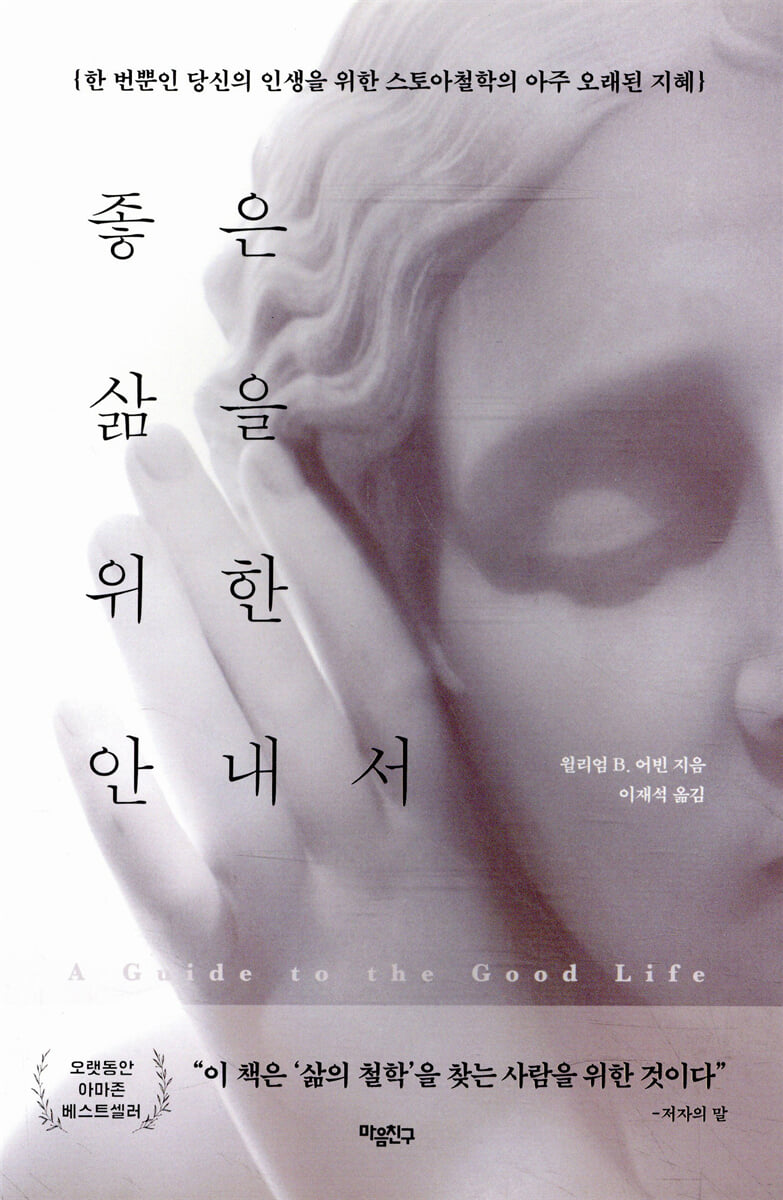
A Guide to a Good Life
 |
Description
Book Introduction
The wisdom of Stoic philosophy for those who want to establish their own philosophy of life so that they do not regret living their one and only life wrong.
Using equanimity techniques developed by the Stoics, such as negative visualization and the control dichotomy, readers will learn how to reduce worry, let go of past events, and focus on what they can control.
We also learn how to deal with the insults of others, how to face grief and old age, and how to resist the temptations of wealth and fame.
According to Stoic philosophy, inner strength that can withstand the twists and turns of life is the foundation of a 'good life' that brings peace of mind and true joy.
The psychological insights and practical life skills learned by ancient Stoic philosophers like Seneca, Epictetus, and Marcus Aurelius can serve as an excellent roadmap for us to escape the chronic dissatisfaction we find ourselves in today and move toward a life of self-reliance, self-respect, and freedom.
The most accessible and accessible guide to modern Stoic philosophy, it has been an Amazon bestseller since its publication in the US in 2009.
Using equanimity techniques developed by the Stoics, such as negative visualization and the control dichotomy, readers will learn how to reduce worry, let go of past events, and focus on what they can control.
We also learn how to deal with the insults of others, how to face grief and old age, and how to resist the temptations of wealth and fame.
According to Stoic philosophy, inner strength that can withstand the twists and turns of life is the foundation of a 'good life' that brings peace of mind and true joy.
The psychological insights and practical life skills learned by ancient Stoic philosophers like Seneca, Epictetus, and Marcus Aurelius can serve as an excellent roadmap for us to escape the chronic dissatisfaction we find ourselves in today and move toward a life of self-reliance, self-respect, and freedom.
The most accessible and accessible guide to modern Stoic philosophy, it has been an Amazon bestseller since its publication in the US in 2009.
- You can preview some of the book's contents.
Preview
index
Introduction: How to Live: Planning Your Life
Part 1: The Rise of Stoic Philosophy
Chapter 1: Philosophy: Focusing on Human Life
Chapter 2: The First Stoics
Chapter 3: Stoicism in Rome
Part 2: Psychological Techniques of Stoic Philosophy
Chapter 4: Negative Visualization: Picture Bad Situations in Advance
Chapter 5: The Dichotomy of Control: Distinguish Between What You Can and Cannot Control
Chapter 6: Fatalism, Let Go of the Past…and the Present
Chapter 7: Self-Control or Self-Discipline: Avoiding the Pleasure Trap
Chapter 8: Meditation: Reflect on Yourself as You Practice Stoic Philosophy
Part 3: Advice from Stoic Philosophy
Chapter 9: On Duty and Loving Human Beings
Chapter 10: Human Relationships and Dealing with People
Chapter 11: Don't Be Crushed by Insults and Put-downs
Chapter 12: On Overcoming Tears with Reason
Chapter 13: On Overcoming Anger, the Anger That Eats Away Joy
Chapter 14: On Personal Value and the Pursuit of Fame
Chapter 15: On Personal Values and Luxurious Living
Chapter 16: Exile: How to Survive in a Changing Place
Chapter 17: On Old Age and Being Sent to a Nursing Home
Chapter 18: Death: Ending a Good Life Well
Chapter 19: Becoming a Stoic: Start Now.
And be prepared for the teasing from those around you.
Part 4: Stoic Philosophy for Today's Life
Chapter 20: The Decline of Stoicism
Chapter 21: Revisiting Stoic Philosophy
Chapter 22: Practicing Stoicism
Reading Program for Stoics
Acknowledgments/Notes/References
Part 1: The Rise of Stoic Philosophy
Chapter 1: Philosophy: Focusing on Human Life
Chapter 2: The First Stoics
Chapter 3: Stoicism in Rome
Part 2: Psychological Techniques of Stoic Philosophy
Chapter 4: Negative Visualization: Picture Bad Situations in Advance
Chapter 5: The Dichotomy of Control: Distinguish Between What You Can and Cannot Control
Chapter 6: Fatalism, Let Go of the Past…and the Present
Chapter 7: Self-Control or Self-Discipline: Avoiding the Pleasure Trap
Chapter 8: Meditation: Reflect on Yourself as You Practice Stoic Philosophy
Part 3: Advice from Stoic Philosophy
Chapter 9: On Duty and Loving Human Beings
Chapter 10: Human Relationships and Dealing with People
Chapter 11: Don't Be Crushed by Insults and Put-downs
Chapter 12: On Overcoming Tears with Reason
Chapter 13: On Overcoming Anger, the Anger That Eats Away Joy
Chapter 14: On Personal Value and the Pursuit of Fame
Chapter 15: On Personal Values and Luxurious Living
Chapter 16: Exile: How to Survive in a Changing Place
Chapter 17: On Old Age and Being Sent to a Nursing Home
Chapter 18: Death: Ending a Good Life Well
Chapter 19: Becoming a Stoic: Start Now.
And be prepared for the teasing from those around you.
Part 4: Stoic Philosophy for Today's Life
Chapter 20: The Decline of Stoicism
Chapter 21: Revisiting Stoic Philosophy
Chapter 22: Practicing Stoicism
Reading Program for Stoics
Acknowledgments/Notes/References
Detailed image

Into the book
What do you want from life? A caring spouse? A stable job and a big house? But aren't these things you want "from life"? Beyond what you want from life, what do you want "from life itself"? This is the question we ask in the broadest sense.
Because it is a question about the big goals of life, not about what you want to achieve in everyday life.
--- p.7
The peace of mind that the Stoics sought was not a state of numbness achieved by tranquilizers.
It is a state of mind that is full of positive emotions such as joy while being free of negative emotions such as anger, sadness, anxiety, and fear.
--- p.16
The Stoics believed that we should enjoy the 'good things' that life offers, but not become obsessed with them.
The Stoics believed that we should often step back from enjoying the gifts life offers and constantly reflect on the fact that we could lose what we are enjoying at any moment.
--- p.34
“Stoic ethics is a kind of eudaimonia.
“The central theme of Stoic ethics is what we should do and how we should be in order to live well.” According to historian Paul Venne, “Stoicism is less about ethics and more about a paradoxical prescription for happiness.”
--- p.42
Seneca said:
“Those who practice the principles of Stoic philosophy will find vitality and joy welling up from deep within.
He who finds joy in what he has does not seek any other joy.
“Physical pleasures are paltry and temporary compared to inner joy.”
--- p.55
Most people try to change the world around them to find satisfaction.
But according to Epictetus, it is better to change yourself, or more precisely, your desires, to find satisfaction.
--- p.92
Marcus Aurelius said that the key to living a good life is knowing what is valuable and being indifferent to what is worthless.
He believed that because we have the power to assign value to things, we also have the power to live a good life.
--- p.98
While Cato was defending his case, his opponent, Lentulus, spat in Cato's face.
Instead of getting angry or returning the insult, Kato simply wiped his spit and said:
“Lentullus, if anyone says you are speechless, I assure you they are completely mistaken.” Seneca also cites the case of Socrates, who suffered an even more severe insult.
A man came up to Socrates and suddenly slapped him on the face.
Socrates did not get angry and responded like this.
“It’s really annoying having to wear a helmet every time I go outside.”
--- p.154
“Wealth has the power to make people miserable.
“If you want to make someone miserable, give him money.” Once, Musonius lent a large sum of money to a man who pretended to be a philosopher.
People whispered that he was a wicked swindler, but Musonius simply gave the money he lent away without asking for it back.
Musonius said with a smile.
“If you’re a really bad person, you deserve the money.”
--- p.182
Natural desires can be satisfied, but it is impossible to completely satisfy unnatural desires.
So when you want something, you should stop for a moment and ask yourself whether this is a natural desire or not.
If it is an unnatural desire, you should reconsider whether you should satisfy it.
--- p.186
Many people believe that happiness is something that other people, like therapists or politicians, can bring.
Stoic philosophy rejects this idea.
Stoic philosophy teaches that we are responsible for much of our own happiness and unhappiness.
It is only when you take responsibility for your own happiness that you can achieve happiness.
--- p.233
When properly understood, Stoic philosophy can be called a 'cure for disease'.
Here, 'disease' refers to negative emotions that torment us, such as anxiety, sadness, and fear, that take away the joy of life.
By practicing Stoic psychological techniques, we can cure mental illness and achieve peace of mind.
Because it is a question about the big goals of life, not about what you want to achieve in everyday life.
--- p.7
The peace of mind that the Stoics sought was not a state of numbness achieved by tranquilizers.
It is a state of mind that is full of positive emotions such as joy while being free of negative emotions such as anger, sadness, anxiety, and fear.
--- p.16
The Stoics believed that we should enjoy the 'good things' that life offers, but not become obsessed with them.
The Stoics believed that we should often step back from enjoying the gifts life offers and constantly reflect on the fact that we could lose what we are enjoying at any moment.
--- p.34
“Stoic ethics is a kind of eudaimonia.
“The central theme of Stoic ethics is what we should do and how we should be in order to live well.” According to historian Paul Venne, “Stoicism is less about ethics and more about a paradoxical prescription for happiness.”
--- p.42
Seneca said:
“Those who practice the principles of Stoic philosophy will find vitality and joy welling up from deep within.
He who finds joy in what he has does not seek any other joy.
“Physical pleasures are paltry and temporary compared to inner joy.”
--- p.55
Most people try to change the world around them to find satisfaction.
But according to Epictetus, it is better to change yourself, or more precisely, your desires, to find satisfaction.
--- p.92
Marcus Aurelius said that the key to living a good life is knowing what is valuable and being indifferent to what is worthless.
He believed that because we have the power to assign value to things, we also have the power to live a good life.
--- p.98
While Cato was defending his case, his opponent, Lentulus, spat in Cato's face.
Instead of getting angry or returning the insult, Kato simply wiped his spit and said:
“Lentullus, if anyone says you are speechless, I assure you they are completely mistaken.” Seneca also cites the case of Socrates, who suffered an even more severe insult.
A man came up to Socrates and suddenly slapped him on the face.
Socrates did not get angry and responded like this.
“It’s really annoying having to wear a helmet every time I go outside.”
--- p.154
“Wealth has the power to make people miserable.
“If you want to make someone miserable, give him money.” Once, Musonius lent a large sum of money to a man who pretended to be a philosopher.
People whispered that he was a wicked swindler, but Musonius simply gave the money he lent away without asking for it back.
Musonius said with a smile.
“If you’re a really bad person, you deserve the money.”
--- p.182
Natural desires can be satisfied, but it is impossible to completely satisfy unnatural desires.
So when you want something, you should stop for a moment and ask yourself whether this is a natural desire or not.
If it is an unnatural desire, you should reconsider whether you should satisfy it.
--- p.186
Many people believe that happiness is something that other people, like therapists or politicians, can bring.
Stoic philosophy rejects this idea.
Stoic philosophy teaches that we are responsible for much of our own happiness and unhappiness.
It is only when you take responsibility for your own happiness that you can achieve happiness.
--- p.233
When properly understood, Stoic philosophy can be called a 'cure for disease'.
Here, 'disease' refers to negative emotions that torment us, such as anxiety, sadness, and fear, that take away the joy of life.
By practicing Stoic psychological techniques, we can cure mental illness and achieve peace of mind.
--- p.252
Publisher's Review
William B., the 'philosopher of everyday life'
Professor Ervin tells us
A life philosophy that applies directly to our lives today.
“My interest is in applying Stoic philosophy directly to my life and, furthermore, to the lives of others.” (p.10) According to the author, philosophy should provide answers (or at least hints) to the problems we encounter in our daily lives.
Philosophy should help us decide how to respond to insults, whom to make friends with, how to overcome sorrow and anger, and how to face old age and death.
In fact, the origins of this idea go back far to ancient Greece and Rome.
“Ancient Greek and Roman philosophers considered it important to think about the philosophy of life.
They believed that the very reason for the existence of philosophy was to provide a philosophy of life.
“Their interest in logic and other subjects was also largely aimed at establishing a philosophy of life.” (p.9)
So why do we need a philosophy of life?
According to the author, “Without a philosophy of life, there is a risk of ‘living wrongly’.
“Even if we have all kinds of enjoyable experiences in life, there is a risk that we will end up living a ‘bad life.’” (p.8) Ultimately, the reason we need to establish a philosophy of life is to live a life without regrets, a life we only live once.
In a word, it is for ‘living well.’
So then, what is a good life, a life well-lived?
The Art of the 'Good Life' as Told by Stoic Philosophy
According to Stoic philosophy, a 'good life' is a life that follows the laws of nature, that is, a life in which humans live according to their original creation.
When we live in harmony with nature, we can live a 'good life' of peace of mind and true joy.
So how were humans originally created? When we reflect on ourselves, what becomes clear is that humans are rational beings, social animals designed to live in harmony with others.
The Stoic philosophers, through their deep reflections on how humans should live as rational social animals, acquired various psychological insights and life skills that led to equanimity.
Representative psychological techniques they devised include negative visualization, the dichotomy of control, a fatalistic attitude toward the past, self-control, and meditation.
We can help ourselves cope with everyday stressful situations by practicing these psychological techniques.
Modernized Stoicism with Practical Help
However, the Stoic philosophy that Professor Ervin introduces is not in its stuffed, old form.
What he presents before us is a 'modernized' version of Stoic philosophy, with his own perspective and interpretation.
“I wanted to create a Stoic philosophy that would be of practical help to myself and those around me.
For this purpose, Stoic philosophy has been applied to our current situation.” (p.258)
For example, Professor Irvin changes Epictetus's "dichotomy of control," which divides everything that happens to us into controllable and uncontrollable things, into a "trichotomy of control" (p. 95). According to his analysis, for accuracy, uncontrollable things should be further divided into things that are completely uncontrollable and things that are somewhat controllable but not completely controllable.
Another part is the part that proves the ‘correctness’ of Stoic philosophy.
The ancient Stoic philosophers used Zeus's creation of humans as a basis to 'prove' their philosophy.
But this kind of explanation no longer works for modern readers.
The explanation given by the author is through ‘evolutionary psychology.’
For example, the reason humans were given reason is because, over the long course of evolution, reason helped the human species survive and reproduce, but if that is the case, then it is entirely possible to “misuse” the ability to reason that we possess.
In particular, we can use (or rather, 'misuse') our rational faculties to circumvent our evolutionarily programmed human behavioral tendencies.” (p. 248) “If achieving peace in life is our goal, we can use our rational faculties to conclude that many of the things we pursue are, by evolutionary design, worthless.” (p. 249)
Those who are contemplating their own 'philosophy of life'
For those who want a life of independence, self-respect, and freedom.
However, the author does not 'forcefully' recommend Stoic philosophy to readers as a philosophy of life.
“In this book, I will defend Stoicism as my philosophy of life.
But Stoicism is not the only option for those seeking a philosophy of life.” (p.35) “There is no philosophy of life that suits everyone.
But there is a philosophy of life that you should never choose.
And in most cases, it's better to have an imperfect philosophy of life than to have no philosophy at all.
“Even if no one reads this book and is ‘converted’ to Stoicism, if it gives people an opportunity to seriously think about their own philosophy of life, then I will consider myself to have fulfilled my duty to my fellow human beings according to the principles of Stoic philosophy.” (p. 263)
Readers will find a clue to escaping the chronic dissatisfaction we find ourselves in today in the lives and writings of the ancient Stoic philosophers, who lived lives of self-reliance, self-respect, freedom, and above all, as "strong individuals" characterized by moderation and self-denial, self-discipline and integrity, humor and wit.
This translation is a completely new translation, from beginning to end, of the original book, supplementing the missing parts of the Korean translation of 『Jik-eon』 published in 2012.
Professor Ervin tells us
A life philosophy that applies directly to our lives today.
“My interest is in applying Stoic philosophy directly to my life and, furthermore, to the lives of others.” (p.10) According to the author, philosophy should provide answers (or at least hints) to the problems we encounter in our daily lives.
Philosophy should help us decide how to respond to insults, whom to make friends with, how to overcome sorrow and anger, and how to face old age and death.
In fact, the origins of this idea go back far to ancient Greece and Rome.
“Ancient Greek and Roman philosophers considered it important to think about the philosophy of life.
They believed that the very reason for the existence of philosophy was to provide a philosophy of life.
“Their interest in logic and other subjects was also largely aimed at establishing a philosophy of life.” (p.9)
So why do we need a philosophy of life?
According to the author, “Without a philosophy of life, there is a risk of ‘living wrongly’.
“Even if we have all kinds of enjoyable experiences in life, there is a risk that we will end up living a ‘bad life.’” (p.8) Ultimately, the reason we need to establish a philosophy of life is to live a life without regrets, a life we only live once.
In a word, it is for ‘living well.’
So then, what is a good life, a life well-lived?
The Art of the 'Good Life' as Told by Stoic Philosophy
According to Stoic philosophy, a 'good life' is a life that follows the laws of nature, that is, a life in which humans live according to their original creation.
When we live in harmony with nature, we can live a 'good life' of peace of mind and true joy.
So how were humans originally created? When we reflect on ourselves, what becomes clear is that humans are rational beings, social animals designed to live in harmony with others.
The Stoic philosophers, through their deep reflections on how humans should live as rational social animals, acquired various psychological insights and life skills that led to equanimity.
Representative psychological techniques they devised include negative visualization, the dichotomy of control, a fatalistic attitude toward the past, self-control, and meditation.
We can help ourselves cope with everyday stressful situations by practicing these psychological techniques.
Modernized Stoicism with Practical Help
However, the Stoic philosophy that Professor Ervin introduces is not in its stuffed, old form.
What he presents before us is a 'modernized' version of Stoic philosophy, with his own perspective and interpretation.
“I wanted to create a Stoic philosophy that would be of practical help to myself and those around me.
For this purpose, Stoic philosophy has been applied to our current situation.” (p.258)
For example, Professor Irvin changes Epictetus's "dichotomy of control," which divides everything that happens to us into controllable and uncontrollable things, into a "trichotomy of control" (p. 95). According to his analysis, for accuracy, uncontrollable things should be further divided into things that are completely uncontrollable and things that are somewhat controllable but not completely controllable.
Another part is the part that proves the ‘correctness’ of Stoic philosophy.
The ancient Stoic philosophers used Zeus's creation of humans as a basis to 'prove' their philosophy.
But this kind of explanation no longer works for modern readers.
The explanation given by the author is through ‘evolutionary psychology.’
For example, the reason humans were given reason is because, over the long course of evolution, reason helped the human species survive and reproduce, but if that is the case, then it is entirely possible to “misuse” the ability to reason that we possess.
In particular, we can use (or rather, 'misuse') our rational faculties to circumvent our evolutionarily programmed human behavioral tendencies.” (p. 248) “If achieving peace in life is our goal, we can use our rational faculties to conclude that many of the things we pursue are, by evolutionary design, worthless.” (p. 249)
Those who are contemplating their own 'philosophy of life'
For those who want a life of independence, self-respect, and freedom.
However, the author does not 'forcefully' recommend Stoic philosophy to readers as a philosophy of life.
“In this book, I will defend Stoicism as my philosophy of life.
But Stoicism is not the only option for those seeking a philosophy of life.” (p.35) “There is no philosophy of life that suits everyone.
But there is a philosophy of life that you should never choose.
And in most cases, it's better to have an imperfect philosophy of life than to have no philosophy at all.
“Even if no one reads this book and is ‘converted’ to Stoicism, if it gives people an opportunity to seriously think about their own philosophy of life, then I will consider myself to have fulfilled my duty to my fellow human beings according to the principles of Stoic philosophy.” (p. 263)
Readers will find a clue to escaping the chronic dissatisfaction we find ourselves in today in the lives and writings of the ancient Stoic philosophers, who lived lives of self-reliance, self-respect, freedom, and above all, as "strong individuals" characterized by moderation and self-denial, self-discipline and integrity, humor and wit.
This translation is a completely new translation, from beginning to end, of the original book, supplementing the missing parts of the Korean translation of 『Jik-eon』 published in 2012.
GOODS SPECIFICS
- Date of issue: March 31, 2022
- Page count, weight, size: 320 pages | 145*220*30mm
- ISBN13: 9791191882018
- ISBN10: 1191882012
You may also like
카테고리
korean


korean

![GQ KOREA Mark (Monthly): December [2025]](http://librairie.coreenne.fr/cdn/shop/files/8ef265dbbfbf186523ed75ba7319009d.jpg?v=1765340328&width=3840)


