

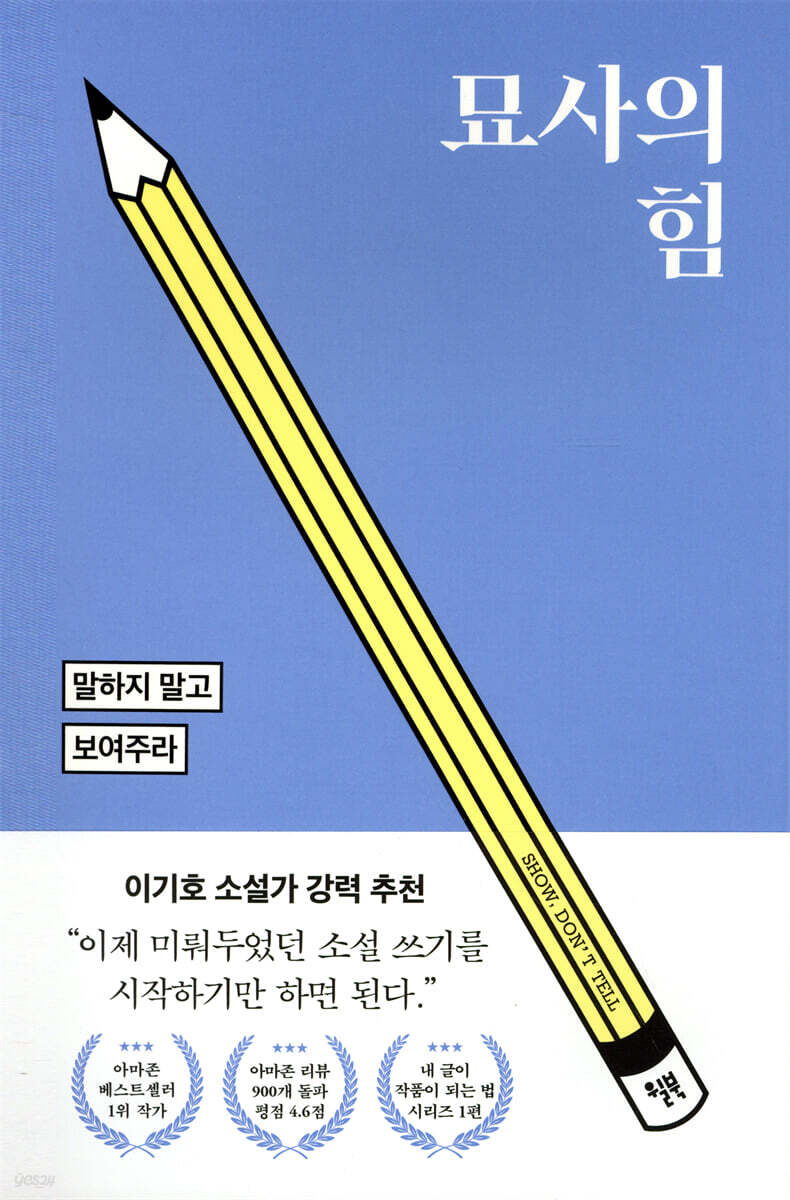
The power of description
 |
Description
Book Introduction
“Now we have this book by our side, “All I have to do is start writing the novel I’ve been putting off.” _Highly recommended by novelist Lee Ki-ho! Write a scene that will remain in the reader's mind forever! Part 1 of the "How to Turn Your Writing into a Work of Art" series A steady seller in the writing field from the #1 Amazon bestselling author and editor. Over 900 Amazon reviews, 4.6 rating There is a famous story known as an anecdote about Hemingway. When someone asked Hemingway to write a novel that would make him cry using only six words, he is said to have immediately written: “Selling never-worn baby shoes.” This legendary tale epitomizes what makes a good novel. The author did not 'tell' the reader what the character's state was or what emotions he was feeling. However, it made the reader actively engage with the story and empathize with the emotions felt by the characters. Moreover, it was written concisely and without any unnecessary details. This is 'showing off'. “Show, don’t tell” is advice that anyone who enjoys literature or writes has probably heard at least once. Sandra Guss, #1 Amazon bestselling author and editor, says many writers and aspiring writers either don't fully understand these writing principles or, even if they do, struggle to apply them to their own writing. This book, based on the numerous bestsellers Sandra Guss has written and the enormous volume of manuscripts she has edited, clearly explains the delicate and nuanced difference between 'telling' and 'showing.' Furthermore, we introduce realistic editing methods and writing training methods so that you can revise your writing immediately. The power of description starts with the definition of the saying, "show, don't tell," and systematically organizes why we must "show" and how we can "show." How do I reveal a character's personality? How do I build suspense? What words should I absolutely avoid in dialogue? Why should I avoid adjectives and adverbs? When should I effectively introduce information that helps me understand the world? Let's keep this book by my side and revise my writing, sentence by sentence. Just like the novel of my life that I read with excitement, my writing can also become a work of art. Don't speak, overwhelm! |
- You can preview some of the book's contents.
Preview
index
Preface: Show, Don't Tell
Chapter 1 Definition
Chapter 2: The Importance of 'Showing'
Chapter 3: Nine Red Flags of Speaking
Chapter 4: The Art of 'Showing'
Chapter 5: Avoiding Unnecessary Repetition
Chapter 6: Danger Zones to Watch Out for in 'Speaking' 1
Chapter 7: Danger Zones to Watch Out for in Speaking 2
Chapter 8: Danger Zones to Watch Out for in 'Speaking'
Chapter 9: Speaking in Conversation
Chapter 10: Excessive 'Showing Off'
Chapter 11: Uses of 'Speaking'
Chapter 12 Practice
Chapter 13 Answers
Conclusion: What to write now
Chapter 1 Definition
Chapter 2: The Importance of 'Showing'
Chapter 3: Nine Red Flags of Speaking
Chapter 4: The Art of 'Showing'
Chapter 5: Avoiding Unnecessary Repetition
Chapter 6: Danger Zones to Watch Out for in 'Speaking' 1
Chapter 7: Danger Zones to Watch Out for in Speaking 2
Chapter 8: Danger Zones to Watch Out for in 'Speaking'
Chapter 9: Speaking in Conversation
Chapter 10: Excessive 'Showing Off'
Chapter 11: Uses of 'Speaking'
Chapter 12 Practice
Chapter 13 Answers
Conclusion: What to write now
Detailed image
.jpg)
Into the book
"Show, don't tell" is probably the most common piece of advice new writers hear from editors and writing teachers.
---From the "first sentence"
However, many writers do not properly understand this principle and have difficulty applying it to their work.
Even authors who have already published several books often fail to grasp the subtle and nuanced difference between "showing" and "telling."
--- p.7
Let's think about why we read novels.
Unlike readers of nonfiction, readers of fiction do not read to gain information.
Novel readers read to be entertained and to escape into another world.
--- p.19
'Speaking' cannot evoke any image in the reader's mind.
'Speaking' is the act of interpreting information for the reader, depriving the reader of the opportunity to think about and discover the world of the story for himself.
--- p.20
If you use an adverb, it usually means 'speaking'.
Let's eliminate adverbs as much as possible.
Some sentences are fine without adverbs.
If you remove the adverb and it sounds awkward, it's better to rewrite the sentence.
--- p.28
But be careful not to go too far.
Sometimes, instead of having a character stamp their feet, walk, or wander around to attract attention, they just need to cross the room.
It's okay to use weak verbs for actions that aren't very important.
However, in scenes where you want to build suspense and tension, use strong verbs to show what it feels like when a character walks.
--- p.39
The best metaphors and similes always come from the character's background.
For example, if someone thinks Betty's palms feel like sandpaper, they've definitely touched sandpaper before.
--- p.41
Just 'telling' the reader that a character is a mean and nasty woman may not be enough to convince the reader of that fact.
On the other hand, if you 'show' a woman kicking a dog, the reader will immediately be convinced that she is a bad person.
--- p.44
The woman's long, slender legs were revealed in a short, black, tight-fitting skirt.
If I were you, I would just leave out a few adjectives here.
For example, the adjective 'short' is unnecessary.
If a woman's legs are exposed, the reader may assume that the skirt is short.
--- p.81
Make a list of the emotional words you use most often.
When revising any manuscript, refer to this list and use the search function of your document program to find the expressions of emotion included in this list.
You must find all noun, adjective, and adverb conjugations of each expression.
For example, 'furious', 'enraged', 'infuriated'.
'Infuriated'.
--- p.85
If you take the advice of "show, don't tell" to the extreme and try to "show" every little detail, even the most unimportant ones, your story will end up bogged down.
--- p.111
Perhaps the best advice one can give a writer is not 'show, don't tell', but 'show and tell.'
Writing a great story requires both, and writers must have both "show" and "tell" skills in their writing toolbox.
---From the "first sentence"
However, many writers do not properly understand this principle and have difficulty applying it to their work.
Even authors who have already published several books often fail to grasp the subtle and nuanced difference between "showing" and "telling."
--- p.7
Let's think about why we read novels.
Unlike readers of nonfiction, readers of fiction do not read to gain information.
Novel readers read to be entertained and to escape into another world.
--- p.19
'Speaking' cannot evoke any image in the reader's mind.
'Speaking' is the act of interpreting information for the reader, depriving the reader of the opportunity to think about and discover the world of the story for himself.
--- p.20
If you use an adverb, it usually means 'speaking'.
Let's eliminate adverbs as much as possible.
Some sentences are fine without adverbs.
If you remove the adverb and it sounds awkward, it's better to rewrite the sentence.
--- p.28
But be careful not to go too far.
Sometimes, instead of having a character stamp their feet, walk, or wander around to attract attention, they just need to cross the room.
It's okay to use weak verbs for actions that aren't very important.
However, in scenes where you want to build suspense and tension, use strong verbs to show what it feels like when a character walks.
--- p.39
The best metaphors and similes always come from the character's background.
For example, if someone thinks Betty's palms feel like sandpaper, they've definitely touched sandpaper before.
--- p.41
Just 'telling' the reader that a character is a mean and nasty woman may not be enough to convince the reader of that fact.
On the other hand, if you 'show' a woman kicking a dog, the reader will immediately be convinced that she is a bad person.
--- p.44
The woman's long, slender legs were revealed in a short, black, tight-fitting skirt.
If I were you, I would just leave out a few adjectives here.
For example, the adjective 'short' is unnecessary.
If a woman's legs are exposed, the reader may assume that the skirt is short.
--- p.81
Make a list of the emotional words you use most often.
When revising any manuscript, refer to this list and use the search function of your document program to find the expressions of emotion included in this list.
You must find all noun, adjective, and adverb conjugations of each expression.
For example, 'furious', 'enraged', 'infuriated'.
'Infuriated'.
--- p.85
If you take the advice of "show, don't tell" to the extreme and try to "show" every little detail, even the most unimportant ones, your story will end up bogged down.
--- p.111
Perhaps the best advice one can give a writer is not 'show, don't tell', but 'show and tell.'
Writing a great story requires both, and writers must have both "show" and "tell" skills in their writing toolbox.
--- p.129
Publisher's Review
The magical transformation brought about by 'showing'
Don't just make the reader read,
Let them live in the world you created!
Think of immortal classics, international bestsellers, and works that are popular through word of mouth.
What do these have in common? The works that come to mind right now all contain unforgettable scenes and events, and heart-pounding lines.
As they pile up, intertwine, and move forward, a new world unfolds.
That world may be similar to reality, or it may be completely unfamiliar.
Either way, we feel like we've lived in that world rather than just read it.
You lose track of time, follow the characters, laugh, cry, empathize with their emotions, or criticize their attitudes, and grow together with them.
Those that are called someone's life novels leave a deep impression on the heart, unlike so many other ordinary works.
So how is this possible?
“Don’t tell me the moon shines, show me a ray of light on a broken piece of glass.” (Anton Chekhov)
“The most moving writing comes when the writer shows a situation without explaining it.” (Leo Tolstoy)
“A clear text attracts readers, but an ambiguous text attracts only critics.” (Albert Camus)
“The road to hell is paved with adverbs.” (Stephen King)
Sandra Guss, a novelist and editor whose works have repeatedly reached number one on Amazon's bestsellers list, finds answers in the "show, don't tell" writing principle that countless writers, from the great classics to contemporary bestsellers, have emphasized.
No matter how interesting a story is, if the sentences, the basic units that unfold the story, are simply "speaking" to the reader, the reader will not be able to immerse themselves in a new world, empathize with the characters, and simply read the information the author explains.
In order to write like the life novels we were so engrossed in reading, we must not just 'tell' the story unilaterally, but 'show' a world vividly before the reader.
However, many aspiring writers or authors fail to properly distinguish the subtle difference between 'telling' and 'showing'.
Sandra Guss has refined the famous writing principle of "show, don't tell" to help contemporary writers understand it accurately and has created a training system that anyone can use to write and revise.
The Power of Description, which has already helped many aspiring writers in the United States and has become a steady seller in the writing field, is the first and core of Sandra Guss's "How to Make Your Writing a Work of Art" series.
How to turn your ordinary writing into a masterpiece
The only way to improve your writing skills is to write.
We've already heard the same advice over and over again about how to write well: to be specific or to be brief.
But when I actually start writing, I feel lost.
The more I write, the more blunt the message I want to convey becomes and the more my sentences become.
It starts out pretty well, but as it goes on, it gets lost.
There's a lot of writing advice out there, but the problem is I don't know how to apply it to my own writing.
The power of description starts with explaining which words to avoid.
For example, verbs like 'saw', 'smelled', 'felt', and 'noticed', and adjectives like 'beautiful' and 'fearful' are typical expressions that the author 'tells', which prevent the reader from immersing themselves in the characters and properly experiencing the events in the story.
This book follows the principle of "show, don't tell," and shows how to revise certain sentences and in what way through vivid examples from the novel.
In addition, it presents clear methods rather than intuitions, such as how adjectives and adverbs ruin writing, what makes a good line, when to spill information about the world and characters, how modern novel readers differ from classic novel readers, and why editors and readers dislike flashback scenes.
Above all, the goal of this book is to help me improve my writing.
So, for each chapter, I provide rewriting tips and practice exercises so that you can immediately check what parts of your actual manuscript need to be deleted or revised, and apply the "show me" technique.
The only way to improve your writing skills is to write yourself.
The more you edit a piece of writing, the more it shines.
The power of description is a book that only helps the writer.
So the program in this book makes anyone write.
Let's fix it.
If you're someone who wants to express your world through writing, an aspiring writer who's started but isn't sure if you're writing properly, or a writer who's feeling discouraged because the scene you're currently writing isn't coming together, keep this book by your side and open it often.
As you progress through each of the 13 chapters, the sentences that were stuck are thrillingly resolved.
The important thing is to keep writing without getting frustrated.
This book shows all the difficulties a writer may face and suggests ways to continue working.
Don't just make the reader read,
Let them live in the world you created!
Think of immortal classics, international bestsellers, and works that are popular through word of mouth.
What do these have in common? The works that come to mind right now all contain unforgettable scenes and events, and heart-pounding lines.
As they pile up, intertwine, and move forward, a new world unfolds.
That world may be similar to reality, or it may be completely unfamiliar.
Either way, we feel like we've lived in that world rather than just read it.
You lose track of time, follow the characters, laugh, cry, empathize with their emotions, or criticize their attitudes, and grow together with them.
Those that are called someone's life novels leave a deep impression on the heart, unlike so many other ordinary works.
So how is this possible?
“Don’t tell me the moon shines, show me a ray of light on a broken piece of glass.” (Anton Chekhov)
“The most moving writing comes when the writer shows a situation without explaining it.” (Leo Tolstoy)
“A clear text attracts readers, but an ambiguous text attracts only critics.” (Albert Camus)
“The road to hell is paved with adverbs.” (Stephen King)
Sandra Guss, a novelist and editor whose works have repeatedly reached number one on Amazon's bestsellers list, finds answers in the "show, don't tell" writing principle that countless writers, from the great classics to contemporary bestsellers, have emphasized.
No matter how interesting a story is, if the sentences, the basic units that unfold the story, are simply "speaking" to the reader, the reader will not be able to immerse themselves in a new world, empathize with the characters, and simply read the information the author explains.
In order to write like the life novels we were so engrossed in reading, we must not just 'tell' the story unilaterally, but 'show' a world vividly before the reader.
However, many aspiring writers or authors fail to properly distinguish the subtle difference between 'telling' and 'showing'.
Sandra Guss has refined the famous writing principle of "show, don't tell" to help contemporary writers understand it accurately and has created a training system that anyone can use to write and revise.
The Power of Description, which has already helped many aspiring writers in the United States and has become a steady seller in the writing field, is the first and core of Sandra Guss's "How to Make Your Writing a Work of Art" series.
How to turn your ordinary writing into a masterpiece
The only way to improve your writing skills is to write.
We've already heard the same advice over and over again about how to write well: to be specific or to be brief.
But when I actually start writing, I feel lost.
The more I write, the more blunt the message I want to convey becomes and the more my sentences become.
It starts out pretty well, but as it goes on, it gets lost.
There's a lot of writing advice out there, but the problem is I don't know how to apply it to my own writing.
The power of description starts with explaining which words to avoid.
For example, verbs like 'saw', 'smelled', 'felt', and 'noticed', and adjectives like 'beautiful' and 'fearful' are typical expressions that the author 'tells', which prevent the reader from immersing themselves in the characters and properly experiencing the events in the story.
This book follows the principle of "show, don't tell," and shows how to revise certain sentences and in what way through vivid examples from the novel.
In addition, it presents clear methods rather than intuitions, such as how adjectives and adverbs ruin writing, what makes a good line, when to spill information about the world and characters, how modern novel readers differ from classic novel readers, and why editors and readers dislike flashback scenes.
Above all, the goal of this book is to help me improve my writing.
So, for each chapter, I provide rewriting tips and practice exercises so that you can immediately check what parts of your actual manuscript need to be deleted or revised, and apply the "show me" technique.
The only way to improve your writing skills is to write yourself.
The more you edit a piece of writing, the more it shines.
The power of description is a book that only helps the writer.
So the program in this book makes anyone write.
Let's fix it.
If you're someone who wants to express your world through writing, an aspiring writer who's started but isn't sure if you're writing properly, or a writer who's feeling discouraged because the scene you're currently writing isn't coming together, keep this book by your side and open it often.
As you progress through each of the 13 chapters, the sentences that were stuck are thrillingly resolved.
The important thing is to keep writing without getting frustrated.
This book shows all the difficulties a writer may face and suggests ways to continue working.
GOODS SPECIFICS
- Publication date: September 10, 2021
- Page count, weight, size: 156 pages | 224g | 135*205*20mm
- ISBN13: 9791155814024
- ISBN10: 1155814029
You may also like
카테고리
korean


korean

![GQ KOREA Mark (Monthly): December [2025]](http://librairie.coreenne.fr/cdn/shop/files/8ef265dbbfbf186523ed75ba7319009d.jpg?v=1765340328&width=3840)


