

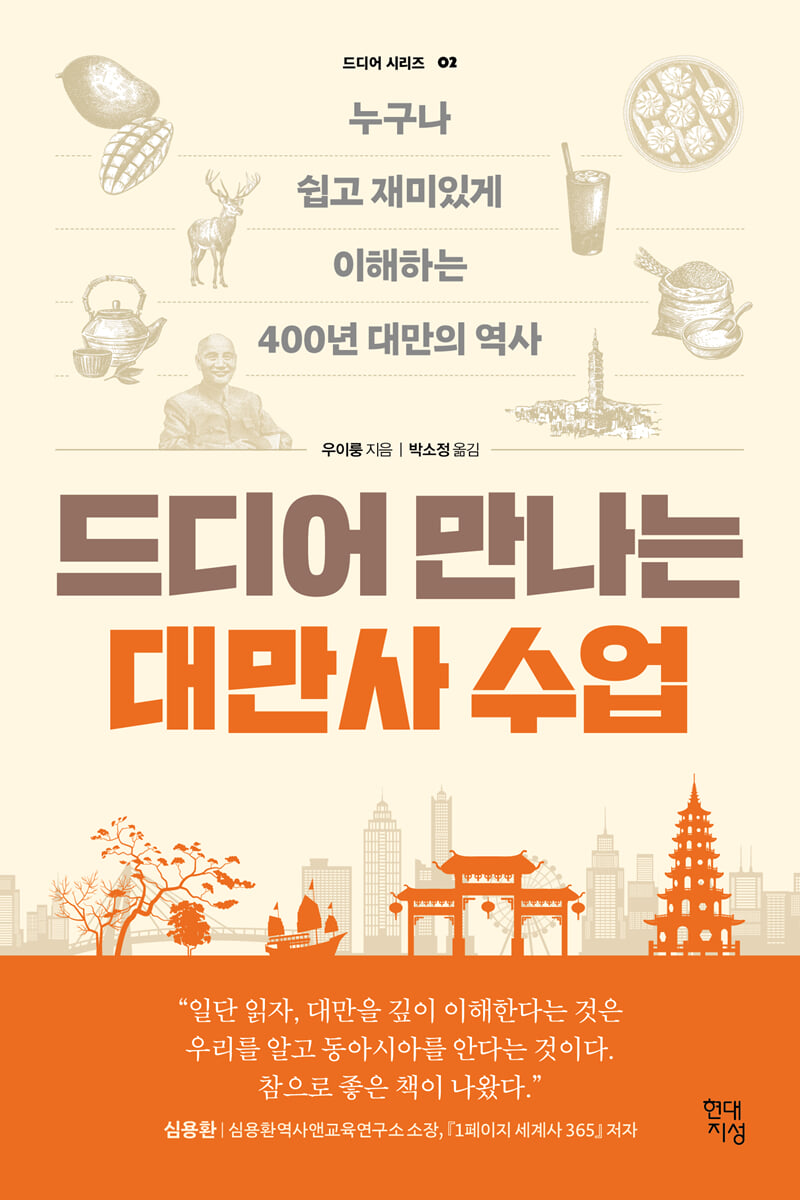
Finally, a Taiwanese history class
 |
Description
Book Introduction
Taiwan has a population of 23 million, 47 languages, and 400 years of history.
Quickly organized into 16 topics with colorful images.
"This is the easiest and most meaningful book on Taiwanese history ever published." _Tae-seong Choi, "Big Star Teacher"
“Let’s read first, to understand Taiwan is to know us.
“A truly good book has come out.” _Writer Sim Yong-hwan
*** Highly recommended by Choi Tae-seong, Shim Yong-hwan, and Ryu Young-ha
*** "Top 10 Most Influential Books in Taiwan in 2024" Selected by Jinshitang, a Leading Taiwanese Bookstore
This book condenses the unfamiliar yet intriguing history of Taiwan into 16 carefully selected themes, from the creation myths of the indigenous people to the K-pop craze, in an engaging way.
Not only does it faithfully cover Taiwan's history curriculum by topic, it also includes explanations and colorful images tailored to the level of Korean readers, making it easy and fun for anyone to understand.
The author, a current history teacher in Taiwan, uses his characteristically witty banter to explain key events in Taiwanese history while maintaining a balanced perspective that is not biased towards either the left or the right.
As you read the book following the author's perspective, you will be captivated by Taiwan's history, which is both similar and different from Korean history, and you will be able to look back on our past and present and even look into the future.
Quickly organized into 16 topics with colorful images.
"This is the easiest and most meaningful book on Taiwanese history ever published." _Tae-seong Choi, "Big Star Teacher"
“Let’s read first, to understand Taiwan is to know us.
“A truly good book has come out.” _Writer Sim Yong-hwan
*** Highly recommended by Choi Tae-seong, Shim Yong-hwan, and Ryu Young-ha
*** "Top 10 Most Influential Books in Taiwan in 2024" Selected by Jinshitang, a Leading Taiwanese Bookstore
This book condenses the unfamiliar yet intriguing history of Taiwan into 16 carefully selected themes, from the creation myths of the indigenous people to the K-pop craze, in an engaging way.
Not only does it faithfully cover Taiwan's history curriculum by topic, it also includes explanations and colorful images tailored to the level of Korean readers, making it easy and fun for anyone to understand.
The author, a current history teacher in Taiwan, uses his characteristically witty banter to explain key events in Taiwanese history while maintaining a balanced perspective that is not biased towards either the left or the right.
As you read the book following the author's perspective, you will be captivated by Taiwan's history, which is both similar and different from Korean history, and you will be able to look back on our past and present and even look into the future.
- You can preview some of the book's contents.
Preview
index
Recommendation
Recommended Preface: A Quick Guide to Taiwanese History_Tsai Ching-hua, Deputy Minister of Education
Preface So close yet so far
Part 1: From Prehistoric Times to the Anti-Qing Rebellion (Prehistoric Times to 1683)
Chapter 1: How did Taiwan begin? _The Creation Myth of the Taiwanese Aboriginal People
Chapter 2: Two Nations Visit the Beautiful Island of Formosa: The Dutch and Spanish Rule
Chapter 3: "The Story of the King": What Kind of Man Was Zheng Chenggong? _Conflicting Evaluations of Zheng Chenggong
Part 2: The Qing Dynasty (1683–1895)
Chapter 4: Why Did the Han Chinese Risk Their Lives to Come to Taiwan? _Han Chinese Immigrants from the Qing Dynasty
Chapter 5: What Would You Believe?_The Religious Beliefs of the Han Chinese
Chapter 6: 'Made in Taiwan' Sells Like Hot Cakes - Tea, Sugar, and Camphor
Chapter 7: Is "Gaesanmuban" a Reclamation or an Encroachment? _Relations between Taiwanese Aborigines and the Han Chinese during the Qing Dynasty
Chapter 8: Why Did Missionaries Come All the Way to Taiwan? Missionaries Who Visited Taiwan in the 19th Century
Part 3: Japanese Rule (1895–1945)
Chapter 9: Qing or Japan, That is the Question: The Beginning of Japanese Rule
Chapter 10: Converting Taiwanese People into Japanese Citizens?_Taiwan's New Education
Chapter 11: What Did People Do for Fun 100 Years Ago?_Leisure and Entertainment during the Japanese Colonial Period
Chapter 12: Taiwan is the Taiwan of the Taiwanese: Efforts to Enlighten the People
Part 4: Republic of China Era (1945~)
Chapter 13: Night Has Fallen, Mafia, Open Your Eyes_People Who Lived During the Martial Law Era
Chapter 14: No Eternal Friends, No Eternal Enemies: The Diplomatic History of the Republic of China
Chapter 15: Unlimited Growth Continues: The Miracle of Taiwan's Postwar Economy
Chapter 16: From the Spirit of the Chinese Nation to K-POP: Changes in Taiwan's Socio-Cultural Landscape
Recommended Preface: A Quick Guide to Taiwanese History_Tsai Ching-hua, Deputy Minister of Education
Preface So close yet so far
Part 1: From Prehistoric Times to the Anti-Qing Rebellion (Prehistoric Times to 1683)
Chapter 1: How did Taiwan begin? _The Creation Myth of the Taiwanese Aboriginal People
Chapter 2: Two Nations Visit the Beautiful Island of Formosa: The Dutch and Spanish Rule
Chapter 3: "The Story of the King": What Kind of Man Was Zheng Chenggong? _Conflicting Evaluations of Zheng Chenggong
Part 2: The Qing Dynasty (1683–1895)
Chapter 4: Why Did the Han Chinese Risk Their Lives to Come to Taiwan? _Han Chinese Immigrants from the Qing Dynasty
Chapter 5: What Would You Believe?_The Religious Beliefs of the Han Chinese
Chapter 6: 'Made in Taiwan' Sells Like Hot Cakes - Tea, Sugar, and Camphor
Chapter 7: Is "Gaesanmuban" a Reclamation or an Encroachment? _Relations between Taiwanese Aborigines and the Han Chinese during the Qing Dynasty
Chapter 8: Why Did Missionaries Come All the Way to Taiwan? Missionaries Who Visited Taiwan in the 19th Century
Part 3: Japanese Rule (1895–1945)
Chapter 9: Qing or Japan, That is the Question: The Beginning of Japanese Rule
Chapter 10: Converting Taiwanese People into Japanese Citizens?_Taiwan's New Education
Chapter 11: What Did People Do for Fun 100 Years Ago?_Leisure and Entertainment during the Japanese Colonial Period
Chapter 12: Taiwan is the Taiwan of the Taiwanese: Efforts to Enlighten the People
Part 4: Republic of China Era (1945~)
Chapter 13: Night Has Fallen, Mafia, Open Your Eyes_People Who Lived During the Martial Law Era
Chapter 14: No Eternal Friends, No Eternal Enemies: The Diplomatic History of the Republic of China
Chapter 15: Unlimited Growth Continues: The Miracle of Taiwan's Postwar Economy
Chapter 16: From the Spirit of the Chinese Nation to K-POP: Changes in Taiwan's Socio-Cultural Landscape
Detailed image

Into the book
As I write, I realize that Taiwan, where I live, is a land that is both familiar and unfamiliar, a land that seems within reach but is also so close and yet so far away.
There were many times when I had a hard time choosing which material to talk about, and I worried a lot about whether I could explain it this way.
Every time I wrote, I was overcome with pain and felt a sense of doubt.
I kept pushing forward, fidgeting and feeling restless, and that seems to be very similar to Taiwan's history.
Taiwan has been caught up in complex ethnic relations and has also been caught up in the tangled web of international power struggles.
Yet, perhaps the ups and downs of our daily lives have brought us here, step by step.
In this bustling land of Taiwan, with a population of approximately 23 million and 47 languages, I wondered what it was that brought us together.
I think the answer lies in the broad-mindedness and understanding of the islanders.
--- p.16
It is often said that the origin of Taiwan's name, "Formosa," is the anecdote that a Portuguese person shouted "Ila Formosa!" when passing through Taiwan.
But this story may not be true.
According to numerous recent historical studies by historians, there is no direct record in any country's records or historical materials collected to date of Portuguese navigators or sailors shouting "Ila Formosa!" when passing Taiwan.
Instead, the majority of Portuguese people at the time called Taiwan Xiaoliuqiu (小琉球, Lequeo Pequeno).
So why did Taiwan become known as Formosa?
--- p.42
The inexperienced stowaways set foot on the island without even knowing what was going on.
The guesthouse waited until the tide rose and the sea was full, then released the people within seconds, which was called 'release' or 'bait'.
Among the stowaways, there were those who fell into the water or those who were unable to walk more than a few steps before their feet sank into the mud, leaving only their heads behind.
Because it looked like taro planted in a field, it was also called ‘taran planting.’
So it is no wonder that such a sad song was written.
“I advise you not to go to Taiwan.
Taiwan is like a ghost gate (a dangerous place or a crossroads of life and death, where ghosts pass through). Even if a thousand people go there, no one returns, and there is no way to know whether they are alive or dead.”
--- p.80
At that time, an assassination attempt suddenly occurred that shocked the international community.
On the afternoon of March 24, 1895, 73-year-old Li Hongzhang was shot while traveling between his residence and the negotiating table in Japan.
The scene was stained with blood as the bullet struck Li Hongzhang's cheek.
The bullet failed to kill Li Hongzhang immediately, but it sent a chill through Japanese politics.
Thanks to the bullet missing the vital point, Li Hongzhang quickly recovered after receiving first aid.
But Japan was not at all proud.
“How can a Chinese foreign minister be shot in his own country?” Japan rushed to conclude the treaty after Li Hongzhang recovered.
At 11:40 a.m. local time in Japan on April 17, 1895, the Qing Dynasty and Japan signed the Sino-Japanese Peace Treaty, also known as the Treaty of Shimonoseki.
The Qing Dynasty was forced to pay Japan 200 million taels of silver in compensation and permanently cede Taiwan and the Penghu Islands to Japan.
The treaty was ratified by the Guangxu Emperor and officially came into force on May 8, 1895.
--- p.145
The government made every effort to prevent any possibility of communist forces infiltrating Taiwan.
First, we will thoroughly block the inflow of reactionary books and magazines into Taiwan.
On May 28, 1949, the government enacted the "Taiwan Province Martial Law Period Newspaper, Magazine, and Book Management Act," strictly reviewing the content of newspapers, magazines, and books and thoroughly inspecting printed materials carried by passengers at each port terminal.
Second, reading or discussing government-designated subversive books was strictly prohibited.
The government published a "List of Reactionary Books," and once a book appeared on this list, anyone who accidentally picked it up, had a few words about it with a friend, or even used it as a lunchbox holder could be punished.
--- p.202
At 4:00 a.m. on June 25, 1950, the Korean People's Army of North Korea crossed the 38th parallel and invaded South Korea, beginning the Korean War.
The United States believed that the Soviet Union was behind it.
The Korean Peninsula was soon to become a battlefield, and the Taiwan Strait was on the brink of becoming a second battlefield.
Two days later, US President Truman dispatched the US Navy's 7th Fleet to Taiwan to defend it, in order to prevent the front from expanding.
The Republic of China government, which had been abandoned by the United States, received help during the Korean War.
The Taiwan Strait has once again come into the spotlight due to clashes between the two camps during the Cold War.
The Chinese Communist Party then sent troops to aid North Korea.
As the United States and the UN forces, led by the US, stood against each other for three years under the slogan of "Resist US Aggression and Aid Korea," American hostility toward the Chinese Communist Party flared.
The Korean War, while seemingly a civil war on the Korean Peninsula, also had a significant impact on the triangular relationship between the United States, China, and Taiwan.
This war soured relations between the United States and the Chinese Communist Party, and for 20 years the United States regarded the Chinese Communist Party as a threatening enemy, suspended diplomatic relations, and maintained a distance from the Chinese Communist Party, antagonizing each other.
There were many times when I had a hard time choosing which material to talk about, and I worried a lot about whether I could explain it this way.
Every time I wrote, I was overcome with pain and felt a sense of doubt.
I kept pushing forward, fidgeting and feeling restless, and that seems to be very similar to Taiwan's history.
Taiwan has been caught up in complex ethnic relations and has also been caught up in the tangled web of international power struggles.
Yet, perhaps the ups and downs of our daily lives have brought us here, step by step.
In this bustling land of Taiwan, with a population of approximately 23 million and 47 languages, I wondered what it was that brought us together.
I think the answer lies in the broad-mindedness and understanding of the islanders.
--- p.16
It is often said that the origin of Taiwan's name, "Formosa," is the anecdote that a Portuguese person shouted "Ila Formosa!" when passing through Taiwan.
But this story may not be true.
According to numerous recent historical studies by historians, there is no direct record in any country's records or historical materials collected to date of Portuguese navigators or sailors shouting "Ila Formosa!" when passing Taiwan.
Instead, the majority of Portuguese people at the time called Taiwan Xiaoliuqiu (小琉球, Lequeo Pequeno).
So why did Taiwan become known as Formosa?
--- p.42
The inexperienced stowaways set foot on the island without even knowing what was going on.
The guesthouse waited until the tide rose and the sea was full, then released the people within seconds, which was called 'release' or 'bait'.
Among the stowaways, there were those who fell into the water or those who were unable to walk more than a few steps before their feet sank into the mud, leaving only their heads behind.
Because it looked like taro planted in a field, it was also called ‘taran planting.’
So it is no wonder that such a sad song was written.
“I advise you not to go to Taiwan.
Taiwan is like a ghost gate (a dangerous place or a crossroads of life and death, where ghosts pass through). Even if a thousand people go there, no one returns, and there is no way to know whether they are alive or dead.”
--- p.80
At that time, an assassination attempt suddenly occurred that shocked the international community.
On the afternoon of March 24, 1895, 73-year-old Li Hongzhang was shot while traveling between his residence and the negotiating table in Japan.
The scene was stained with blood as the bullet struck Li Hongzhang's cheek.
The bullet failed to kill Li Hongzhang immediately, but it sent a chill through Japanese politics.
Thanks to the bullet missing the vital point, Li Hongzhang quickly recovered after receiving first aid.
But Japan was not at all proud.
“How can a Chinese foreign minister be shot in his own country?” Japan rushed to conclude the treaty after Li Hongzhang recovered.
At 11:40 a.m. local time in Japan on April 17, 1895, the Qing Dynasty and Japan signed the Sino-Japanese Peace Treaty, also known as the Treaty of Shimonoseki.
The Qing Dynasty was forced to pay Japan 200 million taels of silver in compensation and permanently cede Taiwan and the Penghu Islands to Japan.
The treaty was ratified by the Guangxu Emperor and officially came into force on May 8, 1895.
--- p.145
The government made every effort to prevent any possibility of communist forces infiltrating Taiwan.
First, we will thoroughly block the inflow of reactionary books and magazines into Taiwan.
On May 28, 1949, the government enacted the "Taiwan Province Martial Law Period Newspaper, Magazine, and Book Management Act," strictly reviewing the content of newspapers, magazines, and books and thoroughly inspecting printed materials carried by passengers at each port terminal.
Second, reading or discussing government-designated subversive books was strictly prohibited.
The government published a "List of Reactionary Books," and once a book appeared on this list, anyone who accidentally picked it up, had a few words about it with a friend, or even used it as a lunchbox holder could be punished.
--- p.202
At 4:00 a.m. on June 25, 1950, the Korean People's Army of North Korea crossed the 38th parallel and invaded South Korea, beginning the Korean War.
The United States believed that the Soviet Union was behind it.
The Korean Peninsula was soon to become a battlefield, and the Taiwan Strait was on the brink of becoming a second battlefield.
Two days later, US President Truman dispatched the US Navy's 7th Fleet to Taiwan to defend it, in order to prevent the front from expanding.
The Republic of China government, which had been abandoned by the United States, received help during the Korean War.
The Taiwan Strait has once again come into the spotlight due to clashes between the two camps during the Cold War.
The Chinese Communist Party then sent troops to aid North Korea.
As the United States and the UN forces, led by the US, stood against each other for three years under the slogan of "Resist US Aggression and Aid Korea," American hostility toward the Chinese Communist Party flared.
The Korean War, while seemingly a civil war on the Korean Peninsula, also had a significant impact on the triangular relationship between the United States, China, and Taiwan.
This war soured relations between the United States and the Chinese Communist Party, and for 20 years the United States regarded the Chinese Communist Party as a threatening enemy, suspended diplomatic relations, and maintained a distance from the Chinese Communist Party, antagonizing each other.
--- p.216
Publisher's Review
Taiwan: A Hot Potato That Will Determine the Fate of the US, China, and South Korea
The key to understanding world affairs lies hidden in Taiwan's history.
How much do we know about Taiwan? Taiwan is a very close country, less than three hours by plane from our country.
However, compared to Japan or China, which are located at a similar distance, it is a country that is not well known to us.
Information about traveling to Taiwan is readily available online, and Taiwan's signature foods, such as milk tea, jippai, and mango shaved ice, have become familiar. However, knowledge about Taiwan's history, politics, society, and culture remains shallow.
Taiwan's importance in today's international situation is growing by the day.
In particular, Taiwan is a country directly related to South Korea's security issues.
As long as we maintain tensions with North Korea, the future fate of South Korea will inevitably be greatly influenced by our relations with the United States, China, and Taiwan.
Why doesn't China recognize Taiwan as a country? Why do the United States and China engage in a power struggle over Taiwan? What impact will the relationship between Taiwan and China have on our country? Without understanding Taiwan's history, it's difficult to predict not only Taiwan's future, but also our own future, and even the future of East Asia and the world.
“The most beautiful scenery in Taiwan is its people.”
The wisdom of those who survived in the cracks between great powers
Taiwan's history spans only 400 years since the first written records were discovered, but the circumstances surrounding it are extremely complex.
There are at least five countries that are related to Taiwan's history: the Netherlands, Spain, China, the United States, and Japan.
Even the 'Taiwanese' are a mixture of people with different personalities, from the aboriginal tribes that settled on the island of Taiwan in prehistoric times, to the Han Chinese of the original province who migrated in search of a way to live during the Qing Dynasty, and to the Han Chinese of the outer provinces who settled in Taiwan after the Chinese Civil War.
They have created their own unique culture by fusing and recreating various cultures in the gap between various powerful countries.
Taiwan has many aspects of its history that are similar to ours.
It was heavily influenced by China, including the Ming and Qing Dynasties, and also shares the experience of Japanese colonial rule.
After World War II, it maintained friendly relations with the United States and protected liberal democracy.
Of course, there are many other differences.
Taiwan has relatively less resentment toward its experience of Japanese colonial rule than we do.
Unlike our country, which is composed of a single ethnic group, Taiwan is a country of many ethnic groups that have formed a unique ethnic identity.
Both Taiwan and South Korea experienced rapid economic growth, earning them the nickname "Four Tigers of Asia." However, Taiwan experienced a relatively small gap between the rich and the poor, compared to South Korea, which developed primarily around conglomerates and corporations.
How could they, sharing similar past experiences, develop such different cultures? What experiences made them unique?
Contains the 2019 revised curriculum
A living history class in Taiwan from a local history teacher
The author of this book is a history teacher who has been teaching students in the field for many years.
The author has carefully selected 16 themes based on what actual Taiwanese students are learning, and faithfully compiled them into one volume, in line with Taiwan's revised 2019 curriculum.
For the author, history is not simply a subject to be memorized, but another window through which to meet ‘people.’
The author's educational passion, presenting multiple perspectives on a single event and encouraging students to consider the hidden meanings for themselves, is fully evident in the book.
For example, it shows without reservation how 'Zheng Shenggong', who is called the founding father of Taiwan, was taught in each era.
Textbooks from the Japanese colonial era claimed he was Japanese, and textbooks from the martial law era used his image to promote the ideology of "anti-communist rebellion."
Even after his death, Zheng Chenggong is constantly being recreated in new images for the benefit of various groups.
Furthermore, the author constantly focuses on the experiences of ordinary people like us, not leaders, in the whirlwind of history, such as the stories of Han Chinese immigrants who risked their lives to land on the island of Taiwan from the Qing Dynasty, the stories of indigenous people who lost their homes and were forced to live in the mountains due to Han Chinese land reclamation, and the stories of people at the time when Taiwan was ceded to Japan under the Sino-Japanese Peace Treaty. He sheds light on their lives.
From prehistoric times to the K-pop craze
16 themes presented from a balanced perspective
By reading this book, domestic readers can organize the major themes of Taiwanese history, from prehistoric times to modern society and culture, into 16 categories.
Above all, we can learn how actual Taiwanese people define their identity and view history, breaking free from the narrow, outsider-centric perspective.
This not only allows us to view Taiwan's history from a diversified perspective, but also allows us to assess the various issues facing East Asia in a three-dimensional manner, without being bound by political ideology or preconceptions.
The approximately 50 images placed throughout the text help readers gain a deeper understanding of Taiwan's history, which may be unfamiliar.
The 'One Step Further' corner is designed to provide a deeper look into Taiwanese history by covering topics or important events that domestic readers might be curious about, although not covered in the main text.
As readers progress through the book, they will discover that Taiwan's history is not far removed from our own.
Taiwan and we share a past experience of colonial rule, and the Korean War had a profound impact on Taiwanese history.
Studying Taiwan's history will provide a valuable opportunity to reflect on Korea's past and present and foresee the direction we should take in the future.
The key to understanding world affairs lies hidden in Taiwan's history.
How much do we know about Taiwan? Taiwan is a very close country, less than three hours by plane from our country.
However, compared to Japan or China, which are located at a similar distance, it is a country that is not well known to us.
Information about traveling to Taiwan is readily available online, and Taiwan's signature foods, such as milk tea, jippai, and mango shaved ice, have become familiar. However, knowledge about Taiwan's history, politics, society, and culture remains shallow.
Taiwan's importance in today's international situation is growing by the day.
In particular, Taiwan is a country directly related to South Korea's security issues.
As long as we maintain tensions with North Korea, the future fate of South Korea will inevitably be greatly influenced by our relations with the United States, China, and Taiwan.
Why doesn't China recognize Taiwan as a country? Why do the United States and China engage in a power struggle over Taiwan? What impact will the relationship between Taiwan and China have on our country? Without understanding Taiwan's history, it's difficult to predict not only Taiwan's future, but also our own future, and even the future of East Asia and the world.
“The most beautiful scenery in Taiwan is its people.”
The wisdom of those who survived in the cracks between great powers
Taiwan's history spans only 400 years since the first written records were discovered, but the circumstances surrounding it are extremely complex.
There are at least five countries that are related to Taiwan's history: the Netherlands, Spain, China, the United States, and Japan.
Even the 'Taiwanese' are a mixture of people with different personalities, from the aboriginal tribes that settled on the island of Taiwan in prehistoric times, to the Han Chinese of the original province who migrated in search of a way to live during the Qing Dynasty, and to the Han Chinese of the outer provinces who settled in Taiwan after the Chinese Civil War.
They have created their own unique culture by fusing and recreating various cultures in the gap between various powerful countries.
Taiwan has many aspects of its history that are similar to ours.
It was heavily influenced by China, including the Ming and Qing Dynasties, and also shares the experience of Japanese colonial rule.
After World War II, it maintained friendly relations with the United States and protected liberal democracy.
Of course, there are many other differences.
Taiwan has relatively less resentment toward its experience of Japanese colonial rule than we do.
Unlike our country, which is composed of a single ethnic group, Taiwan is a country of many ethnic groups that have formed a unique ethnic identity.
Both Taiwan and South Korea experienced rapid economic growth, earning them the nickname "Four Tigers of Asia." However, Taiwan experienced a relatively small gap between the rich and the poor, compared to South Korea, which developed primarily around conglomerates and corporations.
How could they, sharing similar past experiences, develop such different cultures? What experiences made them unique?
Contains the 2019 revised curriculum
A living history class in Taiwan from a local history teacher
The author of this book is a history teacher who has been teaching students in the field for many years.
The author has carefully selected 16 themes based on what actual Taiwanese students are learning, and faithfully compiled them into one volume, in line with Taiwan's revised 2019 curriculum.
For the author, history is not simply a subject to be memorized, but another window through which to meet ‘people.’
The author's educational passion, presenting multiple perspectives on a single event and encouraging students to consider the hidden meanings for themselves, is fully evident in the book.
For example, it shows without reservation how 'Zheng Shenggong', who is called the founding father of Taiwan, was taught in each era.
Textbooks from the Japanese colonial era claimed he was Japanese, and textbooks from the martial law era used his image to promote the ideology of "anti-communist rebellion."
Even after his death, Zheng Chenggong is constantly being recreated in new images for the benefit of various groups.
Furthermore, the author constantly focuses on the experiences of ordinary people like us, not leaders, in the whirlwind of history, such as the stories of Han Chinese immigrants who risked their lives to land on the island of Taiwan from the Qing Dynasty, the stories of indigenous people who lost their homes and were forced to live in the mountains due to Han Chinese land reclamation, and the stories of people at the time when Taiwan was ceded to Japan under the Sino-Japanese Peace Treaty. He sheds light on their lives.
From prehistoric times to the K-pop craze
16 themes presented from a balanced perspective
By reading this book, domestic readers can organize the major themes of Taiwanese history, from prehistoric times to modern society and culture, into 16 categories.
Above all, we can learn how actual Taiwanese people define their identity and view history, breaking free from the narrow, outsider-centric perspective.
This not only allows us to view Taiwan's history from a diversified perspective, but also allows us to assess the various issues facing East Asia in a three-dimensional manner, without being bound by political ideology or preconceptions.
The approximately 50 images placed throughout the text help readers gain a deeper understanding of Taiwan's history, which may be unfamiliar.
The 'One Step Further' corner is designed to provide a deeper look into Taiwanese history by covering topics or important events that domestic readers might be curious about, although not covered in the main text.
As readers progress through the book, they will discover that Taiwan's history is not far removed from our own.
Taiwan and we share a past experience of colonial rule, and the Korean War had a profound impact on Taiwanese history.
Studying Taiwan's history will provide a valuable opportunity to reflect on Korea's past and present and foresee the direction we should take in the future.
GOODS SPECIFICS
- Date of issue: October 29, 2024
- Page count, weight, size: 352 pages | 336g | 140*210*16mm
- ISBN13: 9791139718492
- ISBN10: 1139718495
You may also like
카테고리
korean


korean

![GQ KOREA Mark (Monthly): December [2025]](http://librairie.coreenne.fr/cdn/shop/files/8ef265dbbfbf186523ed75ba7319009d.jpg?v=1765340328&width=3840)


