

Korean History of Consumption
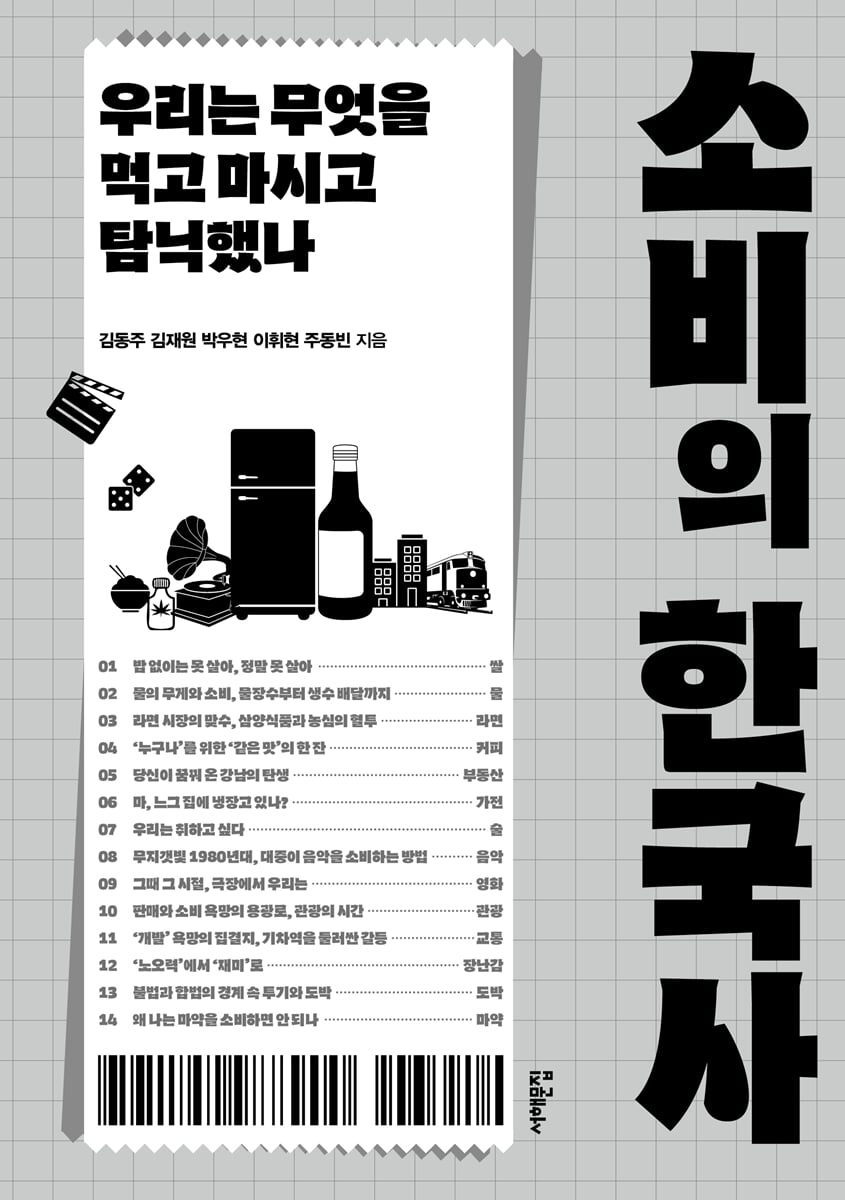 |
Description
Book Introduction
In purchasing daily necessities that support our daily lives
Even addictive consumption that delves into desire
The daily lives and desires of Korean consumers in modern and contemporary history
A different kind of Korean history presented by young historians!
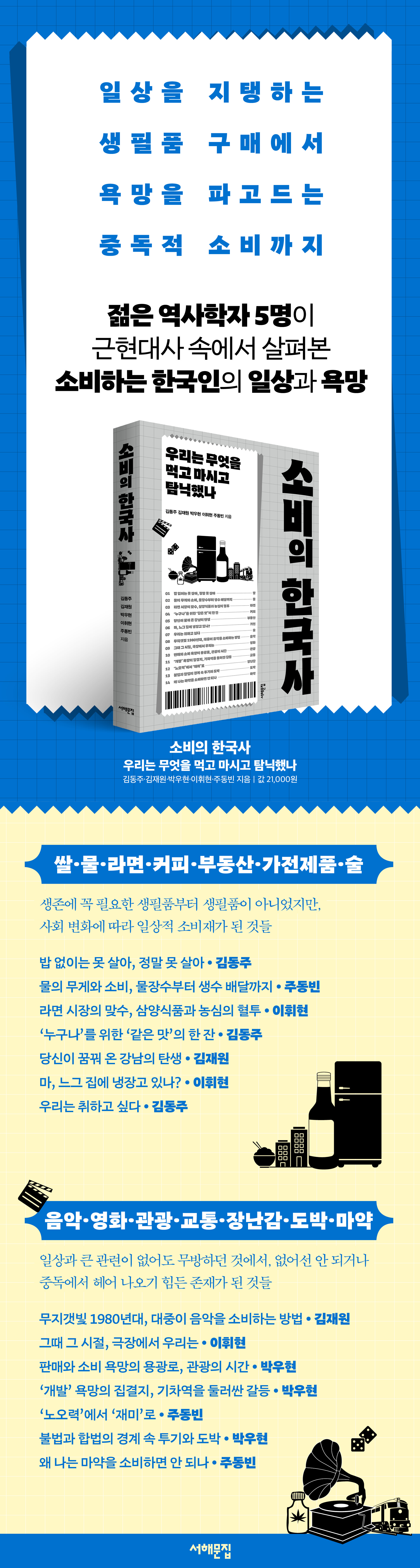
Rice, water, ramen, coffee, real estate, home appliances, alcohol
From essential necessities for survival to everyday consumer goods that have become part of our daily lives due to social changes.
Nowadays, there are very few people who go hungry because they cannot eat rice.
But people still talk about the days when they went hungry.
The first chapter of the book, “I Can’t Live Without Rice, I Really Can’t Live,” examines the extraordinary love Koreans have for rice, who “cannot live without rice,” and states that the desire to “eat white rice with family” was the driving force of an era.
Following rice, in "The Weight and Consumption of Water, From Water Seller to Bottled Water Delivery," we look back on the history of Koreans' use of water, from the days when people bought water from water sellers, through the Japanese colonial period when tap water was first available, to the present day when bottled water is delivered to our doorstep, and talk about the sense of déjà vu between "water seller" and "bottled water delivery" that spans centuries.
〈The Ramen Market Rivals: Samyang Foods and Nongshim's Fierce Battle〉 covers the history of ramen, a food that has been in the spotlight from its birth to the present.
In particular, we will examine modern Korean history, covering the development of ramen by Samyang Foods and Nongshim, the two giants of the ramen industry, and the rise and fall of companies due to ramen.
After eating rice, water, and ramen, coffee, which is easily accessible to everyone, is examined in modern history in “A Cup of the ‘Same Taste’ for ‘Everyone’.”
It provides an interesting look at how coffee, once secretly smuggled from US military bases, became a popular beverage among modern Koreans through its rebirth as coffee mix.
Subtitled “People Who Consume Addresses,” “The Birth of the Gangnam You’ve Dreamed of” examines the history of housing consumption, which has become an important consumer good and investment destination.
Among these, we delve into the desires of modern Koreans by examining the history of new city development, represented by Gangnam.
When you own a home, the first thing you'll buy will be appliances.
"Ma, Is There a Refrigerator in Your House?" tells the story of how essential home appliances for modern people, such as refrigerators, TVs, washing machines, and vacuum cleaners, are consumed and what kind of desires they have.
"We Want to Get Drunk" deals with alcohol as another food, following rice, water, ramen, and coffee.
We examine why alcohol, as an uncommon consumer good, quenches the emotional thirst of Koreans and has been a constant presence throughout modern history.
Even addictive consumption that delves into desire
The daily lives and desires of Korean consumers in modern and contemporary history
A different kind of Korean history presented by young historians!
Rice, water, ramen, coffee, real estate, home appliances, alcohol
From essential necessities for survival to everyday consumer goods that have become part of our daily lives due to social changes.
Nowadays, there are very few people who go hungry because they cannot eat rice.
But people still talk about the days when they went hungry.
The first chapter of the book, “I Can’t Live Without Rice, I Really Can’t Live,” examines the extraordinary love Koreans have for rice, who “cannot live without rice,” and states that the desire to “eat white rice with family” was the driving force of an era.
Following rice, in "The Weight and Consumption of Water, From Water Seller to Bottled Water Delivery," we look back on the history of Koreans' use of water, from the days when people bought water from water sellers, through the Japanese colonial period when tap water was first available, to the present day when bottled water is delivered to our doorstep, and talk about the sense of déjà vu between "water seller" and "bottled water delivery" that spans centuries.
〈The Ramen Market Rivals: Samyang Foods and Nongshim's Fierce Battle〉 covers the history of ramen, a food that has been in the spotlight from its birth to the present.
In particular, we will examine modern Korean history, covering the development of ramen by Samyang Foods and Nongshim, the two giants of the ramen industry, and the rise and fall of companies due to ramen.
After eating rice, water, and ramen, coffee, which is easily accessible to everyone, is examined in modern history in “A Cup of the ‘Same Taste’ for ‘Everyone’.”
It provides an interesting look at how coffee, once secretly smuggled from US military bases, became a popular beverage among modern Koreans through its rebirth as coffee mix.
Subtitled “People Who Consume Addresses,” “The Birth of the Gangnam You’ve Dreamed of” examines the history of housing consumption, which has become an important consumer good and investment destination.
Among these, we delve into the desires of modern Koreans by examining the history of new city development, represented by Gangnam.
When you own a home, the first thing you'll buy will be appliances.
"Ma, Is There a Refrigerator in Your House?" tells the story of how essential home appliances for modern people, such as refrigerators, TVs, washing machines, and vacuum cleaners, are consumed and what kind of desires they have.
"We Want to Get Drunk" deals with alcohol as another food, following rice, water, ramen, and coffee.
We examine why alcohol, as an uncommon consumer good, quenches the emotional thirst of Koreans and has been a constant presence throughout modern history.
- You can preview some of the book's contents.
Preview
index
preface
01 I can't live without food, I really can't live without it_ Kim Dong-ju
02 The Weight and Consumption of Water, From Water Merchants to Water Delivery_ Joo Dong-bin
03 Ramen Market Rivals: Samyang Foods and Nongshim's Fierce Battle_ Lee Hwi-hyeon
04 A Glass of 'Same Taste' for 'Everyone'_ Kim Dong-ju
05 The Birth of the Gangnam You've Dreamed of_ Kim Jae-won
06 Ma, do you have a refrigerator at home?_ Lee Hwi-hyun
07 We Want to Get Drunk_ Kim Dong-ju
08 The Rainbow 1980s: How the Public Consumed Music_ Kim Jae-won
09 Back then, in the theater, we_ Lee Hwi-hyun
10. The Melting Pot of Sales and Consumption Desires, Time for Tourism_ Park Woo-hyun
11 Conflicts Surrounding Train Stations: A Convergence of Desire for "Development"_ Park Woo-hyun
12 From 'Effort' to 'Fun'_ Joo Dong-bin
13 Speculation and Gambling on the Boundary Between Legal and Illegal_ Park Woo-hyun
14 Why I Shouldn't Use Drugs_ Joo Dong-bin
main
01 I can't live without food, I really can't live without it_ Kim Dong-ju
02 The Weight and Consumption of Water, From Water Merchants to Water Delivery_ Joo Dong-bin
03 Ramen Market Rivals: Samyang Foods and Nongshim's Fierce Battle_ Lee Hwi-hyeon
04 A Glass of 'Same Taste' for 'Everyone'_ Kim Dong-ju
05 The Birth of the Gangnam You've Dreamed of_ Kim Jae-won
06 Ma, do you have a refrigerator at home?_ Lee Hwi-hyun
07 We Want to Get Drunk_ Kim Dong-ju
08 The Rainbow 1980s: How the Public Consumed Music_ Kim Jae-won
09 Back then, in the theater, we_ Lee Hwi-hyun
10. The Melting Pot of Sales and Consumption Desires, Time for Tourism_ Park Woo-hyun
11 Conflicts Surrounding Train Stations: A Convergence of Desire for "Development"_ Park Woo-hyun
12 From 'Effort' to 'Fun'_ Joo Dong-bin
13 Speculation and Gambling on the Boundary Between Legal and Illegal_ Park Woo-hyun
14 Why I Shouldn't Use Drugs_ Joo Dong-bin
main
Detailed image
Publisher's Review
Music, movies, tourism, transportation, toys, gambling, drugs
Things that were once considered irrelevant to our daily lives have become essential or difficult to break free from addiction.
While the previous articles primarily dealt with consumption related to necessities or daily life, the following articles discuss consumption that reflects more of consumers' emotional desires.
"The Rainbow 1980s: How the Public Consumed Music" examines how people, focusing on the 1980s, lived rainbow-colored lives in a colorless era through their music consumption. Today, with the abundance of entertainment options, including OTT, and the disappearance of theaters, "Back Then, in the Theaters" reveals how people enjoyed and consumed their leisure time through theater and film.
〈The Melting Pot of Sales and Consumption Desire, Time for Tourism〉 examines tourism, a representative leisure activity following music and film.
The history of tourism, which has become increasingly industrialized throughout modern times, encompasses not only the public's desire to enjoy tourism but also the desire of a nation to profit from tourism.
〈Conflict Surrounding the Train Station, a Gathering Place of Desire for 'Development'〉 uses the case of the opening of 'Jeomchon Station' in Mungyeong, Gyeongsangbuk-do during the Japanese colonial period to show how train stations, the center of modern transportation, maximized people's desires and conflicts.
In “From ‘Effort’ to ‘Fun’,” as the subtitle suggests, “The History of the Production and Consumption of Korean Toys,” the bitter side of economic development shown by the toy industry in modern Korean history is discussed.
Finally, the two articles “Speculation and Gambling on the Boundary Between Legal and Illegal” and “Why I Shouldn’t Consume Drugs” deal with gambling and drugs as “addictive consumption that stimulates desire.”
By examining the relationship between those who consume gambling and drugs, which occupy an ambiguous position between legal and illegal in modern history, and those who become addicted to them and become criminals, and the state that cracks down on and punishes them, this study examines a dark self-portrait of modern history.
Young historians present a unique perspective on Korean history.
As the stories unfold in each chapter, five researchers gathered together to select topics to cover in the book in order to examine the historical context of the consumer society we live in today.
We first covered essential necessities for survival, such as rice, water, ramen, coffee, real estate, home appliances, and alcohol, as well as non-essential items that have become everyday consumer goods due to social changes.
Next, we will talk about things like music, movies, tourism, transportation, toys, gambling, and drugs that have changed in consumer culture according to tastes and preferences.
The majority of things that were once considered irrelevant to our daily lives have become essential or difficult to break free from addiction.
These are things that seem completely unrelated, like toys or drugs, but have something in common: they tempt consumption by appealing to human desires.
Things that were once considered irrelevant to our daily lives have become essential or difficult to break free from addiction.
While the previous articles primarily dealt with consumption related to necessities or daily life, the following articles discuss consumption that reflects more of consumers' emotional desires.
"The Rainbow 1980s: How the Public Consumed Music" examines how people, focusing on the 1980s, lived rainbow-colored lives in a colorless era through their music consumption. Today, with the abundance of entertainment options, including OTT, and the disappearance of theaters, "Back Then, in the Theaters" reveals how people enjoyed and consumed their leisure time through theater and film.
〈The Melting Pot of Sales and Consumption Desire, Time for Tourism〉 examines tourism, a representative leisure activity following music and film.
The history of tourism, which has become increasingly industrialized throughout modern times, encompasses not only the public's desire to enjoy tourism but also the desire of a nation to profit from tourism.
〈Conflict Surrounding the Train Station, a Gathering Place of Desire for 'Development'〉 uses the case of the opening of 'Jeomchon Station' in Mungyeong, Gyeongsangbuk-do during the Japanese colonial period to show how train stations, the center of modern transportation, maximized people's desires and conflicts.
In “From ‘Effort’ to ‘Fun’,” as the subtitle suggests, “The History of the Production and Consumption of Korean Toys,” the bitter side of economic development shown by the toy industry in modern Korean history is discussed.
Finally, the two articles “Speculation and Gambling on the Boundary Between Legal and Illegal” and “Why I Shouldn’t Consume Drugs” deal with gambling and drugs as “addictive consumption that stimulates desire.”
By examining the relationship between those who consume gambling and drugs, which occupy an ambiguous position between legal and illegal in modern history, and those who become addicted to them and become criminals, and the state that cracks down on and punishes them, this study examines a dark self-portrait of modern history.
Young historians present a unique perspective on Korean history.
As the stories unfold in each chapter, five researchers gathered together to select topics to cover in the book in order to examine the historical context of the consumer society we live in today.
We first covered essential necessities for survival, such as rice, water, ramen, coffee, real estate, home appliances, and alcohol, as well as non-essential items that have become everyday consumer goods due to social changes.
Next, we will talk about things like music, movies, tourism, transportation, toys, gambling, and drugs that have changed in consumer culture according to tastes and preferences.
The majority of things that were once considered irrelevant to our daily lives have become essential or difficult to break free from addiction.
These are things that seem completely unrelated, like toys or drugs, but have something in common: they tempt consumption by appealing to human desires.
GOODS SPECIFICS
- Date of issue: September 20, 2024
- Page count, weight, size: 320 pages | 444g | 148*210*19mm
- ISBN13: 9791192988900
- ISBN10: 1192988906
You may also like
카테고리
korean


korean

![ELLE 엘르 스페셜 에디션 A형 : 12월 [2025]](http://librairie.coreenne.fr/cdn/shop/files/b8e27a3de6c9538896439686c6b0e8fb.jpg?v=1766436872&width=3840)


