

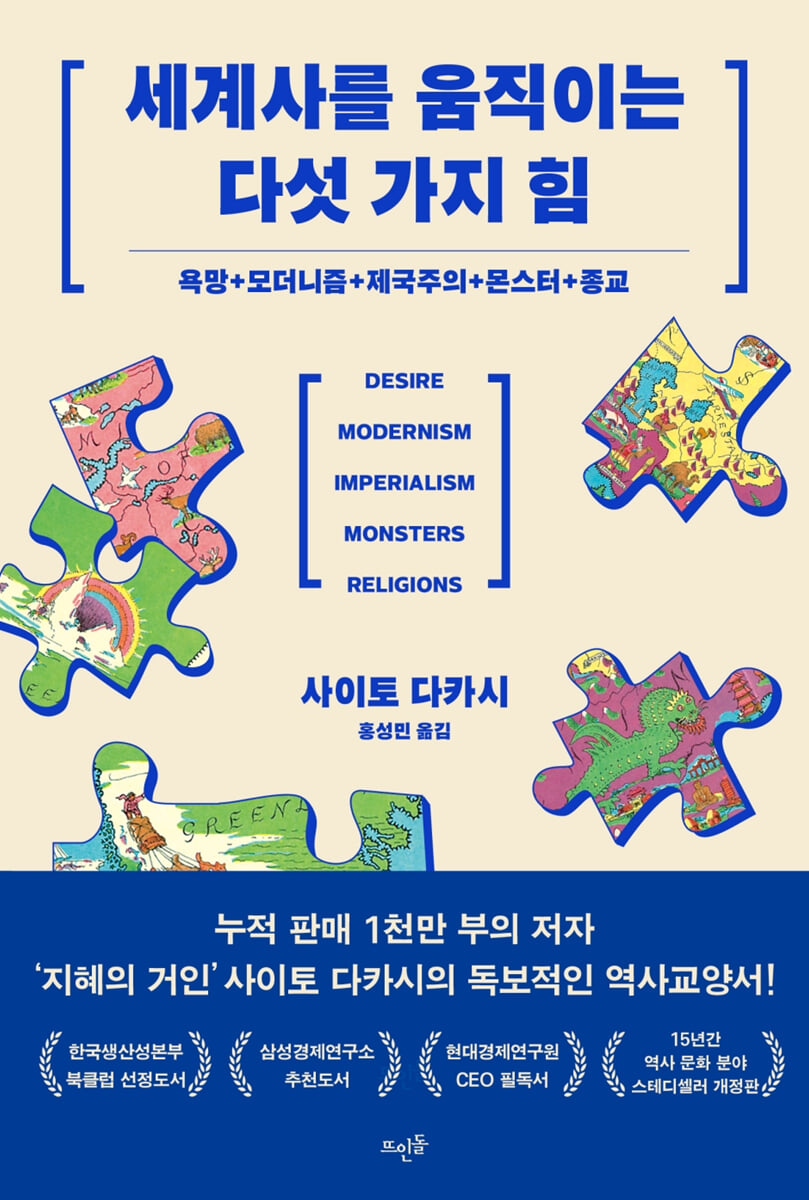
Five Forces That Move World History
 |
Description
Book Introduction
Author of 10 million copies sold,
A unique history textbook by Takashi Saito, the "giant of wisdom"!
Takashi Saito's "Five Forces That Move World History," which sold 100,000 copies in just 10 months upon its publication and was selected as a must-read by leading companies and economic organizations, and has long been a bestseller in the history and culture section of bookstores nationwide, has returned after 15 years in a revised edition with a new design.
"Five Forces That Move World History" sharply analyzes history as a whole, focusing on major issues that permeate world history, and presents diverse perspectives that allow us to carefully examine and reflect on the path humanity has taken.
Based on the premise that human emotions have played a significant role in the flow of world history, the author proposes five forces created by those emotions: desire, modernism, imperialism, monsters (capitalism, socialism, fascism), and religion.
A unique history textbook by Takashi Saito, the "giant of wisdom"!
Takashi Saito's "Five Forces That Move World History," which sold 100,000 copies in just 10 months upon its publication and was selected as a must-read by leading companies and economic organizations, and has long been a bestseller in the history and culture section of bookstores nationwide, has returned after 15 years in a revised edition with a new design.
"Five Forces That Move World History" sharply analyzes history as a whole, focusing on major issues that permeate world history, and presents diverse perspectives that allow us to carefully examine and reflect on the path humanity has taken.
Based on the premise that human emotions have played a significant role in the flow of world history, the author proposes five forces created by those emotions: desire, modernism, imperialism, monsters (capitalism, socialism, fascism), and religion.
- You can preview some of the book's contents.
Preview
index
Prologue: Reading history through 'The Five Powers' and 'Human Emotions'!
Chapter 1 Desire
A World History of Desire: How Materialism and Longing Drive History
1. The modern driving force that divides the world? Coffee and tea.
Starbucks and Globalism | The 'Black Liquid' That Made Balzac's Masterpiece Possible | Coffee, the Driving Force of the 'Never-Sleeping' Modern Era | The Modern Business Developed by Coffeehouses | The Commercial Tactics of Coffee Merchants, Creating Non-Existent Desires | The Extreme Gap Between the Rich and the Poor Created by Coffee | Was Black Tea More Popular Than Green Tea in Europe Because of 'Sugar'? | 'Tea vs.
The World History of Coffee | Coca-Cola: A Symbol of America's Global Dominance Strategy
2. The two great wheels that drive world history? Gold and iron.
Humanity's material desires led to colonization | Humans who acquired the "body of God" | The movement of "gold" led to the movement of "power" | The alchemy of desire that gave birth to modern science | The world history of the ugly metal "iron" | The merits and demerits of iron in human history
3. Desire Moves People? Brands and Cities
The Age of Consumption of Symbols | Brands Rule Modern Society | Modern People Dance to Their Own "Aspirations" | The Great Currents of World History Seen Through the "Shift of the Center" | The Herding Instinct: "Urbanization"
Chapter 2 Modernism
The Force of Western Modernization: The Unstoppable Train of Modernism
1 Where did the power of modernization come from?
The Modernization of Dilemmas | The "Acceleration" That Created the Dilemmas of Modern Civilization | Democracy, the Origin of Modern Europe | The "Humiliation of Canossa," a Symbol of the Middle Ages | Because I Hate Modernity, I Hate Christianity Too
2 Capitalism arose from Christianity.
The Church Selling "God's Forgiveness" | The Reformation That Shattered the Iron Fortress of "God's Language = Power" | Protestantism Losing Catholicism's "Looseness" | The Secret of the Birth of Capitalism as Seen Through by Weber
3 The neglected 'body' of modern times
Skepticism about Descartes' "methodological doubt" | Why perspective was invented in the modern era | He who controls the "gaze" controls the world | The horrors of a world dominated by the seer | A modern society where information replaces the "dominant eye" | Modern people starving for "physical" desires
Chapter 3 Imperialism
Imperial Ambition: Why Monarchs Obsess Over Territorial Expansion
1 The monster called 'empire' created by ambition
World history is a record of conflicts over "identity." | The source of imperial ambition is "Kneel before me!" | Empires self-destruct without knowing the end.
2 Successful Empires, Failing Empires
The tradition of 'speech' that has continued since the Greek era | The essence of empire - the difference between the Egyptian kingdom and the Roman Empire | Julius Caesar, who left religion alone | The Roman Empire collapsed as the system of sharing social structures with other peoples collapsed | Islam, the most heterogeneous empire | An empire cannot be maintained through force alone
3 Hereditary succession is the first step to the collapse of the empire.
The secret of male ambition, inspired by national conquest and the Romance of the Three Kingdoms | Emperors who survived death | The 'Invisible Empire' that rules the modern world | Is a 'hereditary ban' necessary to free ourselves from ambition?
Chapter 4 Monsters
Monsters in World History - The Upheavals Caused by Capitalism, Socialism, and Fascism
1 Capitalism Dominating the Modern World
The Essence of Capitalism as Seen by Marx | Why Will the "Rusty Locomotive" of Capitalism Never Stop? | China, Running with Capitalist Wheels on a Socialist Body | Capitalism's Enemy Is Within Itself | The Counterattack of Emerging Capitalism in China and India
2 The greatest experiment of the 20th century, socialism
The era when Marxism was a litmus test for intellectuals | The Soviet Union, an empire that collapsed on its own | The religion of socialism born from the labyrinth of Marx's "Das Kapital" | The difference between "equality" and "dictatorship" is a thin sheet of paper | The figure who predicted the collapse of Soviet socialism immediately after the Russian Revolution | The "great" workers who became slaves of the state | The obstacle called "bureaucracy" blocking the path to equality
3 The monster called fascism created by crisis
The "ordinary" people who embraced Nazi fascism | The "nothing-goes" mentality that underpinned fascism | The essence of World Wars I and II | Hitler, history's unparalleled propagandist | Fascism's clever exploitation of the public's desire to "remember nothing" | Has the modern world truly defeated fascism?
Chapter 5 Religions
Religion has always been at the center of world history - did the gods really save the world?
1. The Three Monotheistic Brothers Who Shaped World History? Judaism, Christianity, Islam
The Resurrection of 'Gods' in Modern Times | Christianity, the Vanguard of the Conquest of South America | Is the History of Almost All Warfare a Family Squabble Between Three Monotheistic Brothers? | Modern People Returning to Religion | A Glimpse into the Religious Views of Ancients Through Chinese Characters and Hieroglyphs | The Great Power Common to World Mythology | Return to the 'Age of Myth' Rather than the Age of Religion | Anxiety About Existence Revives Religion
2 It Wasn't Darkness!? The Middle Ages Recognized
The medieval Catholic Church as a "sexual control center" | Why the clergy had to be the most sexually explicit | The medieval Christian Church controlled people by dominating the body | The Crusades that sparked the Renaissance | Alchemy that turned medieval Europe upside down | Was alchemy's ultimate destination not "gold," but "chemistry"?
3 Things We Got Wrong About Islam
Why the terrifying image of "Islam = Terror" was created | The Islamic world, which achieved the forefront of global culture | Why Cassius Clay changed his name to Muhammad Ali | For Muslims, Islam is community itself | The surprisingly lax precepts of Islam | The Islamic world spreading globally | The Palestinian conflict: the worst fratricide in human history
Useful world history knowledge provided by Takashi Saito, author of "Context" and "Detail"? Woo Seok-hoon
Chapter 1 Desire
A World History of Desire: How Materialism and Longing Drive History
1. The modern driving force that divides the world? Coffee and tea.
Starbucks and Globalism | The 'Black Liquid' That Made Balzac's Masterpiece Possible | Coffee, the Driving Force of the 'Never-Sleeping' Modern Era | The Modern Business Developed by Coffeehouses | The Commercial Tactics of Coffee Merchants, Creating Non-Existent Desires | The Extreme Gap Between the Rich and the Poor Created by Coffee | Was Black Tea More Popular Than Green Tea in Europe Because of 'Sugar'? | 'Tea vs.
The World History of Coffee | Coca-Cola: A Symbol of America's Global Dominance Strategy
2. The two great wheels that drive world history? Gold and iron.
Humanity's material desires led to colonization | Humans who acquired the "body of God" | The movement of "gold" led to the movement of "power" | The alchemy of desire that gave birth to modern science | The world history of the ugly metal "iron" | The merits and demerits of iron in human history
3. Desire Moves People? Brands and Cities
The Age of Consumption of Symbols | Brands Rule Modern Society | Modern People Dance to Their Own "Aspirations" | The Great Currents of World History Seen Through the "Shift of the Center" | The Herding Instinct: "Urbanization"
Chapter 2 Modernism
The Force of Western Modernization: The Unstoppable Train of Modernism
1 Where did the power of modernization come from?
The Modernization of Dilemmas | The "Acceleration" That Created the Dilemmas of Modern Civilization | Democracy, the Origin of Modern Europe | The "Humiliation of Canossa," a Symbol of the Middle Ages | Because I Hate Modernity, I Hate Christianity Too
2 Capitalism arose from Christianity.
The Church Selling "God's Forgiveness" | The Reformation That Shattered the Iron Fortress of "God's Language = Power" | Protestantism Losing Catholicism's "Looseness" | The Secret of the Birth of Capitalism as Seen Through by Weber
3 The neglected 'body' of modern times
Skepticism about Descartes' "methodological doubt" | Why perspective was invented in the modern era | He who controls the "gaze" controls the world | The horrors of a world dominated by the seer | A modern society where information replaces the "dominant eye" | Modern people starving for "physical" desires
Chapter 3 Imperialism
Imperial Ambition: Why Monarchs Obsess Over Territorial Expansion
1 The monster called 'empire' created by ambition
World history is a record of conflicts over "identity." | The source of imperial ambition is "Kneel before me!" | Empires self-destruct without knowing the end.
2 Successful Empires, Failing Empires
The tradition of 'speech' that has continued since the Greek era | The essence of empire - the difference between the Egyptian kingdom and the Roman Empire | Julius Caesar, who left religion alone | The Roman Empire collapsed as the system of sharing social structures with other peoples collapsed | Islam, the most heterogeneous empire | An empire cannot be maintained through force alone
3 Hereditary succession is the first step to the collapse of the empire.
The secret of male ambition, inspired by national conquest and the Romance of the Three Kingdoms | Emperors who survived death | The 'Invisible Empire' that rules the modern world | Is a 'hereditary ban' necessary to free ourselves from ambition?
Chapter 4 Monsters
Monsters in World History - The Upheavals Caused by Capitalism, Socialism, and Fascism
1 Capitalism Dominating the Modern World
The Essence of Capitalism as Seen by Marx | Why Will the "Rusty Locomotive" of Capitalism Never Stop? | China, Running with Capitalist Wheels on a Socialist Body | Capitalism's Enemy Is Within Itself | The Counterattack of Emerging Capitalism in China and India
2 The greatest experiment of the 20th century, socialism
The era when Marxism was a litmus test for intellectuals | The Soviet Union, an empire that collapsed on its own | The religion of socialism born from the labyrinth of Marx's "Das Kapital" | The difference between "equality" and "dictatorship" is a thin sheet of paper | The figure who predicted the collapse of Soviet socialism immediately after the Russian Revolution | The "great" workers who became slaves of the state | The obstacle called "bureaucracy" blocking the path to equality
3 The monster called fascism created by crisis
The "ordinary" people who embraced Nazi fascism | The "nothing-goes" mentality that underpinned fascism | The essence of World Wars I and II | Hitler, history's unparalleled propagandist | Fascism's clever exploitation of the public's desire to "remember nothing" | Has the modern world truly defeated fascism?
Chapter 5 Religions
Religion has always been at the center of world history - did the gods really save the world?
1. The Three Monotheistic Brothers Who Shaped World History? Judaism, Christianity, Islam
The Resurrection of 'Gods' in Modern Times | Christianity, the Vanguard of the Conquest of South America | Is the History of Almost All Warfare a Family Squabble Between Three Monotheistic Brothers? | Modern People Returning to Religion | A Glimpse into the Religious Views of Ancients Through Chinese Characters and Hieroglyphs | The Great Power Common to World Mythology | Return to the 'Age of Myth' Rather than the Age of Religion | Anxiety About Existence Revives Religion
2 It Wasn't Darkness!? The Middle Ages Recognized
The medieval Catholic Church as a "sexual control center" | Why the clergy had to be the most sexually explicit | The medieval Christian Church controlled people by dominating the body | The Crusades that sparked the Renaissance | Alchemy that turned medieval Europe upside down | Was alchemy's ultimate destination not "gold," but "chemistry"?
3 Things We Got Wrong About Islam
Why the terrifying image of "Islam = Terror" was created | The Islamic world, which achieved the forefront of global culture | Why Cassius Clay changed his name to Muhammad Ali | For Muslims, Islam is community itself | The surprisingly lax precepts of Islam | The Islamic world spreading globally | The Palestinian conflict: the worst fratricide in human history
Useful world history knowledge provided by Takashi Saito, author of "Context" and "Detail"? Woo Seok-hoon
Detailed image

Into the book
The stimulation of coffee overcomes human limitations and laziness.
And this mindset of “continuing without stopping until the limit is reached” is the basic element and foundation of the “unstoppable” continuity that is clearly revealed in Western culture, especially in the process of modernization.
--- p.24
I believe that the shift from the leisurely taste of tea to the stimulating power of coffee may have been one of the unseen driving forces behind America's subsequent global dominance.
Black tea has created a rich, savory, and smooth atmosphere, as well as a refined culture and art.
On the other hand, coffee was able to dominate the post-modern world by creating a lively atmosphere, business development, and price advancement.
Tea and coffee, these two still dominate the global beverage market.
It is no exaggeration to say that the national character of a country is still influenced by which side it supports, as it still exerts a powerful influence.
--- p.37~38
In simple terms, “gold always gathers under the highest power of the time.”
Spain, which had plundered a large amount of gold from the New World, reached its peak in the 16th century, boasting of its invincible fleet.
However, in 1588, the Armada was defeated by England and the gold was stolen, resulting in the loss of hegemony in Europe.
Having taken gold from Spain, Britain then went on to discover gold mines in Brazil, eventually acquiring a large amount of gold, and succeeded in taking gold from Portugal as well, ultimately establishing the British Empire.
At this time, the way Britain amassed gold was not through 'war' but through 'trade'.
--- p.49~50
The brand of Egypt is a product of thousands of years of history, but there are also places that have become brands from nothing to places that capture people's longing and aspirations.
A representative example is Hollywood.
It is now a mecca for movies, but in the past it was a barren land.
Hollywood films reflected the bright and mild climate of the West Coast, and people around the world became enthusiastic about the films made in that bright atmosphere.
For example, the image of beauty that Americans have is a product of Hollywood.
Vivien Leigh, Audrey Hepburn, Marilyn Monroe, etc. are all 'brand beauties' provided to the world by the brand called Hollywood.
--- p.70
All countries in the world today are being driven by the acceleration created by modernization.
It was in 1903 that the Wright brothers successfully flew the first engine-powered airplane in human history.
And it was in 1969 that Apollo 11 traveled over 380,000 kilometers through space and landed on the moon.
It took only 66 years from the time humans first flew to the time they set foot on the moon.
This never-ending pressure to “more, more” is the very essence of the pressure that is coming from the United States and Europe.
--- p.86~87
When we think of power, we often think of things like controlling a powerful military and ruling the people as you wish, or controlling huge capital and then controlling the market.
But real power is a bit different from that.
True power is monopolizing the knowledge of your time.
The most important thing in the European world at that time was the knowledge of God.
--- p.108
To face God one-on-one was also to reveal oneself directly to God through the Bible.
In fact, this was a much more strict and painful task than I could have imagined.
Therefore, while it was a good thing on one hand that the Reformation allowed people to face God directly without the interference of the Pope or priests, on the other hand, many people suffered from mental illness due to the strictness and pressure of a one-on-one encounter with God.
--- p.110
So where and how was the money raised with such a calling used? No matter how much money they accumulated, Protestants were extremely restrained in spending it on themselves, so there was only one way to spend it.
In other words, it is expanding the work, which in modern terms is an 'investment'.
And as such investments continue to expand and reproduce, wealth increases exponentially.
Weber's idea is that this is the mother and mechanism of the birth of capitalism.
--- p.116
Just as dominating the knowledge of the 'Bible' in the Middle Ages led to power that ruled everything, in modern times dominating the 'gaze' leads to power.
Although we are not fully aware of it, the domination by gaze continues even now.
One of them is ‘artificial satellite’.
--- p.128
Praying to the invisible watcher?
This means that the one who is watching is becoming a 'god'.
The exposed party becomes more and more passive and suffers because of the fact that their every move is being exposed.
Then, you start to feel more comfortable worshipping the other person as a god.
Eventually, prisoners come to believe that there is a guard even when there is not, and they internalize and establish the one-sided gaze within themselves.
--- p.130
Even search engines like Google, which we use every day without a second thought, contain the inherent danger of “those who are seen = those who are ruled.”
What you search for on the Internet reflects your hobbies and preferences.
The specific keywords you entered into your computer and your purchase history on auction sites are already leaked, and your tastes are reflected in the algorithm.
Doesn't that sound scary?
--- p.134
Islamic law stipulates that anyone who converts to Islam is exempt from paying the poll tax, even if they are not Arabs, and that anyone engaged in agriculture, even if they are Arabs, must pay the land tax.
Because these equal tax laws, which did not discriminate against ethnic minorities, were applied to subsequent Islamic dynasties, Islam was able to spread throughout the world, and the empire continued to prosper.
--- p.173~175
Despite all these problems and contradictions, why does the locomotive known as capitalism never stop? While this may not be a complete explanation, the reason capitalism persists is because the experiments that emerged to counter it, communism and socialism, ended in blatant failure.
--- p.205
The fight between 'capitalism and socialism' was not a dispute caused by differences in the development of the times and systems, but a struggle between 'the natural and the artificial.'
…Capitalism is, in a sense, a system that revolves around ‘desire,’ and desire here is not necessarily a bad thing.
Because desire is the most basic element for human life.
For example, the desire to eat delicious food, the desire to live long, the desire to have nice things—these are all desires.
The capitalist system is the result of these diverse desires colliding and reconciling with each other.
Because socialism sought to build an ideal world by solving the problems of capitalism, it had no choice but to create systems and mechanisms that ignored the fundamental emotional movements of each and every person.
They created a theoretically ideal system that completely ignored human desires, but in the end, the humans who operated it still had desires, so it couldn't work properly.
--- p.206~207
I often wonder whether capitalism, a system based on the distinction between the haves and have-nots, will be able to withstand the enormous pressures that will befall the majority of the world's population when they become the haves.
This is something you can't know unless you experience it.
The fact that human plans may not always go as planned can be easily predicted from the failures of the socialist system that we have already experienced.
The future of capitalism is also the future of all humanity.
--- p.217
This extreme inflation led the German economy to collapse.
And until then, people who had lived in the middle class were forced to go downstream.
But even though we were pushed to the lower classes, we had a strong sense of pride that we were different from the lower classes.
So, they refused to unite with the lower classes, saying, "We cannot unite with the lower classes to carry out a socialist revolution. We are a class that deserves a better life."
It was Hitler and the Nazis who saw through this class consciousness unique to the middle class and meticulously exploited the gap.
--- p.251
It is difficult to blame only the Germans, because in terms of human nature, any nation, if faced with a similar situation as Germany at the time and a leader like Hitler were to emerge, would run the risk of engaging in similar behavior.
Recently, America seems to be trying to unite by targeting Islam, much like the Germans scapegoated the Jews during World War II.
Frankly, I feel skeptical and even a little fearful as I watch them try to concentrate the world's wealth in their own countries, promote nationalism under the pretext of a "war on terror," and repeatedly wage wars against Islam.
--- p.267
Some people might think of religious 'brainwashing' when they see people reciting the Quran in groups.
However, for Muslims, the Quran is the word of God, the most important and sacred thing.
There is no doubt that it is a 'great thing' to teach your children these precious things from a young age.
Moreover, it would be problematic if we had the preconceived notion that all Muslims are aggressive and a threat to world peace, but history shows that they are, in fact, relatively tolerant and peace-oriented compared to Christians.
The reason why children reciting the Quran are perceived as a terrorist training scene is because the terrorist videos are shown alongside such children.
Perhaps we are being brainwashed with the fearful image of 'Islam = terrorism' as a result of unilaterally accepting images provided by American media outlets such as CNN.
To properly judge modern society, it is very important to understand religion through history.
--- p.314
In short, we can say that we are in a situation where we know almost nothing about Korean history.
Of course, there are studies done during the period when the Marxist historical materialism was being discussed, and although it is criticized, there are some very old studies from the Japanese colonial era based on empirical history.
However, from our perspective as we live in the 21st century, such research that has been reinterpreted no longer exists.
So, does that mean we no longer need history?
--- p.335
History is interpreted and reinterpreted according to the times.
History that is not reinterpreted in modern times is dead, and that era is reinterpreted in later generations according to the way that era interprets history.
An era in which interpretation is dead is either dead itself or inevitably subordinate to another era in which interpretation is alive.
It is simply impossible for a country without a history department to actively open or lead an era.
--- p.335~336
Can a country that has abandoned the study of history truly maintain its current economic scale, resolve the numerous internal problems arising, and continue its evolution to the next stage? It seems unlikely.
However, the side effects of the collapse of historiography are not limited to problems at the grand scale of nations and societies, but also create fatal flaws in individuals.
And this mindset of “continuing without stopping until the limit is reached” is the basic element and foundation of the “unstoppable” continuity that is clearly revealed in Western culture, especially in the process of modernization.
--- p.24
I believe that the shift from the leisurely taste of tea to the stimulating power of coffee may have been one of the unseen driving forces behind America's subsequent global dominance.
Black tea has created a rich, savory, and smooth atmosphere, as well as a refined culture and art.
On the other hand, coffee was able to dominate the post-modern world by creating a lively atmosphere, business development, and price advancement.
Tea and coffee, these two still dominate the global beverage market.
It is no exaggeration to say that the national character of a country is still influenced by which side it supports, as it still exerts a powerful influence.
--- p.37~38
In simple terms, “gold always gathers under the highest power of the time.”
Spain, which had plundered a large amount of gold from the New World, reached its peak in the 16th century, boasting of its invincible fleet.
However, in 1588, the Armada was defeated by England and the gold was stolen, resulting in the loss of hegemony in Europe.
Having taken gold from Spain, Britain then went on to discover gold mines in Brazil, eventually acquiring a large amount of gold, and succeeded in taking gold from Portugal as well, ultimately establishing the British Empire.
At this time, the way Britain amassed gold was not through 'war' but through 'trade'.
--- p.49~50
The brand of Egypt is a product of thousands of years of history, but there are also places that have become brands from nothing to places that capture people's longing and aspirations.
A representative example is Hollywood.
It is now a mecca for movies, but in the past it was a barren land.
Hollywood films reflected the bright and mild climate of the West Coast, and people around the world became enthusiastic about the films made in that bright atmosphere.
For example, the image of beauty that Americans have is a product of Hollywood.
Vivien Leigh, Audrey Hepburn, Marilyn Monroe, etc. are all 'brand beauties' provided to the world by the brand called Hollywood.
--- p.70
All countries in the world today are being driven by the acceleration created by modernization.
It was in 1903 that the Wright brothers successfully flew the first engine-powered airplane in human history.
And it was in 1969 that Apollo 11 traveled over 380,000 kilometers through space and landed on the moon.
It took only 66 years from the time humans first flew to the time they set foot on the moon.
This never-ending pressure to “more, more” is the very essence of the pressure that is coming from the United States and Europe.
--- p.86~87
When we think of power, we often think of things like controlling a powerful military and ruling the people as you wish, or controlling huge capital and then controlling the market.
But real power is a bit different from that.
True power is monopolizing the knowledge of your time.
The most important thing in the European world at that time was the knowledge of God.
--- p.108
To face God one-on-one was also to reveal oneself directly to God through the Bible.
In fact, this was a much more strict and painful task than I could have imagined.
Therefore, while it was a good thing on one hand that the Reformation allowed people to face God directly without the interference of the Pope or priests, on the other hand, many people suffered from mental illness due to the strictness and pressure of a one-on-one encounter with God.
--- p.110
So where and how was the money raised with such a calling used? No matter how much money they accumulated, Protestants were extremely restrained in spending it on themselves, so there was only one way to spend it.
In other words, it is expanding the work, which in modern terms is an 'investment'.
And as such investments continue to expand and reproduce, wealth increases exponentially.
Weber's idea is that this is the mother and mechanism of the birth of capitalism.
--- p.116
Just as dominating the knowledge of the 'Bible' in the Middle Ages led to power that ruled everything, in modern times dominating the 'gaze' leads to power.
Although we are not fully aware of it, the domination by gaze continues even now.
One of them is ‘artificial satellite’.
--- p.128
Praying to the invisible watcher?
This means that the one who is watching is becoming a 'god'.
The exposed party becomes more and more passive and suffers because of the fact that their every move is being exposed.
Then, you start to feel more comfortable worshipping the other person as a god.
Eventually, prisoners come to believe that there is a guard even when there is not, and they internalize and establish the one-sided gaze within themselves.
--- p.130
Even search engines like Google, which we use every day without a second thought, contain the inherent danger of “those who are seen = those who are ruled.”
What you search for on the Internet reflects your hobbies and preferences.
The specific keywords you entered into your computer and your purchase history on auction sites are already leaked, and your tastes are reflected in the algorithm.
Doesn't that sound scary?
--- p.134
Islamic law stipulates that anyone who converts to Islam is exempt from paying the poll tax, even if they are not Arabs, and that anyone engaged in agriculture, even if they are Arabs, must pay the land tax.
Because these equal tax laws, which did not discriminate against ethnic minorities, were applied to subsequent Islamic dynasties, Islam was able to spread throughout the world, and the empire continued to prosper.
--- p.173~175
Despite all these problems and contradictions, why does the locomotive known as capitalism never stop? While this may not be a complete explanation, the reason capitalism persists is because the experiments that emerged to counter it, communism and socialism, ended in blatant failure.
--- p.205
The fight between 'capitalism and socialism' was not a dispute caused by differences in the development of the times and systems, but a struggle between 'the natural and the artificial.'
…Capitalism is, in a sense, a system that revolves around ‘desire,’ and desire here is not necessarily a bad thing.
Because desire is the most basic element for human life.
For example, the desire to eat delicious food, the desire to live long, the desire to have nice things—these are all desires.
The capitalist system is the result of these diverse desires colliding and reconciling with each other.
Because socialism sought to build an ideal world by solving the problems of capitalism, it had no choice but to create systems and mechanisms that ignored the fundamental emotional movements of each and every person.
They created a theoretically ideal system that completely ignored human desires, but in the end, the humans who operated it still had desires, so it couldn't work properly.
--- p.206~207
I often wonder whether capitalism, a system based on the distinction between the haves and have-nots, will be able to withstand the enormous pressures that will befall the majority of the world's population when they become the haves.
This is something you can't know unless you experience it.
The fact that human plans may not always go as planned can be easily predicted from the failures of the socialist system that we have already experienced.
The future of capitalism is also the future of all humanity.
--- p.217
This extreme inflation led the German economy to collapse.
And until then, people who had lived in the middle class were forced to go downstream.
But even though we were pushed to the lower classes, we had a strong sense of pride that we were different from the lower classes.
So, they refused to unite with the lower classes, saying, "We cannot unite with the lower classes to carry out a socialist revolution. We are a class that deserves a better life."
It was Hitler and the Nazis who saw through this class consciousness unique to the middle class and meticulously exploited the gap.
--- p.251
It is difficult to blame only the Germans, because in terms of human nature, any nation, if faced with a similar situation as Germany at the time and a leader like Hitler were to emerge, would run the risk of engaging in similar behavior.
Recently, America seems to be trying to unite by targeting Islam, much like the Germans scapegoated the Jews during World War II.
Frankly, I feel skeptical and even a little fearful as I watch them try to concentrate the world's wealth in their own countries, promote nationalism under the pretext of a "war on terror," and repeatedly wage wars against Islam.
--- p.267
Some people might think of religious 'brainwashing' when they see people reciting the Quran in groups.
However, for Muslims, the Quran is the word of God, the most important and sacred thing.
There is no doubt that it is a 'great thing' to teach your children these precious things from a young age.
Moreover, it would be problematic if we had the preconceived notion that all Muslims are aggressive and a threat to world peace, but history shows that they are, in fact, relatively tolerant and peace-oriented compared to Christians.
The reason why children reciting the Quran are perceived as a terrorist training scene is because the terrorist videos are shown alongside such children.
Perhaps we are being brainwashed with the fearful image of 'Islam = terrorism' as a result of unilaterally accepting images provided by American media outlets such as CNN.
To properly judge modern society, it is very important to understand religion through history.
--- p.314
In short, we can say that we are in a situation where we know almost nothing about Korean history.
Of course, there are studies done during the period when the Marxist historical materialism was being discussed, and although it is criticized, there are some very old studies from the Japanese colonial era based on empirical history.
However, from our perspective as we live in the 21st century, such research that has been reinterpreted no longer exists.
So, does that mean we no longer need history?
--- p.335
History is interpreted and reinterpreted according to the times.
History that is not reinterpreted in modern times is dead, and that era is reinterpreted in later generations according to the way that era interprets history.
An era in which interpretation is dead is either dead itself or inevitably subordinate to another era in which interpretation is alive.
It is simply impossible for a country without a history department to actively open or lead an era.
--- p.335~336
Can a country that has abandoned the study of history truly maintain its current economic scale, resolve the numerous internal problems arising, and continue its evolution to the next stage? It seems unlikely.
However, the side effects of the collapse of historiography are not limited to problems at the grand scale of nations and societies, but also create fatal flaws in individuals.
--- p.339
Publisher's Review
Takashi Saito, author of 'Context' and 'Detail',
Reconstructing the grand history of the world with five keywords!
The author has extracted five keywords from the magnificent flow of world history.
World history, rewritten through desire, modernism, imperialism, monsters (capitalism, socialism, fascism), and religion, helps us understand why modern society took this form.
Furthermore, it presents the fundamental principles of social functioning to each individual who must live and write his or her own history.
If the knowledge of world history is scattered like fragments, it is nothing in itself.
But when gathered in the context presented by the author, it will become a weapon for understanding humanity and navigating society.
Five Codes for Thinking and Understanding World History
Desire + Modernism + Imperialism + Monsters + Religion
"Five Forces That Move World History" sharply analyzes history as a whole, focusing on major issues that permeate world history, and presents diverse perspectives that allow us to carefully examine and reflect on the path humanity has taken.
Based on the premise that human emotions have played a significant role in the flow of world history, the author proposes five forces created by those emotions: desire, modernism, imperialism, monsters (capitalism, socialism, fascism), and religion.
Chapter 1 begins with the code of "desire," examining how coffee and tea, or alcohol and Coca-Cola, have shaped and transformed the major trends of world history; how gold, which stimulates human desire, has created a solid framework for the global economy; and how iron, which does not stimulate desire but is armed with strength and practicality, has shaken and dominated the world.
It also explores why brands and cities are so important in a world history built on desire.
Chapter 2 provides a sharp insight into why modern civilization, which has been accelerating like a locomotive with a broken brake pedal through the code of 'modernism', inevitably fell into a fatal dilemma.
And, changing direction a bit, it reveals why modern European society, which had come to disregard the body under the influence of Descartes' philosophy, which is acknowledged by all as the most modern philosopher, could not help but place special importance on 'sight'.
It also examines why 'perspective' had to be invented during the 'European Renaissance' rather than in a different time or space.
In this extension, we also carefully examine the process by which modern society maximized the structure of 'seeing-being seen' and created a mechanism in which the 'seeer' dominates the 'being seen'.
Chapter 3 analyzes that the "imperialism" that drove the Middle Ages and modern times, including the Macedonian Empire, the Roman Empire, the Islamic Empire, and the Qin Dynasty, actually originated from the innate desire of men to flaunt their power and to dominate and conquer others. It also reveals how the mechanisms of imperialism are fully reflected within global companies such as Microsoft and Google.
Chapter 4 deals with the monsters that have appeared in world history - capitalism, socialism, and fascism.
We examine why the "rusty locomotive" of capitalism never stops, how Nazi fascism initially gained widespread support, and whether the modern world has truly defeated fascism.
Chapter 5 moves to the perspective of religion, examining the astonishing history of how the "three monotheistic brothers" (Judaism, Christianity, and Islam) inevitably became the main culprits of almost all human wars, as well as the ironic history of how Christianity, the "religion of love," became one with imperial ambitions, and how Islam, which is fundamentally tolerant, became the spark of global conflict.
If we look at the big picture of what has moved the world, we can understand human history more easily and accurately.
Anyone who studied world history during their school days, obsessively pursuing detailed knowledge as if being chased by someone, will encounter a completely new history in this book.
It gives you a quick overview of world history.
A useful comprehensive textbook
This book was first published in Korea in 2009 and immediately received an enthusiastic response from readers, selling a whopping 100,000 copies in just 10 months.
It was selected as a must-read for CEOs by the Korea Productivity Center, Samsung Economic Research Institute, and Hyundai Research Institute, and was recommended to leading reading groups such as the Korean Publishers Association, Bookttase, Happy Morning Reading, and Indigo Bookstore.
It goes without saying that it has been ranked first in the history and culture section of bookstores nationwide for quite some time.
So what is the secret to captivating readers like this?
This is because it has the insight to clearly grasp the main thread of history, moving away from the conventional chronological world history and away from the profound, complex, and multifaceted.
As you read the insightful historical narratives of Takashi Saito, author of "Context" and "Detail," the complex context of world history becomes readily apparent in your mind.
Furthermore, as economist Woo Seok-hoon revealed in the introduction, this book offers the pleasure of reading history and the fun of thinking about the origins and functions of small things in life, and its great appeal is that it arouses interest in 'comprehensive liberal arts' containing encyclopedic knowledge in readers who have little exposure to world history.
This book, now in a revised edition after 15 years, will meet readers with an easy-to-hold format and a sensuous design, doubling the enjoyment of reading world history.
Reconstructing the grand history of the world with five keywords!
The author has extracted five keywords from the magnificent flow of world history.
World history, rewritten through desire, modernism, imperialism, monsters (capitalism, socialism, fascism), and religion, helps us understand why modern society took this form.
Furthermore, it presents the fundamental principles of social functioning to each individual who must live and write his or her own history.
If the knowledge of world history is scattered like fragments, it is nothing in itself.
But when gathered in the context presented by the author, it will become a weapon for understanding humanity and navigating society.
Five Codes for Thinking and Understanding World History
Desire + Modernism + Imperialism + Monsters + Religion
"Five Forces That Move World History" sharply analyzes history as a whole, focusing on major issues that permeate world history, and presents diverse perspectives that allow us to carefully examine and reflect on the path humanity has taken.
Based on the premise that human emotions have played a significant role in the flow of world history, the author proposes five forces created by those emotions: desire, modernism, imperialism, monsters (capitalism, socialism, fascism), and religion.
Chapter 1 begins with the code of "desire," examining how coffee and tea, or alcohol and Coca-Cola, have shaped and transformed the major trends of world history; how gold, which stimulates human desire, has created a solid framework for the global economy; and how iron, which does not stimulate desire but is armed with strength and practicality, has shaken and dominated the world.
It also explores why brands and cities are so important in a world history built on desire.
Chapter 2 provides a sharp insight into why modern civilization, which has been accelerating like a locomotive with a broken brake pedal through the code of 'modernism', inevitably fell into a fatal dilemma.
And, changing direction a bit, it reveals why modern European society, which had come to disregard the body under the influence of Descartes' philosophy, which is acknowledged by all as the most modern philosopher, could not help but place special importance on 'sight'.
It also examines why 'perspective' had to be invented during the 'European Renaissance' rather than in a different time or space.
In this extension, we also carefully examine the process by which modern society maximized the structure of 'seeing-being seen' and created a mechanism in which the 'seeer' dominates the 'being seen'.
Chapter 3 analyzes that the "imperialism" that drove the Middle Ages and modern times, including the Macedonian Empire, the Roman Empire, the Islamic Empire, and the Qin Dynasty, actually originated from the innate desire of men to flaunt their power and to dominate and conquer others. It also reveals how the mechanisms of imperialism are fully reflected within global companies such as Microsoft and Google.
Chapter 4 deals with the monsters that have appeared in world history - capitalism, socialism, and fascism.
We examine why the "rusty locomotive" of capitalism never stops, how Nazi fascism initially gained widespread support, and whether the modern world has truly defeated fascism.
Chapter 5 moves to the perspective of religion, examining the astonishing history of how the "three monotheistic brothers" (Judaism, Christianity, and Islam) inevitably became the main culprits of almost all human wars, as well as the ironic history of how Christianity, the "religion of love," became one with imperial ambitions, and how Islam, which is fundamentally tolerant, became the spark of global conflict.
If we look at the big picture of what has moved the world, we can understand human history more easily and accurately.
Anyone who studied world history during their school days, obsessively pursuing detailed knowledge as if being chased by someone, will encounter a completely new history in this book.
It gives you a quick overview of world history.
A useful comprehensive textbook
This book was first published in Korea in 2009 and immediately received an enthusiastic response from readers, selling a whopping 100,000 copies in just 10 months.
It was selected as a must-read for CEOs by the Korea Productivity Center, Samsung Economic Research Institute, and Hyundai Research Institute, and was recommended to leading reading groups such as the Korean Publishers Association, Bookttase, Happy Morning Reading, and Indigo Bookstore.
It goes without saying that it has been ranked first in the history and culture section of bookstores nationwide for quite some time.
So what is the secret to captivating readers like this?
This is because it has the insight to clearly grasp the main thread of history, moving away from the conventional chronological world history and away from the profound, complex, and multifaceted.
As you read the insightful historical narratives of Takashi Saito, author of "Context" and "Detail," the complex context of world history becomes readily apparent in your mind.
Furthermore, as economist Woo Seok-hoon revealed in the introduction, this book offers the pleasure of reading history and the fun of thinking about the origins and functions of small things in life, and its great appeal is that it arouses interest in 'comprehensive liberal arts' containing encyclopedic knowledge in readers who have little exposure to world history.
This book, now in a revised edition after 15 years, will meet readers with an easy-to-hold format and a sensuous design, doubling the enjoyment of reading world history.
GOODS SPECIFICS
- Date of issue: July 8, 2024
- Page count, weight, size: 344 pages | 436g | 135*200*22mm
- ISBN13: 9788958070177
You may also like
카테고리
korean


korean

![GQ KOREA Mark (Monthly): December [2025]](http://librairie.coreenne.fr/cdn/shop/files/8ef265dbbfbf186523ed75ba7319009d.jpg?v=1765340328&width=3840)


