

The Democracy Movement in Comics
 |
Description
Book Introduction
Created the proud democracy of Korea
Meet the four most heart-pounding scenes in comic form
There were countless conflicts and adversities before our society achieved a mature democracy.
Democracy did not come suddenly one day; it was achieved by ordinary citizens coming together to fight against injustice and oppression.
The 'Democratization Movement in Comics' series was launched in 2020 to correctly remember the history of the democratization movement and vividly convey the passion of that day to the younger generation. Since its publication, it has received a warm response and love from 80,000 citizen readers, including children and teenagers.
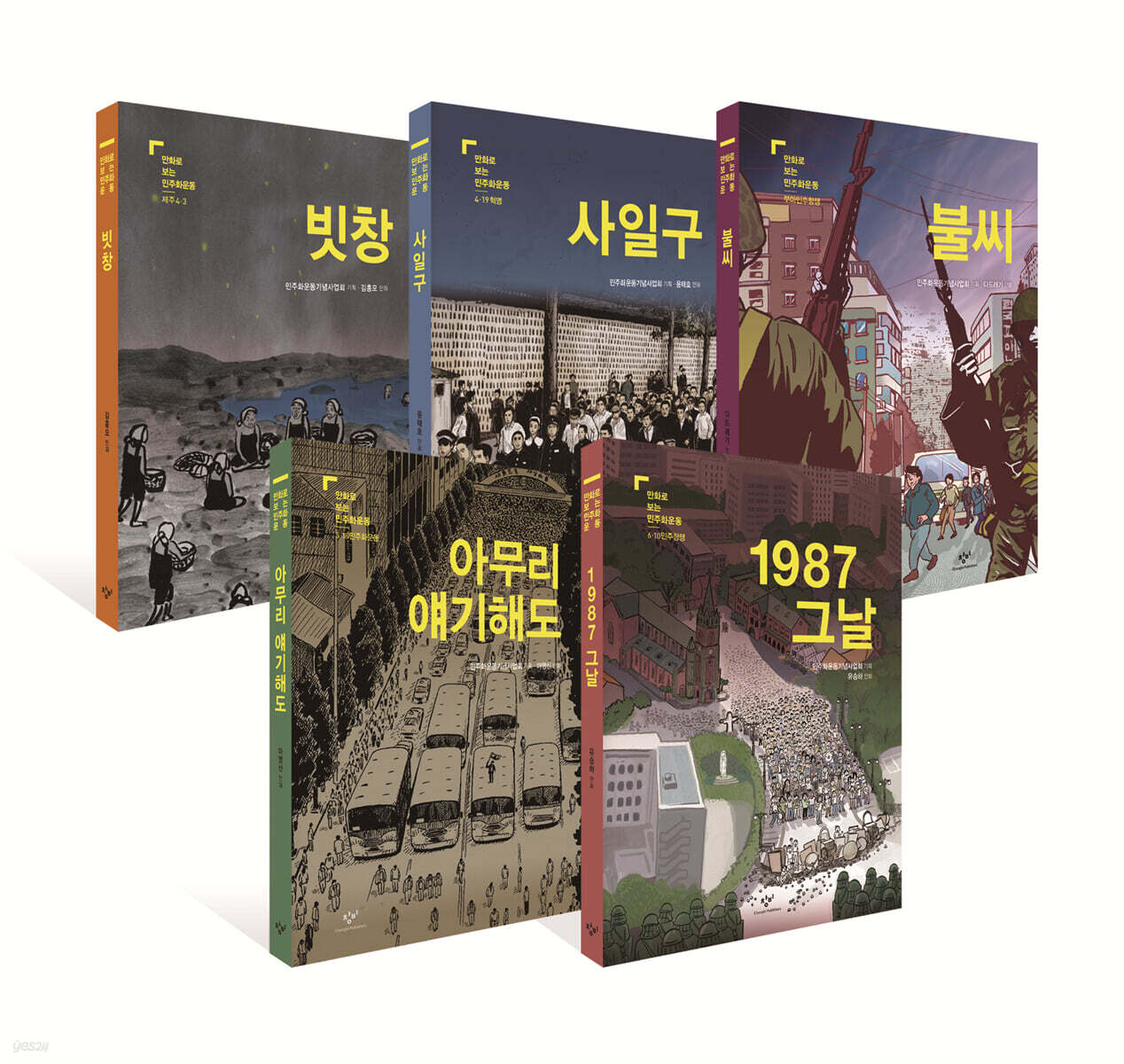
The Memorial Foundation for the Democratization Movement planned the project, and four artists, Kim Hong-mo, Yoon Tae-ho, Ma Young-shin, and Yoo Seung-ha, participated in drawing the Jeju April 3 Incident, the April 19 Revolution, the May 18 Democratization Movement, and the June 10 Democratization Movement. This year, artist Dadraegi joined the project, capturing the historical moments of the Busan-Masan Democratization Movement in a vivid cartoon.
Kim Hong-mo uses his imagination to connect the anti-Japanese protests of Jeju female divers with the Jeju April 3rd Incident, and recalls the Jeju April 3rd Incident through the voices of the female divers.
Yoon Tae-ho candidly shares the thoughts of those who witnessed Korea's development and the April 19 Revolution through the eyes of the generation that experienced the war.
Dadraegi reconstructs the history of the 1979 Busan-Masan Democratic Struggle, which sparked the great democratization movement of the 1980s, from the perspective of the citizens of Busan and Masan.
Ma Young-shin points out the ongoing distortion and disparagement of the May 18 Democratization Movement, and asks how we should remember Gwangju 40 years ago.
Seung-ha Yoo, who ran around the scene of the June 10th Democratic Uprising, faithfully conveys the shouts that everyone shouted together on that day in 1987, drawing on his own experience.
The series 'The Democratization Movement in Comics' provides an interesting look at the path our society has taken to achieve the democracy we have today.
All five works rediscover significant events and offer a balance of historical significance and comic fun.
All 'democratization movements' that speak of yesterday's lessons and tomorrow's hopes will continue to be remembered by mature citizens.
Meet the four most heart-pounding scenes in comic form
There were countless conflicts and adversities before our society achieved a mature democracy.
Democracy did not come suddenly one day; it was achieved by ordinary citizens coming together to fight against injustice and oppression.
The 'Democratization Movement in Comics' series was launched in 2020 to correctly remember the history of the democratization movement and vividly convey the passion of that day to the younger generation. Since its publication, it has received a warm response and love from 80,000 citizen readers, including children and teenagers.
The Memorial Foundation for the Democratization Movement planned the project, and four artists, Kim Hong-mo, Yoon Tae-ho, Ma Young-shin, and Yoo Seung-ha, participated in drawing the Jeju April 3 Incident, the April 19 Revolution, the May 18 Democratization Movement, and the June 10 Democratization Movement. This year, artist Dadraegi joined the project, capturing the historical moments of the Busan-Masan Democratization Movement in a vivid cartoon.
Kim Hong-mo uses his imagination to connect the anti-Japanese protests of Jeju female divers with the Jeju April 3rd Incident, and recalls the Jeju April 3rd Incident through the voices of the female divers.
Yoon Tae-ho candidly shares the thoughts of those who witnessed Korea's development and the April 19 Revolution through the eyes of the generation that experienced the war.
Dadraegi reconstructs the history of the 1979 Busan-Masan Democratic Struggle, which sparked the great democratization movement of the 1980s, from the perspective of the citizens of Busan and Masan.
Ma Young-shin points out the ongoing distortion and disparagement of the May 18 Democratization Movement, and asks how we should remember Gwangju 40 years ago.
Seung-ha Yoo, who ran around the scene of the June 10th Democratic Uprising, faithfully conveys the shouts that everyone shouted together on that day in 1987, drawing on his own experience.
The series 'The Democratization Movement in Comics' provides an interesting look at the path our society has taken to achieve the democracy we have today.
All five works rediscover significant events and offer a balance of historical significance and comic fun.
All 'democratization movements' that speak of yesterday's lessons and tomorrow's hopes will continue to be remembered by mature citizens.
index
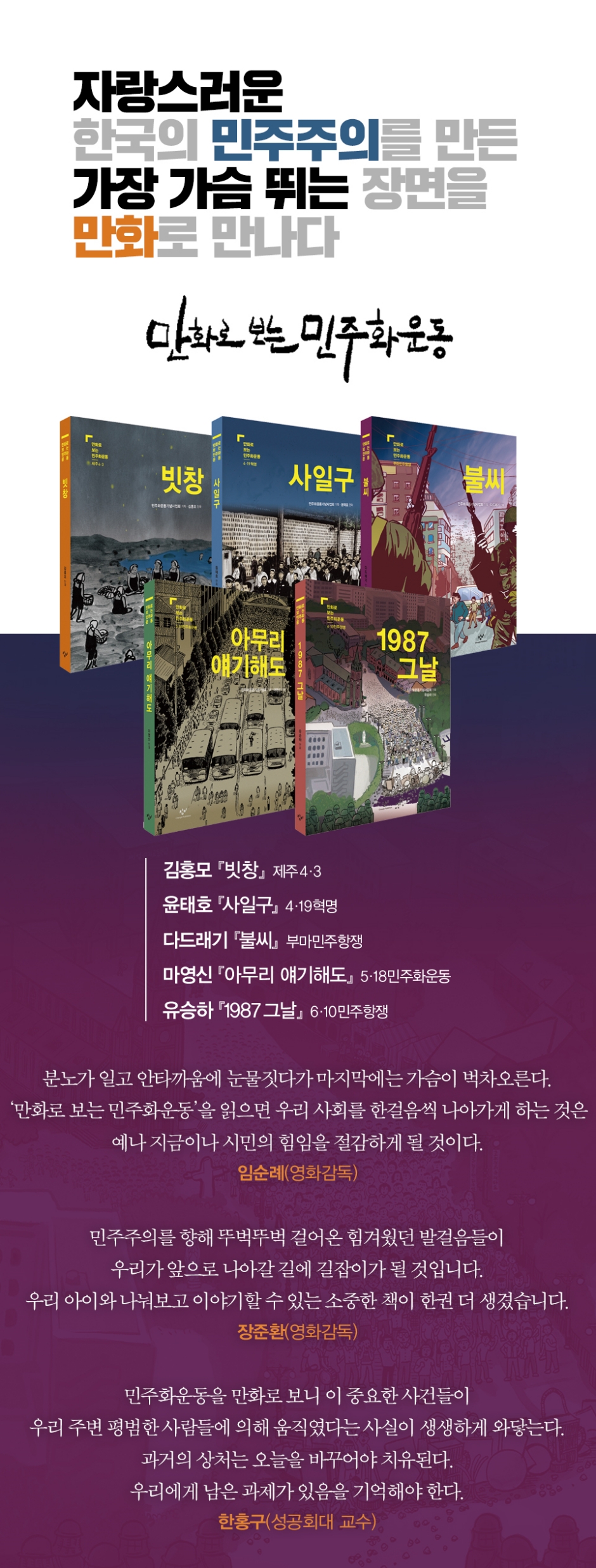
The Democracy Movement in Comics (5 Volumes)
Kim Hong-mo's "Rain Window" (Jeju 4.3)
Yoon Tae-ho's "Sa-il-gu" (April 19 Revolution)
Dadraegi "Spark" (Bu-Ma Democratic Struggle)
Ma Young-shin, "No Matter How Much I Talk" (May 18th Democratization Movement)
Yoo Seung-ha's "That Day in 1987" (June 10th Democratic Uprising)
Kim Hong-mo's "Rain Window" (Jeju 4.3)
Yoon Tae-ho's "Sa-il-gu" (April 19 Revolution)
Dadraegi "Spark" (Bu-Ma Democratic Struggle)
Ma Young-shin, "No Matter How Much I Talk" (May 18th Democratization Movement)
Yoo Seung-ha's "That Day in 1987" (June 10th Democratic Uprising)
Detailed image
Publisher's Review
“We dreamed of a liberated world, a new world.
“My heart was pounding.”
Kim Hong-mo's "Rain Window" (Jeju 4.3)
Before and after liberation, Jeju Island was in a state of great chaos.
The people of the island suffered greatly from unemployment and hardship due to population growth, as well as oppression and exploitation by the Japanese and US military governments.
In particular, during the late Japanese colonial period, when the governor of Jeju Island also served as the head of the Haenyeo Association, the unfair exploitation of the Haenyeo reached its peak.
Kim Hong-mo's "Rain Window," which has garnered attention for its distinct social tone, sensitively depicts the anti-Japanese protests by female divers and the Jeju April 3 Incident that took place in Jeju Island during this chaotic time.
The three female divers, Yeonhwa, Miryang, and Jaein, who met at night school, led a demonstration to protect the female divers' right to survive and protest against Japanese exploitation.
In this protest that took place at the end of the Japanese colonial period, many female divers took part, carrying 'bitchang', a tool used to catch abalone, and they fought for their rights through their own efforts.
But the oppression didn't end there.
With Japan's surrender, the US military government began, and the bureaucrats who had served Japan continued to enjoy power under the US military government.
Unjust police repression and terrorism by the Northwest Youth Association also continued.
Yeonhwa, Miryang, and Jaein experience major events together, from the female divers' protests at the end of the Japanese colonial period to the Jeju April 3 Incident in 1948, and they do not yield to oppression and constantly resist.
The Jeju April 3 Incident, which resulted in countless casualties due to merciless suppression, is vivid and poignant as the cries of the female divers in this tragedy resonate deeply.
“When we were liberated from the oppression of something so obvious,
Because the things we get are so obvious
It was difficult to feel it anew.
“Like air, wind, water, freedom.”
Yoon Tae-ho's "Sa-il-gu" (April 19 Revolution)
Kim Hyeon-yong, the protagonist of 『Sa-il-gu』, was born in 1936 and came into the world during the Japanese colonial period.
I was born into a Japanese world, so I grew up adapting to it, and experienced liberation and war without even knowing what they meant.
Having lost his father in an air raid and being drafted at a young age to avoid bullets on the battlefield, what mattered most to him was not causes like peace, freedom, or democracy, but immediate survival.
In 1960, when the voices of students and citizens condemning the March 15 rigged election and seeking to realize democracy were loud, Hyeon-yong, who was busy solving the problem of making a living, tried to ignore the unfair reality despite his younger brother's criticism that he was a "coward."
Hyun-yong feels complex emotions as he watches his younger brother Hyun-seok and his friend Seok-min, who, unlike his cynical self, jump into dangerous battlefields and shout for justice.
Having lived through the turbulent modern history, he reached the age of eighty. In the winter of 2016, he finally realized that avoidance and indifference were not the only answers, and he quietly visited the square where the revolution took place 60 years ago, holding a candle.
The candlelight vigil of Hyun-yong, who appeared to be nothing more than a snobby old man, is a message of reconciliation carefully delivered to his family, friends, and all citizens who participated in the revolution. It also serves as a clue to inheriting the spirit of the April 19 Revolution and further understanding our different historical experiences.
“Even a small spark
“If you ride the wind, you will fly far.”
Dadraegi "Spark" (Bu-Ma Democratic Struggle)
In 1979, when the dictatorship of Park Chung-hee had lasted nearly 20 years, civil liberties and basic rights were being thoroughly suppressed under the chilling Yushin regime.
In October of that year, the uprisings that broke out in Busan and Masan caused cracks in the seemingly solid Yushin regime.
On October 16, the Busan-Masan Democratic Struggle began with the first bonfire lit on the campus of Pusan National University. University students from the Busan and Masan regions joined in, and gradually, people from various classes, including workers, small business owners, employees, and the unemployed, took the lead in the movement, developing into a large-scale civil uprising.
The five-day Buma Uprising sparked political conflict within the Yushin regime, leading to the assassination of the president. The spark of Buma ushered in the turbulent 1980s and became the seed of the great democratization epic that led to the May 18th Democratization Movement and the June 10th Democratization Movement.
"Spark" brings to life the October 1979 uprising in Busan and Masan in the most three-dimensional way possible.
High school students, college students, industrial complex workers, construction workers, delivery workers, factory owners, and other common people living here that day unfold their lives and stories, and finally come together as one under the flames of the democratic struggle.
The work focuses on the lives of ordinary citizens before and after the struggle, and reflects on the changes and challenges the Buma Democratic Uprising left behind in our society.
To mark the 45th anniversary of the Buma Democratic Struggle, the first Buma Democratic Struggle comic book was created, vividly and meticulously restoring the five-day struggle 45 years ago through the combined efforts of experts' rigorous and reliable content review, historical research, and author Dadraegi's solid storytelling.
“We are Gwangju
How will you remember?”
Ma Young-shin, "No Matter How Much I Talk" (May 18th Democratization Movement)
Ma Young-shin's "No Matter How Much I Talk" begins in a high school in Seoul in 2020.
The protagonist, who appears to be an ordinary high school student, comes across a photo containing a false claim that a person who participated in the May 18th Democratization Movement was a member of North Korean special forces—the so-called "Gwangsu photo"—and shares it with his friends, only to be scolded by his homeroom teacher.
The homeroom teacher, who is aware of the problem, explains in detail during class the background of the May 18th Democratization Movement, the brutal atrocities committed by the martial law forces deployed at the time, and the problem of the truth surrounding the massacre not being clearly revealed even to this day, but the main character's thoughts do not change as he listens while yawning.
Rather than spreading fake news that the Gwangju Citizens' Army resembles North Korean soldiers, he thinks that the problem is not his teachers and friends who mistake him for an Ilbe member, and this further solidifies his distorted perception of history.
The work jumps between 1980 and 2020, contrasting the brutal truth of Gwangju at the time with the cold indifference of the present.
The protagonist, who closes his ears and sees only what he wants to see, no matter how much he is told, and grows his illusions at will, evokes disgust and pity in the reader, but on the other hand, it makes him question whether he himself has ever been deceived by fake news and turned away from the truth.
“You just have to be as courageous as you can be.
“Because we can do it together.”
Yoo Seung-ha's "That Day in 1987" (June 10th Democratic Uprising)
"That Day in 1987" depicts the year 1987, focusing on the young people who had to struggle with not knowing what to do right now, let alone dreaming of the future, in the harsh reality under the Chun Doo-hwan regime.
The main characters are Jinju, who joined the movement because she felt social responsibility as a college student and could not turn a blind eye to injustice; Hyeseung, a college student who lost faith in the world because of her older sister who made an extreme choice while struggling between her family and the movement; and Na-ri, who dreamed of going to art school but is now in the desperate situation of her house being demolished.
1987 was a year of great change in the history of our democracy.
This is because the June 10th Democratic Uprising, in which countless people, including students and citizens, participated, finally led to the resignation of the Chun Doo-hwan regime and the people were able to directly elect the government.
From today's perspective, directly electing the president seems like a natural thing, but before 1987, "voting" was nothing more than a rite of passage, a posthumous endorsement of the power seized by the military through force.
Yoo Seung-ha's "That Day in 1987" covers major events of the June 10th Democratic Uprising, including the May 3rd Incheon Uprising, the Bucheon Police Station sexual torture incident, the Konkuk University student protests, and the sacrifices of Park Hye-jeong, Park Jong-cheol, and Lee Han-yeol, while also not missing how the history of the demolition movement and people's art, such as the forced eviction of Sanggye-dong and the Sinchon mural incident, were part of the flow of 1987.
“My heart was pounding.”
Kim Hong-mo's "Rain Window" (Jeju 4.3)
Before and after liberation, Jeju Island was in a state of great chaos.
The people of the island suffered greatly from unemployment and hardship due to population growth, as well as oppression and exploitation by the Japanese and US military governments.
In particular, during the late Japanese colonial period, when the governor of Jeju Island also served as the head of the Haenyeo Association, the unfair exploitation of the Haenyeo reached its peak.
Kim Hong-mo's "Rain Window," which has garnered attention for its distinct social tone, sensitively depicts the anti-Japanese protests by female divers and the Jeju April 3 Incident that took place in Jeju Island during this chaotic time.
The three female divers, Yeonhwa, Miryang, and Jaein, who met at night school, led a demonstration to protect the female divers' right to survive and protest against Japanese exploitation.
In this protest that took place at the end of the Japanese colonial period, many female divers took part, carrying 'bitchang', a tool used to catch abalone, and they fought for their rights through their own efforts.
But the oppression didn't end there.
With Japan's surrender, the US military government began, and the bureaucrats who had served Japan continued to enjoy power under the US military government.
Unjust police repression and terrorism by the Northwest Youth Association also continued.
Yeonhwa, Miryang, and Jaein experience major events together, from the female divers' protests at the end of the Japanese colonial period to the Jeju April 3 Incident in 1948, and they do not yield to oppression and constantly resist.
The Jeju April 3 Incident, which resulted in countless casualties due to merciless suppression, is vivid and poignant as the cries of the female divers in this tragedy resonate deeply.
“When we were liberated from the oppression of something so obvious,
Because the things we get are so obvious
It was difficult to feel it anew.
“Like air, wind, water, freedom.”
Yoon Tae-ho's "Sa-il-gu" (April 19 Revolution)
Kim Hyeon-yong, the protagonist of 『Sa-il-gu』, was born in 1936 and came into the world during the Japanese colonial period.
I was born into a Japanese world, so I grew up adapting to it, and experienced liberation and war without even knowing what they meant.
Having lost his father in an air raid and being drafted at a young age to avoid bullets on the battlefield, what mattered most to him was not causes like peace, freedom, or democracy, but immediate survival.
In 1960, when the voices of students and citizens condemning the March 15 rigged election and seeking to realize democracy were loud, Hyeon-yong, who was busy solving the problem of making a living, tried to ignore the unfair reality despite his younger brother's criticism that he was a "coward."
Hyun-yong feels complex emotions as he watches his younger brother Hyun-seok and his friend Seok-min, who, unlike his cynical self, jump into dangerous battlefields and shout for justice.
Having lived through the turbulent modern history, he reached the age of eighty. In the winter of 2016, he finally realized that avoidance and indifference were not the only answers, and he quietly visited the square where the revolution took place 60 years ago, holding a candle.
The candlelight vigil of Hyun-yong, who appeared to be nothing more than a snobby old man, is a message of reconciliation carefully delivered to his family, friends, and all citizens who participated in the revolution. It also serves as a clue to inheriting the spirit of the April 19 Revolution and further understanding our different historical experiences.
“Even a small spark
“If you ride the wind, you will fly far.”
Dadraegi "Spark" (Bu-Ma Democratic Struggle)
In 1979, when the dictatorship of Park Chung-hee had lasted nearly 20 years, civil liberties and basic rights were being thoroughly suppressed under the chilling Yushin regime.
In October of that year, the uprisings that broke out in Busan and Masan caused cracks in the seemingly solid Yushin regime.
On October 16, the Busan-Masan Democratic Struggle began with the first bonfire lit on the campus of Pusan National University. University students from the Busan and Masan regions joined in, and gradually, people from various classes, including workers, small business owners, employees, and the unemployed, took the lead in the movement, developing into a large-scale civil uprising.
The five-day Buma Uprising sparked political conflict within the Yushin regime, leading to the assassination of the president. The spark of Buma ushered in the turbulent 1980s and became the seed of the great democratization epic that led to the May 18th Democratization Movement and the June 10th Democratization Movement.
"Spark" brings to life the October 1979 uprising in Busan and Masan in the most three-dimensional way possible.
High school students, college students, industrial complex workers, construction workers, delivery workers, factory owners, and other common people living here that day unfold their lives and stories, and finally come together as one under the flames of the democratic struggle.
The work focuses on the lives of ordinary citizens before and after the struggle, and reflects on the changes and challenges the Buma Democratic Uprising left behind in our society.
To mark the 45th anniversary of the Buma Democratic Struggle, the first Buma Democratic Struggle comic book was created, vividly and meticulously restoring the five-day struggle 45 years ago through the combined efforts of experts' rigorous and reliable content review, historical research, and author Dadraegi's solid storytelling.
“We are Gwangju
How will you remember?”
Ma Young-shin, "No Matter How Much I Talk" (May 18th Democratization Movement)
Ma Young-shin's "No Matter How Much I Talk" begins in a high school in Seoul in 2020.
The protagonist, who appears to be an ordinary high school student, comes across a photo containing a false claim that a person who participated in the May 18th Democratization Movement was a member of North Korean special forces—the so-called "Gwangsu photo"—and shares it with his friends, only to be scolded by his homeroom teacher.
The homeroom teacher, who is aware of the problem, explains in detail during class the background of the May 18th Democratization Movement, the brutal atrocities committed by the martial law forces deployed at the time, and the problem of the truth surrounding the massacre not being clearly revealed even to this day, but the main character's thoughts do not change as he listens while yawning.
Rather than spreading fake news that the Gwangju Citizens' Army resembles North Korean soldiers, he thinks that the problem is not his teachers and friends who mistake him for an Ilbe member, and this further solidifies his distorted perception of history.
The work jumps between 1980 and 2020, contrasting the brutal truth of Gwangju at the time with the cold indifference of the present.
The protagonist, who closes his ears and sees only what he wants to see, no matter how much he is told, and grows his illusions at will, evokes disgust and pity in the reader, but on the other hand, it makes him question whether he himself has ever been deceived by fake news and turned away from the truth.
“You just have to be as courageous as you can be.
“Because we can do it together.”
Yoo Seung-ha's "That Day in 1987" (June 10th Democratic Uprising)
"That Day in 1987" depicts the year 1987, focusing on the young people who had to struggle with not knowing what to do right now, let alone dreaming of the future, in the harsh reality under the Chun Doo-hwan regime.
The main characters are Jinju, who joined the movement because she felt social responsibility as a college student and could not turn a blind eye to injustice; Hyeseung, a college student who lost faith in the world because of her older sister who made an extreme choice while struggling between her family and the movement; and Na-ri, who dreamed of going to art school but is now in the desperate situation of her house being demolished.
1987 was a year of great change in the history of our democracy.
This is because the June 10th Democratic Uprising, in which countless people, including students and citizens, participated, finally led to the resignation of the Chun Doo-hwan regime and the people were able to directly elect the government.
From today's perspective, directly electing the president seems like a natural thing, but before 1987, "voting" was nothing more than a rite of passage, a posthumous endorsement of the power seized by the military through force.
Yoo Seung-ha's "That Day in 1987" covers major events of the June 10th Democratic Uprising, including the May 3rd Incheon Uprising, the Bucheon Police Station sexual torture incident, the Konkuk University student protests, and the sacrifices of Park Hye-jeong, Park Jong-cheol, and Lee Han-yeol, while also not missing how the history of the demolition movement and people's art, such as the forced eviction of Sanggye-dong and the Sinchon mural incident, were part of the flow of 1987.
GOODS SPECIFICS
- Date of issue: May 17, 2024
- Page count, weight, size: Checking page count | Checking size
- ISBN13: 9788936480233
You may also like
카테고리
korean


korean

![GQ KOREA Mark (Monthly): December [2025]](http://librairie.coreenne.fr/cdn/shop/files/8ef265dbbfbf186523ed75ba7319009d.jpg?v=1765340328&width=3840)


