

The logic of persuasion
 |
Description
Book Introduction
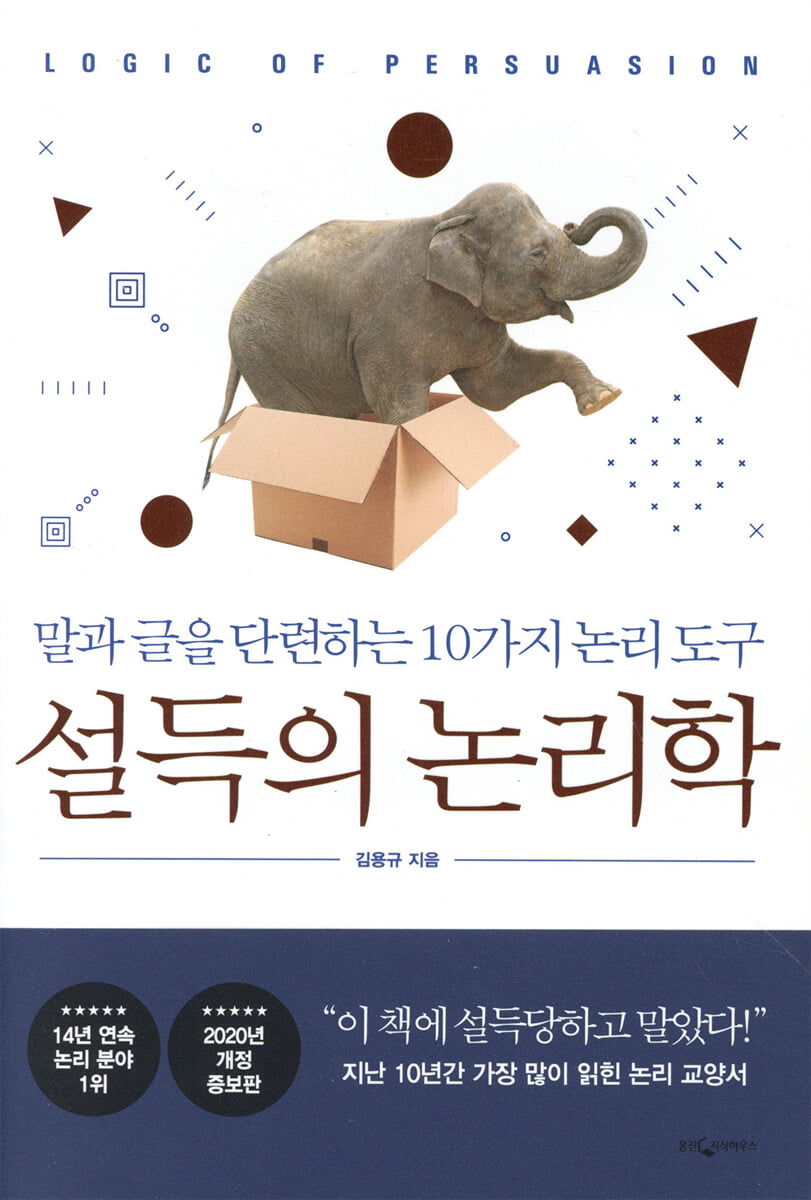
The most widely read logic bestseller of the past decade: The Logic of Persuasion
Newly published in a revised and expanded edition to commemorate the 14th anniversary of the first edition!
A weapon of persuasion that remains powerful over time
10 Logical Tools to Win Friends and Influence People Through Words and Writing
"The Logic of Persuasion" is a practical logic textbook that teaches the secrets of persuasive speaking and writing.
The author, who has popularized philosophy across all fields of the humanities, systematically and easily unravels the story of logic, focusing on "persuasion," a keyword in modern life.
This book, which has received enthusiastic responses from not only the general readership but also teachers, law school students, and students preparing for essays and interviews, has gone through more than 50 printings and sold approximately 100,000 copies over the past 14 years, establishing itself as a bestseller in the field of logic.
This book teaches you how to win over your opponents through logical speech and writing to achieve the results you want.
From Socrates' example method to Aristotle's syllogism, Bacon's induction, the method of abduction that made Sherlock Holmes a famous detective, and Schopenhauer's clever debate techniques, these ten logical tools, discovered from great minds and classics, have proven their effectiveness over time and are therefore excellent weapons of persuasion.
Furthermore, it provides specific suggestions on how to apply each logic to real-world situations such as discussions, essays, reports, advertisements, and presentations, making it a useful extension of the mind for modern people who must persuade others at all times.
The appendix, "Guide to Logic," which summarizes the main content of the text in a clear and concise manner, helps even beginners who are new to logic to progress step by step.
The revised and expanded edition published in 2020 reflects the opinions of readers of the first edition, supplementing any shortcomings to enhance its completeness.
We have replaced the examples with the latest ones to help you understand more accurately the usage of literary rhetorical devices commonly encountered in real life, such as enumeration, parallelism, inversion, and exposition.
Any inaccuracies or ambiguous expressions in the first edition have been carefully revised, and diagrams and tables have been reorganized to make the content easier to understand at a glance.
The newly added "Preface to the Revised Edition" corrects the prejudice that "logic is the exclusive domain of engineering" and reexamines the value of "the logic of persuasion," which will make us most human in today's era of the Fourth Industrial Revolution.
"The Logic of Persuasion," which has been redesigned after a decade and has been rewritten with even more robust content and structure, will provide satisfaction to both existing and new readers.
Newly published in a revised and expanded edition to commemorate the 14th anniversary of the first edition!
A weapon of persuasion that remains powerful over time
10 Logical Tools to Win Friends and Influence People Through Words and Writing
"The Logic of Persuasion" is a practical logic textbook that teaches the secrets of persuasive speaking and writing.
The author, who has popularized philosophy across all fields of the humanities, systematically and easily unravels the story of logic, focusing on "persuasion," a keyword in modern life.
This book, which has received enthusiastic responses from not only the general readership but also teachers, law school students, and students preparing for essays and interviews, has gone through more than 50 printings and sold approximately 100,000 copies over the past 14 years, establishing itself as a bestseller in the field of logic.
This book teaches you how to win over your opponents through logical speech and writing to achieve the results you want.
From Socrates' example method to Aristotle's syllogism, Bacon's induction, the method of abduction that made Sherlock Holmes a famous detective, and Schopenhauer's clever debate techniques, these ten logical tools, discovered from great minds and classics, have proven their effectiveness over time and are therefore excellent weapons of persuasion.
Furthermore, it provides specific suggestions on how to apply each logic to real-world situations such as discussions, essays, reports, advertisements, and presentations, making it a useful extension of the mind for modern people who must persuade others at all times.
The appendix, "Guide to Logic," which summarizes the main content of the text in a clear and concise manner, helps even beginners who are new to logic to progress step by step.
The revised and expanded edition published in 2020 reflects the opinions of readers of the first edition, supplementing any shortcomings to enhance its completeness.
We have replaced the examples with the latest ones to help you understand more accurately the usage of literary rhetorical devices commonly encountered in real life, such as enumeration, parallelism, inversion, and exposition.
Any inaccuracies or ambiguous expressions in the first edition have been carefully revised, and diagrams and tables have been reorganized to make the content easier to understand at a glance.
The newly added "Preface to the Revised Edition" corrects the prejudice that "logic is the exclusive domain of engineering" and reexamines the value of "the logic of persuasion," which will make us most human in today's era of the Fourth Industrial Revolution.
"The Logic of Persuasion," which has been redesigned after a decade and has been rewritten with even more robust content and structure, will provide satisfaction to both existing and new readers.
index
Preface to the revised edition.
Resurrection of the Phoenix
Preface to the first edition.
Logic masters gather in the persuasion club
1.
Socrates' Advertising Strategies: Rhetoric and Illustration
- Persuasion is argument.
- What is an argument?
- One example is better than nine explanations
- Make a Topeka!
- If Socrates had created advertising
*A Guide to Logic
2.
Mr. Shakespeare! Do you know anything about logic?: Three variations of the syllogism
- Shakespeare's rhetoric
- Standing on Shakespeare's shoulders
- Get rid of the cliché: the elliptical syllogism
- Give evidence point by point: Daejeungsik
- The tail bites the tail: the chain syllogism
- Stepping on Aristotle's ladder
*A Guide to Logic
3.
If Aristotle wrote an essay: Arrangement and yes-but arguments
- Hide and seek with arguments
- What Barbara Minto can't do
- Aristotle wrote:
- yes-but argument
*A Guide to Logic
4.
Do You Like Bacon?: Induction and the Rhetoric of Science
- How to Explore Elephants
- The secret to opening the eyes of the blind
- Science also requires the art of persuasion.
- Bacon's induction and Bacon's painting
*A Guide to Logic
5.
Sherlock Holmes' Secrets of Detectives: Deductive and Hypothetico-deductive Methods
- These beans came out of this bag.
- Detective and Scientist
- This masterpiece is a fake.
- Mr. Perth, that's a bit much.
*A Guide to Logic
6.
Wittgenstein and the Taming of the Wild Horse: Deduction and Natural Language
- This is how logic began
- What's Hidden in Plato's Dialectics
- Aristotelian method
- Wittgenstein's Dream
- Harry Potter Returns
*A Guide to Logic
7.
Pascal, the Wager: The Psychology of Persuasion and the Logic of Decision-Making
- We are Pavlov's dog
- Believe in God, take the red wine.
- Beyond rationality
- If you regret doing it, and if you regret not doing it,
*A Guide to Logic
8.
Schopenhauer's Shameless Debate Strategy: How to Win an Argument
- Techniques for discussion
- Attack and defense using deductive methods
- Attack and defense using induction
- Musashi's swordsmanship and Schopenhauer's argumentative skills
- Tricks for argument
- Be shameless and win.
*A Guide to Logic
9.
Plato's Red Apple: Logical Logic and Fuzzy Logic
- The rate of identity and the rate of contradiction
- The most outstanding idea in the history of Western philosophy
- Prometheus' second gift
- The Mysterious Key of Pythagoras
- Ichi logic and multivalued logic
- Engineering and Fuzzy Logic
- Platonic system
*A Guide to Logic
10.
If you ask what truth is: Theory of Truth
- Saying that something exists: correspondence theory
- Einstein was right
- Would it be perfect if there were no contradictions? : Theory of consistency
- Postmodern truth
- Again in Pilate's court
*A Guide to Logic
Resurrection of the Phoenix
Preface to the first edition.
Logic masters gather in the persuasion club
1.
Socrates' Advertising Strategies: Rhetoric and Illustration
- Persuasion is argument.
- What is an argument?
- One example is better than nine explanations
- Make a Topeka!
- If Socrates had created advertising
*A Guide to Logic
2.
Mr. Shakespeare! Do you know anything about logic?: Three variations of the syllogism
- Shakespeare's rhetoric
- Standing on Shakespeare's shoulders
- Get rid of the cliché: the elliptical syllogism
- Give evidence point by point: Daejeungsik
- The tail bites the tail: the chain syllogism
- Stepping on Aristotle's ladder
*A Guide to Logic
3.
If Aristotle wrote an essay: Arrangement and yes-but arguments
- Hide and seek with arguments
- What Barbara Minto can't do
- Aristotle wrote:
- yes-but argument
*A Guide to Logic
4.
Do You Like Bacon?: Induction and the Rhetoric of Science
- How to Explore Elephants
- The secret to opening the eyes of the blind
- Science also requires the art of persuasion.
- Bacon's induction and Bacon's painting
*A Guide to Logic
5.
Sherlock Holmes' Secrets of Detectives: Deductive and Hypothetico-deductive Methods
- These beans came out of this bag.
- Detective and Scientist
- This masterpiece is a fake.
- Mr. Perth, that's a bit much.
*A Guide to Logic
6.
Wittgenstein and the Taming of the Wild Horse: Deduction and Natural Language
- This is how logic began
- What's Hidden in Plato's Dialectics
- Aristotelian method
- Wittgenstein's Dream
- Harry Potter Returns
*A Guide to Logic
7.
Pascal, the Wager: The Psychology of Persuasion and the Logic of Decision-Making
- We are Pavlov's dog
- Believe in God, take the red wine.
- Beyond rationality
- If you regret doing it, and if you regret not doing it,
*A Guide to Logic
8.
Schopenhauer's Shameless Debate Strategy: How to Win an Argument
- Techniques for discussion
- Attack and defense using deductive methods
- Attack and defense using induction
- Musashi's swordsmanship and Schopenhauer's argumentative skills
- Tricks for argument
- Be shameless and win.
*A Guide to Logic
9.
Plato's Red Apple: Logical Logic and Fuzzy Logic
- The rate of identity and the rate of contradiction
- The most outstanding idea in the history of Western philosophy
- Prometheus' second gift
- The Mysterious Key of Pythagoras
- Ichi logic and multivalued logic
- Engineering and Fuzzy Logic
- Platonic system
*A Guide to Logic
10.
If you ask what truth is: Theory of Truth
- Saying that something exists: correspondence theory
- Einstein was right
- Would it be perfect if there were no contradictions? : Theory of consistency
- Postmodern truth
- Again in Pilate's court
*A Guide to Logic
Into the book
The age of authority is over.
Now is the time for persuasion.
For the Hamlets living today, the question of 'to be or not to be' has changed to 'to be persuaded or not to be persuaded.'
If you can persuade others at work, school, and home, you will be successful and happy.
The question is how to develop the ability to persuade others, and the answer lies in logic.
If you think about it, persuasion is nothing more than a sweet fruit that grows on the tree called logic.
But misconceptions still circulate.
(……) Logic is a powerful and lasting tool of persuasion.
Because logic is a rational mental activity.
Humans are creatures who do not enjoy being persuaded by others.
But if the reason is reasonable and justified, it is at least not unpleasant even if it is persuasive.
There is no need to promise yourself, 'I will never do that again.'
---「Preface to the first edition.
From "Logic Masters Gather in the Persuasion Club"
The strength of the example method lies in its great persuasive power.
No theological or philosophical theory of creationism can convince people more simply and powerfully than Paley's argument.
One appropriate example is more persuasive than nine complex explanations.
For this reason, the method of illustration has been loved by great orators, preachers, politicians, and scholars since ancient times.
---From "One example is worth nine explanations"
Topica, which is often translated as 'story site' or 'speech site' in Korean, has become a 'collection of frequently used cliches by topic' in debates or speeches, contrary to its original meaning or use.
(……) If you want to become a persuasive person through speech or writing, in other words, if you want to be excellent at presentations, speeches, sermons, debates, etc., or if you want to write an excellent argumentative essay, you should prepare this kind of topic on a regular basis.
It would be good if it contained not only idioms, proverbs, facts, and verified theories on various topics, but also the latest statistical data.
Only then will it be used appropriately no matter what topic is given.
---From "Make Topeka!"
This method is also useful in discussions.
This is the so-called 'yes-but' speech style.
When debating, the 'no-because' method, which involves first denying the opponent's argument and then listing the reasons for it in detail, is not a good method.
First of all, it hurts the other person's feelings and gives the impression that you are a self-righteous and irrational person who only puts forward your own opinions without any consideration for other people's opinions.
In contrast, the 'yes-but' style of speaking shows that you fully understand the other person's argument and agree with it to some extent, but still show that your own argument is correct, giving the impression that you are a democratic and rational person.
---From "yes-but argument"
Let's say your fancy car suddenly won't start.
First, you will open the hood and look around the interior of the car to observe it.
In some cases, you may need to replace the spark plug with a new one.
However, if the engine still does not start, a faulty spark plug is excluded as a cause of the failure.
Next, you can look at the contacts on the key that starts the engine or the fuel pump.
If it doesn't work even though there is nothing wrong with it, these can also be excluded as causes of failure.
In this way, you will find the inappropriate causes among the breakdowns and eliminate them one by one.
The same thing happens if your favorite audio device breaks down.
Isn't this the very procedure of 'exclusion and exclusion' that Bacon used?
For such a simple problem, you may already be using Bacon's method without even knowing it.
If you're faced with a more complex problem involving multiple variables, like buying a home or applying to college (problems like these often arise in our lives), I encourage you to carefully follow Bacon's inductive procedure step by step.
It will definitely help.
---From "The Secret of Opening the Eyes of the Blind"
Deductive reasoning tells us what will necessarily happen, and inductive reasoning tells us what will likely happen.
But the law of abduction tells us something that has already happened but we don't know yet.
(……) For example, if all people are mortal and A is a person, then deduction tells us that ‘A necessarily dies.’
And induction tells us that if A, B, C, D… … are dead and they are human, then ‘all human beings are mortal.’
But the law of deduction is different.
All people die, and although we don't know A's true identity, if he died anyway, it tells us that 'A is probably a person.'
This is the exploratory or inferential nature of the method of inference.
It was precisely this nature of the abduction method that fascinated Peirce.
And thanks to that, Sherlock Holmes and Professor Joseph Bell were able to become famous detectives.
Detectives and scientists who try to find out something new from what has already happened always use deductive reasoning.
---From "These beans came out of this bag"
Similarly, there is also 'answering a specific issue by generalizing it'.
For example, let's say the government is accused of being indifferent to the human rights issues of people with disabilities.
If you have nothing to say about this, you can just go on and on about how much effort the government has put into addressing human rights issues.
This is a tactic often used by politicians.
In modern logic, these types of tricks are called 'straw man arguments'.
It is to create a scarecrow with many vulnerabilities by distorting the opponent's argument so that it can be easily attacked, and then attack it.
(……) The straw man argument collapses when it is pointed out that the fallacy of the straw man argument is committed by clearly revealing the part where the opinion is overinterpreted or generalized.
However, the reason Schopenhauer recommends this kind of argument is that in the midst of a heated debate in real life, it is extremely rare to find someone who can make such a cool-headed point.
---From "Attack and Defense Using Deductive Method"
In a debate, a person who is good at asking questions can take the lead in the debate and lead the other person to their own thoughts.
It's like a left hand jab in boxing.
The boxer who is good at throwing left-hand jabs dominates the boxing match.
That's why the saying, "He who controls the left controls the world" came about.
Even in a debate, the one who asks good questions will dominate the opponent.
The questions asked at this time are completely different from the 'everyday questions' that are simply intended to find out certain facts from the other person.
Questions in a debate are 'strategic questions' that are designed to confuse the opponent and prevent him from presenting his argument correctly, or conversely, to force him to agree with his argument.
In short, it is a 'pillow press' that renders all of the enemy's skills useless and allows you to control the enemy.
---From "Tricks for Argumentation"
The moment you sense that you are about to lose to the other person, you should suddenly start talking about something else.
Of course, logically speaking, this is a case of 'off-topic error'.
We encounter situations like this almost every day around us.
For example, if you say that someone is tall, the other person will immediately change the subject to say that the person is fat.
If you protest and ask why someone parked their car in front of someone else's house, they will start an argument by asking why you are speaking informally to them.
---From "Be Shameless and Win"
From the perspective of persuasion, there is nothing more compelling than truth.
Because truth implies something that must be accepted and followed.
In this sense, truth is indistinguishable from ethics.
It was Aristotle who began to distinguish between truth and ethics.
And that tradition has continued for the past 2,300 years.
You may have heard at least once that there is a distinction between the fact that ‘… … is’ and the duty that ‘… … must be done.’
The same goes for the term ‘value neutrality of science.’
These claims are valid assuming that objective truth exists.
If truth is merely a product of paradigms or Jewishness, that is, a useful belief that is created and used from time to time according to consensus, then the two can no longer be distinguished.
Because our lives are determined by what we recognize as truth.
This is true for environmental issues, nuclear issues, biotechnology issues, hunger issues, violence issues, etc.
In matters like these, the claim that fact and ought are distinct, or that science is value-neutral, is nothing but an evasion of responsibility and hypocrisy.
Now is the time for persuasion.
For the Hamlets living today, the question of 'to be or not to be' has changed to 'to be persuaded or not to be persuaded.'
If you can persuade others at work, school, and home, you will be successful and happy.
The question is how to develop the ability to persuade others, and the answer lies in logic.
If you think about it, persuasion is nothing more than a sweet fruit that grows on the tree called logic.
But misconceptions still circulate.
(……) Logic is a powerful and lasting tool of persuasion.
Because logic is a rational mental activity.
Humans are creatures who do not enjoy being persuaded by others.
But if the reason is reasonable and justified, it is at least not unpleasant even if it is persuasive.
There is no need to promise yourself, 'I will never do that again.'
---「Preface to the first edition.
From "Logic Masters Gather in the Persuasion Club"
The strength of the example method lies in its great persuasive power.
No theological or philosophical theory of creationism can convince people more simply and powerfully than Paley's argument.
One appropriate example is more persuasive than nine complex explanations.
For this reason, the method of illustration has been loved by great orators, preachers, politicians, and scholars since ancient times.
---From "One example is worth nine explanations"
Topica, which is often translated as 'story site' or 'speech site' in Korean, has become a 'collection of frequently used cliches by topic' in debates or speeches, contrary to its original meaning or use.
(……) If you want to become a persuasive person through speech or writing, in other words, if you want to be excellent at presentations, speeches, sermons, debates, etc., or if you want to write an excellent argumentative essay, you should prepare this kind of topic on a regular basis.
It would be good if it contained not only idioms, proverbs, facts, and verified theories on various topics, but also the latest statistical data.
Only then will it be used appropriately no matter what topic is given.
---From "Make Topeka!"
This method is also useful in discussions.
This is the so-called 'yes-but' speech style.
When debating, the 'no-because' method, which involves first denying the opponent's argument and then listing the reasons for it in detail, is not a good method.
First of all, it hurts the other person's feelings and gives the impression that you are a self-righteous and irrational person who only puts forward your own opinions without any consideration for other people's opinions.
In contrast, the 'yes-but' style of speaking shows that you fully understand the other person's argument and agree with it to some extent, but still show that your own argument is correct, giving the impression that you are a democratic and rational person.
---From "yes-but argument"
Let's say your fancy car suddenly won't start.
First, you will open the hood and look around the interior of the car to observe it.
In some cases, you may need to replace the spark plug with a new one.
However, if the engine still does not start, a faulty spark plug is excluded as a cause of the failure.
Next, you can look at the contacts on the key that starts the engine or the fuel pump.
If it doesn't work even though there is nothing wrong with it, these can also be excluded as causes of failure.
In this way, you will find the inappropriate causes among the breakdowns and eliminate them one by one.
The same thing happens if your favorite audio device breaks down.
Isn't this the very procedure of 'exclusion and exclusion' that Bacon used?
For such a simple problem, you may already be using Bacon's method without even knowing it.
If you're faced with a more complex problem involving multiple variables, like buying a home or applying to college (problems like these often arise in our lives), I encourage you to carefully follow Bacon's inductive procedure step by step.
It will definitely help.
---From "The Secret of Opening the Eyes of the Blind"
Deductive reasoning tells us what will necessarily happen, and inductive reasoning tells us what will likely happen.
But the law of abduction tells us something that has already happened but we don't know yet.
(……) For example, if all people are mortal and A is a person, then deduction tells us that ‘A necessarily dies.’
And induction tells us that if A, B, C, D… … are dead and they are human, then ‘all human beings are mortal.’
But the law of deduction is different.
All people die, and although we don't know A's true identity, if he died anyway, it tells us that 'A is probably a person.'
This is the exploratory or inferential nature of the method of inference.
It was precisely this nature of the abduction method that fascinated Peirce.
And thanks to that, Sherlock Holmes and Professor Joseph Bell were able to become famous detectives.
Detectives and scientists who try to find out something new from what has already happened always use deductive reasoning.
---From "These beans came out of this bag"
Similarly, there is also 'answering a specific issue by generalizing it'.
For example, let's say the government is accused of being indifferent to the human rights issues of people with disabilities.
If you have nothing to say about this, you can just go on and on about how much effort the government has put into addressing human rights issues.
This is a tactic often used by politicians.
In modern logic, these types of tricks are called 'straw man arguments'.
It is to create a scarecrow with many vulnerabilities by distorting the opponent's argument so that it can be easily attacked, and then attack it.
(……) The straw man argument collapses when it is pointed out that the fallacy of the straw man argument is committed by clearly revealing the part where the opinion is overinterpreted or generalized.
However, the reason Schopenhauer recommends this kind of argument is that in the midst of a heated debate in real life, it is extremely rare to find someone who can make such a cool-headed point.
---From "Attack and Defense Using Deductive Method"
In a debate, a person who is good at asking questions can take the lead in the debate and lead the other person to their own thoughts.
It's like a left hand jab in boxing.
The boxer who is good at throwing left-hand jabs dominates the boxing match.
That's why the saying, "He who controls the left controls the world" came about.
Even in a debate, the one who asks good questions will dominate the opponent.
The questions asked at this time are completely different from the 'everyday questions' that are simply intended to find out certain facts from the other person.
Questions in a debate are 'strategic questions' that are designed to confuse the opponent and prevent him from presenting his argument correctly, or conversely, to force him to agree with his argument.
In short, it is a 'pillow press' that renders all of the enemy's skills useless and allows you to control the enemy.
---From "Tricks for Argumentation"
The moment you sense that you are about to lose to the other person, you should suddenly start talking about something else.
Of course, logically speaking, this is a case of 'off-topic error'.
We encounter situations like this almost every day around us.
For example, if you say that someone is tall, the other person will immediately change the subject to say that the person is fat.
If you protest and ask why someone parked their car in front of someone else's house, they will start an argument by asking why you are speaking informally to them.
---From "Be Shameless and Win"
From the perspective of persuasion, there is nothing more compelling than truth.
Because truth implies something that must be accepted and followed.
In this sense, truth is indistinguishable from ethics.
It was Aristotle who began to distinguish between truth and ethics.
And that tradition has continued for the past 2,300 years.
You may have heard at least once that there is a distinction between the fact that ‘… … is’ and the duty that ‘… … must be done.’
The same goes for the term ‘value neutrality of science.’
These claims are valid assuming that objective truth exists.
If truth is merely a product of paradigms or Jewishness, that is, a useful belief that is created and used from time to time according to consensus, then the two can no longer be distinguished.
Because our lives are determined by what we recognize as truth.
This is true for environmental issues, nuclear issues, biotechnology issues, hunger issues, violence issues, etc.
In matters like these, the claim that fact and ought are distinct, or that science is value-neutral, is nothing but an evasion of responsibility and hypocrisy.
---From "Again in Pilate's Court"
Publisher's Review
Bestseller in the logic category for 14 consecutive years
How Logic Becomes a Weapon of Persuasion
The most practical logic textbook, recognized by 100,000 readers
We are now in the 'age of persuasion', where we can get what we want through words and writing.
Students promote themselves through essay tests and interviews, and in the business world, they design elaborate negotiation strategies to maximize profits.
Merchants who fail to attract customers cannot sell their goods, and politicians who fail to persuade voters suffer the bitter cup of defeat.
Even in everyday conversation, the person who captures the other person's heart takes the initiative.
The question of whether we can persuade or not has become a crucial challenge that determines our success or failure in life.
"The Logic of Persuasion" started from the idea that logical speaking and writing are the best tools for persuasion.
The author of this book, Yong-gyu Kim, is a leading figure in popularizing philosophy through 『Reading Literature at a Philosophy Café』 and 『Reading Poetry at a Philosophy Café』, which were loved by 200,000 readers.
True to the author's reputation, this book systematically and easily explains logic according to the code of 'persuasion.'
Logic is often thought of as rigid and difficult, but this is actually formal logic, which focuses on verifying the validity of arguments.
There is a different kind of logic that we need.
It is the ‘logic of language’ that firmly controls the other person’s mind through words and writing.
Logic that clearly determines a victory by presenting rational and justified grounds is a competitive weapon of persuasion.
Since its publication in 2007, this book has gone through 50 printings thanks to the enthusiastic response of 100,000 readers, and has been a bestseller in the field of logic for over 10 years.
“There is no book as friendly and easy to understand as this one for practical writing and strengthening logic,” “I never imagined I would be so moved by a logic book,” “I would have greatly regretted not reading it,” and other such loving praise from readers tell us why this book should be the first one you pick up among the countless books on logic.
Socrates lectures on the art of persuasion
What if Aristotle taught us how to write?
The greatest logicians in history gather together!
As the saying goes, “Even beads need to be strung to be considered valuable,” no matter how excellent logic is at persuading someone, if it is difficult to apply in reality, it will lose its appeal to readers.
This is also why the author brought together renowned 'masters of logic' from both the East and the West in 'The Logic of Persuasion'.
From Socrates' example method to Aristotle's syllogism, the method of abduction that made Sherlock Holmes a famous detective, and Schopenhauer's shameless debating techniques, this book introduces ten logical tools discovered in great minds and classics.
It also provides specific guidelines that are useful in real life.
Topica, a favorite of master calligraphers and eloquent speakers, the "yes-but" idiom for getting your point across without causing resentment, and literary rhetoric that influences every single line of a sentence are all powerful tools for practical speaking and writing.
Chapter 8 organizes about 20 commonly used errors by type, enabling readers to become 'masters of argument' who can persuade others while remaining unconvinced.
In addition, the book presents a wealth of examples of how each logical concept is applied in real-world situations, including newspapers, magazines, broadcasts, advertisements, reports, discussions, and presentations, provoking a surprising sense of how diverse the utility of logic can be.
The appendix "Guide to Logic" at the end of each chapter provides a clear overview of the material covered in the text, helping even beginners who are new to logic to progress step by step.
This book, filled with logical tools that have been empirically proven to be effective over time, will serve as a reliable extension of the mind of modern people who must persuade someone at every moment.
This method is also useful in discussions.
This is the so-called 'yes-but' speech style.
When debating, the 'no-because' method, which involves first denying the opponent's argument and then listing the reasons for it in detail, is not a good method.
First of all, it hurts the other person's feelings and gives the impression that you are a self-righteous and irrational person who only puts forward your own opinions without any consideration for other people's opinions.
In contrast, the 'yes-but' style of speaking shows that you fully understand the other person's argument and agree with it to some extent, but still show that your own argument is correct, giving the impression that you are a democratic and rational person.
- From the "yes-but argument"
Revised and Expanded Edition 2020 Released!
Solid content and structure, vivid and rich examples…
The power of logic becomes even more decisive in the era of the Fourth Industrial Revolution.
This revised and expanded edition, published in 2020, reflects the opinions of readers of the first edition, supplementing any missing content and enhancing readability to enhance the completeness of the book.
Outdated examples have been replaced, and diagrams and tables have been reorganized to make them easier to read at a glance.
In particular, the advertisement quoted in Chapter 2 has been completely revised in the latest version, vividly showing readers how literary rhetorical techniques such as enumeration, parallelism, inversion, and exposition introduced in the text are applied in reality and to what extent they have an impact.
The newly added "Preface to the Revised Edition" corrects the prejudice that "logic is the exclusive domain of engineering" and reexamines the value of "the logic of persuasion," which will make us most human in today's era of the Fourth Industrial Revolution.
"The Logic of Persuasion," which has been redesigned after a decade and has been rewritten with even more robust content and structure, will provide satisfaction to both existing and new readers.
How Logic Becomes a Weapon of Persuasion
The most practical logic textbook, recognized by 100,000 readers
We are now in the 'age of persuasion', where we can get what we want through words and writing.
Students promote themselves through essay tests and interviews, and in the business world, they design elaborate negotiation strategies to maximize profits.
Merchants who fail to attract customers cannot sell their goods, and politicians who fail to persuade voters suffer the bitter cup of defeat.
Even in everyday conversation, the person who captures the other person's heart takes the initiative.
The question of whether we can persuade or not has become a crucial challenge that determines our success or failure in life.
"The Logic of Persuasion" started from the idea that logical speaking and writing are the best tools for persuasion.
The author of this book, Yong-gyu Kim, is a leading figure in popularizing philosophy through 『Reading Literature at a Philosophy Café』 and 『Reading Poetry at a Philosophy Café』, which were loved by 200,000 readers.
True to the author's reputation, this book systematically and easily explains logic according to the code of 'persuasion.'
Logic is often thought of as rigid and difficult, but this is actually formal logic, which focuses on verifying the validity of arguments.
There is a different kind of logic that we need.
It is the ‘logic of language’ that firmly controls the other person’s mind through words and writing.
Logic that clearly determines a victory by presenting rational and justified grounds is a competitive weapon of persuasion.
Since its publication in 2007, this book has gone through 50 printings thanks to the enthusiastic response of 100,000 readers, and has been a bestseller in the field of logic for over 10 years.
“There is no book as friendly and easy to understand as this one for practical writing and strengthening logic,” “I never imagined I would be so moved by a logic book,” “I would have greatly regretted not reading it,” and other such loving praise from readers tell us why this book should be the first one you pick up among the countless books on logic.
Socrates lectures on the art of persuasion
What if Aristotle taught us how to write?
The greatest logicians in history gather together!
As the saying goes, “Even beads need to be strung to be considered valuable,” no matter how excellent logic is at persuading someone, if it is difficult to apply in reality, it will lose its appeal to readers.
This is also why the author brought together renowned 'masters of logic' from both the East and the West in 'The Logic of Persuasion'.
From Socrates' example method to Aristotle's syllogism, the method of abduction that made Sherlock Holmes a famous detective, and Schopenhauer's shameless debating techniques, this book introduces ten logical tools discovered in great minds and classics.
It also provides specific guidelines that are useful in real life.
Topica, a favorite of master calligraphers and eloquent speakers, the "yes-but" idiom for getting your point across without causing resentment, and literary rhetoric that influences every single line of a sentence are all powerful tools for practical speaking and writing.
Chapter 8 organizes about 20 commonly used errors by type, enabling readers to become 'masters of argument' who can persuade others while remaining unconvinced.
In addition, the book presents a wealth of examples of how each logical concept is applied in real-world situations, including newspapers, magazines, broadcasts, advertisements, reports, discussions, and presentations, provoking a surprising sense of how diverse the utility of logic can be.
The appendix "Guide to Logic" at the end of each chapter provides a clear overview of the material covered in the text, helping even beginners who are new to logic to progress step by step.
This book, filled with logical tools that have been empirically proven to be effective over time, will serve as a reliable extension of the mind of modern people who must persuade someone at every moment.
This method is also useful in discussions.
This is the so-called 'yes-but' speech style.
When debating, the 'no-because' method, which involves first denying the opponent's argument and then listing the reasons for it in detail, is not a good method.
First of all, it hurts the other person's feelings and gives the impression that you are a self-righteous and irrational person who only puts forward your own opinions without any consideration for other people's opinions.
In contrast, the 'yes-but' style of speaking shows that you fully understand the other person's argument and agree with it to some extent, but still show that your own argument is correct, giving the impression that you are a democratic and rational person.
- From the "yes-but argument"
Revised and Expanded Edition 2020 Released!
Solid content and structure, vivid and rich examples…
The power of logic becomes even more decisive in the era of the Fourth Industrial Revolution.
This revised and expanded edition, published in 2020, reflects the opinions of readers of the first edition, supplementing any missing content and enhancing readability to enhance the completeness of the book.
Outdated examples have been replaced, and diagrams and tables have been reorganized to make them easier to read at a glance.
In particular, the advertisement quoted in Chapter 2 has been completely revised in the latest version, vividly showing readers how literary rhetorical techniques such as enumeration, parallelism, inversion, and exposition introduced in the text are applied in reality and to what extent they have an impact.
The newly added "Preface to the Revised Edition" corrects the prejudice that "logic is the exclusive domain of engineering" and reexamines the value of "the logic of persuasion," which will make us most human in today's era of the Fourth Industrial Revolution.
"The Logic of Persuasion," which has been redesigned after a decade and has been rewritten with even more robust content and structure, will provide satisfaction to both existing and new readers.
GOODS SPECIFICS
- Date of issue: February 25, 2020
- Format: Paperback book binding method guide
- Page count, weight, size: 360 pages | 584g | 145*215*30mm
- ISBN13: 9788901239767
- ISBN10: 8901239760
You may also like
카테고리
korean


korean

![GQ KOREA Mark (Monthly): December [2025]](http://librairie.coreenne.fr/cdn/shop/files/8ef265dbbfbf186523ed75ba7319009d.jpg?v=1765340328&width=3840)


