

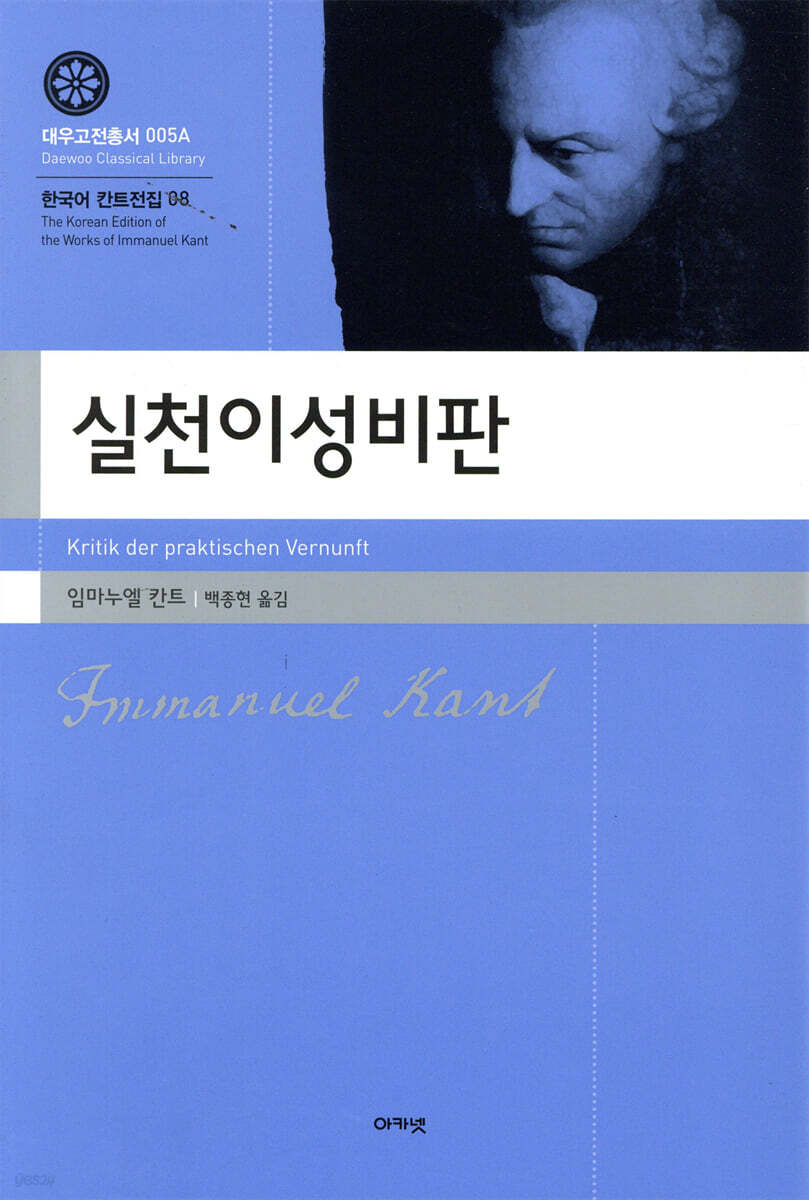
Critique of Practical Reason
 |
Description
Book Introduction
The ethical motif that underpins Kant's entire philosophy: the Critique of Practical Reason
The revised and edited second edition of the Critique of Practical Reason (1st edition 2002/revised edition 2009) has been published.
With the publication of 『Groundworks of the Metaphysics of Morals』 (Korean Kant Complete Works 06) and 『Metaphysics of Morals』 (Korean Kant Complete Works 12), which can be considered a trilogy on Kant's moral philosophy along with 『Critique of Practical Reason』, the outline of Kant's philosophy and general introduction to moral philosophy that were included in the appendix of 『Critique of Practical Reason』 were deemed unnecessary, so they were deleted, the overall volume was reduced, and some of the content was revised.
It is a well-known fact that Western modern philosophy underwent a dramatic change through Kant's philosophy.
This is not limited to the changes within the field of theoretical philosophy that occurred with the publication of the Critique of Pure Reason.
This change also occurred in ethics, a field of practical philosophy.
At a time when scientific knowledge was making tremendous progress, Kant's ethical thought, which criticized and set limits on human theoretical reason, the driving force behind it, and insisted that it must be included in the system of practical reason, became one of the most important axes in discussions of Western ethics, along with Aristotle's ethics.
Moreover, there are many expressions referring to Kantian ethics, as it occupies a significant place in the history of Western ethics.
The various expressions that express the nature of Kantian ethics, such as metaphysical ethics, normative ethics, nomological ethics, deontological ethics, solemnistic ethics, motivational ethics, maximal ethics, and formalistic ethics, allow us to guess how diversely Kantian ethics has been interpreted and understood up to now.
The book that contains this very ideological core is the famous Critique of Practical Reason.
The revised and edited second edition of the Critique of Practical Reason (1st edition 2002/revised edition 2009) has been published.
With the publication of 『Groundworks of the Metaphysics of Morals』 (Korean Kant Complete Works 06) and 『Metaphysics of Morals』 (Korean Kant Complete Works 12), which can be considered a trilogy on Kant's moral philosophy along with 『Critique of Practical Reason』, the outline of Kant's philosophy and general introduction to moral philosophy that were included in the appendix of 『Critique of Practical Reason』 were deemed unnecessary, so they were deleted, the overall volume was reduced, and some of the content was revised.
It is a well-known fact that Western modern philosophy underwent a dramatic change through Kant's philosophy.
This is not limited to the changes within the field of theoretical philosophy that occurred with the publication of the Critique of Pure Reason.
This change also occurred in ethics, a field of practical philosophy.
At a time when scientific knowledge was making tremendous progress, Kant's ethical thought, which criticized and set limits on human theoretical reason, the driving force behind it, and insisted that it must be included in the system of practical reason, became one of the most important axes in discussions of Western ethics, along with Aristotle's ethics.
Moreover, there are many expressions referring to Kantian ethics, as it occupies a significant place in the history of Western ethics.
The various expressions that express the nature of Kantian ethics, such as metaphysical ethics, normative ethics, nomological ethics, deontological ethics, solemnistic ethics, motivational ethics, maximal ethics, and formalistic ethics, allow us to guess how diversely Kantian ethics has been interpreted and understood up to now.
The book that contains this very ideological core is the famous Critique of Practical Reason.
index
Introduction to Part 1 of the Critique of Practical Reason
Commentary on the Critique of Practical Reason
Background of the writing
The nature of the Critique of Practical Reason and its relationship with the Critique of Pure Reason
The Position of the Critique of Practical Reason in Kant's Moral Philosophy
Outline of the Critique of Practical Reason
Themes of Kant's moral philosophy
Analytics of Pure Practical Reason
: The autonomy of practical reason and the dignity of the person
Dialectics of Pure Practical Reason
: The idea of 'highest good'
From knowledge to wisdom
Titles of Kant's original treatises using Korean titles in the commentary and annotations [abbreviations], and the volume numbers of the Berlin Academic Edition [AA] containing them (and the cited translations)
Major literature related to Kant's moral philosophy
I.
Major editions of the original text
II.
Supplementary Material for the Critique of Practical Reason
III.
Kant's other works on moral philosophy
1.
Writings published or planned for publication by Kant and their corresponding parts
2.
Kant's posthumous works
3.
Other lecture notes
4.
Letters sent and received by Kant
IV.
Research Assistant
1.
Bibliography
2.
Miscellaneous records
V.
Collections and newsletters
VI.
Writings deeply related to the formation of Kant's ethical theory
VII.
Research papers
1.
Research paper on 『Critique of Practical Reason』
1) Commentaries and introductory texts
2) Research papers by topic
2.
Comprehensive research paper
3.
Ethics-focused research papers
4.
Research papers focusing on the philosophy of religion
5.
Research papers on legal philosophy, political philosophy, and social philosophy
6.
Research papers on influence and development history
7.
Korean research papers
Translator's Notes for Part 2 of the Critique of Practical Reason
Principle of translator
Corresponding translations of similar and related words
Translation and annotation of the Critique of Practical Reason
Search
Note
Find a person
Finding the concept
Commentary on the Critique of Practical Reason
Background of the writing
The nature of the Critique of Practical Reason and its relationship with the Critique of Pure Reason
The Position of the Critique of Practical Reason in Kant's Moral Philosophy
Outline of the Critique of Practical Reason
Themes of Kant's moral philosophy
Analytics of Pure Practical Reason
: The autonomy of practical reason and the dignity of the person
Dialectics of Pure Practical Reason
: The idea of 'highest good'
From knowledge to wisdom
Titles of Kant's original treatises using Korean titles in the commentary and annotations [abbreviations], and the volume numbers of the Berlin Academic Edition [AA] containing them (and the cited translations)
Major literature related to Kant's moral philosophy
I.
Major editions of the original text
II.
Supplementary Material for the Critique of Practical Reason
III.
Kant's other works on moral philosophy
1.
Writings published or planned for publication by Kant and their corresponding parts
2.
Kant's posthumous works
3.
Other lecture notes
4.
Letters sent and received by Kant
IV.
Research Assistant
1.
Bibliography
2.
Miscellaneous records
V.
Collections and newsletters
VI.
Writings deeply related to the formation of Kant's ethical theory
VII.
Research papers
1.
Research paper on 『Critique of Practical Reason』
1) Commentaries and introductory texts
2) Research papers by topic
2.
Comprehensive research paper
3.
Ethics-focused research papers
4.
Research papers focusing on the philosophy of religion
5.
Research papers on legal philosophy, political philosophy, and social philosophy
6.
Research papers on influence and development history
7.
Korean research papers
Translator's Notes for Part 2 of the Critique of Practical Reason
Principle of translator
Corresponding translations of similar and related words
Translation and annotation of the Critique of Practical Reason
Search
Note
Find a person
Finding the concept
Publisher's Review
The ethical motif that underpins Kant's entire philosophy: the Critique of Practical Reason
The revised and edited second edition of the Critique of Practical Reason (1st edition 2002/revised edition 2009) has been published.
With the publication of 『Groundworks of the Metaphysics of Morals』 (Korean Kant Complete Works 06) and 『Metaphysics of Morals』 (Korean Kant Complete Works 12), which can be considered a trilogy on Kant's moral philosophy along with 『Critique of Practical Reason』, the outline of Kant's philosophy and general introduction to moral philosophy that were included in the appendix of 『Critique of Practical Reason』 were deemed unnecessary, so they were deleted, the overall volume was reduced, and some of the content was revised.
If you had to read just one book in your life, it would be Kant's Critique of Practical Reason.
In the "Preface," the translator states, "Setting aside the special relationship between human life and religion, which brings people closer to scripture, if an ordinary educated person were to read only one book in their lifetime, what would it be? When asked, the answer is Kant's Critique of Practical Reason."
That is because Kant's Critique of Practical Reason tells us, "Why do humans, who are extremely lowly when compared to the ideal, have dignity?" and "How can we maintain that dignity?"
We have the famous dictum in the Critique of Practical Reason: “There are two things which fill the mind with ever newer and greater wonder and awe, the more often and continually one reflects on them:
Here we can find the first line of the conclusion of the Critique of Practical Reason, which later generations engraved on a bronze plaque commemorating Kant: “It is the starry sky above me and the moral law within me.”
These concise words succinctly express what Kant truly wanted to awaken in us.
Key contents of Kant's Critique of Practical Reason
It is a well-known fact that Western modern philosophy underwent a dramatic change through Kant's philosophy.
This is not limited to the changes within the field of theoretical philosophy that occurred with the publication of the Critique of Pure Reason.
This change also occurred in ethics, a field of practical philosophy.
At a time when scientific knowledge was making tremendous progress, Kant's ethical thought, which criticized and set limits on human theoretical reason, the driving force behind it, and insisted that it must be included in the system of practical reason, became one of the most important axes in discussions of Western ethics, along with Aristotle's ethics.
Moreover, there are many expressions referring to Kantian ethics, as it occupies a significant place in the history of Western ethics.
The various expressions that express the nature of Kantian ethics, such as metaphysical ethics, normative ethics, nomological ethics, deontological ethics, solemnistic ethics, motivational ethics, maximal ethics, and formalistic ethics, allow us to guess how diversely Kantian ethics has been interpreted and understood up to now.
The book that contains this very ideological core is the famous Critique of Practical Reason.
In the Critique of Practical Reason, Kant addresses the problem of ethical practice with a unique methodology.
He abandoned the common ethical strategy of simply presenting a theory persuasively and getting people to act according to it, and tried to prove that the fundamental system (architecture) that human reason ultimately demands cannot be completed through theory alone, but must be preceded by practice.
The freedom that makes human actions ethical cannot be proven theoretically and must be put into practice to become possible.
So Kant demands ethical practice as an indispensable element of his transtheoretical system of reason.
Ultimately, it shows that ethics that is not accompanied by practice, that is, ethics that is merely a theoretical play, cannot be established even in theory.
In this sense, Kant's ethical motif is not a secondary part hidden behind metaphysics, epistemology, aesthetics, and anthropology, but an essential prerequisite that supports the entire system of Kant's thought.
The revised and edited second edition of the Critique of Practical Reason (1st edition 2002/revised edition 2009) has been published.
With the publication of 『Groundworks of the Metaphysics of Morals』 (Korean Kant Complete Works 06) and 『Metaphysics of Morals』 (Korean Kant Complete Works 12), which can be considered a trilogy on Kant's moral philosophy along with 『Critique of Practical Reason』, the outline of Kant's philosophy and general introduction to moral philosophy that were included in the appendix of 『Critique of Practical Reason』 were deemed unnecessary, so they were deleted, the overall volume was reduced, and some of the content was revised.
If you had to read just one book in your life, it would be Kant's Critique of Practical Reason.
In the "Preface," the translator states, "Setting aside the special relationship between human life and religion, which brings people closer to scripture, if an ordinary educated person were to read only one book in their lifetime, what would it be? When asked, the answer is Kant's Critique of Practical Reason."
That is because Kant's Critique of Practical Reason tells us, "Why do humans, who are extremely lowly when compared to the ideal, have dignity?" and "How can we maintain that dignity?"
We have the famous dictum in the Critique of Practical Reason: “There are two things which fill the mind with ever newer and greater wonder and awe, the more often and continually one reflects on them:
Here we can find the first line of the conclusion of the Critique of Practical Reason, which later generations engraved on a bronze plaque commemorating Kant: “It is the starry sky above me and the moral law within me.”
These concise words succinctly express what Kant truly wanted to awaken in us.
Key contents of Kant's Critique of Practical Reason
It is a well-known fact that Western modern philosophy underwent a dramatic change through Kant's philosophy.
This is not limited to the changes within the field of theoretical philosophy that occurred with the publication of the Critique of Pure Reason.
This change also occurred in ethics, a field of practical philosophy.
At a time when scientific knowledge was making tremendous progress, Kant's ethical thought, which criticized and set limits on human theoretical reason, the driving force behind it, and insisted that it must be included in the system of practical reason, became one of the most important axes in discussions of Western ethics, along with Aristotle's ethics.
Moreover, there are many expressions referring to Kantian ethics, as it occupies a significant place in the history of Western ethics.
The various expressions that express the nature of Kantian ethics, such as metaphysical ethics, normative ethics, nomological ethics, deontological ethics, solemnistic ethics, motivational ethics, maximal ethics, and formalistic ethics, allow us to guess how diversely Kantian ethics has been interpreted and understood up to now.
The book that contains this very ideological core is the famous Critique of Practical Reason.
In the Critique of Practical Reason, Kant addresses the problem of ethical practice with a unique methodology.
He abandoned the common ethical strategy of simply presenting a theory persuasively and getting people to act according to it, and tried to prove that the fundamental system (architecture) that human reason ultimately demands cannot be completed through theory alone, but must be preceded by practice.
The freedom that makes human actions ethical cannot be proven theoretically and must be put into practice to become possible.
So Kant demands ethical practice as an indispensable element of his transtheoretical system of reason.
Ultimately, it shows that ethics that is not accompanied by practice, that is, ethics that is merely a theoretical play, cannot be established even in theory.
In this sense, Kant's ethical motif is not a secondary part hidden behind metaphysics, epistemology, aesthetics, and anthropology, but an essential prerequisite that supports the entire system of Kant's thought.
GOODS SPECIFICS
- Date of publication: August 29, 2019
- Page count, weight, size: 364 pages | 153*224*30mm
- ISBN13: 9788957336410
- ISBN10: 8957336419
You may also like
카테고리
korean


korean

![GQ KOREA Mark (Monthly): December [2025]](http://librairie.coreenne.fr/cdn/shop/files/8ef265dbbfbf186523ed75ba7319009d.jpg?v=1765340328&width=3840)


