

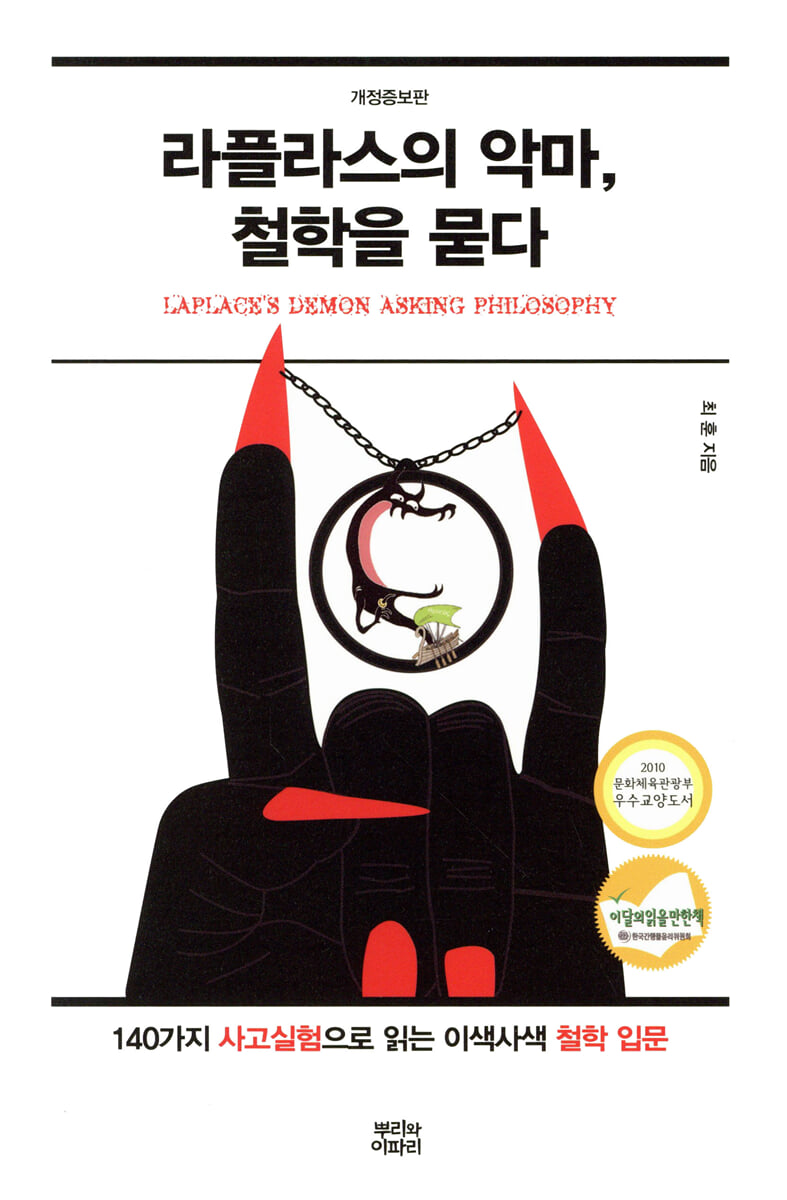
Laplace's Demon: Asking Philosophy
 |
Description
Book Introduction
A collection of deeper and richer accounts of the relationship between thought experiments and philosophy.
A revised and expanded edition after six and a half years! Learn to "philosophize" again!
Professor Choi Hoon, who has been studying logic, philosophy of science, and ethics while also consistently communicating with the public through philosophy books, wrote "Laplace's Demon, Asking Philosophy", an introductory book to philosophy in a unique format that allows readers to explore important philosophical issues through 140 thought experiments selected from major fields of philosophy.
This book has consistently received favorable reviews as the optimal "philosophy textbook" for fostering philosophical reflection and logical thinking through its rich philosophical issues. Accordingly, the author has revised and expanded the book, reflecting the corrections and additions made by readers and students through direct teaching and questioning, and has now been republished in a revised and expanded edition six and a half years after the first edition.
This book, which explores the relationship between thought experiments, which philosophers have used as a compass for their thinking, and philosophy, presents a wider range of examples and the latest research findings, making it a worthy foundational text in philosophy.
A revised and expanded edition after six and a half years! Learn to "philosophize" again!
Professor Choi Hoon, who has been studying logic, philosophy of science, and ethics while also consistently communicating with the public through philosophy books, wrote "Laplace's Demon, Asking Philosophy", an introductory book to philosophy in a unique format that allows readers to explore important philosophical issues through 140 thought experiments selected from major fields of philosophy.
This book has consistently received favorable reviews as the optimal "philosophy textbook" for fostering philosophical reflection and logical thinking through its rich philosophical issues. Accordingly, the author has revised and expanded the book, reflecting the corrections and additions made by readers and students through direct teaching and questioning, and has now been republished in a revised and expanded edition six and a half years after the first edition.
This book, which explores the relationship between thought experiments, which philosophers have used as a compass for their thinking, and philosophy, presents a wider range of examples and the latest research findings, making it a worthy foundational text in philosophy.
- You can preview some of the book's contents.
Preview
index
To the revised and expanded edition
preface
Prologue What is a thought experiment?
Chapter 1.
Is the future determined?
Opening conversation
1.
Laplace's Demon: Determinism and Fatalism
2.
"I'm sorry, brother.": The clash between determinism and free will.
3.
Happy Hostage: Reconciling Determinism and Free Will
Organize/Think/Grow Your Ideas
Chapter 2.
Why am I me?
Opening conversation
1.
The Ship of Theseus: The Basis of Identity
2.
The Prince and the Goblin: Theory of the Body and Theory of the Soul
3.
Changing the Brain: A Psychological Theory
4.
Spatial Movement: The Challenges of Identity
Organize/Think/Grow Your Ideas
Chapter 3.
How should we behave morally?
Opening conversation
1.
The Ring of Gyges: The Foundation of Morality
2.
A Promise is a Promise: Kant's Deontology
3.
Calculating Happiness: Utilitarianism
4.
The Righteous Thief: A Look at Utilitarianism
5.
Broken Streetcar: The Clash of Happiness and Rights
Organize/Think/Grow Your Ideas
Chapter 4.
Is life really precious?
Opening conversation
1.
The Right to Be Born and the Right Not to Give Birth: Abortion
2.
Killing and Letting Die: Euthanasia
3.
Aliens, Humans, and Animals: The Ethical Treatment of Animals
Organize/Think/Grow Your Ideas
Chapter 5.
Is a country really necessary?
Opening conversation
1.
The Dilemma of Bikers: Human Rationality
2.
The War of All Against All: The Social Contract
3.
Even a Bad Law Is a Law?: Civil Disobedience
4.
Sharing the Cake: Distributive Justice
5.
Lifeboat Earth: The Duty of Charity
Organize/Think/Grow Your Ideas
Chapter 6.
Are body and mind one?
Opening conversation
1.
Body and mind separate: dualism
2.
Wittgenstein's Beetle: Monism
3.
Philosophical Zombies: Functionalism
4.
Thinking Machines: The Turing Test and the Chinese Room Argument
5.
A World Without Mind: Eliminationism
Organize/Think/Grow Your Ideas
Chapter 7.
Is there any certain knowledge?
Opening conversation
1.
The Omnipotent Demon: A Methodological Doubt
2.
Brain in a Vat: Modern Skepticism
3.
Shadows in the Cave: Rationalism and Empiricism
4.
The Empty Forest: Realism and Idealism
5.
Knowing by Taking: The Definition of Knowledge
Organize/Think/Grow Your Ideas
Chapter 8.
Why is scientific knowledge special?
Opening conversation
1.
White Crow: Science and Superstition
2.
Clever Chicken: Justification of Induction
3.
Green and Grass: A New Puzzle of Induction
Organize/Think/Grow Your Ideas
Chapter 9.
Does God really exist?
Opening conversation
1.
Who Must Prove First?: Theism or Atheism
2.
The Owner of the Coke Bottle: The Design Argument
3.
The Chain of Causality: Cosmological and Ontological Arguments
4.
Which Side Are You Betting On?: The Argument from Miracles and Pascal's Wager
5.
Irresponsible Dog Owners: The Problem of Evil
Organize/Think/Grow Your Ideas
Entry
Glossary
Search for a topic / Search for a person / Search for a medium
preface
Prologue What is a thought experiment?
Chapter 1.
Is the future determined?
Opening conversation
1.
Laplace's Demon: Determinism and Fatalism
2.
"I'm sorry, brother.": The clash between determinism and free will.
3.
Happy Hostage: Reconciling Determinism and Free Will
Organize/Think/Grow Your Ideas
Chapter 2.
Why am I me?
Opening conversation
1.
The Ship of Theseus: The Basis of Identity
2.
The Prince and the Goblin: Theory of the Body and Theory of the Soul
3.
Changing the Brain: A Psychological Theory
4.
Spatial Movement: The Challenges of Identity
Organize/Think/Grow Your Ideas
Chapter 3.
How should we behave morally?
Opening conversation
1.
The Ring of Gyges: The Foundation of Morality
2.
A Promise is a Promise: Kant's Deontology
3.
Calculating Happiness: Utilitarianism
4.
The Righteous Thief: A Look at Utilitarianism
5.
Broken Streetcar: The Clash of Happiness and Rights
Organize/Think/Grow Your Ideas
Chapter 4.
Is life really precious?
Opening conversation
1.
The Right to Be Born and the Right Not to Give Birth: Abortion
2.
Killing and Letting Die: Euthanasia
3.
Aliens, Humans, and Animals: The Ethical Treatment of Animals
Organize/Think/Grow Your Ideas
Chapter 5.
Is a country really necessary?
Opening conversation
1.
The Dilemma of Bikers: Human Rationality
2.
The War of All Against All: The Social Contract
3.
Even a Bad Law Is a Law?: Civil Disobedience
4.
Sharing the Cake: Distributive Justice
5.
Lifeboat Earth: The Duty of Charity
Organize/Think/Grow Your Ideas
Chapter 6.
Are body and mind one?
Opening conversation
1.
Body and mind separate: dualism
2.
Wittgenstein's Beetle: Monism
3.
Philosophical Zombies: Functionalism
4.
Thinking Machines: The Turing Test and the Chinese Room Argument
5.
A World Without Mind: Eliminationism
Organize/Think/Grow Your Ideas
Chapter 7.
Is there any certain knowledge?
Opening conversation
1.
The Omnipotent Demon: A Methodological Doubt
2.
Brain in a Vat: Modern Skepticism
3.
Shadows in the Cave: Rationalism and Empiricism
4.
The Empty Forest: Realism and Idealism
5.
Knowing by Taking: The Definition of Knowledge
Organize/Think/Grow Your Ideas
Chapter 8.
Why is scientific knowledge special?
Opening conversation
1.
White Crow: Science and Superstition
2.
Clever Chicken: Justification of Induction
3.
Green and Grass: A New Puzzle of Induction
Organize/Think/Grow Your Ideas
Chapter 9.
Does God really exist?
Opening conversation
1.
Who Must Prove First?: Theism or Atheism
2.
The Owner of the Coke Bottle: The Design Argument
3.
The Chain of Causality: Cosmological and Ontological Arguments
4.
Which Side Are You Betting On?: The Argument from Miracles and Pascal's Wager
5.
Irresponsible Dog Owners: The Problem of Evil
Organize/Think/Grow Your Ideas
Entry
Glossary
Search for a topic / Search for a person / Search for a medium
Into the book
Kant once said that we should not learn philosophy, but learn to philosophize.
This statement still holds true.
Knowledge of philosophy—what Plato said and what Kant did—is of no use except when taking a common sense test.
What we need is to follow a philosophical way of thinking.
This is because only then can I apply a philosophical way of thinking to the problems that I or society is struggling with, and receive help in solving them.
(Omitted) The best way to learn to philosophize is to learn how philosophers actually deal with problems.
However, the works of philosophers are abstract and argumentative, making them difficult for the general public to access.
In that respect, thought experiments are one of the best ways to approach philosophy.
---From the "Preface"
Thought Experiment 002
The demon Hoon knew what would happen when this world was first created.
He wrote it down in several books and hid it in a cave.
One day, while hiking, Bongi stumbled upon the book.
The book contained all the records of people who have lived so far and people who will live in the future, and Bongyi read the part about herself, “Bonggyi’s Chapter.”
He was astonished to find that the book perfectly recorded his history.
Moreover, it was written that he was surprised to find the book that very day and read the “Bong-i-pyeon.”
--- p.43
This position that everything in the world has a cause is called determinism.
Consider a game of billiards where the white ball hits the red ball 1, and the red ball 1 then hits the red ball 2.
The reason ball number 2 moves is because it was hit by ball number 1.
And since ball 1 hit the white ball, it moved and hit ball 2.
(Omitted) In this way, the cause of the movement of the billiard ball can be continuously searched for.
Determinism thinks of the world as a giant billiard table.
Everything in the world has a cause, and that cause in turn has another cause.
You can go back indefinitely like that.
(Omitted) Humans are also a part of this world.
Therefore, being human does not mean that we are free from the realm of determinism.
--- p.44
Thought Experiment 040
Hoon is a tram driver.
One day, the brakes on the tram he was driving broke down.
As the tram was going downhill, five workers could be seen working on the tracks.
The workers are unaware of the approaching tram and have no time to evade it.
However, there is a fork in the tracks in front of the work site, so the accident can be avoided by turning the train onto the other track.
But there is one worker working there.
The porter doesn't even know the tram is coming and has no time to dodge.
Hoon can't stop the tank, but he can change its direction.
What should we do? --- p.141
In thought experiment 040, Hoon must choose between five lives and one life.
(Omitted) Consequentialists, such as utilitarians, would naturally say that the direction of the trolley should be changed because it is a better outcome for one person to die than for five to die.
And even people who have never heard of the theory of utilitarianism might think that it would be better with common sense.
But the problem is not that simple.
The five people were on the tracks where the broken down trolley was traveling, and it wasn't Hoon's fault that the trolley broke down, so even if the five people died, it wasn't Hoon's fault.
I just left him to die.
However, the other person was not originally on the same track as the tram, so if he dies, it means Hoon killed him on purpose.
There is a big difference between letting someone die and killing them.
--- p.143~144
Moral theory can be applied to the problems of life.
The results reveal many contradictions in our common sense and intuition about abortion, euthanasia, and the ethical treatment of animals.
Debate on abortion has largely focused on whether a fetus is a person or not, but this thought experiment shows that abortion can be defended even if the fetus is a person.
And our reality is that while passive euthanasia is permitted, active euthanasia is not.
However, it is argued that there is no morally significant difference between the two, so either both should be permitted or neither should be permitted.
Also, although humans are more intelligent and rational than animals, this does not provide a strong ethical justification for eating animals for food and using them as subjects for experiments.
--- p.175
To examine whether God really exists, we must first define what God is.
If you tell someone who is going to find the elixir of life what the elixir of life looks like, they will be able to tell if it is the elixir of life or not when they find something similar to it.
However, as in thought experiment 127, if you are told to find the elixir of life unconditionally, even if you find something similar to the elixir of life, it will be difficult.
The characteristics of God have been suggested for a long time: omniscience, omnipotence, and goodness.
This statement still holds true.
Knowledge of philosophy—what Plato said and what Kant did—is of no use except when taking a common sense test.
What we need is to follow a philosophical way of thinking.
This is because only then can I apply a philosophical way of thinking to the problems that I or society is struggling with, and receive help in solving them.
(Omitted) The best way to learn to philosophize is to learn how philosophers actually deal with problems.
However, the works of philosophers are abstract and argumentative, making them difficult for the general public to access.
In that respect, thought experiments are one of the best ways to approach philosophy.
---From the "Preface"
Thought Experiment 002
The demon Hoon knew what would happen when this world was first created.
He wrote it down in several books and hid it in a cave.
One day, while hiking, Bongi stumbled upon the book.
The book contained all the records of people who have lived so far and people who will live in the future, and Bongyi read the part about herself, “Bonggyi’s Chapter.”
He was astonished to find that the book perfectly recorded his history.
Moreover, it was written that he was surprised to find the book that very day and read the “Bong-i-pyeon.”
--- p.43
This position that everything in the world has a cause is called determinism.
Consider a game of billiards where the white ball hits the red ball 1, and the red ball 1 then hits the red ball 2.
The reason ball number 2 moves is because it was hit by ball number 1.
And since ball 1 hit the white ball, it moved and hit ball 2.
(Omitted) In this way, the cause of the movement of the billiard ball can be continuously searched for.
Determinism thinks of the world as a giant billiard table.
Everything in the world has a cause, and that cause in turn has another cause.
You can go back indefinitely like that.
(Omitted) Humans are also a part of this world.
Therefore, being human does not mean that we are free from the realm of determinism.
--- p.44
Thought Experiment 040
Hoon is a tram driver.
One day, the brakes on the tram he was driving broke down.
As the tram was going downhill, five workers could be seen working on the tracks.
The workers are unaware of the approaching tram and have no time to evade it.
However, there is a fork in the tracks in front of the work site, so the accident can be avoided by turning the train onto the other track.
But there is one worker working there.
The porter doesn't even know the tram is coming and has no time to dodge.
Hoon can't stop the tank, but he can change its direction.
What should we do? --- p.141
In thought experiment 040, Hoon must choose between five lives and one life.
(Omitted) Consequentialists, such as utilitarians, would naturally say that the direction of the trolley should be changed because it is a better outcome for one person to die than for five to die.
And even people who have never heard of the theory of utilitarianism might think that it would be better with common sense.
But the problem is not that simple.
The five people were on the tracks where the broken down trolley was traveling, and it wasn't Hoon's fault that the trolley broke down, so even if the five people died, it wasn't Hoon's fault.
I just left him to die.
However, the other person was not originally on the same track as the tram, so if he dies, it means Hoon killed him on purpose.
There is a big difference between letting someone die and killing them.
--- p.143~144
Moral theory can be applied to the problems of life.
The results reveal many contradictions in our common sense and intuition about abortion, euthanasia, and the ethical treatment of animals.
Debate on abortion has largely focused on whether a fetus is a person or not, but this thought experiment shows that abortion can be defended even if the fetus is a person.
And our reality is that while passive euthanasia is permitted, active euthanasia is not.
However, it is argued that there is no morally significant difference between the two, so either both should be permitted or neither should be permitted.
Also, although humans are more intelligent and rational than animals, this does not provide a strong ethical justification for eating animals for food and using them as subjects for experiments.
--- p.175
To examine whether God really exists, we must first define what God is.
If you tell someone who is going to find the elixir of life what the elixir of life looks like, they will be able to tell if it is the elixir of life or not when they find something similar to it.
However, as in thought experiment 127, if you are told to find the elixir of life unconditionally, even if you find something similar to the elixir of life, it will be difficult.
The characteristics of God have been suggested for a long time: omniscience, omnipotence, and goodness.
--- p.342
Publisher's Review
A collection of deeper and richer accounts of the relationship between thought experiments and philosophy.
A revised and expanded edition after six and a half years! Learn to "philosophize" again!
What if humans were bred and eaten by aliens? Would I be the same person before and after plastic surgery? Should I maintain morality even if I became invisible? Which takes precedence: a mother's right not to give birth or a fetus's right to be born? What right does the state have to collect taxes? Do robots have "human rights"? Are scientists' predictions more reliable than fortune-tellers' prophecies? Can we be sure we're not being deceived by the devil? Does theism or atheism bear the burden of proof for the existence of God?
Professor Choi Hoon, who has been studying logic, philosophy of science, and ethics while also consistently communicating with the public through philosophy books, wrote "Laplace's Demon, Asking Philosophy", an introductory book to philosophy in a unique format that allows readers to explore important philosophical issues through 140 thought experiments selected from major fields of philosophy.
This book has consistently received favorable reviews as the optimal "philosophy textbook" for fostering philosophical reflection and logical thinking through its rich philosophical issues. Accordingly, the author has revised and expanded the book, reflecting the corrections and additions made by readers and students through direct teaching and questioning, and has now been republished in a revised and expanded edition six and a half years after the first edition.
This book, which explores the relationship between thought experiments, which philosophers have used as a compass for their thinking, and philosophy, presents a wider range of examples and the latest research findings, making it a worthy foundational text in philosophy.
The revised and expanded edition has significantly increased in length from 312 pages of the first edition to 412 pages.
The additions are as follows:
● The revised and expanded edition presents 140 thought experiments, further enriching the 117 thought experiments in the first edition.
● New chapter 9, ‘Does God Really Exist?’, which deals with the philosophy of religion, has been added.
?
● To allow for in-depth thinking about each chapter, the ‘organize-think-grow thoughts’ system was added.
We've also created a new glossary to help you see key concepts at a glance.
● The content was greatly expanded with ‘What is a thought experiment?’ as the prologue.
● Chapter 1: Rewritten the description of fatalism and the evaluation of Hume's concept of free will.
Chapter 2: Changed the order of the descriptions of the body theory and the soul theory and supplemented the explanation of the sophisticated psychological theory.
Chapter 3: Corrected the shortcomings in Kant's explanation of the categorical imperative.
Chapter 5: Supplementing Rawls and Nozick's explanations of distributive justice.
Chapter 6: With the emergence of AlphaGo, the setting of the 'Opening Conversation' was changed from '2050' to '2030', and the narrative style of 'The Problem of Other People's Minds' was significantly changed.
Chapter 7: Gettier's problem is presented in the form of a simple thought experiment.
Chapter 8: Added a response to Hume's critique of induction, and added the theory dependence of observation.
Am I the same person before and after plastic surgery?
― A thought experiment, a test of the extreme of reason
A thought experiment is a method of making a claim using a hypothetical situation.
To put it simply, it is thinking, “What if I think about it this way?”
Philosophers say that if we imagine this way and that way, we will arrive at a certain conclusion, so we have no choice but to accept this or that argument.
While scientists conduct experiments in the laboratory with beakers and reagents, philosophers conduct 'thought experiments' in their heads using only their imagination.
Since thought experiments only take place in the mind, many of them involve extreme situations and bizarre imaginations, and there are many cases that are either impossible or have an extremely low probability of occurring in reality.
For example, it is like this.
“Is my choice to choose jajangmyeon over jjambbong free?”, “Isn’t there a devil who knows all the laws of the world deceiving us?”, “What if aliens appeared who raised humans like we raise chickens and pigs?”, “Would I still have to maintain morals even if I became invisible?”, “Would my individual identity be maintained even if I swapped brains?”, “Do robots have ‘human rights’ too?”
Why do philosophers imagine such far-fetched scenarios to advance their arguments? It's because they want the concepts and theories they advocate to be universally applicable.
Just as scientific laws can be applied anytime and anywhere, philosophical concepts and theories should also be applicable in any situation.
This is similar to how mobile phone developers test whether their phones function properly in extreme conditions such as the equator or the poles.
Similarly, a thought experiment is an extreme test of reasoning that imagines an extreme situation and closely examines whether the logical validity of a philosophical concept or theory is maintained in that situation.
So, although the thought experiment may seem far-fetched and absurd at first glance, it actually has a solid logic that cannot be easily refuted.
You say that you can wear the ring of Gyges and still not sin?
― Professor Choi Hoon's Introduction to Philosophy
Although several books introducing thought experiments have been translated into Korean, most of them simply list thought experiments for the sake of interest, making it difficult to understand the context in which a particular thought experiment was presented in the history of philosophy.
This book, written by Professor Choi Hoon, a rare logic major in Korea, is an introductory book to philosophy in a unique format that guides readers through philosophical thinking through 140 thought experiments selected from major fields of philosophy, including metaphysics, epistemology, ethics, philosophy of science, and philosophy of religion.
However, this does not mean that this book provides fragmentary philosophical knowledge, such as what Plato was like and what Kant was like.
The purpose of this book is, above all, to lead us to learn how philosophers actually deal with problems—that is, to "philosophize"—by directly engaging in the debates that thought experiments generate.
This book contains major thought experiments in the history of philosophy, including Laplace's Demon thought experiment, which is also used in the title, the Ring of Gyges, the Ship of Theseus, the Allegory of the Cave, the Allegory of the Wax, the Prince and the Pauper, Buridan's Donkey, the Prisoner's Dilemma, the War of All Against All, Wittgenstein's Beetle, the Turing Test, the Chinese Room Argument, the Brain in a Vat, and the Broken Down Streetcar.
And there are 18 illustrations in total, 2 per chapter, of Jeonghun's clever twist on thought experiments.
As you can guess from the fact that they are still a subject of debate, the questions raised by these thought experiments often have no clear answers.
This is not for any other reason, but because that is the nature of philosophy.
Some readers may feel frustrated because there is no right answer, but if you carefully follow the arguments of thought experiments, the stage where philosophers compete with each other's sophisticated logic, you will be able to experience the essence of philosophical thinking.
140 Bungee Jumps to Grasp Philosophy
This book is broadly divided into metaphysics, ethics, epistemology, and philosophy of science.
The issues of 'free will and determinism' in Chapter 1, 'personal identity' in Chapter 2, and 'body and mind' in Chapter 6 are long-standing topics in metaphysics.
Chapters 3, 4, and 5 are about ethics. Specifically, Chapter 3 deals with the basic theories of ethics, such as Kant's deontology and utilitarianism, Chapter 4 deals with bioethics, such as abortion and euthanasia, and Chapter 5 deals with ethics of society as a whole, such as social contract theory, civil disobedience, and distributive justice.
Chapter 7, which deals with skepticism, rationalism and empiricism, realism and idealism, and the definition of knowledge, belongs to epistemology.
Chapter 8, which examines the validity of induction, a scientific methodology, falls under the philosophy of science.
Chapter 9, newly added in the revised and expanded edition, deals with the philosophy of religion and philosophically examines the question, "Does God really exist?", thereby providing philosophical training through this debate.
The introduction to each chapter includes an 'opening conversation' that provides an idea of the topic to be covered in that chapter through everyday conversation.
Each chapter consists of 3 to 5 sections, and each section contains 2 to 6 thought experiments and their explanations.
At the end of each chapter, we added the device of ‘organizing - strengthening thoughts - developing thoughts’.
I organized the contents of each chapter through ‘Organizing’ and confirmed the contents of each chapter through ‘Thinking Hard’.
You can think of 'thinking' as a kind of 'further studies'.
A revised and expanded edition after six and a half years! Learn to "philosophize" again!
What if humans were bred and eaten by aliens? Would I be the same person before and after plastic surgery? Should I maintain morality even if I became invisible? Which takes precedence: a mother's right not to give birth or a fetus's right to be born? What right does the state have to collect taxes? Do robots have "human rights"? Are scientists' predictions more reliable than fortune-tellers' prophecies? Can we be sure we're not being deceived by the devil? Does theism or atheism bear the burden of proof for the existence of God?
Professor Choi Hoon, who has been studying logic, philosophy of science, and ethics while also consistently communicating with the public through philosophy books, wrote "Laplace's Demon, Asking Philosophy", an introductory book to philosophy in a unique format that allows readers to explore important philosophical issues through 140 thought experiments selected from major fields of philosophy.
This book has consistently received favorable reviews as the optimal "philosophy textbook" for fostering philosophical reflection and logical thinking through its rich philosophical issues. Accordingly, the author has revised and expanded the book, reflecting the corrections and additions made by readers and students through direct teaching and questioning, and has now been republished in a revised and expanded edition six and a half years after the first edition.
This book, which explores the relationship between thought experiments, which philosophers have used as a compass for their thinking, and philosophy, presents a wider range of examples and the latest research findings, making it a worthy foundational text in philosophy.
The revised and expanded edition has significantly increased in length from 312 pages of the first edition to 412 pages.
The additions are as follows:
● The revised and expanded edition presents 140 thought experiments, further enriching the 117 thought experiments in the first edition.
● New chapter 9, ‘Does God Really Exist?’, which deals with the philosophy of religion, has been added.
?
● To allow for in-depth thinking about each chapter, the ‘organize-think-grow thoughts’ system was added.
We've also created a new glossary to help you see key concepts at a glance.
● The content was greatly expanded with ‘What is a thought experiment?’ as the prologue.
● Chapter 1: Rewritten the description of fatalism and the evaluation of Hume's concept of free will.
Chapter 2: Changed the order of the descriptions of the body theory and the soul theory and supplemented the explanation of the sophisticated psychological theory.
Chapter 3: Corrected the shortcomings in Kant's explanation of the categorical imperative.
Chapter 5: Supplementing Rawls and Nozick's explanations of distributive justice.
Chapter 6: With the emergence of AlphaGo, the setting of the 'Opening Conversation' was changed from '2050' to '2030', and the narrative style of 'The Problem of Other People's Minds' was significantly changed.
Chapter 7: Gettier's problem is presented in the form of a simple thought experiment.
Chapter 8: Added a response to Hume's critique of induction, and added the theory dependence of observation.
Am I the same person before and after plastic surgery?
― A thought experiment, a test of the extreme of reason
A thought experiment is a method of making a claim using a hypothetical situation.
To put it simply, it is thinking, “What if I think about it this way?”
Philosophers say that if we imagine this way and that way, we will arrive at a certain conclusion, so we have no choice but to accept this or that argument.
While scientists conduct experiments in the laboratory with beakers and reagents, philosophers conduct 'thought experiments' in their heads using only their imagination.
Since thought experiments only take place in the mind, many of them involve extreme situations and bizarre imaginations, and there are many cases that are either impossible or have an extremely low probability of occurring in reality.
For example, it is like this.
“Is my choice to choose jajangmyeon over jjambbong free?”, “Isn’t there a devil who knows all the laws of the world deceiving us?”, “What if aliens appeared who raised humans like we raise chickens and pigs?”, “Would I still have to maintain morals even if I became invisible?”, “Would my individual identity be maintained even if I swapped brains?”, “Do robots have ‘human rights’ too?”
Why do philosophers imagine such far-fetched scenarios to advance their arguments? It's because they want the concepts and theories they advocate to be universally applicable.
Just as scientific laws can be applied anytime and anywhere, philosophical concepts and theories should also be applicable in any situation.
This is similar to how mobile phone developers test whether their phones function properly in extreme conditions such as the equator or the poles.
Similarly, a thought experiment is an extreme test of reasoning that imagines an extreme situation and closely examines whether the logical validity of a philosophical concept or theory is maintained in that situation.
So, although the thought experiment may seem far-fetched and absurd at first glance, it actually has a solid logic that cannot be easily refuted.
You say that you can wear the ring of Gyges and still not sin?
― Professor Choi Hoon's Introduction to Philosophy
Although several books introducing thought experiments have been translated into Korean, most of them simply list thought experiments for the sake of interest, making it difficult to understand the context in which a particular thought experiment was presented in the history of philosophy.
This book, written by Professor Choi Hoon, a rare logic major in Korea, is an introductory book to philosophy in a unique format that guides readers through philosophical thinking through 140 thought experiments selected from major fields of philosophy, including metaphysics, epistemology, ethics, philosophy of science, and philosophy of religion.
However, this does not mean that this book provides fragmentary philosophical knowledge, such as what Plato was like and what Kant was like.
The purpose of this book is, above all, to lead us to learn how philosophers actually deal with problems—that is, to "philosophize"—by directly engaging in the debates that thought experiments generate.
This book contains major thought experiments in the history of philosophy, including Laplace's Demon thought experiment, which is also used in the title, the Ring of Gyges, the Ship of Theseus, the Allegory of the Cave, the Allegory of the Wax, the Prince and the Pauper, Buridan's Donkey, the Prisoner's Dilemma, the War of All Against All, Wittgenstein's Beetle, the Turing Test, the Chinese Room Argument, the Brain in a Vat, and the Broken Down Streetcar.
And there are 18 illustrations in total, 2 per chapter, of Jeonghun's clever twist on thought experiments.
As you can guess from the fact that they are still a subject of debate, the questions raised by these thought experiments often have no clear answers.
This is not for any other reason, but because that is the nature of philosophy.
Some readers may feel frustrated because there is no right answer, but if you carefully follow the arguments of thought experiments, the stage where philosophers compete with each other's sophisticated logic, you will be able to experience the essence of philosophical thinking.
140 Bungee Jumps to Grasp Philosophy
This book is broadly divided into metaphysics, ethics, epistemology, and philosophy of science.
The issues of 'free will and determinism' in Chapter 1, 'personal identity' in Chapter 2, and 'body and mind' in Chapter 6 are long-standing topics in metaphysics.
Chapters 3, 4, and 5 are about ethics. Specifically, Chapter 3 deals with the basic theories of ethics, such as Kant's deontology and utilitarianism, Chapter 4 deals with bioethics, such as abortion and euthanasia, and Chapter 5 deals with ethics of society as a whole, such as social contract theory, civil disobedience, and distributive justice.
Chapter 7, which deals with skepticism, rationalism and empiricism, realism and idealism, and the definition of knowledge, belongs to epistemology.
Chapter 8, which examines the validity of induction, a scientific methodology, falls under the philosophy of science.
Chapter 9, newly added in the revised and expanded edition, deals with the philosophy of religion and philosophically examines the question, "Does God really exist?", thereby providing philosophical training through this debate.
The introduction to each chapter includes an 'opening conversation' that provides an idea of the topic to be covered in that chapter through everyday conversation.
Each chapter consists of 3 to 5 sections, and each section contains 2 to 6 thought experiments and their explanations.
At the end of each chapter, we added the device of ‘organizing - strengthening thoughts - developing thoughts’.
I organized the contents of each chapter through ‘Organizing’ and confirmed the contents of each chapter through ‘Thinking Hard’.
You can think of 'thinking' as a kind of 'further studies'.
GOODS SPECIFICS
- Date of issue: August 10, 2016
- Page count, weight, size: 412 pages | 514g | 145*218*30mm
- ISBN13: 9788964620755
- ISBN10: 8964620755
You may also like
카테고리
korean


korean

![GQ KOREA Mark (Monthly): December [2025]](http://librairie.coreenne.fr/cdn/shop/files/8ef265dbbfbf186523ed75ba7319009d.jpg?v=1765340328&width=3840)


