

World History of Trade
 |
Description
Book Introduction
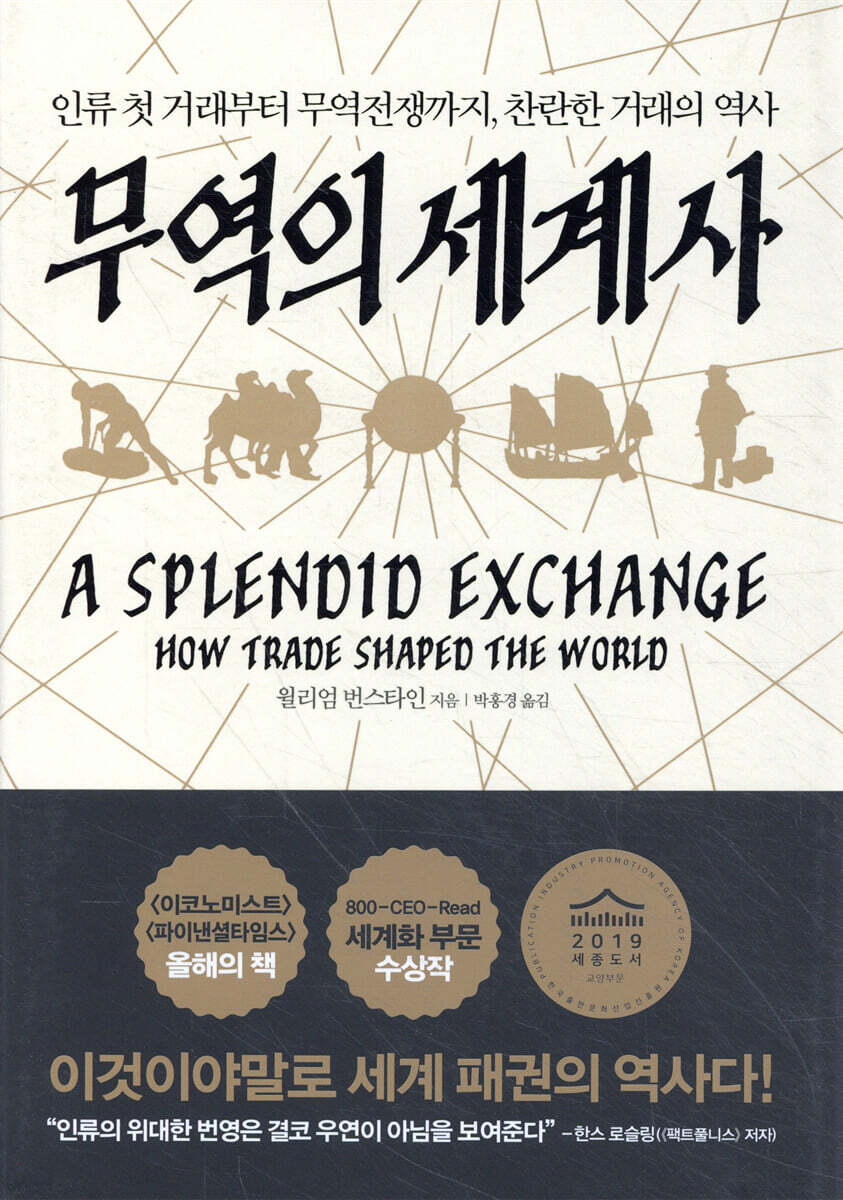
[The Economist] Book of the Year [Financial Times] Book of the Year 800-CEO-READ Globalization Category Winner The Market Economy Award Winner [The Birth of Wealth] William Bernstein's Masterpiece How Trade Made the World What It Is Today! The Epic of 5,000 Years of Human Prosperity from a Trade Perspective Among primates exchanging goods and services, why was Homo sapiens the only one to engage in long-distance trade? How did the East, overlooking the strategic importance of key trade routes, fall prey to the West? What are the common denominators of the Pax Romana, the British Empire, the Dutch East India Company, and today's multinational corporations that achieved global hegemony? What are the roots of today's rampant protectionism, and will trade wars inevitably lead to war between nations? Beginning with bold and compelling questions surrounding trade, "A World History of Trade" unfolds the splendid chronicle of trade that shaped the fate of civilizations and empires, revealing how the world was created. From the Silk Road trade, the spice trade, the slave trade, the conflict between liberalism and protectionism, to the General Agreement on Tariffs and Trade (GATT) that shaped today's world, this book vividly depicts the glories and tragedies surrounding free trade. It will provide readers with a keen understanding of the world situation amid the chaos of anti-globalization triggered by the US-China trade war and Brexit. |
- You can preview some of the book's contents.
Preview
index
Recommended articles
Introduction: How Trade Shaped Today's World
Chapter 1: Early Trade in Mesopotamia
Chapter 2: Who Controls the Greek Straits?
Chapter 3: The Path of the Target: The Camel and the Prophet
Chapter 4: The Religion of the Merchants: The Emergence of Pan-Islamic Trade
Chapter 5: Medieval Spice Trade and Slave Trade
Chapter 6: The Black Death and the Trade of Disease
Chapter 7: The Age of Exploration: The Portuguese Trading Empire
Chapter 8: A World Surrounded by Encirclement: The Spanish Dollar Becomes a Reserve Currency
Chapter 9: The Rise of Corporations: The East India Company
Chapter 10: Plantations and the Triangular Trade
Chapter 11: The Triumph and Tragedy of Free Trade
Chapter 12: Technological Innovation and Transcontinental Trade
Chapter 13: The Great Depression and Protectionism
Chapter 14: Debates Surrounding Globalization
Acknowledgements
main
References
Translator's Note
Introduction: How Trade Shaped Today's World
Chapter 1: Early Trade in Mesopotamia
Chapter 2: Who Controls the Greek Straits?
Chapter 3: The Path of the Target: The Camel and the Prophet
Chapter 4: The Religion of the Merchants: The Emergence of Pan-Islamic Trade
Chapter 5: Medieval Spice Trade and Slave Trade
Chapter 6: The Black Death and the Trade of Disease
Chapter 7: The Age of Exploration: The Portuguese Trading Empire
Chapter 8: A World Surrounded by Encirclement: The Spanish Dollar Becomes a Reserve Currency
Chapter 9: The Rise of Corporations: The East India Company
Chapter 10: Plantations and the Triangular Trade
Chapter 11: The Triumph and Tragedy of Free Trade
Chapter 12: Technological Innovation and Transcontinental Trade
Chapter 13: The Great Depression and Protectionism
Chapter 14: Debates Surrounding Globalization
Acknowledgements
main
References
Translator's Note
Detailed image

Into the book
In 1453, the Ottomans captured Constantinople and halted all trade with Christians, virtually cutting off the trade in spices between Muslims and Italians.
Around the same time, the Portuguese began sailing down the west coast of Africa.
Bartholomew Dias discovered the southernmost tip of Africa in 1488, and ten years later Vasco da Gama reached the Indian Ocean.
This brought an end to the era in which Muslims monopolized trade between Asia and the West.
The glorious and enduring legacy of the spice-slave trade was shattered when the Mongols delivered a devastating gift to the Genoese's newly founded Black Sea port city of Kaffa.
The place name Kaffa is memorable.
Because it is a name that foretells the deaths of millions of Europeans, the collapse of Mongol rule in Asia, the weakening of Muslim trading empires, and ultimately the immortal rise of the West.
--- From Chapter 5 Medieval Spice Trade and Slave Trade
Trade and disease work both ways.
Just as trade fueled the spread of plague, plague changed long-standing trade patterns.
The 14th-century Arab historian Ibn Khaldun provided an insightful analysis of the impact of the Black Death on world trade.
In the mid-14th century, devastating plagues struck Eastern and Western civilizations, destroying nations and decimating populations.
Plagues devoured and destroyed the positive fruits of civilization and overthrew aging dynasties.
Cities and buildings were abandoned, roads and signs disappeared.
Settlements and dwellings were communalized, and dynasties and tribes lost their power.
It seems that the same thing happened in the East, although it may have been different depending on the civilization.
It was as if the world had responded to the voice of a being calling for oblivion and bondage.
The plagues of the 14th to 16th centuries swept through the world, destroying long-distance trade routes.
In the process, the great Muslim civilizations of the Middle East and the most advanced commercial societies, such as the import and export ports of India and China that dazzled Marco Polo and Ibn Battuta, were also devastated.
Europe, too, was nearly destroyed, but within a few hundred years the survivors, combining religiously inspired brutality with genius, attacked the ruins and solidified the modern Western dominance of trade.
--- From Chapter 6, Disease Trade
The Portuguese king had entrusted Lopez de Sequeira, who led the expedition, with the task of establishing trade relations with Malacca.
While Aden, located at the western end of the Indian Ocean, controlled the goods heading to Europe, Egypt, Turkey, and Malacca, Malacca was located at the eastern end of the ocean through a narrow strait through which spices from the Spice Islands and luxury goods from China and Japan passed.
In April 1509 the fleet arrived in Cochin, where it restocked and repaired its ships.
On August 19, riding the summer monsoon winds, they set sail eastward, a territory unknown to European sailors.
The expedition arrived in Malacca on September 11, 23 days later.
--- From "Chapter 7: The Age of Exploration: The Portuguese Trading Empire"
Apart from the 'big ships' trade, Portugal had no real control over maritime trade in the Indies.
Then, sometimes, they used the method of raiding.
Portugal practiced violent extortion by issuing cartaz (passes), forcing Asian ships to buy goods.
Otherwise, there was a high chance that he would be detained or treated worse.
However, Portugal lacked the institutional capacity to implement cartas.
The passes themselves were sold for a nominal price and served as a means of forcing Asian ships to stop at Portuguese ports where customs duties were collected.
For example, in 1540 a ship from Gujarat was seized because the final destination in the Persian Gulf stated in the cartas did not correspond to its location in the Indian Ocean.
The fact that the tariff was as low as 6 percent of the cargo's value is evidence of Portugal's lack of control over Indian Ocean shipping.
If Portugal had focused its limited resources on trade instead of collecting large-scale cartas, operating warships, and fortifying its ports, it could have shipped spices, silk, fine cotton fabrics, porcelain, and pearls across the Cape of Good Hope, and become one of the wealthiest nations in Europe.
While the royal family, merchants, and captains made huge profits from the spice trade, Portugal itself went bankrupt from the enormous military expenditures it incurred in running its global empire.
Portugal was known as the "Genoese Indies," chronically indebted, indebted to Italian merchants, German banks run by the Fugger family, and the kingdom's major creditors. --- From "Chapter 7: The Age of Exploration: Portugal's Trading Empire"
To understand the roots of today's globalization and the discontent it brings, we must first understand five things:
First, within a few decades of Columbus's second voyage in 1493, crops such as corn, wheat, coffee, tea, and sugar were transported across continents, revolutionizing global agriculture and labor markets.
The exchange of crops did not always improve human living conditions.
Second, in the early 17th century, Spanish and Dutch sailors unlocked the last secret of the Earth's wind system.
Thanks to this, it was possible to cross the vast ocean relatively easily.
In 1650, all kinds of goods and people from all over the world could conquer most parts of the world.
Third, the discovery of massive silver mines in Peru and Mexico gave birth to a global monetary system (along with the overmining of silver coins, which led to murderous inflation).
The most commonly used Spanish 8-real coin was used today, much like the US $100 bill or Visa card.
Fourth, the 17th century saw the birth of joint-stock companies, creating a completely new trade order.
Joint stock companies had significant advantages over previous individual salespeople, family businesses, and royal monopolies.
Soon, large corporations dominated global trade, and their position on the world stage has remained unshaken ever since.
Fifth, change has left some people dissatisfied.
The new global economy of the 16th and 17th centuries brought in cheap, high-quality goods, which hurt textile manufacturers, farmers, and service workers.
In today's terms, it was French farmers asserting their rights and American auto workers.
--- From "Chapter 8: The Surrounded World: The Spanish Dollar Becomes a Reserve Currency"
Distribution of ownership was a core feature of 'Dutch finance' and was an excellent way to spread risk among entrepreneurs and investors.
According to court documents from 1610, a petit-bourgeois merchant owned shares in 22 ships.
There were 13 ships with a 1/16th stake, 7 ships with a 1/32nd stake, 1 ship with a 1/17th stake, and 1 ship with a 1/28th stake.
By holding fractional stakes, traders could take risks cautiously.
It also had the effect of increasing investors' margin of safety by mitigating the impact of losses or poor commercial results on specific vessels.
Accordingly, investors actively invested capital, which resulted in further decline in interest rates.
Another innovation in Dutch finance that mitigated risk (at least when used correctly) was the 'buy the herring before it was caught' strategy.
Essentially, in these markets, the price at which a fixed quantity of a commodity will be purchased at a specific point in the future is set in advance.
For example, the price of 1,000 pounds of herring to be caught in one year was set now, and these financial instruments could be bought and sold like real goods.
This financial product was not originally a Dutch concept, but was already well known in Southern Europe and the Muslim world.
But the Dutch took the product and institutionalized it to a whole new level.
Dutch farmers and merchants could sell futures to secure the price of their products six to twelve months in advance.
On the other hand, those who invested in futures were able to avoid the risk of commodity prices suddenly rising along the way.
In addition, through a risk-sharing device called marine insurance, insured carriers were able to prepare for the loss of cargo at sea.
Fractional ownership of shares, futures contracts, and marine insurance all promoted commerce.
--- From "Chapter 9: The Emergence of Corporations: The East India Company"
Most students learn about the "triangular trade" that took place across the Atlantic Ocean from the New World to Europe (coffee, cotton, sugar, rum, and tobacco), Europe to Africa (manufactured goods including textiles), and Africa to the New World (slaves) in the 17th to 19th centuries.
But in oversimplifying the overall picture, short-distance trade was ignored.
For example, a British ship would have carried indigo dye from Jamaica to Philadelphia, then loaded corn on the way to London, where it would then load wool on its way to Le Havre, where it would then load French silk on its way to the African slave coast.
Meanwhile, things were not going smoothly in the East.
The British were crazy about calico and intoxicated with tea, but they had a hard time finding trade goods to exchange for the self-sufficient and complacent Chinese.
We needed a system that would run smoothly, like in the Atlantic.
Just as the slave trade, a key component of the Atlantic Triangle, worsened race relations for centuries, the unequal trade with India and China in the 19th century continues to profoundly impact East-West relations to this day.
Around the same time, the Portuguese began sailing down the west coast of Africa.
Bartholomew Dias discovered the southernmost tip of Africa in 1488, and ten years later Vasco da Gama reached the Indian Ocean.
This brought an end to the era in which Muslims monopolized trade between Asia and the West.
The glorious and enduring legacy of the spice-slave trade was shattered when the Mongols delivered a devastating gift to the Genoese's newly founded Black Sea port city of Kaffa.
The place name Kaffa is memorable.
Because it is a name that foretells the deaths of millions of Europeans, the collapse of Mongol rule in Asia, the weakening of Muslim trading empires, and ultimately the immortal rise of the West.
--- From Chapter 5 Medieval Spice Trade and Slave Trade
Trade and disease work both ways.
Just as trade fueled the spread of plague, plague changed long-standing trade patterns.
The 14th-century Arab historian Ibn Khaldun provided an insightful analysis of the impact of the Black Death on world trade.
In the mid-14th century, devastating plagues struck Eastern and Western civilizations, destroying nations and decimating populations.
Plagues devoured and destroyed the positive fruits of civilization and overthrew aging dynasties.
Cities and buildings were abandoned, roads and signs disappeared.
Settlements and dwellings were communalized, and dynasties and tribes lost their power.
It seems that the same thing happened in the East, although it may have been different depending on the civilization.
It was as if the world had responded to the voice of a being calling for oblivion and bondage.
The plagues of the 14th to 16th centuries swept through the world, destroying long-distance trade routes.
In the process, the great Muslim civilizations of the Middle East and the most advanced commercial societies, such as the import and export ports of India and China that dazzled Marco Polo and Ibn Battuta, were also devastated.
Europe, too, was nearly destroyed, but within a few hundred years the survivors, combining religiously inspired brutality with genius, attacked the ruins and solidified the modern Western dominance of trade.
--- From Chapter 6, Disease Trade
The Portuguese king had entrusted Lopez de Sequeira, who led the expedition, with the task of establishing trade relations with Malacca.
While Aden, located at the western end of the Indian Ocean, controlled the goods heading to Europe, Egypt, Turkey, and Malacca, Malacca was located at the eastern end of the ocean through a narrow strait through which spices from the Spice Islands and luxury goods from China and Japan passed.
In April 1509 the fleet arrived in Cochin, where it restocked and repaired its ships.
On August 19, riding the summer monsoon winds, they set sail eastward, a territory unknown to European sailors.
The expedition arrived in Malacca on September 11, 23 days later.
--- From "Chapter 7: The Age of Exploration: The Portuguese Trading Empire"
Apart from the 'big ships' trade, Portugal had no real control over maritime trade in the Indies.
Then, sometimes, they used the method of raiding.
Portugal practiced violent extortion by issuing cartaz (passes), forcing Asian ships to buy goods.
Otherwise, there was a high chance that he would be detained or treated worse.
However, Portugal lacked the institutional capacity to implement cartas.
The passes themselves were sold for a nominal price and served as a means of forcing Asian ships to stop at Portuguese ports where customs duties were collected.
For example, in 1540 a ship from Gujarat was seized because the final destination in the Persian Gulf stated in the cartas did not correspond to its location in the Indian Ocean.
The fact that the tariff was as low as 6 percent of the cargo's value is evidence of Portugal's lack of control over Indian Ocean shipping.
If Portugal had focused its limited resources on trade instead of collecting large-scale cartas, operating warships, and fortifying its ports, it could have shipped spices, silk, fine cotton fabrics, porcelain, and pearls across the Cape of Good Hope, and become one of the wealthiest nations in Europe.
While the royal family, merchants, and captains made huge profits from the spice trade, Portugal itself went bankrupt from the enormous military expenditures it incurred in running its global empire.
Portugal was known as the "Genoese Indies," chronically indebted, indebted to Italian merchants, German banks run by the Fugger family, and the kingdom's major creditors. --- From "Chapter 7: The Age of Exploration: Portugal's Trading Empire"
To understand the roots of today's globalization and the discontent it brings, we must first understand five things:
First, within a few decades of Columbus's second voyage in 1493, crops such as corn, wheat, coffee, tea, and sugar were transported across continents, revolutionizing global agriculture and labor markets.
The exchange of crops did not always improve human living conditions.
Second, in the early 17th century, Spanish and Dutch sailors unlocked the last secret of the Earth's wind system.
Thanks to this, it was possible to cross the vast ocean relatively easily.
In 1650, all kinds of goods and people from all over the world could conquer most parts of the world.
Third, the discovery of massive silver mines in Peru and Mexico gave birth to a global monetary system (along with the overmining of silver coins, which led to murderous inflation).
The most commonly used Spanish 8-real coin was used today, much like the US $100 bill or Visa card.
Fourth, the 17th century saw the birth of joint-stock companies, creating a completely new trade order.
Joint stock companies had significant advantages over previous individual salespeople, family businesses, and royal monopolies.
Soon, large corporations dominated global trade, and their position on the world stage has remained unshaken ever since.
Fifth, change has left some people dissatisfied.
The new global economy of the 16th and 17th centuries brought in cheap, high-quality goods, which hurt textile manufacturers, farmers, and service workers.
In today's terms, it was French farmers asserting their rights and American auto workers.
--- From "Chapter 8: The Surrounded World: The Spanish Dollar Becomes a Reserve Currency"
Distribution of ownership was a core feature of 'Dutch finance' and was an excellent way to spread risk among entrepreneurs and investors.
According to court documents from 1610, a petit-bourgeois merchant owned shares in 22 ships.
There were 13 ships with a 1/16th stake, 7 ships with a 1/32nd stake, 1 ship with a 1/17th stake, and 1 ship with a 1/28th stake.
By holding fractional stakes, traders could take risks cautiously.
It also had the effect of increasing investors' margin of safety by mitigating the impact of losses or poor commercial results on specific vessels.
Accordingly, investors actively invested capital, which resulted in further decline in interest rates.
Another innovation in Dutch finance that mitigated risk (at least when used correctly) was the 'buy the herring before it was caught' strategy.
Essentially, in these markets, the price at which a fixed quantity of a commodity will be purchased at a specific point in the future is set in advance.
For example, the price of 1,000 pounds of herring to be caught in one year was set now, and these financial instruments could be bought and sold like real goods.
This financial product was not originally a Dutch concept, but was already well known in Southern Europe and the Muslim world.
But the Dutch took the product and institutionalized it to a whole new level.
Dutch farmers and merchants could sell futures to secure the price of their products six to twelve months in advance.
On the other hand, those who invested in futures were able to avoid the risk of commodity prices suddenly rising along the way.
In addition, through a risk-sharing device called marine insurance, insured carriers were able to prepare for the loss of cargo at sea.
Fractional ownership of shares, futures contracts, and marine insurance all promoted commerce.
--- From "Chapter 9: The Emergence of Corporations: The East India Company"
Most students learn about the "triangular trade" that took place across the Atlantic Ocean from the New World to Europe (coffee, cotton, sugar, rum, and tobacco), Europe to Africa (manufactured goods including textiles), and Africa to the New World (slaves) in the 17th to 19th centuries.
But in oversimplifying the overall picture, short-distance trade was ignored.
For example, a British ship would have carried indigo dye from Jamaica to Philadelphia, then loaded corn on the way to London, where it would then load wool on its way to Le Havre, where it would then load French silk on its way to the African slave coast.
Meanwhile, things were not going smoothly in the East.
The British were crazy about calico and intoxicated with tea, but they had a hard time finding trade goods to exchange for the self-sufficient and complacent Chinese.
We needed a system that would run smoothly, like in the Atlantic.
Just as the slave trade, a key component of the Atlantic Triangle, worsened race relations for centuries, the unequal trade with India and China in the 19th century continues to profoundly impact East-West relations to this day.
--- From "Chapter 10: Plantations and the Triangular Trade"
Publisher's Review
"This is the history of world hegemony!"
A history of brilliant trade that determined world hegemony
A world-class commentary on history, geography, economy, and society.
The book "A World History of Trade (Lighting House)", which views world history from the perspective of trade, viewing the "human instinct to transport and exchange" as the driving force behind human development, has been published in its entirety in Korea for the first time.
This book, which has received widespread acclaim from readers and critics worldwide, covers the broad history of world trade, from the early trade of Mesopotamia in 3000 BC to the fierce conflicts surrounding globalization today.
William Bernstein, a world-renowned economic historian and financial theorist, has written a masterpiece called "A World History of Trade." This book exquisitely combines the history of trade with the major events in world history in chronological order, taking advantage of both microhistory and general history.
"A World History of Trade," which offers insight into the present and foresee the future through the history of brilliant trade that determined global hegemony, was selected as a "Book of the Year" by both the Financial Times and the Economist in 2008, quickly establishing itself as a classic in the field of economic history.
As the US-China trade war intensified in 2018, the book's insights gained renewed attention, re-entering bestseller lists after a decade.
[Forbes] recommended this book as a must-read for the summer of 2018, saying, "At a time when free trade is under serious attack in today's political landscape, Bernstein's book, which traces the history of trade, will broaden your perspective with stories you will never hear in a world history lecture."
“Trade, invade, or protect!”
A choice in a trilemma situation that determined the fate of the nation
According to Bernstein, 'globalization', which exposes the entire world to direct competition with other countries, is not a phenomenon that suddenly occurred with the invention of the Internet in the late 20th century, but is a process that has gradually progressed throughout human history.
The earliest records found in Mesopotamia clearly show that there was trade in surplus grain for metals.
Ancient trade between Rome and the Han Dynasty was active throughout the Silk Road, passing through numerous intermediaries, and with the rise of Islam, the "religion of trade," a pan-Islamic commercial zone was formed from Andalusia to the Philippines.
In this Indian Ocean trading system, every country, without exception, was faced with the choice of whether to 'trade', 'invade', or 'protect'.
From small city-states to the world's greatest empires, how you approach these three options will determine your trading environment and even determine your nation's fate.
Portugal's success in breaking the 'Muslim blockade' that had guarded the western gateway to the Indian Ocean and rounding the Cape of Good Hope ushered in an era in which the West once again dominated commerce, as it does today.
However, the Portuguese trading empire was also pushed out by the Dutch a century later, who in turn were pushed out by the British East India Company.
In this process of the world becoming 'flat', there were both winners and losers, and the countries that were pushed out of the competition for hegemony were reduced to puppets of the great powers.
Because the way to feed one side was to starve the other side.
Bernstein uses the Opium Wars as an example to reflect on how China was thoroughly trampled by Western powers, and how this is at the root of today's US-China trade conflict.
The conflict between China, which seeks to regain its past glory by pursuing the Belt and Road Initiative, and the United States, which seeks to maintain global hegemony, is by no means new or unfamiliar in the history of trade.
What is the driving force behind the great advances in human history?
As we entered the modern era, secular ideologies began to dominate history, rather than politics and religion.
The confrontation between free trade and protectionism was nothing more than a proxy war among economists over who would win and lose from free trade.
The incentives and motivations provided by free trade have simultaneously improved the overall well-being of humanity and perpetuated the wealth inequalities that plague society.
Nevertheless, Bernstein maintains an optimistic view of human history throughout his account of A World History of Trade.
Trade is a primal human instinct, and the hope is that the irresistible desire to engage in trade, each preparing and exchanging the best goods, will ultimately lead the world to prosperity.
“Humanity is becoming less violent because it has realized that trade helps its neighbors live rather than die.” _William Bernstein
GOODS SPECIFICS
- Date of issue: April 10, 2019
- Format: Hardcover book binding method guide
- Page count, weight, size: 692 pages | 1,000g | 150*220*38mm
- ISBN13: 9788998075620
- ISBN10: 8998075628
You may also like
카테고리
korean


korean

![GQ KOREA Mark (Monthly): December [2025]](http://librairie.coreenne.fr/cdn/shop/files/8ef265dbbfbf186523ed75ba7319009d.jpg?v=1765340328&width=3840)


